
Casing Design for Hydraulic Fracturing in Horizontal Wells
- Slides: 18
Casing Design for Hydraulic Fracturing in Horizontal Wells What Are the Differences?
Oil and Gas in Shales § The challenges for oil and gas recovery • • Extremely low matrix permeability Relatively low pore pressures High-pressure, high-volume fracturing required Multiple fracturing stages required
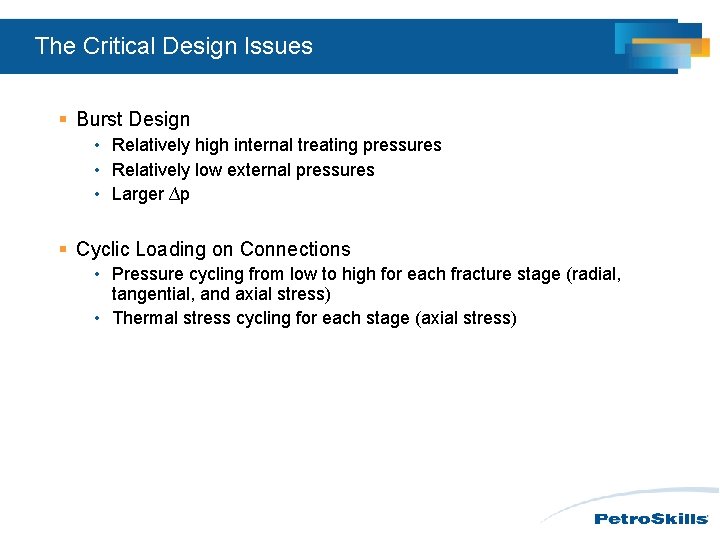
The Critical Design Issues § Burst Design • Relatively high internal treating pressures • Relatively low external pressures • Larger ∆p § Cyclic Loading on Connections • Pressure cycling from low to high for each fracture stage (radial, tangential, and axial stress) • Thermal stress cycling for each stage (axial stress)
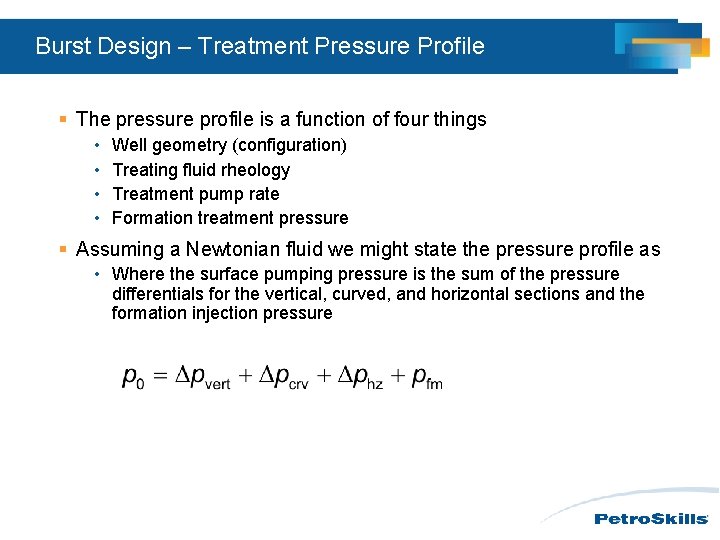
Burst Design – Treatment Pressure Profile § The pressure profile is a function of four things • • Well geometry (configuration) Treating fluid rheology Treatment pump rate Formation treatment pressure § Assuming a Newtonian fluid we might state the pressure profile as • Where the surface pumping pressure is the sum of the pressure differentials for the vertical, curved, and horizontal sections and the formation injection pressure
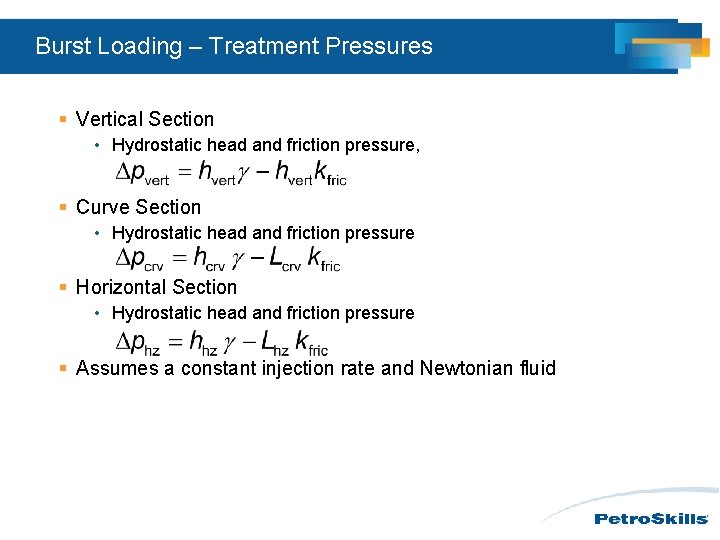
Burst Loading – Treatment Pressures § Vertical Section • Hydrostatic head and friction pressure, § Curve Section • Hydrostatic head and friction pressure § Horizontal Section • Hydrostatic head and friction pressure § Assumes a constant injection rate and Newtonian fluid
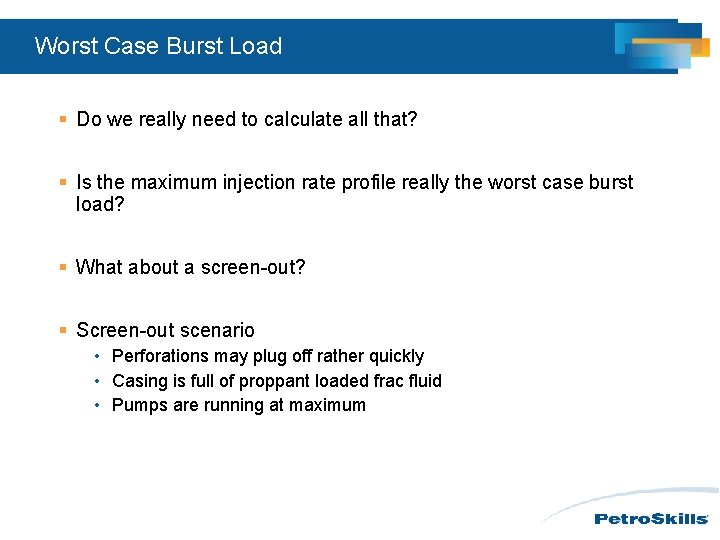
Worst Case Burst Load § Do we really need to calculate all that? § Is the maximum injection rate profile really the worst case burst load? § What about a screen-out? § Screen-out scenario • Perforations may plug off rather quickly • Casing is full of proppant loaded frac fluid • Pumps are running at maximum
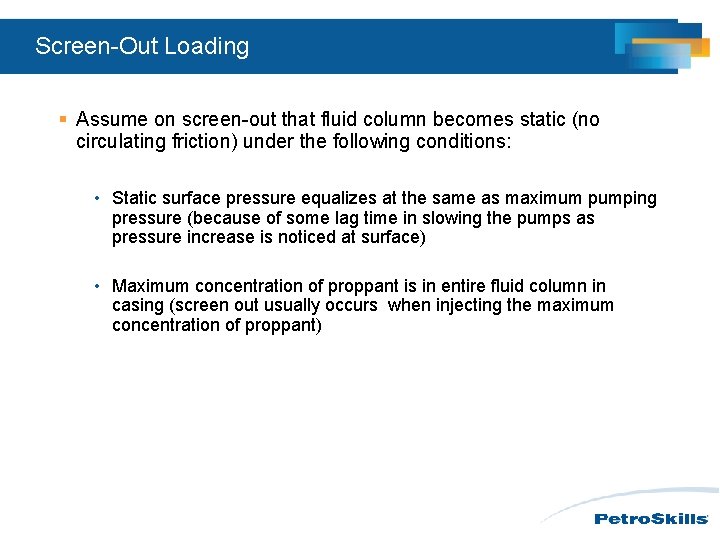
Screen-Out Loading § Assume on screen-out that fluid column becomes static (no circulating friction) under the following conditions: • Static surface pressure equalizes at the same as maximum pumping pressure (because of some lag time in slowing the pumps as pressure increase is noticed at surface) • Maximum concentration of proppant is in entire fluid column in casing (screen out usually occurs when injecting the maximum concentration of proppant)
Burst Design Load § Once we establish our worst case screen out, the burst design process is exactly as we have already done § But there are two things often missing at the design stage: • Maximum surface pumping pressure • Density of the frac fluid with proppant
Maximum Surface Pumping Pressure § We could calculate the surface pumping pressure using: • • Frac fluid properties Pumping rate Formation injection pressure at the planned pumping rate Do we really want to attempt that? § Get an estimate from the service company § Use a typical value from previous jobs in area § In any case, we will want to set a maximum safe pressure based on our design that is not to be exceeded during the job
Fluid and Proppant Density § When we read a frac proposal or final report, we typically see the proppant concentration for a stage listed as lb proppant per gal of frac fluid § For example: • “ 6 lb XYZ proppant per gallon” § What does this mean? • If our frac fluid is 9. 5 ppg then our combined density is 15. 5 ppg, right? No!!!! • It actually means that 6 lb of proppant is added to each gallon of frac fluid • So we need the actual density of the proppant (not the bulk density as in lb/sack for a cubic foot sack)
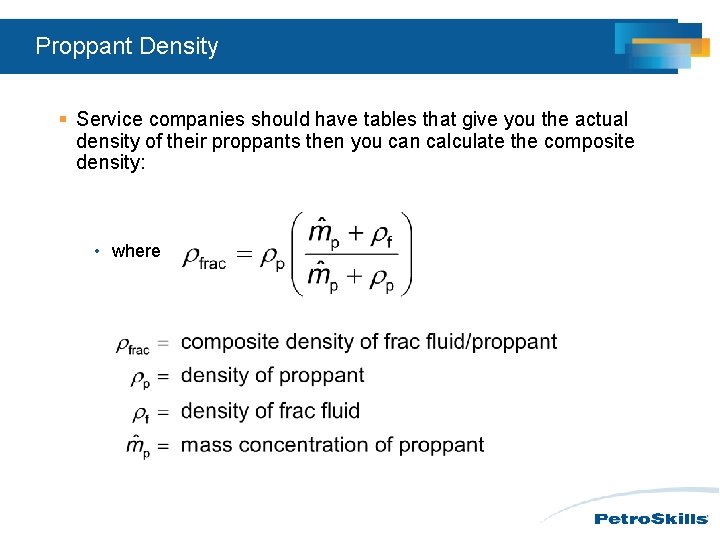
Proppant Density § Service companies should have tables that give you the actual density of their proppants then you can calculate the composite density: • where
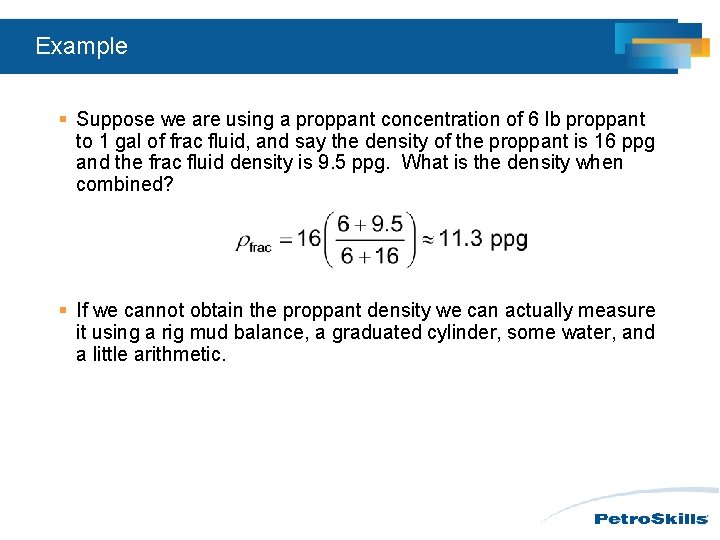
Example § Suppose we are using a proppant concentration of 6 lb proppant to 1 gal of frac fluid, and say the density of the proppant is 16 ppg and the frac fluid density is 9. 5 ppg. What is the density when combined? § If we cannot obtain the proppant density we can actually measure it using a rig mud balance, a graduated cylinder, some water, and a little arithmetic.
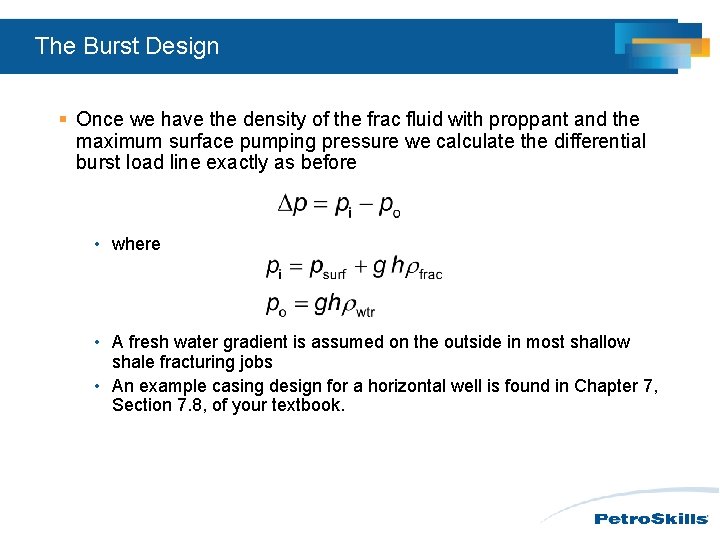
The Burst Design § Once we have the density of the frac fluid with proppant and the maximum surface pumping pressure we calculate the differential burst load line exactly as before • where • A fresh water gradient is assumed on the outside in most shallow shale fracturing jobs • An example casing design for a horizontal well is found in Chapter 7, Section 7. 8, of your textbook.
The Connection Problem § A number of fracture jobs in horizontal wells have resulted in casing failures and an expensive frac stage that goes into the wrong place § Most have occurred not on the first stage but on subsequent stages § They almost always occur in a coupling § The most prevalent explanation is that the repeated stress and thermal cycling reduces the sealing ability of interference type threads
The Cyclic Loading § The cyclic loading during multiple stages of hydraulic fracturing are caused by • High treating pressures • Temperature fluctuations caused by the difference between frac fluid temperature and borehole temperature § Cannot be avoided – connections must be able to accommodate these cycles § An numerical example of cyclic loading is in Section 7. 9 of your textbook.
The Solution § Shouldered integral type connections with metal to metal seals • Successful but. . . • Very expensive solution § Buttress threads that “shoulder” to prevent any tension/compression transitions in connection during cyclic loading • Stop rings (used with buttress in drilling with casing) • Pin-to-pin contact in coupling, (e. g. , USS Star-Seal) § These two inexpensive buttress solutions have been very successful in practice
Field Practice § Pressure test casing well before moving in frac equipment § Test will usually require a mast to install tree saver and a pump truck § Additional cost, but failure to do this can have disastrous and $$$$$ results § More common than you might think
Summary § Two main considerations for high-pressure, high volume fracturing in horizontal wells • High burst pressures call for a high pressure production casing design in low pressure wells • Cyclic loading can cause non-shouldered interference connections to leak and result in casing failure, waste of an expensive fracture stage, and possible failure of the project § Finally • Do not damage casing trying to get it to bottom – Clean the hole !! – Use beveled connections – Do not try to rotate the casing – use friction reducer additives in mud if necessary