
Cash Working Group Meeting 6 May 2020 Update
- Slides: 39
Cash Working Group Meeting 6 May 2020
Update on Market Assessment and monitoring (REACH) Agenda COVID-19 scenarios on population movement and displacement in South Sudan (DTM-IOM) Update on Current new SSSNP Project (World Bank) Update on CWG activities AOB
Rapid Market Assessments (RMAs) Cash Working Group (CWG) April 22 nd, 2020
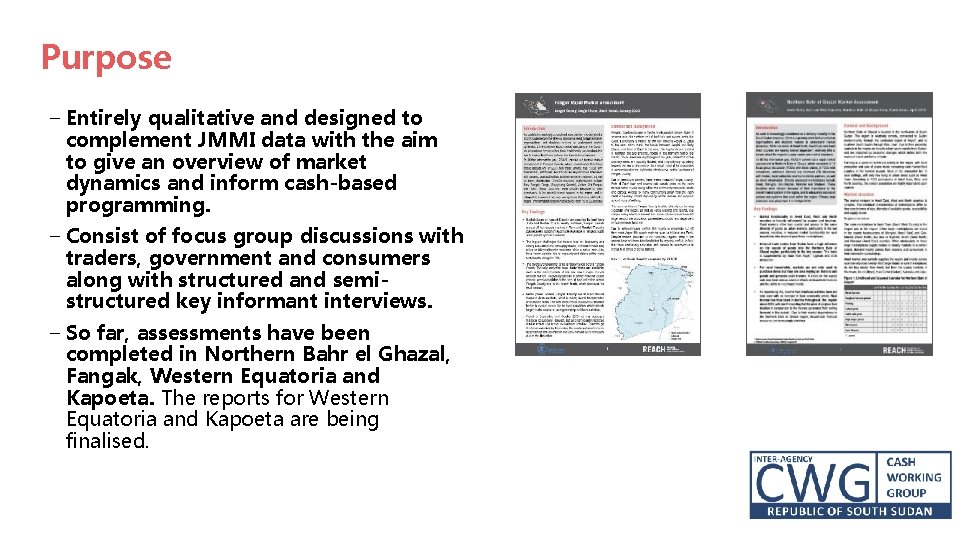
Purpose − Entirely qualitative and designed to complement JMMI data with the aim to give an overview of market dynamics and inform cash-based programming. − Consist of focus group discussions with traders, government and consumers along with structured and semistructured key informant interviews. − So far, assessments have been completed in Northern Bahr el Ghazal, Fangak, Western Equatoria and Kapoeta. The reports for Western Equatoria and Kapoeta are being finalised.
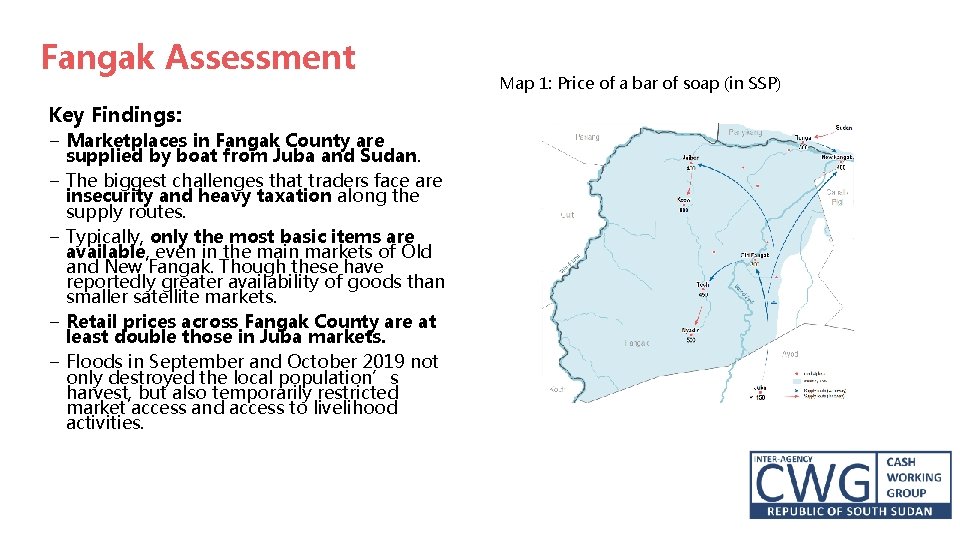
Fangak Assessment Key Findings: − Marketplaces in Fangak County are supplied by boat from Juba and Sudan. − The biggest challenges that traders face are insecurity and heavy taxation along the supply routes. − Typically, only the most basic items are available, even in the main markets of Old and New Fangak. Though these have reportedly greater availability of goods than smaller satellite markets. − Retail prices across Fangak County are at least double those in Juba markets. − Floods in September and October 2019 not only destroyed the local population’s harvest, but also temporarily restricted market access and access to livelihood activities. Map 1: Price of a bar of soap (in SSP)
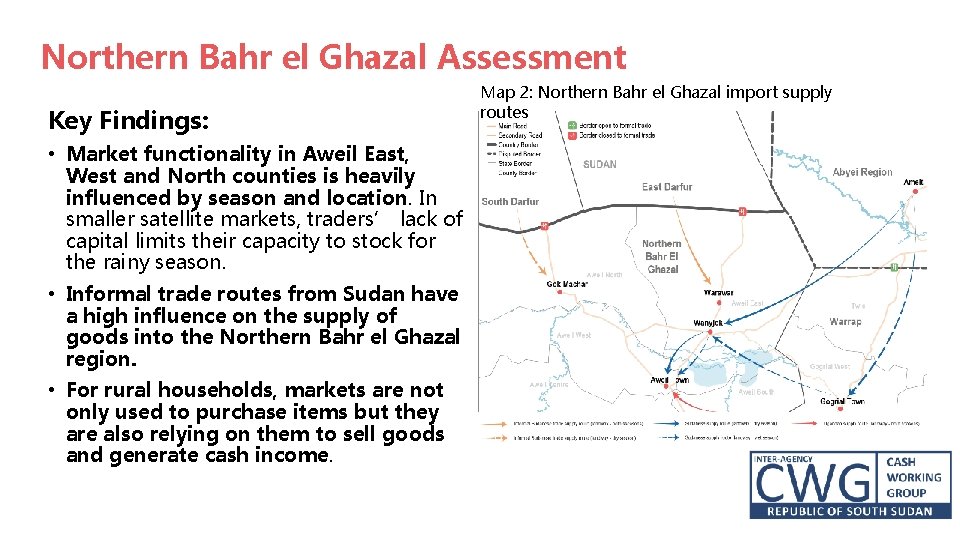
Northern Bahr el Ghazal Assessment Key Findings: • Market functionality in Aweil East, West and North counties is heavily influenced by season and location. In smaller satellite markets, traders’ lack of capital limits their capacity to stock for the rainy season. • Informal trade routes from Sudan have a high influence on the supply of goods into the Northern Bahr el Ghazal region. • For rural households, markets are not only used to purchase items but they are also relying on them to sell goods and generate cash income. Map 2: Northern Bahr el Ghazal import supply routes
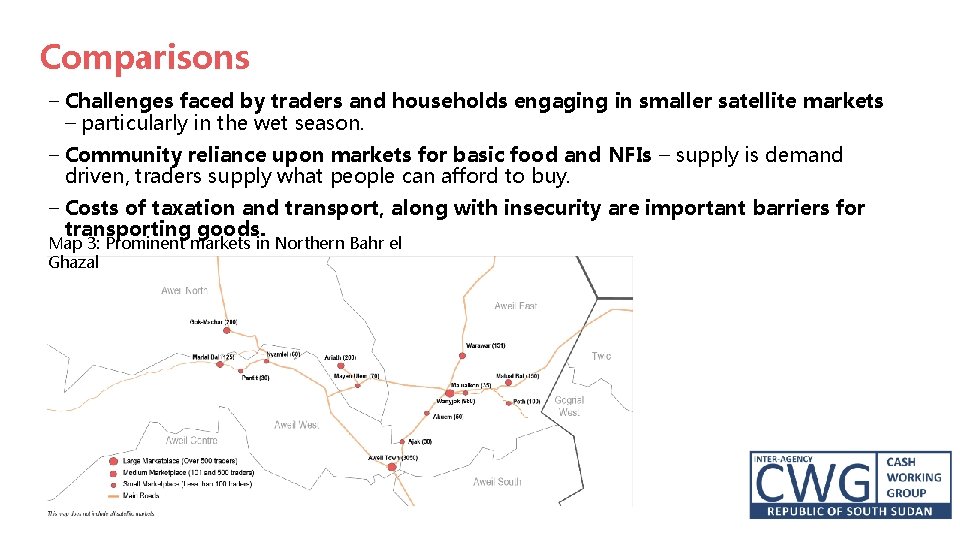
Comparisons − Challenges faced by traders and households engaging in smaller satellite markets – particularly in the wet season. − Community reliance upon markets for basic food and NFIs – supply is demand driven, traders supply what people can afford to buy. − Costs of taxation and transport, along with insecurity are important barriers for transporting goods. Map 3: Prominent markets in Northern Bahr el Ghazal
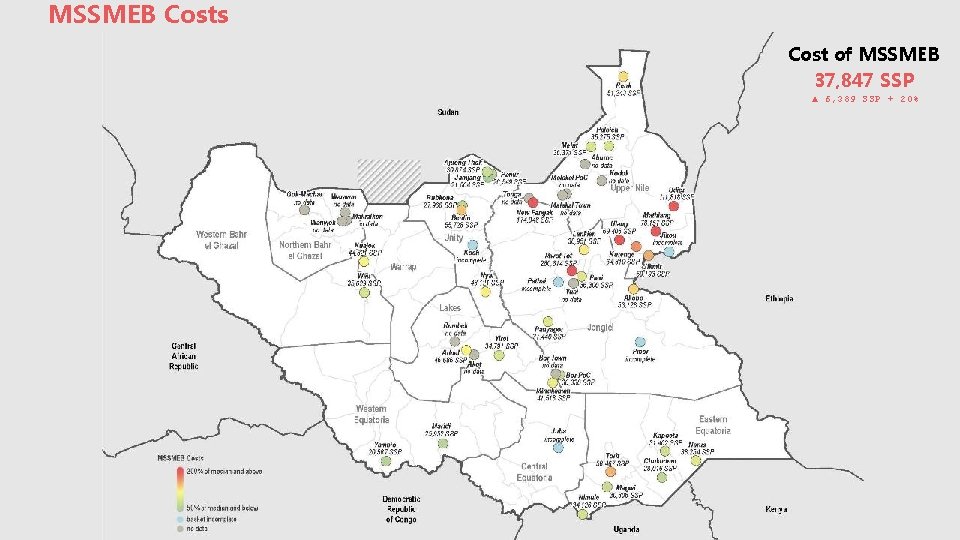
MSSMEB Costs Cost of MSSMEB 37, 847 SSP ▲ 6, 389 SSP + 20%
Contacts Khemis Moses REACH South Sudan khemis. moses@reach-initiative. org Jonathan Buckley REACH South Sudan jonathan. buckley@reach-initiative. org
COVID-19 scenarios on population movement and displacement in South Sudan Juba, 23 April 2020
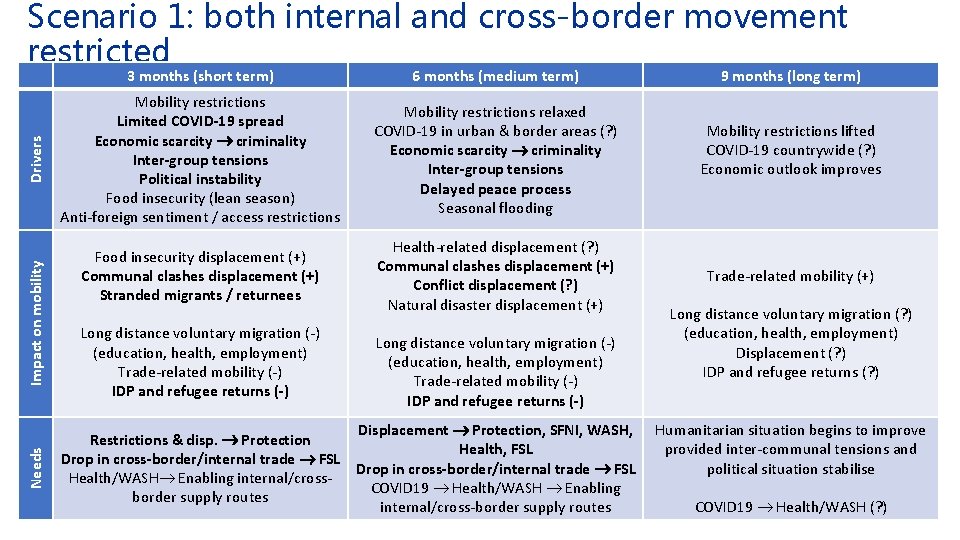
Needs Impact on mobility Drivers Scenario 1: both internal and cross-border movement restricted 3 months (short term) 6 months (medium term) Mobility restrictions Limited COVID-19 spread Economic scarcity criminality Inter-group tensions Political instability Food insecurity (lean season) Anti-foreign sentiment / access restrictions Mobility restrictions relaxed COVID-19 in urban & border areas (? ) Economic scarcity criminality Inter-group tensions Delayed peace process Seasonal flooding Food insecurity displacement (+) Communal clashes displacement (+) Stranded migrants / returnees Health-related displacement (? ) Communal clashes displacement (+) Conflict displacement (? ) Natural disaster displacement (+) Long distance voluntary migration (-) (education, health, employment) Trade-related mobility (-) IDP and refugee returns (-) Displacement Protection, SFNI, WASH, Restrictions & disp. Protection Health, FSL Drop in cross-border/internal trade FSL Health/WASH Enabling internal/cross. COVID 19 Health/WASH Enabling border supply routes internal/cross-border supply routes 9 months (long term) Mobility restrictions lifted COVID-19 countrywide (? ) Economic outlook improves Trade-related mobility (+) Long distance voluntary migration (? ) (education, health, employment) Displacement (? ) IDP and refugee returns (? ) Humanitarian situation begins to improve provided inter-communal tensions and political situation stabilise COVID 19 Health/WASH (? )
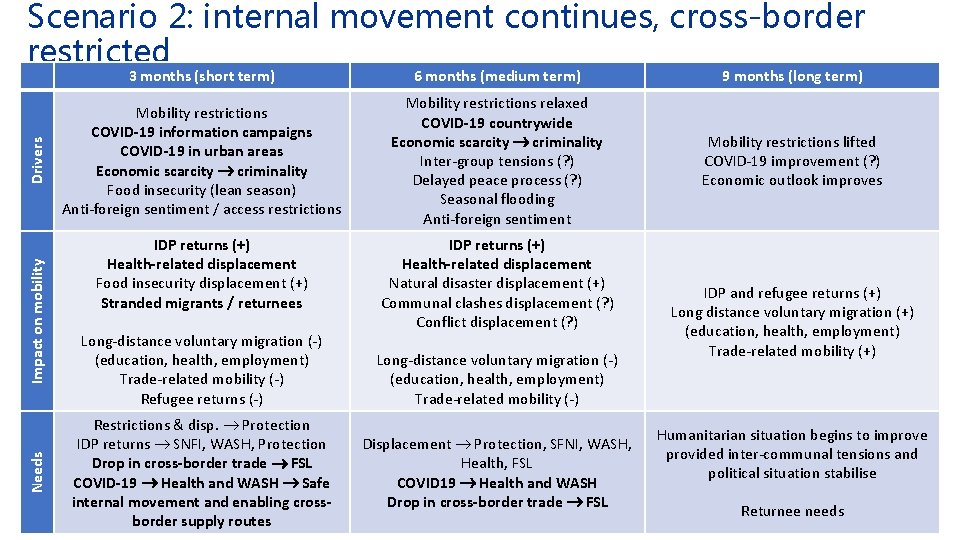
Needs Impact on mobility Drivers Scenario 2: internal movement continues, cross-border restricted 3 months (short term) 6 months (medium term) 9 months (long term) Mobility restrictions COVID-19 information campaigns COVID-19 in urban areas Economic scarcity criminality Food insecurity (lean season) Anti-foreign sentiment / access restrictions Mobility restrictions relaxed COVID-19 countrywide Economic scarcity criminality Inter-group tensions (? ) Delayed peace process (? ) Seasonal flooding Anti-foreign sentiment Mobility restrictions lifted COVID-19 improvement (? ) Economic outlook improves IDP returns (+) Health-related displacement Food insecurity displacement (+) Stranded migrants / returnees Long-distance voluntary migration (-) (education, health, employment) Trade-related mobility (-) Refugee returns (-) Restrictions & disp. Protection IDP returns SNFI, WASH, Protection Drop in cross-border trade FSL COVID-19 Health and WASH Safe internal movement and enabling crossborder supply routes IDP returns (+) Health-related displacement Natural disaster displacement (+) Communal clashes displacement (? ) Conflict displacement (? ) Long-distance voluntary migration (-) (education, health, employment) Trade-related mobility (-) Displacement Protection, SFNI, WASH, Health, FSL COVID 19 Health and WASH Drop in cross-border trade FSL IDP and refugee returns (+) Long distance voluntary migration (+) (education, health, employment) Trade-related mobility (+) Humanitarian situation begins to improve provided inter-communal tensions and political situation stabilise Returnee needs
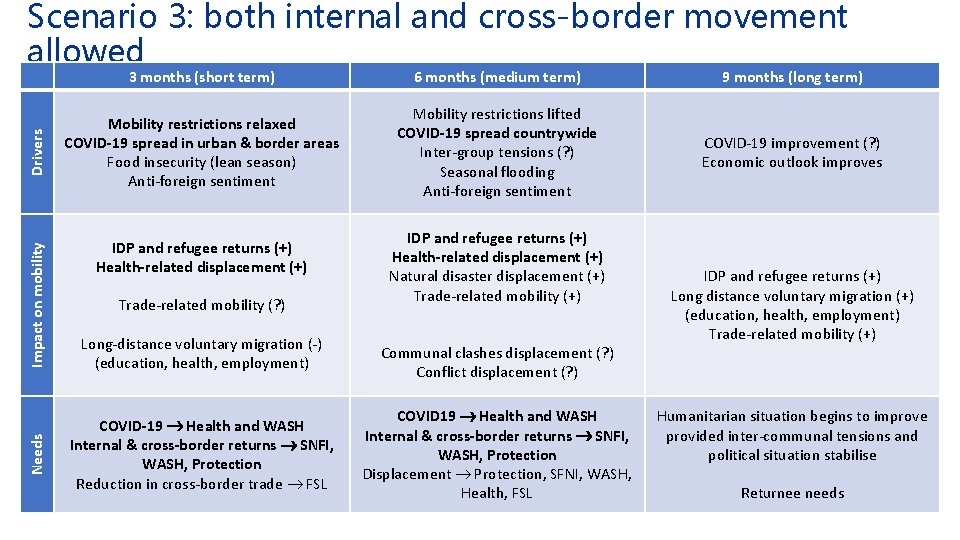
Needs Impact on mobility Drivers Scenario 3: both internal and cross-border movement allowed 3 months (short term) 6 months (medium term) 9 months (long term) Mobility restrictions relaxed COVID-19 spread in urban & border areas Food insecurity (lean season) Anti-foreign sentiment Mobility restrictions lifted COVID-19 spread countrywide Inter-group tensions (? ) Seasonal flooding Anti-foreign sentiment COVID-19 improvement (? ) Economic outlook improves IDP and refugee returns (+) Health-related displacement (+) Trade-related mobility (? ) Long-distance voluntary migration (-) (education, health, employment) COVID-19 Health and WASH Internal & cross-border returns SNFI, WASH, Protection Reduction in cross-border trade FSL IDP and refugee returns (+) Health-related displacement (+) Natural disaster displacement (+) Trade-related mobility (+) Communal clashes displacement (? ) Conflict displacement (? ) COVID 19 Health and WASH Internal & cross-border returns SNFI, WASH, Protection Displacement Protection, SFNI, WASH, Health, FSL IDP and refugee returns (+) Long distance voluntary migration (+) (education, health, employment) Trade-related mobility (+) Humanitarian situation begins to improve provided inter-communal tensions and political situation stabilise Returnee needs
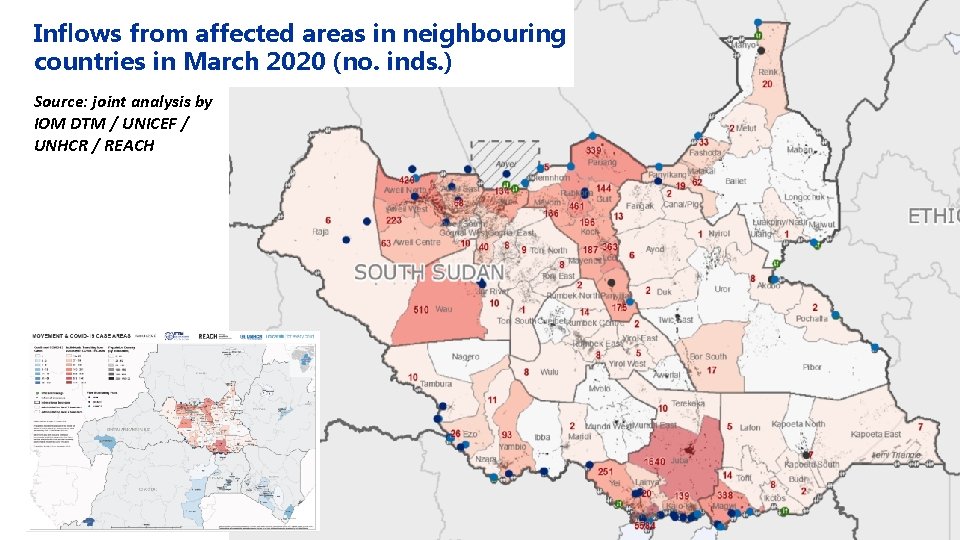
Inflows from affected areas in neighbouring countries in March 2020 (no. inds. ) Source: joint analysis by IOM DTM / UNICEF / UNHCR / REACH
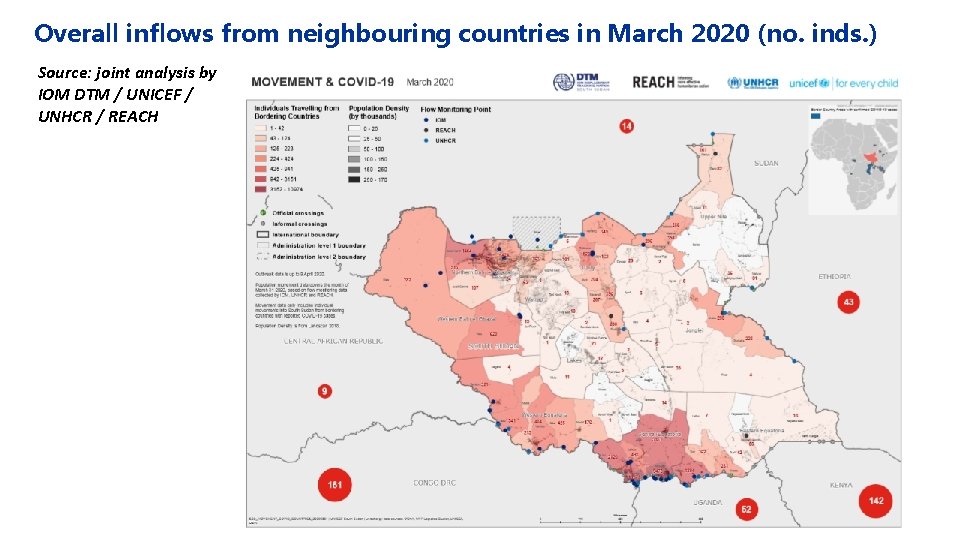
Overall inflows from neighbouring countries in March 2020 (no. inds. ) Source: joint analysis by IOM DTM / UNICEF / UNHCR / REACH
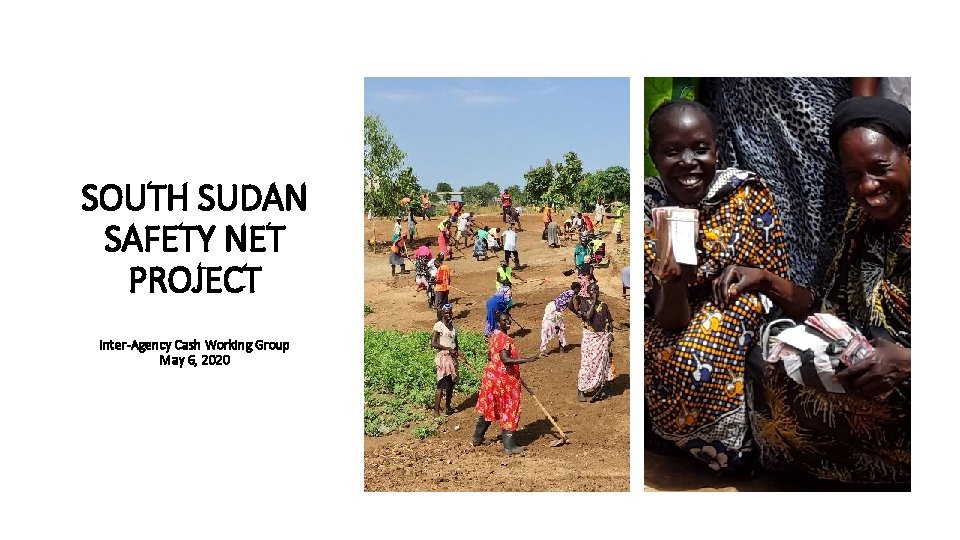
SOUTH SUDAN SAFETY NET PROJECT Inter-Agency Cash Working Group May 6, 2020
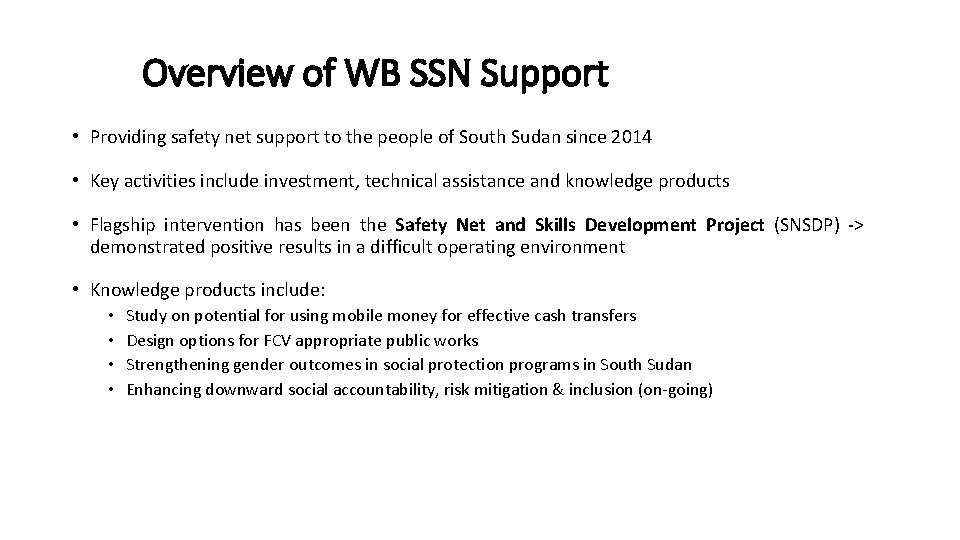
Overview of WB SSN Support • Providing safety net support to the people of South Sudan since 2014 • Key activities include investment, technical assistance and knowledge products • Flagship intervention has been the Safety Net and Skills Development Project (SNSDP) -> demonstrated positive results in a difficult operating environment • Knowledge products include: • • Study on potential for using mobile money for effective cash transfers Design options for FCV appropriate public works Strengthening gender outcomes in social protection programs in South Sudan Enhancing downward social accountability, risk mitigation & inclusion (on-going)
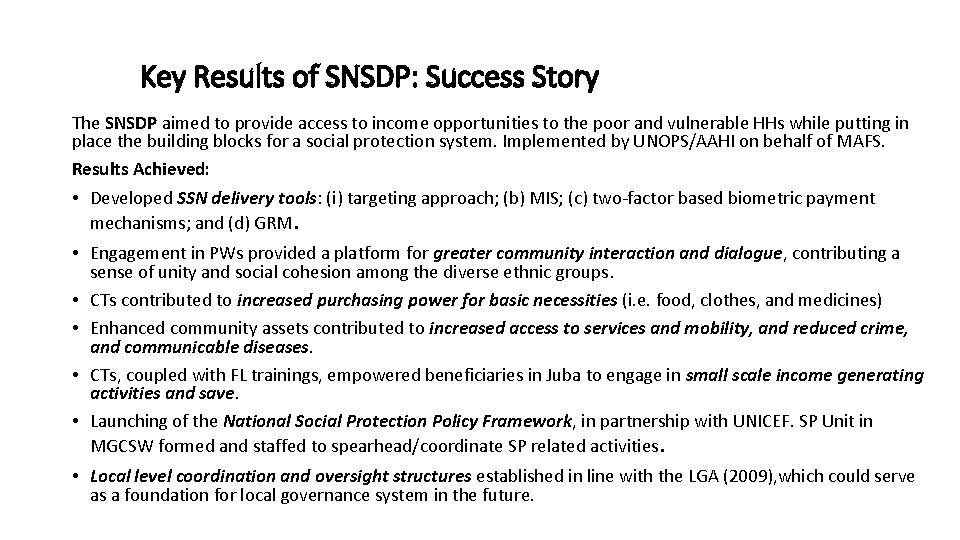
Key Results of SNSDP: Success Story The SNSDP aimed to provide access to income opportunities to the poor and vulnerable HHs while putting in place the building blocks for a social protection system. Implemented by UNOPS/AAHI on behalf of MAFS. Results Achieved: • Developed SSN delivery tools: (i) targeting approach; (b) MIS; (c) two-factor based biometric payment mechanisms; and (d) GRM. • Engagement in PWs provided a platform for greater community interaction and dialogue, contributing a sense of unity and social cohesion among the diverse ethnic groups. • CTs contributed to increased purchasing power for basic necessities (i. e. food, clothes, and medicines) • Enhanced community assets contributed to increased access to services and mobility, and reduced crime, and communicable diseases. • CTs, coupled with FL trainings, empowered beneficiaries in Juba to engage in small scale income generating activities and save. • Launching of the National Social Protection Policy Framework, in partnership with UNICEF. SP Unit in MGCSW formed and staffed to spearhead/coordinate SP related activities. • Local level coordination and oversight structures established in line with the LGA (2009), which could serve as a foundation for local governance system in the future.
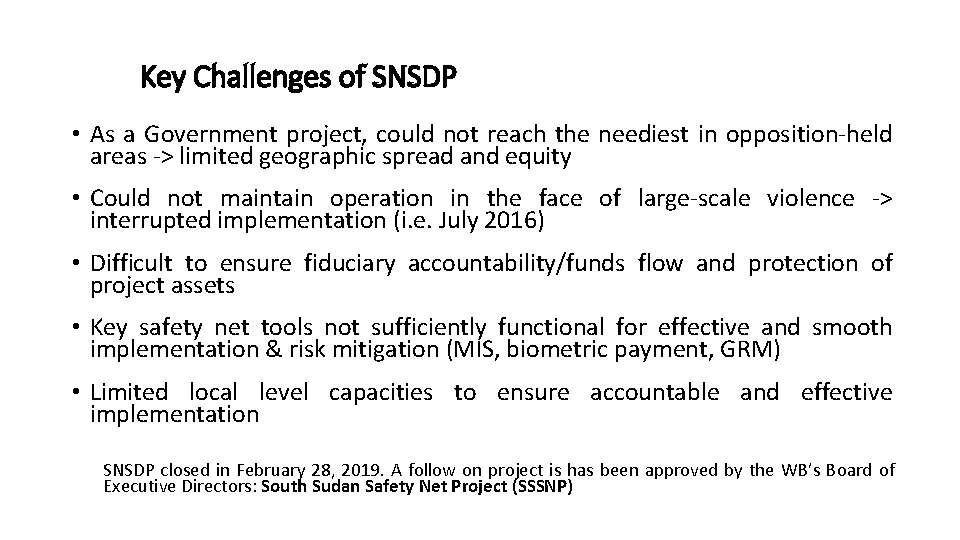
Key Challenges of SNSDP • As a Government project, could not reach the neediest in opposition-held areas -> limited geographic spread and equity • Could not maintain operation in the face of large-scale violence -> interrupted implementation (i. e. July 2016) • Difficult to ensure fiduciary accountability/funds flow and protection of project assets • Key safety net tools not sufficiently functional for effective and smooth implementation & risk mitigation (MIS, biometric payment, GRM) • Limited local level capacities to ensure accountable and effective implementation SNSDP closed in February 28, 2019. A follow on project is has been approved by the WB’s Board of Executive Directors: South Sudan Safety Net Project (SSSNP)
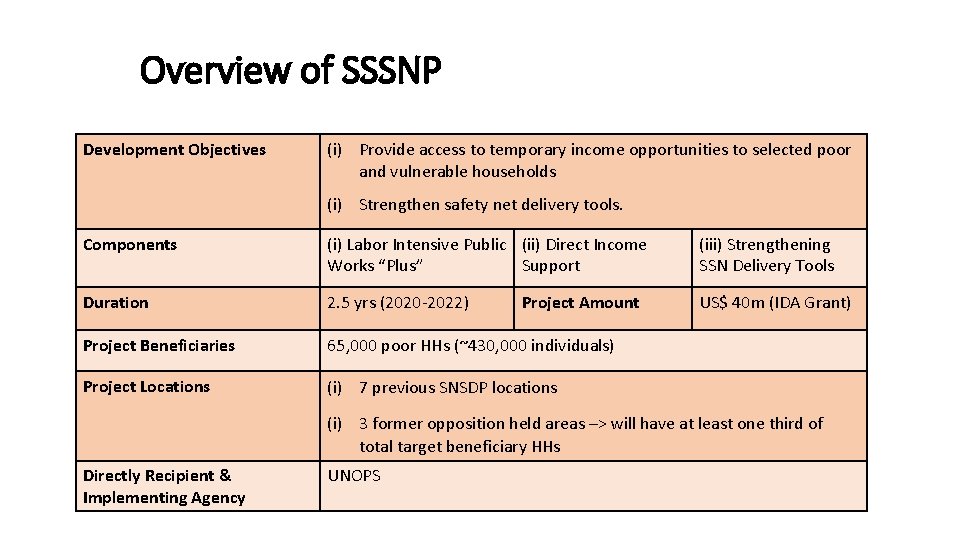
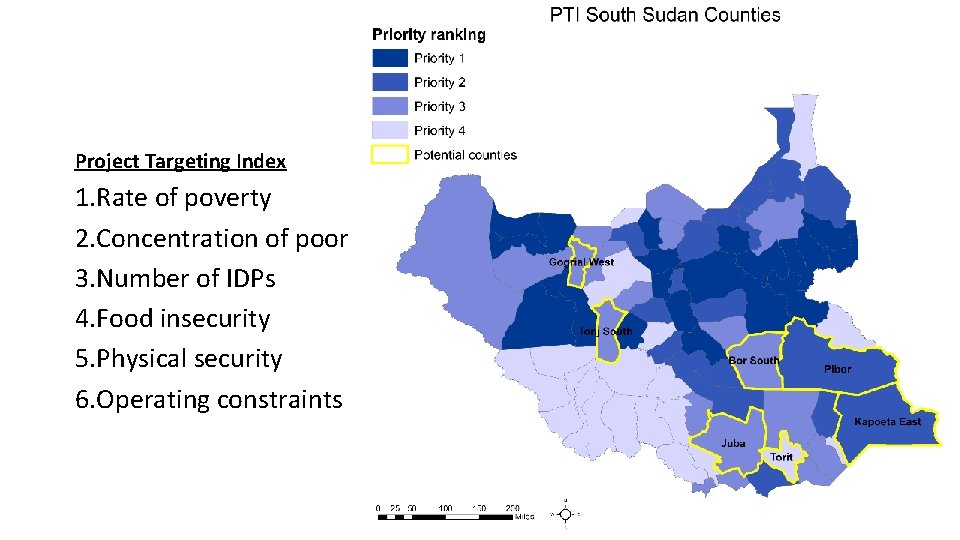
Overview of SSSNP Development Objectives (i) Provide access to temporary income opportunities to selected poor and vulnerable households (i) Strengthen safety net delivery tools. Components (i) Labor Intensive Public (ii) Direct Income Works “Plus” Support (iii) Strengthening SSN Delivery Tools Duration 2. 5 yrs (2020 -2022) US$ 40 m (IDA Grant) Project Beneficiaries 65, 000 poor HHs (~430, 000 individuals) Project Locations (i) 7 previous SNSDP locations Project Amount (i) 3 former opposition held areas –> will have at least one third of total target beneficiary HHs Directly Recipient & Implementing Agency UNOPS
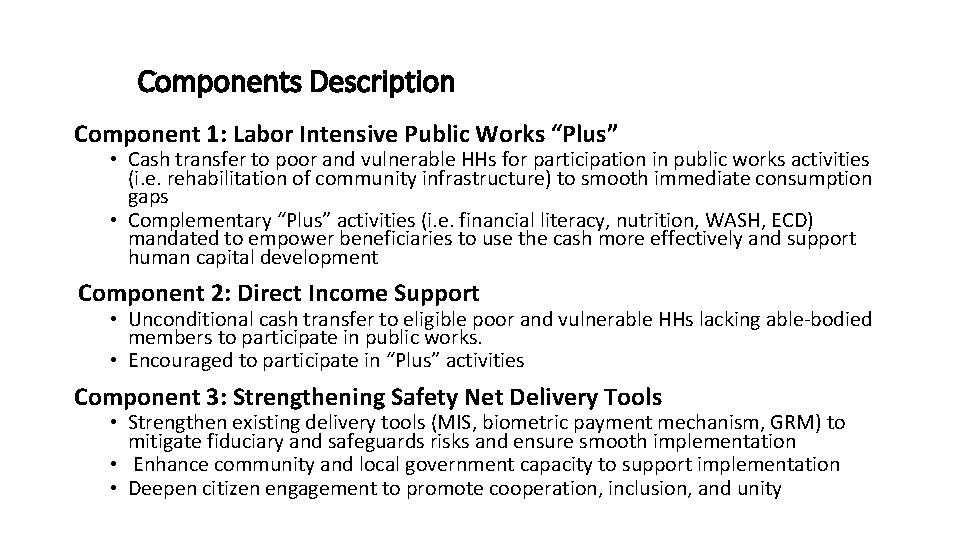
Components Description Component 1: Labor Intensive Public Works “Plus” • Cash transfer to poor and vulnerable HHs for participation in public works activities (i. e. rehabilitation of community infrastructure) to smooth immediate consumption gaps • Complementary “Plus” activities (i. e. financial literacy, nutrition, WASH, ECD) mandated to empower beneficiaries to use the cash more effectively and support human capital development Component 2: Direct Income Support • Unconditional cash transfer to eligible poor and vulnerable HHs lacking able-bodied members to participate in public works. • Encouraged to participate in “Plus” activities Component 3: Strengthening Safety Net Delivery Tools • Strengthen existing delivery tools (MIS, biometric payment mechanism, GRM) to mitigate fiduciary and safeguards risks and ensure smooth implementation • Enhance community and local government capacity to support implementation • Deepen citizen engagement to promote cooperation, inclusion, and unity
Project Targeting Index 1. Rate of poverty 2. Concentration of poor 3. Number of IDPs 4. Food insecurity 5. Physical security 6. Operating constraints
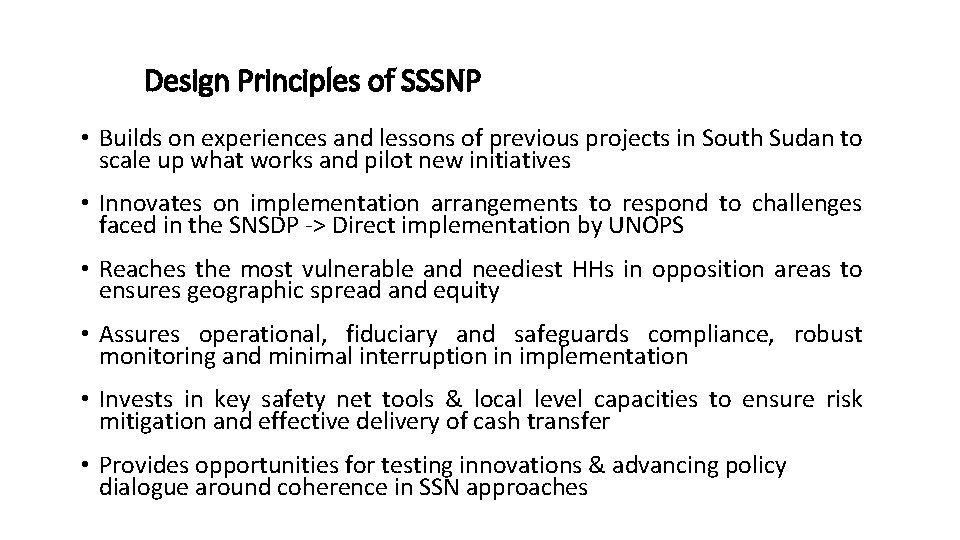
Design Principles of SSSNP • Builds on experiences and lessons of previous projects in South Sudan to scale up what works and pilot new initiatives • Innovates on implementation arrangements to respond to challenges faced in the SNSDP -> Direct implementation by UNOPS • Reaches the most vulnerable and neediest HHs in opposition areas to ensures geographic spread and equity • Assures operational, fiduciary and safeguards compliance, robust monitoring and minimal interruption in implementation • Invests in key safety net tools & local level capacities to ensure risk mitigation and effective delivery of cash transfer • Provides opportunities for testing innovations & advancing policy dialogue around coherence in SSN approaches
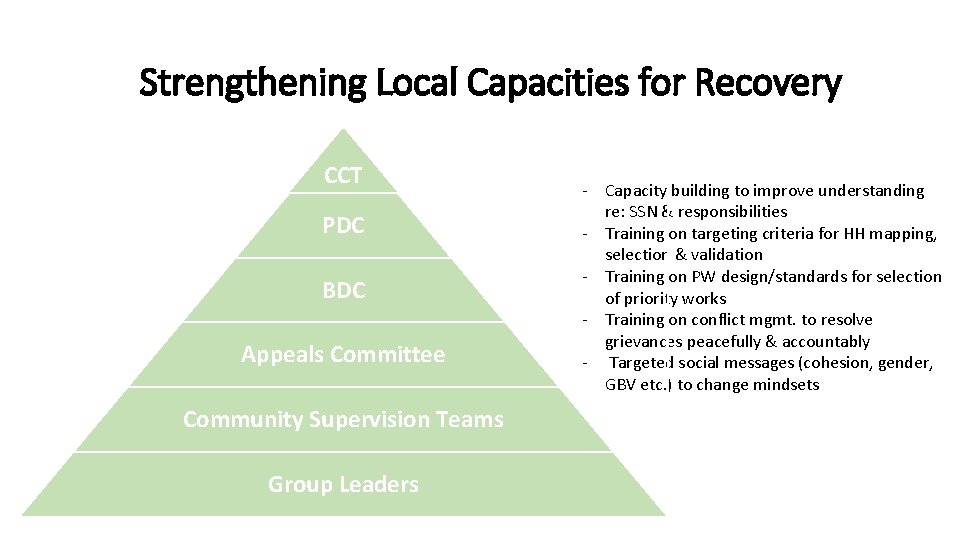
Strengthening Local Capacities for Recovery CCT PDC BDC Appeals Committee Community Supervision Teams Group Leaders - Capacity building to improve understanding re: SSN & responsibilities - Training on targeting criteria for HH mapping, selection & validation - Training on PW design/standards for selection of priority works - Training on conflict mgmt. to resolve grievances peacefully & accountably - Targeted social messages (cohesion, gender, GBV etc. ) to change mindsets
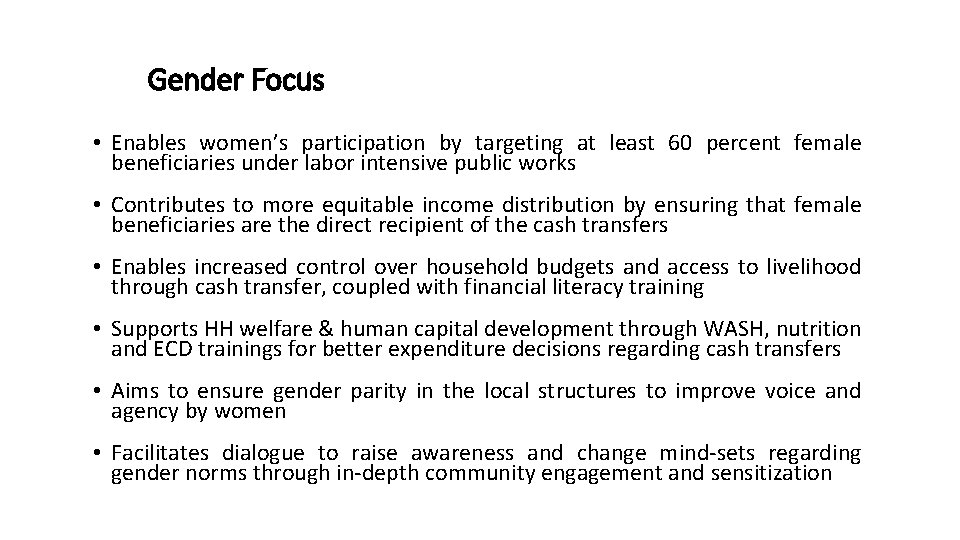
Gender Focus • Enables women’s participation by targeting at least 60 percent female beneficiaries under labor intensive public works • Contributes to more equitable income distribution by ensuring that female beneficiaries are the direct recipient of the cash transfers • Enables increased control over household budgets and access to livelihood through cash transfer, coupled with financial literacy training • Supports HH welfare & human capital development through WASH, nutrition and ECD trainings for better expenditure decisions regarding cash transfers • Aims to ensure gender parity in the local structures to improve voice and agency by women • Facilitates dialogue to raise awareness and change mind-sets regarding gender norms through in-depth community engagement and sensitization
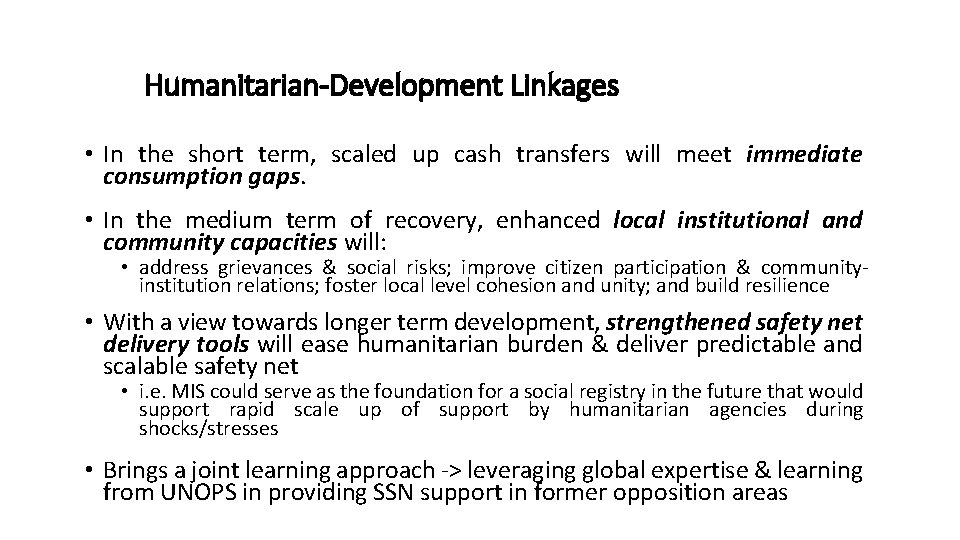
Humanitarian-Development Linkages • In the short term, scaled up cash transfers will meet immediate consumption gaps. • In the medium term of recovery, enhanced local institutional and community capacities will: • address grievances & social risks; improve citizen participation & communityinstitution relations; foster local level cohesion and unity; and build resilience • With a view towards longer term development, strengthened safety net delivery tools will ease humanitarian burden & deliver predictable and scalable safety net • i. e. MIS could serve as the foundation for a social registry in the future that would support rapid scale up of support by humanitarian agencies during shocks/stresses • Brings a joint learning approach -> leveraging global expertise & learning from UNOPS in providing SSN support in former opposition areas
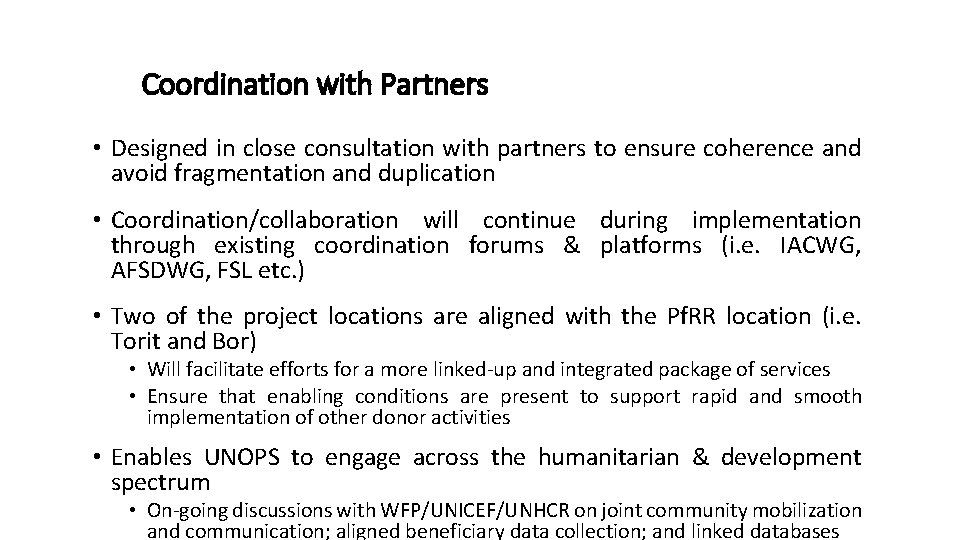
Coordination with Partners • Designed in close consultation with partners to ensure coherence and avoid fragmentation and duplication • Coordination/collaboration will continue during implementation through existing coordination forums & platforms (i. e. IACWG, AFSDWG, FSL etc. ) • Two of the project locations are aligned with the Pf. RR location (i. e. Torit and Bor) • Will facilitate efforts for a more linked-up and integrated package of services • Ensure that enabling conditions are present to support rapid and smooth implementation of other donor activities • Enables UNOPS to engage across the humanitarian & development spectrum • On-going discussions with WFP/UNICEF/UNHCR on joint community mobilization and communication; aligned beneficiary data collection; and linked databases
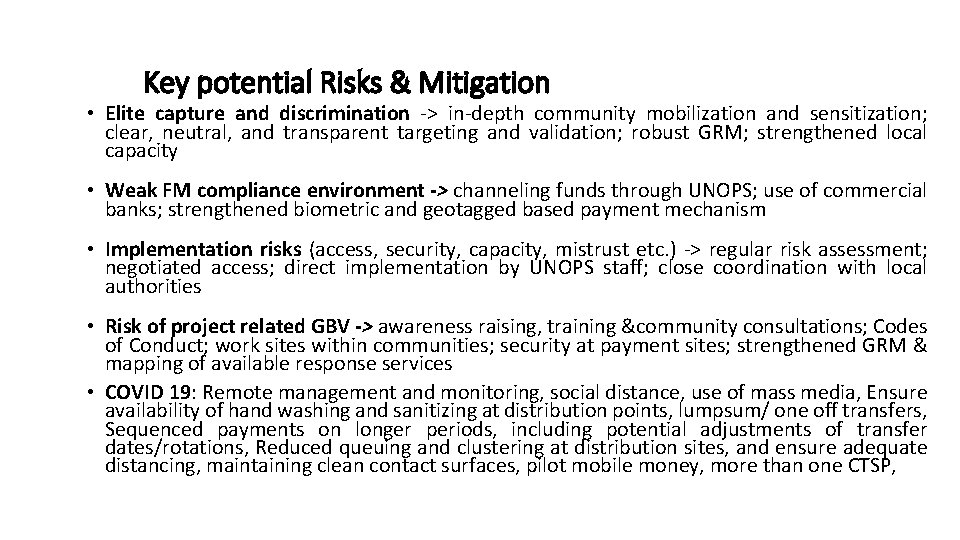
Key potential Risks & Mitigation • Elite capture and discrimination -> in-depth community mobilization and sensitization; clear, neutral, and transparent targeting and validation; robust GRM; strengthened local capacity • Weak FM compliance environment -> channeling funds through UNOPS; use of commercial banks; strengthened biometric and geotagged based payment mechanism • Implementation risks (access, security, capacity, mistrust etc. ) -> regular risk assessment; negotiated access; direct implementation by UNOPS staff; close coordination with local authorities • Risk of project related GBV -> awareness raising, training &community consultations; Codes of Conduct; work sites within communities; security at payment sites; strengthened GRM & mapping of available response services • COVID 19: Remote management and monitoring, social distance, use of mass media, Ensure availability of hand washing and sanitizing at distribution points, lumpsum/ one off transfers, Sequenced payments on longer periods, including potential adjustments of transfer dates/rotations, Reduced queuing and clustering at distribution sites, and ensure adequate distancing, maintaining clean contact surfaces, pilot mobile money, more than one CTSP,
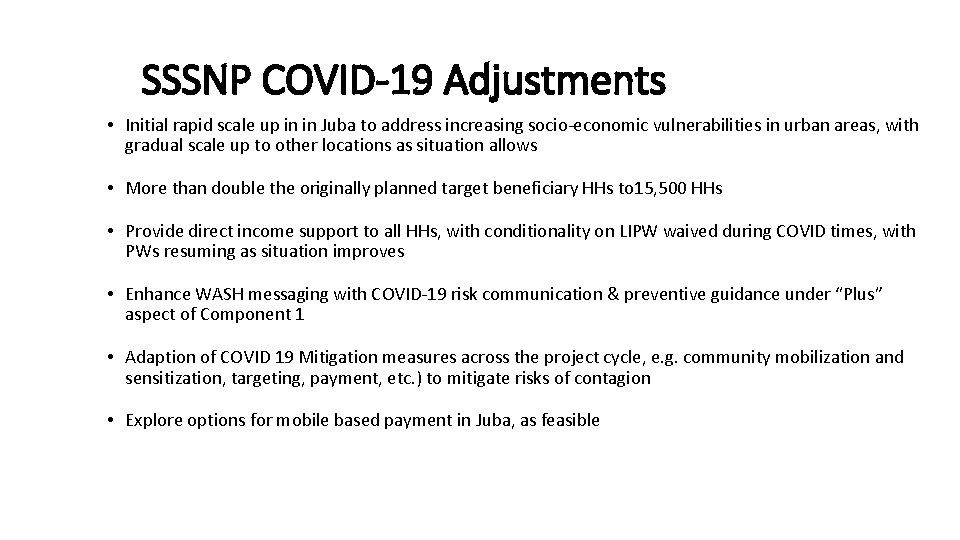
SSSNP COVID-19 Adjustments • Initial rapid scale up in in Juba to address increasing socio-economic vulnerabilities in urban areas, with gradual scale up to other locations as situation allows • More than double the originally planned target beneficiary HHs to 15, 500 HHs • Provide direct income support to all HHs, with conditionality on LIPW waived during COVID times, with PWs resuming as situation improves • Enhance WASH messaging with COVID-19 risk communication & preventive guidance under “Plus” aspect of Component 1 • Adaption of COVID 19 Mitigation measures across the project cycle, e. g. community mobilization and sensitization, targeting, payment, etc. ) to mitigate risks of contagion • Explore options for mobile based payment in Juba, as feasible
THANK YOU!
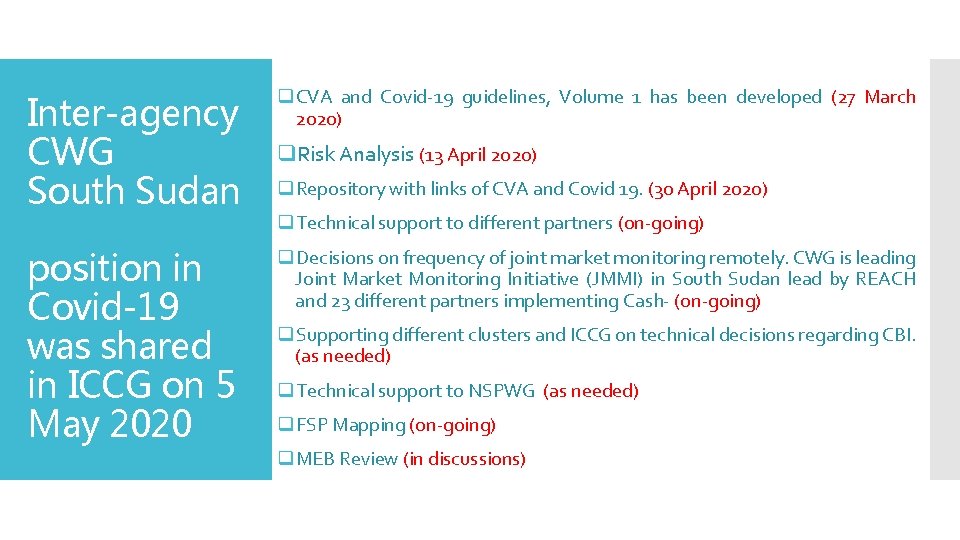
Inter-agency CWG South Sudan q. CVA and Covid-19 guidelines, Volume 1 has been developed (27 March 2020) position in Covid-19 was shared in ICCG on 5 May 2020 q. Decisions on frequency of joint market monitoring remotely. CWG is leading Joint Market Monitoring Initiative (JMMI) in South Sudan lead by REACH and 23 different partners implementing Cash- (on-going) q. Risk Analysis (13 April 2020) q. Repository with links of CVA and Covid 19. (30 April 2020) q. Technical support to different partners (on-going) q. Supporting different clusters and ICCG on technical decisions regarding CBI. (as needed) q. Technical support to NSPWG (as needed) q. FSP Mapping (on-going) q. MEB Review (in discussions)
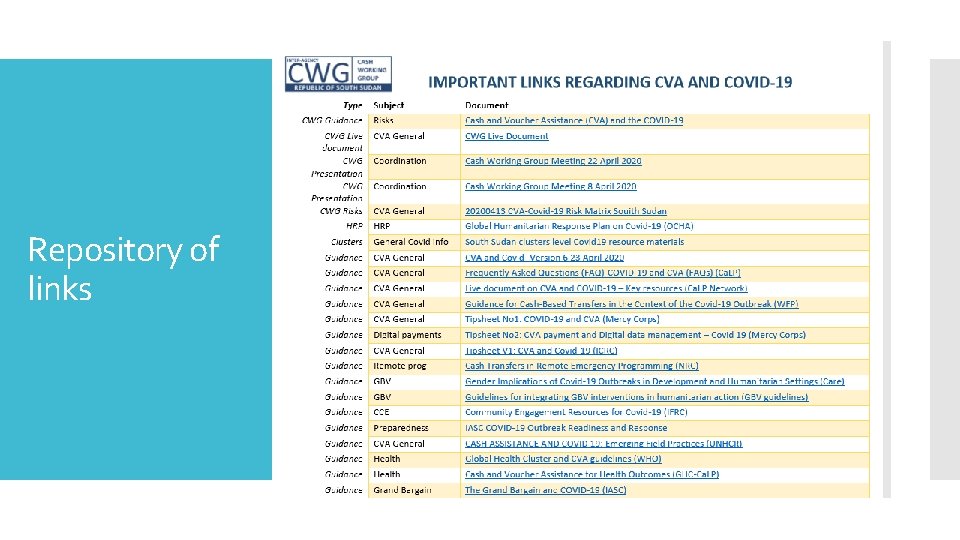
Repository of links
We have received responses from IOM, IMC and FAO FSP Mapping We are waiting for other partners to respond.
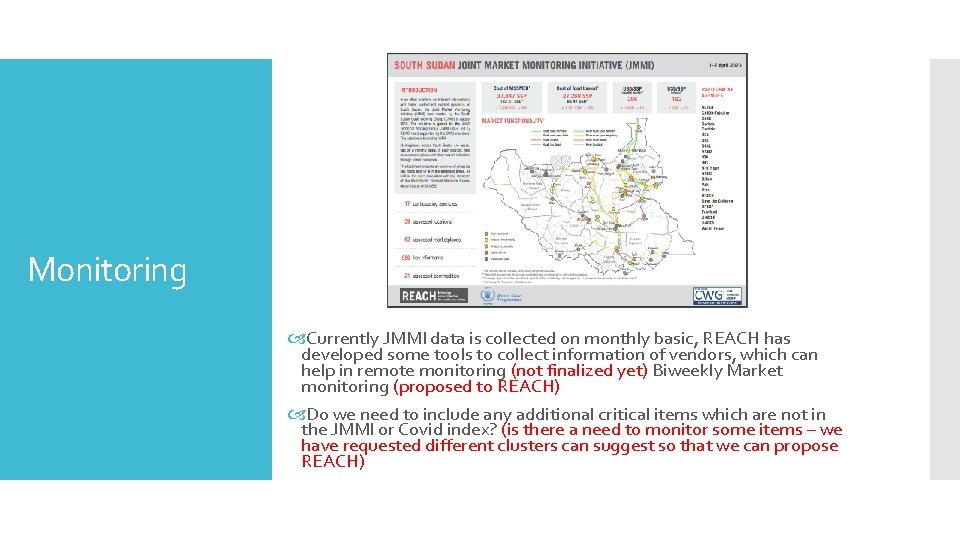
Monitoring Currently JMMI data is collected on monthly basic, REACH has developed some tools to collect information of vendors, which can help in remote monitoring (not finalized yet) Biweekly Market monitoring (proposed to REACH) Do we need to include any additional critical items which are not in the JMMI or Covid index? (is there a need to monitor some items – we have requested different clusters can suggest so that we can propose REACH)
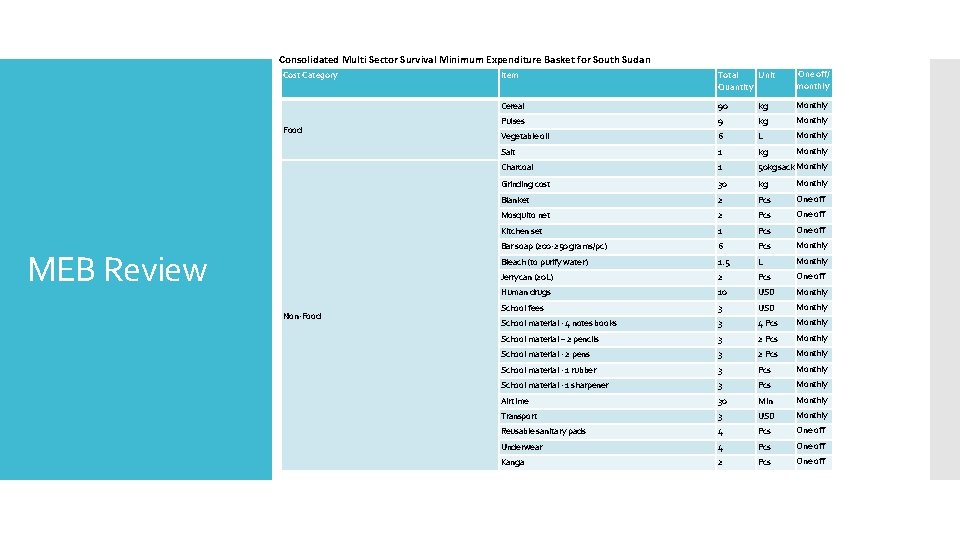
Consolidated Multi Sector Survival Minimum Expenditure Basket for South Sudan Cost Category Food MEB Review Non-Food Item Total Unit Quantity One off/ monthly Cereal 90 kg Monthly Pulses 9 kg Monthly Vegetable oil 6 L Monthly Salt 1 kg Monthly Charcoal 1 50 kg sack Monthly Grinding cost 30 kg Monthly Blanket 2 Pcs One off Mosquito net 2 Pcs One off Kitchen set 1 Pcs One off Bar soap (200 -250 grams/pc) 6 Pcs Monthly Bleach (to purify water) 1. 5 L Monthly Jerrycan (20 L) 2 Pcs One off Human drugs 10 USD Monthly School fees 3 USD Monthly School material - 4 notes books 3 4 Pcs Monthly School material – 2 pencils 3 2 Pcs Monthly School material - 2 pens 3 2 Pcs Monthly School material - 1 rubber 3 Pcs Monthly School material - 1 sharpener 3 Pcs Monthly Airtime 30 Min Monthly Transport 3 USD Monthly Reusable sanitary pads 4 Pcs One off Underwear 4 Pcs One off Kanga 2 Pcs One off
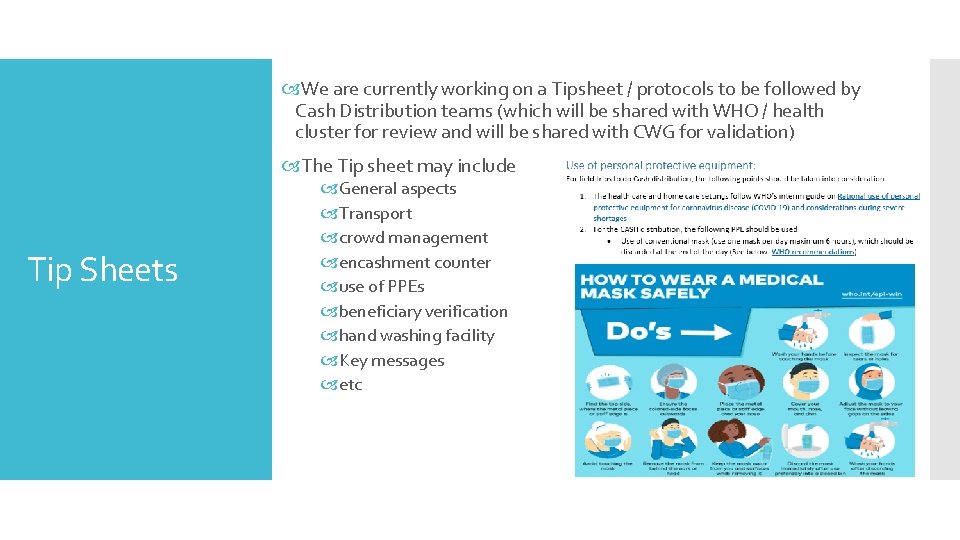
We are currently working on a Tipsheet / protocols to be followed by Cash Distribution teams (which will be shared with WHO / health cluster for review and will be shared with CWG for validation) The Tip sheet may include Tip Sheets General aspects Transport crowd management encashment counter use of PPEs beneficiary verification hand washing facility Key messages etc
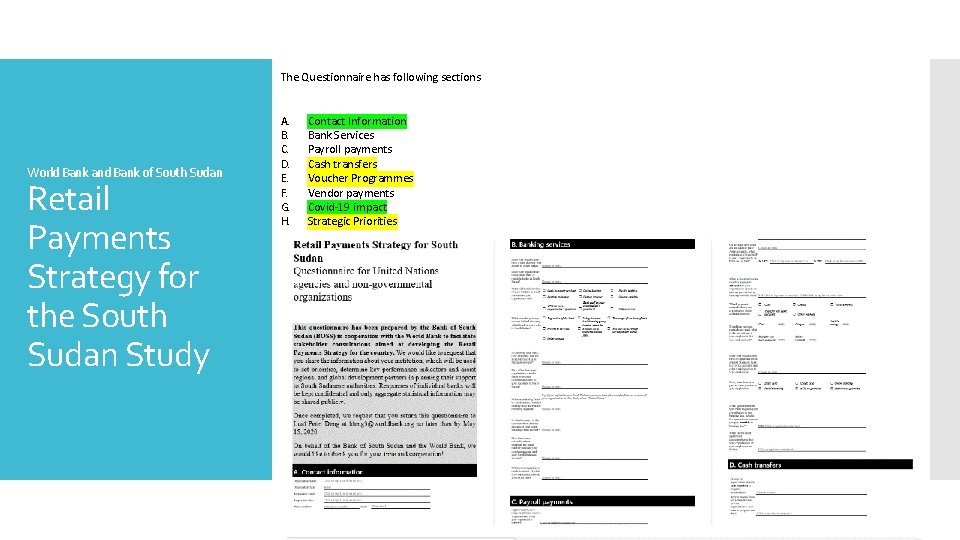
World Bank and Bank of South Sudan Retail Payments Strategy for the South Sudan Study The Questionnaire has following sections A. Contact Information B. Bank Services C. Payroll payments D. Cash transfers E. Voucher Programmes F. Vendor payments G. Covid-19 impact H. Strategic Priorities
Next meeting agenda Learning and sharing initiative: AOB CVA in Covid (WFP) presentation on Settlement project through conditional modality – (IOM-SNFIs) TIAM to present experience of over the counter service in field (OTC in field) What should be included more?
Thanks