
Cash Management Outline Cash Management Process Considerations Liquidity

- Slides: 32
Cash Management Outline: • Cash Management Process Considerations • Liquidity Management • Cash Concentration and Pooling Systems v 3. 0 © 2011 Association for Financial Professionals. All rights reserved. Session 5: Module 4, Chapter 8 - 1
Cash Management Framework • Collection , Disbursement & Concentration ( Speed up Inflows, control outflows and minimize costs) • Determinants : • • Organisation’s industry, legal and regulatory environment, payments system and available payment instruments
Collections • Collection system which minimizes cost of collection and collection float while maintaining desired level and quality of information regarding customer remittances and other sources • Costs include: • Float costs • Expenditures associated with managing the collections system (banking fees, 3 rd party collection etc. ) • Opportunity costs until funds are available for use
Collections • Collection Float : time interval or delay between when a payment is initiated and when a company receives good funds (primarily to paper based instruments) • Mail Float (delay b/w when cheque is mailed and day it is received) • Processing Float ( delay b/w when payee receives the check and the day check is deposited into payees account) • Availability Float ( delay b/w the day a check is deposited and the day a company’s account is credited with collected funds)
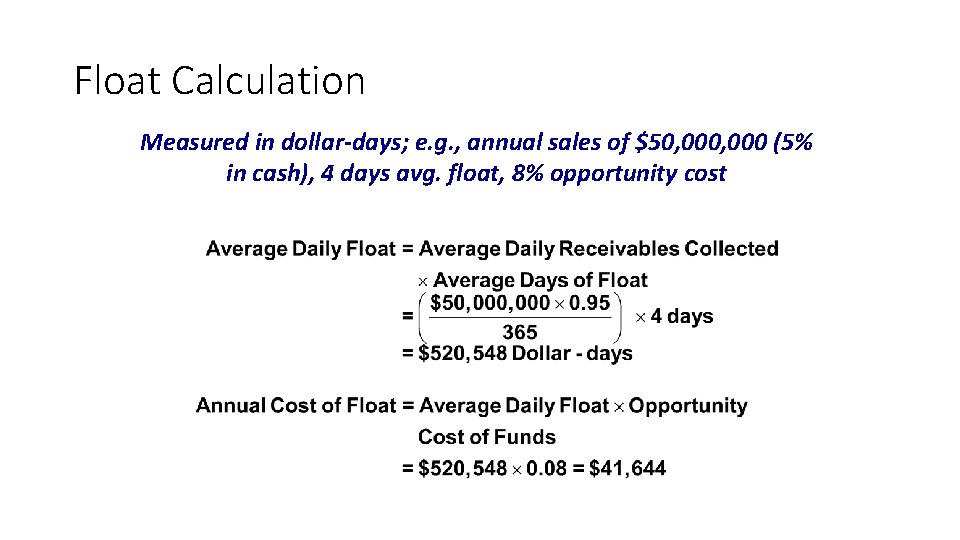
Float Calculation Measured in dollar-days; e. g. , annual sales of $50, 000 (5% in cash), 4 days avg. float, 8% opportunity cost
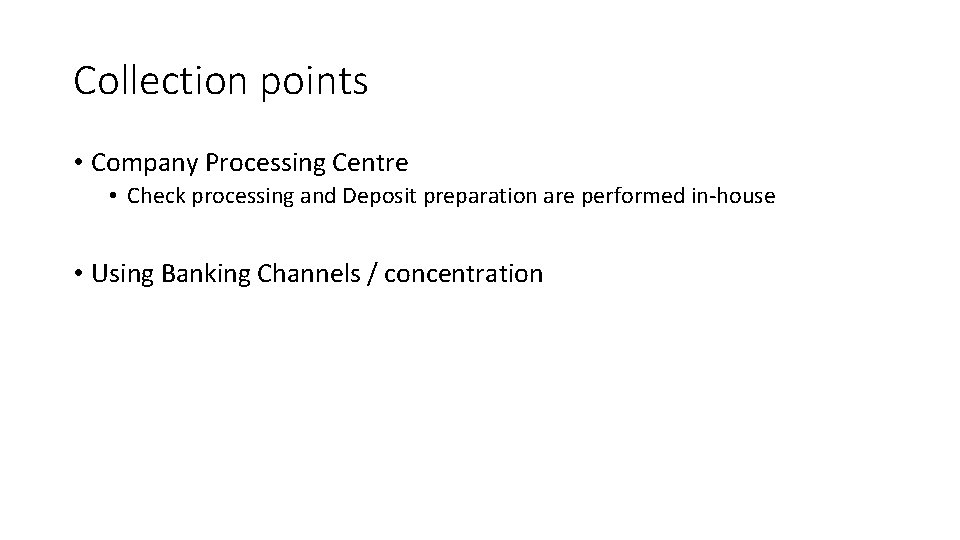
Collection points • Company Processing Centre • Check processing and Deposit preparation are performed in-house • Using Banking Channels / concentration
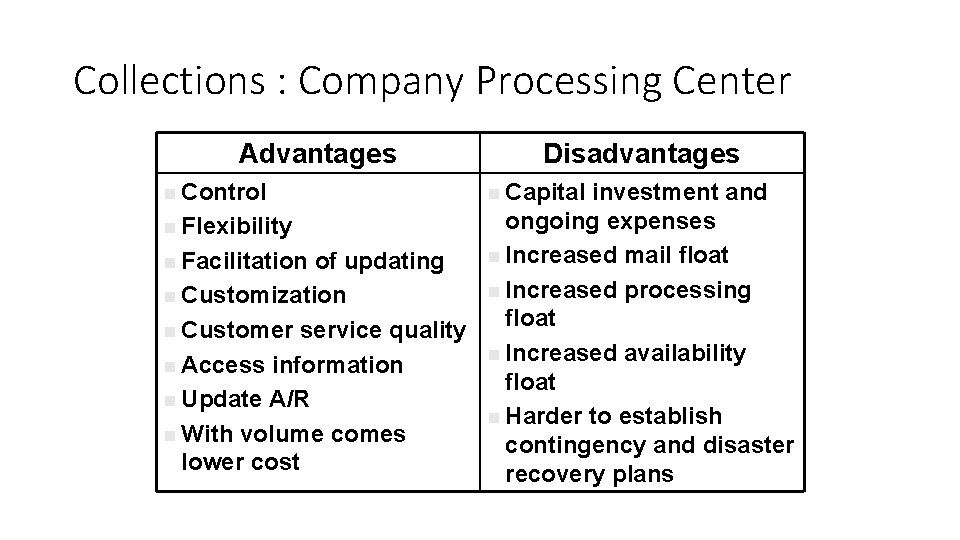
Collections : Company Processing Center Advantages n Control Disadvantages n Capital investment and ongoing expenses n Flexibility n Increased mail float n Facilitation of updating n Increased processing n Customization float n Customer service quality n Increased availability n Access information float n Update A/R n Harder to establish n With volume comes contingency and disaster lower cost recovery plans
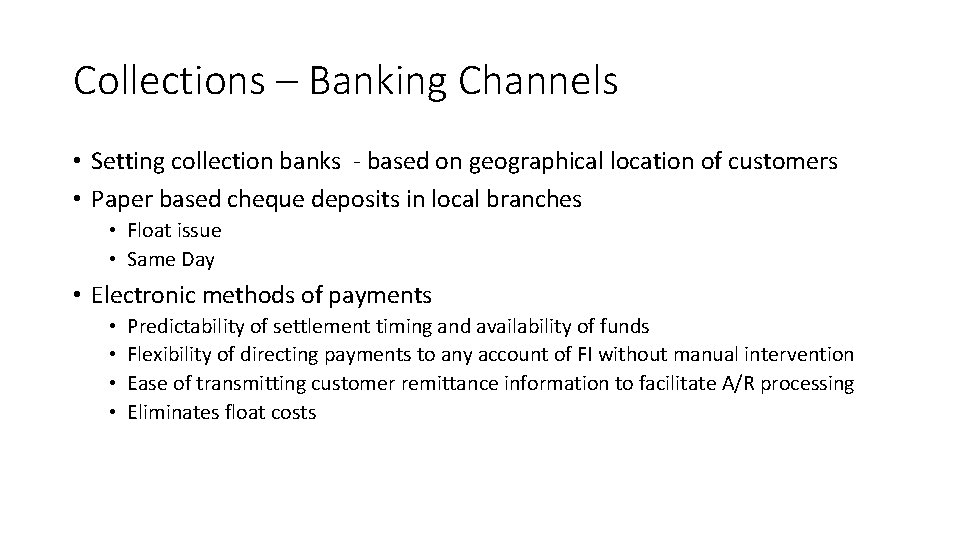
Collections – Banking Channels • Setting collection banks - based on geographical location of customers • Paper based cheque deposits in local branches • Float issue • Same Day • Electronic methods of payments • • Predictability of settlement timing and availability of funds Flexibility of directing payments to any account of FI without manual intervention Ease of transmitting customer remittance information to facilitate A/R processing Eliminates float costs
Collections – Banking Channels • Electronic methods of payments – Examples - Customer payments via online transfers using IBFT - Payment via RTGS - Direct Debits (Standing instructions) - Mobile payments
Major payment mechanisms in Pakistan • Real Time Gross Settlement (RTGS) (2009) Initially banks were using PRISM (RTGS) to transfer and settle inter-bank transactions. This has enabled banks to transfer inter-bank transactions into beneficiaries’ accounts on the same day. • Inter Bank Fund Transfer (IBFT) (2012) Apart from RTGS, through ATM Switch, instant A/C credit facility is also available for beneficiaries through Inter Bank Fund Transfer (IBFT). Now the turnaround time for account credit has considerably reduced to maximum 30 minutes provided correct beneficiary account number (IBAN) is mentioned in the payment instructions. • Cheques • Other electronic mechanisms/ mobile wallets
Major payment mechanisms in Pakistan-RTGS • PRISM (Pakistan Real-time Inter-bank Settlement Mechanism) systems operated by State Bank of Pakistan offers a powerful mechanism for limiting settlement and systemic risks in the interbank settlement process by providing settlement on Gross Basis and in Real Time. • Real Time Gross Settlement Systems (RTGS) are mechanisms that enable banks to make large-value payments to one another in realtime using online telecommunication facilities as well as state-of-theart computer systems. The payments are settled on gross basis in real time thus minimizing the systemic risks that are inherent in largevalue net settlement systems.
Major payment mechanisms in Pakistan-RTGS • SBP took the decision to implement the RTGS primarily with assistance from the World Bank. • Using this system, the banks holding accounts at SBP are able to operate their accounts in real time from their own premises via computerized network between SBP and the participating Banks. • The 3 rd Party transfer through PRISM/RTGS fall into one of two categories a) Big Value 3 rd Party Transfers (Rs 1. 000 M and above) b) Small Value 3 rd Party Transfers (Rs 0. 100 M to Rs 0. 999 M)
Major payment mechanisms in Pakistan-IBFT • Inter Bank Funds Transfer enables customers to transfer the funds in or out of their account instantly between banks without the hassle of making pay orders, writing cheques etc. . • The service allows customers of 1 LINK member banks to transfer funds from their account to any of the millions of accounts of other participating member banks on 1 LINK network across the country. • The IBFT service is real-time and instantaneous which can be performed from any Alternate Delivery Channels (Such as ATM, IVR, Call Center, Internet, Mobile, etc. ) of 1 LINK Member Banks. • Real-time and instantaneous funds transfer • Send up to Rs. 1, 000 per day • IBFT enabled on all delivery channels (ATM, Internet, Call Center, Mobile)
Major payment mechanisms in Pakistan- Cheques • Clearing Services Offered by NIFT • Overnight clearing Including Return Cheque Processing (24 hour Clearing Cycle) • Same Day/High Value Clearing including return cheque Processing (3 hour Clearing Cycle) • Inter City clearing including Return Cheque Processing (48 hour Clearing Cycle) • Countrywide Local US Dollar Clearing (5 day Clearing Cycle)
Cash Concentration • Transfer funds from outlying depository locations to a central bank account – Concentration Account • OBJECTIVES • • • Minimize bank balances Pool funds Facilitate daily liquidity management Invest more funds to increase income Pay debt faster and reduce interest expense Take advantage of vendor discount terms
Cash Concentration System Configuration • Considerations: • Most large retail chains transmit • Size and geographic distribution information from • Transfer alternatives POS terminals to • Branch footprint of headquarters. banks • Multiple branches of • Usually head single bank quarters initiate transfers v 3. 0 © 2011 Association for Financial Professionals. All rights reserved. Session 5: Module 4, Chapter 8 - 17
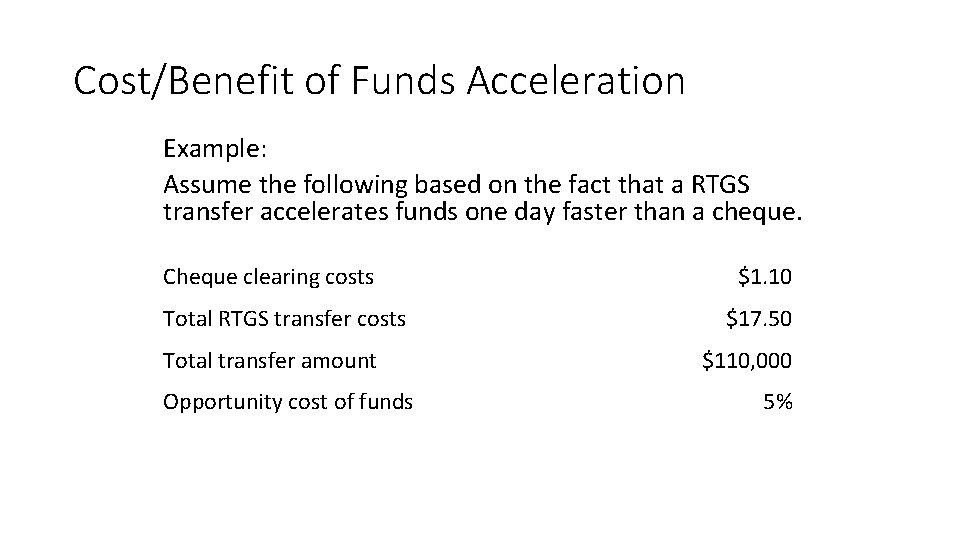
Cost/Benefit of Funds Acceleration Example: Assume the following based on the fact that a RTGS transfer accelerates funds one day faster than a cheque. Cheque clearing costs Total RTGS transfer costs Total transfer amount Opportunity cost of funds $1. 10 $17. 50 $110, 000 5%
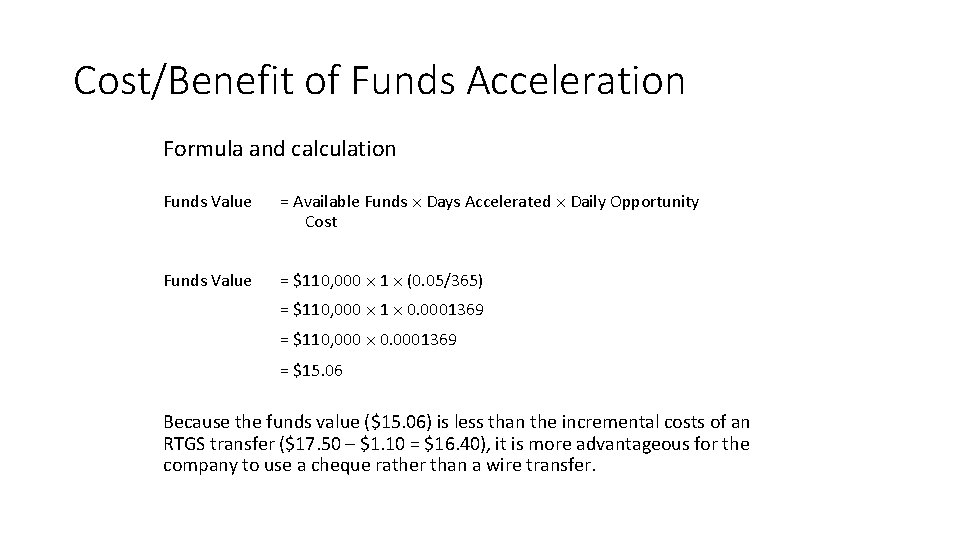
Cost/Benefit of Funds Acceleration Formula and calculation Funds Value = Available Funds Days Accelerated Daily Opportunity Cost Funds Value = $110, 000 1 (0. 05/365) = $110, 000 1 0. 0001369 = $110, 000 0. 0001369 = $15. 06 Because the funds value ($15. 06) is less than the incremental costs of an RTGS transfer ($17. 50 – $1. 10 = $16. 40), it is more advantageous for the company to use a cheque rather than a wire transfer.
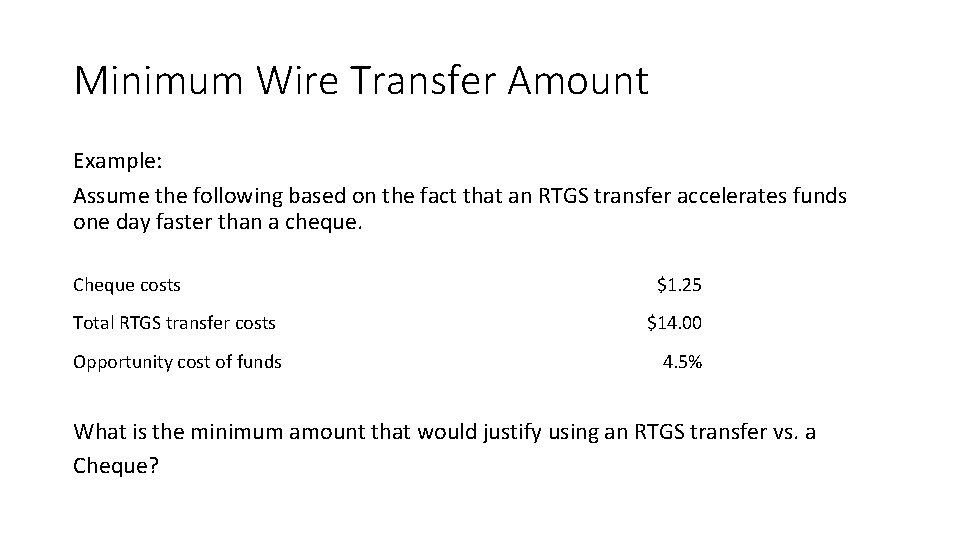
Minimum Wire Transfer Amount Example: Assume the following based on the fact that an RTGS transfer accelerates funds one day faster than a cheque. Cheque costs $1. 25 Total RTGS transfer costs $14. 00 Opportunity cost of funds 4. 5% What is the minimum amount that would justify using an RTGS transfer vs. a Cheque?
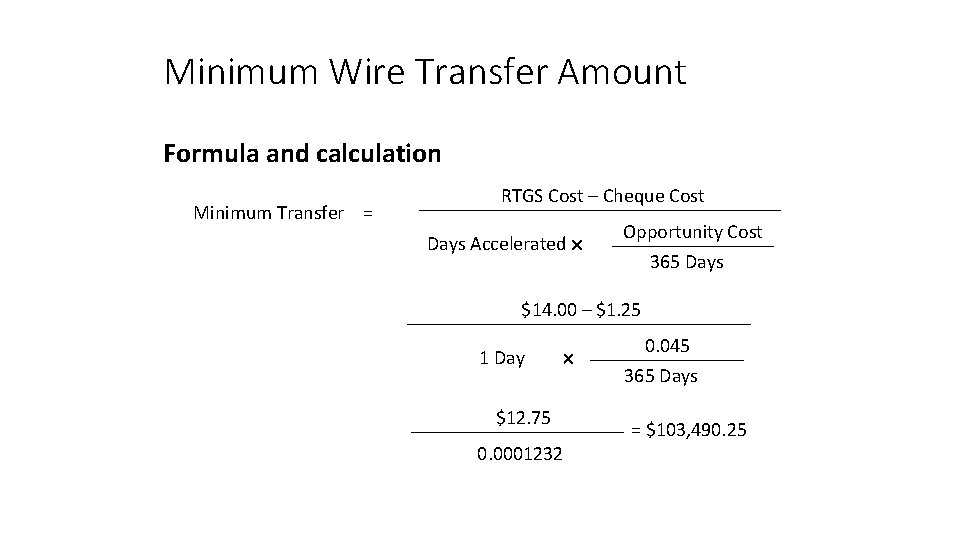
Minimum Wire Transfer Amount Formula and calculation Minimum Transfer = RTGS Cost – Cheque Cost Days Accelerated Opportunity Cost 365 Days $14. 00 – $1. 25 1 Day $12. 75 0. 0001232 0. 045 365 Days = $103, 490. 25
Bank Services that Facilitate Deposit or Automatic Concentration Both require using multiple branches of single bank. v 3. 0 © 2011 Association for Financial Professionals. All rights reserved. Session 5: Module 4, Chapter 8 - 22 Zero balance account (ZBA) • Separate units deposit in distinct depository accounts • Balances transferred automatically at end of day to master concentration account (balance is zero) Deposit reconciliation • Deposits from many locations credited to one corporate bank account
Concentration costs : a)Excess Balances • Average collected balance is greater than bank compensation needs or chosen target. • Causes • Deposit reporting delays by field units • Clearing delays of one day when using ACH for cash concentration • Transfer initiation delays if concentration entries are submitted to the originating bank late or contain reporting errors v 3. 0 © 2011 Association for Financial Professionals. All rights reserved. Session 5: Module 4, Chapter 8 - 23
Concentration costs : b)Bank Charges Deposit and concentration banks may assess fees for each deposit, deposited items, inbound and outbound wires, ACH clearings, deposit reports, overdrafts, negative collected balances, and account maintenance. v 3. 0 © 2011 Association for Financial Professionals. All rights reserved. Session 5: Module 4, Chapter 8 - 24
Concentration costs : C)Admin Costs • Managing deposit reporting—receiving and monitoring daily reports from local managers and concentration banks • Scheduling cash transfers—deciding when and what amounts to transfer • Preparing debit files • Reconciling deposit reports • Monitoring transfers to prevent internal fraud v 3. 0 © 2011 Association for Financial Professionals. All rights reserved. Session 5: Module 4, Chapter 8 - 25
Reducing Concentration System Costs • Enhance concentration system efficiency. • Improve transfer schedule timing. • Reduce excess balances. • Anticipate availability. • Anticipate deposits. • Use faster transfer mechanism. • Reduce transfer costs. • Use less expensive transfer mechanisms. • Transfer funds less frequently. • Threshold and target concentration. v 3. 0 © 2011 Association for Financial Professionals. All rights reserved. Session 5: Module 4, Chapter 8 - 26
Reducing Concentration System Costs • Reduce excess balances. • Anticipate availability involves initiation of a transfer after a deposit has been made, but before all items have been granted availability by the depository bank • Transfer is initiated based on the projected availability • Risks drawing on uncollected funds because potential delays in the clearing system and return items can cause collected balances to be unpredictable • Can sometimes lead to overdrafts • Anticipate deposits involves the initiation of a transfer before the items to be deposited have been received from the customer. • The transfer is initiated on the basis of historical cashflows over the given period. • Because there is substantial risk of overdraft, this is considered an aggressive cash management technique and should be used only with the full knowledge and consent of the depository bank v 3. 0 © 2011 Association for Financial • Retailers often use deposit anticipation to transfer weekend receipts. Professionals. All rights reserved. Session 5: Module 4, Chapter 8 - 27
Reducing Concentration System Costs • Reduce transfer costs. • Use less expensive transfer mechanisms. • Cost benefit analysis of transfers • Transfer funds – more frequently vs less frequently Target Concentration involves frequent often daily transfers • It establishes a target balance. All funds above the target balance level (a floor) are transferred to the concentration bank. • Maintains a constant balance in depository banks as per desired level. Threshold concentration may be used to minimize the number of transfers from an account • Company allows account balances to build to a predetermined level (a ceiling) before transferring funds to the concentration bank • A Treasury professional can monitor average balances and adjust the threshold as necessary v 3. 0 © 2011 Association for Financial Professionals. All rightsover reserved. time. Chapter 8 - 28 Session 5: Module 4,
Disbursements • Main goal of managing an Accounts Payable (A/P) and disbursement system is to disburse funds in a timely, accurate and cost effective manner • A/P and Payroll responsible for initiating vendor and employee payments • Treasury directly responsible for debt and dividend payments in addition to the funding of disbursement accounts
Disbursements • Opportunity Costs • Excess borrowing or lost investment income • Paying bills late such as lost discounts or late fees • Paying bills early such as short-term investment interest income lost or extra short term borrowing interest incurred • Administrative Cost • Overhead Costs of A/P dept • Fixed costs of disbursement system – Account maintenance and balance reporting • Variable costs – costs of issuing cheques, account reconciliation, stop payments & fraud prevention • Overdraft costs
Disbursement Products • Paper Based – Cheques etc. • Direct Deposits • Electronic Transfers • Prepaid Cards • Corporate Credit Cards • Integrated or Comprehensive A/P • Outsource all or part of A/P or disbursement • Co. sends data file to provider containing list of all payments to be made (to whom, instructions on payment method etc. )
Controlled Disbursement • A bank service providing notification of the dollar amount of checks that will clear against a controlled disbursement account that day • Daily clearings usually available by early or mid-morning • Allows treasury professionals to determine the days funding needs at a time when investment and borrowing alternatives may be more favourable • Company funds a controlled disbursement account by its oncentration account. It can also be set up as a ZBA n Adequate funds must then be provided to the account to cover the value of the checks presented
Positive Pay • Used to combat check fraud • Company transmits file of check information to the disbursement bank either at or before the physical distribution of checks • Bank matches numbers and amounts and only pays checks that match the file • Exceptions are reported