
Cash Basis versus Accrual Basis Operation performance metrics
Cash Basis versus Accrual Basis • Operation performance metrics: – Net income under cash basis of accounting – Net income under accrual basis of accounting • Which one is a better metrics? – Comparison criteria 1. Which measure better summarizes a company’s operation activity? 2. Which measure better reflects a company’s ability to generate cash flow in the future?
• Net income under cash basis of accounting – Income (or revenues) are recorded only when cash payment is received. Expenses are recorded only when cash payment is made. – Cash receipts and payments during the same period are reported in an accounting statement called the “statement of cash flows”. – Cash receipts and payments are categorized into three sections: operation, investment, and financing – Net cash receipts and payments = Net income under cash basis of accounting
• Net income under accrual basis of accounting – Under this method income (or revenues) are recognized only when they are earned or realized. Expenses are recorded in the period in which they help to generate revenues. – The revenue and expense during the same period is reported in an accounting statement called the “income statement”. – The (accrual) revenue and expense only related to operation activity. – Net income = Net income under accrual basis of accounting.

• Cash Basis versus Accrual Basis – Example 1: Stock issuance and cash dividend – Example 2: Credit sale transaction – Example 3: Unearned revenue • Analysis tool: – Financial Statement Template • Balance sheet side: accounting equation still applies here. That is, Assets (which is the sum of Cash assets and Non-cash assets) = Liabilities + Shareholders’ Equity (which is the sum of contributed capital and earned capital). • Income statement side: income statement which includes revenue and expense account. The net income is the revenue netting off the expense. Balance sheet and income statement are connected in that the amount of net income in the income statement represents the change in earned capital account in the balance sheet.

• Example 1: Stock Issuance and Cash Dividend: The company issues common stock for 300 dollars and pays cash dividend for 50 dollars. Source: Financial & Managerial Accounting for MBAs 3 rd ED – Transactions with shareholders (that is, stock issuance and dividend distribution) only affect cash inflow/outflow but not net income in the income statement. The reason is that transactions with shareholders are financing activities which are not accounted for in the income statement. – Cash dividends are a distribution of the company’s income to its shareholders. Cash dividend distribution is not an expense and therefore will not appear in the income statement.

• Example 2: Credit sale: The company sells its product worth 100, 000 dollars on credit. Sale on credit means that company delivers product to the customer and the customer promises to pay off the amount owed to the company in the future. Source: Financial & Managerial Accounting for MBAs 3 rd ED – Income statement: • Upon the sale is completed, the revenue account increases by 100, 000 dollars. – Balance sheet: • There is no effect on cash asset because the sale is on credit. In other words, there is no cash inflow/outflow involved in this transaction. • This transaction increases non-cash assets by 100, 000 dollars. The increase represents the company’s right to claim 100, 000 dollars of cash against its customer. In accounting, we term this claim as “accounts receivable”. • Earned capital account increases by 100, 000 dollars, which is exactly equal to the amount of net income.

• Example 3: Unearned Revenue: The company receives prepayment of 400 dollars in cash from its customer. Source: Financial & Managerial Accounting for MBAs 3 rd ED – Balance sheet: • Upon receiving the cash prepayment, cash asset is increased by 400 dollars. • The company is obliged to deliver 400 dollars’ worth of product to its customer. This obligation is a liability the company owes to the customer. In accounting, we term this liability as “unearned revenue”. – Income statement: • This transaction does not affect income statement. This is because the company’s revenue generation process hasn’t been completed and the exchange hasn’t taken place.
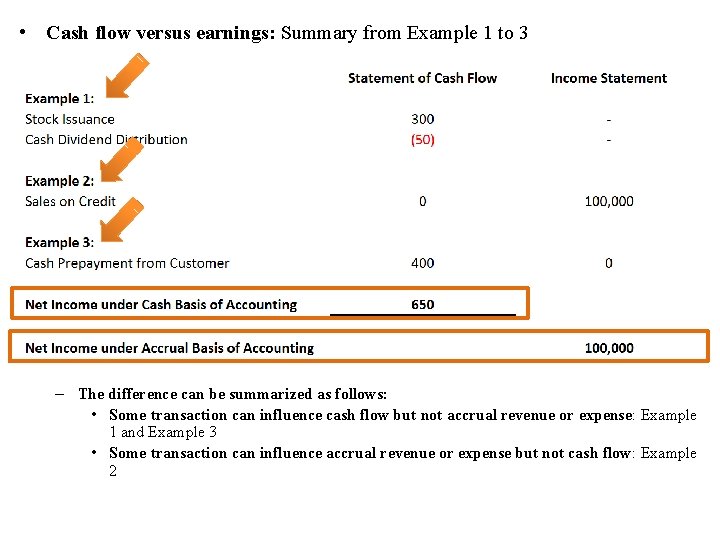
• Cash flow versus earnings: Summary from Example 1 to 3 – The difference can be summarized as follows: • Some transaction can influence cash flow but not accrual revenue or expense: Example 1 and Example 3 • Some transaction can influence accrual revenue or expense but not cash flow: Example 2

• Which one is a better metrics? 1. Which measure better summarizes a company’s operation activity? Answer -> Net income under accrual basis of accounting 2. Which measure better reflects a company’s ability to generate cash flow in the future? Answer -> Net income under accrual basis of accounting
- Slides: 9