
CaseMatched Comparison of Spinal Fusion Versus Growing Rods
- Slides: 19
Case-Matched Comparison of Spinal Fusion Versus Growing Rods for the Surgical Treatment of Progressive Idiopathic Scoliosis in Skeletally Immature Patients Jeff Pawelek, BS Burt Yaszay, MD Stacie Nguyen, MPH Peter O. Newton, MD Gregory M. Mundis, MD Behrooz A. Akbarnia, MD Harms Study Group Growing Spine Study Group International Congress on Early Onset Scoliosis San Diego, CA – November 21 -22, 2013
DISCLOSURES a. Grants/Research Support b. Consultant c. Stock/Shareholder d. Speakers’ Bureau e. Other Financial Support Jeff Pawelek, BS None Burt Yaszay, MD (a) De. Puy synthes; Children’s Spine Study Group Foundation; (b) Depuy-Synthes, K 2 M, Nuvasive; (d) De. Puy-Synthes, K 2 M; (e) K 2 M, Ortho. Pediatrics Stacie Nguyen, MPH None Peter O. Newton, MD (a) De. Puy-Synthes; EOS Imaging; Orthopedic Research & Education Foundation; Pediatric Orthopedic Society of North America, Scoliosis Research Society; Harms Study Group Foundation; Setting Scoliosis Straight Foundation; Childrens Specialist Foundation; (b) De. Puy. Synthes, Cubist, Ethicon; (c) Electro. Core (d) De. Puy-Synthes; (e) De. Puy-Synthes; Thieme Publishing Gregory M. Mundis, Jr. , MD (a, b, d) Nuvasive; (a, b) K 2 M; (a, e) De. Puy Synthes Behrooz A. Akbarnia, MD De. Puy Spine (a, ), Ellipse (b, c), K 2 M (b), KSpine (b, c), Nuvasive (a, b, c) Harms Study Group (a) De. Puy-Synthes, OREF Growing Spine Study Group (a) Growing Spine Foundation
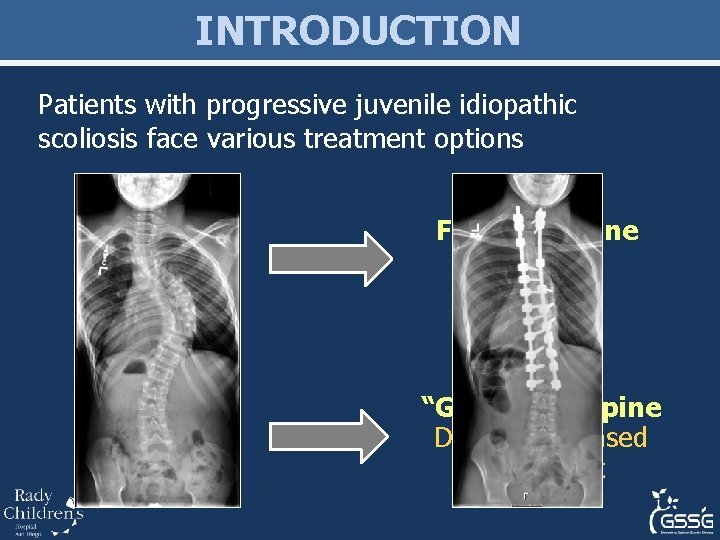
INTRODUCTION Patients with progressive juvenile idiopathic scoliosis face various treatment options Fuse the spine Definitive Treatment “Grow” the spine Distraction-based Treatment
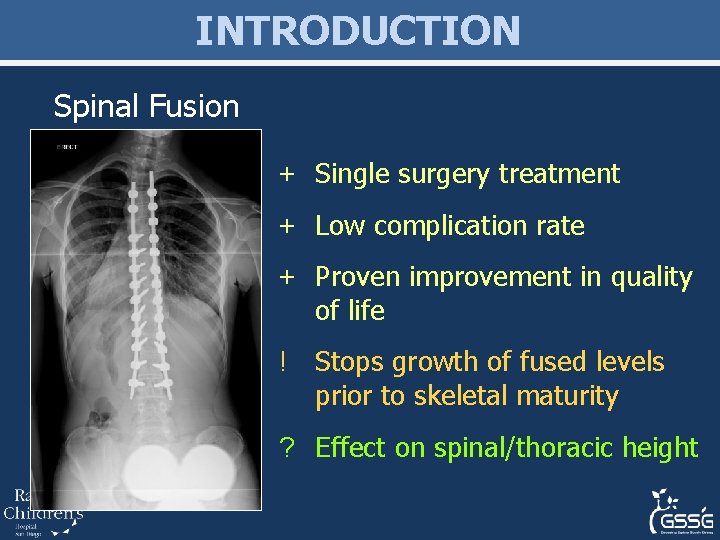
INTRODUCTION Spinal Fusion + Single surgery treatment + Low complication rate + Proven improvement in quality of life ! Stops growth of fused levels prior to skeletal maturity ? Effect on spinal/thoracic height
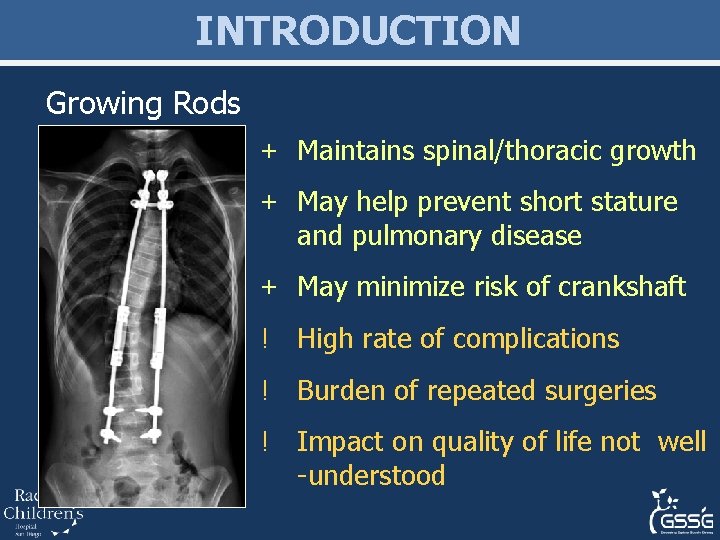
INTRODUCTION Growing Rods + Maintains spinal/thoracic growth + May help prevent short stature and pulmonary disease + May minimize risk of crankshaft ! High rate of complications ! Burden of repeated surgeries ! Impact on quality of life not well -understood
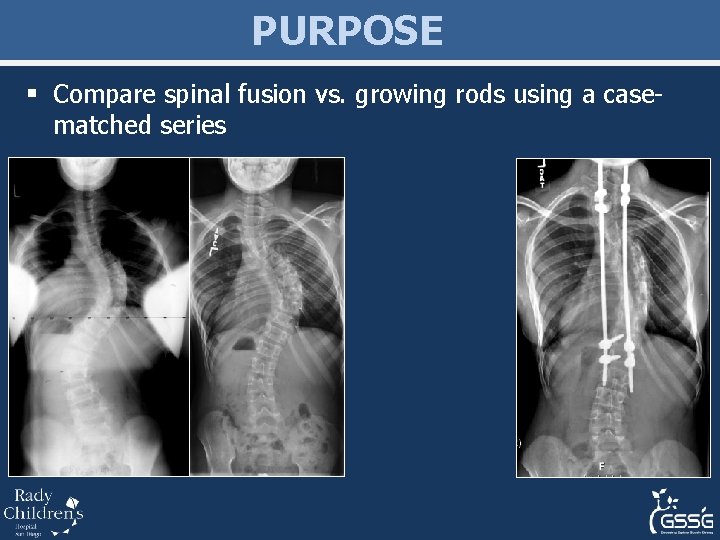
PURPOSE § Compare spinal fusion vs. growing rods using a casematched series
METHODS § Multicenter EOS database was used to identify patients: • Skeletally immature (open tri-radiates) • 9 -11 years old at initial surgery • Major thoracic curve • Idiopathic etiology • Growing rod surgery • Underwent “final” spinal fusion
METHODS § Multicenter AIS database was used to identify patients: • Skeletally immature (open tri-radiates) • 9 -11 years old at surgery • Major thoracic curve • Definitive fusion • Minimum 2 -years follow-up
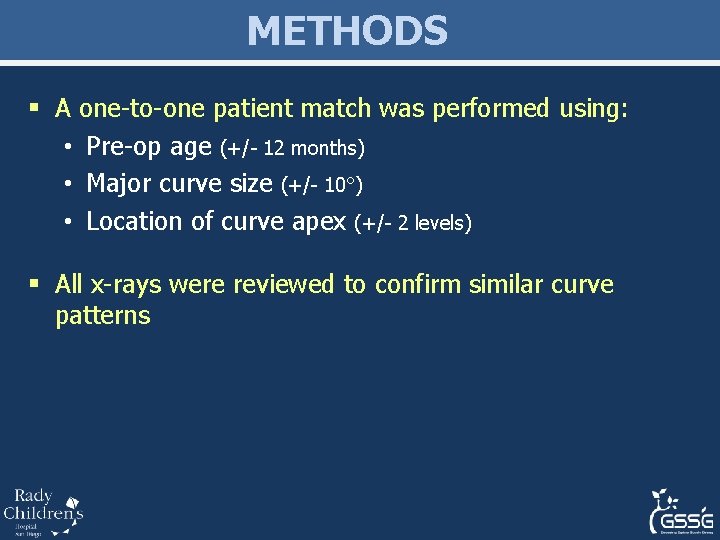
METHODS § A one-to-one patient match was performed using: • Pre-op age (+/- 12 months) • Major curve size (+/- 10°) • Location of curve apex (+/- 2 levels) § All x-rays were reviewed to confirm similar curve patterns
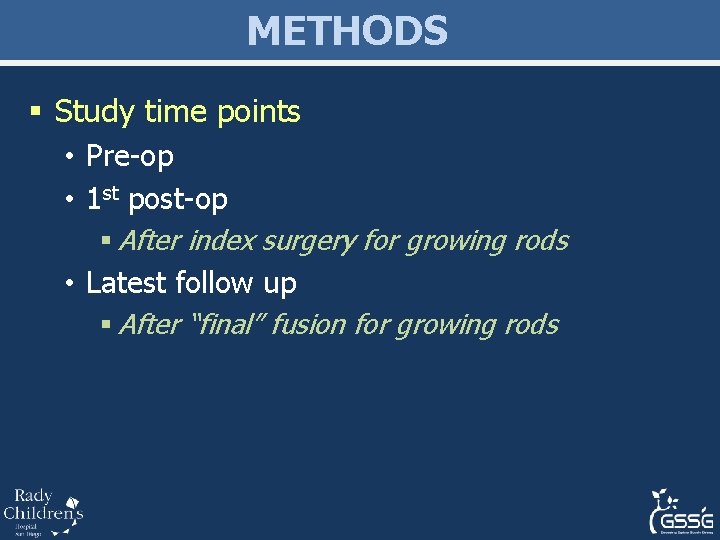
METHODS § Study time points • Pre-op • 1 st post-op § After index surgery for growing rods • Latest follow up § After “final” fusion for growing rods
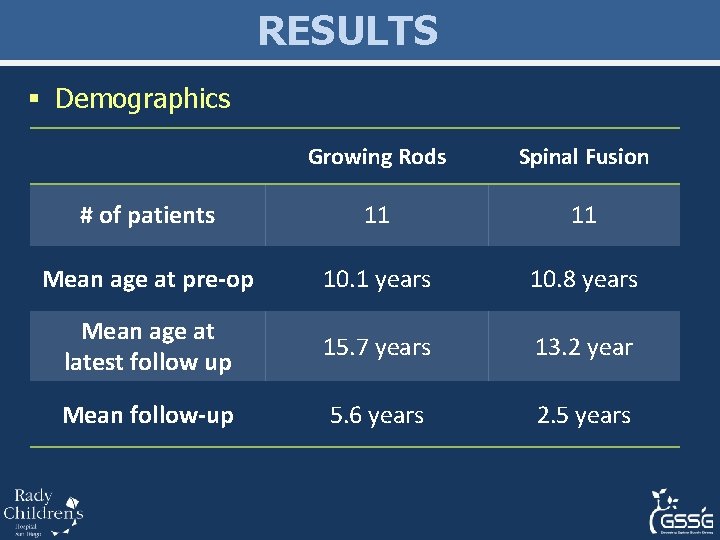
RESULTS § Demographics Growing Rods Spinal Fusion # of patients 11 11 Mean age at pre-op 10. 1 years 10. 8 years Mean age at latest follow up 15. 7 years 13. 2 year Mean follow-up 5. 6 years 2. 5 years
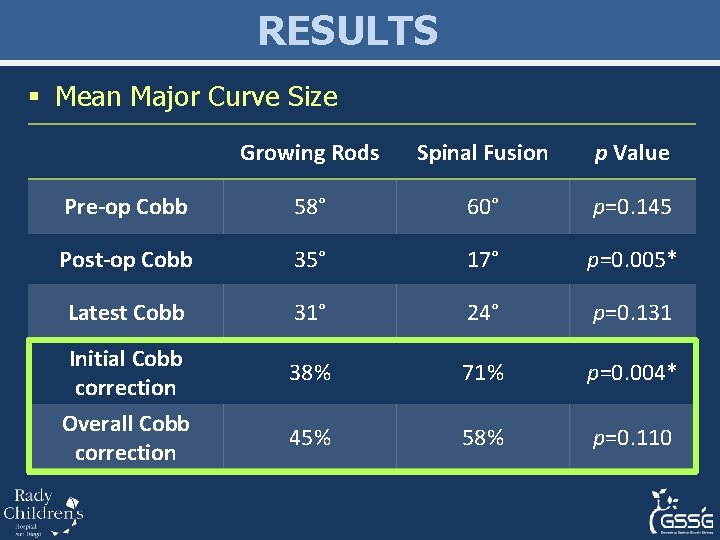
RESULTS § Mean Major Curve Size Growing Rods Spinal Fusion p Value Pre-op Cobb 58° 60° p=0. 145 Post-op Cobb 35° 17° p=0. 005* Latest Cobb 31° 24° p=0. 131 Initial Cobb correction 38% 71% p=0. 004* Overall Cobb correction 45% 58% p=0. 110
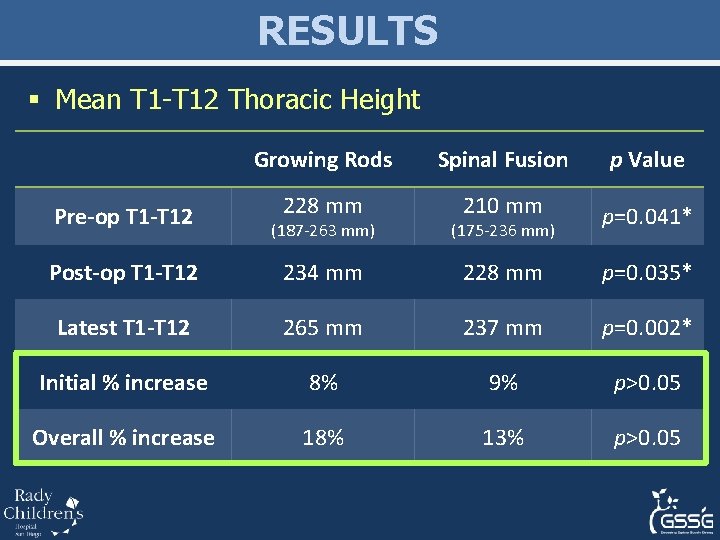
RESULTS § Mean T 1 -T 12 Thoracic Height Growing Rods Spinal Fusion p Value 228 mm (187 -263 mm) 210 mm (175 -236 mm) p=0. 041* Post-op T 1 -T 12 234 mm 228 mm p=0. 035* Latest T 1 -T 12 265 mm 237 mm p=0. 002* Initial % increase 8% 9% p>0. 05 Overall % increase 18% 13% p>0. 05 Pre-op T 1 -T 12
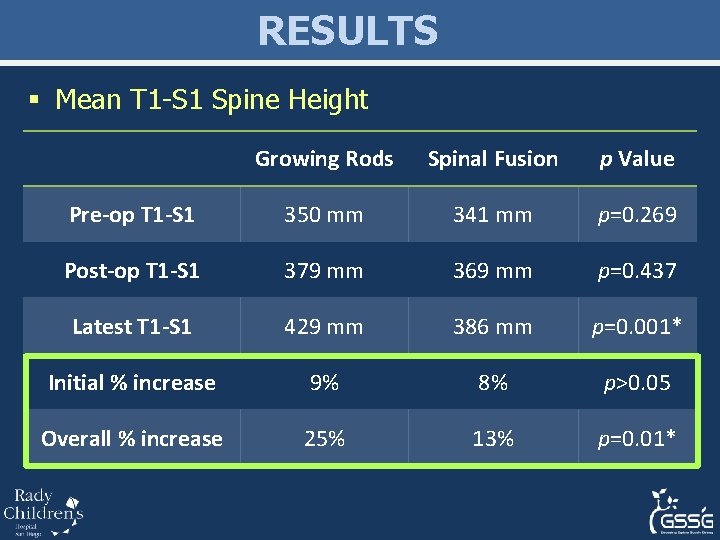
RESULTS § Mean T 1 -S 1 Spine Height Growing Rods Spinal Fusion p Value Pre-op T 1 -S 1 350 mm 341 mm p=0. 269 Post-op T 1 -S 1 379 mm 369 mm p=0. 437 Latest T 1 -S 1 429 mm 386 mm p=0. 001* Initial % increase 9% 8% p>0. 05 Overall % increase 25% 13% p=0. 01*
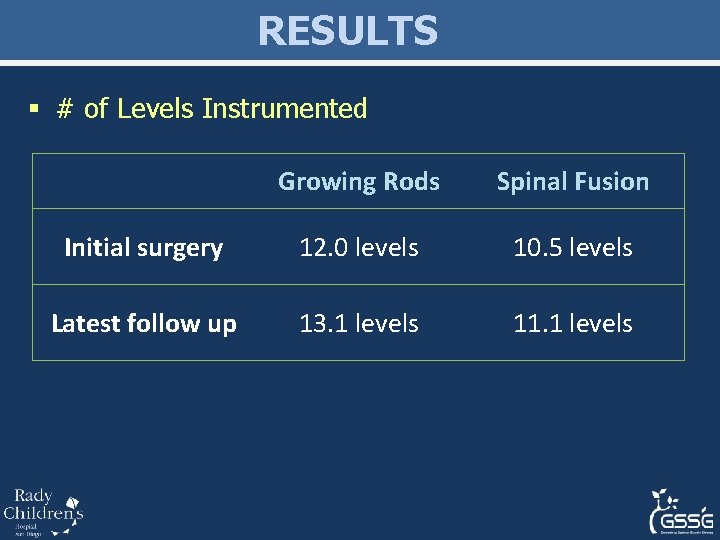
RESULTS § # of Levels Instrumented Growing Rods Spinal Fusion Initial surgery 12. 0 levels 10. 5 levels Latest follow up 13. 1 levels 11. 1 levels
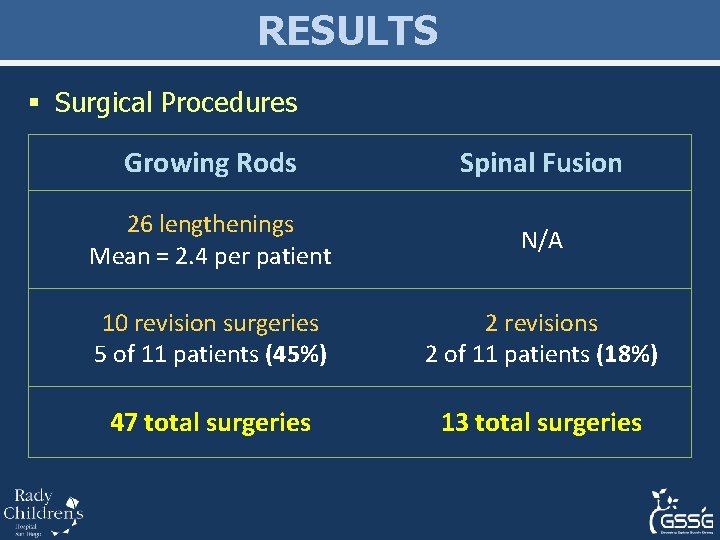
RESULTS § Surgical Procedures Growing Rods Spinal Fusion 26 lengthenings Mean = 2. 4 per patient N/A 10 revision surgeries 5 of 11 patients (45%) 2 revisions 2 of 11 patients (18%) 47 total surgeries 13 total surgeries
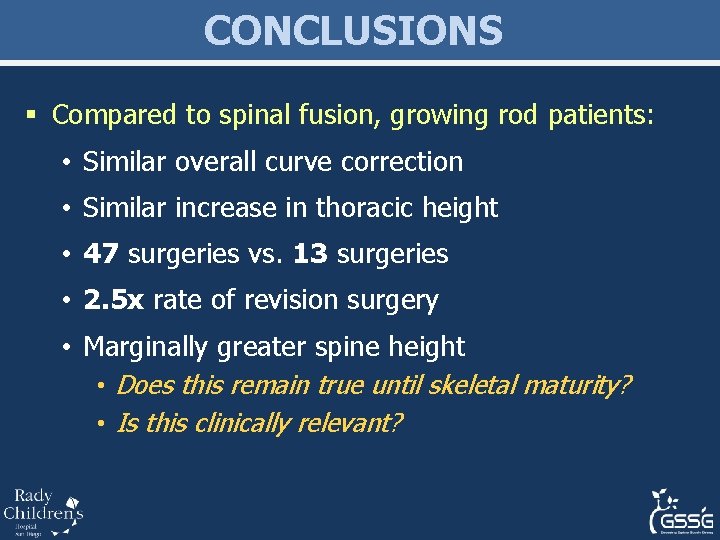
CONCLUSIONS § Compared to spinal fusion, growing rod patients: • Similar overall curve correction • Similar increase in thoracic height • 47 surgeries vs. 13 surgeries • 2. 5 x rate of revision surgery • Marginally greater spine height • Does this remain true until skeletal maturity? • Is this clinically relevant?
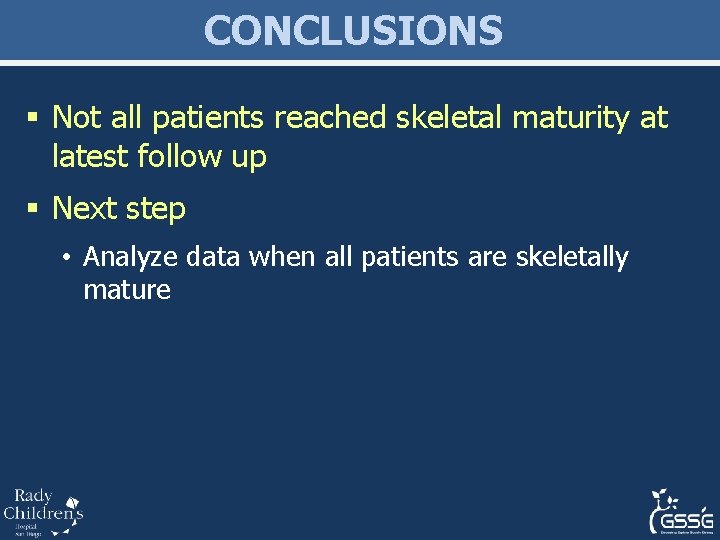
CONCLUSIONS § Not all patients reached skeletal maturity at latest follow up § Next step • Analyze data when all patients are skeletally mature
THANK YOU The Growing Spine Foundation acknowledges and thanks all donors who support its cause.