
Case Themes What They Are and How to
- Slides: 17
Case Themes What They Are and How to Use Them
Presented by Jordan B. Tinsley Former Chair, Mock Trial Committee Arkansas Bar Association Tinsley & Youngdahl, PLLC 300 South Spring, Suite 614 Little Rock, AR 72201 (501) 374 -2099 jordan@tyattorney. com
Amy Singer, Ph. D. • • • Private trial consultant • Founder and president of Trial Consultants Inc. , headquartered in Fort Lauderdale. Coauthor, along with Texas trial attorney Pat Maloney, of Trials and Deliberations: Inside the Jury Room; articles on jury and trial matters are a regular feature of the legal and business media. • • Nationally recognized authority in the field of litigation psychology Expert regarding the psychology of jurors and juries and the dynamics of a jury's deliberations and decision-making processes. Called upon on a routine basis by the national broadcast media to provide informed courtroom commentary regarding prominent trials. She frequently lectures on jury, trial, and settlement matters before numerous professional organizations across the country. http: //www. trialconsultants. com/Library/Jury. Validated. Trial. Themes. html
Scientific Studies Prove It • Over three decades of scientific jury research show that: • • 1) jurors deliberate in themes, • 3) a good theme enables jurors to look for evidence that "fits" the story and to disregard evidence that does not "fit, " and • 4) themes facilitate evidence comprehension and enable juries to reach pre-deliberation verdict decisions 2) the case theme is the primary mental organizer that helps jurors remember the facts,
The Jury Uses Theme • Theme helps jury with processing evidence • Organize • What fits? • What can they discard? • Characterize • How do they interpret the important facts? • How will certain facts look?
What makes a good theme? • Brevity—a few words or less, or even one word • • Easy to explain Easy to understand 30 seconds or less Memorable • • Think about movie taglines or advertising jingles Memorable lines from movies • • “I’ll be back” The Terminator “My name is Inigo Montoya, you killed my father, prepare to die” • • The Princess Bride What makes these things memorable? Consistent with the facts/evidence Consistent with the juror’s beliefs/common sense
What makes a good theme? • Identify Shared Values • • • Create a sense of shared value between the attorney (and thus his or her client) and the jury Extrapolations of common life experiences that find resonance in the jurors’ minds “[T]o produce a mighty book, you must choose a mighty theme. No great and enduring volume can ever be written on the flea…” • Herman Melville, Moby-Dick, Chapter 104 Avoid “correspondence bias” • • • People perceive things differently Don’t assume they will see the world as you do “Dog” Chihahua or Rottweiler? Avoid legalese • Negligence v. “Safety first”
What makes a good theme? • Evoke common imagery or beliefs • Shakespeare • • • “Pound of flesh” “Et tu, Brute” The Bible • “Two by two” • • Samson • • • 7 deadly sins Bulwark of freedom, etc. Motivating • • • Doing things you’re told not to Make the jury feel good and important • • Following the leader Theme should motivate jurors to 1) care, and 2) act Caring = identifying Make the juror identify with your client
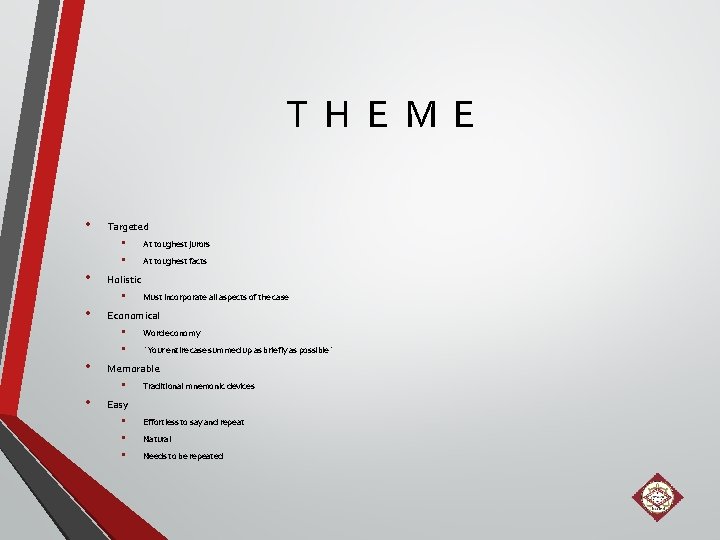
T H E M E • Targeted • • • Word economy “Your entire case summed up as briefly as possible” Memorable • • Must incorporate all aspects of the case Economical • • • At toughest facts Holistic • • At toughest jurors Traditional mnemonic devices Easy • • • Effortless to say and repeat Natural Needs to be repeated
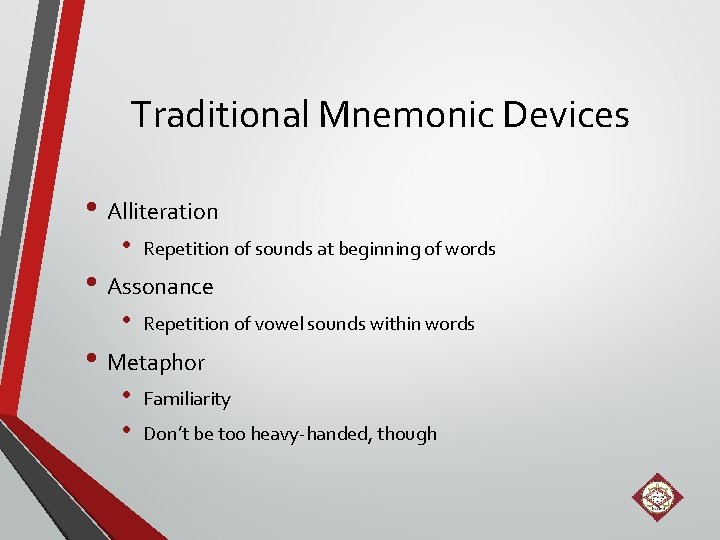
Traditional Mnemonic Devices • Alliteration • Repetition of sounds at beginning of words • Assonance • Repetition of vowel sounds within words • Metaphor • • Familiarity Don’t be too heavy-handed, though
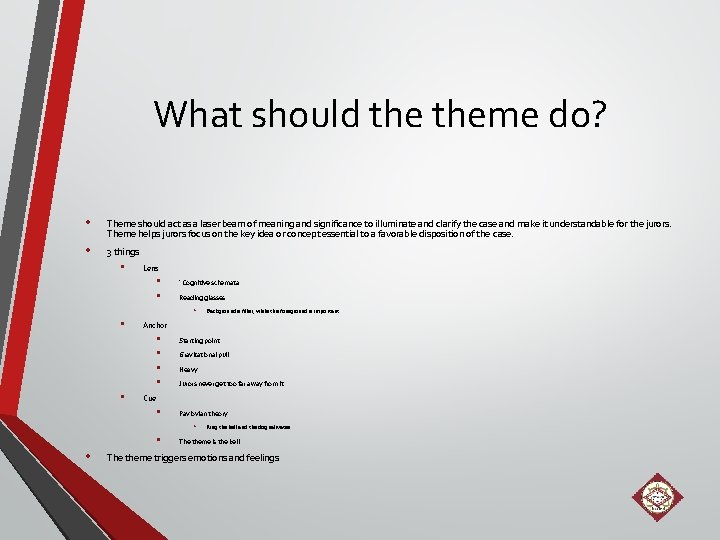
What should theme do? • Theme should act as a laser beam of meaning and significance to illuminate and clarify the case and make it understandable for the jurors. Theme helps jurors focus on the key idea or concept essential to a favorable disposition of the case. • 3 things • Lens • • “Cognitive schemata” Reading glasses • • • Anchor • • Starting point • Pavlovian theory • The theme is the bell Gravitational pull Heavy Jurors never get too far away from it Cue • • Background is filler, while the foreground is important Ring the bell and the dog salivates The theme triggers emotions and feelings
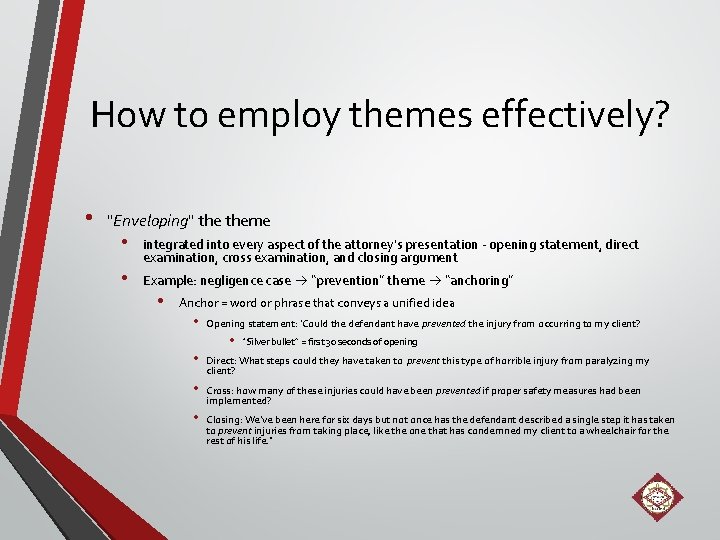
How to employ themes effectively? • "Enveloping" theme • integrated into every aspect of the attorney's presentation - opening statement, direct examination, cross examination, and closing argument • Example: negligence case “prevention” theme “anchoring” • Anchor = word or phrase that conveys a unified idea • Opening statement: 'Could the defendant have prevented the injury from occurring to my client? • “Silver bullet” = first 30 seconds of opening • Direct: What steps could they have taken to prevent this type of horrible injury from paralyzing my client? • Cross: how many of these injuries could have been prevented if proper safety measures had been implemented? • Closing: We've been here for six days but not once has the defendant described a single step it has taken to prevent injuries from taking place, like the one that has condemned my client to a wheelchair for the rest of his life. "
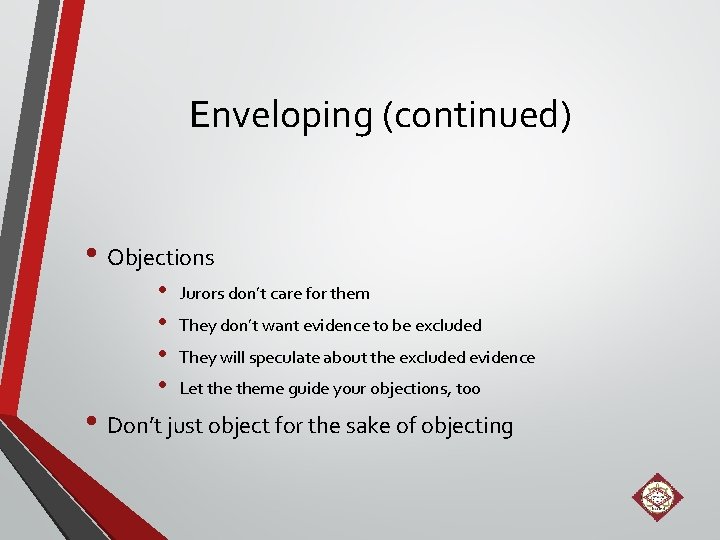
Enveloping (continued) • Objections • • Jurors don’t care for them They don’t want evidence to be excluded They will speculate about the excluded evidence Let theme guide your objections, too • Don’t just object for the sake of objecting
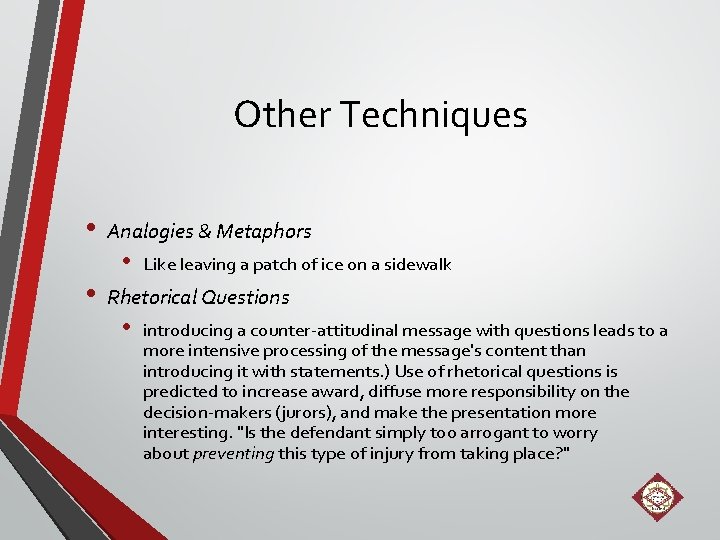
Other Techniques • • Analogies & Metaphors • Like leaving a patch of ice on a sidewalk Rhetorical Questions • introducing a counter-attitudinal message with questions leads to a more intensive processing of the message's content than introducing it with statements. ) Use of rhetorical questions is predicted to increase award, diffuse more responsibility on the decision-makers (jurors), and make the presentation more interesting. "Is the defendant simply too arrogant to worry about preventing this type of injury from taking place? "
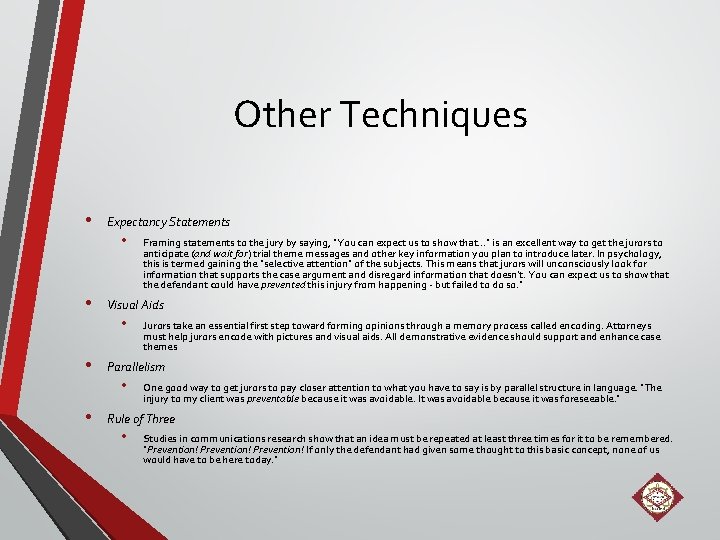
Other Techniques • Expectancy Statements • • Visual Aids • • Jurors take an essential first step toward forming opinions through a memory process called encoding. Attorneys must help jurors encode with pictures and visual aids. All demonstrative evidence should support and enhance case themes Parallelism • • Framing statements to the jury by saying, "You can expect us to show that. . . " is an excellent way to get the jurors to anticipate (and wait for) trial theme messages and other key information you plan to introduce later. In psychology, this is termed gaining the "selective attention" of the subjects. This means that jurors will unconsciously look for information that supports the case argument and disregard information that doesn't. You can expect us to show that the defendant could have prevented this injury from happening - but failed to do so. " One good way to get jurors to pay closer attention to what you have to say is by parallel structure in language. "The injury to my client was preventable because it was avoidable. It was avoidable because it was foreseeable. " Rule of Three • Studies in communications research show that an idea must be repeated at least three times for it to be remembered. "Prevention! If only the defendant had given some thought to this basic concept, none of us would have to be here today. "
Other Techniques • Understatement • • • Let the jurors minds work • Orson Welles, War of the Worlds • The horror in the imagination is worse than in reality • Don’t belabor the point Plaintiff with no arms lunch; he eats like a dog Aim your theme toward the toughest audience on the jury • Engage the skeptical jurors • • The jurors that are predisposed toward you don’t need a good theme Power and its use • • All jurors assess the relative power of the parties • Underdog • David v. Goliath All jurors assess the choice of the parties to use power • Responsibility • Spider-Man • • To whom much is given, much is required Clever Language • “If the glove doesn’t fit, you must acquit”
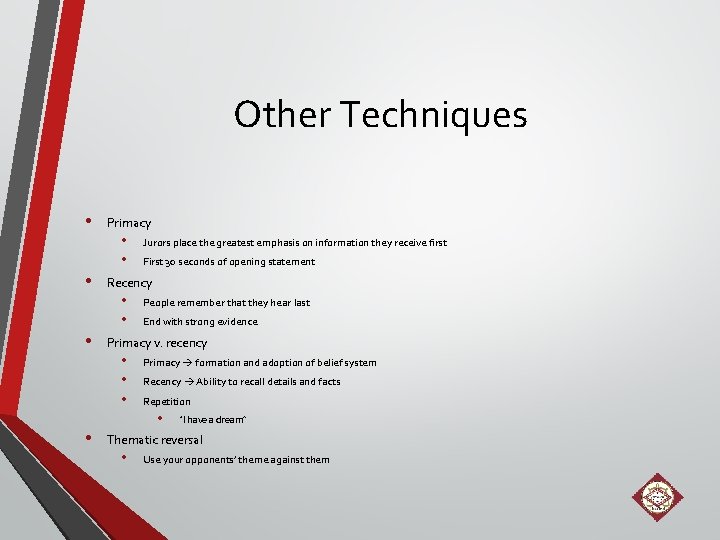
Other Techniques • Primacy • • • First 30 seconds of opening statement Recency • • • Jurors place the greatest emphasis on information they receive first People remember that they hear last End with strong evidence Primacy v. recency • • • Primacy formation and adoption of belief system Recency Ability to recall details and facts Repetition • • “I have a dream” Thematic reversal • Use your opponents’ theme against them