
Case Teaching Curriculum Prepared by Dr Scott Andrews
Case Teaching Curriculum Prepared by Dr Scott Andrews
The slides in this presentation are available for case tutors looking to develop their case teaching curriculum. They may also be of use to those who ‘train the trainers’ aiming to promote future case teaching programmes. The slides are segmented into seven sections, as explained in the accompanying notes.
SECTION A – What is the Case Method? There are many different definitions of what makes a case study, but this section unpacks what is meant by a management case study that can be used with a group of learners for in-class or remote learning purposes. The following slides can be used to provoke a conversation about ‘what is a case’ and ‘how does the case method promote learning. ’ 2
The Case Method can be described as… A student discussion of a planned sequence of cases, drawn from actual situations, with responsibility for analysis and conclusions about issues within the case resting with the students. The case “teacher’s” role is seen as one of guiding student discussion, rather than providing answers. The focus is on student learning through their own individual and joint efforts.
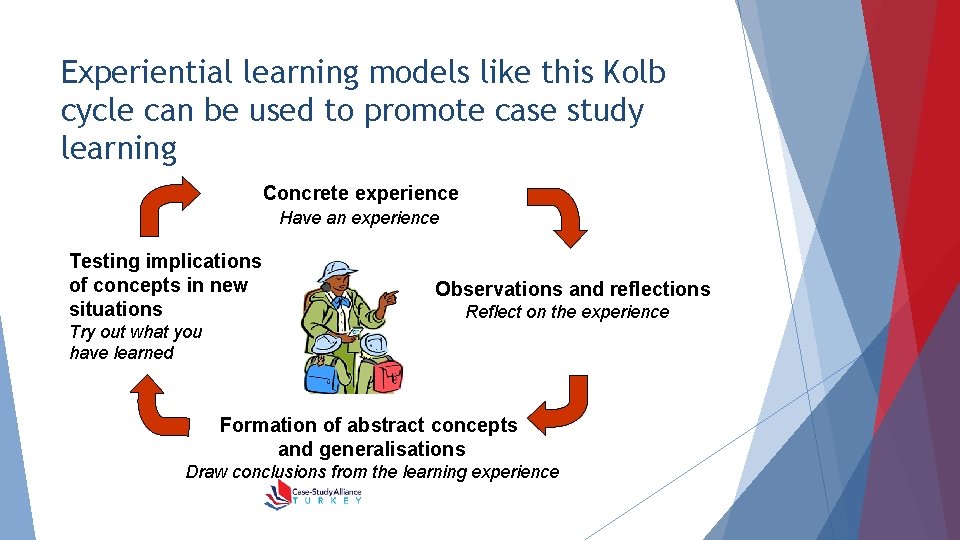
Experiential learning models like this Kolb cycle can be used to promote case study learning Concrete experience Have an experience Testing implications of concepts in new situations Try out what you have learned Observations and reflections Reflect on the experience Formation of abstract concepts and generalisations Draw conclusions from the learning experience
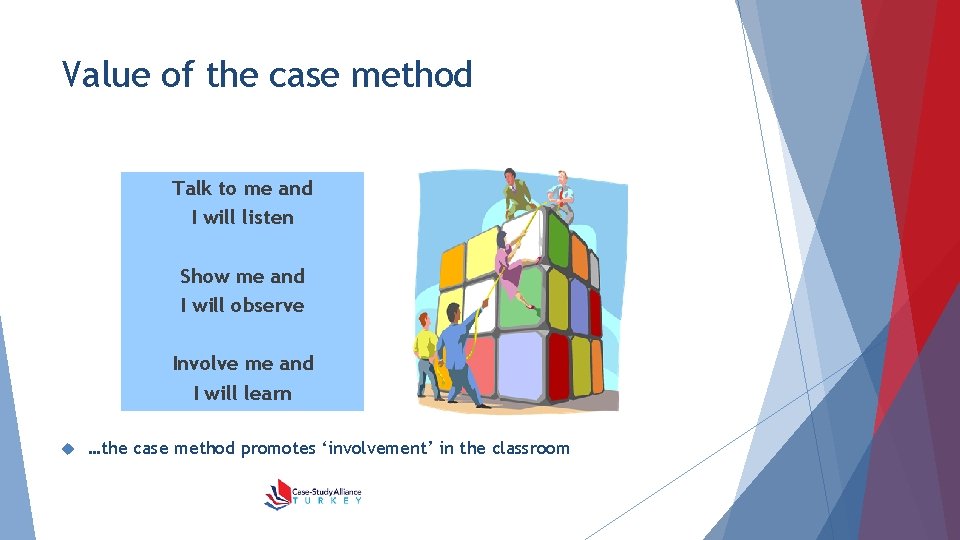
Value of the case method Talk to me and I will listen Show me and I will observe Involve me and I will learn …the case method promotes ‘involvement’ in the classroom
What do we mean by learning? If at the end of the session students. . know something they did not know before, or can do something (or do it better) than they could before, or have formed a view about something that they did not hold before then they have learned
Can the use of the case method promote learning? “ Where truth is relative, where reality is probabilistic and where structural relationships are contingent, teaching and learning are more effectively accomplished through discussion. With intrinsically complex phenomena, little of value can be communicated directly from teacher to student. The learning process must emphasize the development of understanding, judgment and even intuition. ” Thomas Clough - seminar participant, quoted in Barnes L. B. , Christensen C. R. , Hansen A. J. (1984)
Critical considerations Who is to do the learning What is to be learned How is it to be learned Where and under what circumstances is the learning to take place
Beliefs about how we learn – Can you add to this list…. ? We only learn what we are interested in learning Learning depends on wanting to learn We learn best when we are free to create our own response to a situation Learning depends on not knowing the answers We all learn in our own way Learning is largely an emotional experience To learn is to change adapted from J. Heath (1998)
Other benefits of the case method Provides a context within which to explore ideas, identify relationships, test theories, formulate hypotheses. Enables students to perceive their field of studies in a Facilitates deep, rather than surface learning. Develops higher level skills of synthesis, analysis, evaluation, judgement, problem solving, communication. Develops inter-personal skills, team-working. Increases involvement and motivation – a more enjoyable learning experience. broader context.

The case method is not the panacea to all teaching and learning problems. The following other factors need to be taken into consideration too: Specific learning objectives Student characteristics & perceptions Resources available Institutional climate / strategy / policies Staff skills perceptions, preferences
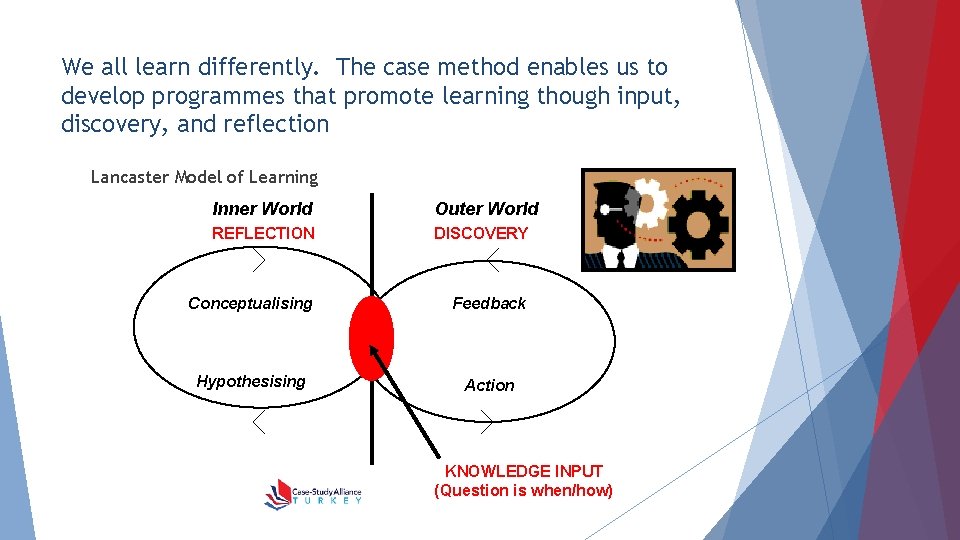
We all learn differently. The case method enables us to develop programmes that promote learning though input, discovery, and reflection Lancaster Model of Learning Inner World Outer World REFLECTION DISCOVERY Conceptualising Feedback Hypothesising Action KNOWLEDGE INPUT (Question is when/how)
Different ‘learning modes’ or alternative ‘learning loops’ enable us to devise three different pathways to learning: Input-discovery-reflection “Here is some data and a procedure. Apply the procedure to the data and come back with some conclusions. ” Input - reflection – discovery “Here is a theory. Let us think about how it might help us to develop a better understanding of what is happening in this situation and the circumstances in which it can be applied elsewhere. Then let us test it in another situation and discover its value in practice. ” adapted from J. Heath (1998)
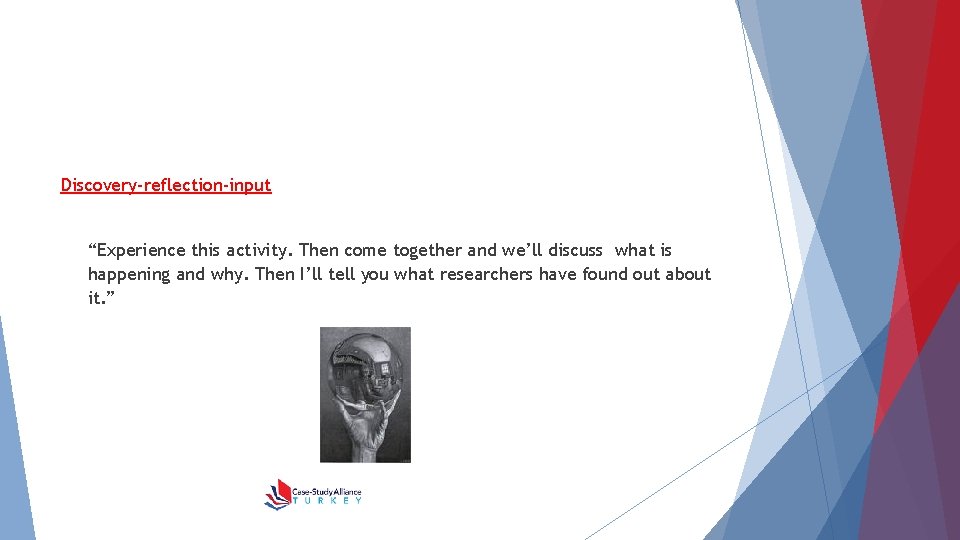
Discovery-reflection-input “Experience this activity. Then come together and we’ll discuss what is happening and why. Then I’ll tell you what researchers have found out about it. ”
So, what is a case study? A case study (or a case) is a description of a situation, or an account of a sequence of events, which raises issues for discussion and/or problems for analysis and solution. adapted from J. Heath (1998)
SECTION B – What makes a good case study learning session? Now that we have considered the case method and how it contributes to learning, it is worth considering whethere are some common principles of the case method that contribute to a good learning experience. Here are some suggestions, which include ideas generated by some well-established case users.
What are the features of a “good” case in your context? A good case is one that ………………. .
What makes a good case? Here are some suggestions from IMD, Switzerland It fulfils pedagogic objectives Tackles a relevant important issue Has a personal touch Provides currently useful generalisations • Has the data required to tackle the problem, but not too much • Is controversial • Is short • Is well-structured and easy to read Abell, D. , ECCHO, Fall 1997 Contains contrasts and comparisons
Here are some suggestions from RSM Rotterdam. A good case is…. A case, not just a story Situation-specific, fresh topic Relevant, important issue Objective, in perspective Broad enough to allow generalization Specific enough to allow thorough exploration Personal touch Provides contrasts, tensions, controversy, or other dramatic elements Includes layers (immediate and root issues) Well-structured and easy to read
SECTION C – What are the different types of case study and how are they classified? There are different kinds of case study that can be used in different contexts to test different skills and evoke different contributions from the learners. The following slides examine three different ways of classifying case studies.
Case Classification There are three ways to classify cases: 1. Types of case – content 2. Mode of treatment of the case data 3. Presentational formatting
1. Types of cases Incident case Background case Exercise case Situation case Complex case Decision case Further definitions of these types of cases can be found in the CAT Case Teaching Coursebook (http: //cat. ba. metu. edu. tr/en/system/files/case_teaching_coursebook_0. pdf)
2. Mode of Treatment of Case Data Is the case based on ‘field’ or ‘desk’ research? Is it simple or complex, long or short? Is there a single issue or are there multiple issues? Does the case promote issue raising, problem solving, problem identification, or decision making? What perspective or level of management is presented? Does this enable an inductive or deductive approach to learning (theory applied or theory generated)? Is the data organised to promote a divergent or convergent approach to learning?
3. Case Presentational Format As a single case or in bite-size pieces? Chicken and egg case Sequential case Case with multiple decision making options Are there additional materials to enhance learning? Is there a well-developed teaching note/case map What media format…… Paper based Video based Web based Interactive CD-ROM/App
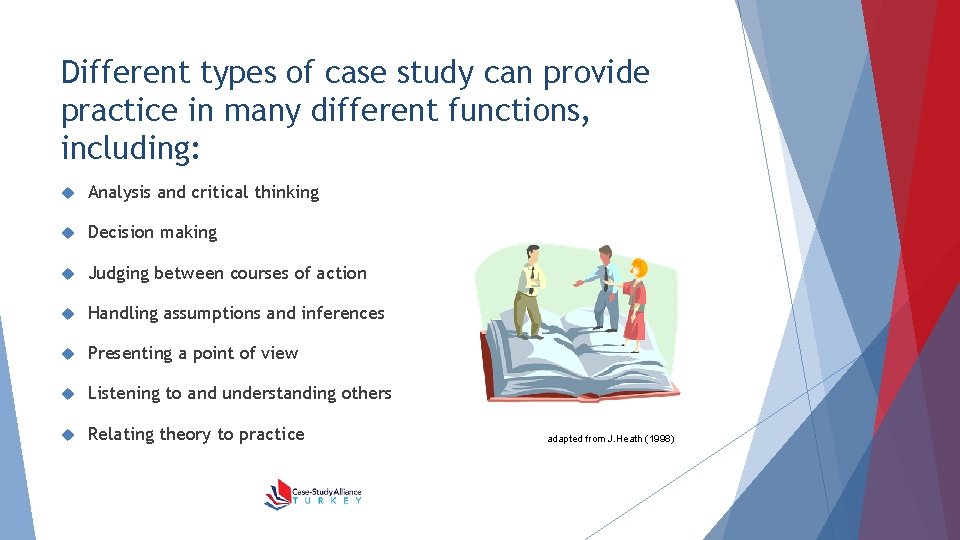
Different types of case study can provide practice in many different functions, including: Analysis and critical thinking Decision making Judging between courses of action Handling assumptions and inferences Presenting a point of view Listening to and understanding others Relating theory to practice adapted from J. Heath (1998)
SECTION D – What different roles and functions does the case tutor play? Now that we have looked at the different types and uses of the case method, it is important to consider what different roles the case tutor should and should not employ in the classroom. Remember, a case tutor is there to ‘facilitate learning, ’ not to teach or to control classroom delivery. The following slides examine different functions of the case tutor.
Roles of the instructor Timekeeper Recorder of discussions Summariser of group discussion Establisher of group consensus And, very importantly, someone who shows enthusiasm, has a sense of humour, is approachable, articulate, inspiring
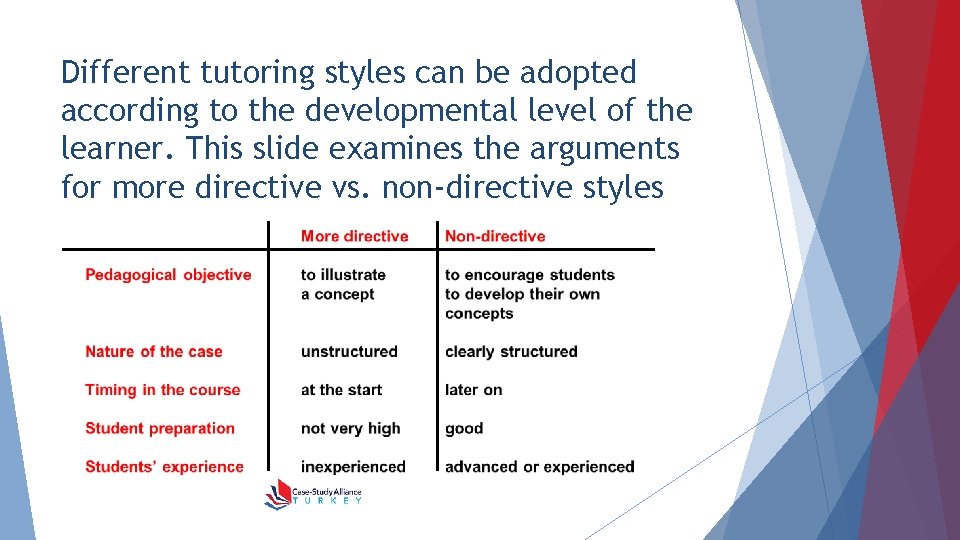
Different tutoring styles can be adopted according to the developmental level of the learner. This slide examines the arguments for more directive vs. non-directive styles
Do’s and Don’ts for Case Tutors Do’s Don’ts Preparation Make sudden changes Present the message Be repetitive Listen Waste time Keep open mind Be unfair Previous experience Be provocative yet constructive Always Bring in further resources Summarise or invite summaries Respect your participants – their background, behaviour, and dignity Stick to the points Smile Evaluate, monitor, and review
SECTION E – Developing a case teaching plan Now that we have looked at the different roles of case tutors, it’s time to think about case preparation. Classroom preparation is essential. The first thing a class of students can spot is an ill-prepared tutor. The following slides consider the types of different things you could consider before embarking on the class case discussion.
It often helps to explore a pre-study meeting with students to set out the guidelines for a healthy case session: Are the students there to ‘learn’ or to be ‘taught’? Discuss the art of learning Explore the Lancaster model Invite initial feedback Setting the ground rules Try out a short ‘warm-up’ case
Consider devising a case map, which should include the following: A framework for the journey The starting point – what do the students bring into the classroom The destination – key learning objective Interesting visiting points (analysis) Directions – carefully crafted questions The following slide provides a suggested template for a case map.
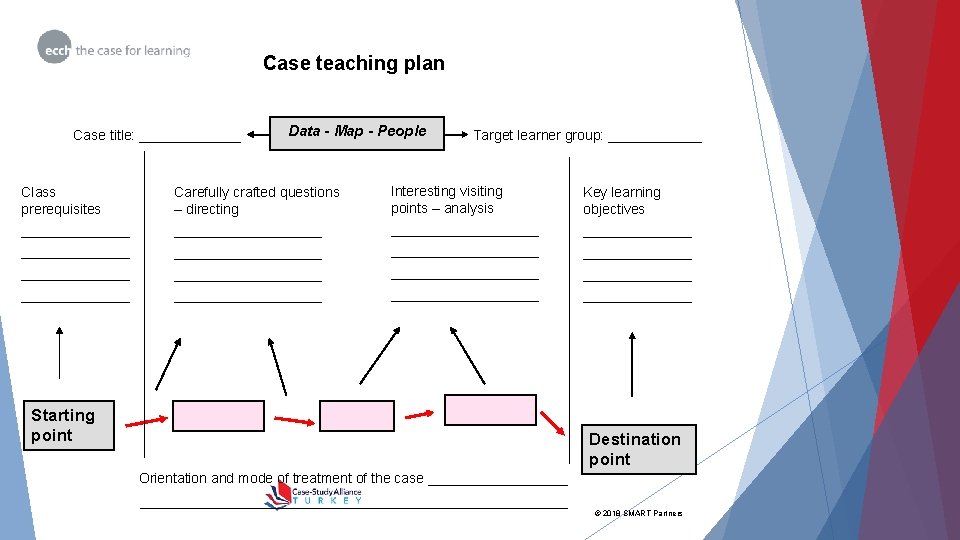
Case teaching plan Case title: _______ Data - Map - People Target learner group: ______ Class prerequisites _______ Carefully crafted questions – directing __________ Interesting visiting points – analysis __________ Key learning objectives ______________ ___________________ _____________________ Starting point Destination point Orientation and mode of treatment of the case _____________________________________ © 2018 SMART Partners
SECTION F – The case discussion Now that you have completed your preparation, here are some thoughts about guiding the case discussion and capturing your own reflections afterwards.
Case ‘teaching’ is about Guiding a process of discovery with: Well-crafted questions Sensitive learning Constructive responses Adapted from J Heath (1998)
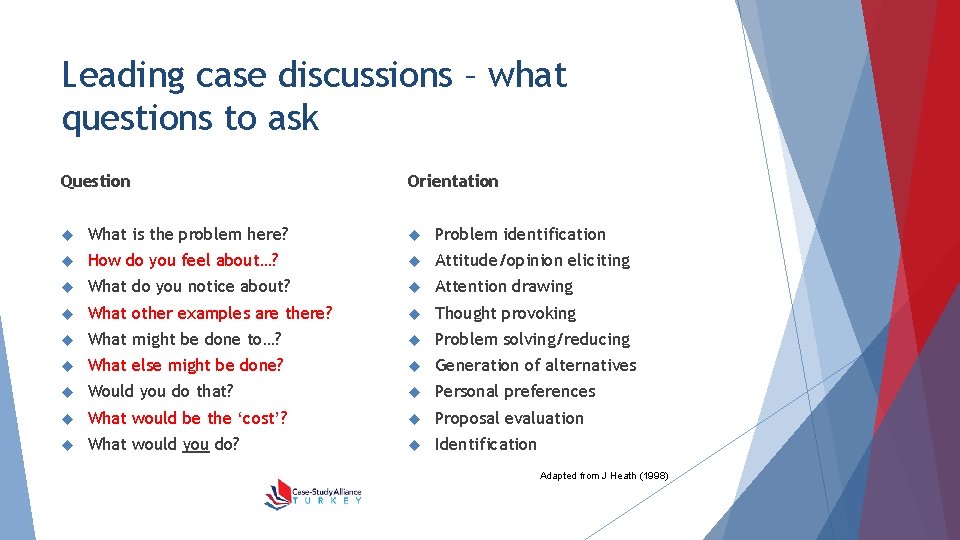
Leading case discussions – what questions to ask Question Orientation What is the problem here? Problem identification How do you feel about…? Attitude/opinion eliciting What do you notice about? Attention drawing What other examples are there? Thought provoking What might be done to…? Problem solving/reducing What else might be done? Generation of alternatives Would you do that? Personal preferences What would be the ‘cost’? Proposal evaluation What would you do? Identification Adapted from J Heath (1998)
Questions that test analytical support for contributions Could you explain the reasoning behind your idea? What evidence did you use to determine that? Is there data to support ……………’s idea? Could you tell us what assumptions you made to proceed with your analysis? Can you see anything we have left out? I’m interested in knowing how you determined that.
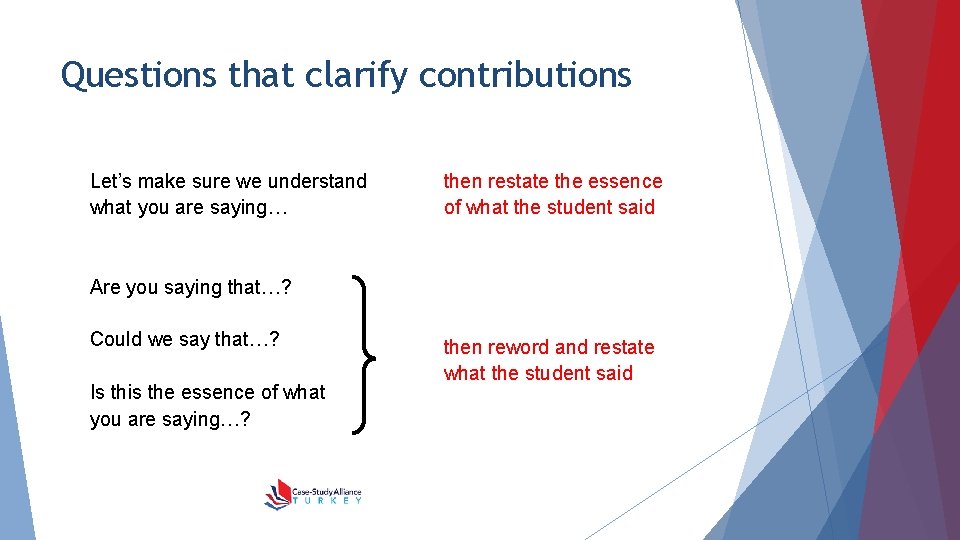
Questions that clarify contributions Let’s make sure we understand what you are saying… then restate the essence of what the student said Are you saying that…? Could we say that…? Is this the essence of what you are saying…? then reword and restate what the student said
Ideas about how to evaluate the case discussion: Wrapping it up: “How else could we approach this? ” “What else could we explore? ” “On a single sheet of paper…. ” “On a rating scale…. ” Written response submitted Tutor feedback to response (annotating)
Reflection is also achieved through feedback - giving and receiving Before, during, and after the case study Offering a choice of cases Through a questionnaire/survey E-mail discussion groups What are you evaluating? How helpful is the feedback?
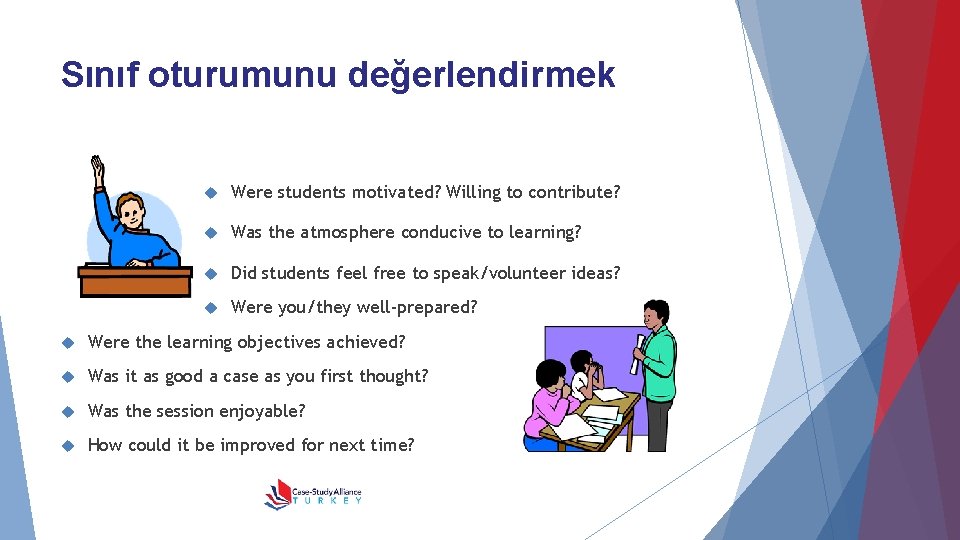
Sınıf oturumunu değerlendirmek Were students motivated? Willing to contribute? Was the atmosphere conducive to learning? Did students feel free to speak/volunteer ideas? Were you/they well-prepared? Were the learning objectives achieved? Was it as good a case as you first thought? Was the session enjoyable? How could it be improved for next time?
Vaka hazırlığı - bir liste Who are the students? What is the purpose of the case? Master the facts Cross-reference personal plan to the teaching note Does the case have any traps? What are the lead questions that will help the class make progress? Are there any intermediate issues that must be tackled before we can get to the end? What will be the best springboards to provoke thought/controversy? At what point and how will it be best to deal with the number-crunching?
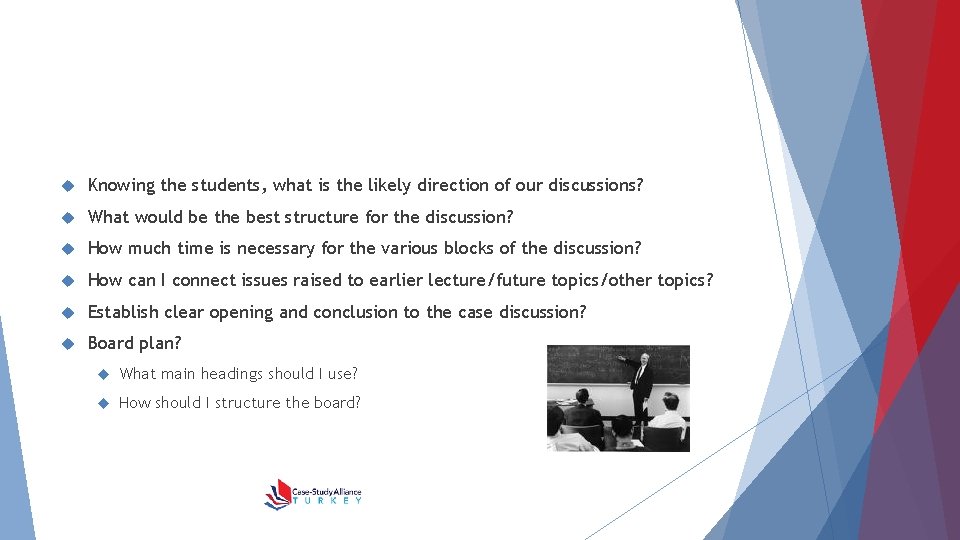
Knowing the students, what is the likely direction of our discussions? What would be the best structure for the discussion? How much time is necessary for the various blocks of the discussion? How can I connect issues raised to earlier lecture/future topics/other topics? Establish clear opening and conclusion to the case discussion? Board plan? What main headings should I use? How should I structure the board?
How have you developed a case teaching plan in the past? Here are some questions to reflect on: What has been the starting point for developing the teaching plan? What was the hardest aspect of case mapping and why? How does case mapping affect my scoring for the case? What would I do differently next time? What has this taught me about the case map?
SECTION G – Using cases for assessment This final section explores how the case method can be used as an assessment tool, whether this is in-class, during the discussion, or as an examination case. The following slides provide some ideas and raise questions for consideration when selecting and implementing cases for assessment purposes.
Cases For Assessment – things to consider…. Learning objectives Type of case Size/format Contribution to learning How to assess? verbal contribution written contribution Feedback Use for examinations: • Size • To preview or not? • Expectation of the student • Marking: • what to mark? how to mark? • the contribution to learning • feedback
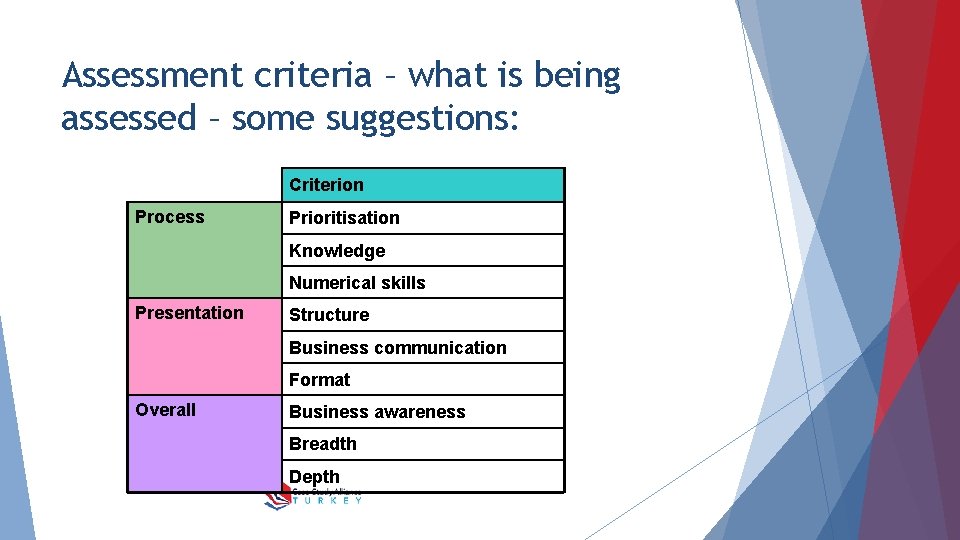
Assessment criteria – what is being assessed – some suggestions: Criterion Process Prioritisation Knowledge Numerical skills Presentation Structure Business communication Format Overall Business awareness Breadth Depth
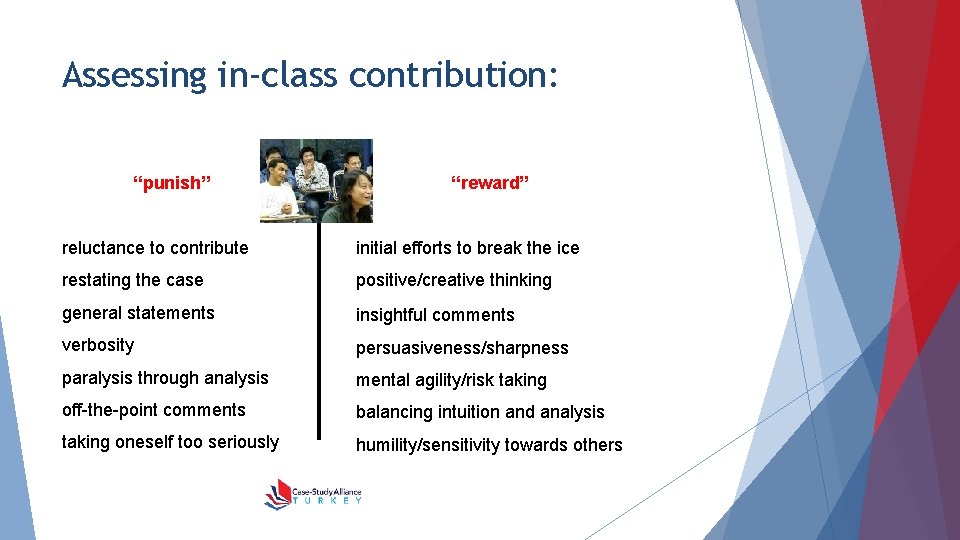
Assessing in-class contribution: “punish” “reward” reluctance to contribute initial efforts to break the ice restating the case positive/creative thinking general statements insightful comments verbosity persuasiveness/sharpness paralysis through analysis mental agility/risk taking off-the-point comments balancing intuition and analysis taking oneself too seriously humility/sensitivity towards others
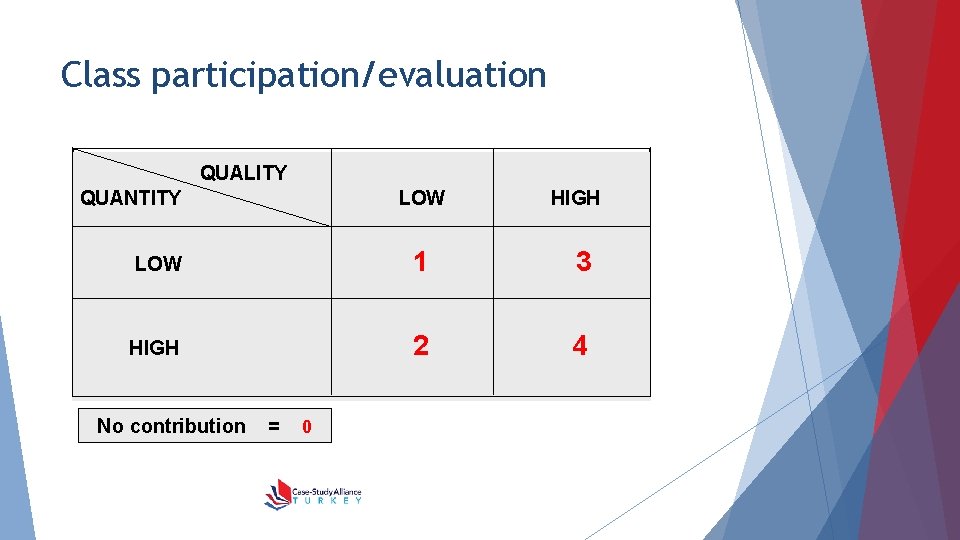
Class participation/evaluation QUALITY QUANTITY LOW HIGH LOW 1 3 HIGH 2 4 No contribution = 0
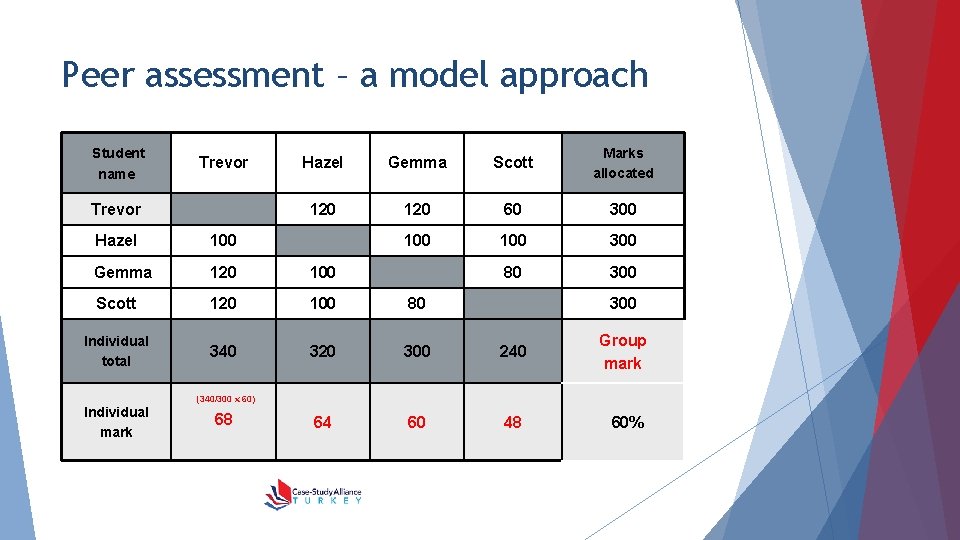
Peer assessment – a model approach Student name Trevor Hazel Gemma Scott Marks allocated 120 60 300 100 300 80 300 Hazel 100 Gemma 120 100 Scott 120 100 80 Individual total 340 320 300 240 Group mark 64 60 48 60% 300 (340/300 x 60) Individual mark 68
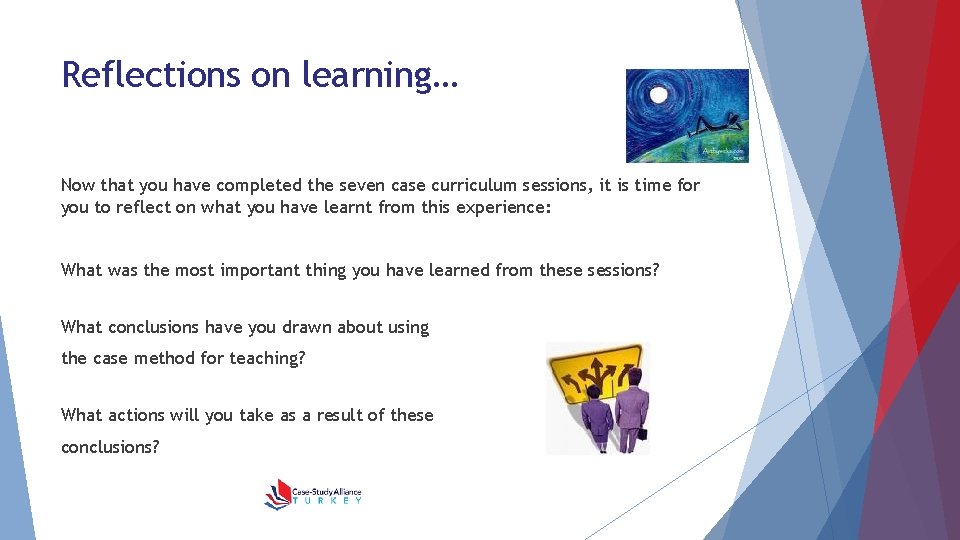
Reflections on learning… Now that you have completed the seven case curriculum sessions, it is time for you to reflect on what you have learnt from this experience: What was the most important thing you have learned from these sessions? What conclusions have you drawn about using the case method for teaching? What actions will you take as a result of these conclusions?

Leading Contributor:
- Slides: 53