
Case study on the higher Education Colleges Association

- Slides: 21
Case study on the higher Education Colleges Association (HECA) Academic Quality Enhancement Forum: collaborative efforts to interpret, adapt and implement the national professional development Ruth Ní Bheoláin, HECA Academic Quality Enhancement Forum
@HECA_IRL @ruthnibheolain Case Study on the HECA Academic Quality Enhancement Forum: Collaborative efforts to interpret, adapt and implement the National Professional Development Framework Ruth Ní Bheoláin (HAQEF Chair, presenter), Edel Gavan, Lorraine Halpin, Ronnie Harrison, Ann King, Jack Leahy, David Mc. Carthy, Aine O'Reilly, Patricia O’Sullivan, Justin Smyth, Greg South
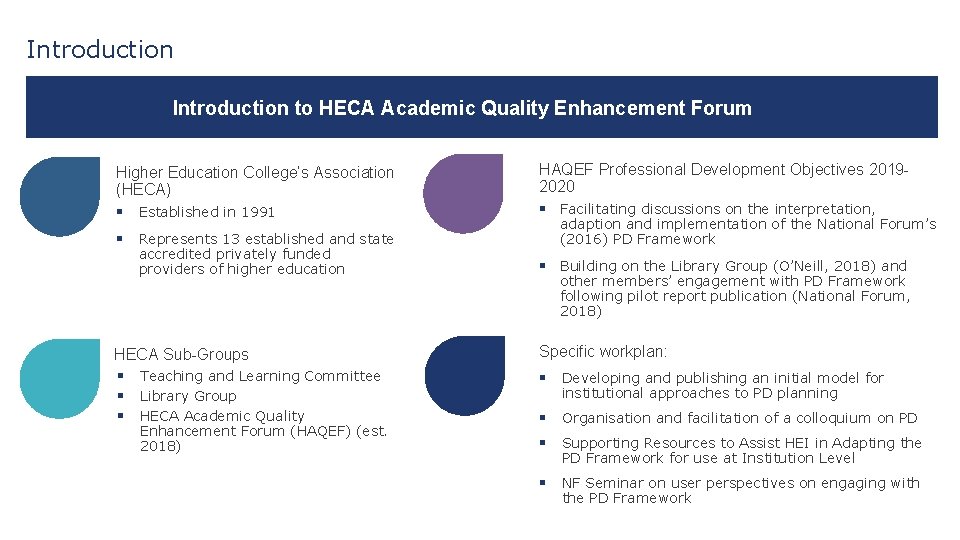
Introduction to HECA Academic Quality Enhancement Forum Higher Education College’s Association (HECA) § Established in 1991 § Represents 13 established and state accredited privately funded providers of higher education HECA Sub-Groups § Teaching and Learning Committee § Library Group § HECA Academic Quality Enhancement Forum (HAQEF) (est. 2018) HAQEF Professional Development Objectives 20192020 § Facilitating discussions on the interpretation, adaption and implementation of the National Forum’s (2016) PD Framework § Building on the Library Group (O’Neill, 2018) and other members’ engagement with PD Framework following pilot report publication (National Forum, 2018) Specific workplan: § Developing and publishing an initial model for institutional approaches to PD planning § Organisation and facilitation of a colloquium on PD § Supporting Resources to Assist HEI in Adapting the PD Framework for use at Institution Level § NF Seminar on user perspectives on engaging with the PD Framework
“All those who teach” Inclusive Institutional Approaches to Professional Development Planning
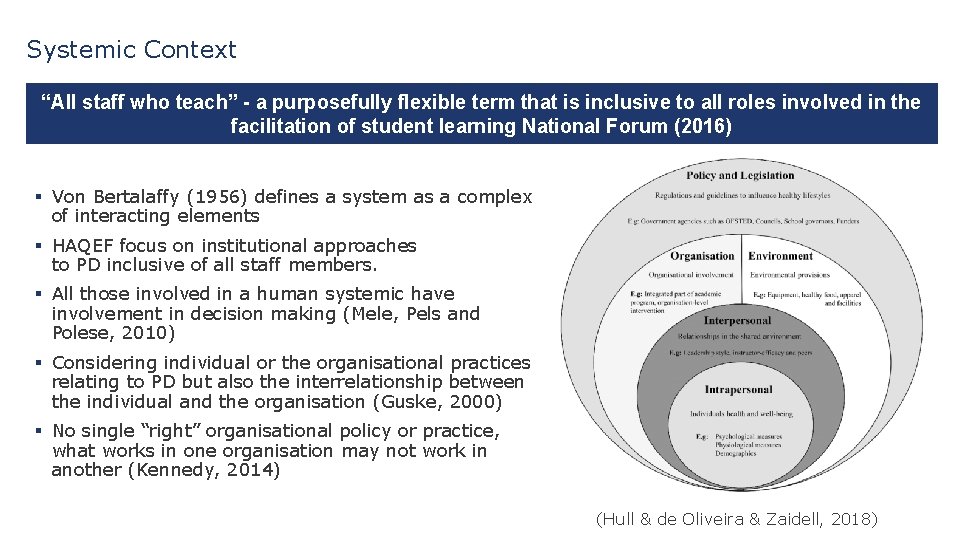
Systemic Context “All staff who teach” - a purposefully flexible term that is inclusive to all roles involved in the facilitation of student learning National Forum (2016) § Von Bertalaffy (1956) defines a system as a complex of interacting elements § HAQEF focus on institutional approaches to PD inclusive of all staff members. § All those involved in a human systemic have involvement in decision making (Mele, Pels and Polese, 2010) § Considering individual or the organisational practices relating to PD but also the interrelationship between the individual and the organisation (Guske, 2000) § No single “right” organisational policy or practice, what works in one organisation may not work in another (Kennedy, 2014) (Hull & de Oliveira & Zaidell, 2018)
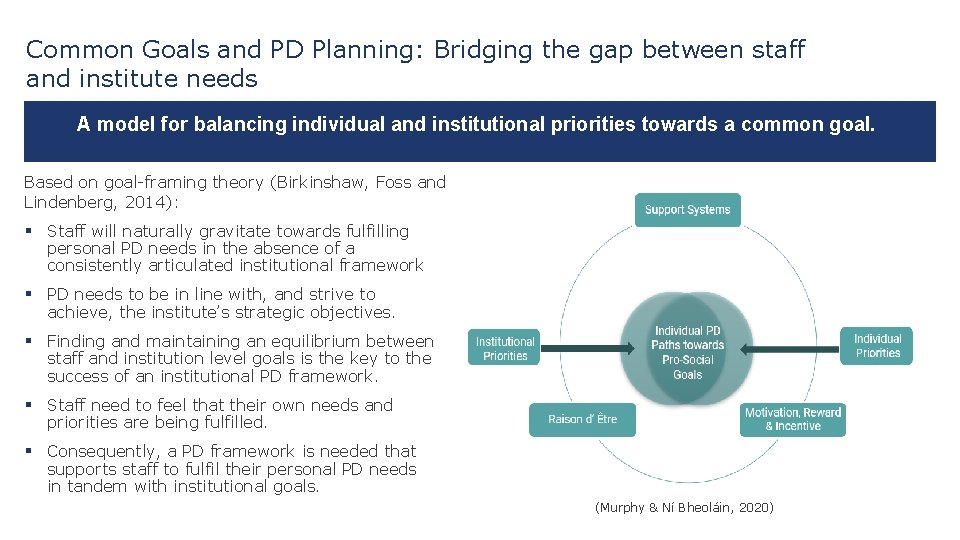
Common Goals and PD Planning: Bridging the gap between staff and institute needs A model for balancing individual and institutional priorities towards a common goal. Based on goal-framing theory (Birkinshaw, Foss and Lindenberg, 2014): § Staff will naturally gravitate towards fulfilling personal PD needs in the absence of a consistently articulated institutional framework § PD needs to be in line with, and strive to achieve, the institute’s strategic objectives. § Finding and maintaining an equilibrium between staff and institution level goals is the key to the success of an institutional PD framework. § Staff need to feel that their own needs and priorities are being fulfilled. § Consequently, a PD framework is needed that supports staff to fulfil their personal PD needs in tandem with institutional goals. (Murphy & Ní Bheoláin, 2020)
Professional Development Colloquium
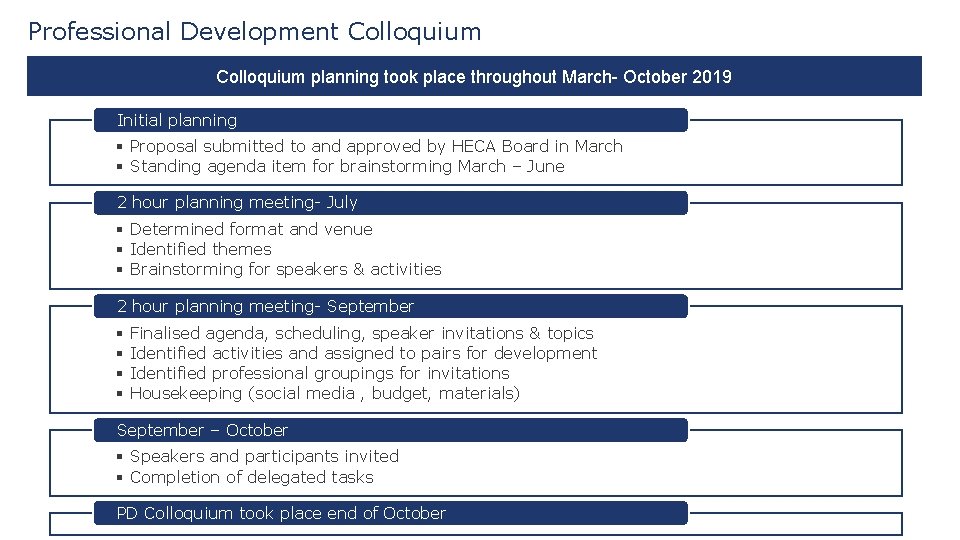
Professional Development Colloquium planning took place throughout March- October 2019 Initial planning § Proposal submitted to and approved by HECA Board in March § Standing agenda item for brainstorming March – June 2 hour planning meeting- July § Determined format and venue § Identified themes § Brainstorming for speakers & activities 2 hour planning meeting- September § § Finalised agenda, scheduling, speaker invitations & topics Identified activities and assigned to pairs for development Identified professional groupings for invitations Housekeeping (social media , budget, materials) September – October § Speakers and participants invited § Completion of delegated tasks PD Colloquium took place end of October
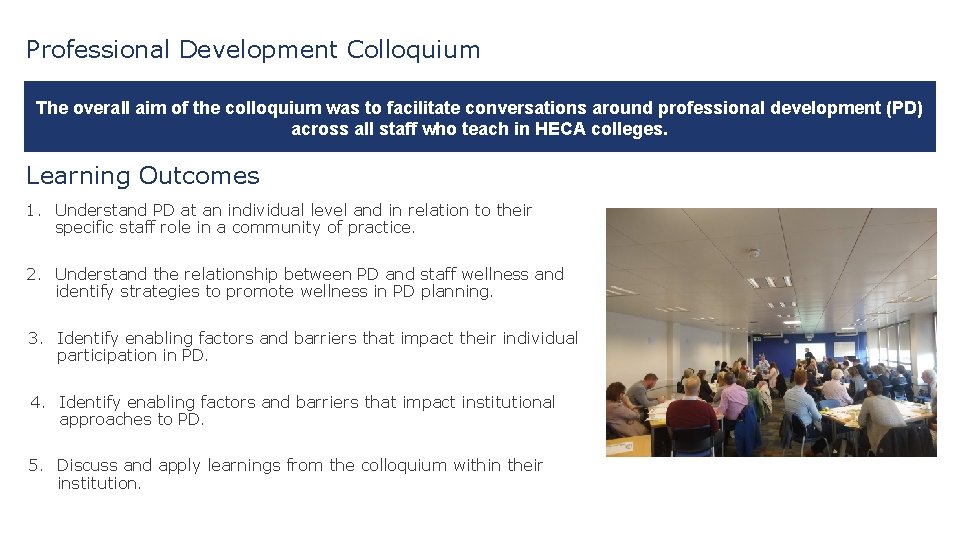
Professional Development Colloquium The overall aim of the colloquium was to facilitate conversations around professional development (PD) across all staff who teach in HECA colleges. Learning Outcomes 1. Understand PD at an individual level and in relation to their specific staff role in a community of practice. 2. Understand the relationship between PD and staff wellness and identify strategies to promote wellness in PD planning. 3. Identify enabling factors and barriers that impact their individual participation in PD. 4. Identify enabling factors and barriers that impact institutional approaches to PD. 5. Discuss and apply learnings from the colloquium within their institution.
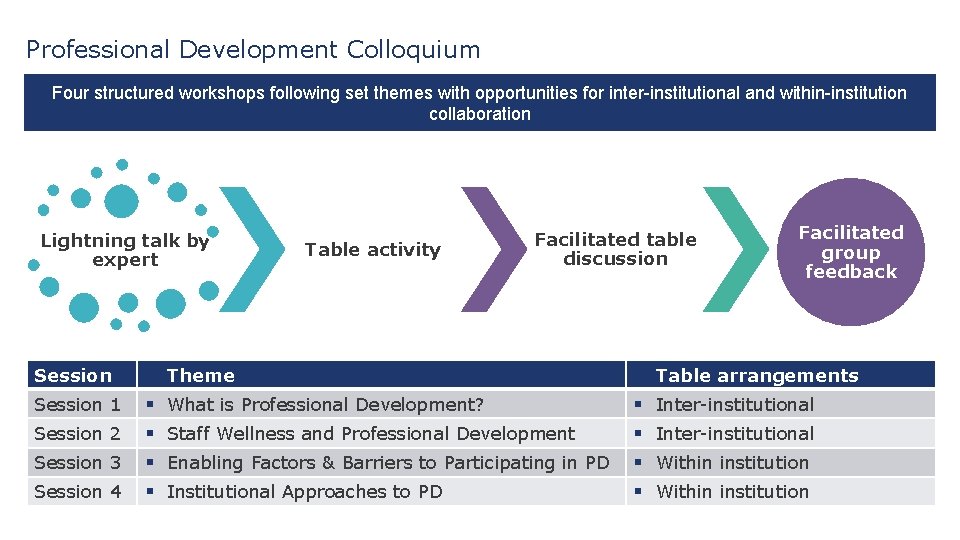
Professional Development Colloquium Four structured workshops following set themes with opportunities for inter-institutional and within-institution collaboration Lightning talk by expert Session 1 Session 2 Session 3 Session 4 § § § Table activity Facilitated table discussion Theme What is Professional Development? Staff Wellness and Professional Development Enabling Factors & Barriers to Participating in PD Institutional Approaches to PD § § § Facilitated group feedback Table arrangements Inter-institutional Within institution
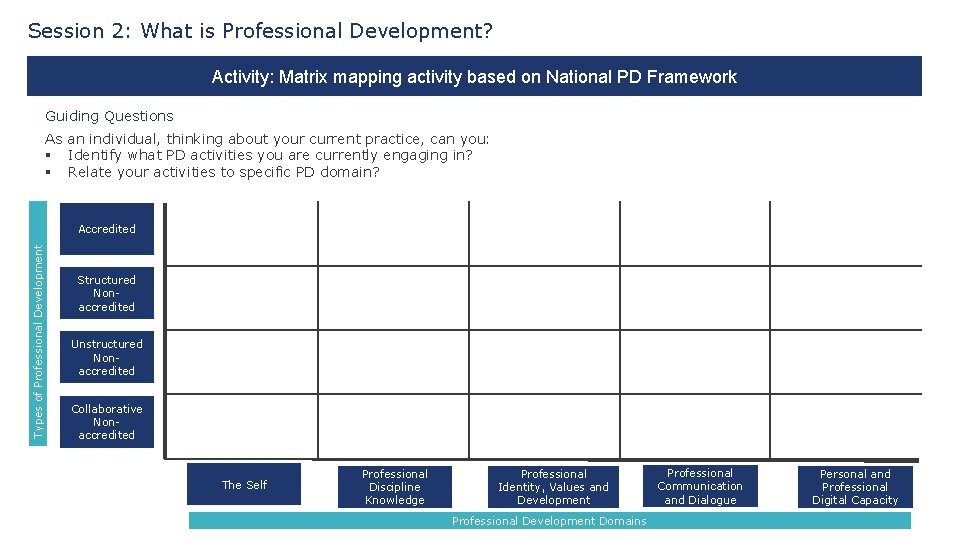
Session 2: What is Professional Development? Activity: Matrix mapping activity based on National PD Framework Guiding Questions As an individual, thinking about your current practice, can you: § Identify what PD activities you are currently engaging in? § Relate your activities to specific PD domain? Types of Professional Development Accredited Structured Nonaccredited Unstructured Nonaccredited Collaborative Nonaccredited The Self Professional Discipline Knowledge Professional Identity, Values and Development Professional Development Domains Professional Communication and Dialogue Personal and Professional Digital Capacity
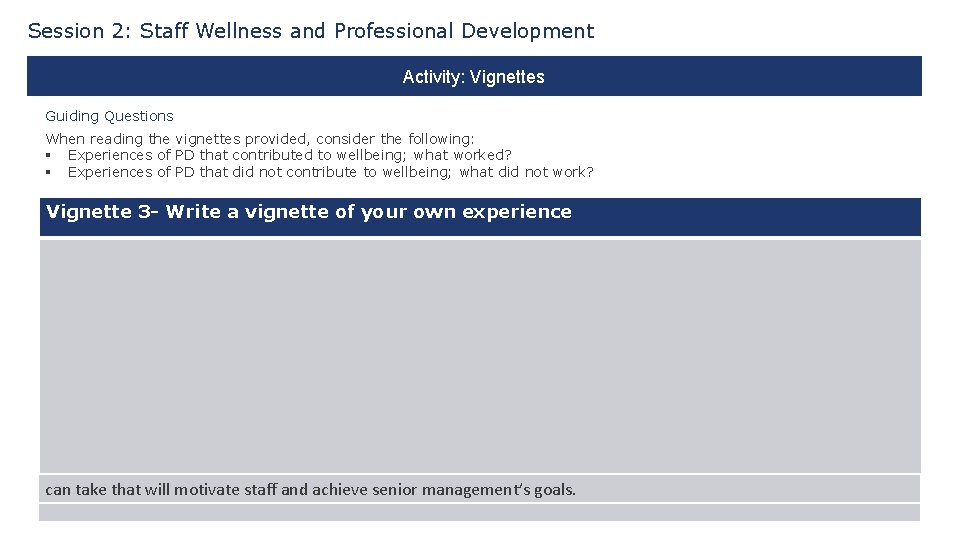
Session 2: Staff Wellness and Professional Development Activity: Vignettes Guiding Questions When reading the vignettes provided, consider the following: § Experiences of PD that contributed to wellbeing; what worked? § Experiences of PD that did not contribute to wellbeing; what did not work? 3 - Reflecting Write a vignette of wellness your ownand experience Vignette 2 on staff professional development: 1 Brian hasisrecently been appointed in a Staff Support unitis in a busy institution. primary develop a. There Michelle a busy programme administrator. Her inbox never empty and she. His spends halfproject her lifeisintomeetings! professional for all staff. done. At times, she can feel stressed and overwhelmed and has never seems development to be enough programme time to get everything Since starting, manyare staff have stopped Brian in. Often the hallway or takes chatted in the kitchen the up difficulties they are noticed her clothes getting a little snugger! Michelle a very short lunchabout to catch on important experiencing. Administrators complain that academic staff don’t follow processes and academics say there is too much educational twitter posts. red tape. Staff are worried that a professional development programme will mean more work on their desk and no Her department manager has offered her a range of opportunities for professional learning but she is too busy to take individual benefit. time out to avail of these opportunities. Senior management have a specific set of goals they want the professional development structure to achieve. There is A learn-at-lunch program was recently started in her workplace to supplement employee training for work and nona small budget for training but there is a willingness to allow staff to take time to participate in training within and work-related topics. outside the college, as long as it is relevant. Her workplace is also raising money for the Make a Wish Foundation as part of their corporate social responsibility. To When Brian tries to get formal feedback, there is very little engagement. Heand is worried theresessions is no approach aid fundraising some staff are completing the mini-marathon later this year runningthat training at lunchheand can that will motivate staff and achieve senior management’s goals. aftertake work.
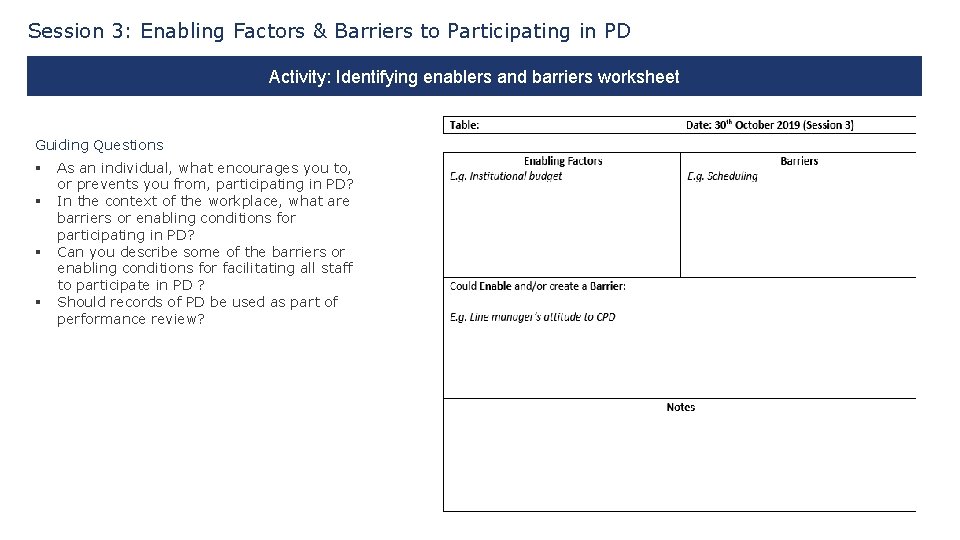
Session 3: Enabling Factors & Barriers to Participating in PD Activity: Identifying enablers and barriers worksheet Guiding Questions § § As an individual, what encourages you to, or prevents you from, participating in PD? In the context of the workplace, what are barriers or enabling conditions for participating in PD? Can you describe some of the barriers or enabling conditions for facilitating all staff to participate in PD ? Should records of PD be used as part of performance review?
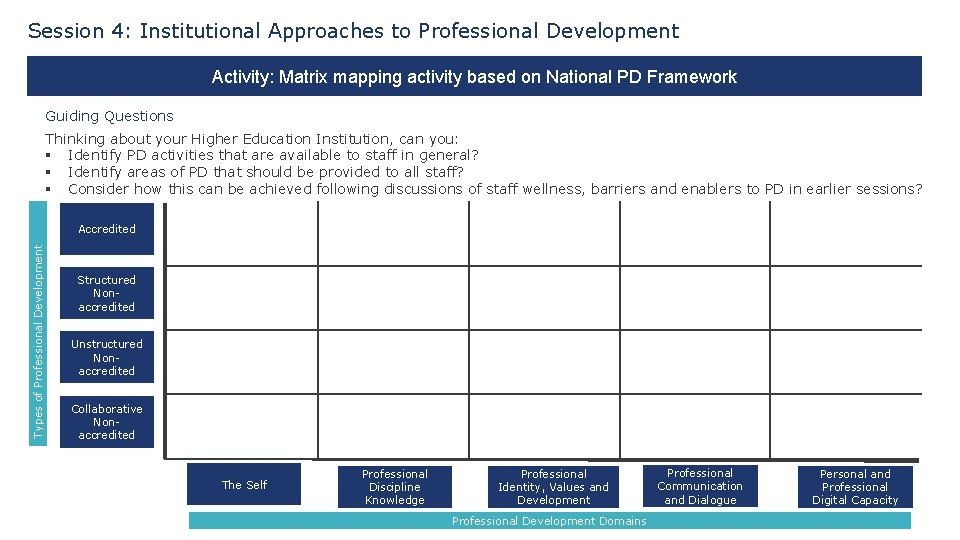
Session 4: Institutional Approaches to Professional Development Activity: Matrix mapping activity based on National PD Framework Guiding Questions Thinking about your Higher Education Institution, can you: § Identify PD activities that are available to staff in general? § Identify areas of PD that should be provided to all staff? § Consider how this can be achieved following discussions of staff wellness, barriers and enablers to PD in earlier sessions? Types of Professional Development Accredited Structured Nonaccredited Unstructured Nonaccredited Collaborative Nonaccredited The Self Professional Discipline Knowledge Professional Identity, Values and Development Professional Development Domains Professional Communication and Dialogue Personal and Professional Digital Capacity
HAQEF Planned Activities and Future Work
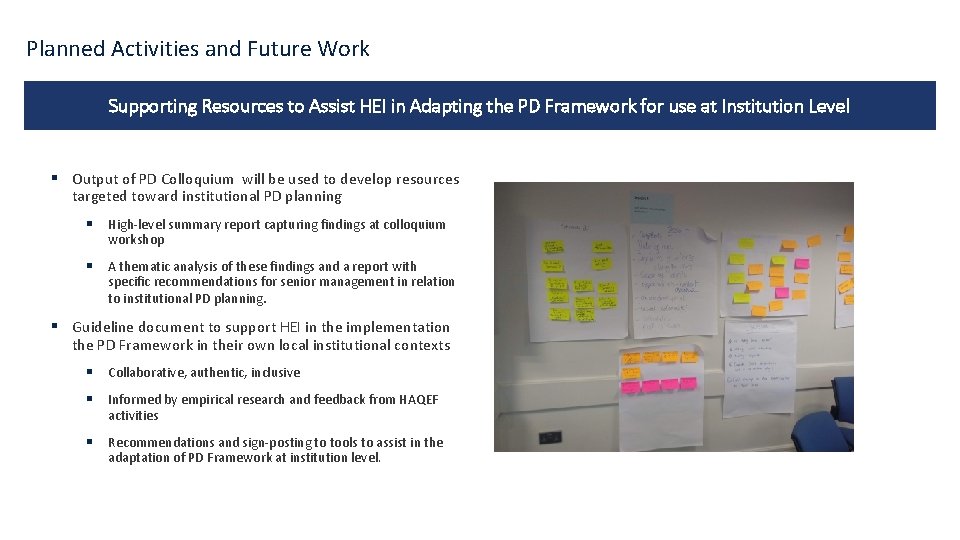
Planned Activities and Future Work Supporting Resources to Assist HEI in Adapting the PD Framework for use at Institution Level § Output of PD Colloquium will be used to develop resources targeted toward institutional PD planning § High-level summary report capturing findings at colloquium workshop § A thematic analysis of these findings and a report with specific recommendations for senior management in relation to institutional PD planning. § Guideline document to support HEI in the implementation the PD Framework in their own local institutional contexts § Collaborative, authentic, inclusive § Informed by empirical research and feedback from HAQEF activities § Recommendations and sign-posting to tools to assist in the adaptation of PD Framework at institution level.
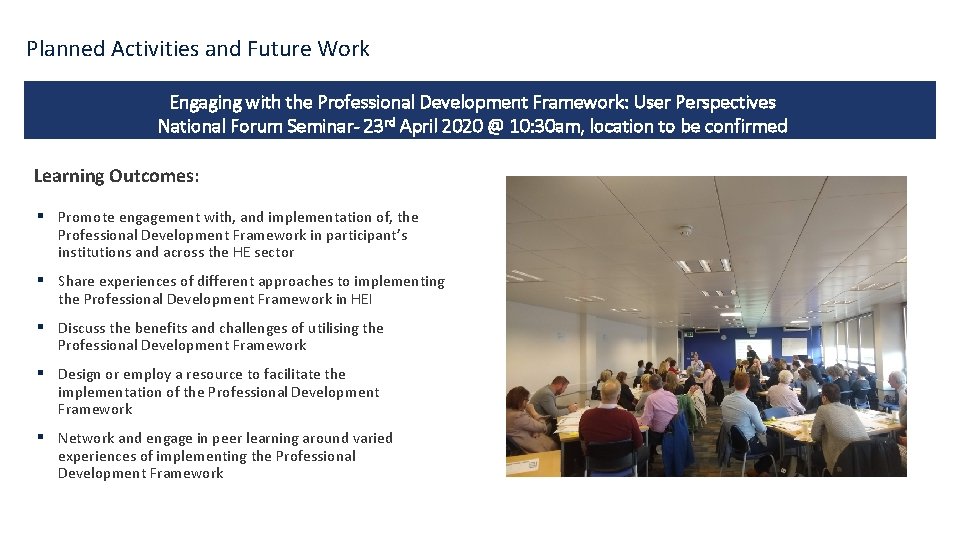
Planned Activities and Future Work Engaging with the Professional Development Framework: User Perspectives National Forum Seminar- 23 rd April 2020 @ 10: 30 am, location to be confirmed Learning Outcomes: § Promote engagement with, and implementation of, the Professional Development Framework in participant’s institutions and across the HE sector § Share experiences of different approaches to implementing the Professional Development Framework in HEI § Discuss the benefits and challenges of utilising the Professional Development Framework § Design or employ a resource to facilitate the implementation of the Professional Development Framework § Network and engage in peer learning around varied experiences of implementing the Professional Development Framework
References
References § Birkinshaw, J. , Foss, N. J. , & Lindenberg, S. (2014). Combining purpose with profits. MIT Sloan Management Review, 55(3), 49. § Guskey, T. R. (2000). Evaluating professional development. Thousand Oaks, CA Corwin Press. § Hull, R. & de Oliveira, R. & Zaidell, L. (2018). An Ecological Approach to Exploring Physical Activity Interventions Aimed at Young UK-Based Females: A Narrative Systematic Review. Psychology. 09. 2795 -2823. 10. 4236/psych. 2018. 914161. § Kennedy, A. (2014). Understanding continuing professional development: the need for theory to impact on policy and practice, Professional Development in Education, 40: 5, 688 -697, DOI: 10. 1080/19415257. 2014. 955122 § Mele, C. , Pels, J. and Polese, F. (2010) A Brief Review of Systems Theories and Their Managerial Applications. Service Science 2(1 -2): 126 -135. https: //doi. org/10. 1287/serv. 2. 1_2. 126
References § Murphy, T. & Ní Bheoláin R. (2020). ommon Goals and PD Planning: Bridging the gap between staff and institute needs. Ireland’s Yearbook of Education. Dublin: Education Matters. § National Forum for the Enhancement of Teaching and Learning. (2016). National PD framework for all staff who teach in higher education. Dublin: National Forum § National Forum for the Enhancement of Teaching and Learning. (2018). Ireland’s national PD framework summary findings from the initial implementation. Dublin: National Forum § O’Neill, M. (2019). Breaking Barriers: CPD for the 21 st Century Academic Librarian. Dublin: National Forum § Von Bertalanffy, L. (1956). General system theory. General systems, 1(1), 11 -17.
Thank you!