
Case study on assembling and assessing AOP information
Case study on assembling and assessing AOP information: Alkylation of DNA leading to heritable genetic effects Carole L. Yauk Environmental Health Science and Research Bureau Health Canada Ottawa, ON Carole. Yauk@canada. ca

Outline • • Review - MIE, KE, AO, KERs and the AOP Introduction and background relevant to case study AOP Selection and summary of events Summary of weight of evidence for key event relationships • Biological plausibility, empirical support, uncertainties/inconsistencies • Assessment of overall weight of evidence • Biological plausibility, empirical support, essentiality • Conclusions

What are AOPs? Aromatase Inhibition Granulosa Reduced E 2 synthesis Plasma Reduced circulating E 2 Hepatocyte Reduced VTG production Ovary Impaired Oocyte Dev. Female Decreased ovulation/spawn Population Declining Trajectory An Adverse Outcome Pathway (AOP) is a conceptual framework that portrays existing knowledge concerning the linkage between a direct molecular initiating event and an adverse outcome, at a level of biological organization relevant to risk assessment (Ankley et al. 2010, Environ. Toxicol. Chem. , 29(3): 730 -741. ) • A way to organize information • Based on biological plausibility and/or statistical inference • A hypothesis and a set of measurements we can make to test that hypothesis • Events span levels of biological organisation relevant to risk assessment (e. g. , molecular, cellular, tissue/organ, organism and/or population).

Five Principles of AOP Development 1. AOPs are not chemical specific 2. AOPs are modular 3. Individual AOPs are a pragmatic simplification of biology 4. AOP networks are the functional unit of prediction (in most cases) 5. AOPs are “living” documents
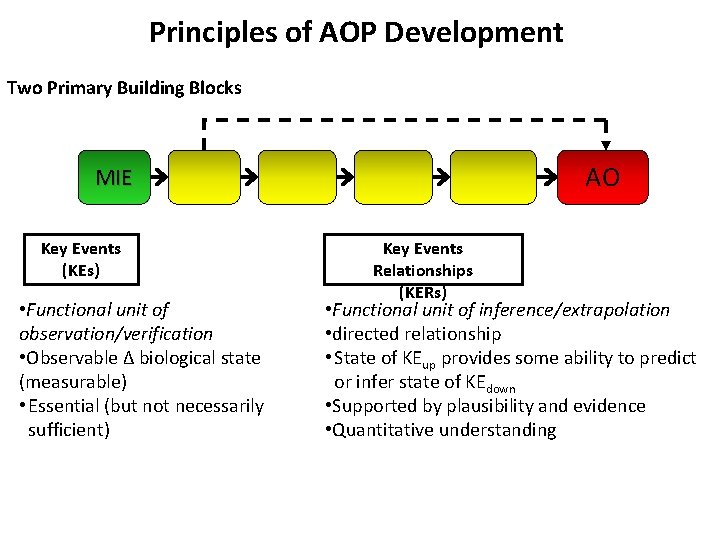
Principles of AOP Development Two Primary Building Blocks AO MIE Key Events (KEs) • Functional unit of observation/verification • Observable ∆ biological state (measurable) • Essential (but not necessarily sufficient) Key Events Relationships (KERs) • Functional unit of inference/extrapolation • directed relationship • State of KEup provides some ability to predict or infer state of KEdown • Supported by plausibility and evidence • Quantitative understanding
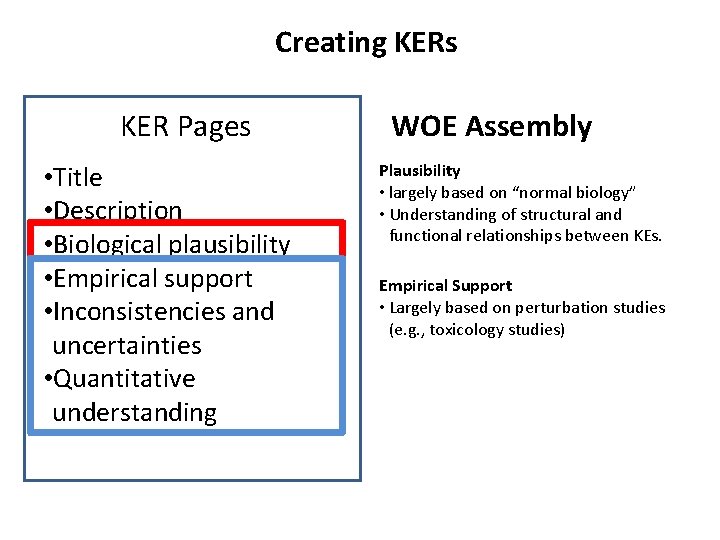
Section 6. Creating KERs KER Pages • Title • Description • Biological plausibility • Empirical support • Inconsistencies and uncertainties • Quantitative understanding WOE Assembly Plausibility • largely based on “normal biology” • Understanding of structural and functional relationships between KEs. Empirical Support • Largely based on perturbation studies (e. g. , toxicology studies)
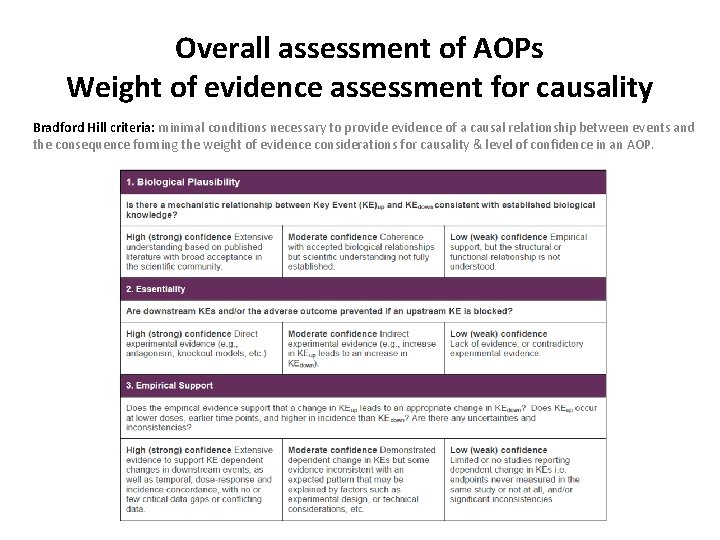
Overall assessment of AOPs Weight of evidence assessment for causality Bradford Hill criteria: minimal conditions necessary to provide evidence of a causal relationship between events and the consequence forming the weight of evidence considerations for causality & level of confidence in an AOP.
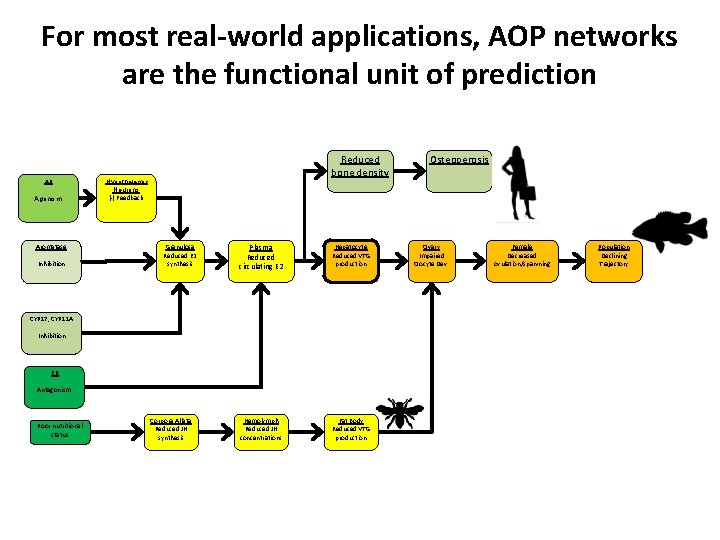
For most real-world applications, AOP networks are the functional unit of prediction AR Agonism Aromatase Inhibition Reduced bone density Hypothalamic Neurons (-) Feedback Granulosa Reduced E 2 synthesis Plasma Reduced circulating E 2 Hepatocyte Reduced VTG production Hemolymph Reduced JH concentrations Fat Body Reduced VTG production CYP 17, CYP 11 A Inhibition ER Antagonism Poor nutritional status Corpora Allata Reduced JH synthesis Osteoperosis Ovary Impaired Oocyte Dev. Female Decreased ovulation/spawning Population Declining Trajectory
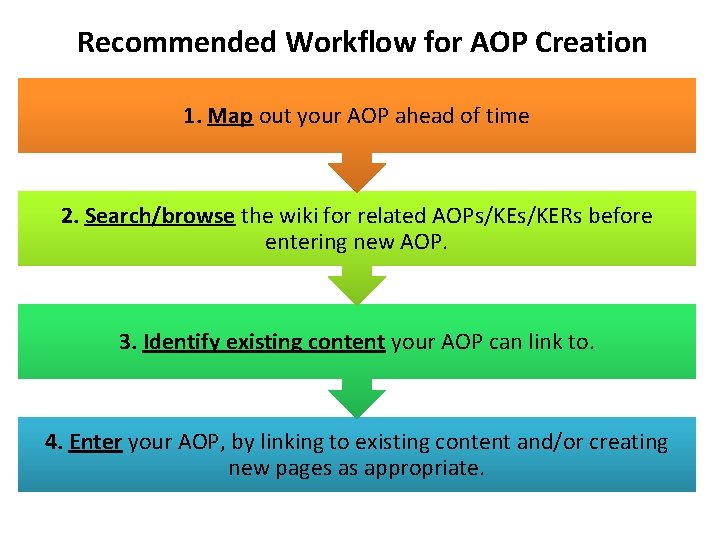
Recommended Workflow for AOP Creation 1. Map out your AOP ahead of time 2. Search/browse the wiki for related AOPs/KERs before entering new AOP. 3. Identify existing content your AOP can link to. 4. Enter your AOP, by linking to existing content and/or creating new pages as appropriate.
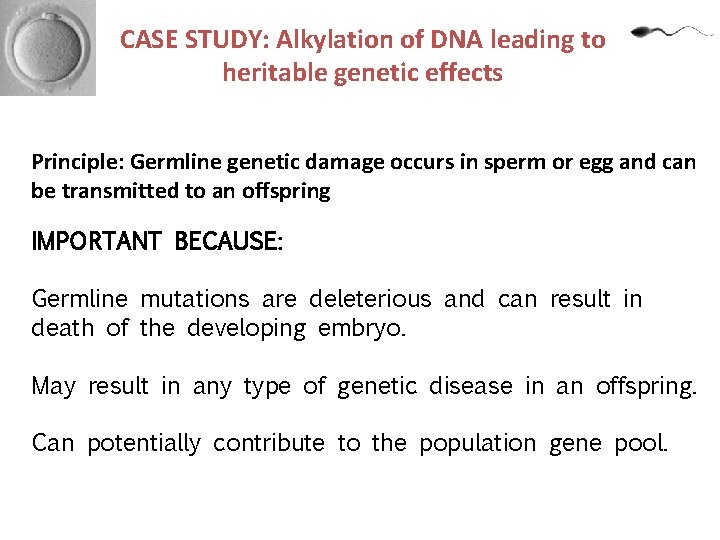
CASE STUDY: Alkylation of DNA leading to heritable genetic effects Principle: Germline genetic damage occurs in sperm or egg and can be transmitted to an offspring IMPORTANT BECAUSE: Germline mutations are deleterious and can result in death of the developing embryo. May result in any type of genetic disease in an offspring. Can potentially contribute to the population gene pool.
AOP: Alkylation of DNA leading to heritable mutations Motivation: • One of the best characterized modes of action in genetic toxicology. • Provide context of use for new methods/technologies to detect somatic and germ cell mutations. • Emphasize gaps in research in this field. • De novo mutations are increasingly recognized as contributing to a large array of human genetic diseases. Proposed changes in the way heritable hazards are assessed are being considered.

Background on biology of this AOP • Alkylating agents: chemicals that add alkyl groups (e. g. , methyl, propyl) to cellular molecules. • Occurs at various sites in DNA. Each site has a different degree of stability. © 2013 Nay SL, O'Connor TR. Published in [short citation] under CC BY 3. 0 license. Available from: http: //dx. doi. org/10. 5772/54449
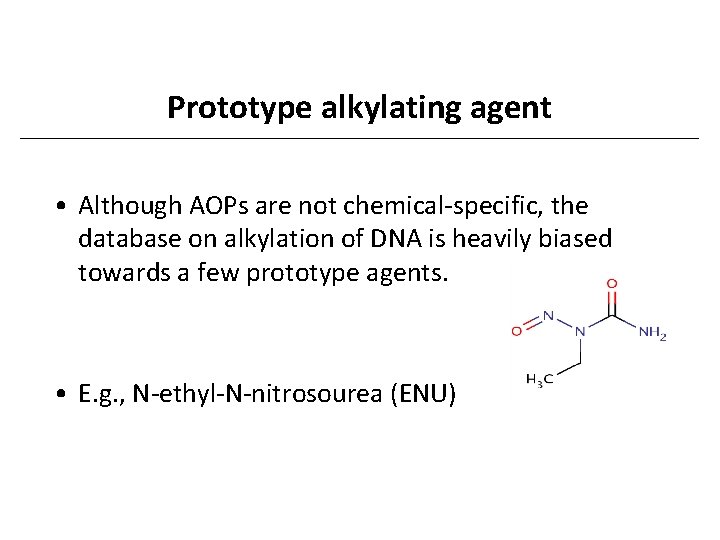
Prototype alkylating agent • Although AOPs are not chemical-specific, the database on alkylation of DNA is heavily biased towards a few prototype agents. • E. g. , N-ethyl-N-nitrosourea (ENU)
Alkyl adducts can be repaired • • • Primary repair protein is AGT: Alkyl guanine transferase. AGT irreversibly binds the alkyl group and is inactivated. Very efficient repair at LOW doses. AGT overwhelmed at HIGH doses = alkyl adducts retained. Not very good at repairing all adduct types.
Replication of alkylated DNA causes mutations • Replication over an alkyl adduct can cause insertion of an incorrect base in the DNA duplex. • Mutation becomes ‘fixed’ and can propagate to daughter cells. O 4 thymine alkylation = AT-GC transitions O 6 guanine alkylation = GC-AT transitions Note: some adducts not mutagenic. N-alkyl adducts tend to be bypassed error-free
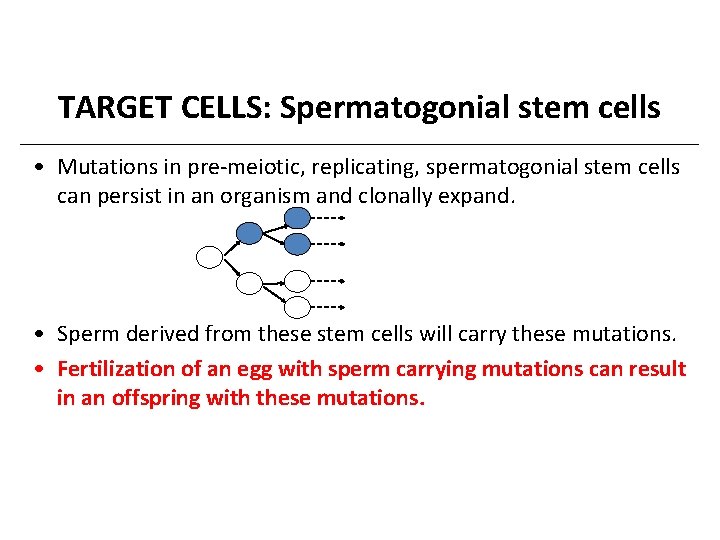
TARGET CELLS: Spermatogonial stem cells • Mutations in pre-meiotic, replicating, spermatogonial stem cells can persist in an organism and clonally expand. • Sperm derived from these stem cells will carry these mutations. • Fertilization of an egg with sperm carrying mutations can result in an offspring with these mutations.
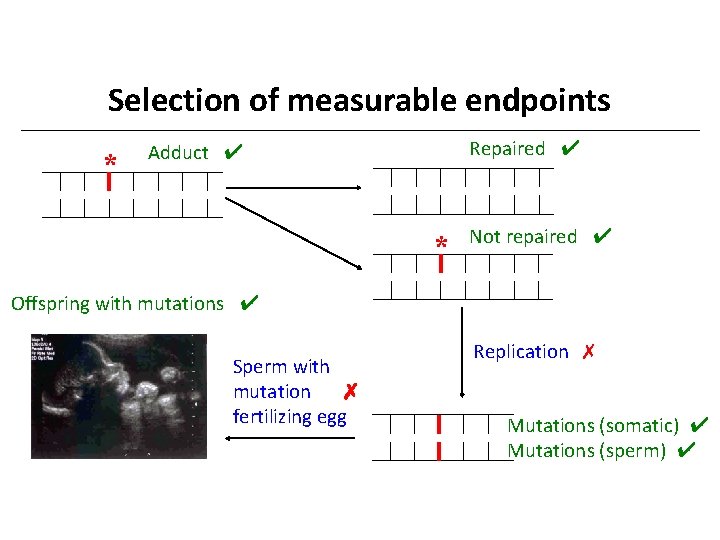
Selection of measurable endpoints * Repaired ✔ Adduct ✔ * Not repaired ✔ Offspring with mutations ✔ Sperm with mutation ✗ fertilizing egg Replication ✗ Mutations (somatic) ✔ Mutations (sperm) ✔
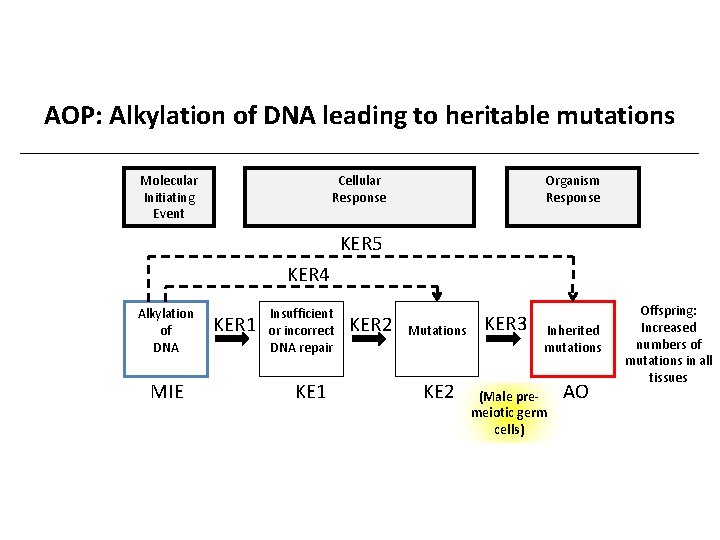
AOP: Alkylation of DNA leading to heritable mutations Molecular Initiating Event Cellular Response Organism Response KER 5 KER 4 Alkylation of DNA MIE KER 1 Insufficient or incorrect DNA repair KE 1 KER 2 Mutations KE 2 KER 3 Inherited mutations (Male premeiotic germ cells) AO Offspring: Increased numbers of mutations in all tissues
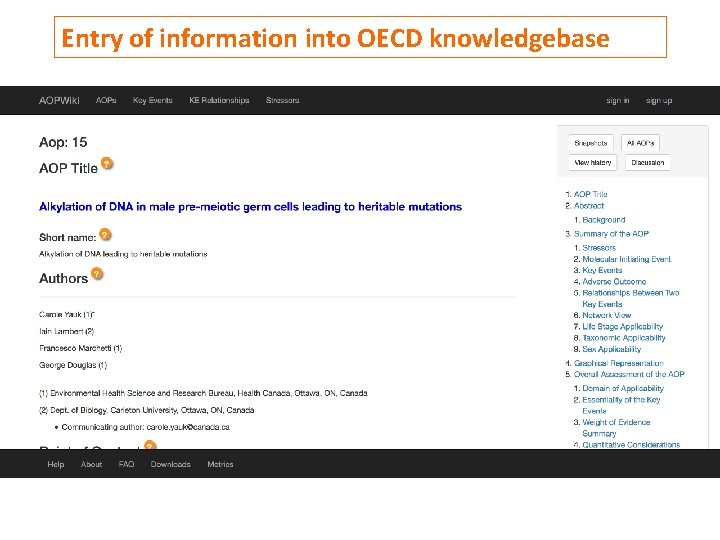
Entry of information into OECD knowledgebase
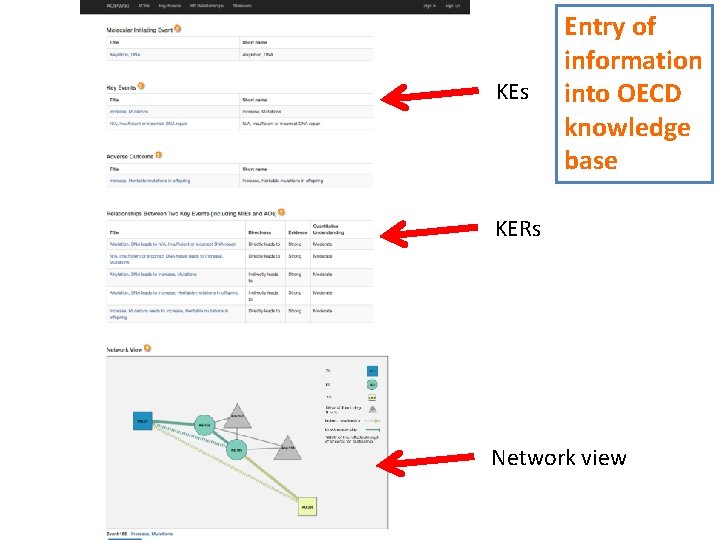
KEs Entry of information into OECD knowledge base KERs Network view
Weight of Evidence for Key Event Relationships 1. Biological plausibility • Each event is well characterized and understood. Highly biologically plausible. 2. Empirical evidence in support of relationships • Find evidence to support that KE 1 occurs before KE 2. • Find evidence to support that incidence KE 1 > KE 2. • Examine concordance of dose- and response–response relationships
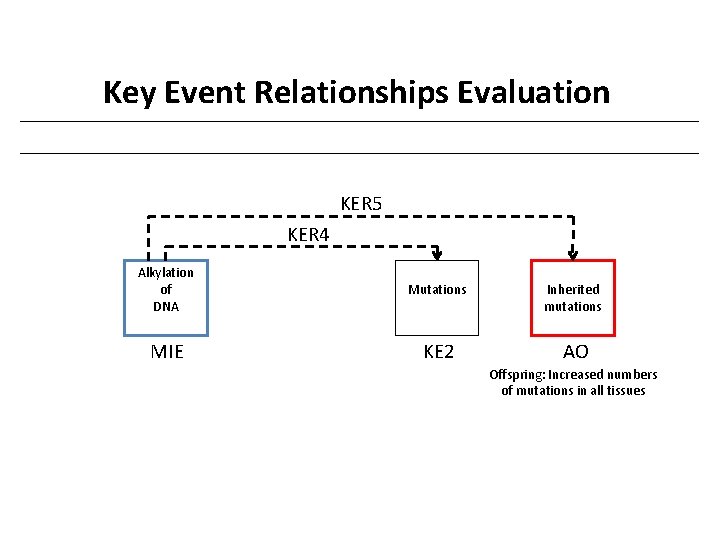
Key Event Relationships Evaluation KER 5 KER 4 Alkylation of DNA Mutations Inherited mutations MIE KE 2 AO Offspring: Increased numbers of mutations in all tissues
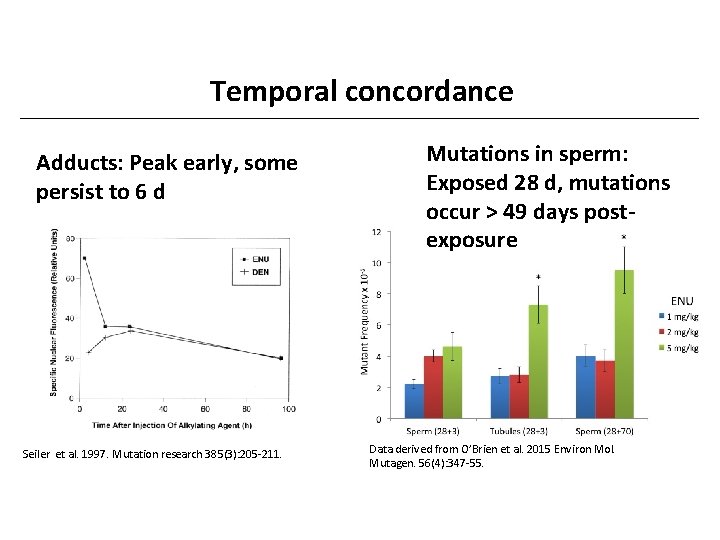
Temporal concordance Adducts: Peak early, some persist to 6 d Seiler et al. 1997. Mutation research 385(3): 205 -211. Mutations in sperm: Exposed 28 d, mutations occur > 49 days postexposure Data derived from O’Brien et al. 2015 Environ Mol. Mutagen. 56(4): 347 -55.
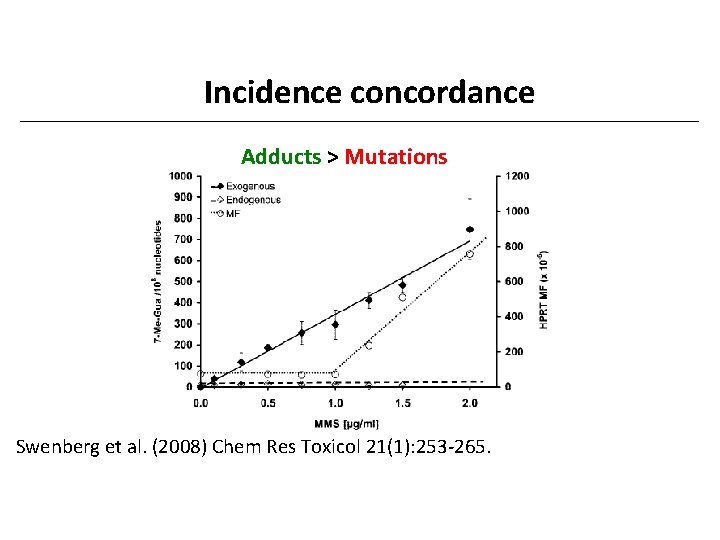
Incidence concordance Adducts > Mutations Swenberg et al. (2008) Chem Res Toxicol 21(1): 253 -265.
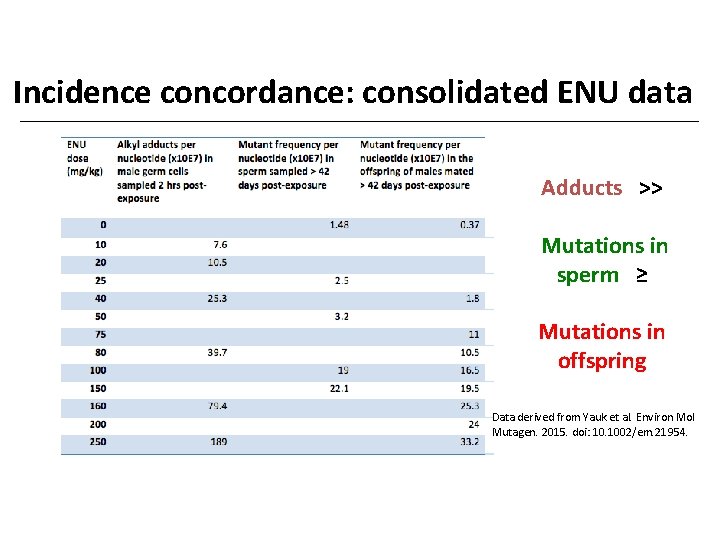
Incidence concordance: consolidated ENU data Adducts >> Mutations in sperm ≥ Mutations in offspring Data derived from Yauk et al. Environ Mol Mutagen. 2015. doi: 10. 1002/em. 21954.
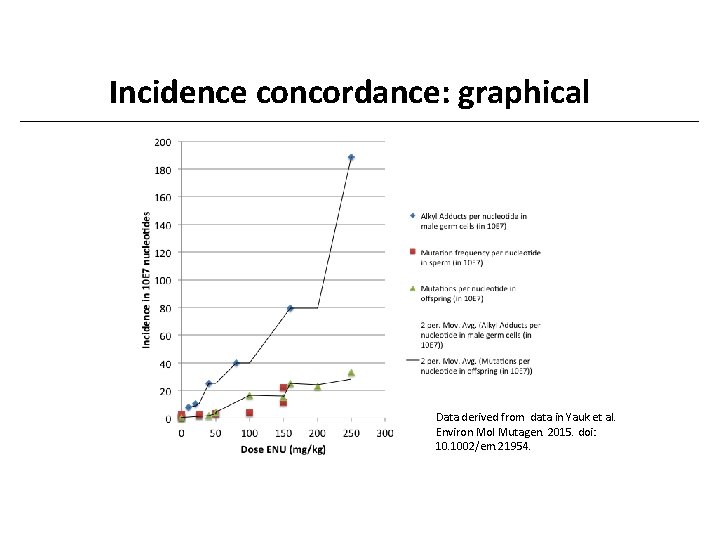
Incidence concordance: graphical Data derived from data in Yauk et al. Environ Mol Mutagen. 2015. doi: 10. 1002/em. 21954.
Consider uncertainties and inconsistencies • Data gaps – empirical evidence comes almost entirely from the chemical ENU in germ cells. • Some inconsistencies across experiments due to sub-standard protocols. • Some inconsistencies in incidence concordance – not appropriate to quantitatively compare some endpoints. • Differences across experiments in chemical delivery made comparisons difficult.
Assessment of overall weight of evidence • AOP based on 32 high quality studies across three rodent species, flies and fish. • No single study compared multiple events, but extrapolations could be made across studies.
Assessment of overall weight of evidence Biological Plausibility: Is there a mechanistic relationship between KEup and KEdown consistent with established biological knowledge? ” • Broad understanding and extensive knowledge for all of the key event relationships. • Generally widely accepted. • Strong.
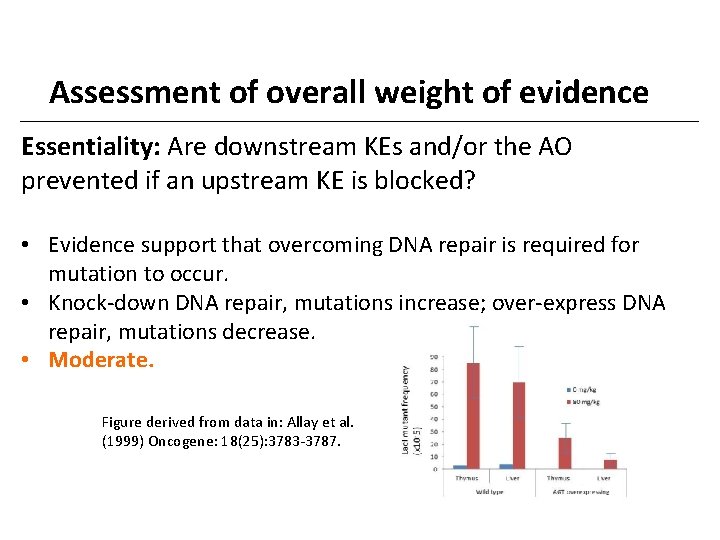
Assessment of overall weight of evidence Essentiality: Are downstream KEs and/or the AO prevented if an upstream KE is blocked? • Evidence support that overcoming DNA repair is required for mutation to occur. • Knock-down DNA repair, mutations increase; over-express DNA repair, mutations decrease. • Moderate. Figure derived from data in: Allay et al. (1999) Oncogene: 18(25): 3783 -3787.
Assessment of overall weight of evidence Empirical support: Does empirical evidence support that a change in KEup leads to an appropriate change in KEdown? Does KEup occur at lower doses and earlier time points than KE down and is the incidence of KEup > than that for Kedown? • Strong primarily for the indirect (non-adjacent) KERs • Use of OECD test guideline or ‘gold standard’ approaches in data collection. • High quality studies. • Overall: moderate – strong.
Conclusions • Currently leveraging KEs and KERs to build other AOPs. • https: //aopkb. org/aopwiki/index. php/Aop: 15 • See also: Yauk et al. Development of the adverse outcome pathway "alkylation of DNA in male premeiotic germ cells leading to heritable mutations" using the OECD's users' handbook supplement. Environ Mol Mutagen. 724 -50. : (9)56 2015 AND Yauk et al. , Adverse Outcome Pathway on Alkylation of DNA in Male Pre-Meiotic Germ Cells Leading to Heritable Mutations. OECD Series on Adverse Outcome Pathways ISSN: 2415 -170 X. http: //dx. doi. org/10. 1787/2415170 X
- Slides: 32