
Case Study How cold storage firm Lineage Logistics
- Slides: 7
Case Study How cold storage firm Lineage Logistics used Io. T Technology to reduce energy by 34% A Video of how they did it can be viewed here https: //youtu. be/V 5 Yp_hafmtg https: //enterpriseiotinsights. com/20181217/channels/use-cases/how-lineage-reduced-energy-by-third
Food Cold Storage Operator Lineage Logistics • Michigan based Lineage Logistics operates 120 warehouses in 26 states in the US, and in four countries globally. On average, its facilities measure around one million square feet. It handled about a quarter of the third-party cold chain in the US in 2017 – or 35 billion pounds of consumer packaged goods and fresh food. The Goal: to reduce annual energy usage by 34 per cent and annual energy costs by $4 million. Here’s how they did it…
Summary of the Problem and the Solution • Freezing and storing this amount of food requires electricity, and lots of it. Lineage keeps temperatures at most sites zero degrees, but some go as low as -20 degrees. Either way, its electricity bill is one of its largest line items, reaching tens of millions of dollars per year. • Its goal was to increase the food storage per square foot, while lowering its electricity usage at the same time. “ We needed a data-driven system that could give us the measures to drive efficiency. Io. T sensors produced that detail for us, ” says Sudarsan Thattai, chief information officer at Lineage. • Lineage engaged solutions provider ndustrial. io, which started with 3 -15 smart meters per facility, taking electricity readings at one-minute intervals. But it needed more data inputs, so ndustrial. io added sensors on top and bottom racks – to the tune of 1, 000 across its facilities. • Everything was provisioned with global SIMs from AT&T, and hooked up to AT&T’s LTE-M network and management platform
How a Combination of Io. T Sensors and Clever Analytics Improved Performance-1 REDUCTION IN ABSOLUTE ENERGY • The Lineage Io. T system has been arranged to collect temperature and humidity data from shelves across it facilities, and cross-reference it with optimised ‘set points’. Chiller systems and frequency drives kick in when the shelf readings are out of tune. • Since 2014, annual energy costs have declined by eight per cent at the 78 warehouses where the system has been installed. Meanwhile, throughput at these warehouses has increased over the same period. As a consequence, it calculates the cost of electricity for each item of food has decreased by 34 per cent. • This efficiency drive has informed its design of new warehouse operations, More importantly, it has re-racked existing set-ups with high density to avoid new constructions.
How a combination of Io. T Sensors and Clever Analytics improved Performance-2 PEAK ENERGY REDUCTION • The vagaries of energy supply and demand mean utilities can charge a higher rate during peak times, and offer a reduction when there is lower demand on the grid. A smart energy system takes advantage of these peaks and troughs in energy pricing. • With its new sensor-and-analytics system, Lineage super-cools its warehouses during periods of low-demand, typically at night, to create a virtual cold ‘battery’ for use during peak hours. Parameters are set to ensure thermoload does not rise too high, and compromise food safety. • This process of temperature management reduces the need for power from the grid by two-to-three megawatts, it reckons.
How a combination of Io. T Sensors and Clever Analytics improved Performance-3 FAST BLAST FREEZING • Blast freezing allows for the rapid freezing of food, which can preserve the cellular integrity of certain foods during the freezing process. The seasonality of certain commodities makes the blast freezing critical at different times of the year. • During strawberry season, for example, Lineage freezes up to six million pounds of strawberries every day. Lineage and ndustrial. io developed a customised dashboard to track the process, and reduce the freeze time from 100 hours to 40 hours, and energy consumption by half.
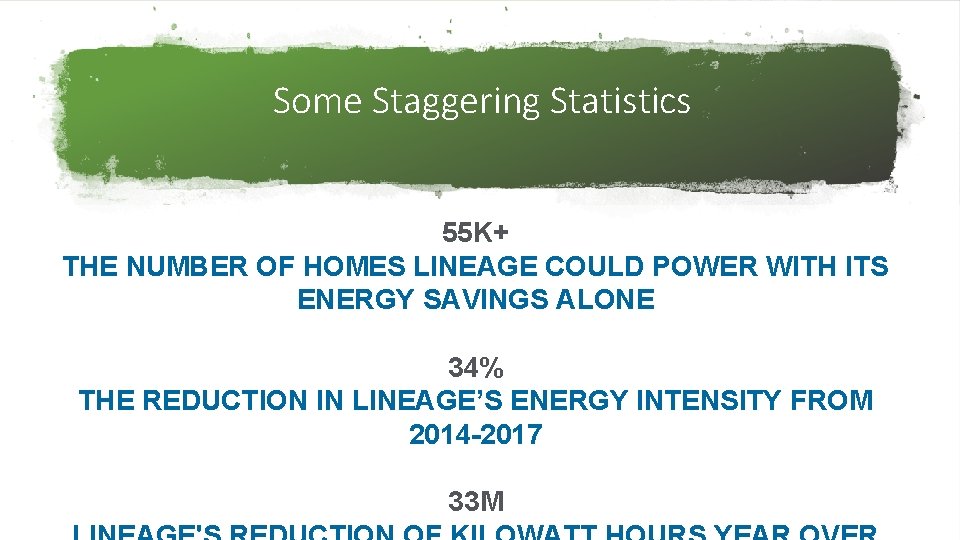
Some Staggering Statistics 55 K+ THE NUMBER OF HOMES LINEAGE COULD POWER WITH ITS ENERGY SAVINGS ALONE 34% THE REDUCTION IN LINEAGE’S ENERGY INTENSITY FROM 2014 -2017 33 M