
Case study analysis including design thinking Dr Anthos
- Slides: 13
Case study analysis including design thinking Dr Anthos Yannakou
Tips • No one can analyse a case after reading it only one time, or even worse, doing the analysis during the first reading of the case. Read through the case once just to get an understanding of the nature of the case. During the second reading, begin to structure and classify the issues as they appear. A truly comprehensive case analysis will probably require at least three readings. These readings should take place with some time in between • Don’t get trapped into thinking the ‘answer’ to the case is hidden somewhere in the case text. There is never a single answer to a case just as there is never a single marketing strategy that is appropriate for all situations. Each case is unique. Looking for tricks or shortcuts is not appropriate RMIT University© 2018 GSBL 2
Tips • Make an effort to put yourself in the shoes of the decision maker in the case. The use of role-playing as part of the analysis can be very useful. It helps you gain some feeling for the perspective of the key parties at the time the case took place. After you have done several analyses, you will likely come up with your own additional procedures or guidelines that assist you with this process • You need to link the case analysis to your course- You need to think as a Business Executive RMIT University© 2018 GSBL 3
Process for working on cases • There are 3 types of case situation- problem, decision, evaluation. You need to decide which is appropriate as this affects the case analysis. However, you need to use judgement, as each case may have problems, require decisions, and need some evaluation • Problem situation: something important has happened, but we don’t know why it did- there is a significant outcome (normally a change which results in a negative outcome), and there is no explicit explanation of the outcome. The analysis of a ‘problem situation’ case begins with a definition of the problem; after that you work out an explanation of the problem by linking the (negative) outcome to its root causes RMIT University© 2018 GSBL 4
Process for working on cases • Decision situation: an example is- What is the best strategy the company should pursue in the future? In this case, need to first analyse the current strategy and how well it works • Evaluation situation: express a judgement about the effectiveness/value of a performance/act/outcome. Examples are- a new CEO evaluating the performance of the company; assessing a decision already taken RMIT University© 2018 GSBL 5
Design thinking
RMIT University© 2018 GSBL 7
RMIT University© 2018 GSBL 8
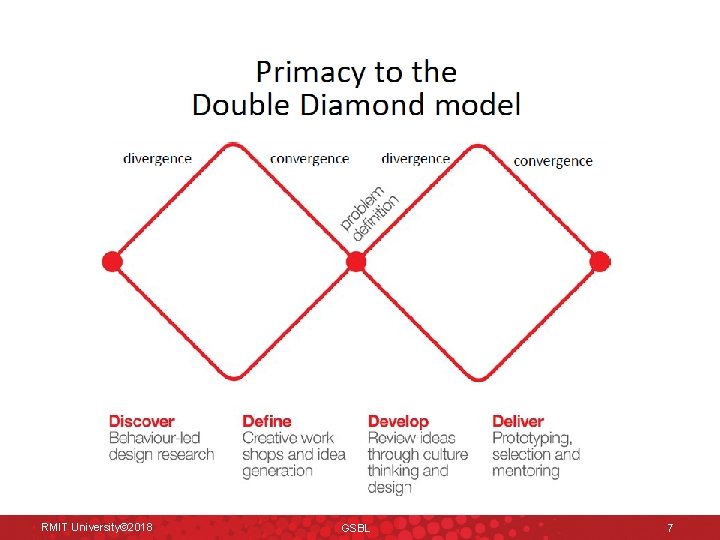
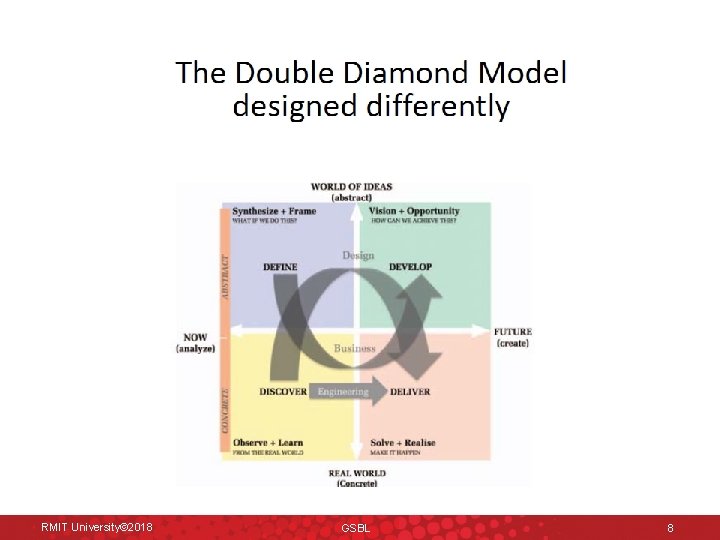
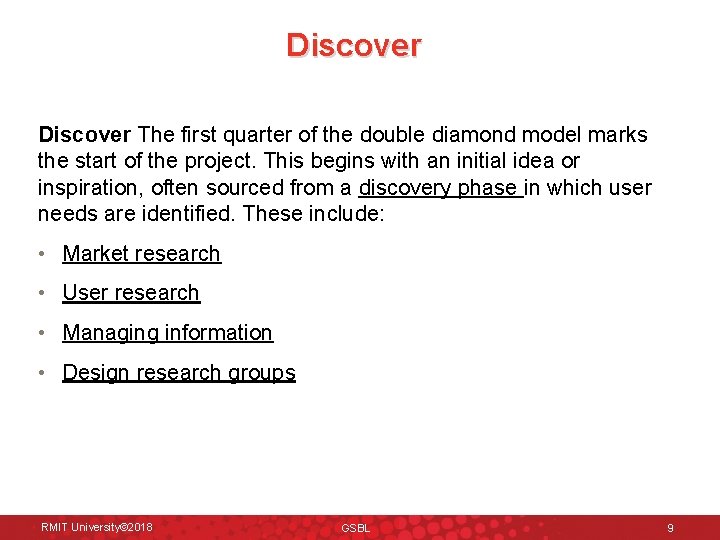
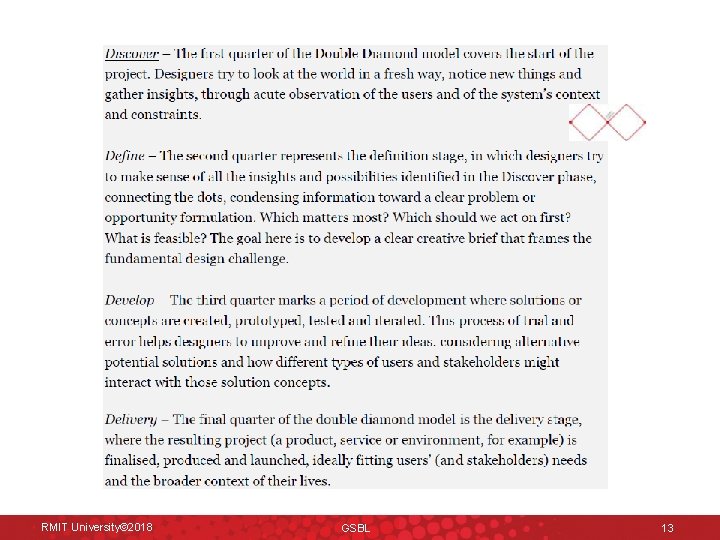
Discover The first quarter of the double diamond model marks the start of the project. This begins with an initial idea or inspiration, often sourced from a discovery phase in which user needs are identified. These include: • Market research • User research • Managing information • Design research groups RMIT University© 2018 GSBL 9
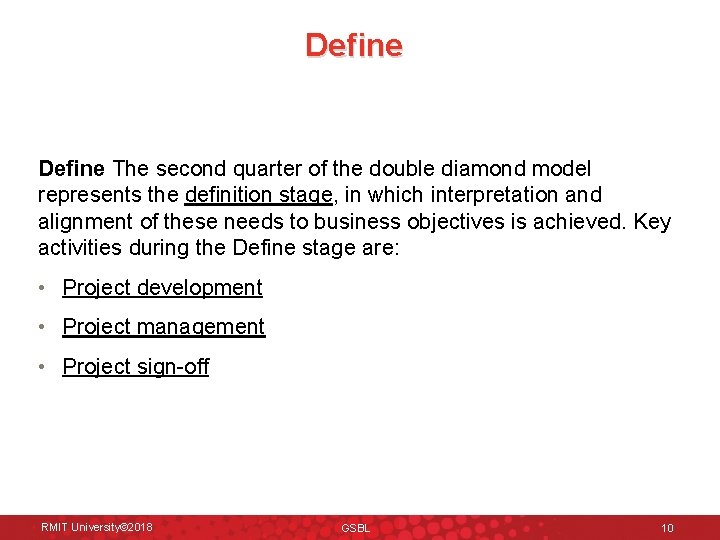
Define The second quarter of the double diamond model represents the definition stage, in which interpretation and alignment of these needs to business objectives is achieved. Key activities during the Define stage are: • Project development • Project management • Project sign-off RMIT University© 2018 GSBL 10
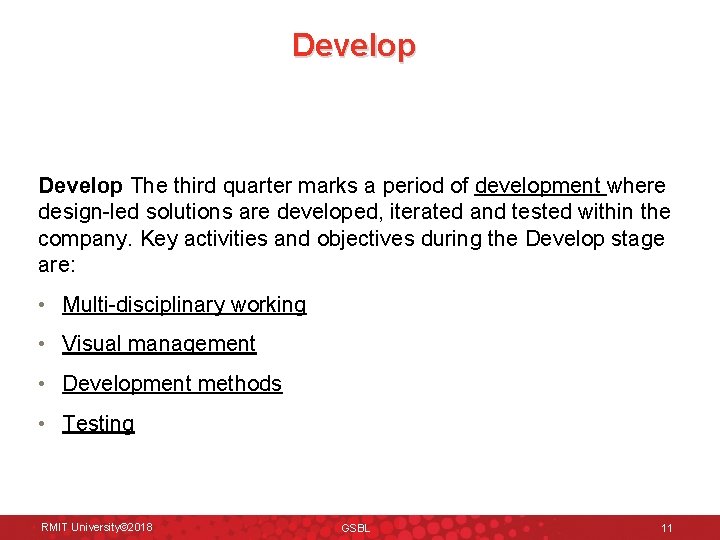
Develop The third quarter marks a period of development where design-led solutions are developed, iterated and tested within the company. Key activities and objectives during the Develop stage are: • Multi-disciplinary working • Visual management • Development methods • Testing RMIT University© 2018 GSBL 11
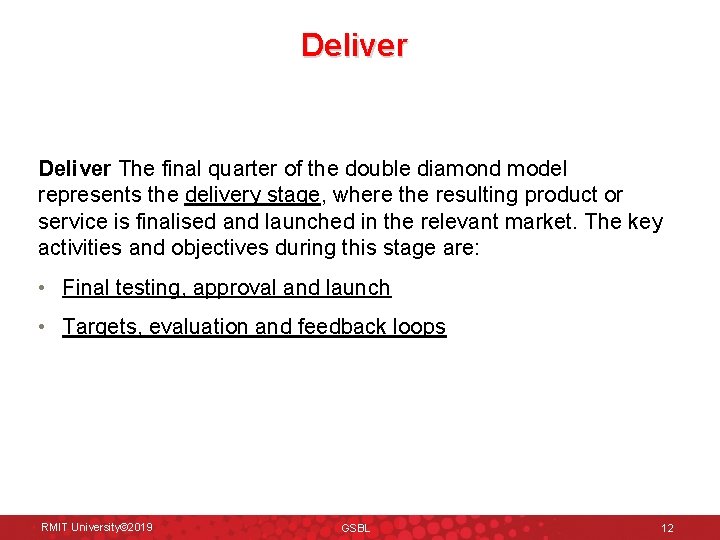
Deliver The final quarter of the double diamond model represents the delivery stage, where the resulting product or service is finalised and launched in the relevant market. The key activities and objectives during this stage are: • Final testing, approval and launch • Targets, evaluation and feedback loops RMIT University© 2019 GSBL 12
RMIT University© 2018 GSBL 13