
Case study 2 Session outline q A sequential
- Slides: 36
Case study 2
Session outline q. A sequential modular approach to solve for a moderate complex flowsheet q Some common unit operations in biochemical industries: ü ü Fermentor Disk-stack centrifugation Diafiltration Chromatography
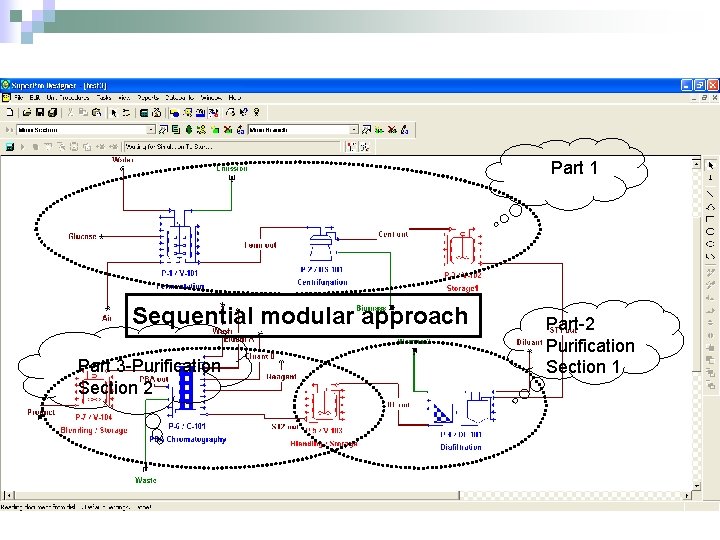
Part 1 Sequential modular approach Part 3 -Purification Section 2 Part-2 Purification Section 1
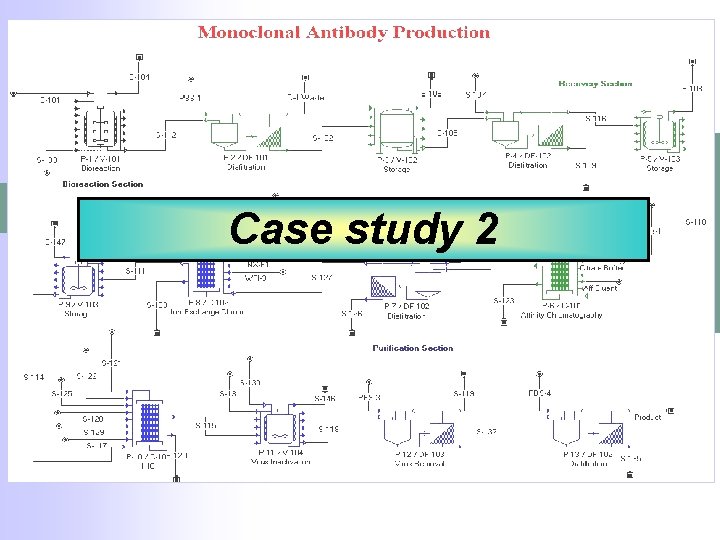
Description Water, microorganisms, nutrients (glucose) and air are fed into a bioreactor where at 37 °C a fermentation takes place yielding an enzyme and impurities. Biomass is separated in a disk-stack centrifuge and the liquid is stored in tank. It is then processed in a diafilter where the remaining biomass is removed (when a small loss of product). It is stored again and then loaded onto a PBA chromatography column where the enzyme binds and is eluted using WFI/Na. Cl mixture.
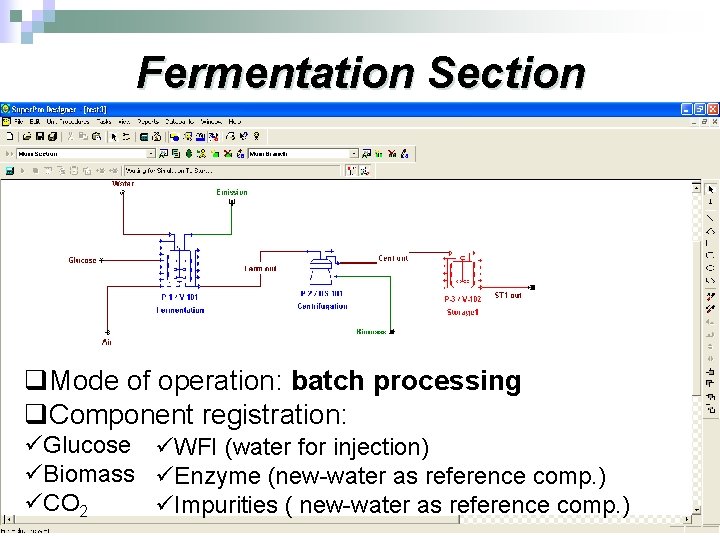
Fermentation Section q. Mode of operation: batch processing q. Component registration: üGlucose üWFI (water for injection) üBiomass üEnzyme (new-water as reference comp. ) üCO 2 üImpurities ( new-water as reference comp. )
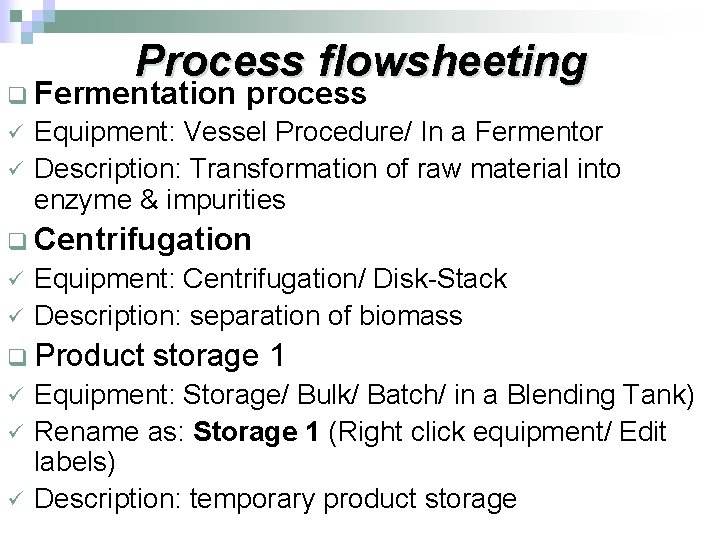
Process flowsheeting q Fermentation ü ü process Equipment: Vessel Procedure/ In a Fermentor Description: Transformation of raw material into enzyme & impurities q Centrifugation ü ü Equipment: Centrifugation/ Disk-Stack Description: separation of biomass q Product ü ü ü storage 1 Equipment: Storage/ Bulk/ Batch/ in a Blending Tank) Rename as: Storage 1 (Right click equipment/ Edit labels) Description: temporary product storage
Product initialisation q. Fermentation q. Centifugation q. Storage 1
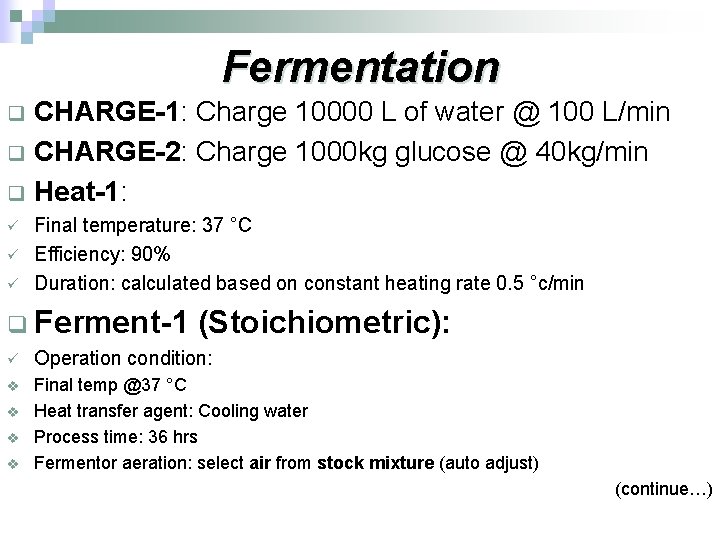
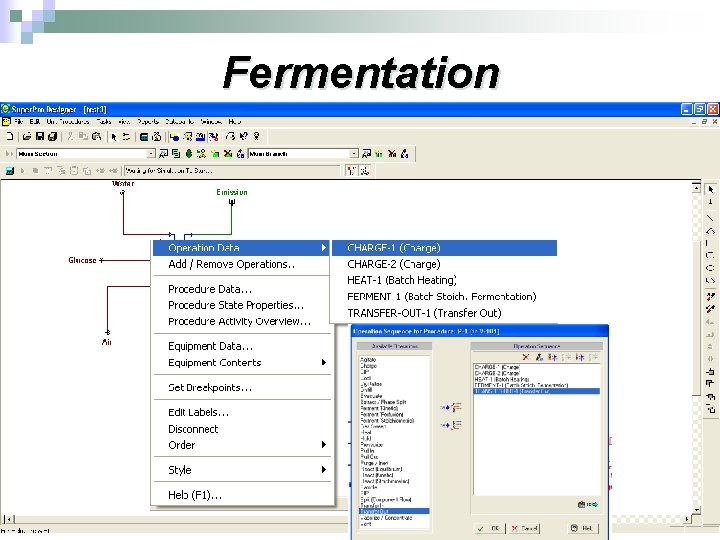
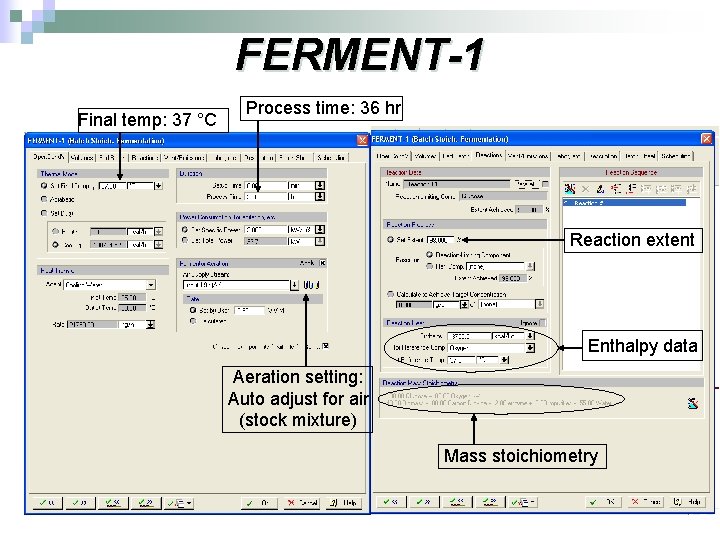
Fermentation CHARGE-1: Charge 10000 L of water @ 100 L/min q CHARGE-2: Charge 1000 kg glucose @ 40 kg/min q Heat-1: q ü ü ü Final temperature: 37 °C Efficiency: 90% Duration: calculated based on constant heating rate 0. 5 °c/min q Ferment-1 (Stoichiometric): ü Operation condition: v Final temp @37 °C Heat transfer agent: Cooling water Process time: 36 hrs Fermentor aeration: select air from stock mixture (auto adjust) v v v (continue…)
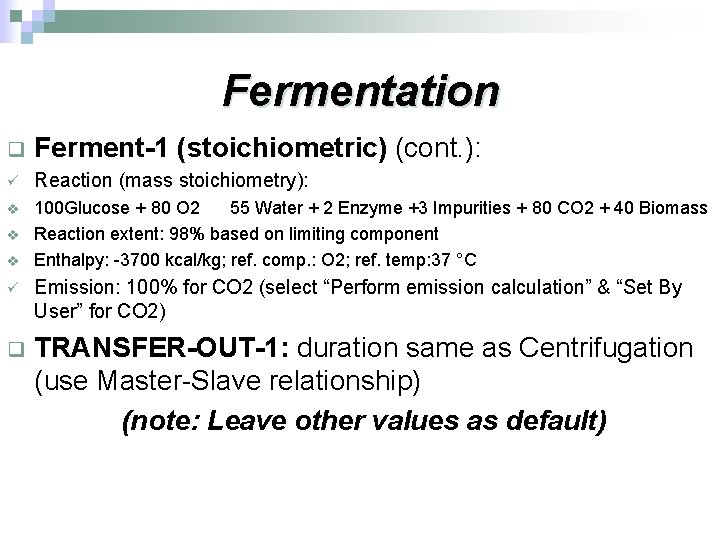
Fermentation q Ferment-1 (stoichiometric) (cont. ): ü Reaction (mass stoichiometry): v 100 Glucose + 80 O 2 55 Water + 2 Enzyme +3 Impurities + 80 CO 2 + 40 Biomass Reaction extent: 98% based on limiting component Enthalpy: -3700 kcal/kg; ref. comp. : O 2; ref. temp: 37 °C v v ü Emission: 100% for CO 2 (select “Perform emission calculation” & “Set By User” for CO 2) q TRANSFER-OUT-1: duration same as Centrifugation (use Master-Slave relationship) (note: Leave other values as default)
Fermentation
FERMENT-1 Final temp: 37 °C Process time: 36 hr Reaction extent Enthalpy data Aeration setting: Auto adjust for air (stock mixture) Mass stoichiometry
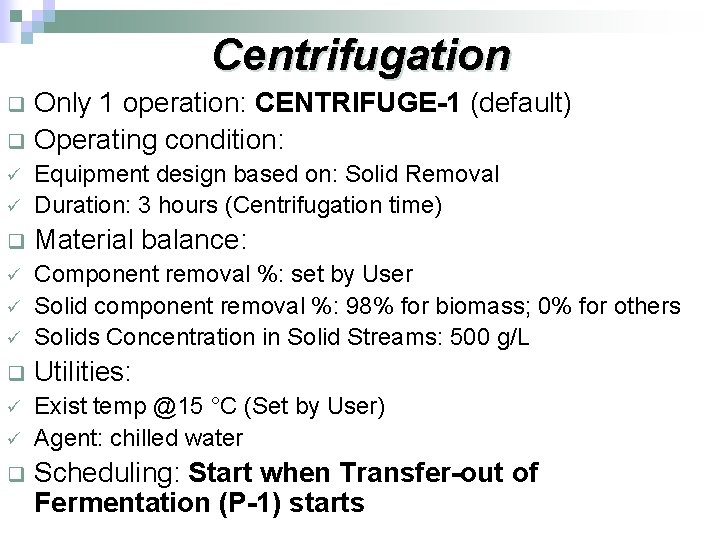
Centrifugation Only 1 operation: CENTRIFUGE-1 (default) q Operating condition: q ü Equipment design based on: Solid Removal Duration: 3 hours (Centrifugation time) q Material balance: ü ü Component removal %: set by User Solid component removal %: 98% for biomass; 0% for others Solids Concentration in Solid Streams: 500 g/L q Utilities: ü Exist temp @15 °C (Set by User) Agent: chilled water ü ü ü q Scheduling: Start when Transfer-out of Fermentation (P-1) starts
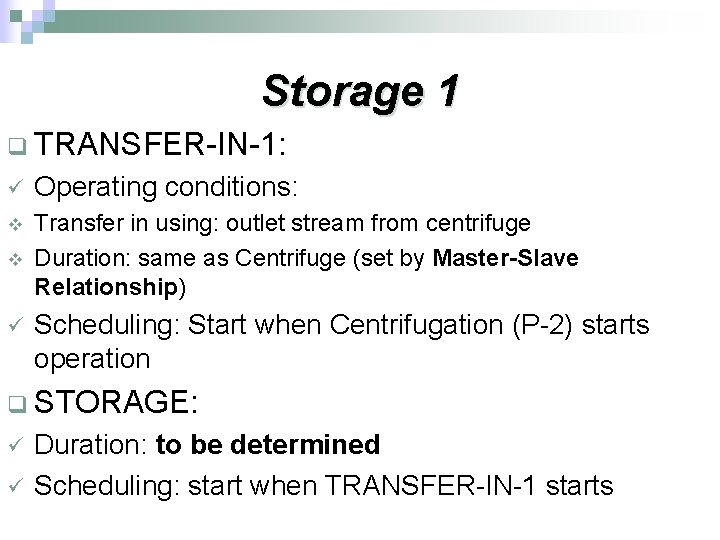
Storage 1 q TRANSFER-IN-1: ü Operating conditions: v Transfer in using: outlet stream from centrifuge Duration: same as Centrifuge (set by Master-Slave Relationship) v ü Scheduling: Start when Centrifugation (P-2) starts operation q STORAGE: ü ü Duration: to be determined Scheduling: start when TRANSFER-IN-1 starts
Let’s simulate the flowsheet & solve the error message given (scheduling problem)
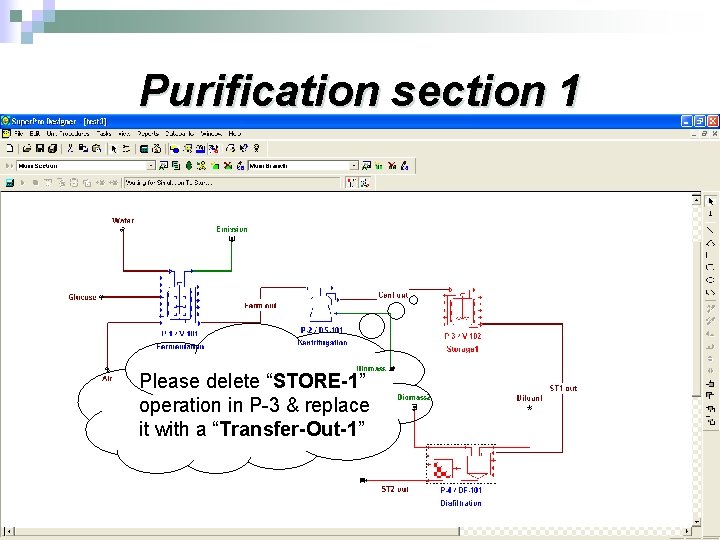
Purification section 1 Please delete “STORE-1” operation in P-3 & replace it with a “Transfer-Out-1”
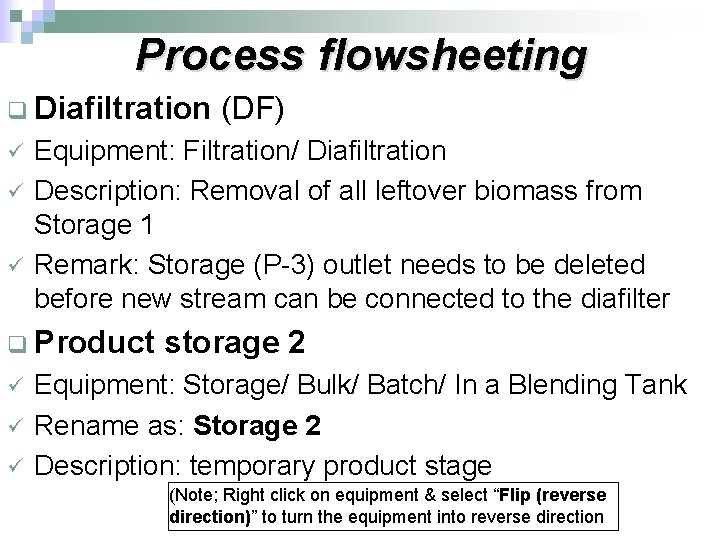
Process flowsheeting q Diafiltration ü ü ü Equipment: Filtration/ Diafiltration Description: Removal of all leftover biomass from Storage 1 Remark: Storage (P-3) outlet needs to be deleted before new stream can be connected to the diafilter q Product ü ü ü (DF) storage 2 Equipment: Storage/ Bulk/ Batch/ In a Blending Tank Rename as: Storage 2 Description: temporary product stage (Note; Right click on equipment & select “Flip (reverse direction)” to turn the equipment into reverse direction
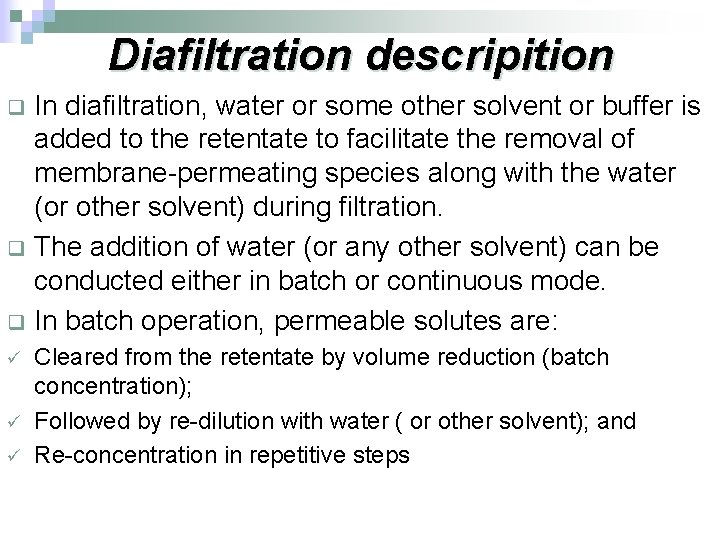
Diafiltration descripition In diafiltration, water or some other solvent or buffer is added to the retentate to facilitate the removal of membrane-permeating species along with the water (or other solvent) during filtration. q The addition of water (or any other solvent) can be conducted either in batch or continuous mode. q In batch operation, permeable solutes are: q ü ü ü Cleared from the retentate by volume reduction (batch concentration); Followed by re-dilution with water ( or other solvent); and Re-concentration in repetitive steps
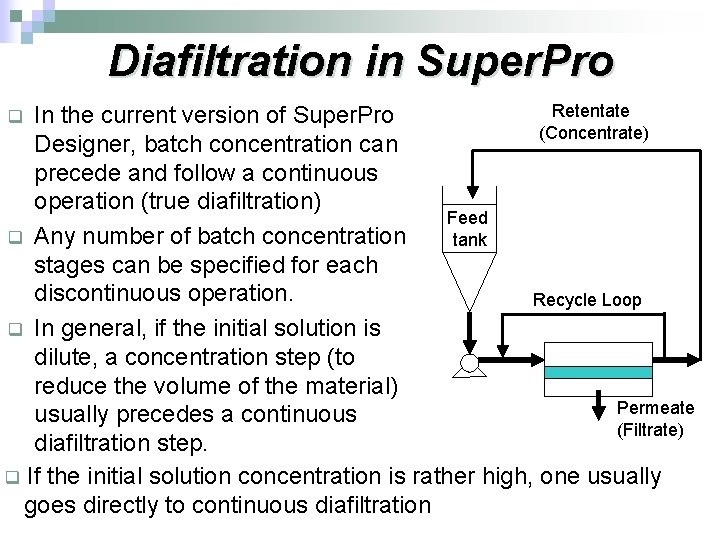
Diafiltration in Super. Pro Retentate In the current version of Super. Pro (Concentrate) Designer, batch concentration can precede and follow a continuous operation (true diafiltration) Feed q Any number of batch concentration tank stages can be specified for each discontinuous operation. Recycle Loop q In general, if the initial solution is dilute, a concentration step (to reduce the volume of the material) Permeate usually precedes a continuous (Filtrate) diafiltration step. q If the initial solution concentration is rather high, one usually goes directly to continuous diafiltration q
Procedure initialisation q Diafiltration q Storage
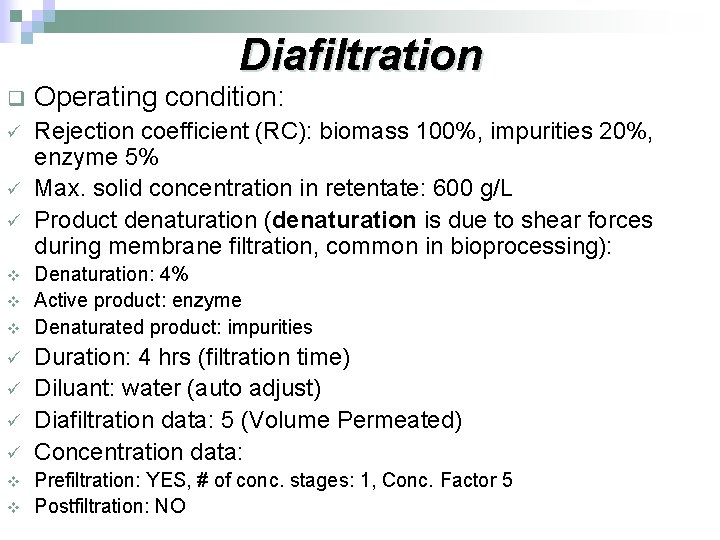
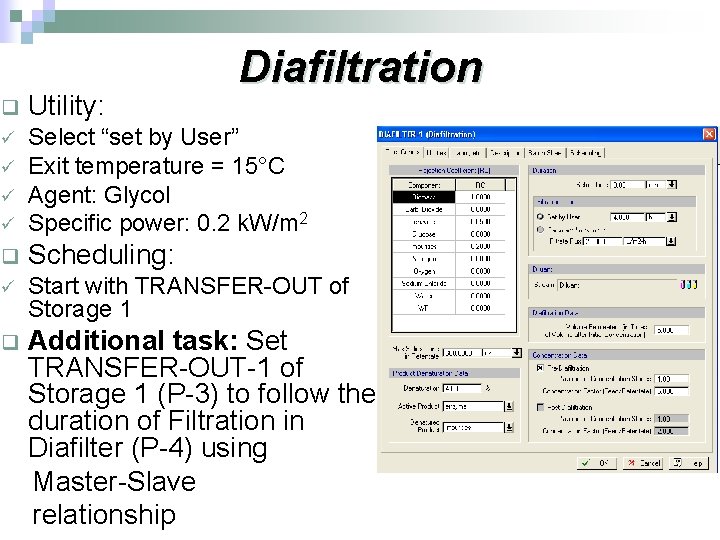
Diafiltration q Operating condition: ü Rejection coefficient (RC): biomass 100%, impurities 20%, enzyme 5% Max. solid concentration in retentate: 600 g/L Product denaturation (denaturation is due to shear forces during membrane filtration, common in bioprocessing): ü ü v v v ü ü v v Denaturation: 4% Active product: enzyme Denaturated product: impurities Duration: 4 hrs (filtration time) Diluant: water (auto adjust) Diafiltration data: 5 (Volume Permeated) Concentration data: Prefiltration: YES, # of conc. stages: 1, Conc. Factor 5 Postfiltration: NO
Diafiltration q Utility: ü ü Select “set by User” Exit temperature = 15°C Agent: Glycol Specific power: 0. 2 k. W/m 2 q Scheduling: ü Start with TRANSFER-OUT of Storage 1 q Additional task: Set TRANSFER-OUT-1 of Storage 1 (P-3) to follow the duration of Filtration in Diafilter (P-4) using Master-Slave relationship ü ü
Storage 2 q TRANSFER-IN-1: ü ü Transfer in using: outlet stream from DF (P-4) Start (scheduling) and duration (Operating condition: Master-Slave) same as DF q STORAGE: ü ü Duration: to be determined Scheduling: start when TRANSFER-IN-1 starts
Simulate the flowsheet & solve the scheduling
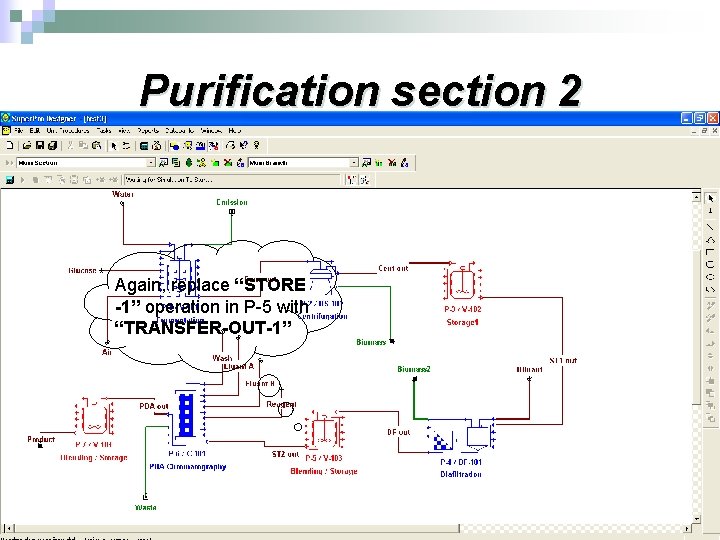
Purification section 2 Again, replace “STORE -1” operation in P-5 with “TRANSFER-OUT-1”
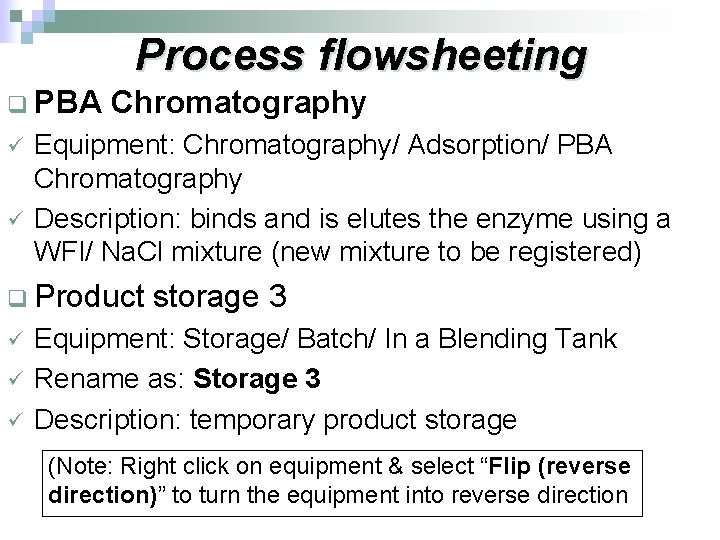
Process flowsheeting q PBA ü ü Chromatography Equipment: Chromatography/ Adsorption/ PBA Chromatography Description: binds and is elutes the enzyme using a WFI/ Na. Cl mixture (new mixture to be registered) q Product ü ü ü storage 3 Equipment: Storage/ Batch/ In a Blending Tank Rename as: Storage 3 Description: temporary product storage (Note: Right click on equipment & select “Flip (reverse direction)” to turn the equipment into reverse direction
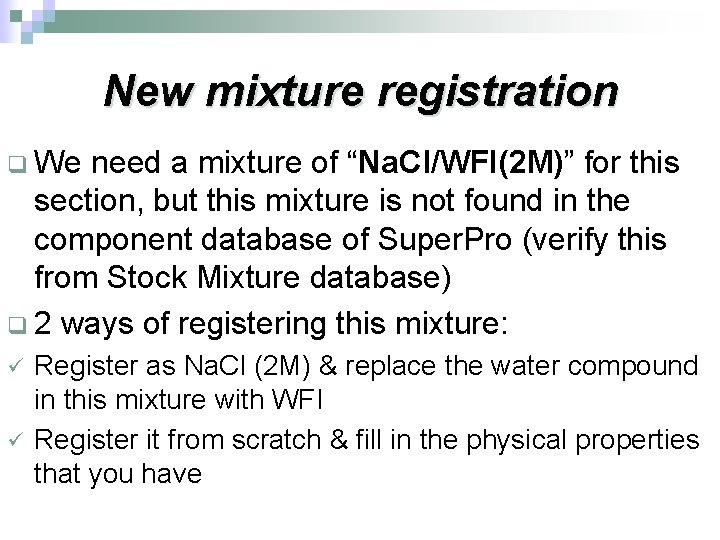
New mixture registration q We need a mixture of “Na. Cl/WFI(2 M)” for this section, but this mixture is not found in the component database of Super. Pro (verify this from Stock Mixture database) q 2 ways of registering this mixture: ü ü Register as Na. Cl (2 M) & replace the water compound in this mixture with WFI Register it from scratch & fill in the physical properties that you have
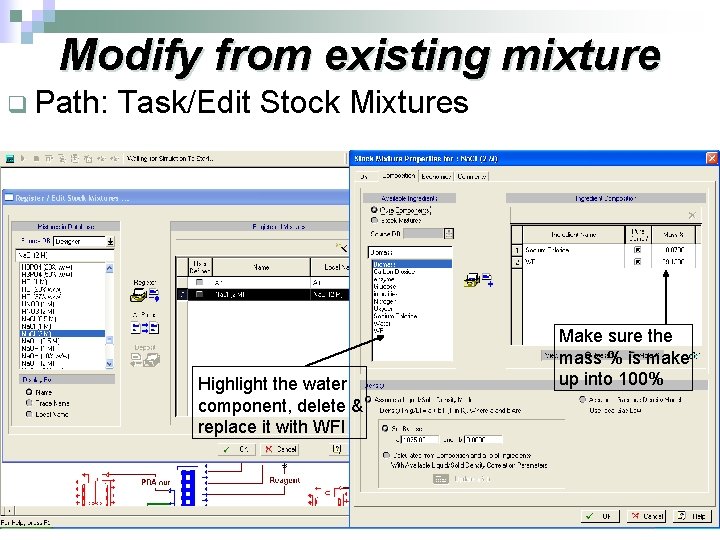
Modify from existing mixture q Path: Task/Edit Stock Mixtures Highlight the water component, delete & replace it with WFI Make sure the mass % is make up into 100%
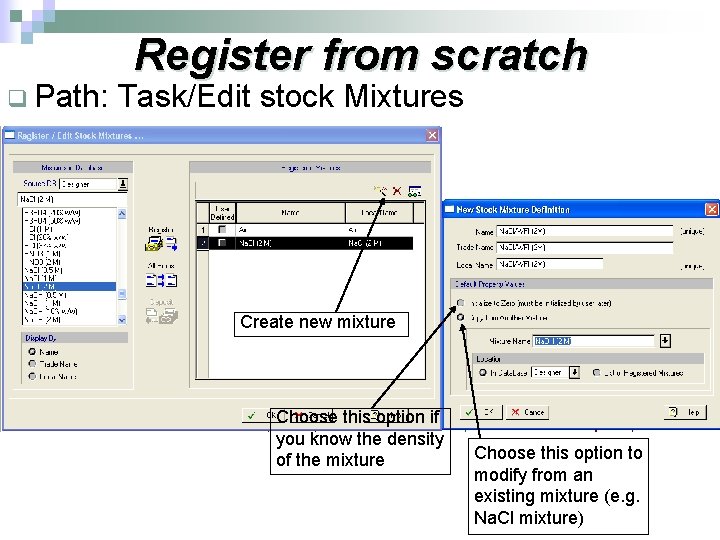
q Path: Register from scratch Task/Edit stock Mixtures Create new mixture Choose this option if you know the density of the mixture Choose this option to modify from an existing mixture (e. g. Na. Cl mixture)
Let’s try it … (Always remember to save your work …)
Procedure intialisation q PBA Chromatography q Storage 3
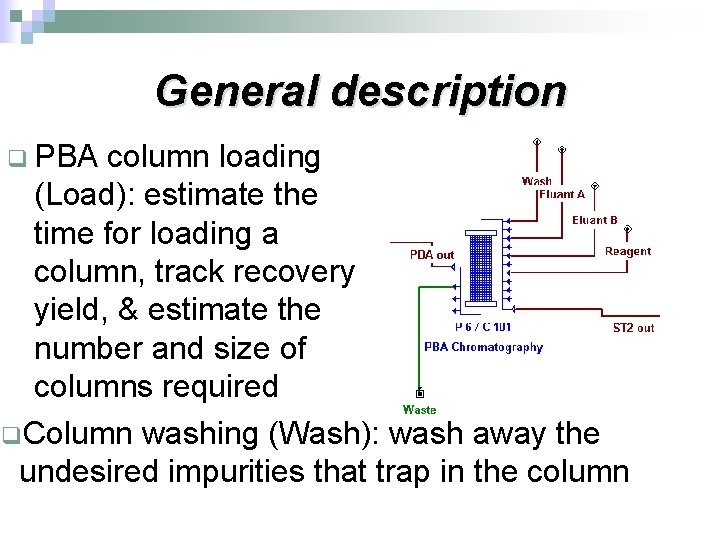
General description q PBA column loading (Load): estimate the time for loading a column, track recovery yield, & estimate the number and size of columns required q. Column washing (Wash): wash away the undesired impurities that trap in the column
General description q Column elution (Elute): ü A column may be used to bind either: v Product component(s); or Impurity components v ü ü For retention of product components, for a component that binds to the resin, its amount in the product stream = (amount in the feed stream) x (binding fraction) x (elution yield) All component present in the feed stream, that do not bind to resin, exit into the waster stream q Colum regeneration (Regenerate): regenerate the resin using a solution
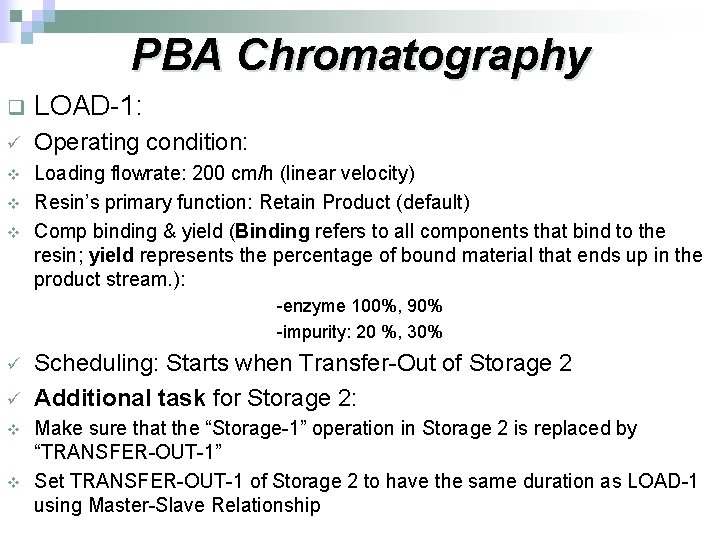
PBA Chromatography q LOAD-1: ü Operating condition: v Loading flowrate: 200 cm/h (linear velocity) Resin’s primary function: Retain Product (default) Comp binding & yield (Binding refers to all components that bind to the resin; yield represents the percentage of bound material that ends up in the product stream. ): v v -enzyme 100%, 90% -impurity: 20 %, 30% ü ü v v Scheduling: Starts when Transfer-Out of Storage 2 Additional task for Storage 2: Make sure that the “Storage-1” operation in Storage 2 is replaced by “TRANSFER-OUT-1” Set TRANSFER-OUT-1 of Storage 2 to have the same duration as LOAD-1 using Master-Slave Relationship
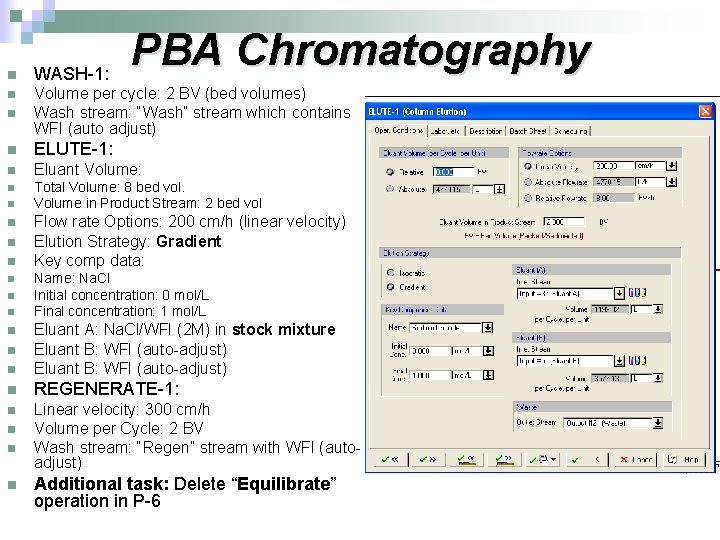
PBA Chromatography n WASH-1: n n Volume per cycle: 2 BV (bed volumes) Wash stream: “Wash” stream which contains WFI (auto adjust) n ELUTE-1: n Eluant Volume: n Total Volume: 8 bed vol. Volume in Product Stream: 2 bed vol n n n n Flow rate Options: 200 cm/h (linear velocity) Elution Strategy: Gradient Key comp data: Name: Na. Cl Initial concentration: 0 mol/L Final concentration: 1 mol/L n Eluant A: Na. Cl/WFI (2 M) in stock mixture Eluant B: WFI (auto-adjust) n REGENERATE-1: n Linear velocity: 300 cm/h Volume per Cycle: 2 BV Wash stream: “Regen” stream with WFI (autoadjust) n n n Additional task: Delete “Equilibrate” operation in P-6
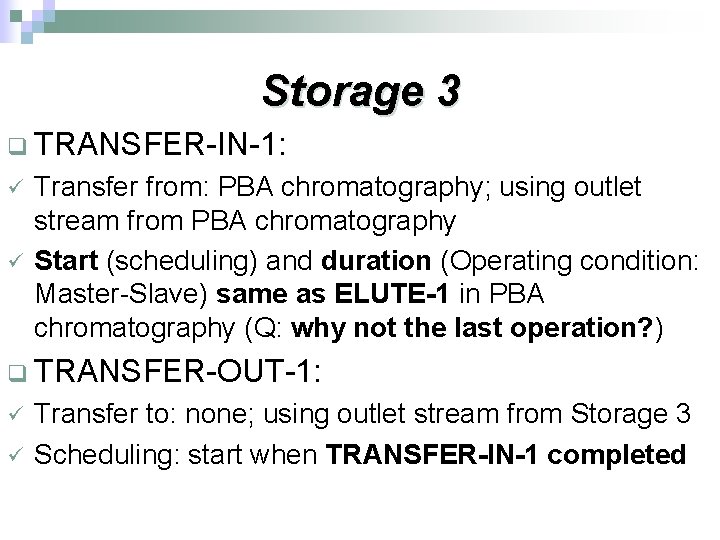
Storage 3 q TRANSFER-IN-1: ü ü Transfer from: PBA chromatography; using outlet stream from PBA chromatography Start (scheduling) and duration (Operating condition: Master-Slave) same as ELUTE-1 in PBA chromatography (Q: why not the last operation? ) q TRANSFER-OUT-1: ü ü Transfer to: none; using outlet stream from Storage 3 Scheduling: start when TRANSFER-IN-1 completed
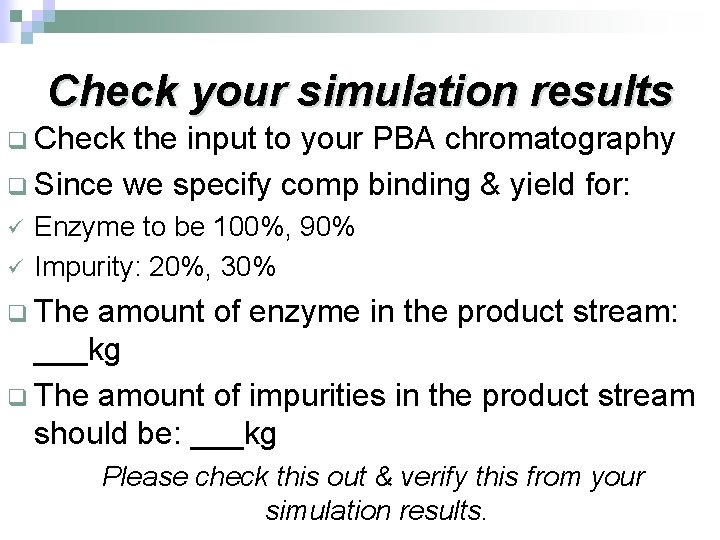
Check your simulation results q Check the input to your PBA chromatography q Since we specify comp binding & yield for: ü ü Enzyme to be 100%, 90% Impurity: 20%, 30% q The amount of enzyme in the product stream: ___kg q The amount of impurities in the product stream should be: ___kg Please check this out & verify this from your simulation results.