
Case Studies of Community College ESOL Programs and
![“I have already my [degree] in Senegal and I, when I come here, I](https://slidetodoc.com/presentation_image_h2/3c66cea68ab96a463cceeb466df3e31f/image-12.jpg "“I have already my [degree] in Senegal and I, when I come here, I")
- Slides: 22
Case Studies of Community College ESOL Programs and the Experiences of English Learners Julia Raufman Research Associate AERA Conference, April 2019
Overview of Presentation • Study background and context • Case Studies of ESOL reform approaches • Experiences of students in ESOL courses
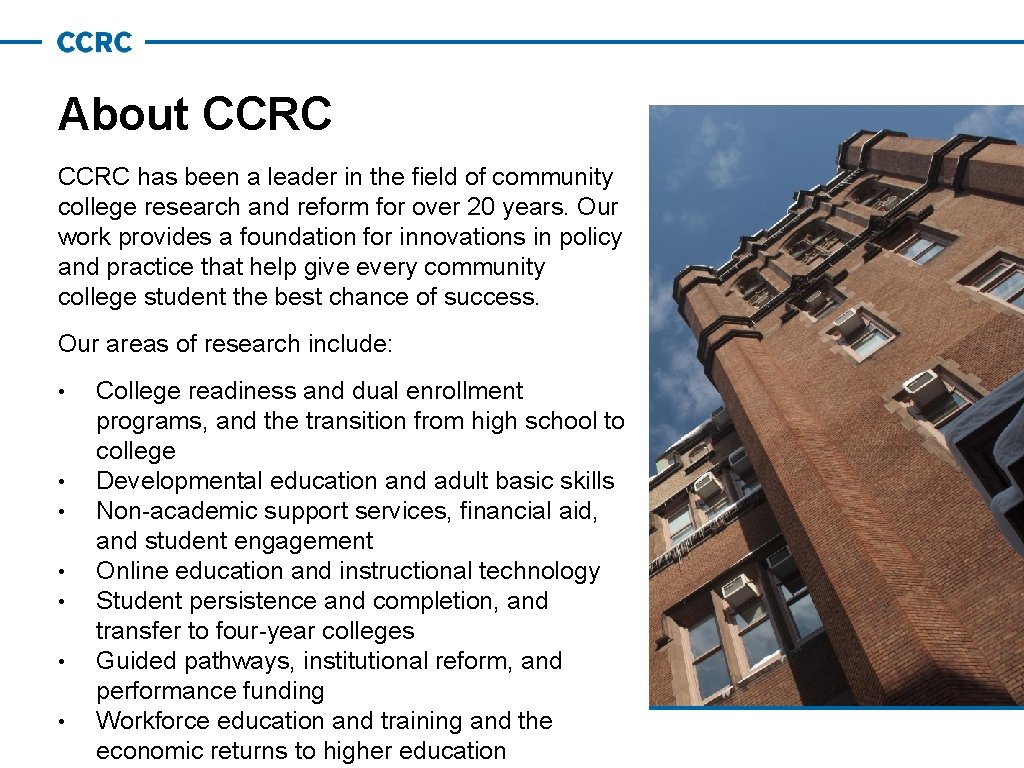
About CCRC has been a leader in the field of community college research and reform for over 20 years. Our work provides a foundation for innovations in policy and practice that help give every community college student the best chance of success. Our areas of research include: • • College readiness and dual enrollment programs, and the transition from high school to college Developmental education and adult basic skills Non-academic support services, financial aid, and student engagement Online education and instructional technology Student persistence and completion, and transfer to four-year colleges Guided pathways, institutional reform, and performance funding Workforce education and training and the economic returns to higher education
Study Background and Context
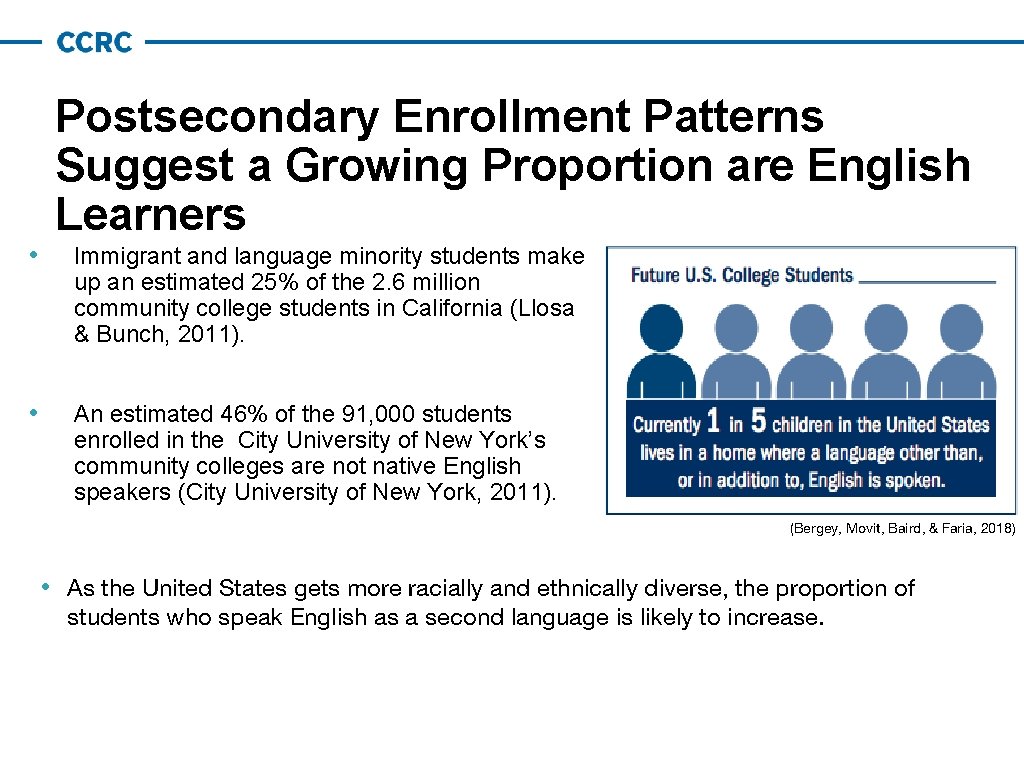
• • Postsecondary Enrollment Patterns Suggest a Growing Proportion are English Learners Immigrant and language minority students make up an estimated 25% of the 2. 6 million community college students in California (Llosa & Bunch, 2011). An estimated 46% of the 91, 000 students enrolled in the City University of New York’s community colleges are not native English speakers (City University of New York, 2011). (Bergey, Movit, Baird, & Faria, 2018) • As the United States gets more racially and ethnically diverse, the proportion of students who speak English as a second language is likely to increase.
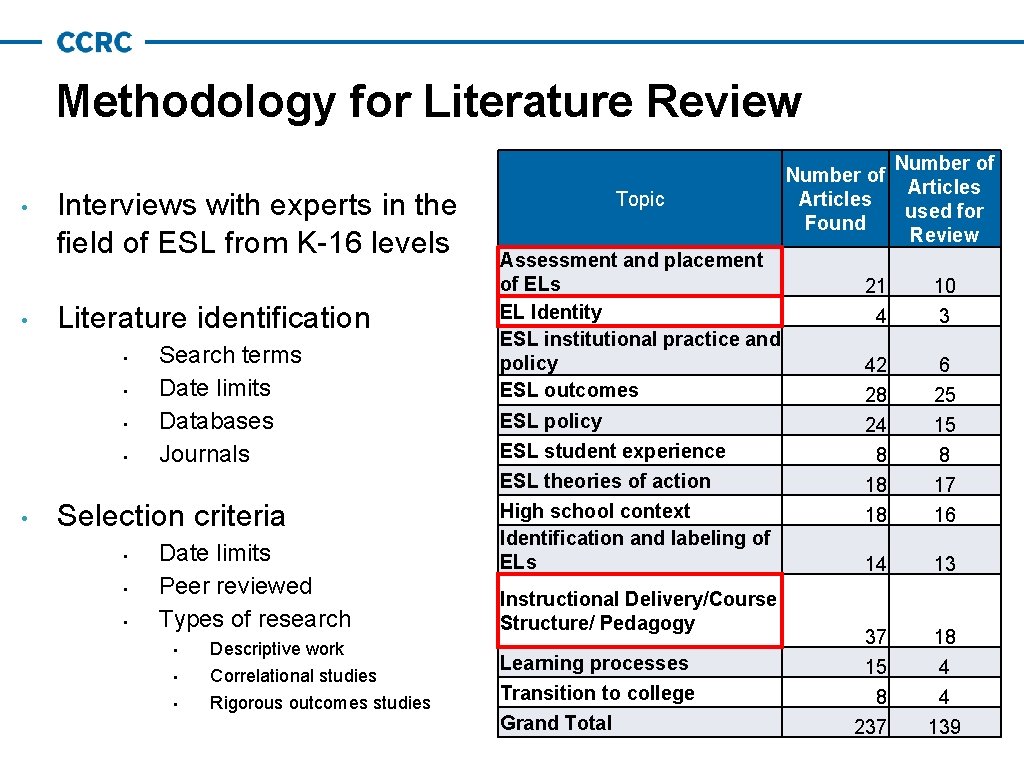
Methodology for Literature Review • • Interviews with experts in the field of ESL from K-16 levels Literature identification • • • Search terms Date limits Databases Journals Selection criteria • • • Date limits Peer reviewed Types of research • • • Descriptive work Correlational studies Rigorous outcomes studies Topic Assessment and placement of ELs EL Identity ESL institutional practice and policy ESL outcomes Number of Articles used for Found Review 21 10 4 3 42 6 28 25 24 15 8 8 ESL theories of action 18 17 High school context Identification and labeling of ELs 18 16 14 13 37 18 Learning processes 15 4 Transition to college 8 4 ESL policy ESL student experience Instructional Delivery/Course Structure/ Pedagogy Grand Total 237 139
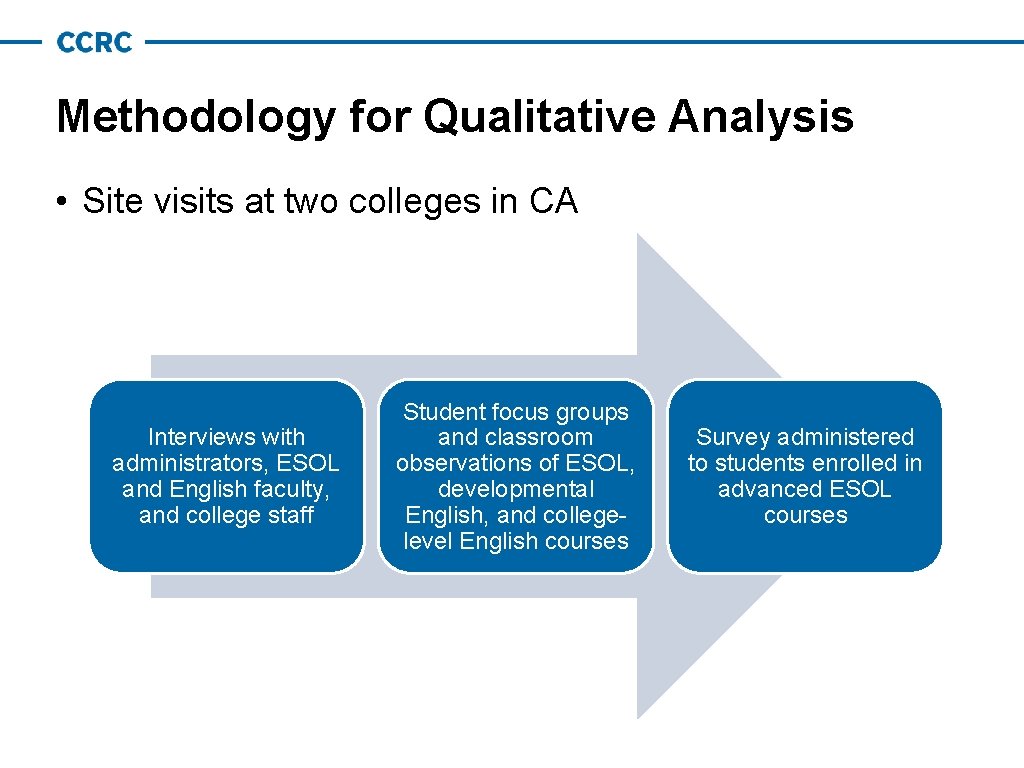
Methodology for Qualitative Analysis • Site visits at two colleges in CA Interviews with administrators, ESOL and English faculty, and college staff Student focus groups and classroom observations of ESOL, developmental English, and collegelevel English courses Survey administered to students enrolled in advanced ESOL courses
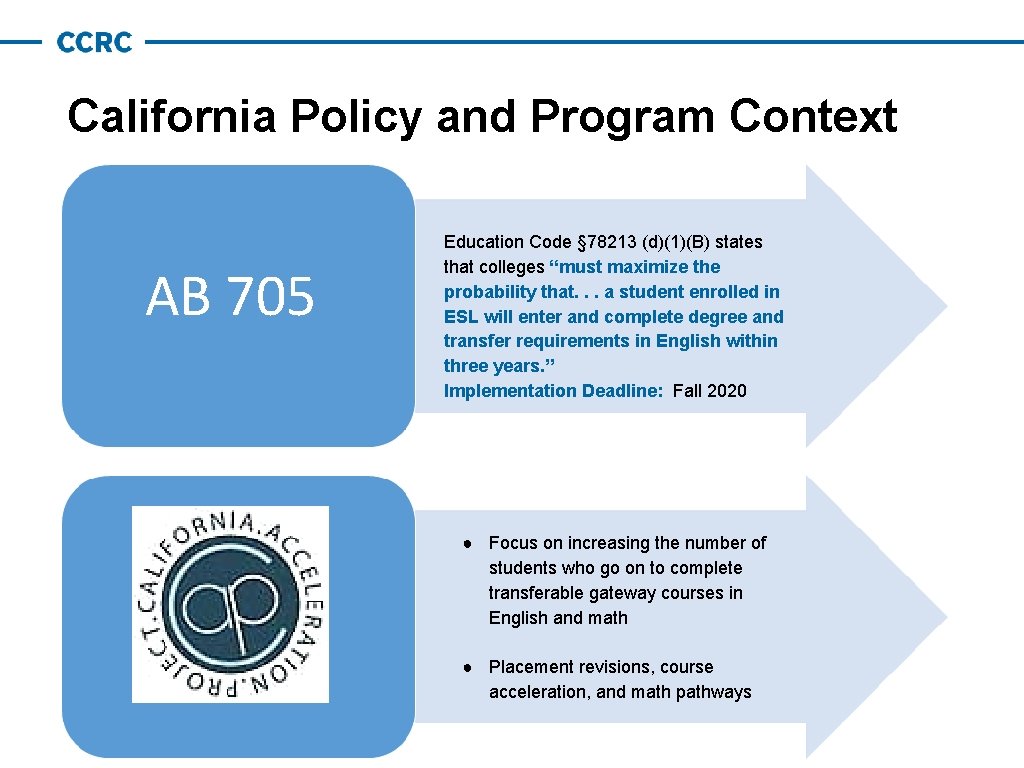
California Policy and Program Context AB 705 Education Code § 78213 (d)(1)(B) states that colleges “must maximize the probability that. . . a student enrolled in ESL will enter and complete degree and transfer requirements in English within three years. ” Implementation Deadline: Fall 2020 ● Focus on increasing the number of students who go on to complete transferable gateway courses in English and math ● Placement revisions, course acceleration, and math pathways
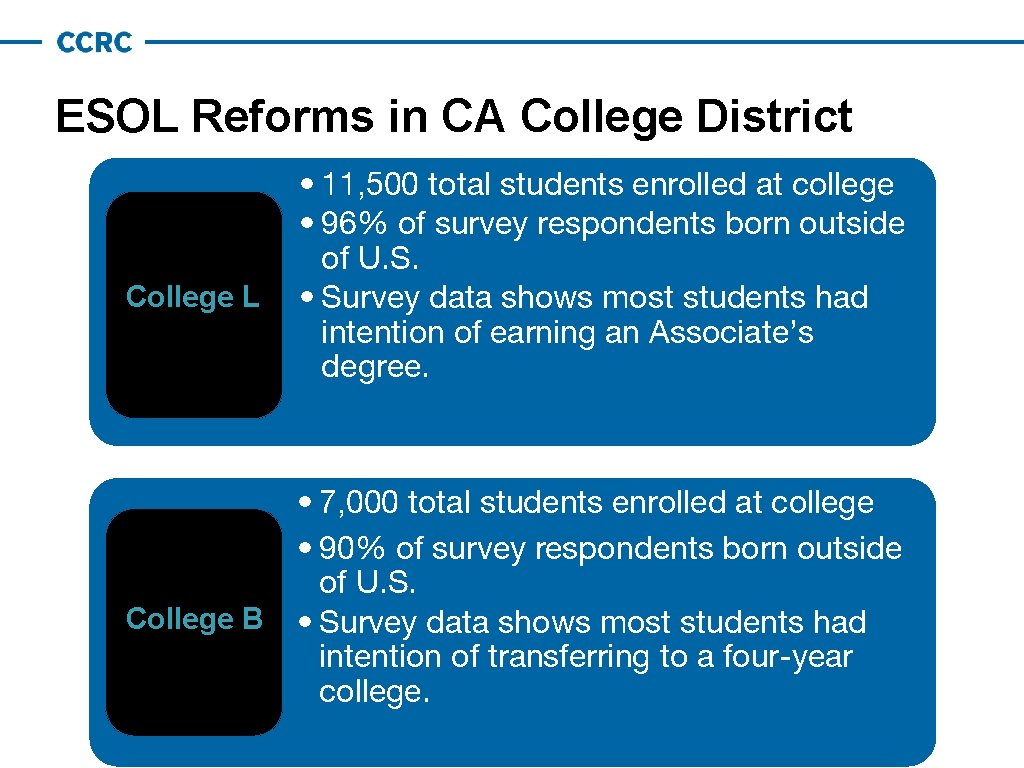
ESOL Reforms in CA College District College L College B • 11, 500 total students enrolled at college • 96% of survey respondents born outside of U. S. • Survey data shows most students had intention of earning an Associate’s degree. • 7, 000 total students enrolled at college • 90% of survey respondents born outside of U. S. • Survey data shows most students had intention of transferring to a four-year college.
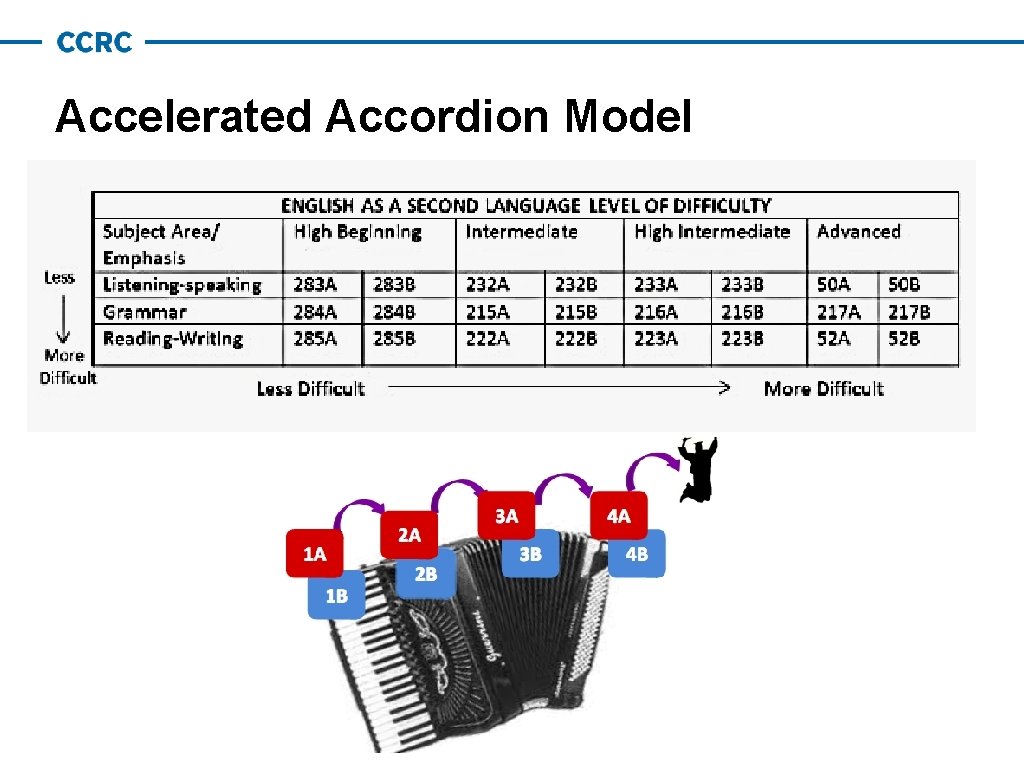
Accelerated Accordion Model
Case Studies of ESOL Reform Approaches and the Experiences of English Learners
“I have already my [degree] in Senegal and I, when I come here, I would like to make a change to know better and to like be more professional. That’s why I chose this program. And I took ESL first and my certificate class and it was like so hard because I do not understand right away what the teacher saying in class. But I used my dictionary to translate words to help me understand better. And right now I’m taking English five. ” Alimatou, 29, Advanced Grammar ESOL course
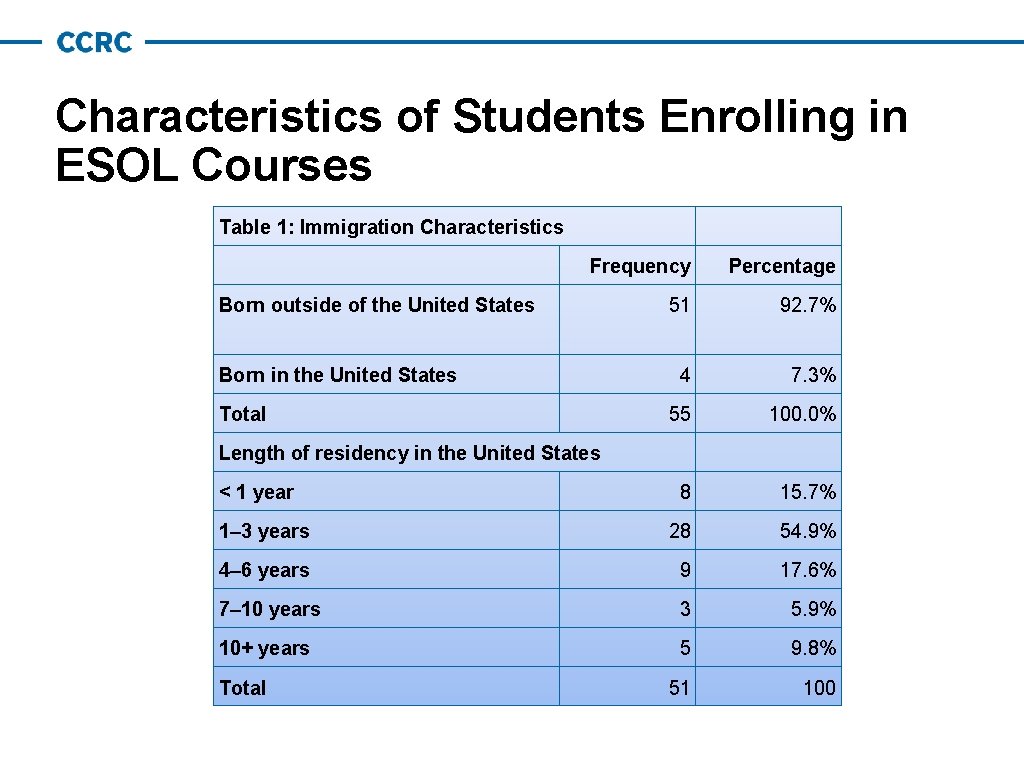
Characteristics of Students Enrolling in ESOL Courses Table 1: Immigration Characteristics Frequency Percentage 51 92. 7% 4 7. 3% 55 100. 0% 8 15. 7% 1– 3 years 28 54. 9% 4– 6 years 9 17. 6% 7– 10 years 3 5. 9% 10+ years 5 9. 8% 51 100 Born outside of the United States Born in the United States Total Length of residency in the United States < 1 year Total
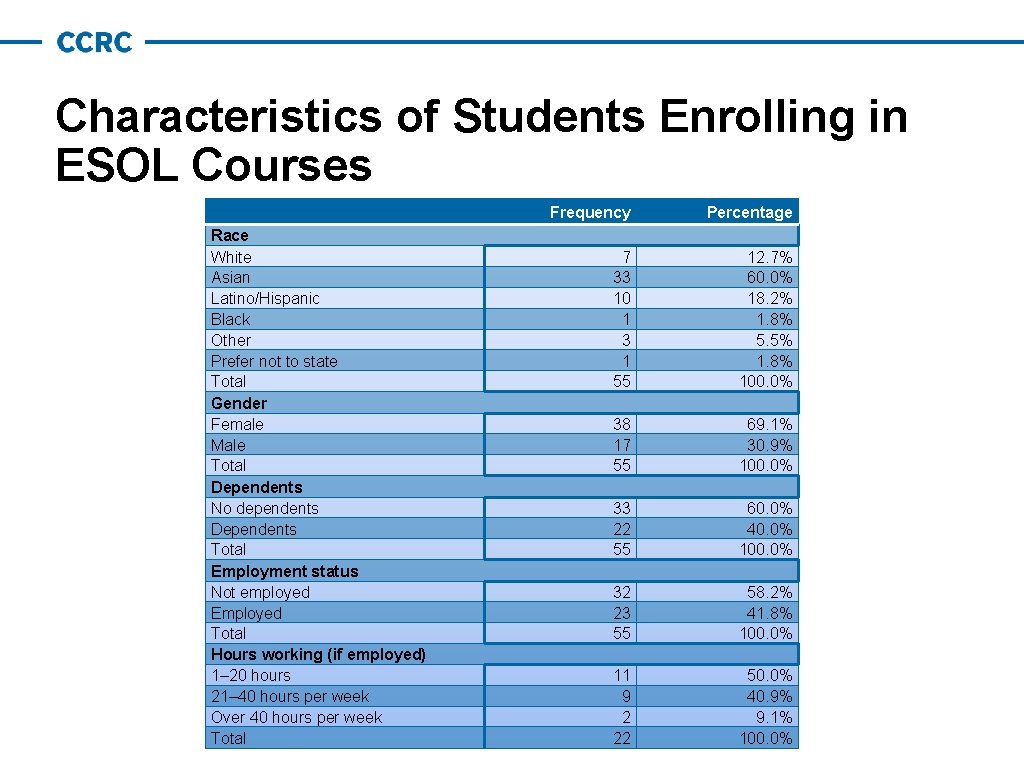
Characteristics of Students Enrolling in ESOL Courses Race White Asian Latino/Hispanic Black Other Prefer not to state Total Gender Female Male Total Dependents No dependents Dependents Total Employment status Not employed Employed Total Hours working (if employed) 1– 20 hours 21– 40 hours per week Over 40 hours per week Total Frequency Percentage 7 33 10 1 3 1 55 12. 7% 60. 0% 18. 2% 1. 8% 5. 5% 1. 8% 100. 0% 38 17 55 69. 1% 30. 9% 100. 0% 33 22 55 60. 0% 40. 0% 100. 0% 32 23 55 58. 2% 41. 8% 100. 0% 11 9 2 22 50. 0% 40. 9% 9. 1% 100. 0%
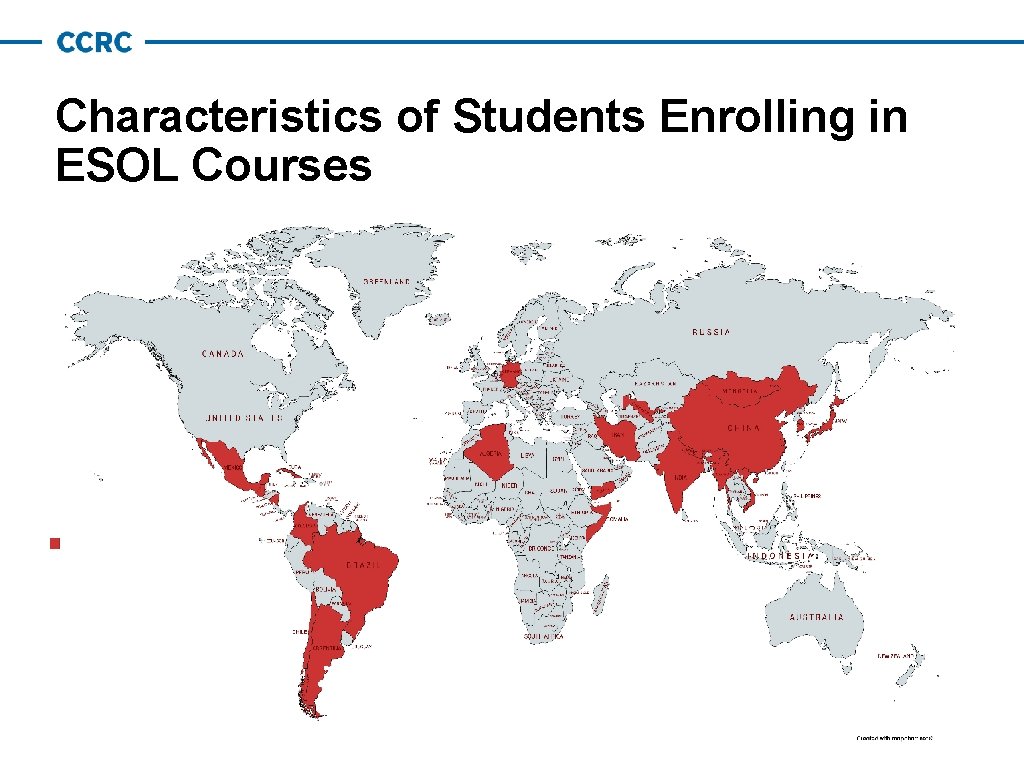
Characteristics of Students Enrolling in ESOL Courses
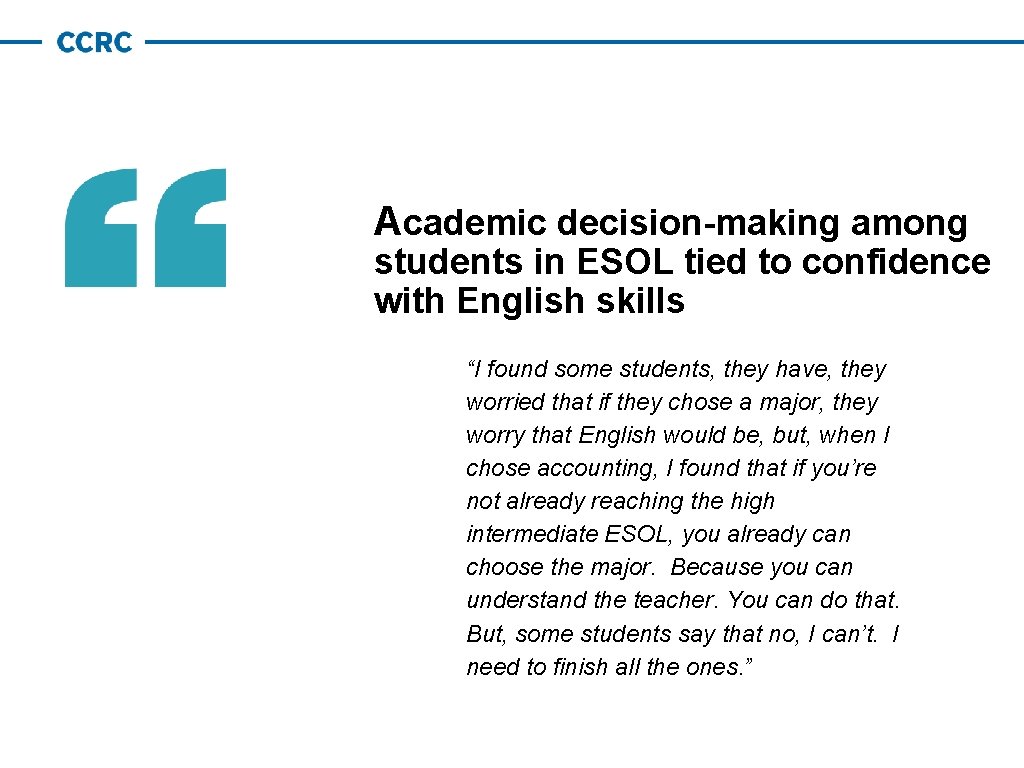
Academic decision-making among students in ESOL tied to confidence with English skills “I found some students, they have, they worried that if they chose a major, they worry that English would be, but, when I chose accounting, I found that if you’re not already reaching the high intermediate ESOL, you already can choose the major. Because you can understand the teacher. You can do that. But, some students say that no, I can’t. I need to finish all the ones. ”
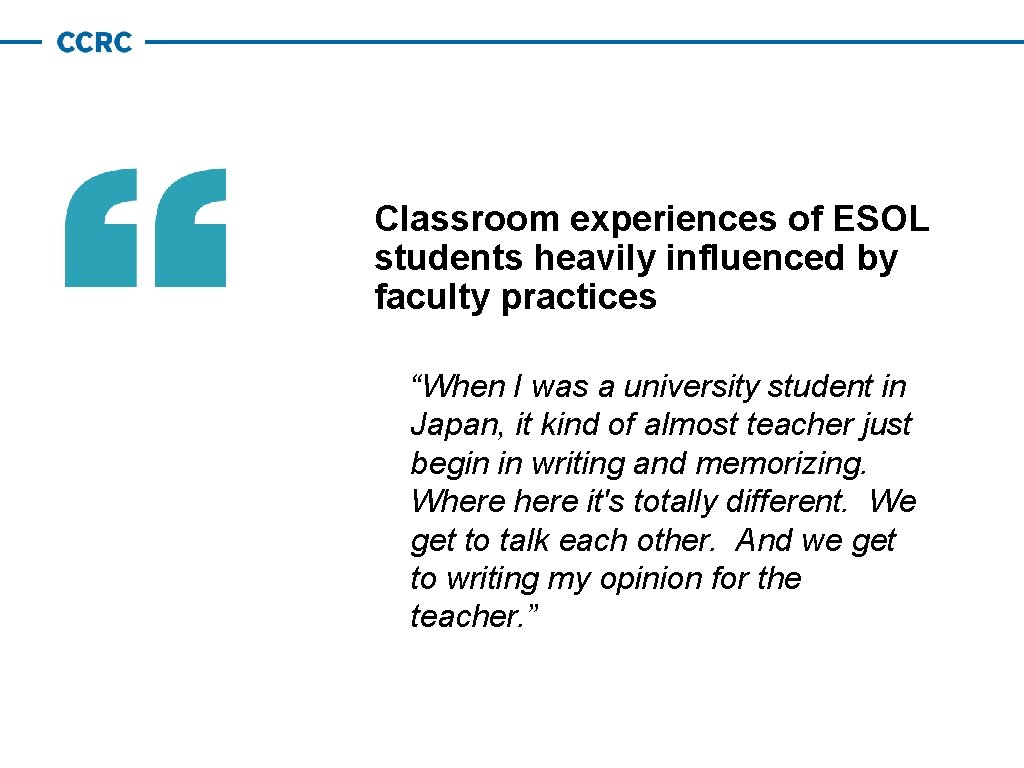
Classroom experiences of ESOL students heavily influenced by faculty practices “When I was a university student in Japan, it kind of almost teacher just begin in writing and memorizing. Where it's totally different. We get to talk each other. And we get to writing my opinion for the teacher. ”
ESOL students engaging with the community college Importance of Intake Processes “…when I met [the counselor], she just look at the things and she said that you selected ESL later and I find out that there’s a difference between English than ESL. The issue that I was expecting these guys to get me some explanation about it it’s good if you start English better for us and what I’m thinking of like if we wanted to complete a degree in two years and two and a half years so if you are adding more subjects so it’s going to be going up to three and a half years. ”
ESOL students engaging with the community college “and then the students are required to make an appointment with a counselor after they get the results of their tests. And that's where I think that interface between the counselors and the teachers I think is really critical because I don’t think the counselors are trained to - I mean sometimes I think they are seduced by a student who is fluent but they are fluently wrong. And so frequently I have - so often a student comes to class and they say well, this is where the counselor told me to go. But they are just so misplaced. ” –ESOL Instructor
ESOL students engaging with the community college Integration of ESOL students in the institution “But we never have like introduction like come from like hi, you’re a student. Not only ESL student, but a student. But, it would be nice to have like a tradition that you feel that you belong to this school. Cause I feel like I more belong to ESL groups and ESL course than I do belong to the [college]. ”
Thank you! Community College Research Center Teachers College, Columbia University 525 W 120 th St. | Box 174 | New York, NY 10027 Raufman@tc. edu
Sign up for announcements at Save the Date! November postsecondaryreadiness. org 21 -22, 2019 New York, NY