
Case Studies for Integrating Certification into Accessibility Strategies

Case Studies for Integrating Certification into Accessibility Strategies Handout available at: http: //www. accessibilityassociation. org/CSUN 18 or http: //bit. ly/IAAPCSUN 18 1
Agenda • Overview of IAAP Certification Program – Sharon Spencer, Managing Director, IAAP • Case Study – Higher Education (Princeton University) – Damian Sian, Sr. Web Accessibility Advisor • Case Study – Large Corporation (Wells Fargo) – Dena Wainwright, VP/Enterprise Online Accessibility Program Manager • Case Study – Accessibility Technology Company (Audio. Eye) – Todd Bankofier, CEO • Case Study – Non-profit (Ability. Net) – Nigel Lewis, CEO • Q&A – All 2
What is IAAP? • IAAP provides a place for professionals & organizations for: • Professional & Organizational Development • Resources to advance skills & best practices • Networking within the community • Activities, events & member-to-member communications • Certification • Demonstrate commitment and professional expertise • Influence change within the industry • Impact how accessibility is applied and perceived 3
Certification Goals • Goals - To strengthen the community of practice among accessibility professionals. • To define what accessibility professionals are expected to know. • To increase the quality and consistency of the work performed by accessibility professionals. • To provide accessibility professionals with a credential as evidence of their commitment to the accessibility field and of their competence within the field. • To provide employers with a metric to measure and assess the accessibility competence of current and/or prospective employees. • To provide colleges, universities, and vocational programs with clear educational outcomes and a curriculum outline for teaching accessibility. 4
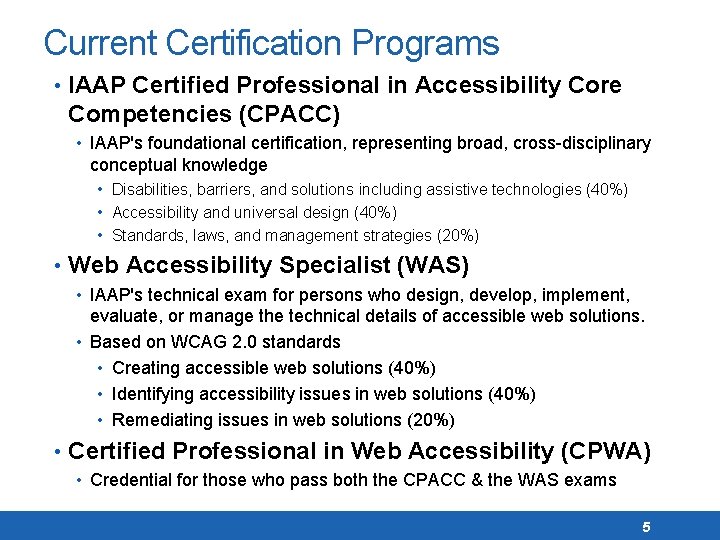
Current Certification Programs • IAAP Certified Professional in Accessibility Core Competencies (CPACC) • IAAP's foundational certification, representing broad, cross-disciplinary conceptual knowledge • Disabilities, barriers, and solutions including assistive technologies (40%) • Accessibility and universal design (40%) • Standards, laws, and management strategies (20%) • Web Accessibility Specialist (WAS) • IAAP's technical exam for persons who design, develop, implement, evaluate, or manage the technical details of accessible web solutions. • Based on WCAG 2. 0 standards • Creating accessible web solutions (40%) • Identifying accessibility issues in web solutions (40%) • Remediating issues in web solutions (20%) • Certified Professional in Web Accessibility (CPWA) • Credential for those who pass both the CPACC & the WAS exams 5
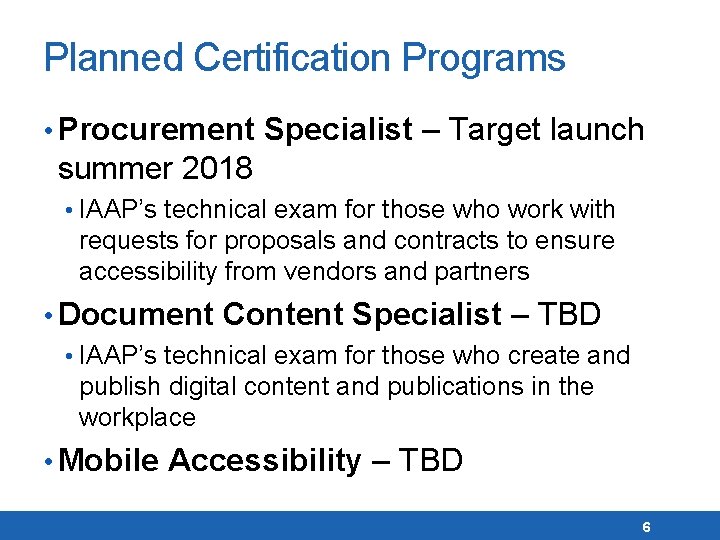
Planned Certification Programs • Procurement Specialist – Target launch summer 2018 • IAAP’s technical exam for those who work with requests for proposals and contracts to ensure accessibility from vendors and partners • Document Content Specialist – TBD • IAAP’s technical exam for those who create and publish digital content and publications in the workplace • Mobile Accessibility – TBD 6
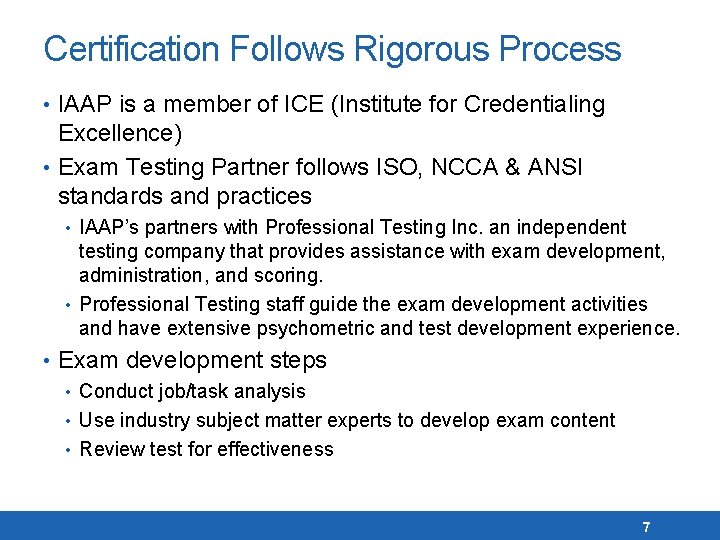
Certification Follows Rigorous Process • IAAP is a member of ICE (Institute for Credentialing Excellence) • Exam Testing Partner follows ISO, NCCA & ANSI standards and practices • IAAP’s partners with Professional Testing Inc. an independent testing company that provides assistance with exam development, administration, and scoring. • Professional Testing staff guide the exam development activities and have extensive psychometric and test development experience. • Exam development steps • Conduct job/task analysis • Use industry subject matter experts to develop exam content • Review test for effectiveness 7
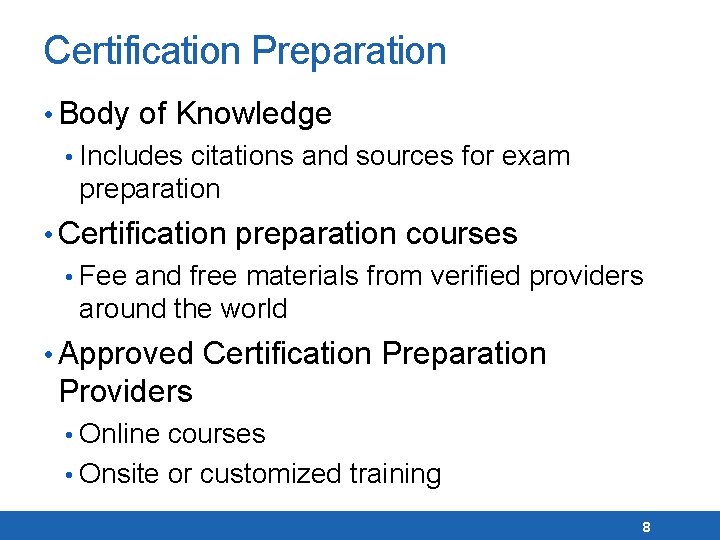
Certification Preparation • Body of Knowledge • Includes citations and sources for exam preparation • Certification preparation courses • Fee and free materials from verified providers around the world • Approved Certification Preparation Providers • Online courses • Onsite or customized training 8
Case Study: Princeton University Damian Sr. Web Accessibility Advisor 9
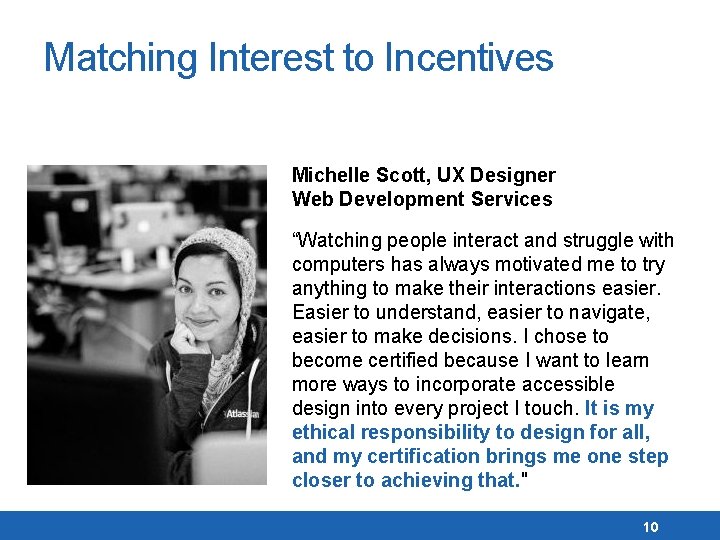
Matching Interest to Incentives Michelle Scott, UX Designer Web Development Services “Watching people interact and struggle with computers has always motivated me to try anything to make their interactions easier. Easier to understand, easier to navigate, easier to make decisions. I chose to become certified because I want to learn more ways to incorporate accessible design into every project I touch. It is my ethical responsibility to design for all, and my certification brings me one step closer to achieving that. " 10
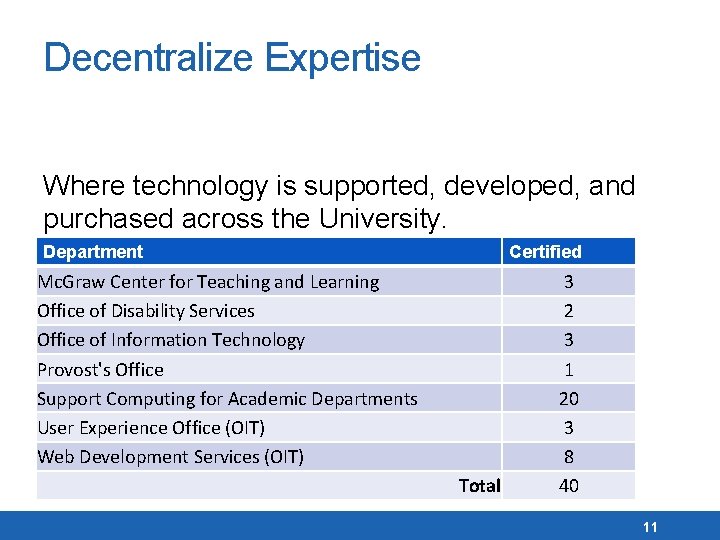
Decentralize Expertise Where technology is supported, developed, and purchased across the University. Department Certified Mc. Graw Center for Teaching and Learning Office of Disability Services Office of Information Technology Provost's Office Support Computing for Academic Departments User Experience Office (OIT) Web Development Services (OIT) Total 3 2 3 1 20 3 8 40 11
Structure of the Training Curriculum • Indoctrinates the novice • Challenges the initiated Flipped and Blended • Online course in ed. X Edge • 24 hours of instructor led classroom learning • Study sessions 12

Success Stories Architecture Security Review Board • Departments purchasing IT are more consistently brining accessible vendors to the table. Support and Operations Center • Princeton’s Help Desk professionals are using the curriculum to build expertise 13
Case Study: Wells Fargo Dena Wainwright VP/Enterprise Online Accessibility Program Manager Enterprise Digital Properties Governance © 2018 Wells Fargo Bank, N. A. All rights reserved. For public use. 14
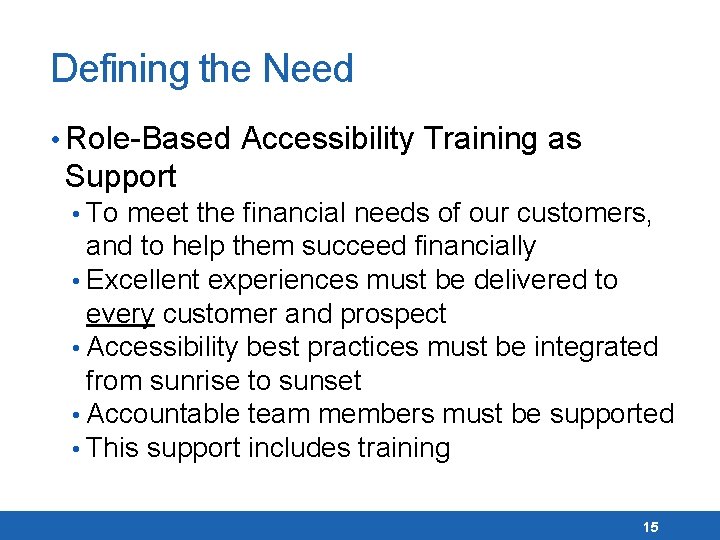
Defining the Need • Role-Based Accessibility Training as Support • To meet the financial needs of our customers, and to help them succeed financially • Excellent experiences must be delivered to every customer and prospect • Accessibility best practices must be integrated from sunrise to sunset • Accountable team members must be supported • This support includes training 15
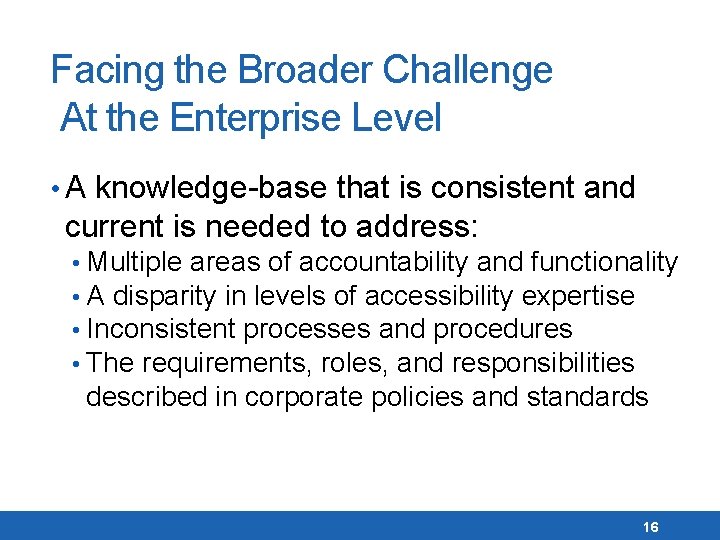
Facing the Broader Challenge At the Enterprise Level • A knowledge-base that is consistent and current is needed to address: • Multiple areas of accountability and functionality • A disparity in levels of accessibility expertise • Inconsistent processes and procedures • The requirements, roles, and responsibilities described in corporate policies and standards 16

Facing the Practical Challenge • At the Team and Individual Level • An effective training model must answer questions like: Who needs training? Which courses are required? Where should the courses come from? How will training requirements and courses be communicated and delivered? • How will completed training be tracked? • Will “recertification” be necessary? If so, how often? • • 17
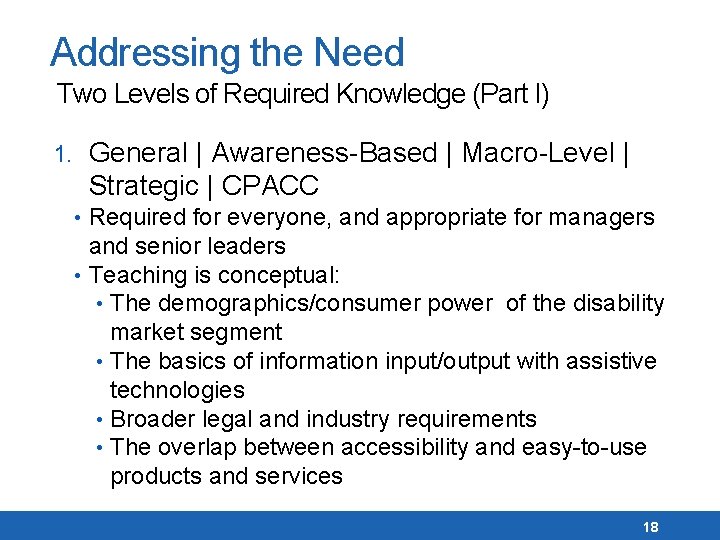
Addressing the Need Two Levels of Required Knowledge (Part I) 1. General | Awareness-Based | Macro-Level | Strategic | CPACC • Required for everyone, and appropriate for managers and senior leaders • Teaching is conceptual: • The demographics/consumer power of the disability market segment • The basics of information input/output with assistive technologies • Broader legal and industry requirements • The overlap between accessibility and easy-to-use products and services 18
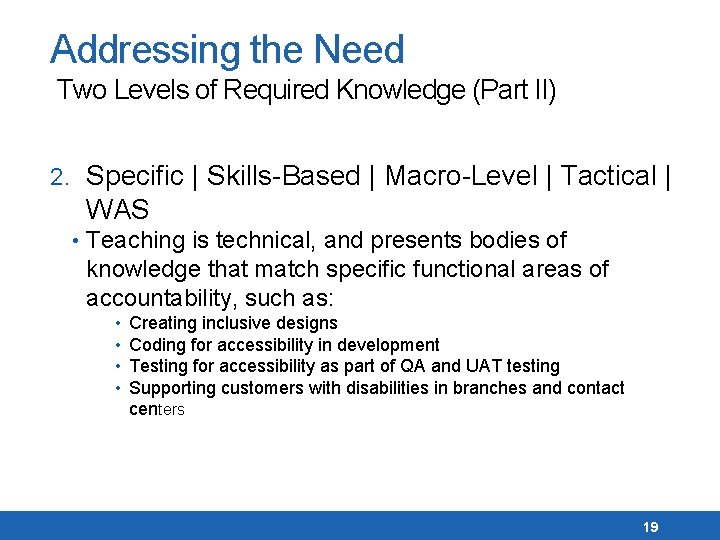
Addressing the Need Two Levels of Required Knowledge (Part II) 2. Specific | Skills-Based | Macro-Level | Tactical | WAS • Teaching is technical, and presents bodies of knowledge that match specific functional areas of accountability, such as: • • Creating inclusive designs Coding for accessibility in development Testing for accessibility as part of QA and UAT testing Supporting customers with disabilities in branches and contact centers 19
Communicating the Path Forward • Laying the Groundwork • Research team member roles and responsibilities • List the required functions of these roles • Survey affected team members about their job activities • Require role-based accessibility training in policies and standards • Create required and recommended course paths • Track completion of courses in a learning system 20
Providing Incentives For. . . Current and Future Certificants • List accessibility certifications in job descriptions • Include accessibility deliverables in team members’ annual performance objectives and reviews • Offer team members access to the study materials, & a reduction in examination fees • Place certified team members into a database of experts 21
Case Study: Audio. Eye, Inc. Todd Bankofier CEO 22
Why Certification? 1. Forces us to Rethink Disability 2. Speaks to our Culture of People First 3. Establishes Subject Matter Expertise for our Customers 23
Rethink Disability • The Knowledge Base provides Audio. Eye team members a true, in-depth understanding of the scope of disability beyond “ramps and rails”. • The information is invaluable from a human perspective; creating an understanding of the nature of, and challenges of individual disabilities, has been life changing for our team. • The information is invaluable from a technical perspective; having a team, beyond technologists, that can speak intelligently to disability-specific challenges, technology requirements and AT, is a key differentiator. 24

People First Our Team ü Certification sets our team up for success, giving them the foundation to speak intelligently and confidently about our industry, our company, and most importantly, to more effectively convey information to the people we ultimately serve – people with disabilities. ü Audio. Eye covers the cost of the exam and our Team receives a bonus upon passing. End Users ü Web accessibility offers a breadth of freedom to people with disabilities that no generation in history has ever experienced. The knowledge we gain from understanding the range of information provided – from legal requirements to WCAG 2. 0 and Universal Design, forces us to continually examine everything we do for greater inclusivity. 25
Subject Matter Expertise Our Clients Rely on us to know what they don’t; they count on us to guide them through “accessibility” and need to have the confidence that we know what we’re doing and talking about. Our Partners Value our expertise and promote to their clients that 50% of the Audio. Eye team is IAAP Certified. 50% of the team has CPACC and 2 WAS certifications. 10+ team members are preparing for WAS and 7 more for CPACC. The understanding we gain from the CPACC and WAS process helps us convey one of our core messages: Accessibility is about People, before compliance. 26

Case Study: Ability. Net Nigel Lewis CEO 27
Ability. Net • UK charity helping disabled and older people • Focus is accessible and inclusive technology • Individuals – how best to adapt their technology • Organisations – how to make web/apps accessible 28
Certification • CPACC – for the majority of staff • WAS – for all accessibility consultants • Procurement – will be for some • Mobile – for all accessibility consultants • Others when they come 29
Benefits of Certification 1. Credibility for our staff and services offered 2. Evidences our expertise for clients 3. Complements and gives bite to our training 4. Provides our staff recognition and reward to accessibility 30
Advance Your Accessibility Strategy • Use certification as a tool to grow skills • Join IAAP and access resources to support individuals and organizations • Join industry leaders and accessibility professionals at the M-Enabling Summit 2018 • Renaissance Arlington Capital View Hotel • June 11 -13, 2018 • This year’s summit track sessions include: • Accessibility Innovation Drivers • Higher Education Forum • Connected Independent Living & End User Solutions • IAAP Technical & Organizational Development Tracks 31
Questions? 32
- Slides: 32