
Case Service Report RSA911 RSA911 Training for VR
- Slides: 48
Case Service Report (RSA-911) RSA-911 Training for VR Counselors
Objectives 1. Provide a breakdown of the information collected in the Case Service Report (RSA-911). 2. Share examples of additional requirements outside of RSA-911 reporting (e. g. , source documentation). 3. Provide considerations and expectations (e. g. , policies State VR agencies need to establish and implement, tools and resources that are available, and internal controls). 2
Presenters Christopher Pope, RSA Rachel Anderson, WINTAC 3
What do the VR regulations say? • The foundation of the VR program is the principle that individuals with disabilities, including those with the most significant disabilities, are capable of achieving high quality, competitive integrated employment when provided the necessary services and supports. • To increase the employment of individuals with disabilities in the competitive integrated labor market, the workforce system must provide individuals with disabilities opportunities to participate in job -driven training and to pursue high quality employment outcomes. Page 55631 Federal Register 4
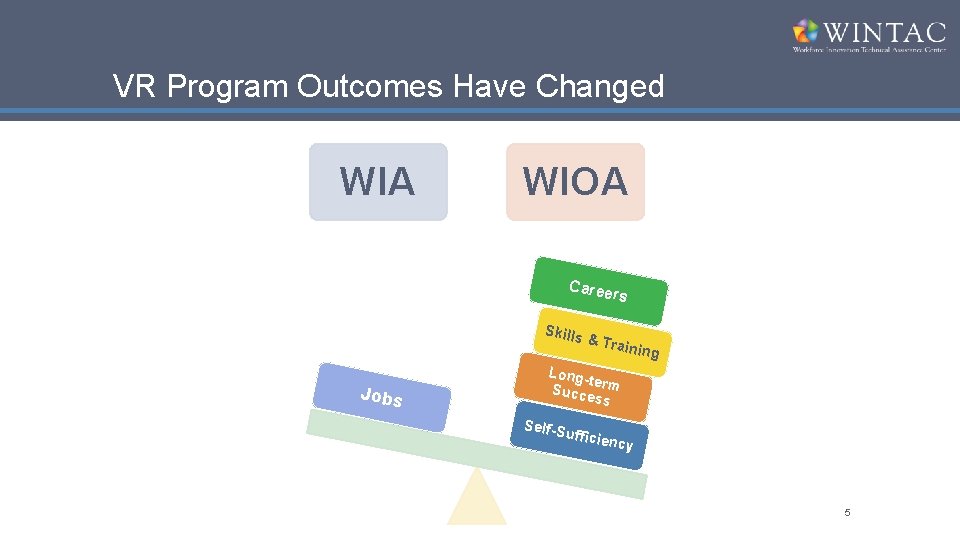
VR Program Outcomes Have Changed WIA WIOA Caree Skills Jobs rs & Tra ining Longte Succe rm ss Self-S ufficie ncy 5
Case Service Report (RSA-911)
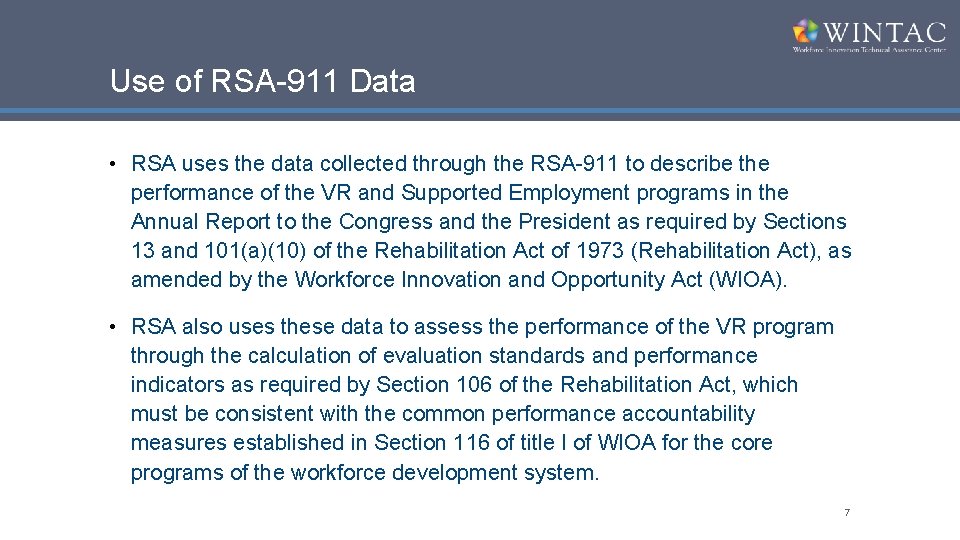
Use of RSA-911 Data • RSA uses the data collected through the RSA-911 to describe the performance of the VR and Supported Employment programs in the Annual Report to the Congress and the President as required by Sections 13 and 101(a)(10) of the Rehabilitation Act of 1973 (Rehabilitation Act), as amended by the Workforce Innovation and Opportunity Act (WIOA). • RSA also uses these data to assess the performance of the VR program through the calculation of evaluation standards and performance indicators as required by Section 106 of the Rehabilitation Act, which must be consistent with the common performance accountability measures established in Section 116 of title I of WIOA for the core programs of the workforce development system. 7
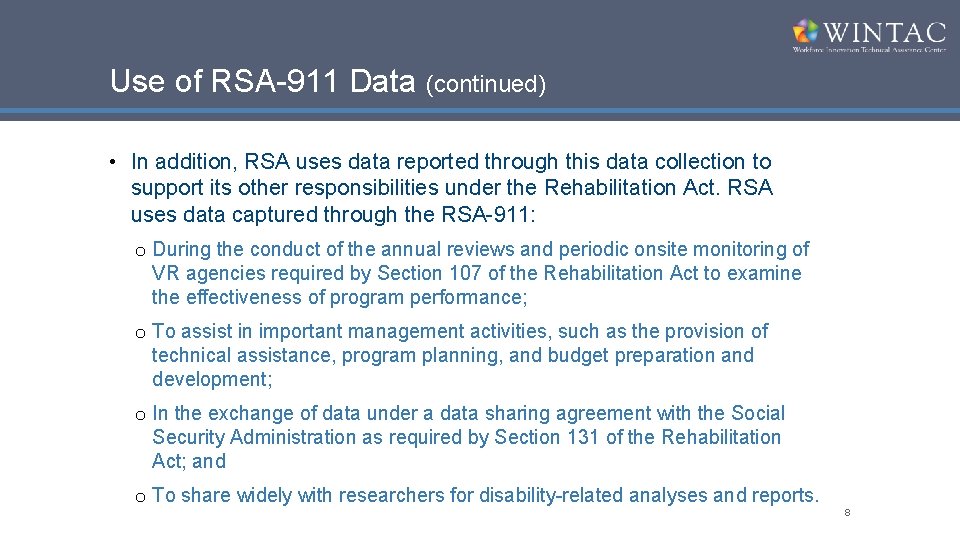
Use of RSA-911 Data (continued) • In addition, RSA uses data reported through this data collection to support its other responsibilities under the Rehabilitation Act. RSA uses data captured through the RSA-911: o During the conduct of the annual reviews and periodic onsite monitoring of VR agencies required by Section 107 of the Rehabilitation Act to examine the effectiveness of program performance; o To assist in important management activities, such as the provision of technical assistance, program planning, and budget preparation and development; o In the exchange of data under a data sharing agreement with the Social Security Administration as required by Section 131 of the Rehabilitation Act; and o To share widely with researchers for disability-related analyses and reports. 8
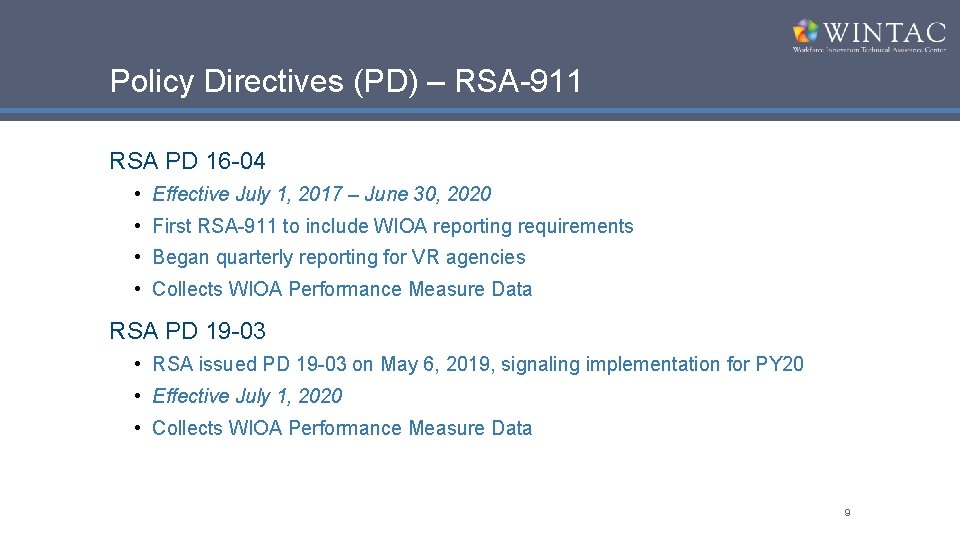
Policy Directives (PD) – RSA-911 RSA PD 16 -04 • Effective July 1, 2017 – June 30, 2020 • First RSA-911 to include WIOA reporting requirements • Began quarterly reporting for VR agencies • Collects WIOA Performance Measure Data RSA PD 19 -03 • RSA issued PD 19 -03 on May 6, 2019, signaling implementation for PY 20 • Effective July 1, 2020 • Collects WIOA Performance Measure Data 9
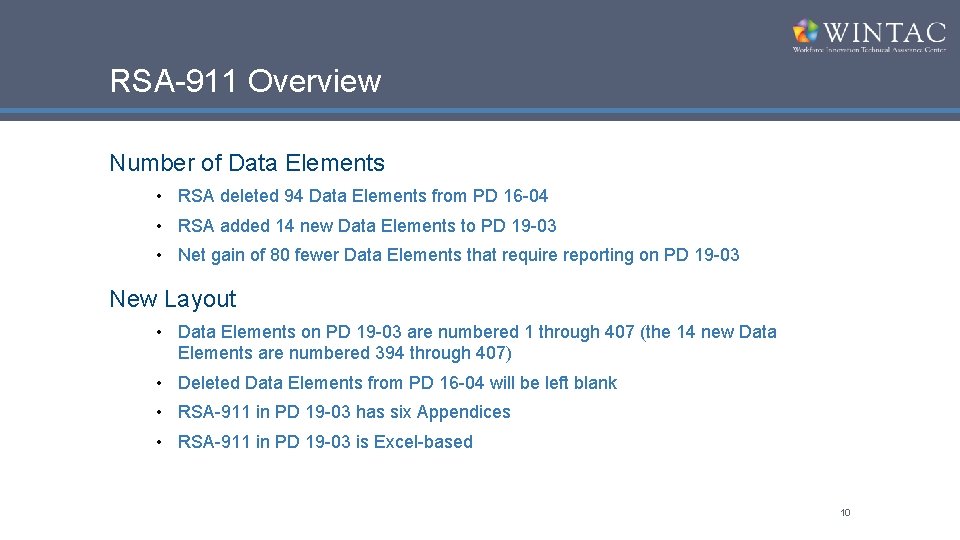
RSA-911 Overview Number of Data Elements • RSA deleted 94 Data Elements from PD 16 -04 • RSA added 14 new Data Elements to PD 19 -03 • Net gain of 80 fewer Data Elements that require reporting on PD 19 -03 New Layout • Data Elements on PD 19 -03 are numbered 1 through 407 (the 14 new Data Elements are numbered 394 through 407) • Deleted Data Elements from PD 16 -04 will be left blank • RSA-911 in PD 19 -03 has six Appendices • RSA-911 in PD 19 -03 is Excel-based 10
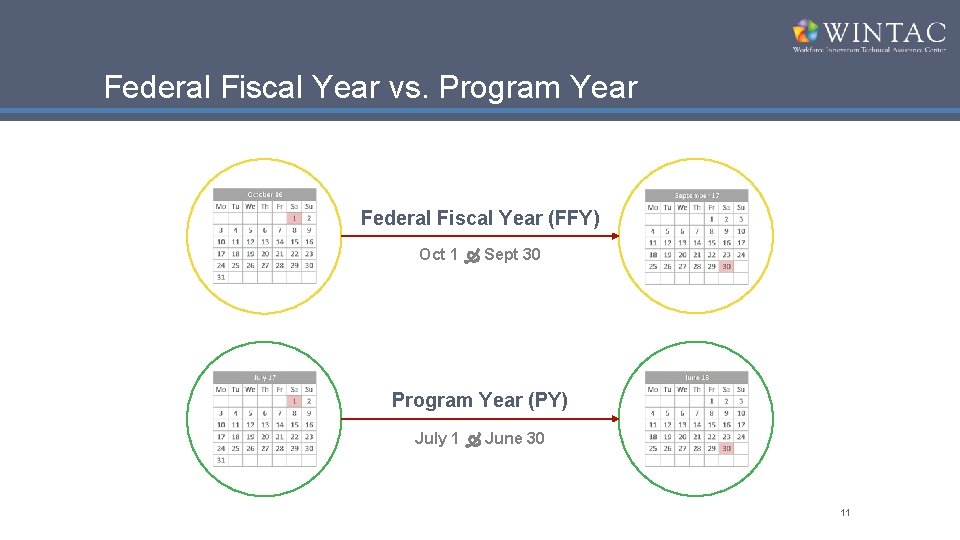
Federal Fiscal Year vs. Program Year Federal Fiscal Year (FFY) Oct 1 Sept 30 Program Year (PY) July 1 June 30 11
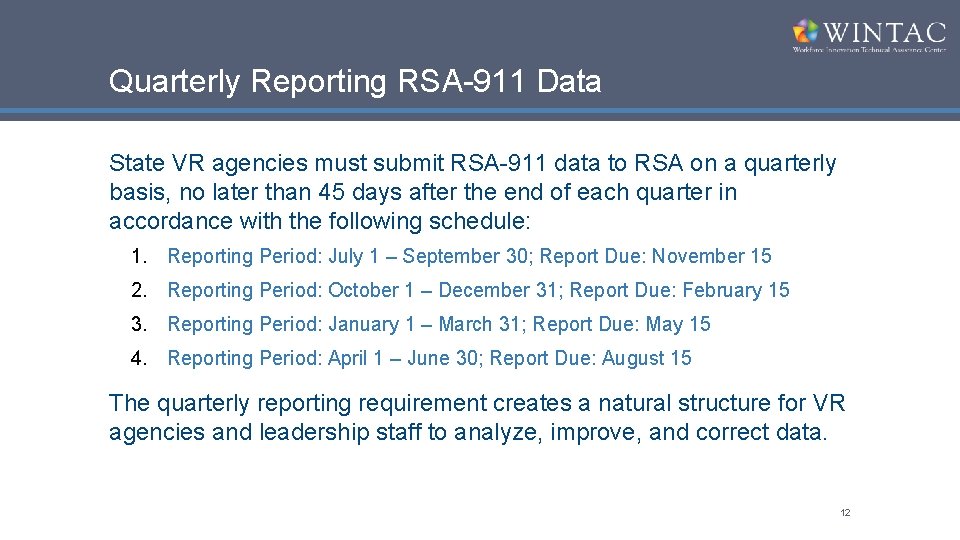
Quarterly Reporting RSA-911 Data State VR agencies must submit RSA-911 data to RSA on a quarterly basis, no later than 45 days after the end of each quarter in accordance with the following schedule: 1. Reporting Period: July 1 – September 30; Report Due: November 15 2. Reporting Period: October 1 – December 31; Report Due: February 15 3. Reporting Period: January 1 – March 31; Report Due: May 15 4. Reporting Period: April 1 – June 30; Report Due: August 15 The quarterly reporting requirement creates a natural structure for VR agencies and leadership staff to analyze, improve, and correct data. 12
Case Management Systems & RSA-911 Data How does information make it into the RSA-911 quarterly report? • VR Counselors (and other direct line staff) create the bulk of the information that completes the RSA-911 report; • The VR agency’s case management system generates the RSA-911 report using the information VR Counselors enter; • The VR agency uploads these files to RSA, correcting any errors identified by the submission process until the file is uploaded successfully. VR Counselors are responsible for entering timely information for every individual being served in order to meet the RSA-911 reporting requirements. 13
Data Reporting Requirements • Applicable portions of the Rehabilitation Act explicitly or implicitly require the collecting and reporting of specific Data Elements by State VR agencies to RSA for the VR and Supported Employment programs. • In addition, reporting requirements to support the performance accountability system under Section 116 of title I of WIOA are applicable to the VR program, as one of the six core programs of the workforce development system. o Section 116 requires the reporting of data needed to calculate State performance on the primary indicators of performance for the core programs. o In addition, States must report information on barriers to employment for participants under each of the core programs. 14
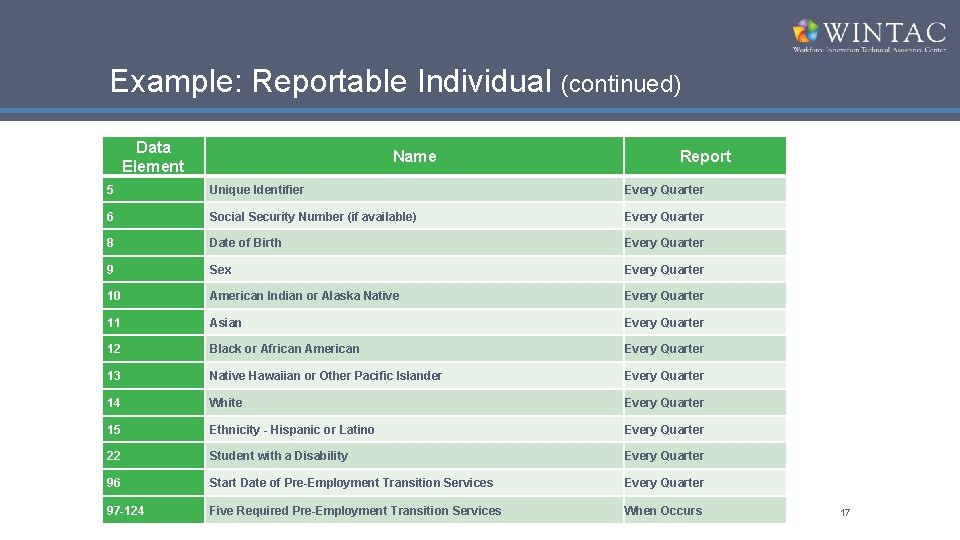
Data Reporting Requirements (continued) Reportable Individuals • Individuals who have applied for VR services, but have not yet met the definition of “participant”; and • Students with disabilities receiving pre-employment transition services prior to applying and being determined eligible for VR services and having an approved IPE (e. g. , the student does not meet the definition of a “participant”). Program Participants • An individual is a “participant” if he or she has an approved individualized plan for employment (IPE) and has begun receiving VR services (i. e. , individual has applied for and been determined eligible for VR services and has begun receiving services under an IPE). 15
Example: Reportable Individual James is a student with a disability who is potentially eligible for the VR program. The VR Counselor collected a referral and consent form from the school and parent verifying that he needed Self-Advocacy and Job Exploration Counseling services. • The VR agency is required to collect and report the reportable individual and pre-employment transition services Data Elements for James. • The VR agency is responsible for the collection of source documentation, time allocation, and other requirements related to the provision of pre-employment transition services, required by the Rehab Act. However, only a portion of this is collected in the RSA-911 report. 16
Example: Reportable Individual (continued) Data Element Name Report 5 Unique Identifier Every Quarter 6 Social Security Number (if available) Every Quarter 8 Date of Birth Every Quarter 9 Sex Every Quarter 10 American Indian or Alaska Native Every Quarter 11 Asian Every Quarter 12 Black or African American Every Quarter 13 Native Hawaiian or Other Pacific Islander Every Quarter 14 White Every Quarter 15 Ethnicity - Hispanic or Latino Every Quarter 22 Student with a Disability Every Quarter 96 Start Date of Pre-Employment Transition Services Every Quarter 97 -124 Five Required Pre-Employment Transition Services When Occurs 17
Example: Participant Candice was found eligible for the VR program due to a cognitive and psychological disorder. Her IPE goal is to become an accountant. She is almost finished completing her training program at the local university, while continuing active participation in her restoration services. • The VR agency is required to collect and report the participant and career/training services Data Elements for Candice. • The VR agency is responsible for the collection of source documentation, case notes, eligibility determination, signed IPE, and other requirements related to the provision of VR services, required by the Rehab Act. However, only a portion of this is collected in the RSA-911 report. • Because Candice is a participant, her outcomes may be included in the WIOA performance measures. 18
Example: Participant (continued) All Data Elements applicable to Candice must be reported on the RSA-911: • Reportable Individual: Unique Identifier, Social Security Number, Date of Birth, Sex, Race/Ethnicity. • Participant: Application date, eligibility date, IPE date, and start of initial VR service on or after IPE. • Career and/or Training Services: All services provided to Candice in the quarter that they were provided. For example, Candice received … o VR Counseling and Guidance o Accounting Tuition/Fees/Books (including Measurable Skill Gains) o Restoration Services (e. g. , counseling, medications) 19
Internal Controls & Data Validation
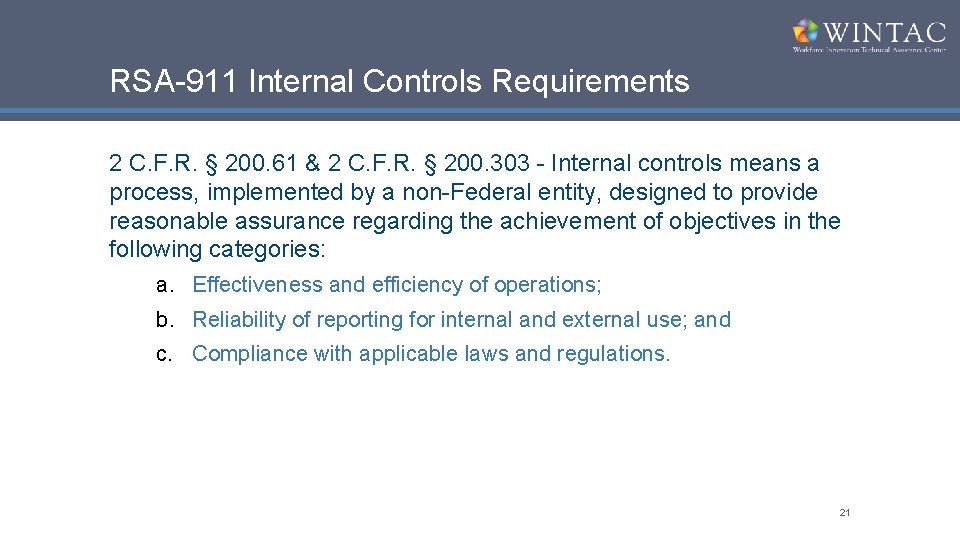
RSA-911 Internal Controls Requirements 2 C. F. R. § 200. 61 & 2 C. F. R. § 200. 303 - Internal controls means a process, implemented by a non-Federal entity, designed to provide reasonable assurance regarding the achievement of objectives in the following categories: a. Effectiveness and efficiency of operations; b. Reliability of reporting for internal and external use; and c. Compliance with applicable laws and regulations. 21
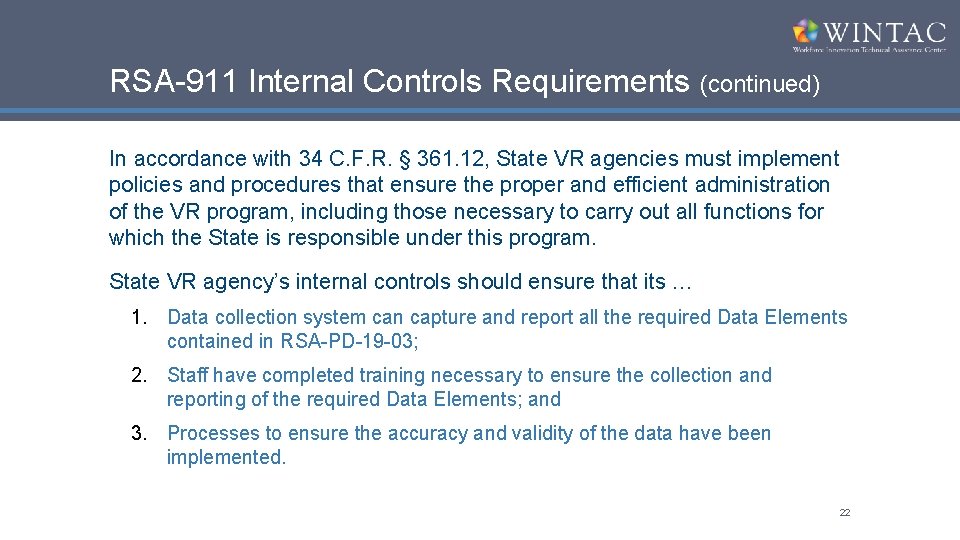
RSA-911 Internal Controls Requirements (continued) In accordance with 34 C. F. R. § 361. 12, State VR agencies must implement policies and procedures that ensure the proper and efficient administration of the VR program, including those necessary to carry out all functions for which the State is responsible under this program. State VR agency’s internal controls should ensure that its … 1. Data collection system can capture and report all the required Data Elements contained in RSA-PD-19 -03; 2. Staff have completed training necessary to ensure the collection and reporting of the required Data Elements; and 3. Processes to ensure the accuracy and validity of the data have been implemented. 22
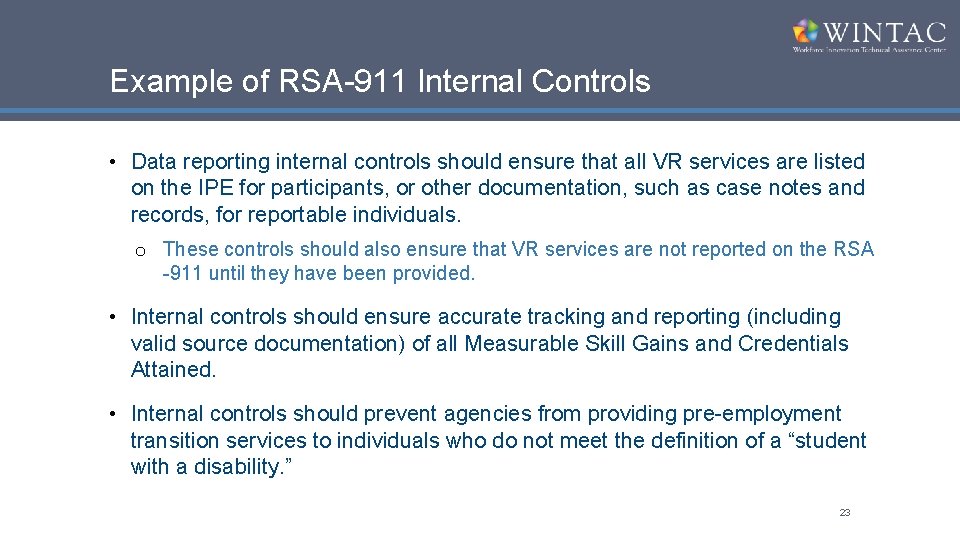
Example of RSA-911 Internal Controls • Data reporting internal controls should ensure that all VR services are listed on the IPE for participants, or other documentation, such as case notes and records, for reportable individuals. o These controls should also ensure that VR services are not reported on the RSA -911 until they have been provided. • Internal controls should ensure accurate tracking and reporting (including valid source documentation) of all Measurable Skill Gains and Credentials Attained. • Internal controls should prevent agencies from providing pre-employment transition services to individuals who do not meet the definition of a “student with a disability. ” 23
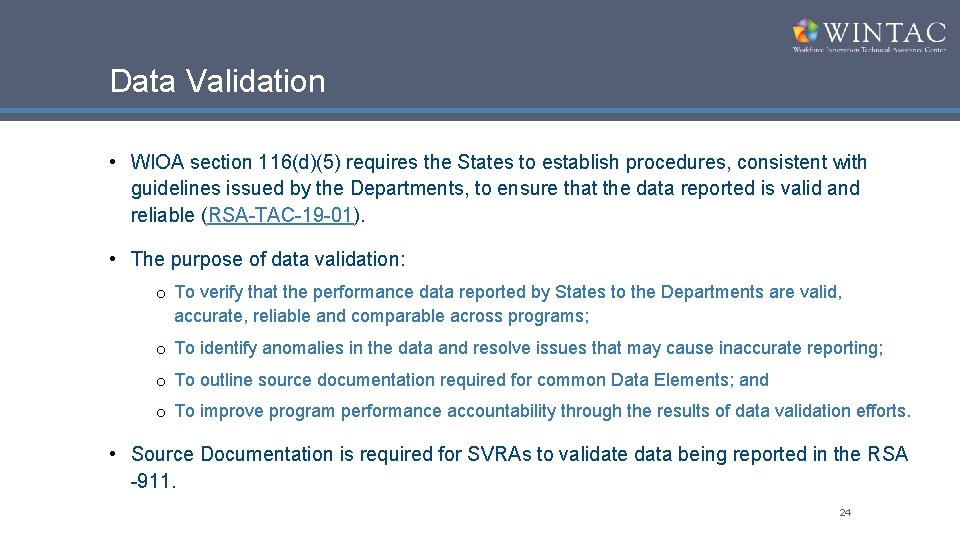
Data Validation • WIOA section 116(d)(5) requires the States to establish procedures, consistent with guidelines issued by the Departments, to ensure that the data reported is valid and reliable (RSA-TAC-19 -01). • The purpose of data validation: o To verify that the performance data reported by States to the Departments are valid, accurate, reliable and comparable across programs; o To identify anomalies in the data and resolve issues that may cause inaccurate reporting; o To outline source documentation required for common Data Elements; and o To improve program performance accountability through the results of data validation efforts. • Source Documentation is required for SVRAs to validate data being reported in the RSA -911. 24
RSA-911 Structure & Expectations
VR Services – Types • There are three types of VR services outlined in the Joint Performance Guidance and the RSA-911: o Career Services (Reported in WIOA Annual Report) o Training Services (Reported in WIOA Annual Report) o Other Services (VR services that support Career and Training Services) • View Career and Training Services in RSA-TAC-17 -01 Attachment 7 Table D – Participant Level Services Chart. 26
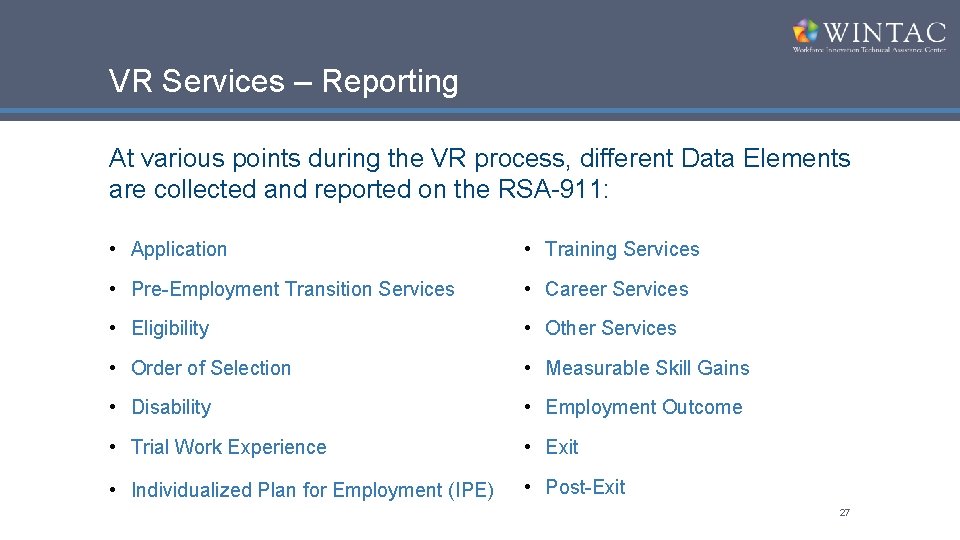
VR Services – Reporting At various points during the VR process, different Data Elements are collected and reported on the RSA-911: • Application • Training Services • Pre-Employment Transition Services • Career Services • Eligibility • Other Services • Order of Selection • Measurable Skill Gains • Disability • Employment Outcome • Trial Work Experience • Exit • Individualized Plan for Employment (IPE) • Post-Exit 27
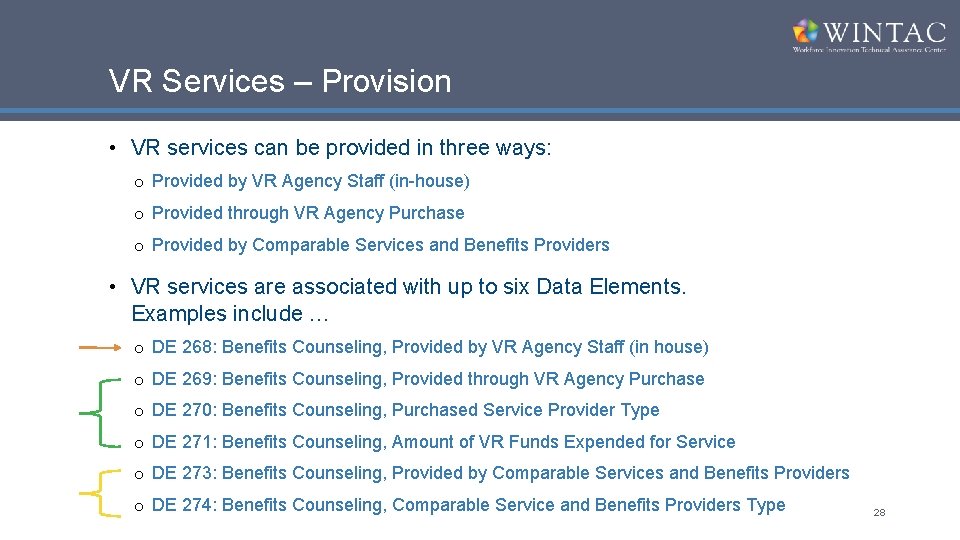
VR Services – Provision • VR services can be provided in three ways: o Provided by VR Agency Staff (in-house) o Provided through VR Agency Purchase o Provided by Comparable Services and Benefits Providers • VR services are associated with up to six Data Elements. Examples include … o DE 268: Benefits Counseling, Provided by VR Agency Staff (in house) o DE 269: Benefits Counseling, Provided through VR Agency Purchase o DE 270: Benefits Counseling, Purchased Service Provider Type o DE 271: Benefits Counseling, Amount of VR Funds Expended for Service o DE 273: Benefits Counseling, Provided by Comparable Services and Benefits Providers o DE 274: Benefits Counseling, Comparable Service and Benefits Providers Type 28
Reporting VR Services Provided State VR agencies must report all VR services on the RSA-911 in the quarter in which they are provided to the individual. • NOT when the initial IPE is developed and VR services are listed on the IPE • NOT when the IPE is amended and additional VR services are added to the IPE • NOT when agencies authorize a VR service to a vendor VR Counselors must follow agency policies and procedures on when and how to document services in the case management system. 29
Reporting VR Services Provided (continued) VR services may be provided more than once, in multiple quarters, and therefore, they may be reported on the RSA-911 in multiple quarters. • For example, a student with a disability receives a Pre-Employment Transition Service: Work Based Learning Experience (WBLE). The WBLE is a four-week program from June 17, 2019, until July 12, 2019. • This VR service began in PY 18 4 th Quarter and ended in PY 19 1 st Quarter. The WBLE must be reported in both quarterly RSA-911 reports. VR Counselors must follow agency policies and procedures to ensure all services are accurately reported, each quarter, in the case management system. 30
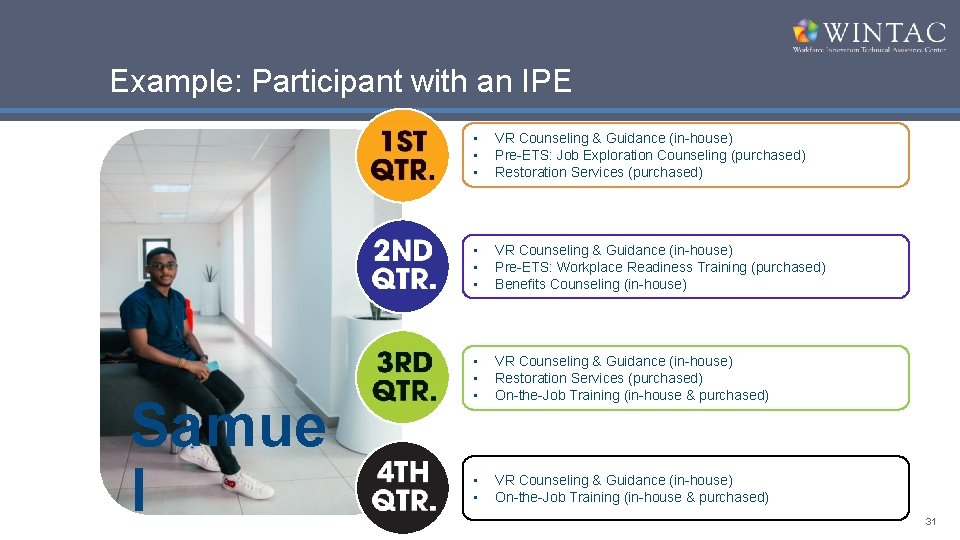
Example: Participant with an IPE Samue l • • • VR Counseling & Guidance (in-house) Pre-ETS: Job Exploration Counseling (purchased) Restoration Services (purchased) • • • VR Counseling & Guidance (in-house) Pre-ETS: Workplace Readiness Training (purchased) Benefits Counseling (in-house) • • • VR Counseling & Guidance (in-house) Restoration Services (purchased) On-the-Job Training (in-house & purchased) • • VR Counseling & Guidance (in-house) On-the-Job Training (in-house & purchased) 31
VR Reporting – Things to Know
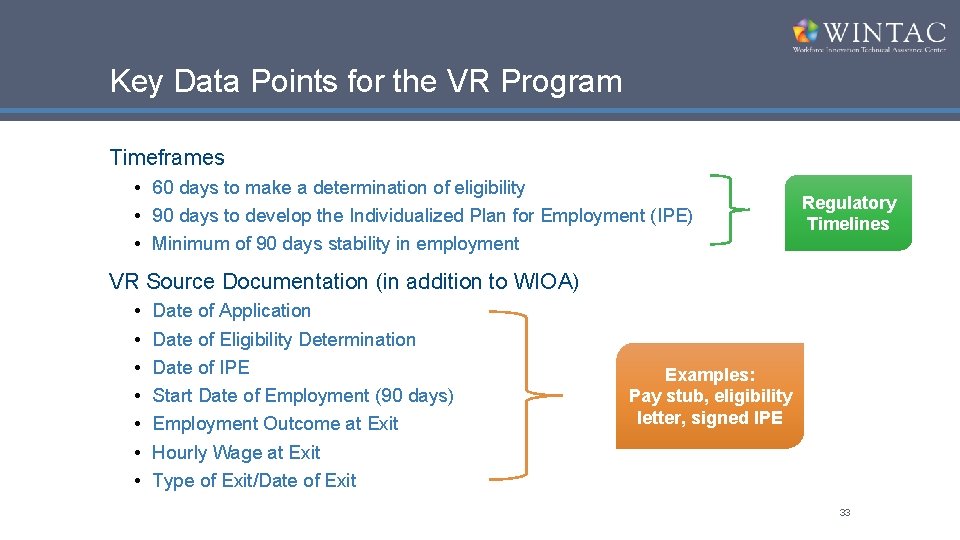
Key Data Points for the VR Program Timeframes • 60 days to make a determination of eligibility • 90 days to develop the Individualized Plan for Employment (IPE) • Minimum of 90 days stability in employment Regulatory Timelines VR Source Documentation (in addition to WIOA) • • Date of Application Date of Eligibility Determination Date of IPE Start Date of Employment (90 days) Employment Outcome at Exit Hourly Wage at Exit Type of Exit/Date of Exit Examples: Pay stub, eligibility letter, signed IPE 33
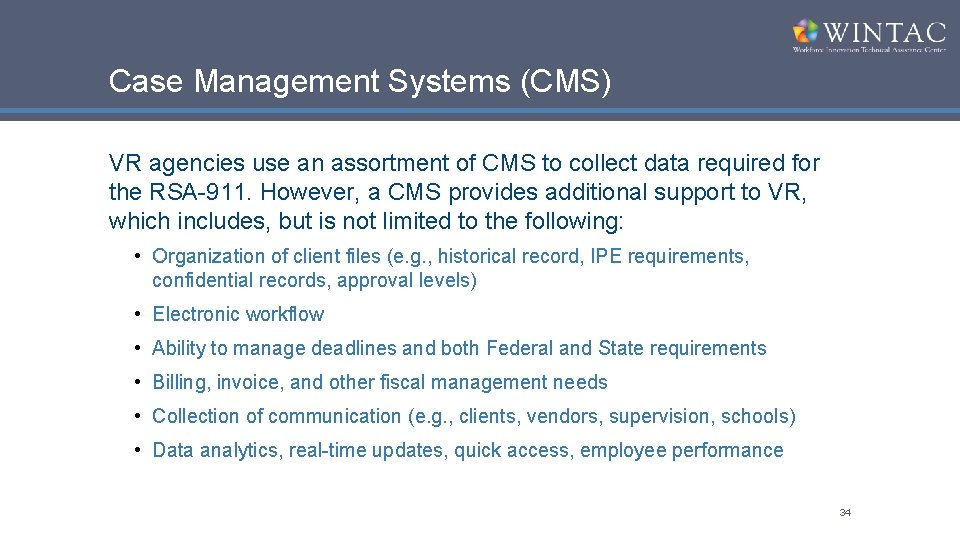
Case Management Systems (CMS) VR agencies use an assortment of CMS to collect data required for the RSA-911. However, a CMS provides additional support to VR, which includes, but is not limited to the following: • Organization of client files (e. g. , historical record, IPE requirements, confidential records, approval levels) • Electronic workflow • Ability to manage deadlines and both Federal and State requirements • Billing, invoice, and other fiscal management needs • Collection of communication (e. g. , clients, vendors, supervision, schools) • Data analytics, real-time updates, quick access, employee performance 34
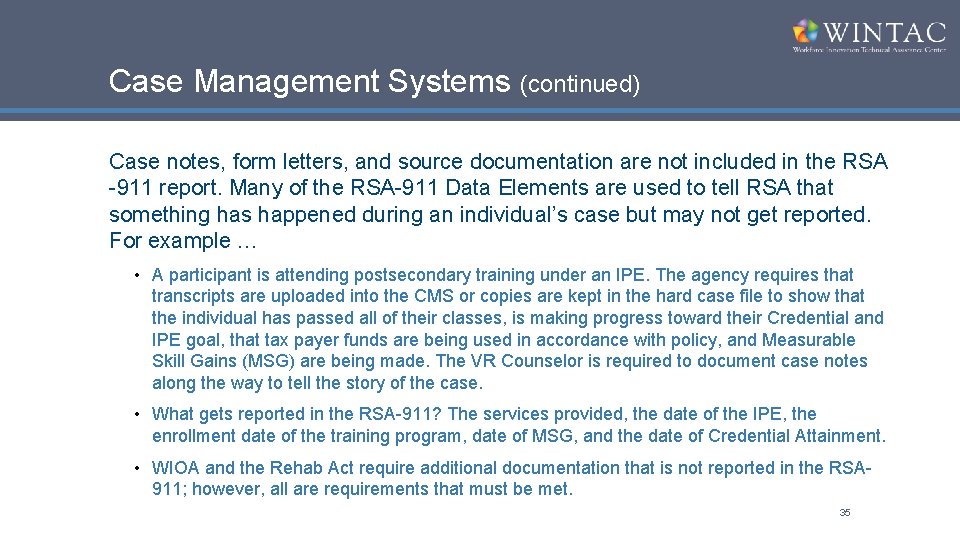
Case Management Systems (continued) Case notes, form letters, and source documentation are not included in the RSA -911 report. Many of the RSA-911 Data Elements are used to tell RSA that something has happened during an individual’s case but may not get reported. For example … • A participant is attending postsecondary training under an IPE. The agency requires that transcripts are uploaded into the CMS or copies are kept in the hard case file to show that the individual has passed all of their classes, is making progress toward their Credential and IPE goal, that tax payer funds are being used in accordance with policy, and Measurable Skill Gains (MSG) are being made. The VR Counselor is required to document case notes along the way to tell the story of the case. • What gets reported in the RSA-911? The services provided, the date of the IPE, the enrollment date of the training program, date of MSG, and the date of Credential Attainment. • WIOA and the Rehab Act require additional documentation that is not reported in the RSA 911; however, all are requirements that must be met. 35
WIOA Reporting – Things to Know 36
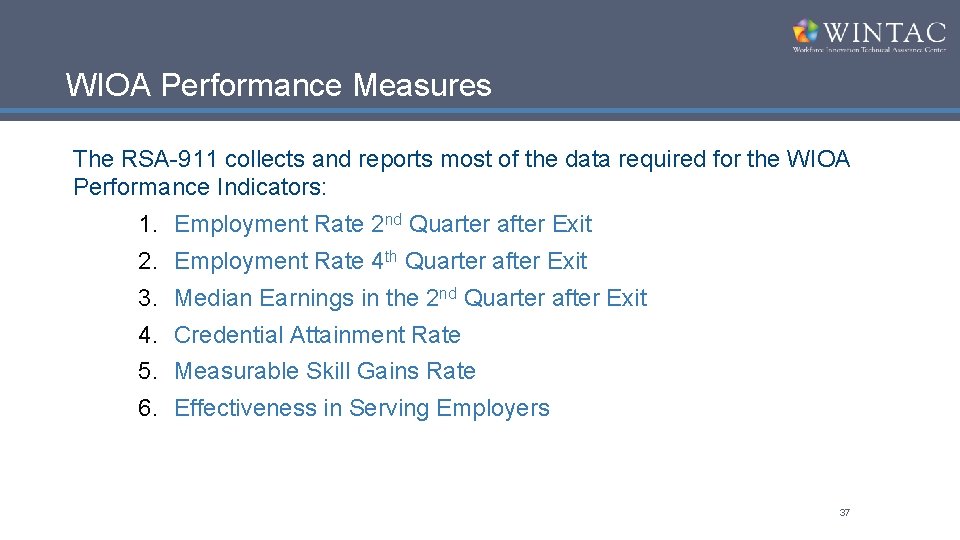
WIOA Performance Measures The RSA-911 collects and reports most of the data required for the WIOA Performance Indicators: 1. Employment Rate 2 nd Quarter after Exit 2. Employment Rate 4 th Quarter after Exit 3. Median Earnings in the 2 nd Quarter after Exit 4. Credential Attainment Rate 5. Measurable Skill Gains Rate 6. Effectiveness in Serving Employers 37
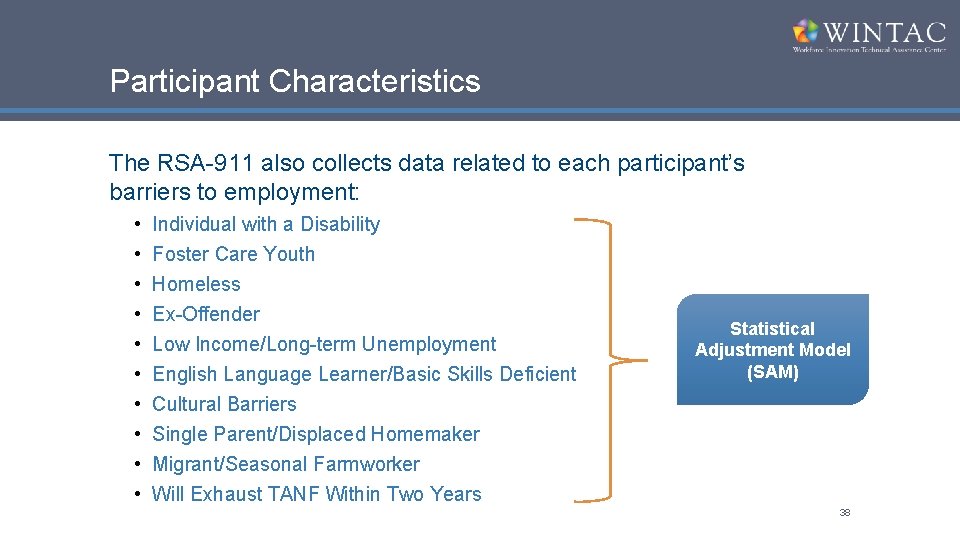
Participant Characteristics The RSA-911 also collects data related to each participant’s barriers to employment: • • • Individual with a Disability Foster Care Youth Homeless Ex-Offender Low Income/Long-term Unemployment English Language Learner/Basic Skills Deficient Cultural Barriers Single Parent/Displaced Homemaker Migrant/Seasonal Farmworker Will Exhaust TANF Within Two Years Statistical Adjustment Model (SAM) 38
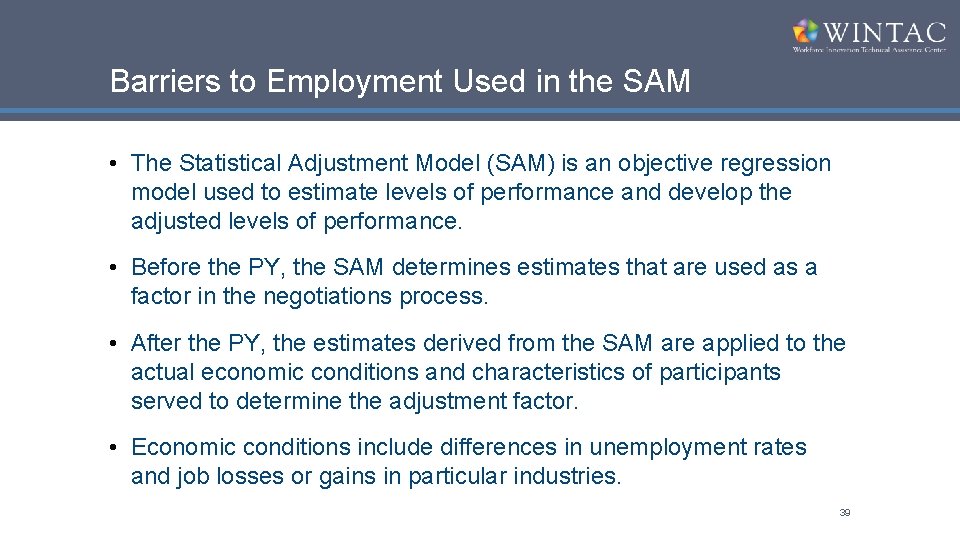
Barriers to Employment Used in the SAM • The Statistical Adjustment Model (SAM) is an objective regression model used to estimate levels of performance and develop the adjusted levels of performance. • Before the PY, the SAM determines estimates that are used as a factor in the negotiations process. • After the PY, the estimates derived from the SAM are applied to the actual economic conditions and characteristics of participants served to determine the adjustment factor. • Economic conditions include differences in unemployment rates and job losses or gains in particular industries. 39
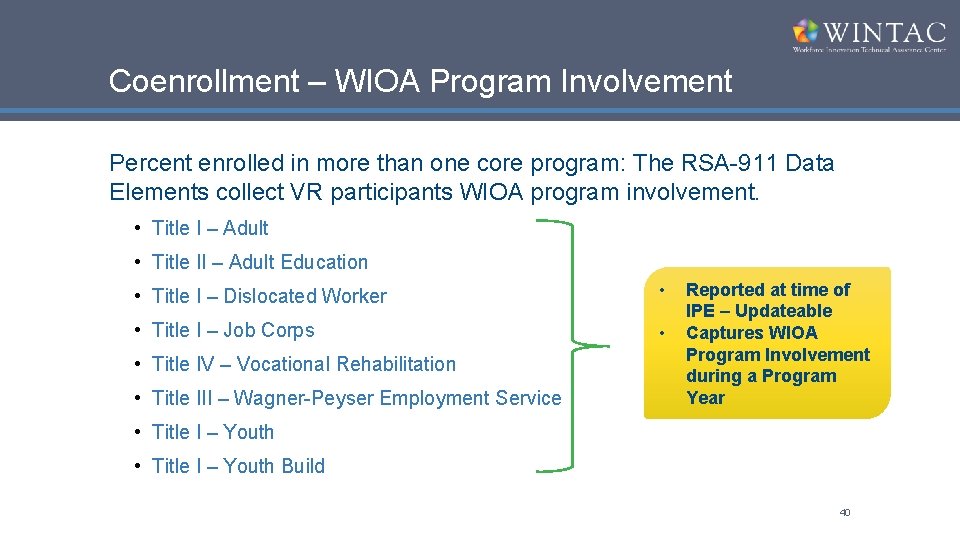
Coenrollment – WIOA Program Involvement Percent enrolled in more than one core program: The RSA-911 Data Elements collect VR participants WIOA program involvement. • Title I – Adult • Title II – Adult Education • Title I – Dislocated Worker • • Title I – Job Corps • • Title IV – Vocational Rehabilitation • Title III – Wagner-Peyser Employment Service Reported at time of IPE – Updateable Captures WIOA Program Involvement during a Program Year • Title I – Youth Build 40
WIOA Annual Report Due October 1: Includes Four Quarters of RSA-911 Data
VR Program: WIOA Annual Reports • The WIOA Annual Report ICR is maintained by the U. S. Department of Labor; however, it is applicable to all core programs, including those administered by the U. S. Department of Education (ED). • Section 116(d)(6)(D) of WIOA requires ED make available the performance reports for the VR program and a national summary of those reports. • Each time RSA publishes WIOA Annual Reports on its website, RSA transmits letters to Congress informing them that these reports are available. 42
VR Program: WIOA Annual Reports (continued) • RSA published Annual Reports for the first time in PY 2017. These reports included performance data for one WIOA indicator. o MSG • In Spring 2020, RSA published Annual Reports for PY 2018. These reports include performance data for three WIOA indicators: o MSG; o Employment Rate in 2 nd Quarter after Exit; and o Median Earnings in 2 nd Quarter after Exit. • The PY 2019 Annual Reports will include performance results for all of the WIOA indicators, with the exception of Effectiveness in Serving Employers, as that indicator is still being piloted. 43
Negotiations and Sanctions Guidance • RSA TAC 20 -02: Negotiations and Sanctions Guidance for the WIOA Core Programs • On February 6, 2020, the Departments, including RSA, issued joint policy guidance that … o Outlines the process for negotiating levels of performance; and o Provides an explanation of the instances in which a State may be sanctioned. • For PY 2020 and PY 2021, the VR program will negotiate performance rates on Measurable Skill Gains. All other performance measures continue to be in the baseline period. 44
Sanctions • The term “sanctions” refers to the reduction of the Governor’s discretionary funds by five percent of the maximum available amount in the Program Year. • The Governor’s reserve funds are awarded under WIOA title I. However, reduction of these funds is not just a detriment to the title I programs; it can affect statewide initiatives that may negatively impact all partners. 45
Summary 1. Understanding of the information collected in the Case Service Report (RSA-911). 2. Understanding of the additional requirements outside of RSA-911 reporting (e. g. , source documentation). 3. Understanding of the various considerations and expectations related to the VR program reporting requirements (e. g. , policies State VR agencies need to establish and implement, tools and resources that are available, and internal controls). 46
Resources: RSA-911 & WIOA Performance Measures RSA-PD-16 -04 Case Service Report (RSA-911) https: //www 2. ed. gov/policy/speced/guid/rsa/subregulatory/pd-16 -04. pdf RSA-PD-19 -03 Case Service Report (RSA-911) https: //www 2. ed. gov/policy/speced/guid/rsa/subregulatory/pd-19 -03. pdf RSA TAC-17 -01 https: //www 2. ed. gov/policy/speced/guid/rsa/subregulatory/tac-1701. pdf? utm_content=&utm_medium=email&utm_name=&utm_source=govdelivery&utm_term= RSA TAC-19 -01 https: //www 2. ed. gov/policy/speced/guid/rsa/subregulatory/tac-19 -01. pdf WINTAC MSG Guide http: //wintac-s 3. s 3 -us-west-2. amazonaws. com/topicareas/t 05_Common. Performance/t 05_resources/MSG_Guide_Final_cn 2. pdf WINTAC Credential Attainment Guide http: //wintacs 3. s 3 uswest 2. amazonaws. com/topicareas/t 05_Common. Performance/t 05_resources/Cred ential_Attainment_Guide_Final_cn 2. pdf 47
Contact Christopher Pope Chief, Data Collection & Analysis Unit (202) 245 -7375 RSAData@ed. gov rsa. ed. gov Rachel Anderson (435) 764 -8487 rcanderson@sdsu. edu www. WINTAC. org 48