
Case Presentation Patient demographics Medical History general anamnesis

- Slides: 17
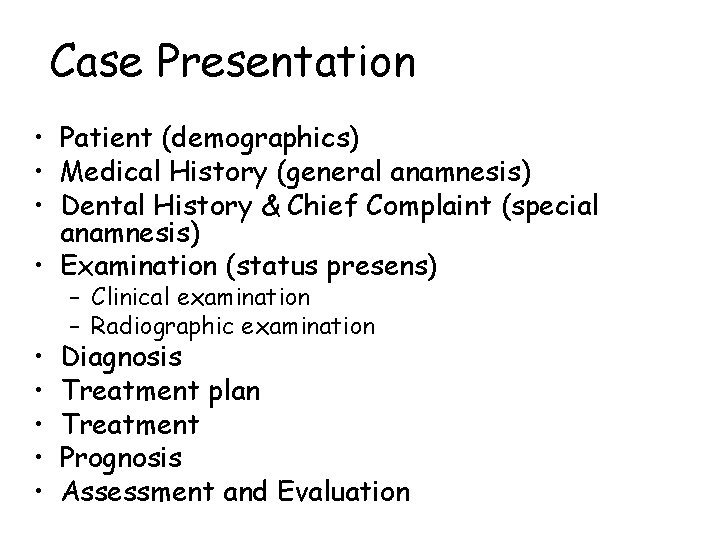
Case Presentation • Patient (demographics) • Medical History (general anamnesis) • Dental History & Chief Complaint (special anamnesis) • Examination (status presens) • • • – Clinical examination – Radiographic examination Diagnosis Treatment plan Treatment Prognosis Assessment and Evaluation
Patient • • Age Gender Race/ethnic origin Referred by ? to whom or where? for what?
Medical History • Systemic conditions that may produce or affect the patient’s symptoms • Drugs the patient is taking: identify possible adverse drug interactions • Systemic contraindications to treatment • Need for premedication and prophylaxis
Dental History & Chief Complaint • What prompted the patient to consult a dentist in the first place (in the patient’s own words) • No diagnosis should be included at this stage • History of present illness/discomfort • An interview process during which the dentist attempts to evaluate the patient’s symptoms accurately, completely, and objectively, avoiding the temptation to make a premature diagnosis
Dental History & Chief Complaint Open-ended, non-leading questions • ”Tell me about the problem” • ”I understand you have been experiencing cold sensitivity in your upper front teeth for several weeks, is that correct? ”
Dental History & Chief Complaint Specific questions about the nature of the symptoms experienced: • Inception (When the first time) • Frequency and cource (How often) • Intensity (Mild, moderate, or severe: medication, home from work) • Quality (Sharp, dull, stabbing, throbbing)
Dental History & Chief Complaint • Location (Pointing to the tooth that hurts) • Provocation factors (heat, cold, momentary or last longer) • Spontaneous (without provocation)? • Attenuating factors (Anything relieving the pain
Examination • Clinical examination – Extraoral examination – Intraoral examination • Documentation (photo) – Frontal view of dentition – Occlusal or lingual (for front teeth) view – Others as necessary for highlighting aspects • Radiographic examination – Dental periapical – Orthopantomogram in special cases – CT in special cases
Intraoral examination • Any alterations of the color, texture, consistency, or contour of the soft tissue and should be noted • The tooth/teeth in question should be inspected for color changes, caries and restorative status • Palpation test • Percussion test • Mobility test • Periodontal examination: gentle probing
Intraoral examination Thermal pulp tests: Cold test • Cold water bath in rubber dam basin • Ice sticks • Compressed gasses: ethyl chloride; 1, 1, 1, 2 tetrafluoroethane (Endo-Ice) • Carbon dioxide snow
Intraoral examination Thermal pulp tests: Heat test • Hot water bath in rubber dam basin • Warm gutta-percha
Intraoral examination Electric pulp tests: • Electric excitation to stimulate the Aδ sensory fibers within the pulp • Does not provide any information about the health or integrity of the pulp; it simply indicates that there are vital sensory fibers present within the pulp
Intraoral examination Special tests: • Crown removal for inspection • Selective anesthesia test • Test cavity for sensitivity • Transillumination for caries and physical defects
Radiographic examination • Diagnostic radiography should be used only after the history is recorded and the clinical examination is accomplished Limitations • Provides a two-dimensional portrayal of a three-dimensional reality • Cannot be used to determine the status of the health and integrity of the pulp
Diagnosis Pulpal and apical periodontal Other relevant: periodontal, prosthodontic
• Treatment plan • Short term and long term • Treatment • Immediate and permanent • Documentation (photo) • As necessary for highlighting aspects of treatment • Final: occlusal or lingual (for front teeth) view of restored tooth • Prognosis • Endodontic and dental • Success rate for the relevant diagnosis and treatment selected
Discussion: Assessment and Evaluation • Assessment of the treatment outcome in this particular case • Reasons for making the diagnosis and treatment plan • Evaluation of the treatment chosen • Factors influencing the treatment outcome in this case • Was there any alternative treatment? And what would happen if another treatment had been chosen