
CASE OF A RARE DISEASE EARLY CONGENITAL SYPHILIS

- Slides: 10
CASE OF A RARE DISEASE : EARLY CONGENITAL SYPHILIS WITH ISOLATED BONE INVOLVMENT - Dr. Pradeep Jhala
OBJECTIVE • CASE STUDY OF EARLY CONGENITAL SYPHILIS IN PEDIATRICS CONDUCTED IN DHIRAJ GENERAL HOISPITAL WITH ISOLATED BONE INVOLVMENT WHICH WAS DIAGNOSED AS A CASE OF CONGENITAL SYPHILIS ON THE BASIS OF X-RAYS AND LATER CONFIRMED BY SEROLOGICAL TESTS.
INTRODUCTION • Congenital syphilis is a severe, disabling infection often with grave consequences seen in infants. It occurs due to the transmission of the disease from an infected mother to the unborn infant through the placenta. This long forgotten disease continues to affect pregnant women resulting in perinatal morbidity and mortality. The continuing prevalence of this disease reveals the failure of control measures established for its prevention. We put forth a case of symptomatic congenital syphilis presenting with isolated skeletal manifestations at birth, a rare finding in literature. We report a newborn infant presenting only with swelling around the wrist joint and knee joint was diagnosed as an early congenital syphilis case.
TYPES OF CONGENITAL SYPHILIS l EARLY CONGENITAL SYPHILIS - Newborns may be asymptomatic and are only identified on routine prenatal screening. Early congenital syphilis occurs in children between 0 and 2 years old. l Lesions are most commonly macular and papular, or purely papular, at first bright violaceous red, and then fading to a copper color. l LATE CONGENITAL SYPHILIS - It occurs in children at or greater than 2 years of age who acquired the infection trans-placentally. Clinical features include Hutchinson's triad, saddle nose, frontal bossing etc.
CASE REPORT • A 1 and half month old female patient came to our Radiology Dept. for X-ray of upper and lower limbs because of swelling around the right wrist joint and both knee joints. From the history obtained from her parents, the swelling was present since birthand gradually enlarged in two weeks and became painful at palpation. She was continuously crying. There was no remarkable family history except the mother’s history of vulvae warts. The infant’s vital signs were in normal range and her weight was 3260 g. The only positive finding was swelling around the right wrist joint and both the knee joints and her physical examination revealed hepatosplenomegaly. There was no skin eruption or palpable lymph node. The patient had mild anemia.
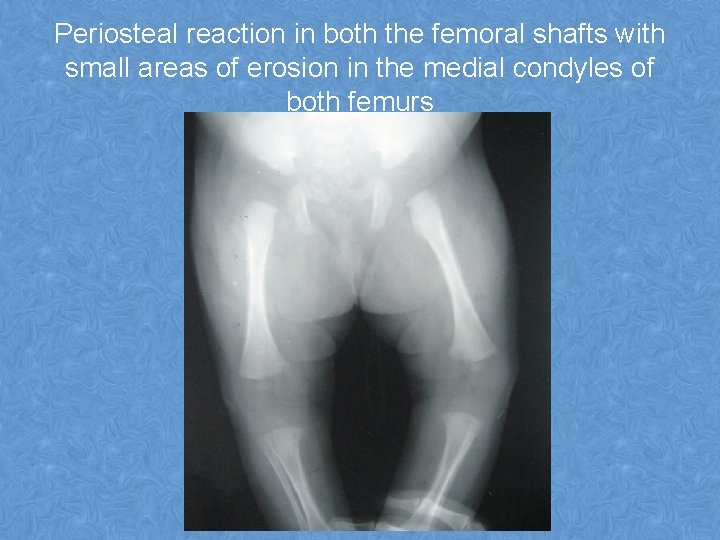
Periosteal reaction in both the femoral shafts with small areas of erosion in the medial condyles of both femurs
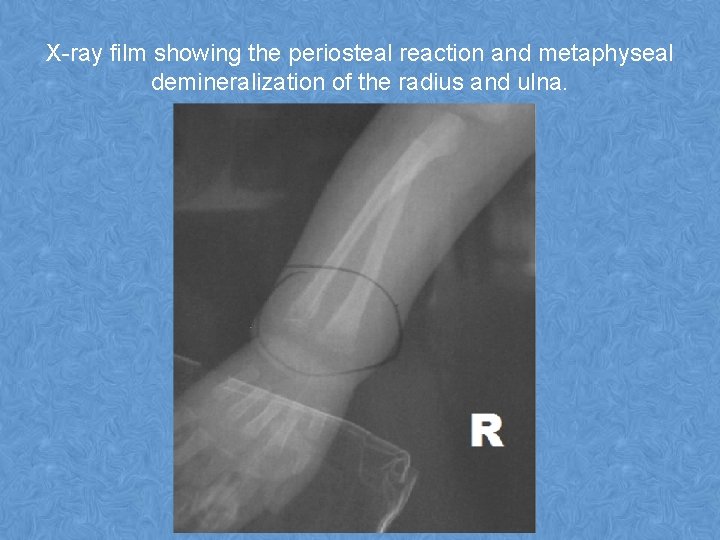
X-ray film showing the periosteal reaction and metaphyseal demineralization of the radius and ulna.
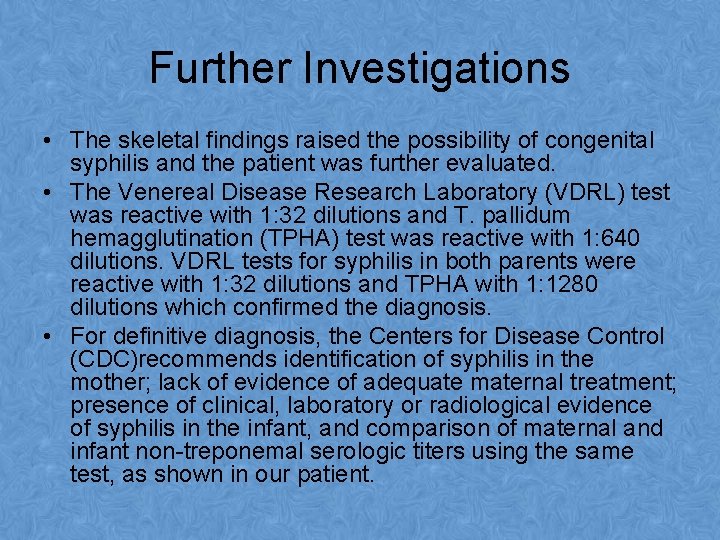
Further Investigations • The skeletal findings raised the possibility of congenital syphilis and the patient was further evaluated. • The Venereal Disease Research Laboratory (VDRL) test was reactive with 1: 32 dilutions and T. pallidum hemagglutination (TPHA) test was reactive with 1: 640 dilutions. VDRL tests for syphilis in both parents were reactive with 1: 32 dilutions and TPHA with 1: 1280 dilutions which confirmed the diagnosis. • For definitive diagnosis, the Centers for Disease Control (CDC)recommends identification of syphilis in the mother; lack of evidence of adequate maternal treatment; presence of clinical, laboratory or radiological evidence of syphilis in the infant, and comparison of maternal and infant non-treponemal serologic titers using the same test, as shown in our patient.
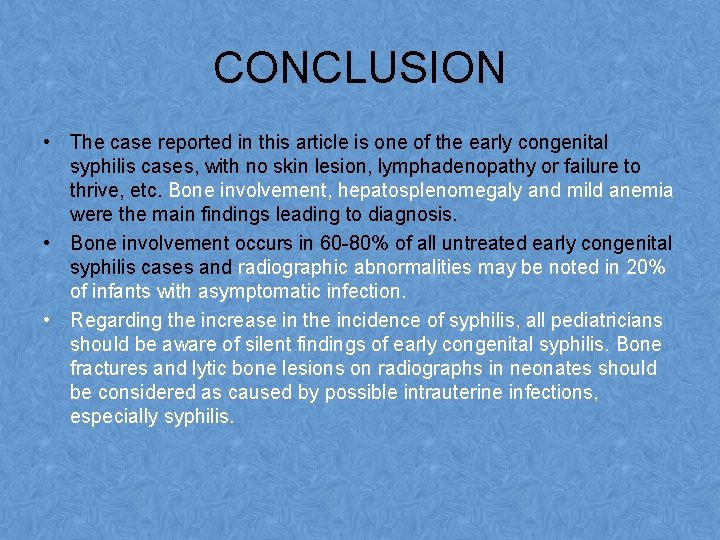
CONCLUSION • The case reported in this article is one of the early congenital syphilis cases, with no skin lesion, lymphadenopathy or failure to thrive, etc. Bone involvement, hepatosplenomegaly and mild anemia were the main findings leading to diagnosis. • Bone involvement occurs in 60 -80% of all untreated early congenital syphilis cases and radiographic abnormalities may be noted in 20% of infants with asymptomatic infection. • Regarding the increase in the incidence of syphilis, all pediatricians should be aware of silent findings of early congenital syphilis. Bone fractures and lytic bone lesions on radiographs in neonates should be considered as caused by possible intrauterine infections, especially syphilis.
• Bone lesions commonly affect the tibia and other long bones of the body, and are usually symmetric. The bone involvement can be very painful, causing an infant to refuse to move the extremity. Swelling of an joint or any extremity and tenderness in a newborn infant should be evaluated immediately. • Diagnosis of early congenital syphilis is difficult because more than half of the infants are asymptomatic, and signs in symptomatic infants may be subtle and nonspecific.