
Case management system for the norwegian courts Endre

- Slides: 26
Case management system for the norwegian courts Endre Helgesen Skjetne, Senior adviser The Norwegian Courts Administration Domstoladministrasjonen - 1
A brief history of electronic case management in the norwegian courts 1988 -1990: SAKS § First case management system (district courts / courts of appeal) § Document oriented – not process oriented § Low level of IT competencies among the users 1999 -2000: Høyrett § Case management system for the Supreme Court § First process oriented CMS in the judiciary § Smalltalk / Gemstone / Sara 98 1991: Applications for the land consolidation courts § A set of applications developed in Visual Fox. Pro § Not process oriented Domstoladministrasjonen - 2
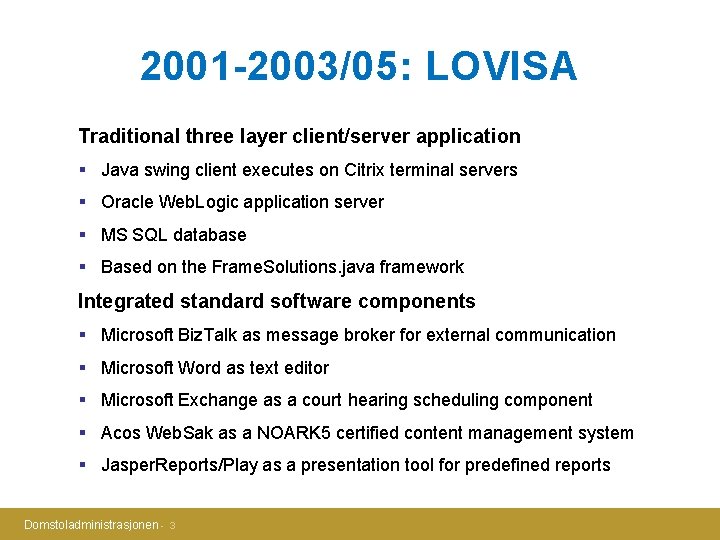
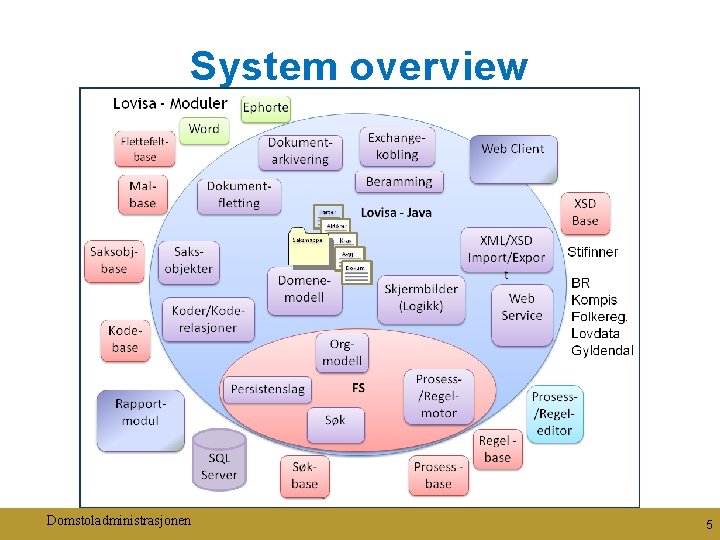
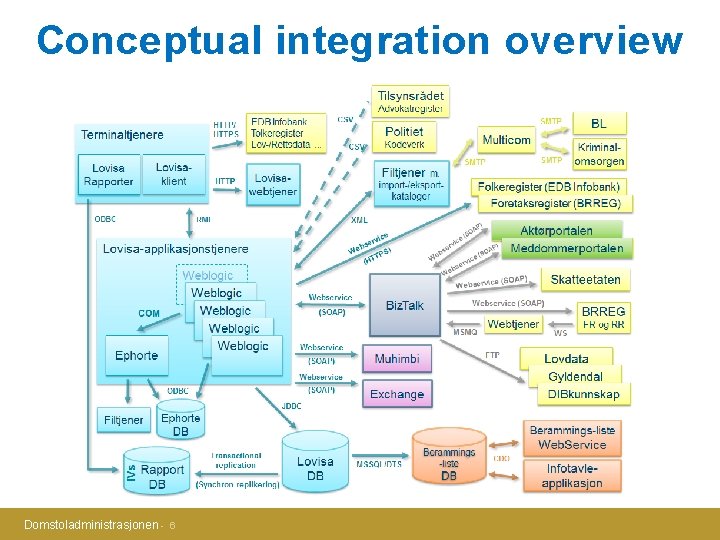
2001 -2003/05: LOVISA Traditional three layer client/server application § Java swing client executes on Citrix terminal servers § Oracle Web. Logic application server § MS SQL database § Based on the Frame. Solutions. java framework Integrated standard software components § Microsoft Biz. Talk as message broker for external communication § Microsoft Word as text editor § Microsoft Exchange as a court hearing scheduling component § Acos Web. Sak as a NOARK 5 certified content management system § Jasper. Reports/Play as a presentation tool for predefined reports Domstoladministrasjonen - 3
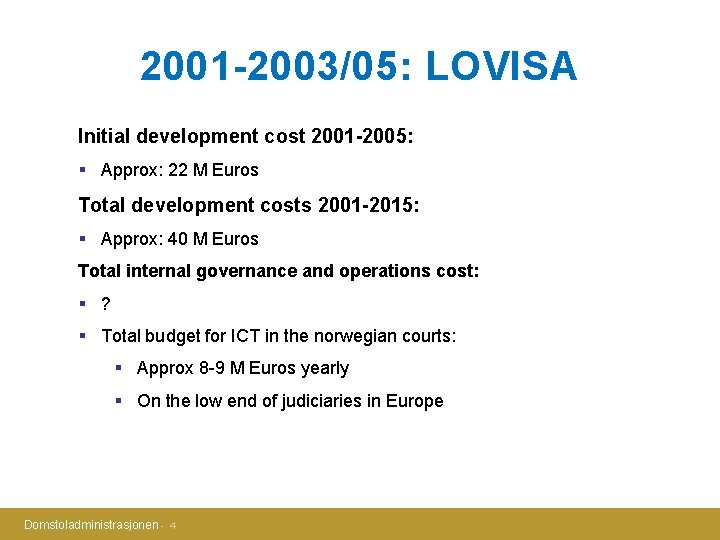
2001 -2003/05: LOVISA Initial development cost 2001 -2005: § Approx: 22 M Euros Total development costs 2001 -2015: § Approx: 40 M Euros Total internal governance and operations cost: § ? § Total budget for ICT in the norwegian courts: § Approx 8 -9 M Euros yearly § On the low end of judiciaries in Europe Domstoladministrasjonen - 4
System overview Domstoladministrasjonen 5
Conceptual integration overview Domstoladministrasjonen - 6
Conceptual architecture overview Domstoladministrasjonen 7
Areas of success § Adaptive case management approach § Focus on court processes § Focus on increasing the efficiency of current processes by utilizing ICT § Utilizing knowledge workers in the development process § Co-locating judges and clerks with IT-architects and developers during the development process § Well organized training and user support system § Centralized development, operations, governance and support Domstoladministrasjonen - 8
Difficulties § Choosing the right technology § Collaborating with other public entities § Identifying user needs and priorities § Changing legislation to accomodate efficiency § Managing the fine line of flexibility vs uniform processes § Developing a system that ensures both fluent and efficient case management and the production of needed statistics Domstoladministrasjonen - 9
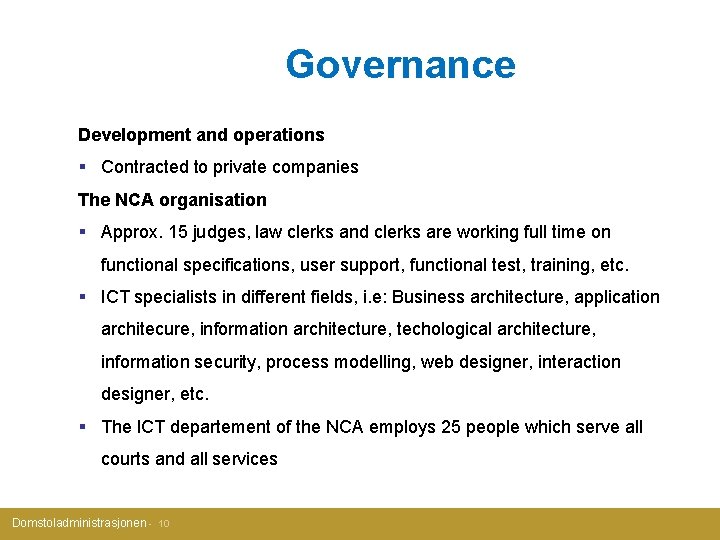
Governance Development and operations § Contracted to private companies The NCA organisation § Approx. 15 judges, law clerks and clerks are working full time on functional specifications, user support, functional test, training, etc. § ICT specialists in different fields, i. e: Business architecture, application architecure, information architecture, techological architecture, information security, process modelling, web designer, interaction designer, etc. § The ICT departement of the NCA employs 25 people which serve all courts and all services Domstoladministrasjonen - 10
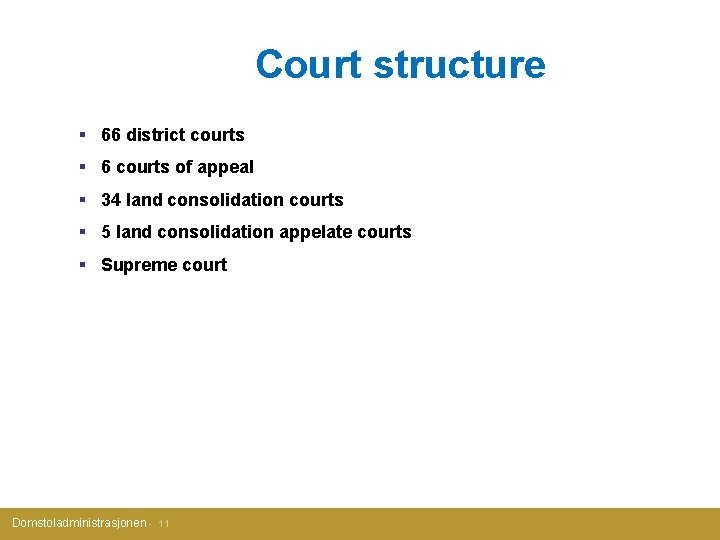
Court structure § 66 district courts § 6 courts of appeal § 34 land consolidation courts § 5 land consolidation appelate courts § Supreme court Domstoladministrasjonen - 11
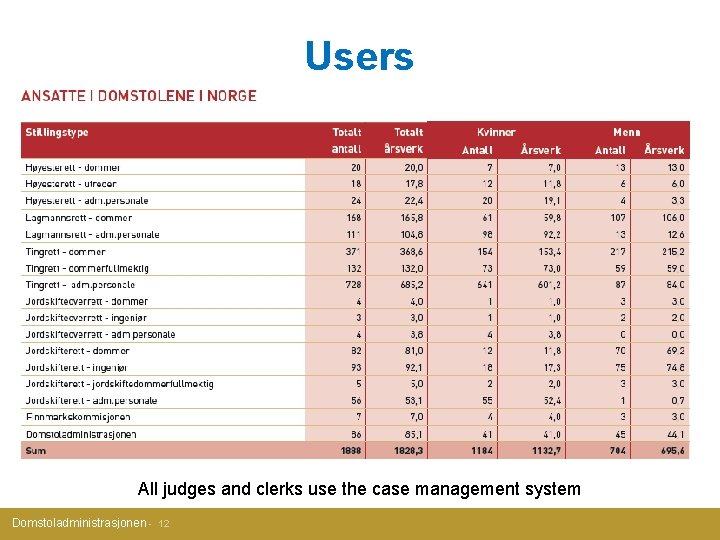
Users All judges and clerks use the case management system Domstoladministrasjonen - 12
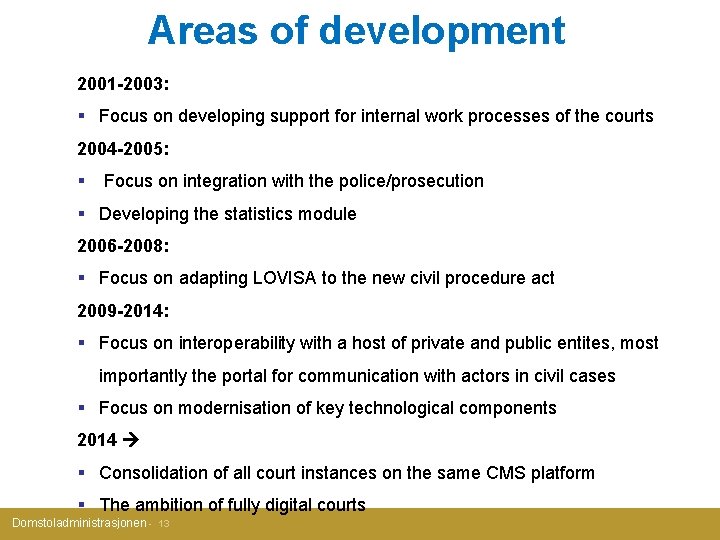
Areas of development 2001 -2003: § Focus on developing support for internal work processes of the courts 2004 -2005: § Focus on integration with the police/prosecution § Developing the statistics module 2006 -2008: § Focus on adapting LOVISA to the new civil procedure act 2009 -2014: § Focus on interoperability with a host of private and public entites, most importantly the portal for communication with actors in civil cases § Focus on modernisation of key technological components 2014 § Consolidation of all court instances on the same CMS platform § The ambition of fully digital courts Domstoladministrasjonen - 13
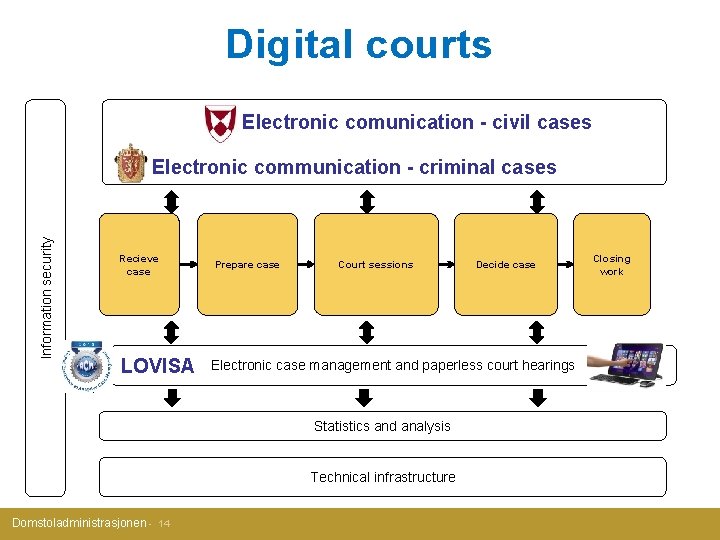
Digital courts Electronic comunication - civil cases Information security Electronic communication - criminal cases Recieve case LOVISA Prepare case Court sessions Electronic case management and paperless court hearings Statistics and analysis Technical infrastructure Domstoladministrasjonen - 14 Decide case Closing work
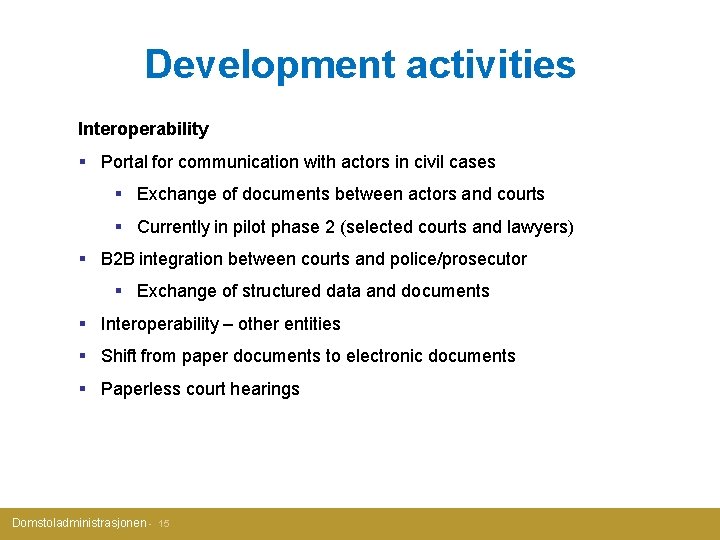
Development activities Interoperability § Portal for communication with actors in civil cases § Exchange of documents between actors and courts § Currently in pilot phase 2 (selected courts and lawyers) § B 2 B integration between courts and police/prosecutor § Exchange of structured data and documents § Interoperability – other entities § Shift from paper documents to electronic documents § Paperless court hearings Domstoladministrasjonen - 15
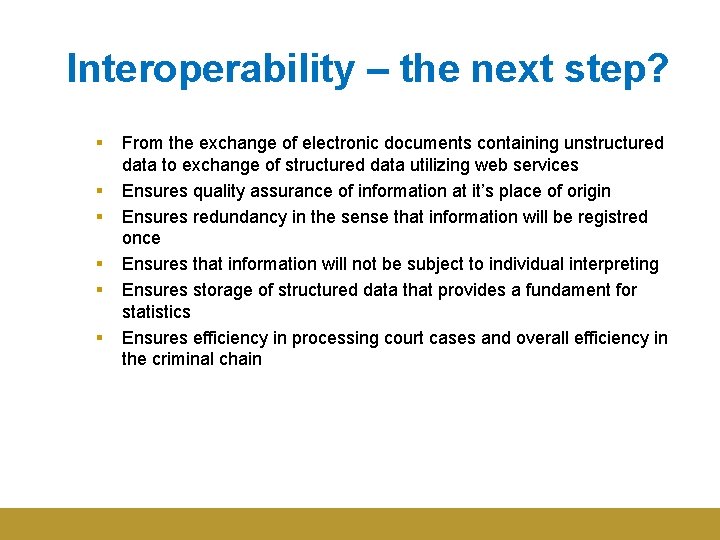
Interoperability – the next step? § § § From the exchange of electronic documents containing unstructured data to exchange of structured data utilizing web services Ensures quality assurance of information at it’s place of origin Ensures redundancy in the sense that information will be registred once Ensures that information will not be subject to individual interpreting Ensures storage of structured data that provides a fundament for statistics Ensures efficiency in processing court cases and overall efficiency in the criminal chain
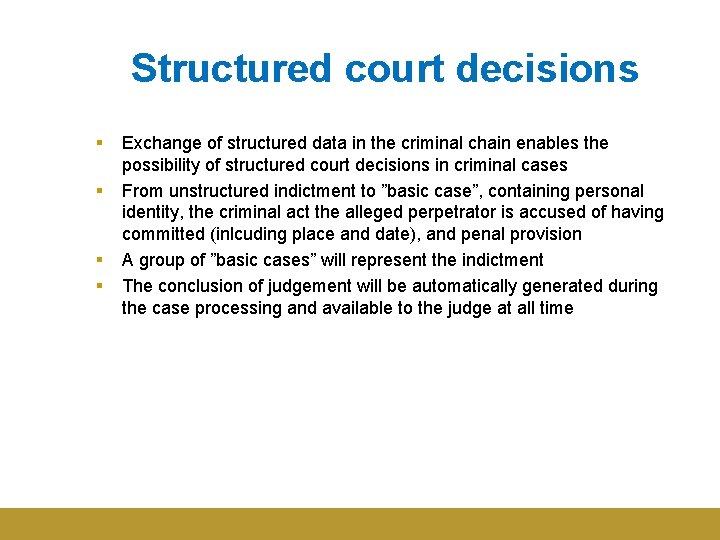
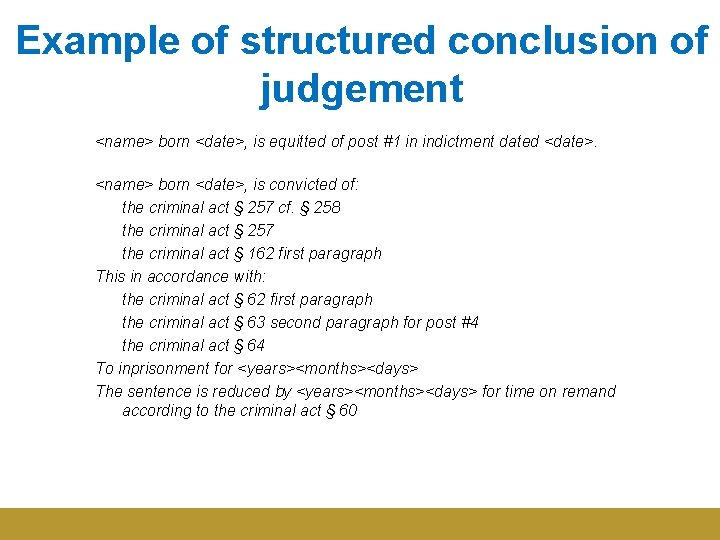
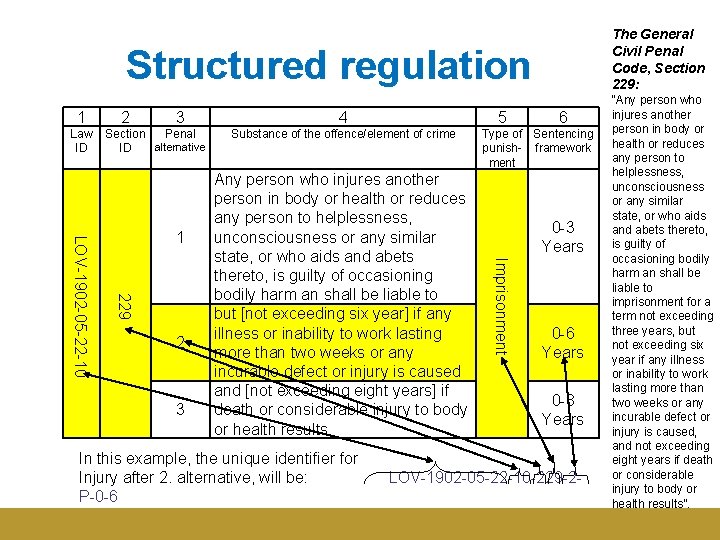
Structured court decisions § § Exchange of structured data in the criminal chain enables the possibility of structured court decisions in criminal cases From unstructured indictment to ”basic case”, containing personal identity, the criminal act the alleged perpetrator is accused of having committed (inlcuding place and date), and penal provision A group of ”basic cases” will represent the indictment The conclusion of judgement will be automatically generated during the case processing and available to the judge at all time
Example of structured conclusion of judgement <name> born <date>, is equitted of post #1 in indictment dated <date>. <name> born <date>, is convicted of: the criminal act § 257 cf. § 258 the criminal act § 257 the criminal act § 162 first paragraph This in accordance with: the criminal act § 62 first paragraph the criminal act § 63 second paragraph for post #4 the criminal act § 64 To inprisonment for <years><months><days> The sentence is reduced by <years><months><days> for time on remand according to the criminal act § 60
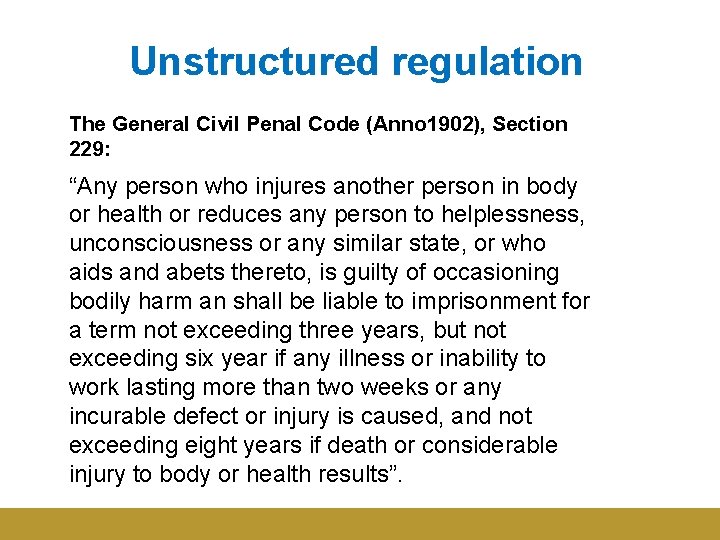
Unstructured regulation The General Civil Penal Code (Anno 1902), Section 229: “Any person who injures another person in body or health or reduces any person to helplessness, unconsciousness or any similar state, or who aids and abets thereto, is guilty of occasioning bodily harm an shall be liable to imprisonment for a term not exceeding three years, but not exceeding six year if any illness or inability to work lasting more than two weeks or any incurable defect or injury is caused, and not exceeding eight years if death or considerable injury to body or health results”.
The General Civil Penal Code, Section 229: Structured regulation 1 Law ID 2 3 Section Penal alternative ID 2 3 5 Substance of the offence/element of crime Any person who injures another person in body or health or reduces any person to helplessness, unconsciousness or any similar state, or who aids and abets thereto, is guilty of occasioning bodily harm an shall be liable to but [not exceeding six year] if any illness or inability to work lasting more than two weeks or any incurable defect or injury is caused and [not exceeding eight years] if death or considerable injury to body or health results In this example, the unique identifier for Injury after 2. alternative, will be: P-0 -6 6 Type of Sentencing punish- framework ment 0 -3 Years Imprisonment 229 LOV-1902 -05 -22 -10 1 4 0 -6 Years 0 -8 Years LOV-1902 -05 -22 -10 -229 -2 - “Any person who injures another person in body or health or reduces any person to helplessness, unconsciousness or any similar state, or who aids and abets thereto, is guilty of occasioning bodily harm an shall be liable to imprisonment for a term not exceeding three years, but not exceeding six year if any illness or inability to work lasting more than two weeks or any incurable defect or injury is caused, and not exceeding eight years if death or considerable injury to body or health results”.
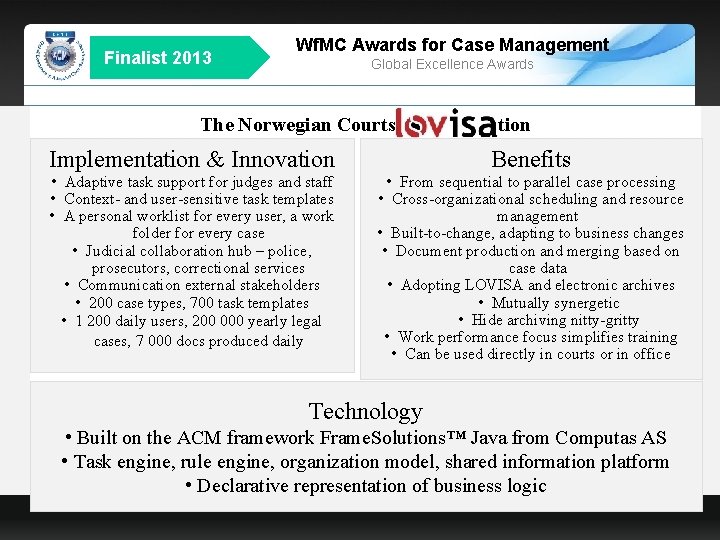
Finalist 2013 Wf. MC Awards for Case Management Global Excellence Awards The Norwegian Courts Administration Implementation & Innovation • Adaptive task support for judges and staff • Context- and user-sensitive task templates • A personal worklist for every user, a work folder for every case • Judicial collaboration hub – police, prosecutors, correctional services • Communication external stakeholders • 200 case types, 700 task templates • 1 200 daily users, 200 000 yearly legal cases, 7 000 docs produced daily Benefits • From sequential to parallel case processing • Cross-organizational scheduling and resource management • Built-to-change, adapting to business changes • Document production and merging based on case data • Adopting LOVISA and electronic archives • Mutually synergetic • Hide archiving nitty-gritty • Work performance focus simplifies training • Can be used directly in courts or in office Technology • Built on the ACM framework Frame. Solutions™ Java from Computas AS • Task engine, rule engine, organization model, shared information platform • Declarative representation of business logic 21
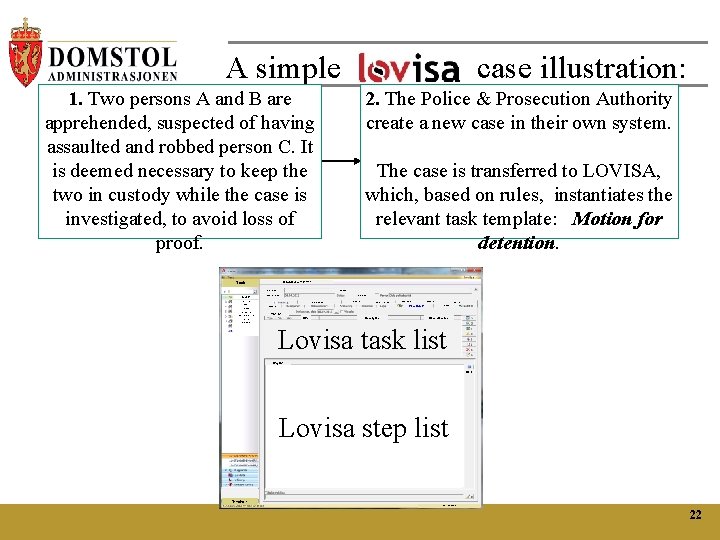
A simple case illustration: 1. Two persons A and B are apprehended, suspected of having assaulted and robbed person C. It is deemed necessary to keep the two in custody while the case is investigated, to avoid loss of proof. Tools Criminal case #4711/13 Case number Inbox Case type Received Date registered Activities Search Processed by Journal & archive Deadlines Parties involved Requirements Case inbox Meetings Judge Scheduling 2. The Police & Prosecution Authority create a new case in their own system. The case is transferred to LOVISA, which, based on rules, instantiates the relevant task template: Motion for detention. Deadlines Decisions Economy Task list Description Case executive Date 13. 08. 04 Motion for detention: Oslo police district (document 1) Loss, Joe Counsels Org. editor Lovisa task list Step list Categorise the case Register case executive Register parties Register other involved Register demands Allocate case to judge Schedule court session Register appointment of interpreter Register appointment of counsel Register appointment of expert witness Make dossier front page Create task for processing more requirements/court sessions/records Write appointment of counsel for the defence Register appointment of counsel in foreigner case Create and write record of court session Register closed court session and check court hours /witnesses Terminate Task Do it Lovisa step list Terminate Loss, Joe (JLO) 22
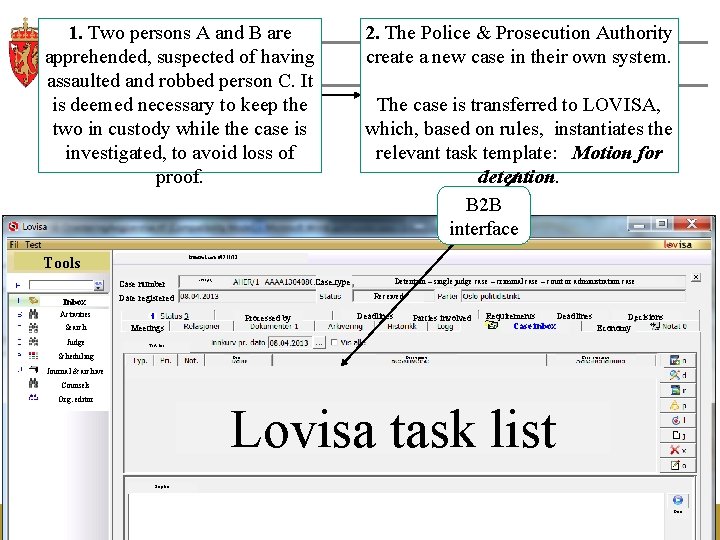
1. Two persons A and B are apprehended, suspected of having assaulted and robbed person C. It is deemed necessary to keep the two in custody while the case is investigated, to avoid loss of proof. Tools Criminal case #4711/13 Case number Inbox Case type 4711/13 Judge Detention – single judge case – criminal case – court or administration case Received Date registered Activities Search 2. The Police & Prosecution Authority create a new case in their own system. The case is transferred to LOVISA, which, based on rules, instantiates the relevant task template: Motion for detention. B 2 B interface Processed by Deadlines Meetings Parties involved Requirements Deadlines Decisions Case inbox Economy Task list Scheduling Description Date Journal & archive 13. 08. 04 Motion for detention: Oslo police district (document 1) Case executive Loss, Joe Counsels Org. editor Lovisa task list Step list Categorise the case Register case executive Register parties Register other involved Do it 23
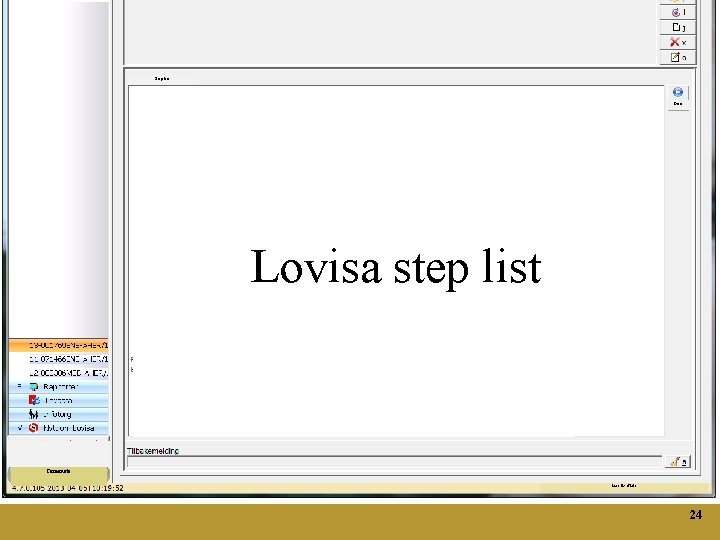
Step list Categorise the case Register case executive Register parties Register other involved Register demands Allocate case to judge Schedule court session Register appointment of interpreter Register appointment of counsel Register appointment of expert witness Make dossier front page Create task for processing more requirements/court sessions/records Write appointment of counsel for the defence Register appointment of counsel in foreigner case Create and write record of court session Register closed court session and check court hours /witnesses Terminate Task Do it Lovisa step list Terminate Loss, Joe (JLO) 24
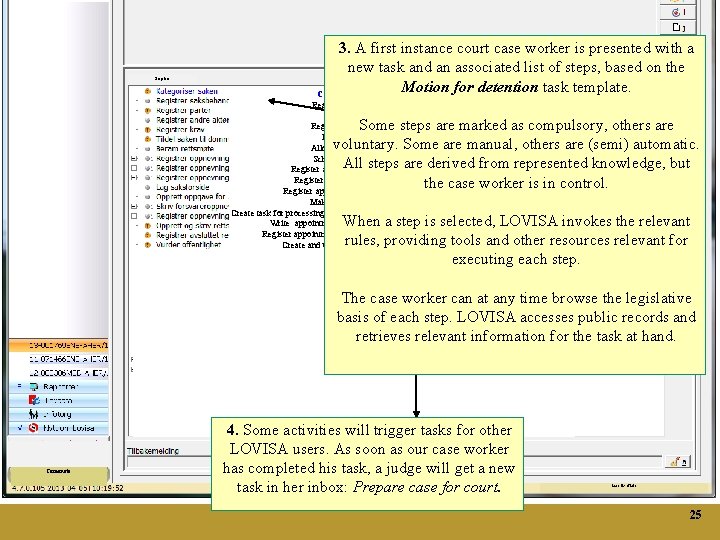
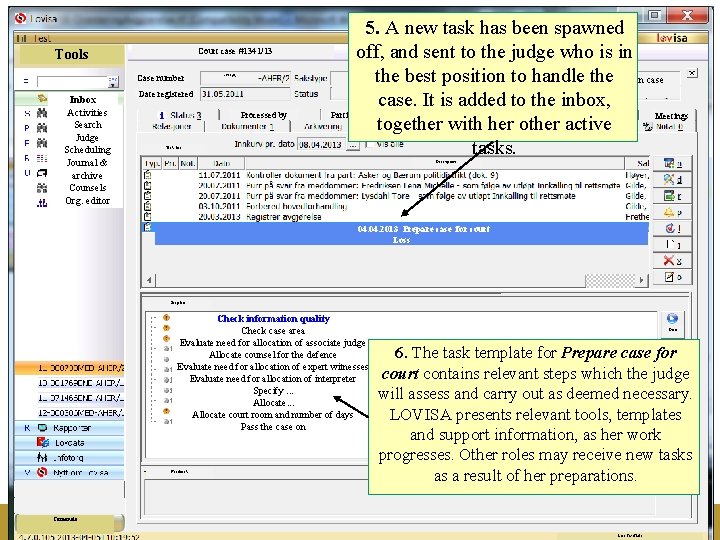
Step list 3. A first instance court case worker is presented with a new task and an associated list of steps, based on the Motion for detention task template. Categorise the case Register case executive Register parties Register other involved Some steps are marked as compulsory, others are Register demands voluntary. Some are manual, others are (semi) automatic. Allocate case to judge Schedule court session All steps are derived from represented knowledge, but Register appointment of interpreter Register appointment of counsel the case worker is in control. Register appointment of expert witness Make dossier front page Create task for processing more requirements/court sessions/records When a step is selected, LOVISA invokes the relevant Write appointment of counsel for the defence Register appointment of counsel in foreigner case rules, providing tools and other resources relevant for Create and write record of court session Register closed court session and check court hours /witnesses executing each step. Terminate Task The case worker can at any time browse the legislative basis of each step. LOVISA accesses public records and retrieves relevant information for the task at hand. Do it Terminate 4. Some activities will trigger tasks for other LOVISA users. As soon as our case worker has completed his task, a judge will get a new task in her inbox: Prepare case for court. Loss, Joe (JLO) 25
Court case #1341/13 Tools Case number Inbox Activities Search Judge Scheduling Journal & archive Counsels Org. editor 4711/13 Date registered Processed by Task list 5. A new task has been spawned off, and sent to the judge who is in the best position to handle the Detention – single judge case – criminal case – court or administration case. It is added to the inbox, Parties involved Deadlines Meetings Decisions Case inbox Economy together with her other active tasks. Description 04. 2013 Prepare case for court Loss Step list Check information quality Check case area Evaluate need for allocation of associate judge Allocate counsel for the defence Evaluate need for allocation of expert witnesses Evaluate need for allocation of interpreter Specify. . . Allocate court room and number of days Pass the case on Feedback Do it 6. The task template for Prepare case for court contains relevant steps which the judge will assess and carry out as deemed necessary. LOVISA presents relevant tools, templates and support information, as her work progresses. Other roles may receive new tasks as a result of her preparations. 26 Terminate Loss, Joe (JLO)