
CASE MANAGEMENT SYSTEM FOR PROSECUTION AND COURTS 2


- Slides: 51
CASE MANAGEMENT SYSTEM FOR PROSECUTION AND COURTS 2
Key Challenges in the Justice Sector • Highly traditional: low level of automation • Highly complex business logic • High volume and flow of cases • High expectations from stakeholders • Significant media focus In fact, maybe the most important part of a modern state 4 A solution for justice authorities must be built to last for 15 -20 years, while accepting almost continuous change
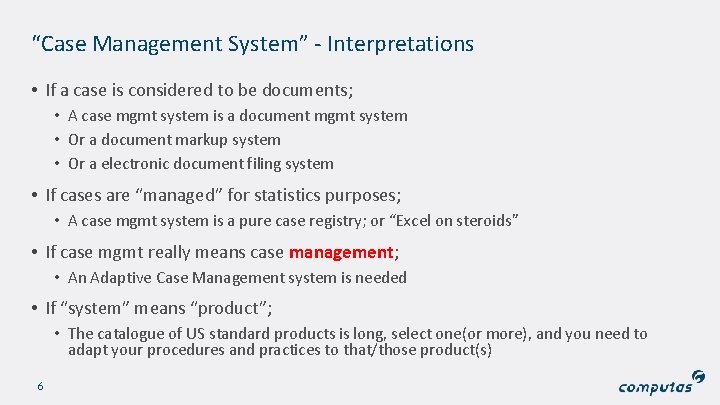
“Case Management System” - Interpretations • If a case is considered to be documents; • A case mgmt system is a document mgmt system • Or a document markup system • Or a electronic document filing system • If cases are “managed” for statistics purposes; • A case mgmt system is a pure case registry; or “Excel on steroids” • If case mgmt really means case management; • An Adaptive Case Management system is needed • If “system” means “product”; • The catalogue of US standard products is long, select one(or more), and you need to adapt your procedures and practices to that/those product(s) 6
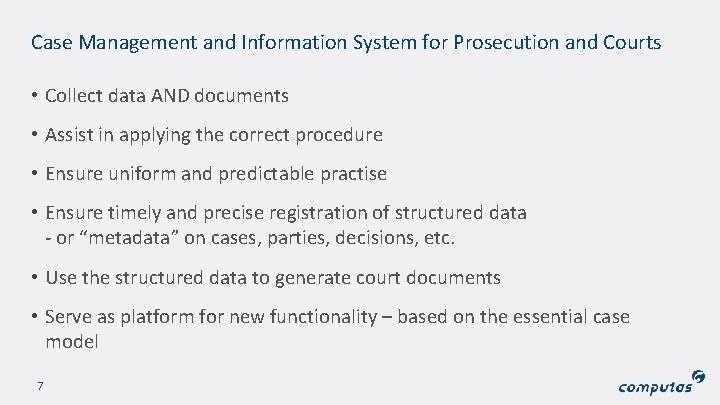
Case Management and Information System for Prosecution and Courts • Collect data AND documents • Assist in applying the correct procedure • Ensure uniform and predictable practise • Ensure timely and precise registration of structured data - or “metadata” on cases, parties, decisions, etc. • Use the structured data to generate court documents • Serve as platform for new functionality – based on the essential case model 7
Standard Products for Legal Case Mgmt Systems? • A long list of such products could be set up • Most are created for US legislation and practise • Typically focused on certain functionalities • E-Filing; “dockets”/calendaring; jury mgmt; probation; etc. • Some products have moderate workflow facilities • None of these are truly adaptable to the procedure specifics of the different case types found in European legislation 8
Key Success Elements • Separate business logic from «household logic» • Respect the importance of time in the system foundation • Don’t overdo architecture – new stuff will become fashionable during system lifetime anyway • Respect that it’s an organizational project, not really an IT project 9
Contents • ACM – Adaptive Case Management • LOVISA – The Domain • What about the Prosecution? • CMIS - Kosovo • Integration • Summary
ACM – ADAPTIVE CASE MANAGEMENT
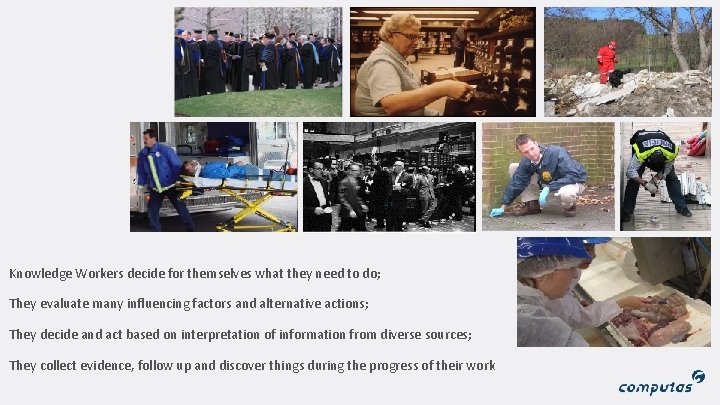
Knowledge Workers decide for themselves what they need to do; They evaluate many influencing factors and alternative actions; They decide and act based on interpretation of information from diverse sources; They collect evidence, follow up and discover things during the progress of their work
Characteristics of knowledge work (1) Non-Repeated Two different audits will not lead to the same result or plans No two corporate mergers are identical No chain of accident events are identical
Characteristics of knowledge work (1) Non-Repeated (2) Unpredictable The chain of events in a court case can take unexpected turns So does a criminal case investigation… The sequence of (human) actions are not known in advance, although guidelines and directives are often given
Characteristics of knowledge work (1) Non-Repeated (2) Unpredictable (3) Emergent A doctor orders a blood test on a patient leading to a treatment plan which is supervised; leading to new tests leading to a modified treatment which is supervised….
Characteristics of knowledge work (1) Non-Repeated (2) Unpredictable (3) Emergent (4) Robustness in the face of variable conditions However, there are patterns, the work can indeed be organized Knowledge work organized through effective, efficient and dependable institutions based on experience, competence and repeatable action fragments
LOVISA – COURT CASE MANAGEMENT IN THE NORWEGIAN COURTS THE DOMAIN MODEL
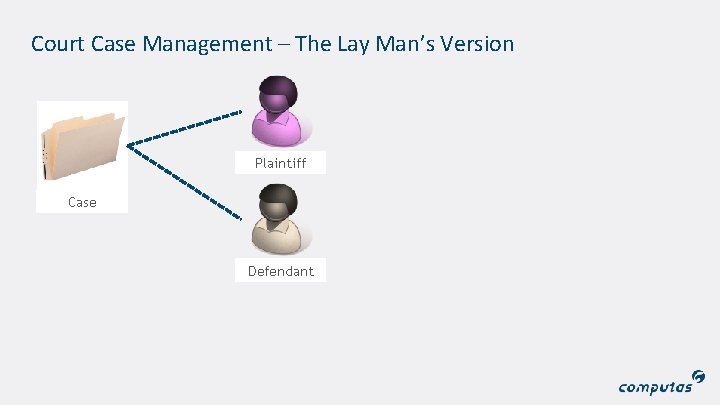
Court Case Management – The Lay Man’s Version Plaintiff Case Defendant
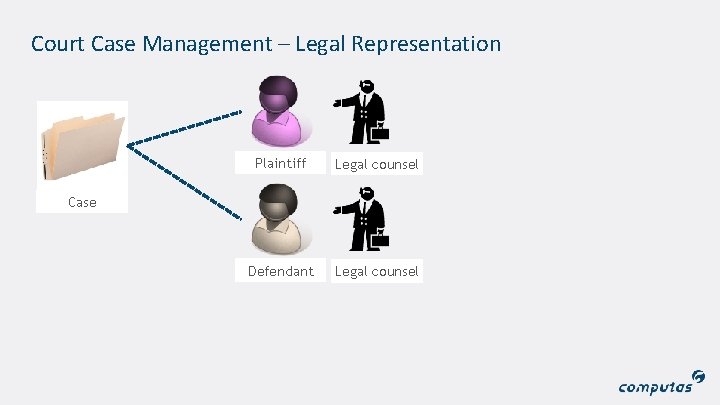
Court Case Management – Legal Representation Plaintiff Legal counsel Defendant Legal counsel Case
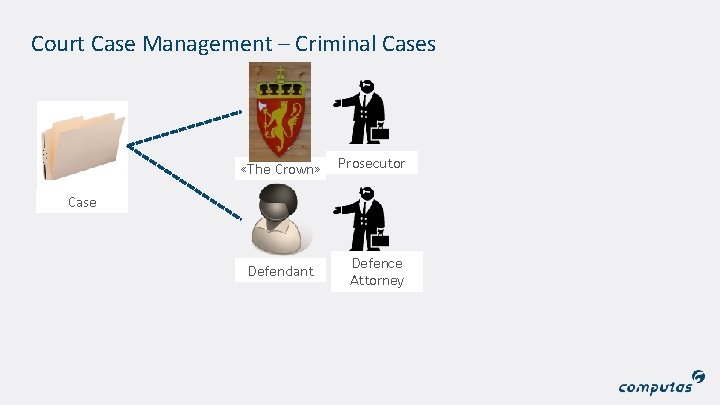
Court Case Management – Criminal Cases «The Crown» Prosecutor Case Defendant Defence Attorney
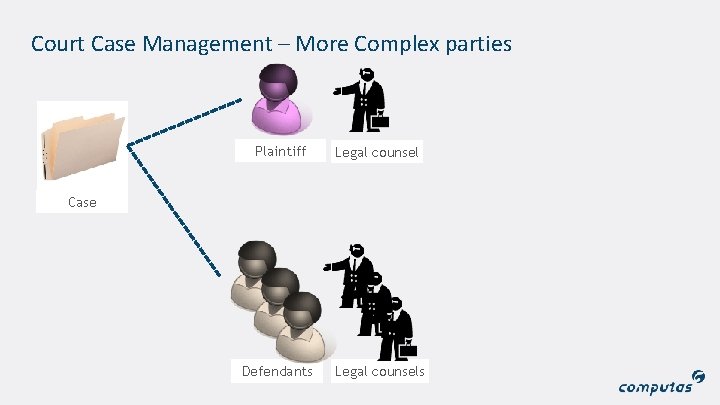
Court Case Management – More Complex parties Plaintiff Legal counsel Defendants Legal counsels Case
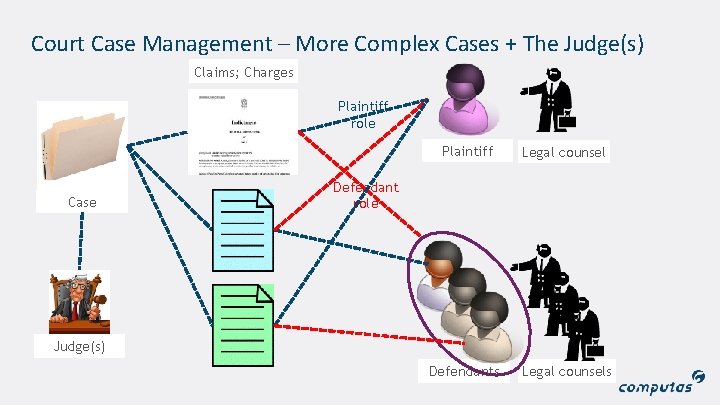
Court Case Management – More Complex Cases + The Judge(s) Claims; Charges Plaintiff role Case Plaintiff Legal counsel Defendants Legal counsels Defendant role Judge(s)
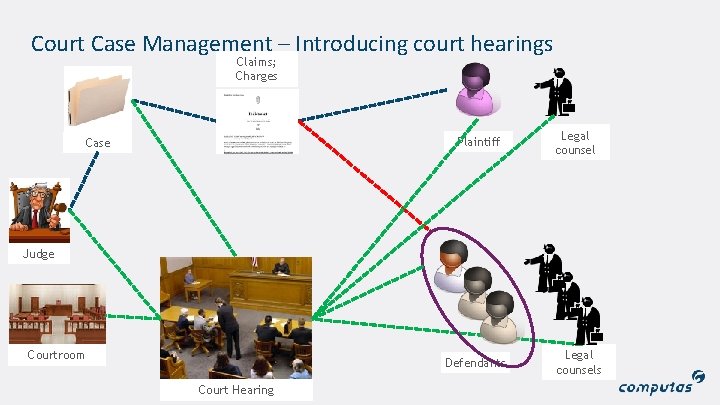
Court Case Management – Introducing court hearings Claims; Charges Plaintiff Case Legal counsel Judge Courtroom Defendants Court Hearing Legal counsels
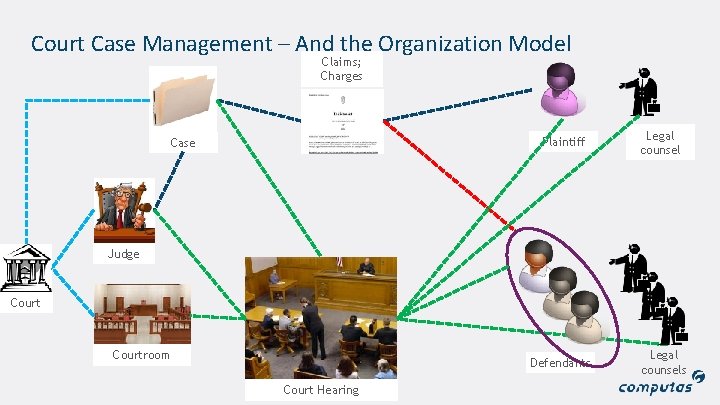
Court Case Management – And the Organization Model Claims; Charges Plaintiff Case Legal counsel Judge Courtroom Defendants Court Hearing Legal counsels
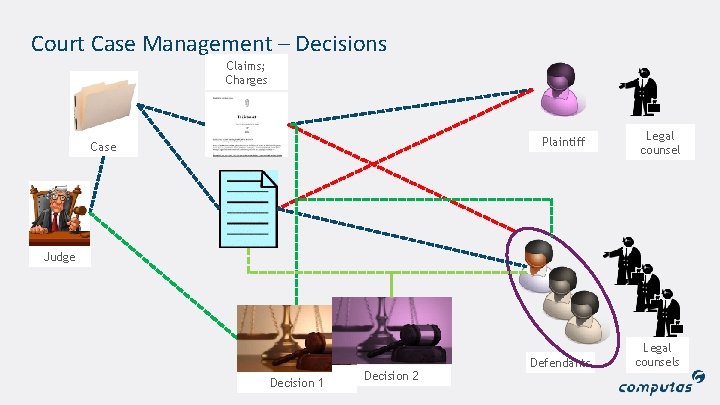
Court Case Management – Decisions Claims; Charges Plaintiff Case Legal counsel Judge Decision 1 Decision 2 Defendants Legal counsels
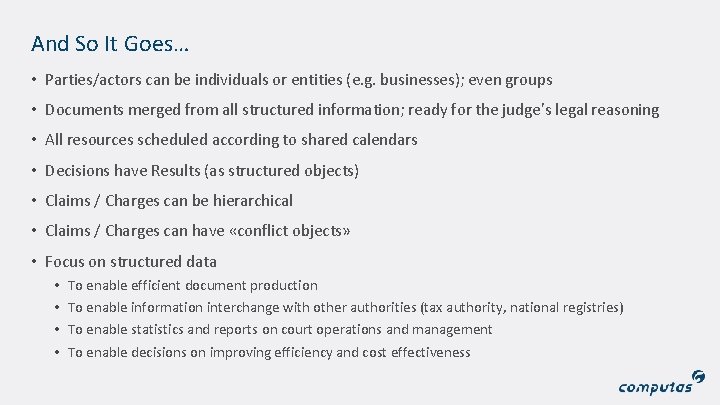
And So It Goes… • Parties/actors can be individuals or entities (e. g. businesses); even groups • Documents merged from all structured information; ready for the judge’s legal reasoning • All resources scheduled according to shared calendars • Decisions have Results (as structured objects) • Claims / Charges can be hierarchical • Claims / Charges can have «conflict objects» • Focus on structured data • • To enable efficient document production To enable information interchange with other authorities (tax authority, national registries) To enable statistics and reports on court operations and management To enable decisions on improving efficiency and cost effectiveness
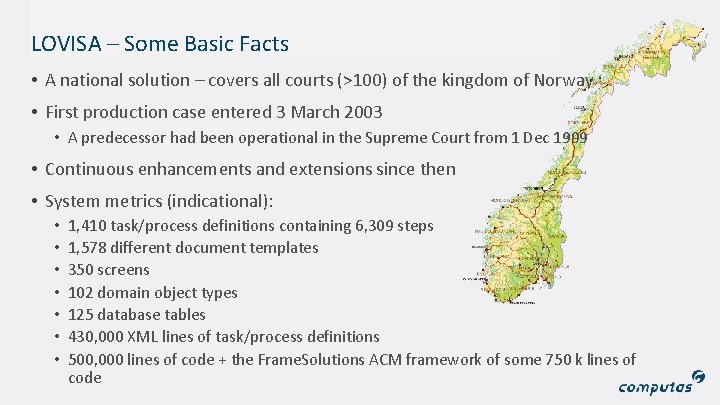
LOVISA – Some Basic Facts • A national solution – covers all courts (>100) of the kingdom of Norway • First production case entered 3 March 2003 • A predecessor had been operational in the Supreme Court from 1 Dec 1999 • Continuous enhancements and extensions since then • System metrics (indicational): • • 1, 410 task/process definitions containing 6, 309 steps 1, 578 different document templates 350 screens 102 domain object types 125 database tables 430, 000 XML lines of task/process definitions 500, 000 lines of code + the Frame. Solutions ACM framework of some 750 k lines of code
WHAT ABOUT THE PROSECUTION?
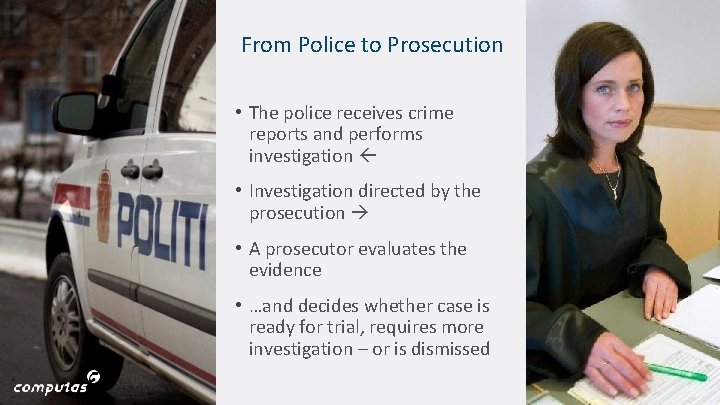
From Police to Prosecution • The police receives crime reports and performs investigation • Investigation directed by the prosecution • A prosecutor evaluates the evidence • …and decides whether case is ready for trial, requires more investigation – or is dismissed 29
The Norwegian criminal case proceedings system – «BL» • Supports criminal case investigation – performed by police investigators; directed by prosecutors • Handle court motions for various investigatory steps • Prepare final indictment for the trial • Ensures Criminal Procedure Code compliance • Has been operational since 1996 • Continuously developed to support new regulations, integrations, reorganizations, etc. • A predecessor of LOVISA – the court system
Structure in BL • Cases – with relations • Persons – with roles in cases • Artifacts – related to the case • Documents – e. g witness statements • «Codes» – structured data • Allowing case information to «grow» as required in investigation
Electronic Interchange • When indictment is ready, it’s packaged electronically, and • …submitted to court, and autoentered in the court system • When court decision is ready, it’s returned to the prosecution • …and the prosecutor can take action • More integrations are under way (the ESAS project) • Summons, dispatch information, etc. 32
CMIS – Case Management and Information System For the Courts and Prosecution Authority of the Republic of Kosovo • Project runs from Feb 2016 until July 2018 • Milestone 3 C (ordinary criminal cases) deployed to pilot courts April 2017 • Milestone 2 P (prosecution prototype) approved Nov 1, 2017 • Currently: • Finalizing Milestone 4 C (serious crime, juvenile crime) • Starting work on Milestone 5 C (civil cases) • Starting work on Milestone 3 P (ordinary prosecution cases) 35
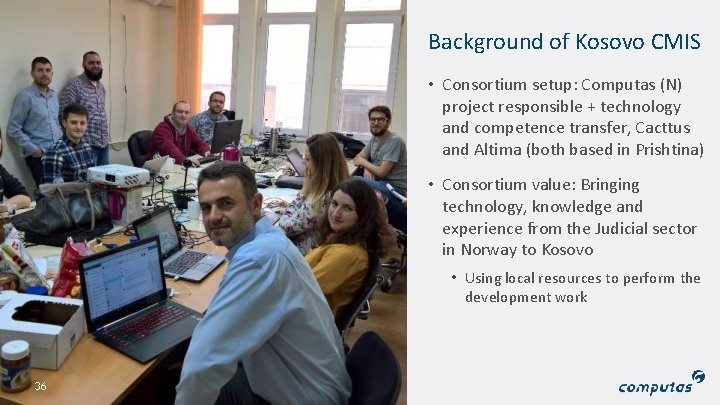
Background of Kosovo CMIS • Consortium setup: Computas (N) project responsible + technology and competence transfer, Cacttus and Altima (both based in Prishtina) • Consortium value: Bringing technology, knowledge and experience from the Judicial sector in Norway to Kosovo • Using local resources to perform the development work 36
CASE FLOW ACROSS AUTHORITIES
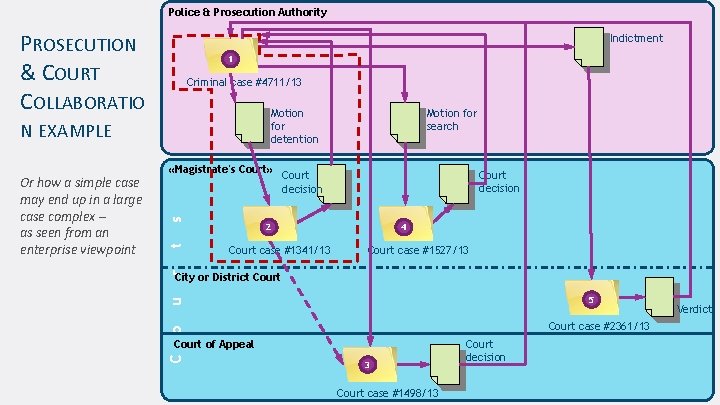
Police & Prosecution Authority PROSECUTION & COURT COLLABORATIO Indictment 1 Criminal case #4711/13 Motion for detention N EXAMPLE Court decision 2 Court case #1341/13 4 Court case #1527/13 r t s «Magistrate's Court» City or District Court u 5 o Court case #2361/13 Court of Appeal C Or how a simple case may end up in a large case complex – as seen from an enterprise viewpoint Motion for search 3 Court case #1498/13 Court decision Verdict
SUMMARY
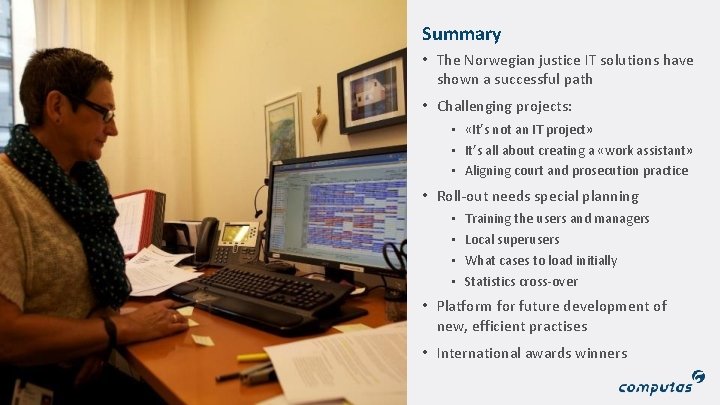
Summary • The Norwegian justice IT solutions have shown a successful path • Challenging projects: • «It’s not an IT project» • It’s all about creating a «work assistant» • Aligning court and prosecution practice • Roll-out needs special planning • • Training the users and managers Local superusers What cases to load initially Statistics cross-over • Platform for future development of new, efficient practises • International awards winners
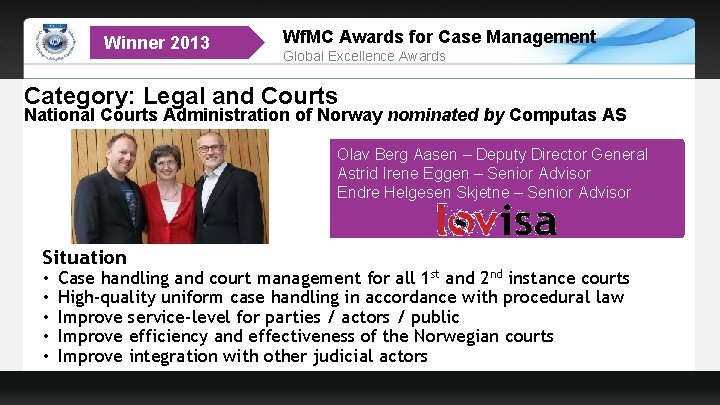
Winner 2013 Wf. MC Awards for Case Management Global Excellence Awards Category: Legal and Courts National Courts Administration of Norway nominated by Computas AS Olav Berg Aasen – Deputy Director General Astrid Irene Eggen – Senior Advisor Endre Helgesen Skjetne – Senior Advisor Situation • • • Case handling and court management for all 1 st and 2 nd instance courts High-quality uniform case handling in accordance with procedural law Improve service-level for parties / actors / public Improve efficiency and effectiveness of the Norwegian courts Improve integration with other judicial actors
Thank you!
WEDNESDAY, 8 NOV 2017 46
CONSIDERATIONS ON IMPLEMENTING CASE MANAGEMENT SYSTEMS 47
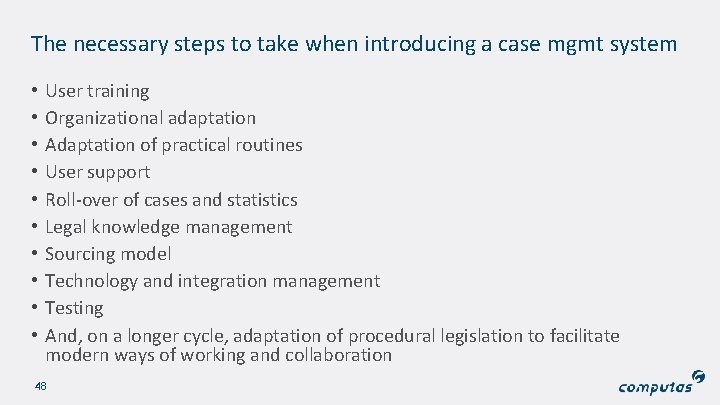
The necessary steps to take when introducing a case mgmt system • • • User training Organizational adaptation Adaptation of practical routines User support Roll-over of cases and statistics Legal knowledge management Sourcing model Technology and integration management Testing And, on a longer cycle, adaptation of procedural legislation to facilitate modern ways of working and collaboration 48
User Training • “Train the trainers” • Use the local “super users” 49
Organizational Adaptation • Identify roles for the employees • Unify the way different roles take part in the processes • For economical and practical reasons, the various instances need to operate according to similar patterns – although not necessarily equal 50
Adaptation of Practical Routines • Of particular interest are the links between the physical world and the registrations in the syste • Documents on paper vs documents stored electronically • “Metadata” • The reception desk is vital – the interface between the citizen/business and the authority 51
User Support • Appoint local super-users • 1 st tier of support • Central support • 2 nd tier • Use the professional group – the «BPU» • Developers • 3 rd tier • When things «go rough» 52
Roll-over of Cases and Statistics • Migration of cases from previous systems to the new CMIS • Typically old case registries do not contain sufficient data to enable a valid registration in the new CMIS • Need a strategy • Finalize existing cases in the old system • Enter new cases in the new system • Decide after a grace period how to enter ongoing cases into the new system • Roll-over of statistics • Not probable that the old stats data are counted in the same way as the new • Must be planned how to deal with this 53
Legal Knowledge Management • Coming changes in the laws and regulations must be monitored • …and consequences analyzed • …in order to design and implement required changes before the come into effect • Requires legal professionals with knowledge about how legal changes affect the implementation 54
Sourcing Model • In-house employees? • Can you really establish and keep the competence in-house? • Are you willing to invest in the competence required? Can these employees get sufficient inspiration from other domains to provide innovation? • Hiring “lone rangers”? • Individuals. You can be lucky, but few possess the methodology required • A contracted application supplier? • A well-formed contract with appropriate incentives is important • You get access to a larger competence pool, with cross-domain expertise 55
Technology and Integration Management • Changes in technology that affect the implementation need to be analyzed • Technology-related activities must be prioritized along with the business changes • …a never ending story 56
Testing • Technical and system testing • From the developer point of view • User testing • By “BPU” and user representatives • Pilot deployment • For use in the pilot court or pilot prosecution office 57
Adaptation about Procedural Legislation • Often, the procedure legislation presupposes paper routines • Do change it – without sacrificing the rights of the parties – to streamline proceedings • Examples… 58
USE THE CMIS AS A WELL-TUNED INSTRUMENT! 59