
CASE Gift Processing Workshop Understanding and Working with

![DAF vs. DDF n Donor Advised Fund (DAF) F Charitable organization [501(c)(3)] F Issues](https://slidetodoc.com/presentation_image_h2/0cbd36e8e616ce8c0c9a0c343c09ab78/image-39.jpg "DAF vs. DDF n Donor Advised Fund (DAF) F Charitable organization [501(c)(3)] F Issues")
- Slides: 60
CASE Gift Processing Workshop Understanding and Working with Development Amy J. Phillips Museum of Science, Boston
Overview
n Welcome to the wide, and wonderful (not to mention frequently wacky) world of institutional fundraising operations!
n Where in the world are YOU?
Who’s Who and What do they Do? (a. k. a. Acronyms R Us)
Development vs. Advancement n n Development – traditional name associated with fundraising divisions Still commonly used to describe the contribution solicitation side of an Advancement/Development division if or when the support services departments are managed separately
Development vs. Advancement n n n Advancement – comparatively recent designation for fundraising divisions More commonly used at academic facilities Often incorporates alumni (or other constituent), public and government relations departments plus database management, donor research and special events staff
VP or CDO n n Vice President or Chief Development Officer (a. k. a. “The Boss”) has primary direction and oversight accountability for all division productivity often has a select pool of highest end potential donors to cultivate provides integral link between institution and board members
DOD vs. DODR n n n Director of Development (DOD) Frequently provides oversight and management of division’s daily processes Typically has a list of prospects to cultivate and manages prospect moves management related to major donors
DOD vs. DODR n n n Director of Donor Relations (DODR) Often found where “services” side of division is managed separately from fundraising staff He/She manages the nuts and bolts of systems management, donor acknowledgment, and most areas of “external relations”
LGO (or MGO) n n n Leadership or Major Gift Officer Cultivates high end potential donors Often responsible for contributions with a restricted or designated purpose Less volume, more muscle Often plays key role in planned giving cultivation and realization
AF n n n Annual Fund Responsible for bulk fundraising efforts to bring in contributions (primarily from Individuals) that will support the unrestricted annual operating costs of the institution Common practice includes setting $ ranges and defining recognition of donors in “giving societies” (honor rolls, annual reports, plaques, etc. )
AF n Traditional bulk fundraising methods F Telemarketing and/or Phonathons (outsourcing to contractors vs. onsite organized telephone solicitations) F Mass mailings F Pledges F Student – as volunteers or paid workers
CF&G n n Corporation, Foundation and Government relations staff Responsible for discovery, cultivation and solicitation of constituents other than Individuals F Foundations – Family or Corporate F Corporations F Government (NSF, DOE) F Other Organization (Chamber of Commerce, Hospital, Community Library)
CF&G n Written proposals and grant submissions F RFPs – requests for proposals F Subcontracts n Sponsorships F Can you say Golf Tournament? F Special events (reunion weekends, homecoming, etc. ) F Omni/Imax film F Community outreach
Alumni and/or Membership n n n Liaison to primary constituency pool Assist with definition of solicitation domains Organize and implement annual reunion or other institutionally focused events to promote sustained and strengthened bond between institution and constituent
Advancement Services n Data entry and reporting F Establish solicitation codes F Process transactions F Deposit gifts and dues payments F Exception reports n Policies and Procedures F Assist with policy definition F Construct and maintain procedure manuals
Advancement Services n Account reconciliation F Batch reports F Account coding F Calendar and fiscal year end reconciliation processes n Systems training F Define and maintain software utilization manuals F Develop and lead regular software training sessions
Advancement Services n Constituent record maintenance F Database organization and structure F Data integrity F Paper files F Electronic archives F Global updates
Prospect Research n n n Self-defined position and related tasks Constituent “archeologist” who delves into any resource available to explore for and record the most current and complete information Often helps define and establish prospect reporting tools to aid prospect managers in their donor cultivation processes
External Relations n Publications F Editors, graphic designers, writers F Alumni or other constituent magazines F Promotional materials n Marketing F Advertisement media F Web presence development F Special promotional opportunities
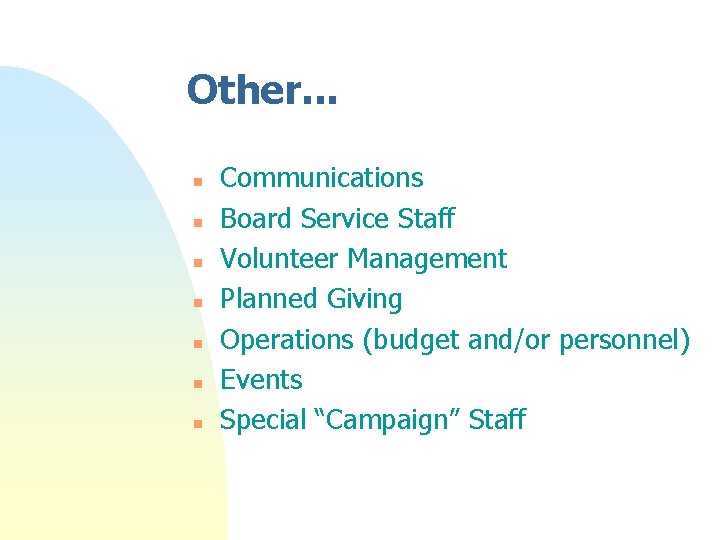
Other. . . n n n n Communications Board Service Staff Volunteer Management Planned Giving Operations (budget and/or personnel) Events Special “Campaign” Staff
The Language They Use (Fundraisese or Developmentspeak)
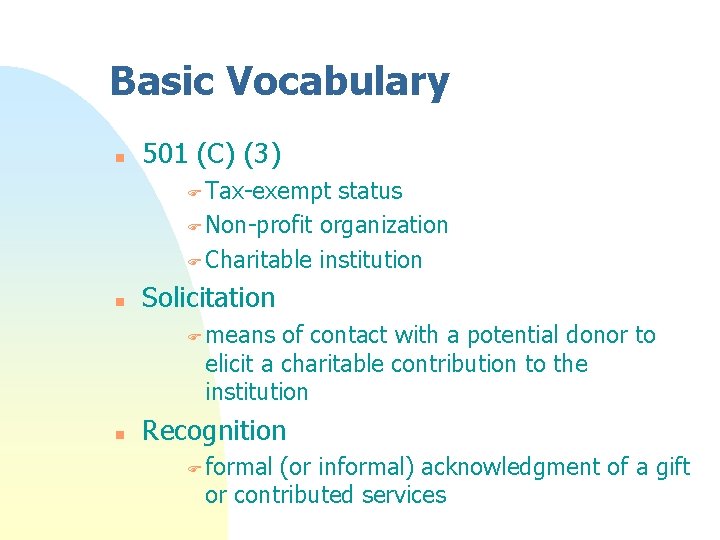
Basic Vocabulary n 501 (C) (3) F Tax-exempt status F Non-profit organization F Charitable institution n Solicitation F means of contact with a potential donor to elicit a charitable contribution to the institution n Recognition F formal (or informal) acknowledgment of a gift or contributed services
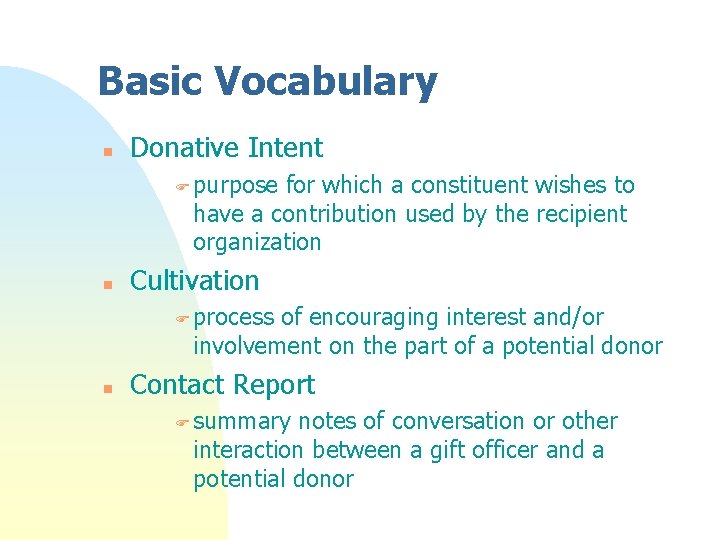
Basic Vocabulary n Donative Intent F purpose for which a constituent wishes to have a contribution used by the recipient organization n Cultivation F process of encouraging interest and/or involvement on the part of a potential donor n Contact Report F summary notes of conversation or other interaction between a gift officer and a potential donor
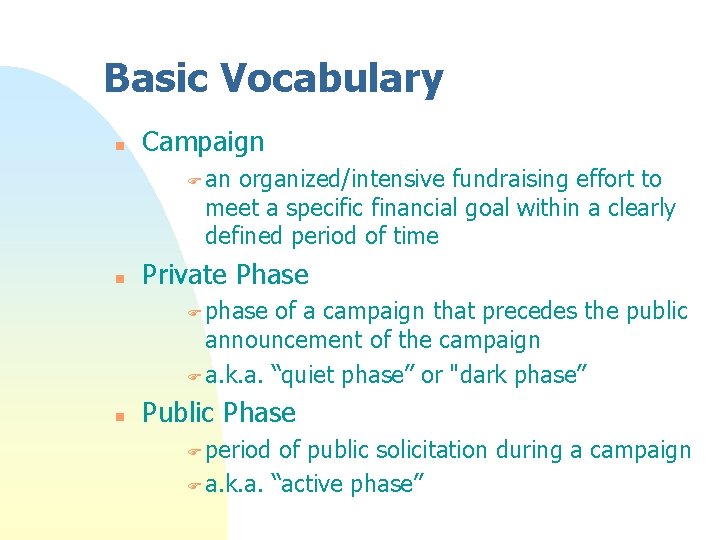
Basic Vocabulary n Campaign F an organized/intensive fundraising effort to meet a specific financial goal within a clearly defined period of time n Private Phase F phase of a campaign that precedes the public announcement of the campaign F a. k. a. “quiet phase” or "dark phase” n Public Phase F period of public solicitation during a campaign F a. k. a. “active phase”
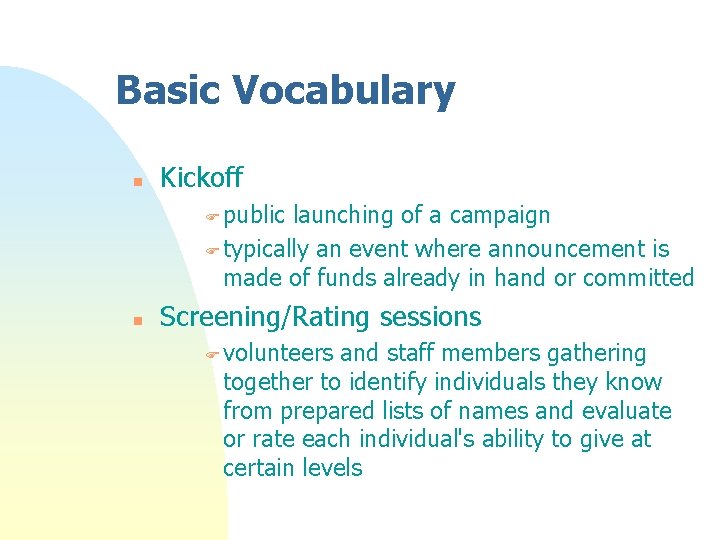
Basic Vocabulary n Kickoff F public launching of a campaign F typically an event where announcement is made of funds already in hand or committed n Screening/Rating sessions F volunteers and staff members gathering together to identify individuals they know from prepared lists of names and evaluate or rate each individual's ability to give at certain levels
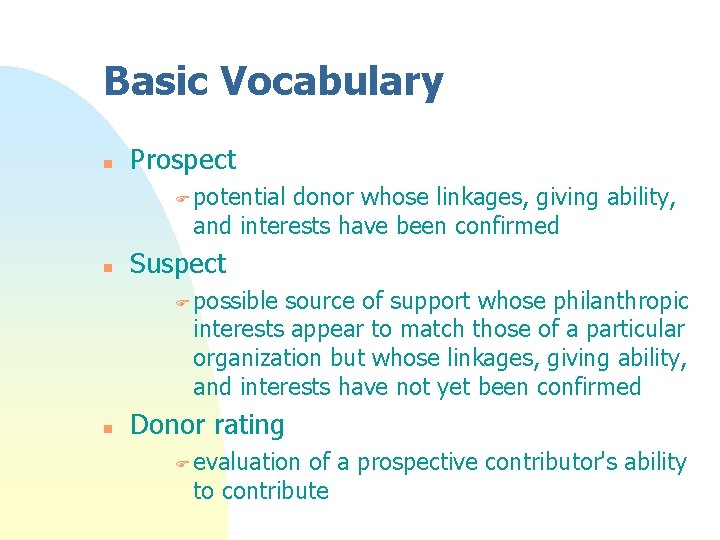
Basic Vocabulary n Prospect F potential donor whose linkages, giving ability, and interests have been confirmed n Suspect F possible source of support whose philanthropic interests appear to match those of a particular organization but whose linkages, giving ability, and interests have not yet been confirmed n Donor rating F evaluation of a prospective contributor's ability to contribute
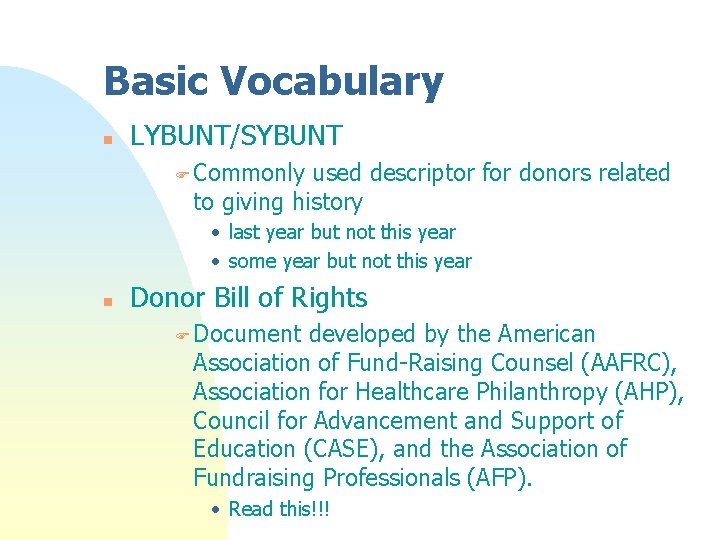
Basic Vocabulary n LYBUNT/SYBUNT F Commonly used descriptor for donors related to giving history • last year but not this year • some year but not this year n Donor Bill of Rights F Document developed by the American Association of Fund-Raising Counsel (AAFRC), Association for Healthcare Philanthropy (AHP), Council for Advancement and Support of Education (CASE), and the Association of Fundraising Professionals (AFP). • Read this!!!
Basic Gift Processing Vocabulary (Advancementology)
What is a Gift? n Contribution or Donation F “A gift is a transfer of money and/or property by one person to another, where there is an absence of consideration, in whole or in part, in relation to the amount transferred. ” • As defined by Bruce R. Hopkins – (Thank you, John H. Taylor)
Gift Transaction Types or “Tenders” n Cash F simplest and most straightforward means of contribution n Check F ditto n (see above) Charge F second easiest contribution mechanism
Gift Transaction Types or “Tenders” n Securities (shares of stock) F Date of Gift • What defines it? F Determining value • High, Low and MEAN F Importance n of gift date In-Kind Gift F Property, goods, “Bargain Sale” F Fair Market Value (FMV) F IRS Form 8283
Gift Transaction Types or “Tenders” n Planned Gift F Annuity • An amount (usually fixed) to be paid periodically • American Council On Gift Annuities – nonprofit formed in 1927 – provides services to charities regarding gift annuities and other planned gifts • Red Book (Guide for Computing the Federal Tax Implications of Property Transfers Subject to Life Income Agreements under Pooled Income Funds) • Green Book (Tax Implications of an Annuity Gift) • Yellow Book (Deferred Gift Annuities)
Gift Transaction Types or “Tenders” n Planned Gift (continued) F Trust • Legal means to set aside money/property of one person for the benefit of one or more persons or organizations F Unitrust • Lead Unitrust - pays a fixed percentage of its annual value to a nonprofit or a private foundation or the greater of a fixed percentage of the trust's annual value or its net income • Remainder Unitrust - provides a variable income payment based on a fixed percentage of the net fair market value of the trust assets as valued each year
Gift Transaction Types or “Tenders” n Planned Gift (continued) F Pooled Income Fund • Trust to which a donor transfers property and contributes irrevocably the remainder interest to a qualified charity, retaining a life-income interest for one or more beneficiaries • Internal Revenue Code Subsection 642(c) paragraph(5) F Insurance policy • Institution sets parameters as to whether or not such policies will be accepted and under what terms
Gift Transaction Types or “Tenders” n Pledge F Unconditional • Most common occurrence related to “Annual Fund” pledges • No constraints placed on the recipient institution by the donor to assure donor fulfillment of pledge payment F Conditional • terms applied to pledge by donor on institution that effect payment (“if…then”)
Gift Transaction Types or “Tenders” n Credit F Hard credit • real value of asset F Soft credit • gift through DAF, company F Recognition credit • site defined
DAF vs. DDF n Donor Advised Fund (DAF) F Charitable organization [501(c)(3)] F Issues tax receipt to donor at time funds are deposited F Disperses funds to recipient institution at recommendation of individual donor F Is NOT obligated to comply with donor recommendation (though they usually do)
DAF vs. DDF n Donor Directed Fund (DDF) F Glorified checking account F Makes contributions solely at direction of individual donor F Does not typically issue a tax receipt to donor F If in doubt whether contribution is DAF vs. DDF, pick up the phone…
Other Common Transaction Terms n Quid pro quo (you scratch my back and I’ll scratch yours) F Goods returned to donor in recognition of a contribution F If value of goods is not greater than $80 or 2% total of total value of the contribution – no quid adjustment is necessary F Example: “Low cost articles” not in excess of $8 value with minimum $40 gift F IRS publication 1771
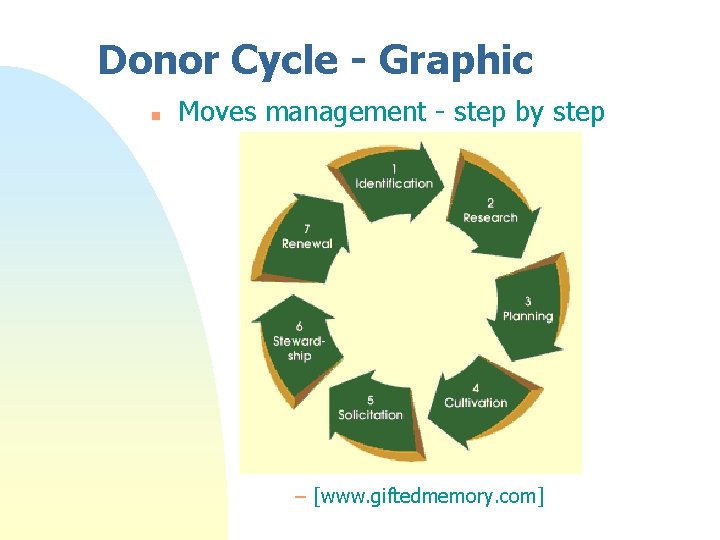
Donor Cycle (a. k. a. Moves Management)
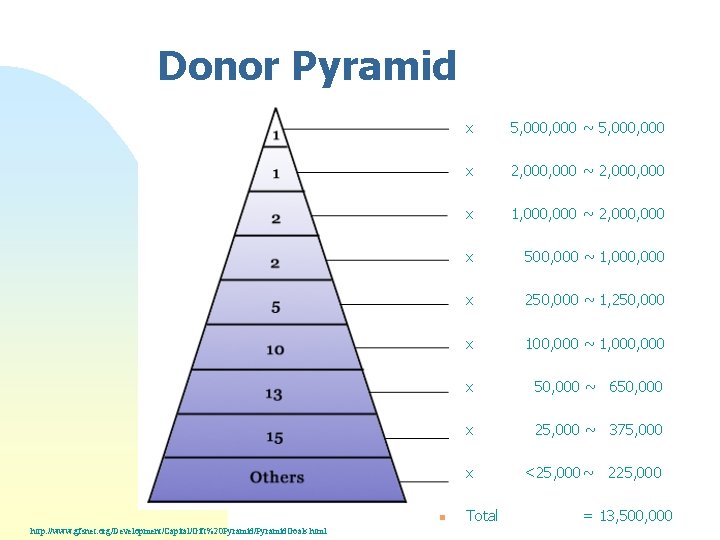
Donor Pyramid n n Graphic representation of the hierarchy of donors by gift size Commonly used for planning strategies related to capital campaign
Donor Pyramid http: //www. gfsnet. org/Development/Capital/Gift%20 Pyramid/Pyramid. Goals. html n x 5, 000 ~ 5, 000 n x 2, 000 ~ 2, 000 n x 1, 000 ~ 2, 000 n x 500, 000 ~ 1, 000 n x 250, 000 ~ 1, 250, 000 n x 100, 000 ~ 1, 000 n x 50, 000 ~ 650, 000 n x 25, 000 ~ 375, 000 n x <25, 000 ~ 225, 000 n Total = 13, 500, 000
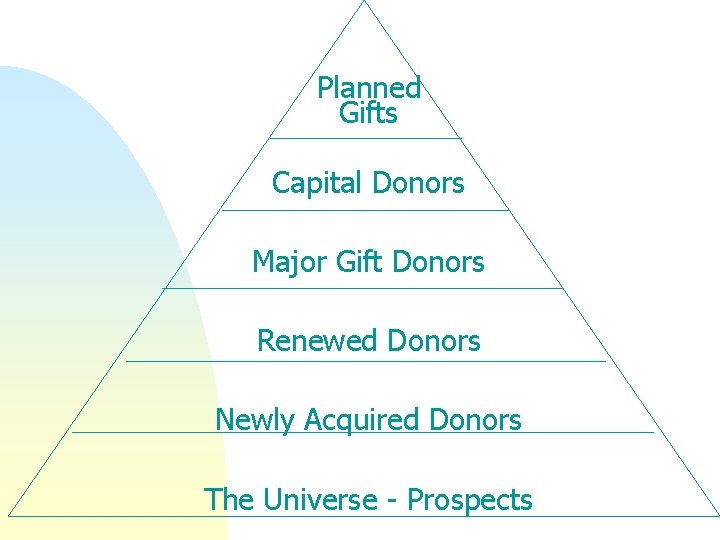
Donor Pyramid (2) n n n Graphic representation of universe of donors Reflective of donor levels as individuals are moved through the donor cycle Basic flow of moves management objectives
Planned Gifts Capital Donors Major Gift Donors Renewed Donors Newly Acquired Donors The Universe - Prospects
Donor Cycle - Graphic n Moves management - step by step – [www. giftedmemory. com]
Step 1 n Identification F Evaluation of both constituent database and larger target audience F Develop pool of potential donors who believe in your institutional mission and also have a capacity to make a significant contribution F Primary purpose of campaign “screening sessions”
Step 2 n Research F Discovery, data entry and subsequent reporting of donor related information. F Basic concept is to determine a prospect's capacity (potential) and inclination (propensity) for making a charitable contribution. F Suspects vs. prospects
Step 3 n Planning F “Mini-campaign” F Devise various concepts to engage the prospective donor in various meetings or events to foster an affiliation with the institution F Be prepared to answer any possible questions and provide solid proof of institutional merit
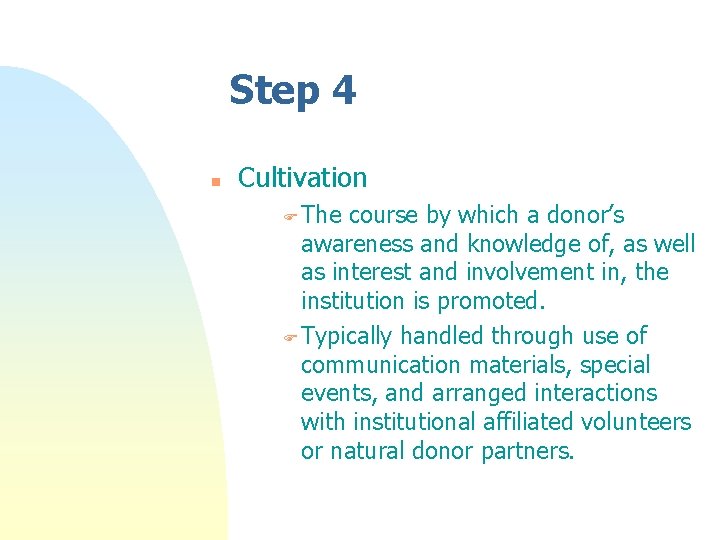
Step 4 n Cultivation F The course by which a donor’s awareness and knowledge of, as well as interest and involvement in, the institution is promoted. F Typically handled through use of communication materials, special events, and arranged interactions with institutional affiliated volunteers or natural donor partners.
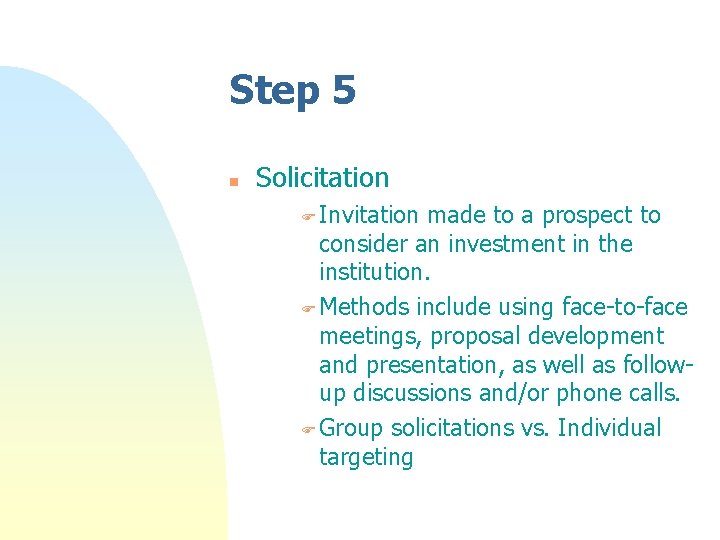
Step 5 n Solicitation F Invitation made to a prospect to consider an investment in the institution. F Methods include using face-to-face meetings, proposal development and presentation, as well as followup discussions and/or phone calls. F Group solicitations vs. Individual targeting
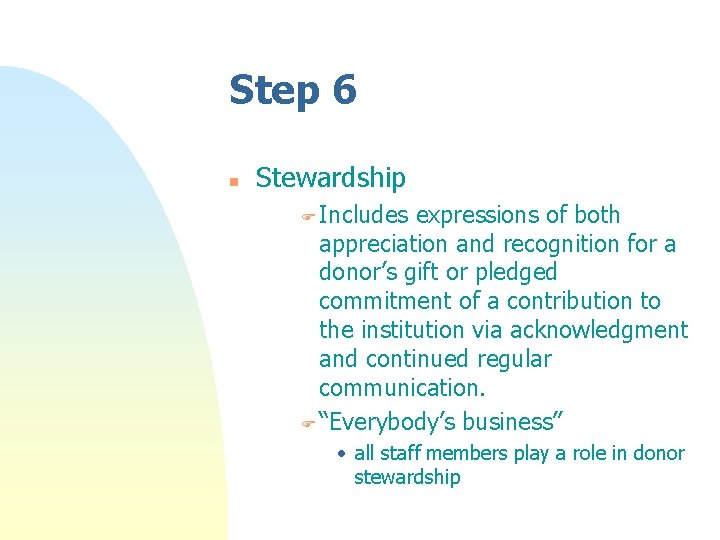
Step 6 n Stewardship F Includes expressions of both appreciation and recognition for a donor’s gift or pledged commitment of a contribution to the institution via acknowledgment and continued regular communication. F “Everybody’s business” • all staff members play a role in donor stewardship
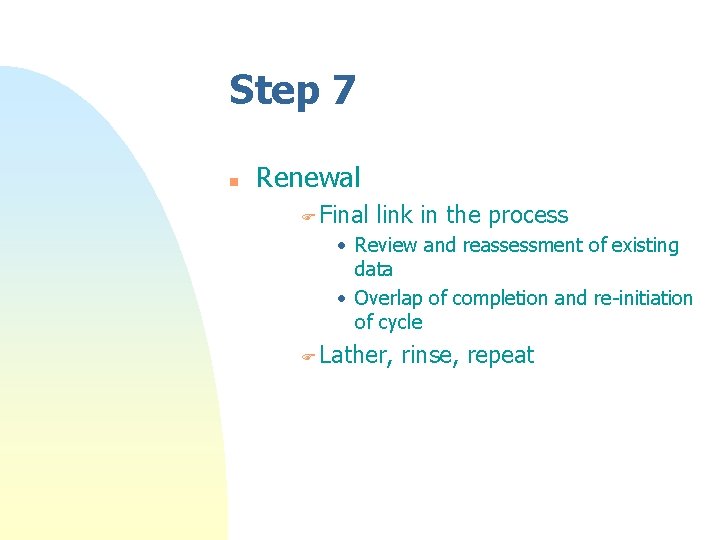
Step 7 n Renewal F Final link in the process • Review and reassessment of existing data • Overlap of completion and re-initiation of cycle F Lather, rinse, repeat
Rules and Regulations vs. Industry Standards / Best Practices vs. Institutional Policies and Procedures
IRS n Internal Revenue Service n (They Who Must Be Obeyed) n [www. irs. gov]
FASB / GASB n Financial Accounting Standards Board F Independent authority founded in 1973 to establish accounting principles in the US F Mission - “to establish and improve standards of financial accounting and reporting for the guidance and education of the public, including issuers, auditors and users of financial information. ” n Government Accounting Standards Board F Organized in 1984 by the Financial Accounting Foundation F “Yeah, what they said, only for state and local governmental entities…”
CASE / CAE n Council for Advancement and Support of Education F www. case. org F “Professional organization for advancement professionals” F Management and Reporting Standards n Council for Aid to Education F www. cae. org F Subsidiary of Rand • Established in 1952 to advance corporate support of education
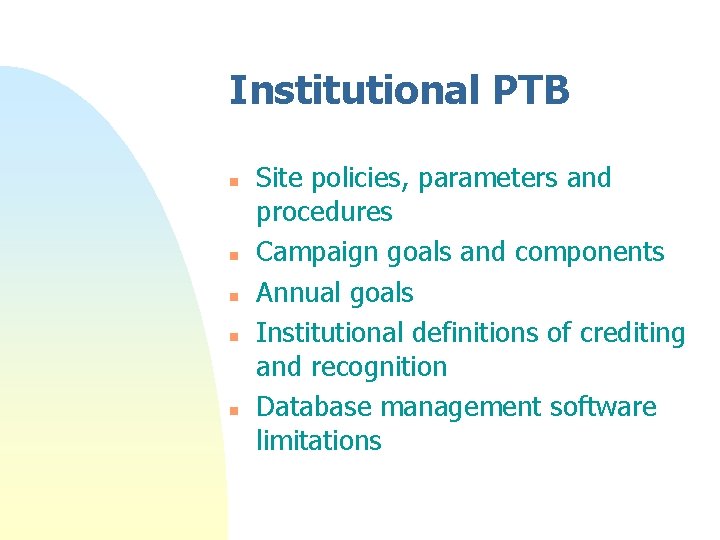
Institutional PTB n n n Site policies, parameters and procedures Campaign goals and components Annual goals Institutional definitions of crediting and recognition Database management software limitations
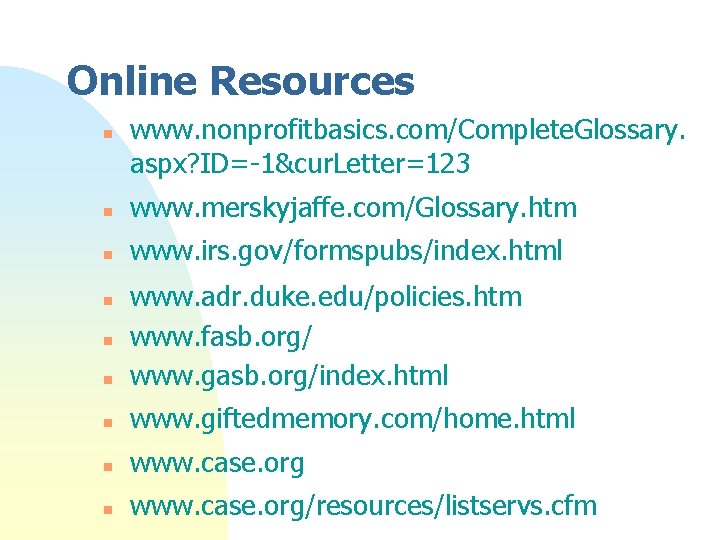
Online Resources n www. nonprofitbasics. com/Complete. Glossary. aspx? ID=-1&cur. Letter=123 n www. merskyjaffe. com/Glossary. htm n www. irs. gov/formspubs/index. html n www. adr. duke. edu/policies. htm www. fasb. org/ www. gasb. org/index. html n www. giftedmemory. com/home. html n www. case. org/resources/listservs. cfm n n