
CASE FOR CHANGE NEW GOVERNANCE FINANCIAL MODEL Presentation
- Slides: 18
CASE FOR CHANGE: NEW GOVERNANCE & FINANCIAL MODEL Presentation for Faculty & Departments January, 2020 Confidential Draft
Confidential Draft Outline • Overview • Shared Principles • Financial Model • Governance Model • Educational Governance • Research Governance • Faculty Governance 2
Confidential Draft Overview • The vision and direction of the school is to foster interdisciplinary as well as disciplinary science, enable cutting edge research, education and service and support to investment in the future • There is a need to enhance our governance structure to achieve mission of the school for the 2 nd century, position the school for effective leadership in the 21 st century. The key drivers for the recommended updates to the governance and financial model include: • Need to modernize and clarify • Set a platform for future • Enable investments and innovation • Be more competitive • Standardize across departments • The newly developed financial model is meant to drive and reinforce the key incentives to growth and eminence as becoming a premiere research and teaching school • A financial model is one component of our governance structure and is a tool to help the school realize its mission and goals. The governance component includes establishing or refining school guidelines in support of University policies: Research and Scholarships, Education, and Faculty Policies 3
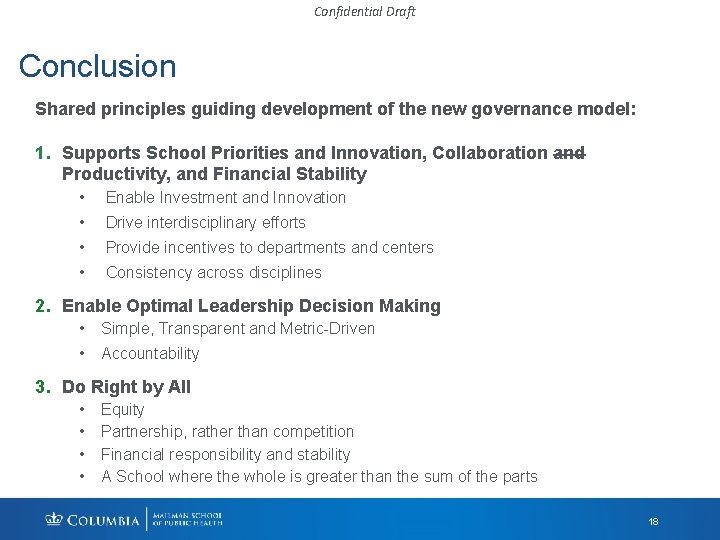
Confidential Draft Shared Principles Shared principles guiding development of the new governance model: 1. Supports School Priorities and Innovation, Collaboration and Productivity, and Financial Stability • Enable Investment and Innovation • Drive interdisciplinary efforts • Provide incentives to departments and centers • Consistency across disciplines 2. Enable Optimal Leadership Decision Making • Simple, Transparent and Metric-Driven • Accountability 3. Do Right by All • • Equity Partnership, rather than competition Financial responsibility and stability A School where the whole is greater than the sum of the parts 4
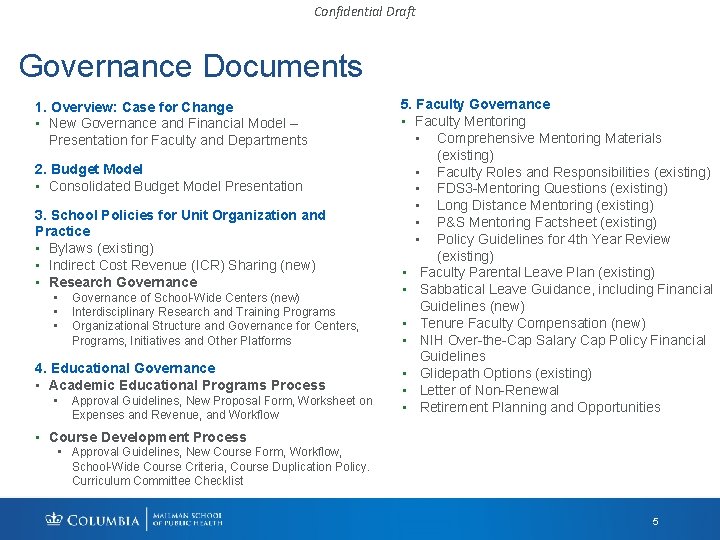
Confidential Draft Governance Documents 1. Overview: Case for Change • New Governance and Financial Model – Presentation for Faculty and Departments 2. Budget Model • Consolidated Budget Model Presentation 3. School Policies for Unit Organization and Practice • Bylaws (existing) • Indirect Cost Revenue (ICR) Sharing (new) • Research Governance • • • Governance of School-Wide Centers (new) Interdisciplinary Research and Training Programs Organizational Structure and Governance for Centers, Programs, Initiatives and Other Platforms 4. Educational Governance • Academic Educational Programs Process • Approval Guidelines, New Proposal Form, Worksheet on Expenses and Revenue, and Workflow 5. Faculty Governance • Faculty Mentoring • Comprehensive Mentoring Materials (existing) • Faculty Roles and Responsibilities (existing) • FDS 3 -Mentoring Questions (existing) • Long Distance Mentoring (existing) • P&S Mentoring Factsheet (existing) • Policy Guidelines for 4 th Year Review (existing) • Faculty Parental Leave Plan (existing) • Sabbatical Leave Guidance, including Financial Guidelines (new) • Tenure Faculty Compensation (new) • NIH Over-the-Cap Salary Cap Policy Financial Guidelines • Glidepath Options (existing) • Letter of Non-Renewal • Retirement Planning and Opportunities • Course Development Process • Approval Guidelines, New Course Form, Workflow, School-Wide Course Criteria, Course Duplication Policy. Curriculum Committee Checklist 5
New Financial Model
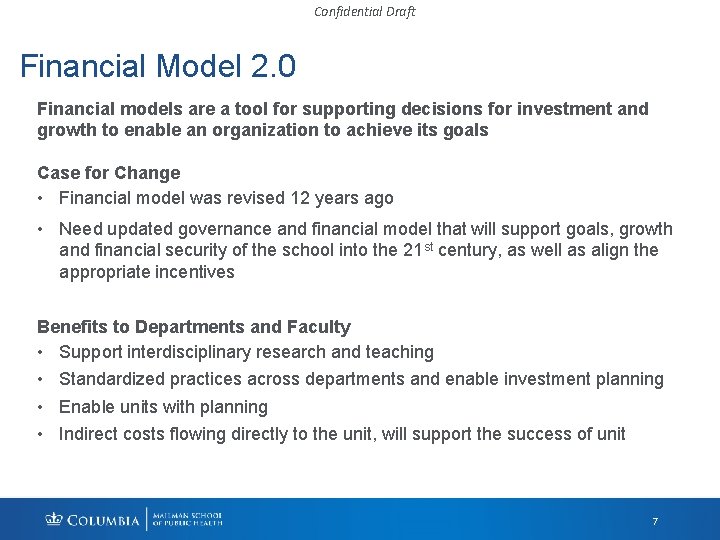
Confidential Draft Financial Model 2. 0 Financial models are a tool for supporting decisions for investment and growth to enable an organization to achieve its goals Case for Change • Financial model was revised 12 years ago • Need updated governance and financial model that will support goals, growth and financial security of the school into the 21 st century, as well as align the appropriate incentives Benefits to Departments and Faculty • Support interdisciplinary research and teaching • Standardized practices across departments and enable investment planning • Enable units with planning • Indirect costs flowing directly to the unit, will support the success of unit 7
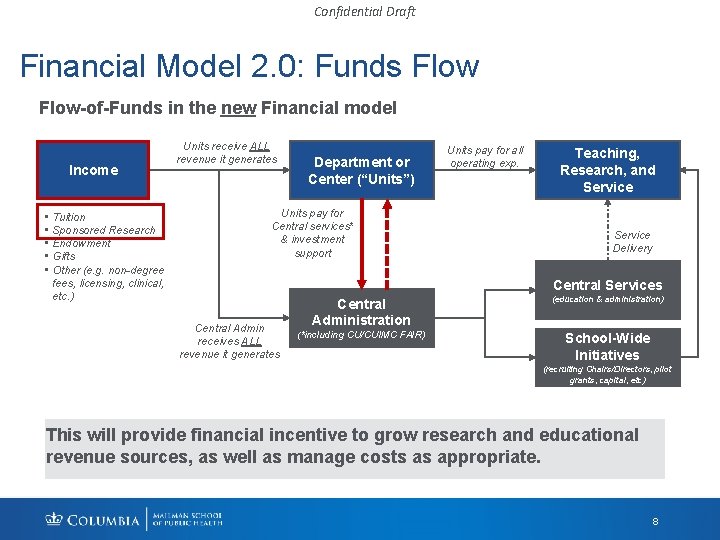
Confidential Draft Financial Model 2. 0: Funds Flow-of-Funds in the new Financial model Income • Tuition • Sponsored Research • Endowment • Gifts • Other (e. g. non-degree fees, licensing, clinical, etc. ) Units receive ALL revenue it generates Department or Center (“Units”) Units pay for Central services* & investment support Units pay for all operating exp. Teaching, Research, and Service Delivery Central Services Central Admin receives ALL revenue it generates Central Administration (education & administration) (*including CU/CUIMC FAIR) School-Wide Initiatives (recruiting Chairs/Directors, pilot grants, capital, etc) This will provide financial incentive to grow research and educational revenue sources, as well as manage costs as appropriate. 8
Governance and Policies to Complement the Financial Model 2. 0
Confidential Draft Educational Governance: Overview Changes in financial model that support: • Financial planning and investment • Innovation and growth • Interdisciplinarity and partnership 10
Confidential Draft Educational Governance: Guiding Principles • Provide guidance to support innovation, entrepreneurial activity, diversification and growth • Make process transparent and streamlined • Establish or refine policies to support and align school and departmental priorities • Foster partnership and interdisciplinarity among departments • Ensure alignment with University process and policy and CEPH accreditation standards • Improve efficiency; reduce duplication • Financial return on investment (ROI) assessed 11
Confidential Draft Educational Governance: New/Revised Educational Programs Process Standardized process and workflow for new and revised academic programs, including: • Degree programs • CPAs • MPH certificates • Tracks/concentrations within a degree program 12
Confidential Draft Educational Governance: Course Development Process and Approval Standardized process and workflow for course development including: • Development of school-wide course criteria • Update of course duplication policy • Curriculum committee review checklist and approval workflow 13
Confidential Draft Research Governance: IC Sharing Objective • • To fairly allocate IC in ways that parallel appropriate time and resource needs To create a uniform guideline that is fair across the school and CUIMC, that fosters collaboration Current IC Sharing Model • • IC sharing 25/25/50 Centralized commitment to shared IC with MSPH needs to be established Proposed New IC Sharing Model • • An MPI or Scope account model (could be a modified Scope to address admin. costs) Establish agreement with each school in CUICM Expected Outcomes • • Standardized process and agreement, so ad hoc negotiations not needed Indirect funds flow to where the work is actually being conducted Fair sharing to foster inter-unit collaboration Positions the school to more effectively negotiate with P&S. Nursing, Dental, Medicine, and other partners 14
Confidential Draft Research Governance: NIH Over the Cap School Guidelines • Nothing currently in place • Recommend clarification that over the cap is the responsibility of the home department or unit • We do not want to create any sort of disincentive for faculty who get NIH grants Financial Guidelines • NIH established these rules to require a contribution from Universities, Schools, and Departments. • Departments benefit from faculty being funded by NIH and should be responsible for over the cap salary. 15
Confidential Draft Faculty Governance: Tenure Faculty Compensation Commitment Drivers for Change • Current lack of clarity as to the institution’s financial commitment • Ensure fairness for all tenured faculty across units • CUIMC expectation that Mailman School implement Medical Center policy What is Changing? • No changes to University guidelines on tenure • A clear financial commitment to tenured faculty is established, standard across units • A 5 -year probationary period to allow necessary adjustments • A guaranteed base salary with benefits Expected Outcomes • Clarity for tenured faculty • Supports an entrepreneurial atmosphere (all faculty are expected to attract resources to the School) • Ensure financial stability of the School with a growing faculty and an uncertain funding environment • Competitive with peer schools 16
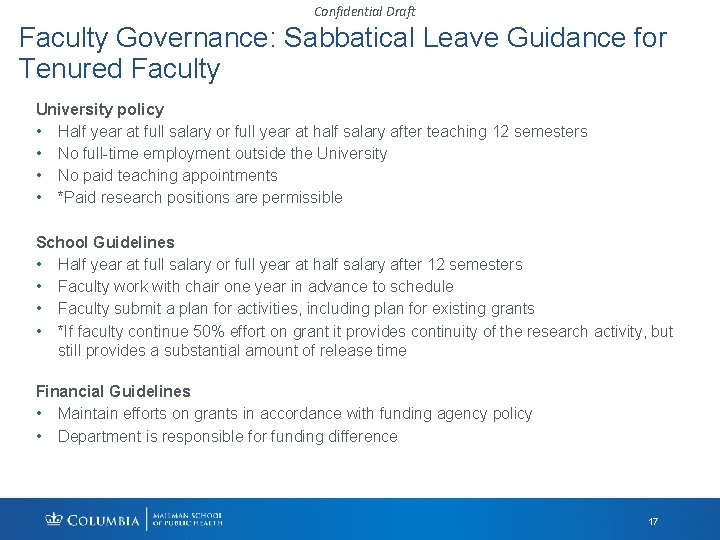
Confidential Draft Faculty Governance: Sabbatical Leave Guidance for Tenured Faculty University policy • Half year at full salary or full year at half salary after teaching 12 semesters • No full-time employment outside the University • No paid teaching appointments • *Paid research positions are permissible School Guidelines • Half year at full salary or full year at half salary after 12 semesters • Faculty work with chair one year in advance to schedule • Faculty submit a plan for activities, including plan for existing grants • *If faculty continue 50% effort on grant it provides continuity of the research activity, but still provides a substantial amount of release time Financial Guidelines • Maintain efforts on grants in accordance with funding agency policy • Department is responsible for funding difference 17
Confidential Draft Conclusion Shared principles guiding development of the new governance model: 1. Supports School Priorities and Innovation, Collaboration and Productivity, and Financial Stability • Enable Investment and Innovation • Drive interdisciplinary efforts • Provide incentives to departments and centers • Consistency across disciplines 2. Enable Optimal Leadership Decision Making • Simple, Transparent and Metric-Driven • Accountability 3. Do Right by All • • Equity Partnership, rather than competition Financial responsibility and stability A School where the whole is greater than the sum of the parts 18