
Case Closure in Adult Protective Services APS CORE

- Slides: 41
Case Closure in Adult Protective Services APS CORE COMPENTENCY MODULE 23 HALF-DAY TRAINING Curriculum Developed by Susan Castano Developed July 2015
This training was produced by the Academy for Professional Excellence under 2009 -SZ-B 9 -K 008, awarded by the Office for Victims of Crime, Office of Justice Programs, U. S. Department of Justice. The opinions, findings, and conclusions or recommendations expressed in this training are those of the contributors and do not necessarily represent the official position or policies of the U. S. Department of Justice. The National APS Training Project is a project of the Academy for Professional Excellence, San Diego State University School of Social Work 2
Housekeeping and Introductions • • • Schedule for the day CEU instructions Location of restrooms Set cell phones to vibrate Introductions 3
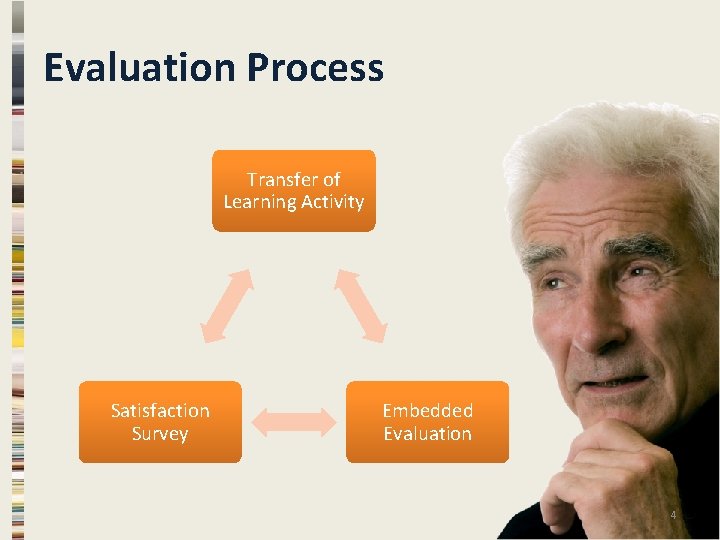
Evaluation Process Transfer of Learning Activity Satisfaction Survey Embedded Evaluation 4
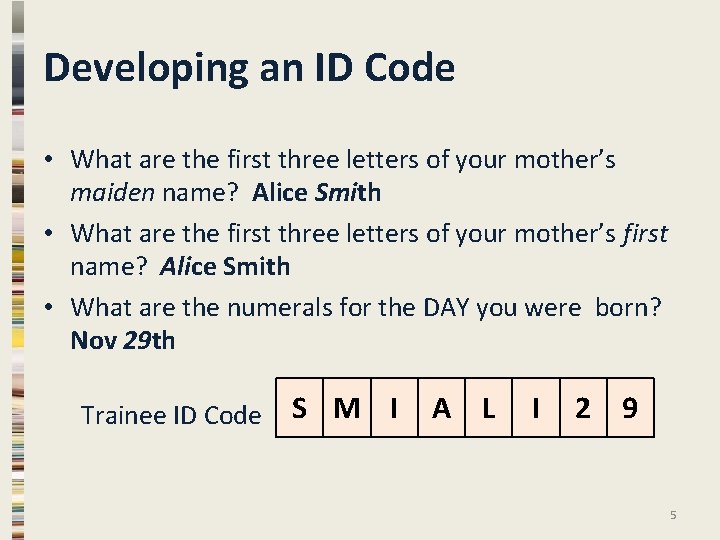
Developing an ID Code • What are the first three letters of your mother’s maiden name? Alice Smith • What are the first three letters of your mother’s first name? Alice Smith • What are the numerals for the DAY you were born? Nov 29 th Trainee ID Code S M I A L I 2 9 5
Learning Objectives • Identify factors and conditions which indicate appropriateness/inappropriateness of closing an APS case. • Explain how aspects of the helping relationship affect the outcome of the case at termination. • Write a case closure summary that includes all essential case elements. • Recognize how grief and loss dynamics lead to worker stress at case closure and identify a personal method to relieve burnout.
What the Policy Says • Goal of APS intervention • Achievement of goal • Non-achievement of goal • Documentation requirements • Follow up requirements
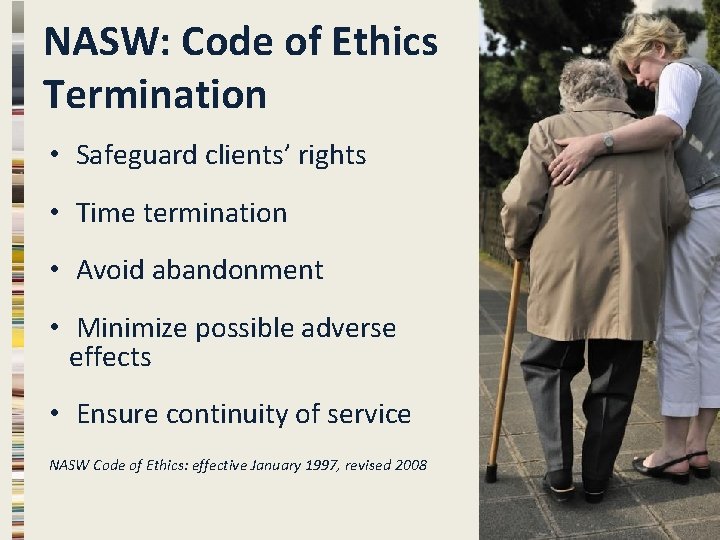
NASW: Code of Ethics Termination • Safeguard clients’ rights • Time termination • Avoid abandonment • Minimize possible adverse effects • Ensure continuity of service NASW Code of Ethics: effective January 1997, revised 2008
APS Case Closing Conditions • Risk resolved or reduced • Unable to locate • Client refused services • Client referred to another agency • Client placed • Client deceased
Risk Resolved or Reduced Conditions? • Presenting problem addressed successfully • Client’s needs being met • Services in place • Perpetrator no longer a threat • Guardian/conservator appointed
Unable to Locate Conditions? • Not at current address • Moved to another state with no contact • Unable to make contact with client • Made reasonable efforts to get locating information
Client Refused Services Conditions? • Client has capacity • Client making informed decision • Client does not wish to take recommended action • Client does not allow worker in home • All reasonable efforts made
Client Referred to Another Agency Conditions? • No longer meets APS criteria • Guardian/conservator assumed responsibility • Case turned over to law enforcement/prosecutor • Client care assumed by mental health system or DD system • Client is out-of-state
Client Placement Conditions? • Long term care facility • Supervised living facility not under APS jurisdiction
Client Deceased Conditions? • Death not related to allegations of abuse, neglect, or exploitation
What is Reasonable Effort? Let’s be Realistic • Personal choice on the part of the client may limit the effectiveness of APS intervention; • Resources available to APS for helping clients are limited; and • APS cannot remedy all situations. Texas APS In Home Training, December 2008 (3 slides)
Reasonable Efforts Include: • Searching for a solution among available regional resources, if resources are unavailable; • Searching for a solution in other parts of the state, if those services meet the needs of the client;
Reasonable Efforts Include: • Changing the service plan if an intervention fails to solve the problem, and a different action is likely to be more effective;
Reasonable Efforts Include: • Evaluating services continually to ensure effectiveness;
Reasonable Efforts Include: • Recognizing that some problems cannot be solved if the resources are not available • Recognizing that some clients are not willing to change their circumstances.
Reasonable Efforts Do NOT Include: • Keeping a case open indefinitely in the eventuality that a resource will become available; • Making a positive outcome an absolute condition for closure; or • Doing more for one client than would be done for another in the same situation.
Case Vignettes • What is the criteria for termination? • Is this case ready for termination? • What reasonable efforts been made to meet the goal?
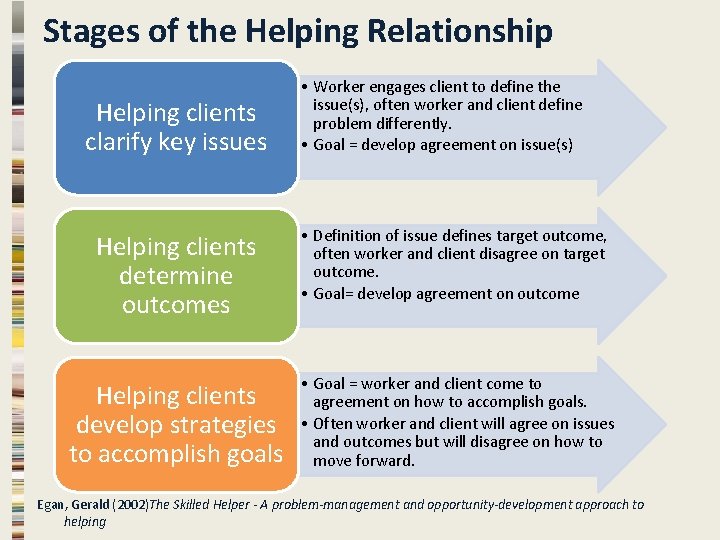
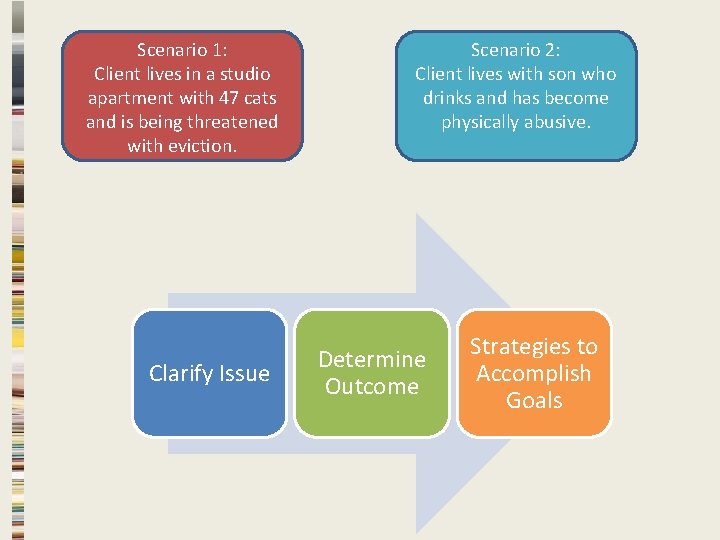
Stages of the Helping Relationship Helping clients clarify key issues • Worker engages client to define the issue(s), often worker and client define problem differently. • Goal = develop agreement on issue(s) Helping clients determine outcomes • Definition of issue defines target outcome, often worker and client disagree on target outcome. • Goal= develop agreement on outcome Helping clients develop strategies to accomplish goals • Goal = worker and client come to agreement on how to accomplish goals. • Often worker and client will agree on issues and outcomes but will disagree on how to move forward. Egan, Gerald (2002)The Skilled Helper - A problem-management and opportunity-development approach to helping
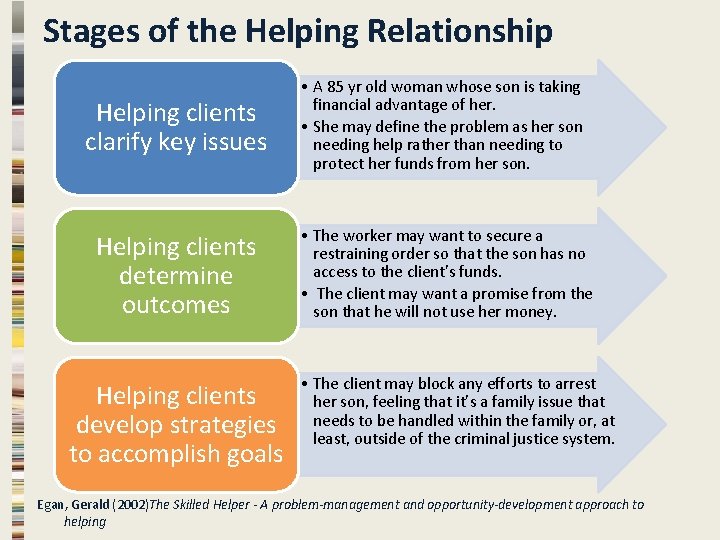
Stages of the Helping Relationship Helping clients clarify key issues • A 85 yr old woman whose son is taking financial advantage of her. • She may define the problem as her son needing help rather than needing to protect her funds from her son. Helping clients determine outcomes • The worker may want to secure a restraining order so that the son has no access to the client’s funds. • The client may want a promise from the son that he will not use her money. Helping clients develop strategies to accomplish goals • The client may block any efforts to arrest her son, feeling that it’s a family issue that needs to be handled within the family or, at least, outside of the criminal justice system. Egan, Gerald (2002)The Skilled Helper - A problem-management and opportunity-development approach to helping
Scenario 1: Client lives in a studio apartment with 47 cats and is being threatened with eviction. Clarify Issue Scenario 2: Client lives with son who drinks and has become physically abusive. Determine Outcome Strategies to Accomplish Goals
Whose Needs Were Met? • Cooperative? • Adversarial? • Whose needs were met? • Rush to close? • Push to keep open?
So, Where do YOU fit in? • Helping relationship begins with YOU • Rapport and empathy are the source • Self-awareness is crucial to the helping process • Your feelings, attitudes, assumptions influence the outcome
Activity: Dynamics of Case Termination • • Dependence Fear Guilt Anxiety Relief Dealing with and clarifying value differences Dealing with and accepting resistance/anger
Don’t “Sleep” With Your Clients • • Not ethical Not good for your mental health Not good for your other relationships Not good for professional morale I forgot to call Mr. B and I need a food voucher for Alice
How to Sleep at Night…and Get Through the Day…
Compassion Satisfaction/ Fatigue Self-Test for Helpers
How can we enjoy life while being responsible to others? Buddhists advise: “Act as if the future of the universe depends on what you do, while laughing at yourself for thinking that your actions make a difference. ”
Closing an APS Case: Necessary Steps • Risk reassessment • Evaluation of case intervention and progress • Referrals • Review of documentation • Discussion with supervisor
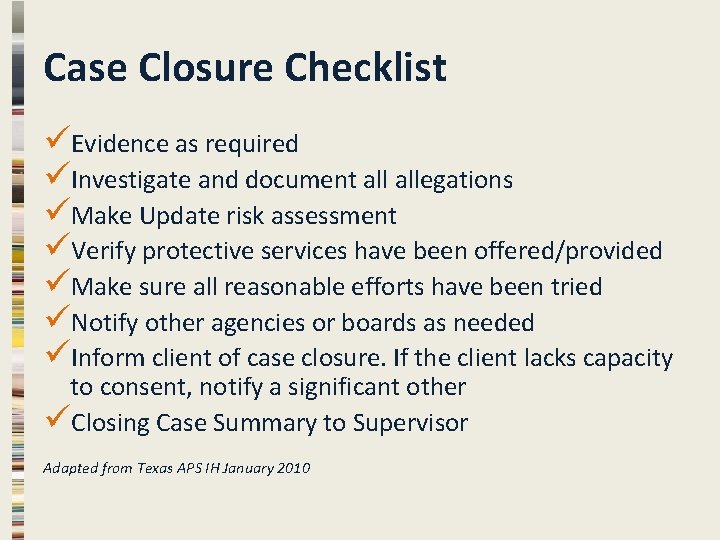
Case Closure Checklist üEvidence as required üInvestigate and document allegations üMake Update risk assessment üVerify protective services have been offered/provided üMake sure all reasonable efforts have been tried üNotify other agencies or boards as needed üInform client of case closure. If the client lacks capacity to consent, notify a significant other üClosing Case Summary to Supervisor Adapted from Texas APS IH January 2010
Taking the Steps Activity • Make the case your own • Take all necessary steps to prepare for termination • Write what you would do if it were your case
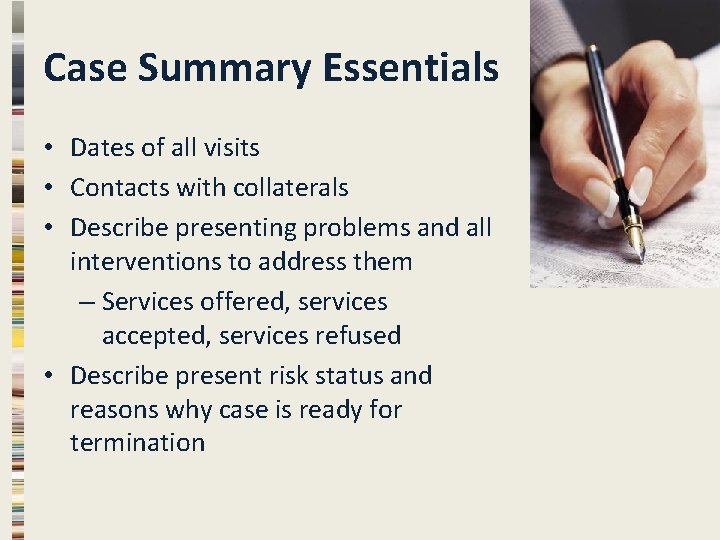
Case Summary Essentials • Dates of all visits • Contacts with collaterals • Describe presenting problems and all interventions to address them – Services offered, services accepted, services refused • Describe present risk status and reasons why case is ready for termination
Practice: Transfer of Learning • Use your case • Measure the outcome • Write the summary • Present to your supervisor
Bottom Line Issues: Cover All Bases • Did I do everything I could… – To engage the client – To understand/respect the client, her needs, her wishes – To provide appropriate services in the least restrictive manner • Did I involve others as needed? – Family/friends/significant others – Other disciplines – Law enforcement
Bottom Line Issues: Liability • Did I fulfill my legal responsibilities? • Was a final risk assessment completed? • Is my documentation clear, factual, and complete? • Could this case come back to haunt me/my agency? – How have I prepared for the possibility? – Have I made follow-up plans when appropriate?
Bottom Line Issues: Partners • Did I use partners from other disciplines? • Was termination discussed with partners? • Were confidentiality issues addressed? • Will a partner agency be available to follow up/provide case management after APS is terminated?
Questions? Comments? • Please complete the evaluation