
CASE CITATION STRUCTURE Outline Purposes of a judicial
- Slides: 18
CASE CITATION & STRUCTURE Outline ♦ Purposes of a judicial opinion ♦ Case citation ♦ Essential elements of a judicial opinion
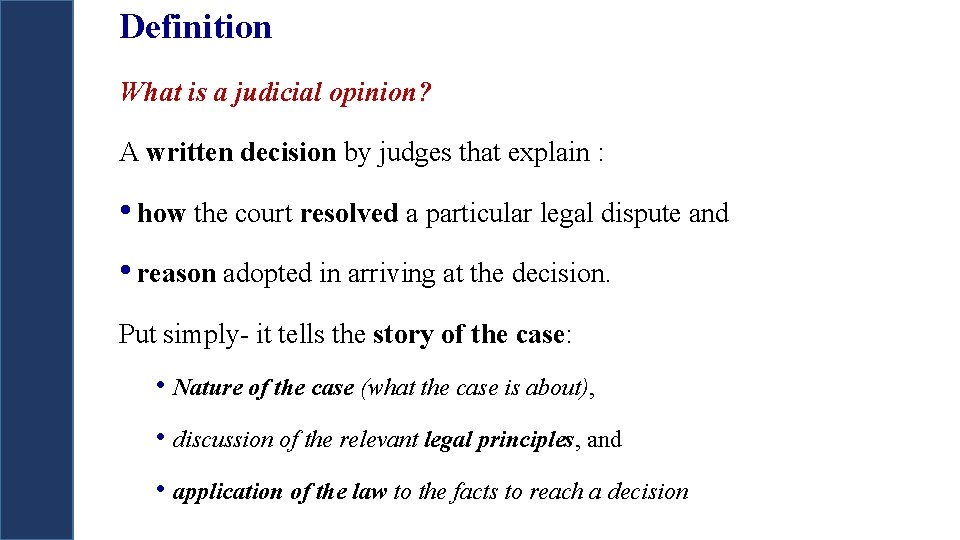
Definition What is a judicial opinion? A written decision by judges that explain : • how the court resolved a particular legal dispute and • reason adopted in arriving at the decision. Put simply- it tells the story of the case: • Nature of the case (what the case is about), • discussion of the relevant legal principles, and • application of the law to the facts to reach a decision
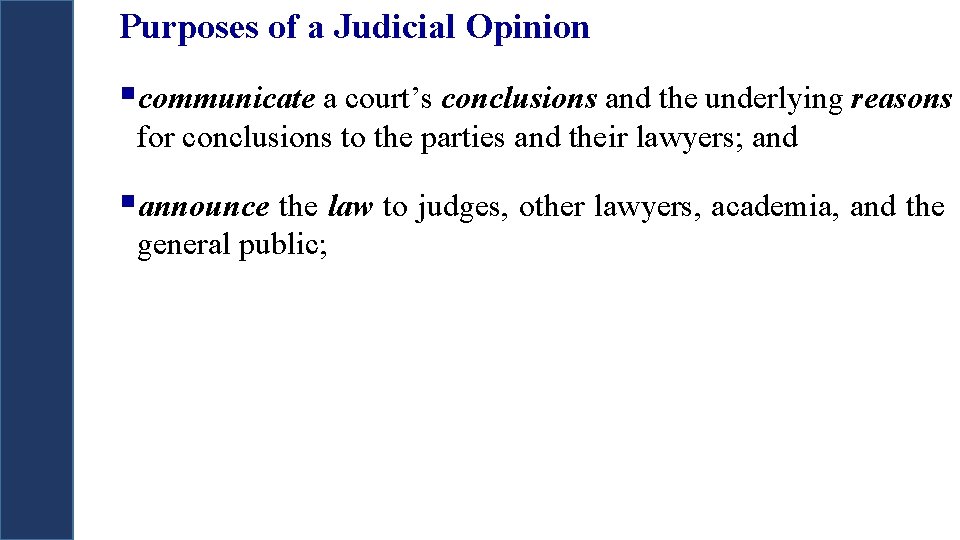
Purposes of a Judicial Opinion §communicate a court’s conclusions and the underlying reasons for conclusions to the parties and their lawyers; and §announce the law to judges, other lawyers, academia, and the general public;
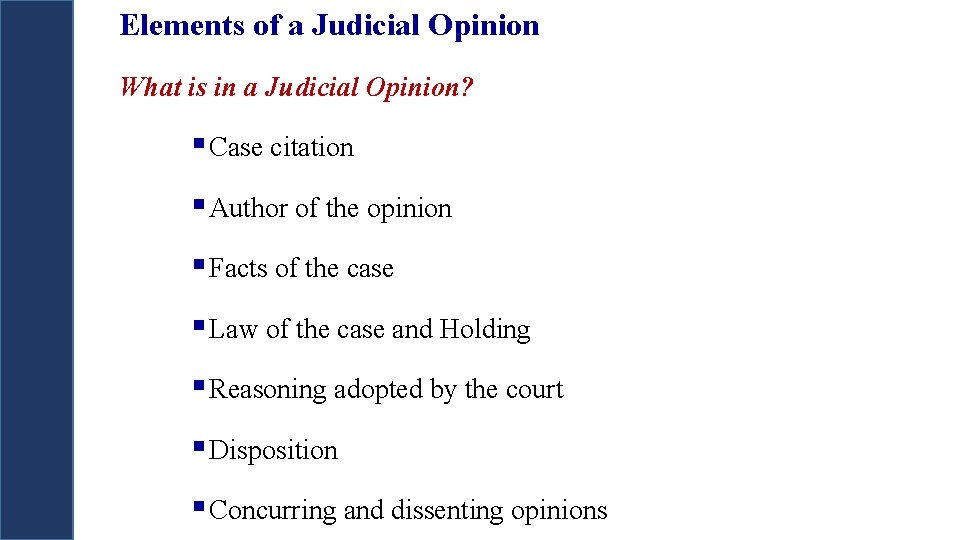
Elements of a Judicial Opinion What is in a Judicial Opinion? § Case citation § Author of the opinion § Facts of the case § Law of the case and Holding § Reasoning adopted by the court § Disposition § Concurring and dissenting opinions
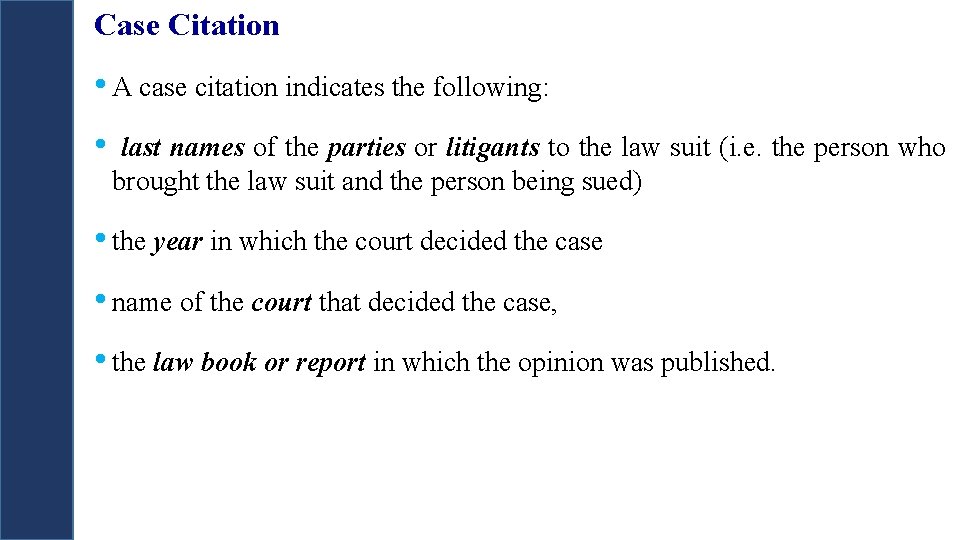
Case Citation • A case citation indicates the following: • last names of the parties or litigants to the law suit (i. e. the person who brought the law suit and the person being sued) • the year in which the court decided the case • name of the court that decided the case, • the law book or report in which the opinion was published.
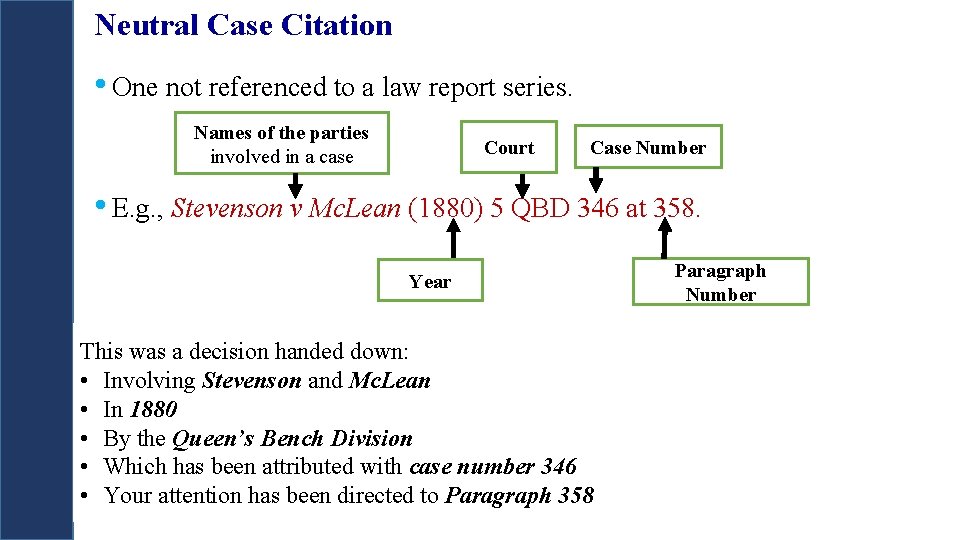
Neutral Case Citation • One not referenced to a law report series. Names of the parties involved in a case Court Case Number • E. g. , Stevenson v Mc. Lean (1880) 5 QBD 346 at 358. Year This was a decision handed down: • Involving Stevenson and Mc. Lean • In 1880 • By the Queen’s Bench Division • Which has been attributed with case number 346 • Your attention has been directed to Paragraph 358 Paragraph Number
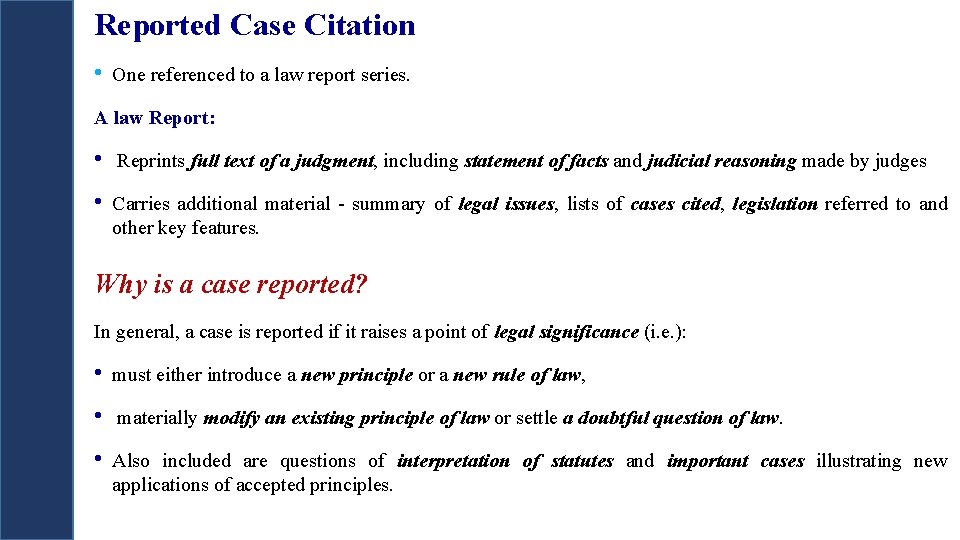
Reported Case Citation • One referenced to a law report series. A law Report: • Reprints full text of a judgment, including statement of facts and judicial reasoning made by judges • Carries additional material - summary of legal issues, lists of cases cited, legislation referred to and other key features. Why is a case reported? In general, a case is reported if it raises a point of legal significance (i. e. ): • must either introduce a new principle or a new rule of law, • materially modify an existing principle of law or settle a doubtful question of law. • Also included are questions of interpretation of statutes and important cases illustrating new applications of accepted principles.
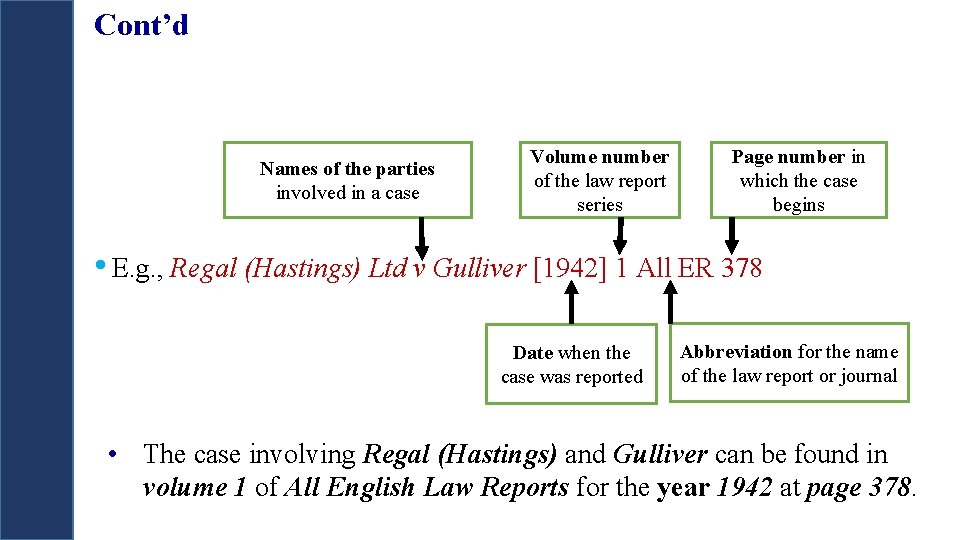
Cont’d Names of the parties involved in a case Volume number of the law report series Page number in which the case begins • E. g. , Regal (Hastings) Ltd v Gulliver [1942] 1 All ER 378 Date when the case was reported Abbreviation for the name of the law report or journal • The case involving Regal (Hastings) and Gulliver can be found in volume 1 of All English Law Reports for the year 1942 at page 378.
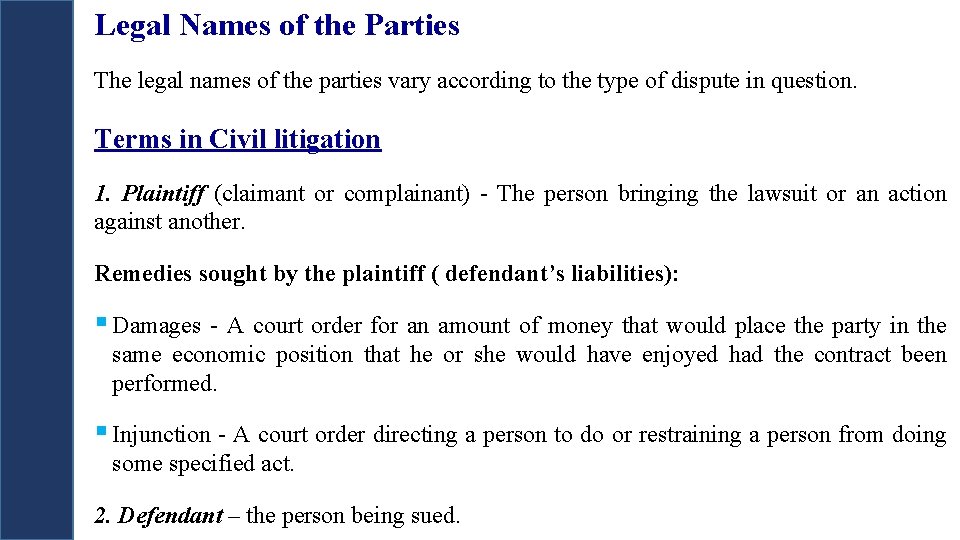
Legal Names of the Parties The legal names of the parties vary according to the type of dispute in question. Terms in Civil litigation 1. Plaintiff (claimant or complainant) - The person bringing the lawsuit or an action against another. Remedies sought by the plaintiff ( defendant’s liabilities): § Damages - A court order for an amount of money that would place the party in the same economic position that he or she would have enjoyed had the contract been performed. § Injunction - A court order directing a person to do or restraining a person from doing some specified act. 2. Defendant – the person being sued.
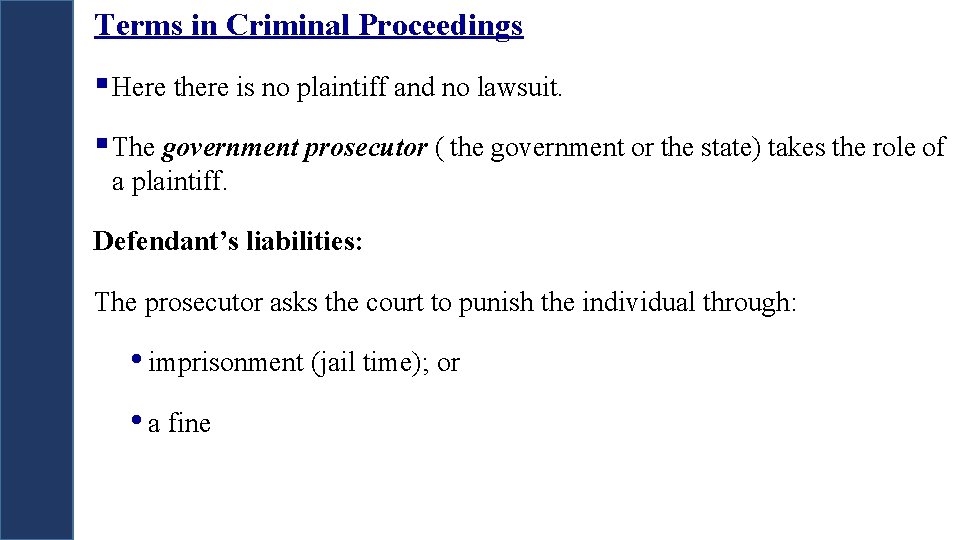
Terms in Criminal Proceedings § Here there is no plaintiff and no lawsuit. § The government prosecutor ( the government or the state) takes the role of a plaintiff. Defendant’s liabilities: The prosecutor asks the court to punish the individual through: • imprisonment (jail time); or • a fine
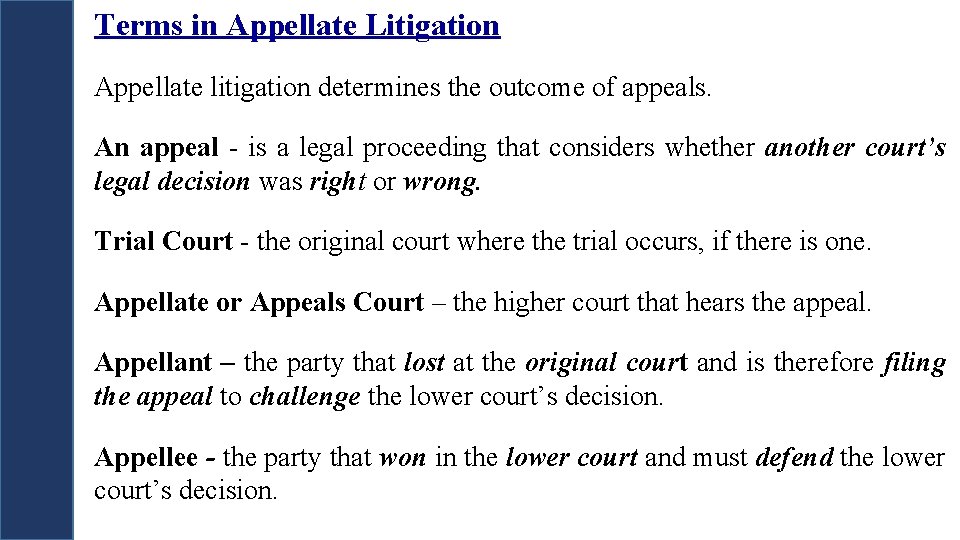
Terms in Appellate Litigation Appellate litigation determines the outcome of appeals. An appeal - is a legal proceeding that considers whether another court’s legal decision was right or wrong. Trial Court - the original court where the trial occurs, if there is one. Appellate or Appeals Court – the higher court that hears the appeal. Appellant – the party that lost at the original court and is therefore filing the appeal to challenge the lower court’s decision. Appellee - the party that won in the lower court and must defend the lower court’s decision.
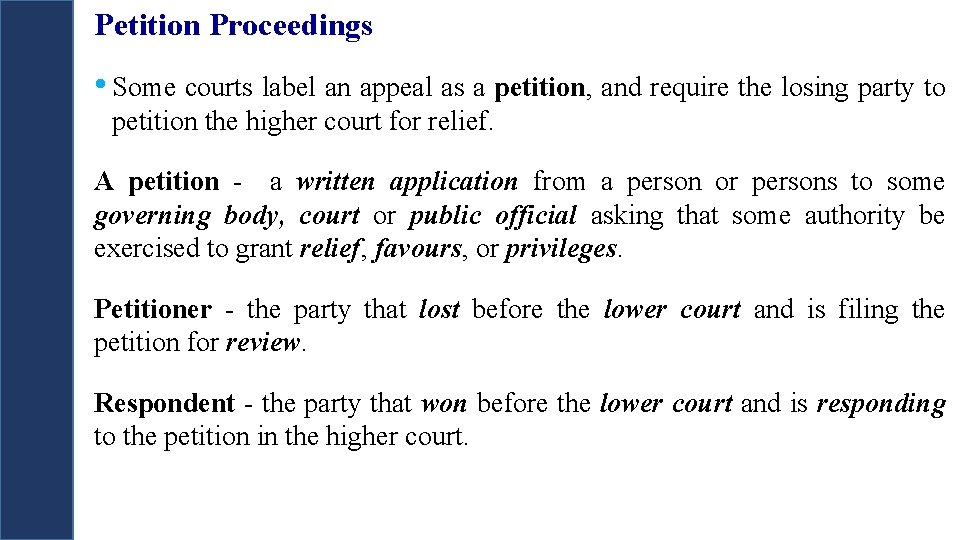
Petition Proceedings • Some courts label an appeal as a petition, and require the losing party to petition the higher court for relief. A petition - a written application from a person or persons to some governing body, court or public official asking that some authority be exercised to grant relief, favours, or privileges. Petitioner - the party that lost before the lower court and is filing the petition for review. Respondent - the party that won before the lower court and is responding to the petition in the higher court.
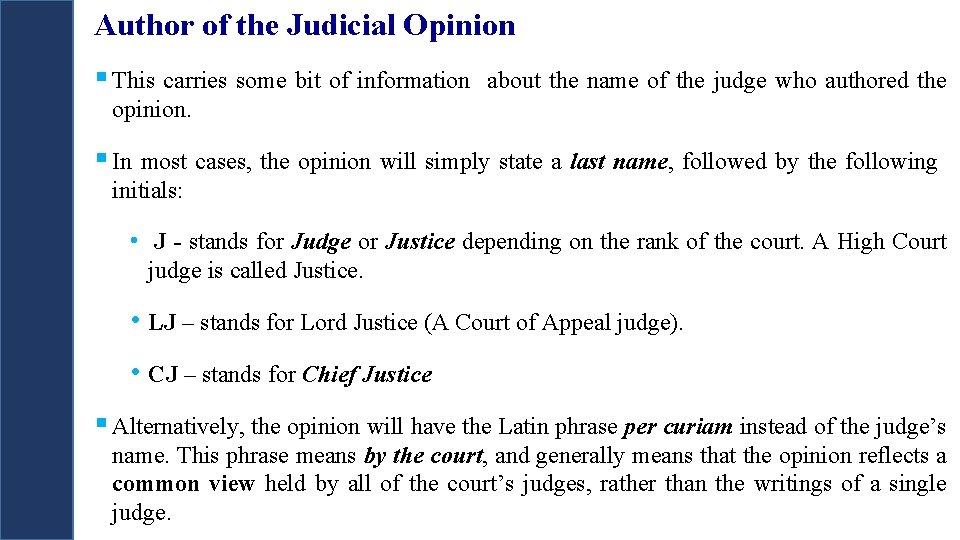
Author of the Judicial Opinion § This carries some bit of information about the name of the judge who authored the opinion. § In most cases, the opinion will simply state a last name, followed by the following initials: • J - stands for Judge or Justice depending on the rank of the court. A High Court judge is called Justice. • LJ – stands for Lord Justice (A Court of Appeal judge). • CJ – stands for Chief Justice § Alternatively, the opinion will have the Latin phrase per curiam instead of the judge’s name. This phrase means by the court, and generally means that the opinion reflects a common view held by all of the court’s judges, rather than the writings of a single judge.
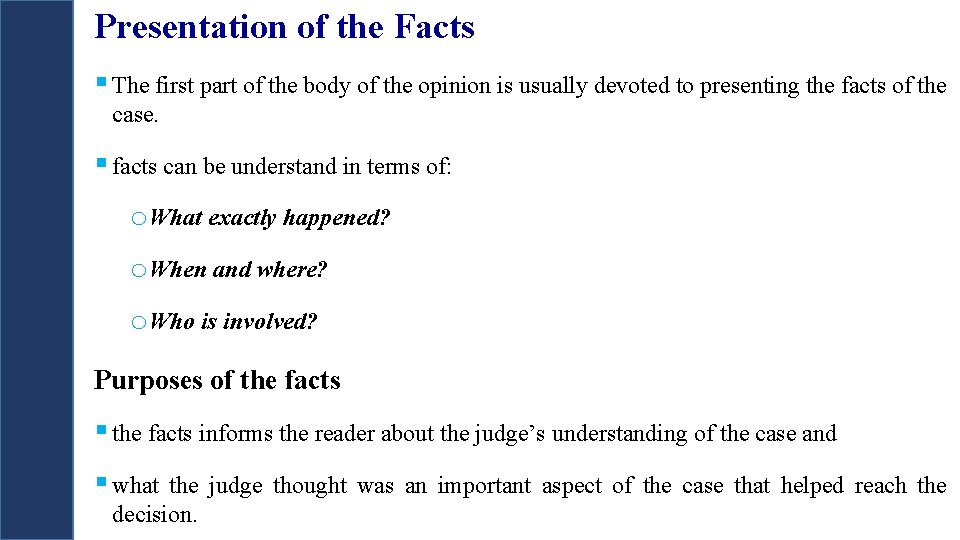
Presentation of the Facts § The first part of the body of the opinion is usually devoted to presenting the facts of the case. § facts can be understand in terms of: o. What exactly happened? o. When and where? o. Who is involved? Purposes of the facts § the facts informs the reader about the judge’s understanding of the case and § what the judge thought was an important aspect of the case that helped reach the decision.
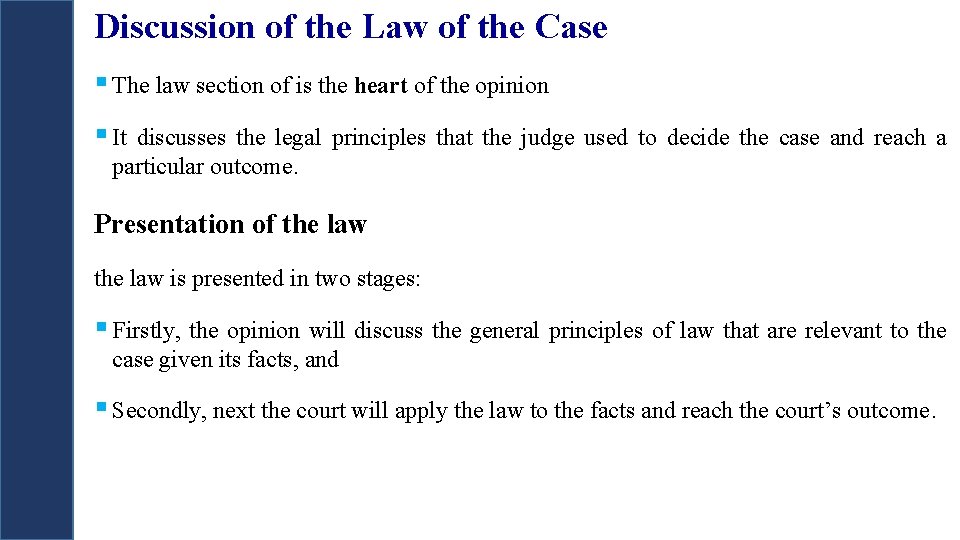
Discussion of the Law of the Case § The law section of is the heart of the opinion § It discusses the legal principles that the judge used to decide the case and reach a particular outcome. Presentation of the law is presented in two stages: § Firstly, the opinion will discuss the general principles of law that are relevant to the case given its facts, and § Secondly, next the court will apply the law to the facts and reach the court’s outcome.
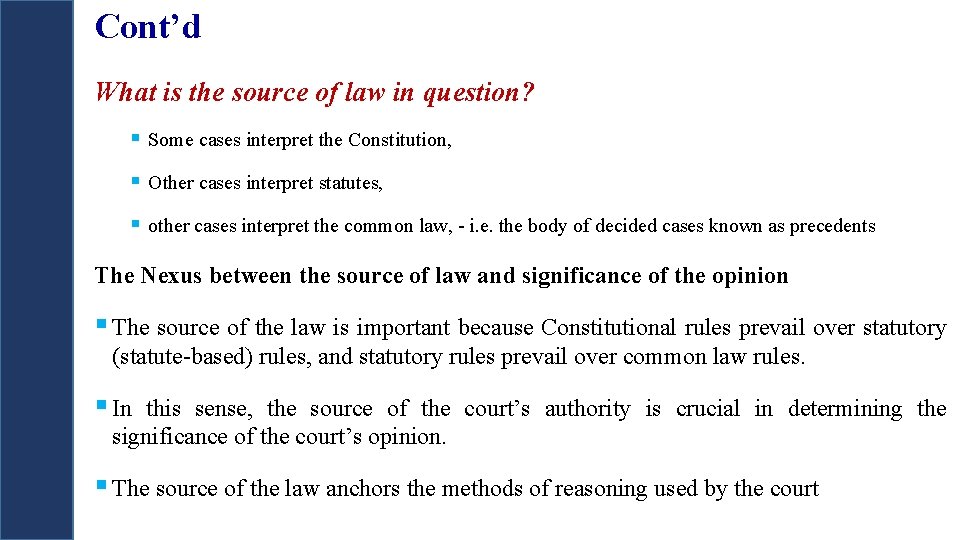
Cont’d What is the source of law in question? § Some cases interpret the Constitution, § Other cases interpret statutes, § other cases interpret the common law, - i. e. the body of decided cases known as precedents The Nexus between the source of law and significance of the opinion § The source of the law is important because Constitutional rules prevail over statutory (statute-based) rules, and statutory rules prevail over common law rules. § In this sense, the source of the court’s authority is crucial in determining the significance of the court’s opinion. § The source of the law anchors the methods of reasoning used by the court
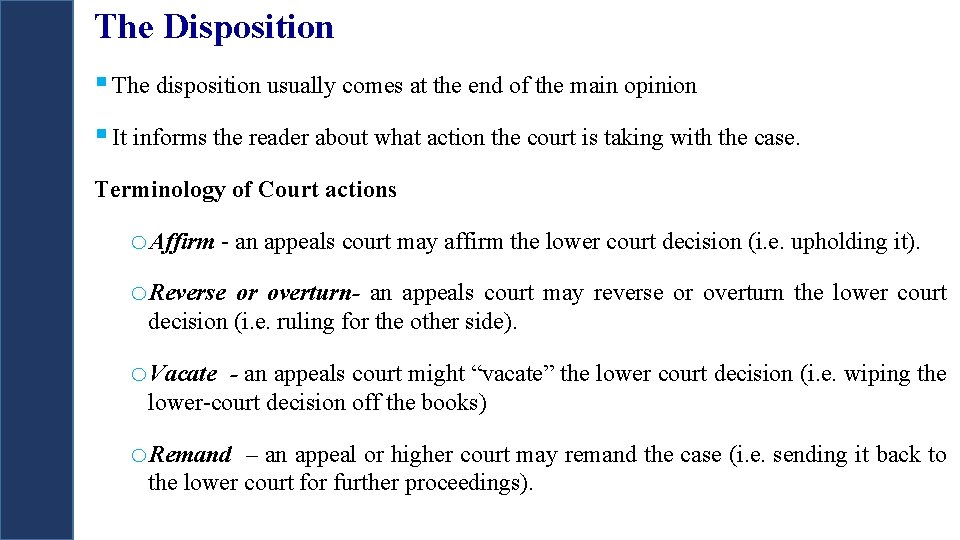
The Disposition § The disposition usually comes at the end of the main opinion § It informs the reader about what action the court is taking with the case. Terminology of Court actions o. Affirm - an appeals court may affirm the lower court decision (i. e. upholding it). o. Reverse or overturn- an appeals court may reverse or overturn the lower court decision (i. e. ruling for the other side). o. Vacate - an appeals court might “vacate” the lower court decision (i. e. wiping the lower-court decision off the books) o. Remand – an appeal or higher court may remand the case (i. e. sending it back to the lower court for further proceedings).
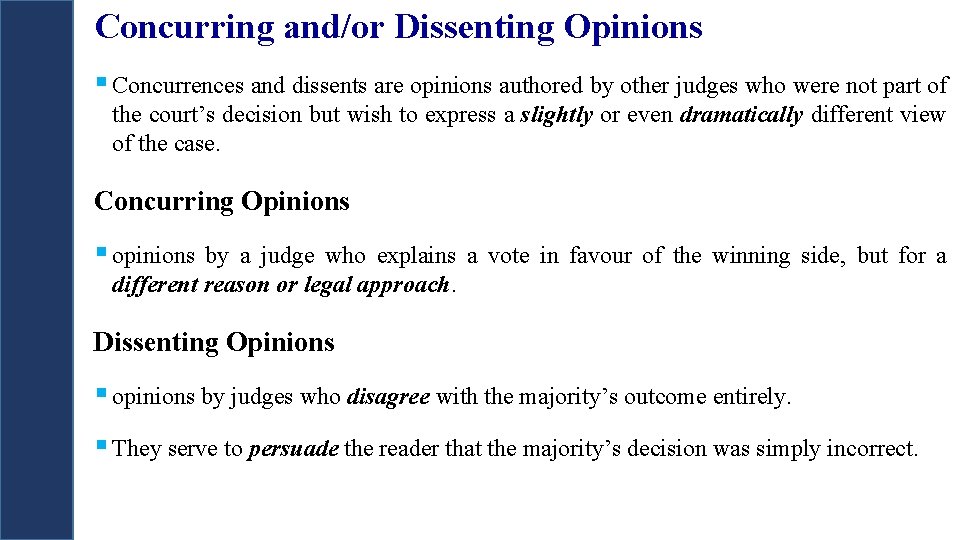
Concurring and/or Dissenting Opinions § Concurrences and dissents are opinions authored by other judges who were not part of the court’s decision but wish to express a slightly or even dramatically different view of the case. Concurring Opinions § opinions by a judge who explains a vote in favour of the winning side, but for a different reason or legal approach. Dissenting Opinions § opinions by judges who disagree with the majority’s outcome entirely. § They serve to persuade the reader that the majority’s decision was simply incorrect.