
Case Brief A tool to assist in remembering
Case Brief A tool to assist in remembering Important Facts in an Appellate Court Decision
Overview • Introduction • Reasons for a Case Brief • Appellate Court Decision • Case Brief

Introduction Reasons for a Case Brief • Lawyers will read multiple cases during any action they are engaged in • Case Briefs help the lawyer keep the facts/issues/holding of a multitude cases separate from each other which will help when writing legal documents • It is essentially a one-page synopsis of an Appellate Court decision, highlighting the important part of a Court’s Decision
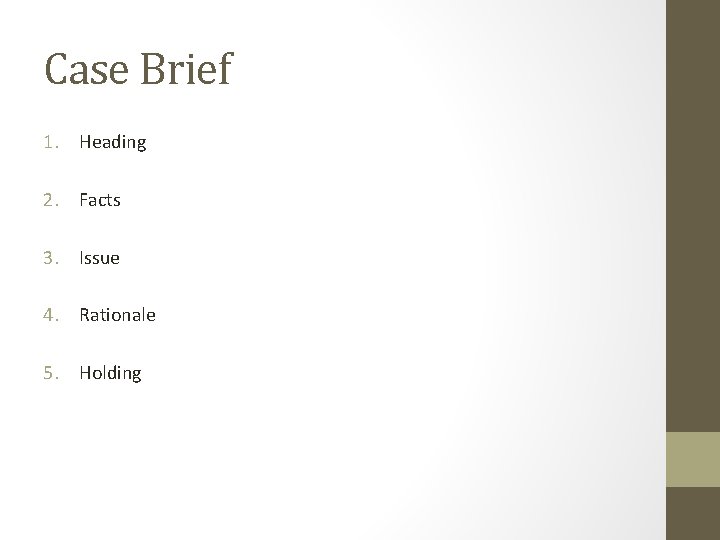
Case Brief 1. Heading 2. Facts 3. Issue 4. Rationale 5. Holding
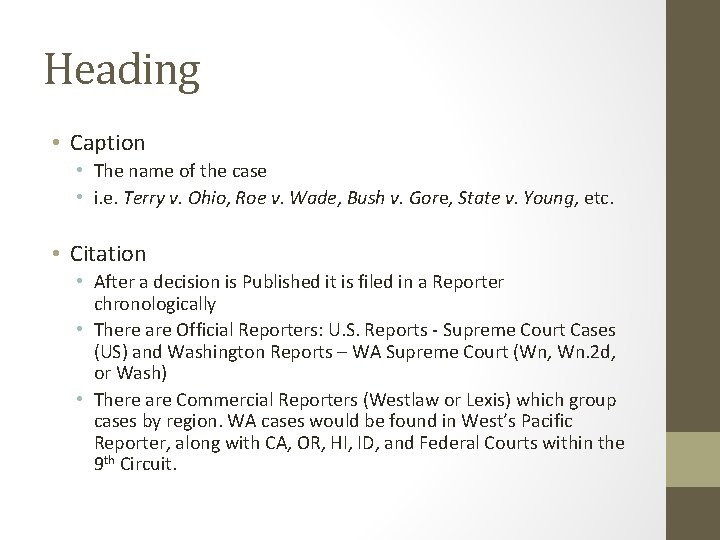
Heading • Caption • The name of the case • i. e. Terry v. Ohio, Roe v. Wade, Bush v. Gore, State v. Young, etc. • Citation • After a decision is Published it is filed in a Reporter chronologically • There are Official Reporters: U. S. Reports - Supreme Court Cases (US) and Washington Reports – WA Supreme Court (Wn, Wn. 2 d, or Wash) • There are Commercial Reporters (Westlaw or Lexis) which group cases by region. WA cases would be found in West’s Pacific Reporter, along with CA, OR, HI, ID, and Federal Courts within the 9 th Circuit.

Heading Example: Terry v. Ohio, 392 US 1 (1968) • Caption = Terry v. Ohio • Citation • Volume = 392 • Reporter = US; in this case US Reports • Page = 1
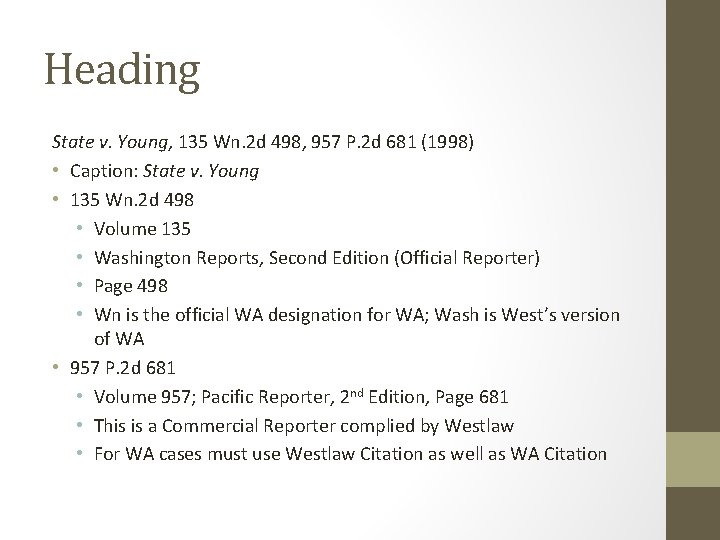
Heading State v. Young, 135 Wn. 2 d 498, 957 P. 2 d 681 (1998) • Caption: State v. Young • 135 Wn. 2 d 498 • Volume 135 • Washington Reports, Second Edition (Official Reporter) • Page 498 • Wn is the official WA designation for WA; Wash is West’s version of WA • 957 P. 2 d 681 • Volume 957; Pacific Reporter, 2 nd Edition, Page 681 • This is a Commercial Reporter complied by Westlaw • For WA cases must use Westlaw Citation as well as WA Citation
Heading Examples: Caption: Terry v. Ohio Citation: 392 US 1 (1968) Caption: State v. Young Citation: 135 Wn. 2 d 498, 957 P. 2 d 681 (1998)
Facts • Short Synopsis – 3 to 5 sentences – of the case. • Allows the writer of the Case Brief to remember the case at a later time Example: Caption: Terry v. Ohio Citation: 392 US 1 (1968) Facts: Police officer observes 3 -4 men “casing” a store. Officer conducts a “pat-down” of the men for his safety and based on his experience. During the “pat-down” a gun is found on one of the men.
Facts Example: Caption: State v. Young Citation: 135 Wn. 2 d 498, 957 P. 2 d 681 (1998) Facts: Officer on patrol has a “social contact” with Young; and obtains Young’s name. Officer leaves the area and sees Young in the middle of the street. Officer shines light on Young, and observes Young walk behind a tree and toss an item. Officer then “stops” Young, retrieves the item, finding it to be used for smoking narcotics.
Issue • What is the legal issue involved in the case? • Essentially, given the facts and law of the case, what question is the Court attempting to answer? • Under… Is/Does… When… Example: Terry v. Ohio Issue: UNDER the Fourth Amendment, IS a Warrant required to conduct a “pat-down” search, WHEN a Police Officer fears for his personal safety and suspects persons are engaged in criminal activity?
Issue Example: State v. Young Issue: UNDER Article I, Sec 7 of the Washington Constitution, IS there a “seizure” WHEN a Police Officer shines a spotlight on a person the Police Officer suspects is engaged in criminal activity?
Rationale • Second most important part of the Case Brief • This is a summarization of the Court’s discussion of the relevant law AND how the law applies to the facts of the case • It is an explanation of how the Court came to the Conclusion/Decision/Holding it did • You may have to read the Analysis a couple of times to figure out why the Court ruled the way it did
Rationale Example: Terry v. Ohio Rationale: (very truncated version of the Court’s Analysis) • Fourth Amendment requires a Warrant for all seizures • There are some exceptions to the Warrant requirement • Police Officers have a duty to protect themselves and the public • Police officers may conduct “stop & frisks” for protection; but it must not be only for criminal investigation purposes • Any “contraband” found during a “lawful” stop and frisk is admissible at court.
Rationale Example: State v. Young Rationale: (again a shortened version of the Court’s Analysis) • Analysis of SCOTUS rulings on seizures • Gunwall analysis • WA, under Art I, Sec 7 has greater protections against unreasonable search and seizure • Seizure: objective evaluation of the totality of the circumstances of the law enforcement contact
Holding • Most important part of the case • This is the disposition of the case, the end result • It will either create a new rule of law; or will qualify/explain a current rule • However, the Holding goes hand-in-hand with the Rationale. • When writing a legal document, it is the rationale of the case that a lawyer will use to distinguish when the Holding is applicable to a certain case or circumstances.
Holding Example: Terry v. Ohio Holding: • A police officer may “stop and frisk” a suspect upon reasonable suspicion – specific and articulable facts – that the suspect is about to engage in an imminent criminal act or is a danger to the police officer or the public. • The intrusion – the Frisk – is limited to a “patdown” of the suspects outer clothing in a effort to find a weapon only.
Holding Example: State v. Young Holding: • A “seizure” occurs when, in view of the “totality of the circumstances” surrounding the incident, a “reasonable person” would have believed that he was “not free to leave. ” • Evaluation depends on: (1) the threatening presence of several officers; (2) the display of a weapon by an officer; (3) some physical touching of the person of the citizen; (4) or the use of language or tone of voice indicating that compliance with the officer's request might be compelled. • Article I, Sec 7 of the Washington Constitution provides GREATER protections that the Fourth Amendment to the U. S. Constitution
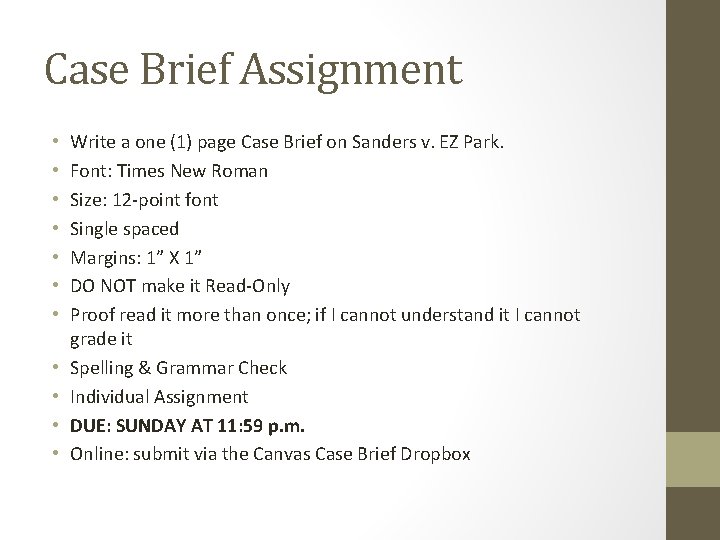
Case Brief Assignment • • • Write a one (1) page Case Brief on Sanders v. EZ Park. Font: Times New Roman Size: 12 -point font Single spaced Margins: 1” X 1” DO NOT make it Read-Only Proof read it more than once; if I cannot understand it I cannot grade it Spelling & Grammar Check Individual Assignment DUE: SUNDAY AT 11: 59 p. m. Online: submit via the Canvas Case Brief Dropbox
- Slides: 19