
CASE B HISTORICAL FINDINGS AND PRESENTING SIGNS 4
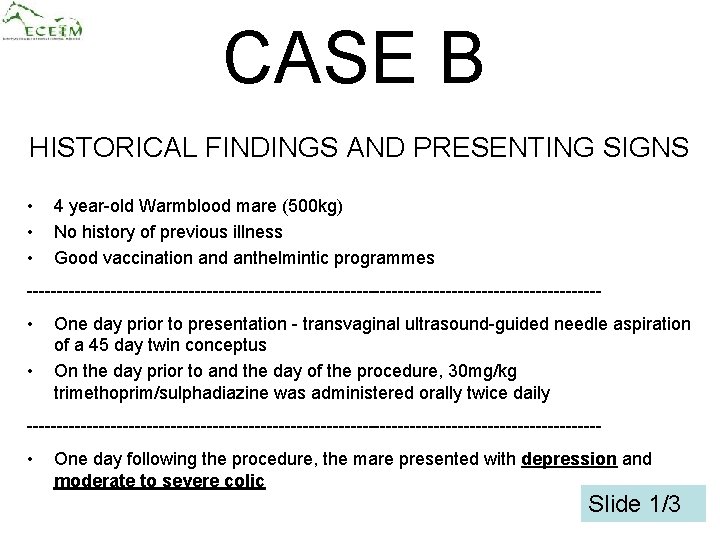
CASE B HISTORICAL FINDINGS AND PRESENTING SIGNS • • • 4 year-old Warmblood mare (500 kg) No history of previous illness Good vaccination and anthelmintic programmes ------------------------------------------------ • • One day prior to presentation - transvaginal ultrasound-guided needle aspiration of a 45 day twin conceptus On the day prior to and the day of the procedure, 30 mg/kg trimethoprim/sulphadiazine was administered orally twice daily ------------------------------------------------ • One day following the procedure, the mare presented with depression and moderate to severe colic Slide 1/3 1
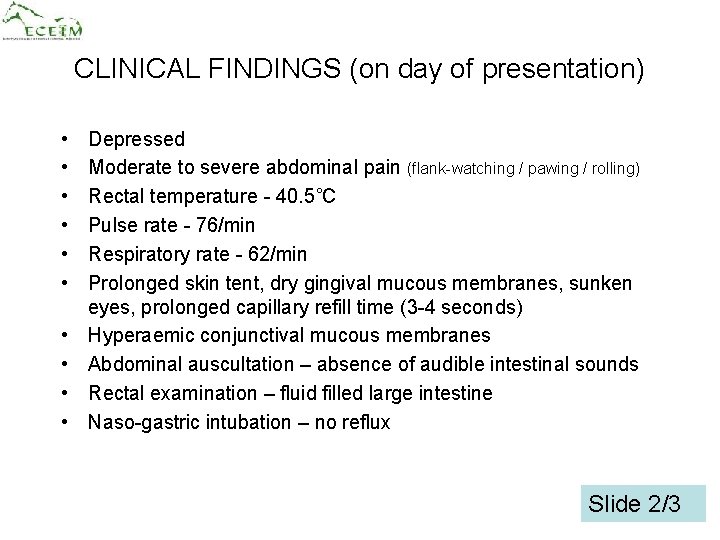
CLINICAL FINDINGS (on day of presentation) • • • Depressed Moderate to severe abdominal pain (flank-watching / pawing / rolling) Rectal temperature - 40. 5˚C Pulse rate - 76/min Respiratory rate - 62/min Prolonged skin tent, dry gingival mucous membranes, sunken eyes, prolonged capillary refill time (3 -4 seconds) Hyperaemic conjunctival mucous membranes Abdominal auscultation – absence of audible intestinal sounds Rectal examination – fluid filled large intestine Naso-gastric intubation – no reflux Slide 2/3 2
When you enter the examination room, you will be asked to 1. Interpret the individual presenting clinical problems and clinical examination findings 2. Interpret the combined clinical examination findings to formulate a differential diagnosis list, giving justification for the inclusion of each differential diagnosis 3. Comment on how you would further differentiate between the main differential diagnoses From this stage onwards, further information (clinical and laboratory data) will be provided either on your request or automatically. You will be asked to comment on this data. Slide 3/3 3

PERITONEAL FLUID ANALYSIS Appearance straw coloured Nucleated cell count 1. 63 x 109/L Red blood cell count 0 x 1012/L Total protein 9. 7 g/L Cytological description Primarily mature polymorphs and reactive mesothelial cells 4
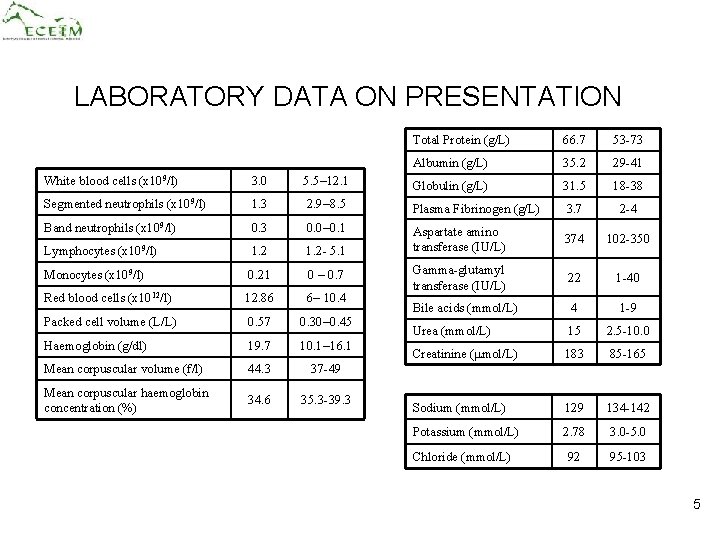
LABORATORY DATA ON PRESENTATION Total Protein (g/L) 66. 7 53 -73 Albumin (g/L) 35. 2 29 -41 White blood cells (x 109/l) 3. 0 5. 5– 12. 1 Globulin (g/L) 31. 5 18 -38 Segmented neutrophils (x 109/l) 1. 3 2. 9– 8. 5 Plasma Fibrinogen (g/L) 3. 7 2 -4 0. 3 0. 0– 0. 1 Lymphocytes (x 109/l) 1. 2 - 5. 1 Aspartate amino transferase (IU/L) 374 102 -350 Monocytes (x 109/l) 0. 21 0 – 0. 7 22 1 -40 Red blood cells (x 1012/l) 12. 86 6– 10. 4 Gamma-glutamyl transferase (IU/L) Packed cell volume (L/L) 0. 57 0. 30– 0. 45 Bile acids (mmol/L) 4 1 -9 Haemoglobin (g/dl) 19. 7 10. 1– 16. 1 Urea (mmol/L) 15 2. 5 -10. 0 Creatinine (mmol/L) 183 85 -165 Mean corpuscular volume (f/l) 44. 3 37 -49 Mean corpuscular haemoglobin concentration (%) 34. 6 35. 3 -39. 3 Sodium (mmol/L) 129 134 -142 Potassium (mmol/L) 2. 78 3. 0 -5. 0 92 95 -103 Band neutrophils (x 109/l) Chloride (mmol/L) 5
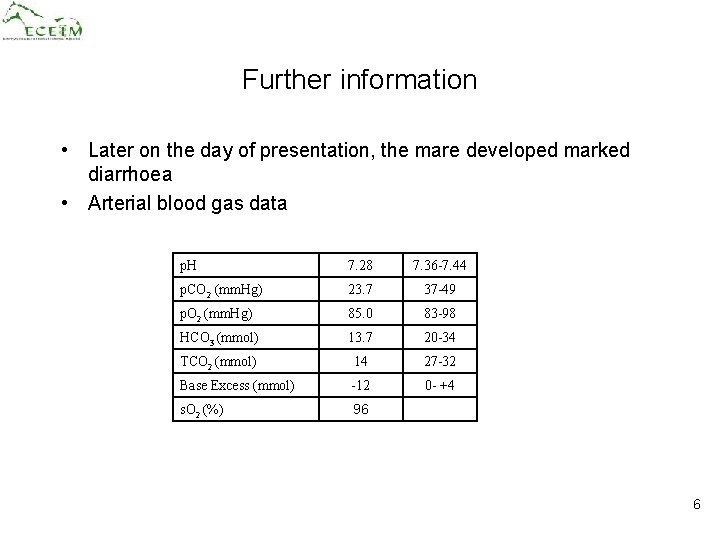
Further information • Later on the day of presentation, the mare developed marked diarrhoea • Arterial blood gas data p. H 7. 28 7. 36 -7. 44 p. CO 2 (mm. Hg) 23. 7 37 -49 p. O 2 (mm. Hg) 85. 0 83 -98 HCO 3 (mmol) 13. 7 20 -34 TCO 2 (mmol) 14 27 -32 Base Excess (mmol) -12 0 - +4 s. O 2 (%) 96 6
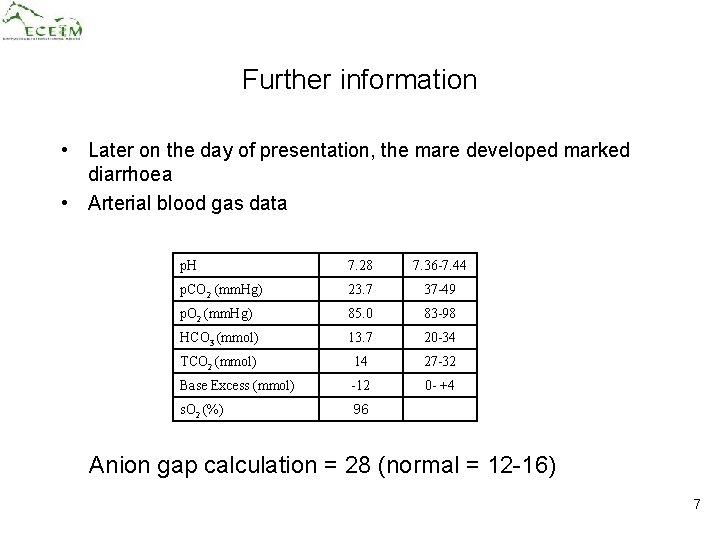
Further information • Later on the day of presentation, the mare developed marked diarrhoea • Arterial blood gas data p. H 7. 28 7. 36 -7. 44 p. CO 2 (mm. Hg) 23. 7 37 -49 p. O 2 (mm. Hg) 85. 0 83 -98 HCO 3 (mmol) 13. 7 20 -34 TCO 2 (mmol) 14 27 -32 Base Excess (mmol) -12 0 - +4 s. O 2 (%) 96 Anion gap calculation = 28 (normal = 12 -16) 7
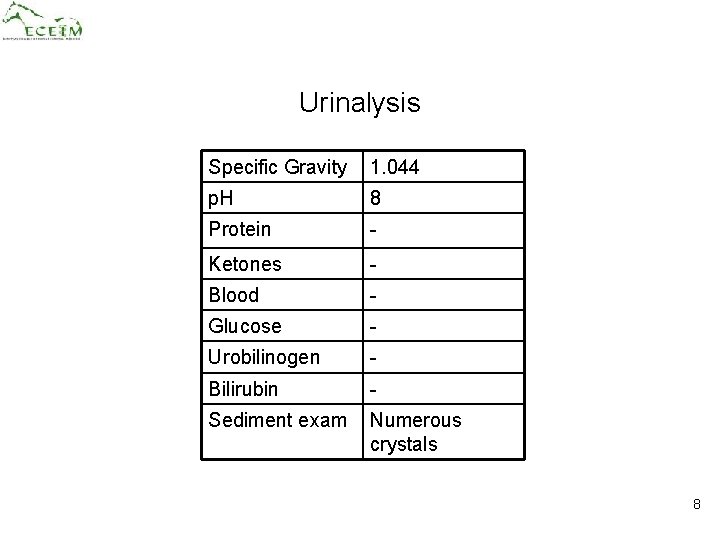
Urinalysis Specific Gravity 1. 044 p. H 8 Protein - Ketones - Blood - Glucose - Urobilinogen - Bilirubin - Sediment exam Numerous crystals 8
• Therapeutic aims that you would consider at this stage? 9
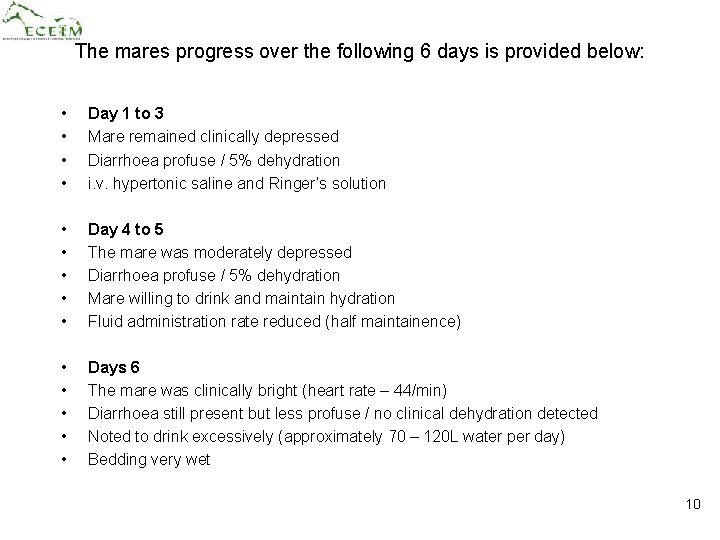
The mares progress over the following 6 days is provided below: • • Day 1 to 3 Mare remained clinically depressed Diarrhoea profuse / 5% dehydration i. v. hypertonic saline and Ringer’s solution • • • Day 4 to 5 The mare was moderately depressed Diarrhoea profuse / 5% dehydration Mare willing to drink and maintain hydration Fluid administration rate reduced (half maintainence) • • • Days 6 The mare was clinically bright (heart rate – 44/min) Diarrhoea still present but less profuse / no clinical dehydration detected Noted to drink excessively (approximately 70 – 120 L water per day) Bedding very wet 10
- Slides: 10