
Case 6 Condylomas Diagnosis treatment and followup Dr
- Slides: 16
Case 6 Condylomas: Diagnosis, treatment and follow-up Dr. Andrés Carlos López
Reason for consultation • Patient vaccinated against human papillomavirus (HPV) with recent appearance of condylomatous genital lesions.
Medical History • • • 32 years of age. No children or previous pregnancies. User of oral contraceptives. Open heterosexual relations. Use of condom. Social smoker. Vaccinated with Cervarix® 10 years ago.
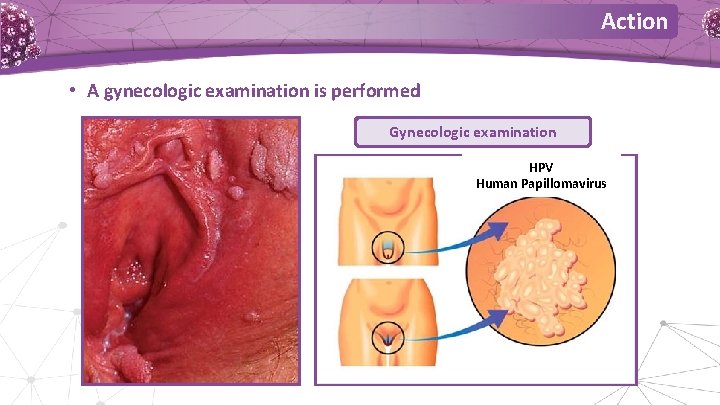
Action • A gynecologic examination is performed Gynecologic examination HPV Human Papillomavirus
Results Multiple exophytic lesions, of pink or white-gray color, on whose surface are visible filiform or papillomatous projections.
Treatment • 5% Imiquimod cream is prescribed for use three times per week on non-consecutive days (e. g. Monday, Wednesday, and Friday) for a maximum of 16 weeks.
Evolution • Resolution of the profile at 8 weeks of treatment. • Check-up visits at 3, 6 and 12 months without recurrence.
Discussion • Condylomas are benign lesions caused by HPV infection. • The HPV types responsible for 95% of condylomas are HPV type 6 and 11. • The lesions are generally asymptomatic. Depending on the number, size, and location, they can cause mild symptoms like itching, stinging, irritation or inflammation.
Discussion • HPV determination is not indicated in patients with condylomata acuminata, as it does not add clinical information or change the actions taken against these lesions. • The diagnosis of condylomata acuminata is based primarily on the physical examination.
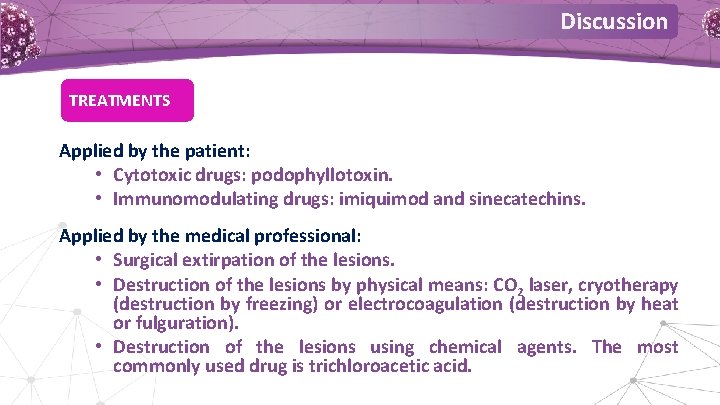
Discussion TREATMENTS Applied by the patient: • Cytotoxic drugs: podophyllotoxin. • Immunomodulating drugs: imiquimod and sinecatechins. Applied by the medical professional: • Surgical extirpation of the lesions. • Destruction of the lesions by physical means: CO 2 laser, cryotherapy (destruction by freezing) or electrocoagulation (destruction by heat or fulguration). • Destruction of the lesions using chemical agents. The most commonly used drug is trichloroacetic acid.
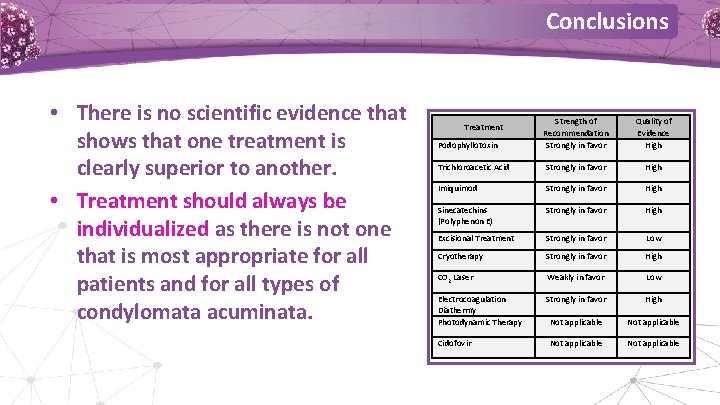
Conclusions • There is no scientific evidence that shows that one treatment is clearly superior to another. • Treatment should always be individualized as there is not one that is most appropriate for all patients and for all types of condylomata acuminata. Podophyllotoxin Strength of Recommendation Strongly in favor Quality of Evidence High Trichloroacetic Acid Strongly in favor High Imiquimod Strongly in favor High Sinecatechins (Polyphenon E) Strongly in favor High Excisional Treatment Strongly in favor Low Cryotherapy Strongly in favor High CO 2 Laser Weakly in favor Low Electrocoagulation Diathermy Photodynamic Therapy Strongly in favor High Not applicable Treatment Cidofovir
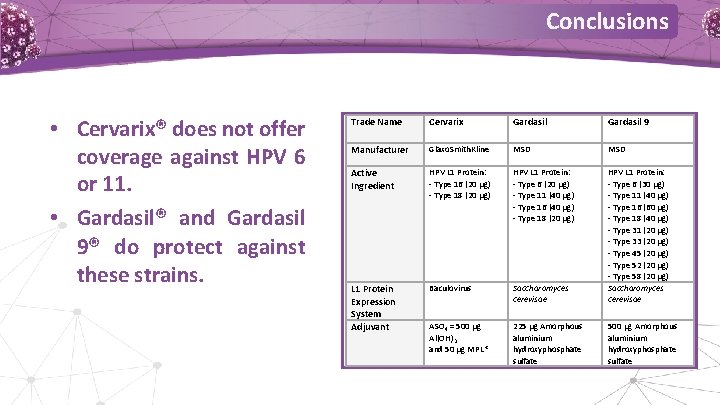
Conclusions • Cervarix® does not offer coverage against HPV 6 or 11. • Gardasil® and Gardasil 9® do protect against these strains. Trade Name Cervarix Gardasil 9 Manufacturer Glaxo. Smith. Kline MSD Active Ingredient HPV L 1 Protein: - Type 16 (20 µg) - Type 18 (20 µg) HPV L 1 Protein: - Type 6 (20 µg) - Type 11 (40 µg) - Type 16 (40 µg) - Type 18 (20 µg) L 1 Protein Expression System Adjuvant Baculovirus Saccharomyces cerevisae HPV L 1 Protein: - Type 6 (30 µg) - Type 11 (40 µg) - Type 16 (60 µg) - Type 18 (40 µg) - Type 31 (20 µg) - Type 33 (20 µg) - Type 45 (20 µg) - Type 52 (20 µg) - Type 58 (20 µg) Saccharomyces cerevisae ASO 4 = 500 µg Al(OH)3 and 50 µg MPL* 225 µg Amorphous aluminium hydroxyphosphate sulfate 500 µg Amorphous aluminium hydroxyphosphate sulfate
Question 1 What are the primary serotypes of HPV responsible for condylomas? A. Unknown. B. 6 and 11. C. 16 and 18.
Question 2 What are the primary symptoms of condylomas? A. They are mostly asymptomatic. B. They indicate an active HPV infection. C. HPV is not detected.
Question 3 What is the best treatment against condylomas for a healthy and immunocompetent woman? A. Spontaneous resolution of the lesions. B. Cryotherapy. C. Treatment should always be individualized.
Recommended bibliography • Condylomata acuminata (anogenital warts): Treatment of vulvar and vaginal warts Uptodate Feb 2020 • Guía condilomas acuminados AEPCC 2015 [Spanish Association of Cervical Pathology and Colposcopy 2015 Guide to Condylomata Acuminata] • Human papillomavirus infections: associations Uptodate Feb 2020 Epidemiology and disease • Manual de vacunas en línea de la AEP [Spanish Pediatrics Association Online Vaccine Manual] (https: //vacunasaep. org/)