
Case 5 21 People Express Airlines Inc v

- Slides: 20
Case 5 -21 People Express Airlines, Inc. v. Consolidated Rail Corp. ——MADE BY 康婷&夏彬
Contents Facts and Procedure Histrory Plaintiff Asserting Defendant Arguments Issue Principle Two Avenues of Analysis Conclusion
Facts & Procedure History Facts: On July 22, 1981, a fire began in the Port Newark freight yard of defendant Consolidated Rail Corporation (Conrail) when ethylene oxide manufactured by defendant BASF Wyandotte Company (BASF) escaped from a tank car, punctured during a “coupling” operation with another rail car, and ignited. The tank car was owned by defendant Union Tank Car Company (Union Car) and was leased to defendant BASF. Procedure Histrory: The trial court entered summary judgment for defendants, and plaintiff appealed. The appellate division reversed and remanded, and defendants appealed to the Supreme Court.
At least some of the defendants were aware from prior experiences that ethylene oxide is a highly volatile substance; Further,that emergency response plans in case of an accident had been prepared. When the fire occurred that gave rise to this lawsuit, some of the defendants' consultants helped determine how much of the surrounding area to evacuate. The municipal authorities then evacuated the area within a one-mile radius surrounding the fire to lessen the risk to persons within the area should the burning tank car explode. The evacuation area included the adjacent North Terminal building of Newark International Airport, where plaintiff People Express Airlines' (People Express) business operations are based. Although the feared explosion never occurred, People Express employees were prohibited from using the North Terminal for twelve hours. Plaintiff Asserting
The plaintiff contends that it suffered businessinterruption losses as a result of the evacuation. These losses consist of cancelled scheduled flights and lost reservations because employees were unable to answer the telephones to accept bookings; also, certain fixed operating expenses allocable to the evacuation time period were incurred and paid despite the fact that plaintiff's offices were closed. Plaintiff Asserting
Defendant Arguments Conrail moved for summary judgment, seeking dismissal of the complaint and cross-claims against it; the motion was opposed by plaintiff, People Express, and defendants BASF and Union Car. The trial court granted Conrail's summary judgment motion on the ground that absent property damage or personal injury economic loss was not recoverable in tort. Defendants BASF and Union Car subsequently sought summary judgment dismissing the complaint; the trial court also granted these motions based on the same reasoning.
Whether a defendant's negligent conduct that interferes with a plaintiff's business resulting in purely economic losses, unaccompanied by property damage or personal injury, is compensable in tort? Issue
a virtually per se rule barring recovery for economic loss unless the negligent conduct also caused physical harm. Principles Principle of physical harm Principle of duty and proximate cause a tortfeasor is liable only for that harm that he proximately caused
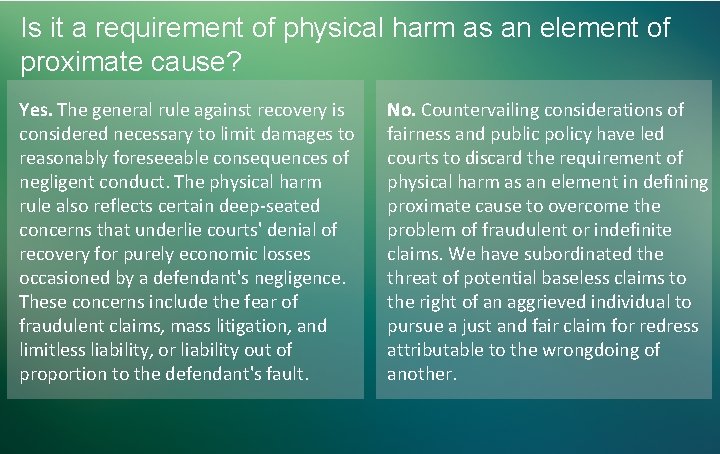
Is it a requirement of physical harm as an element of proximate cause? Yes. The general rule against recovery is considered necessary to limit damages to reasonably foreseeable consequences of negligent conduct. The physical harm rule also reflects certain deep-seated concerns that underlie courts' denial of recovery for purely economic losses occasioned by a defendant's negligence. These concerns include the fear of fraudulent claims, mass litigation, and limitless liability, or liability out of proportion to the defendant's fault. No. Countervailing considerations of fairness and public policy have led courts to discard the requirement of physical harm as an element in defining proximate cause to overcome the problem of fraudulent or indefinite claims. We have subordinated the threat of potential baseless claims to the right of an aggrieved individual to pursue a just and fair claim for redress attributable to the wrongdoing of another.
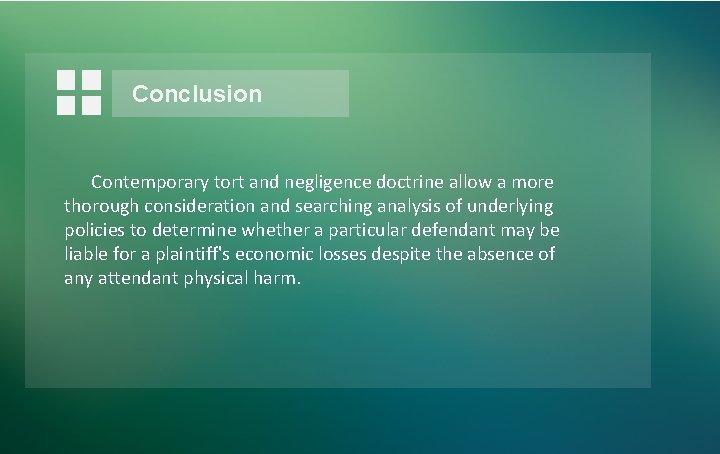
Conclusion Contemporary tort and negligence doctrine allow a more thorough consideration and searching analysis of underlying policies to determine whether a particular defendant may be liable for a plaintiff's economic losses despite the absence of any attendant physical harm.
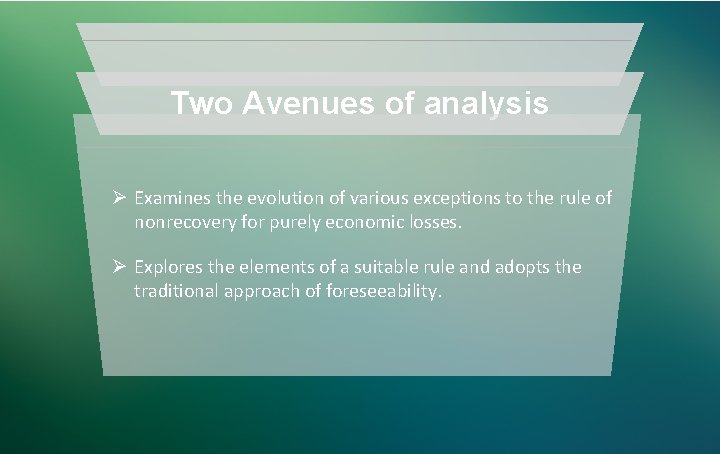
Two Avenues of analysis Ø Examines the evolution of various exceptions to the rule of nonrecovery for purely economic losses. Ø Explores the elements of a suitable rule and adopts the traditional approach of foreseeability.
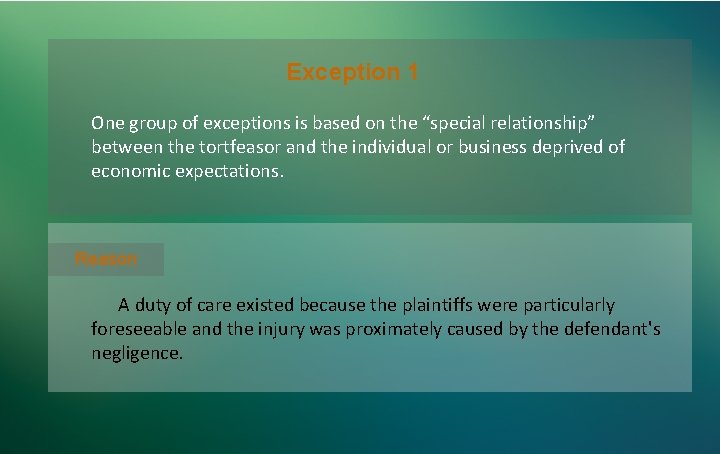
Exception 1 One group of exceptions is based on the “special relationship” between the tortfeasor and the individual or business deprived of economic expectations. Reason A duty of care existed because the plaintiffs were particularly foreseeable and the injury was proximately caused by the defendant's negligence.
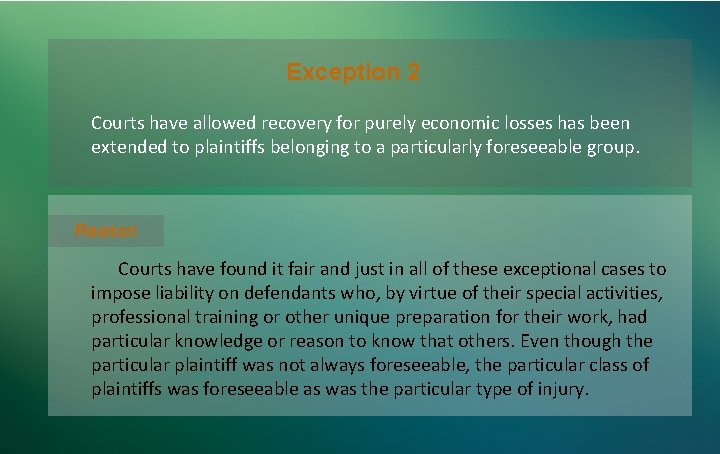
Exception 2 Courts have allowed recovery for purely economic losses has been extended to plaintiffs belonging to a particularly foreseeable group. Reason Courts have found it fair and just in all of these exceptional cases to impose liability on defendants who, by virtue of their special activities, professional training or other unique preparation for their work, had particular knowledge or reason to know that others. Even though the particular plaintiff was not always foreseeable, the particular class of plaintiffs was foreseeable as was the particular type of injury.
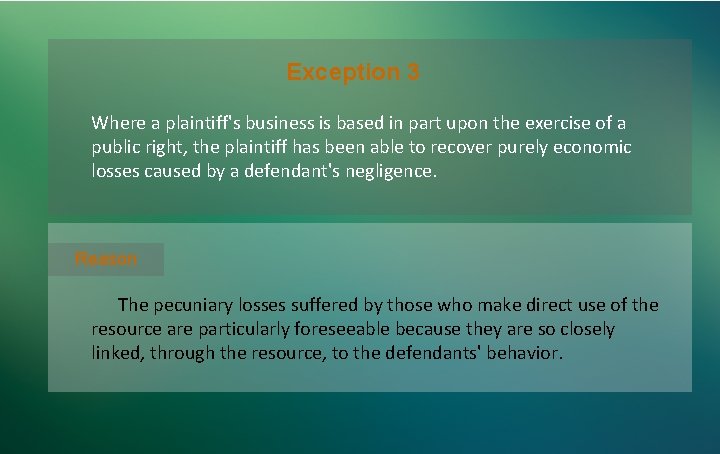
Exception 3 Where a plaintiff's business is based in part upon the exercise of a public right, the plaintiff has been able to recover purely economic losses caused by a defendant's negligence. Reason The pecuniary losses suffered by those who make direct use of the resource are particularly foreseeable because they are so closely linked, through the resource, to the defendants' behavior.
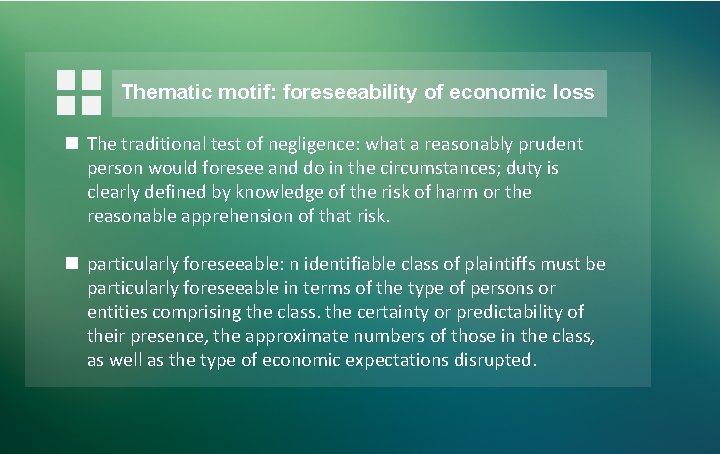
Thematic motif: foreseeability of economic loss n The traditional test of negligence: what a reasonably prudent person would foresee and do in the circumstances; duty is clearly defined by knowledge of the risk of harm or the reasonable apprehension of that risk. n particularly foreseeable: n identifiable class of plaintiffs must be particularly foreseeable in terms of the type of persons or entities comprising the class. the certainty or predictability of their presence, the approximate numbers of those in the class, as well as the type of economic expectations disrupted.
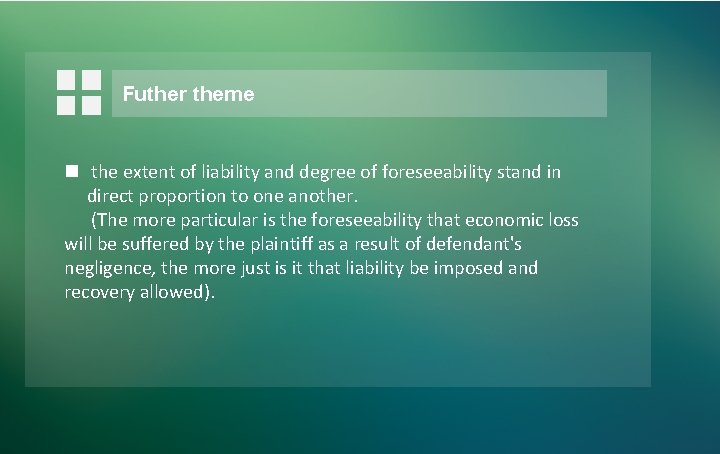
Futher theme n the extent of liability and degree of foreseeability stand in direct proportion to one another. (The more particular is the foreseeability that economic loss will be suffered by the plaintiff as a result of defendant's negligence, the more just is it that liability be imposed and recovery allowed).
The standard of particular foreseeability may be successfully employed to determine whether the economic injury was proximately caused. The particular-general foreseeability axis is also accordant with the policies underlying tort law and the negligence doctrine.
Underlying policy of the tort law Wronged persons should be compensated for their injuries and that those responsible for the wrong should bear the cost of their tortious conduct. Underlying policy of the negligence doctrine The imposition of liability should deter negligent conduct by creating incentives to minimize the risks and costs of accidents. The imposition of liability for unforeseeable risks cannot serve to deter the conduct that has eventuated in attenuated results, but instead arbitrarily assigns liability unrelated or out of proportion to the defendant's fault.
Conclusion Ø Plaintiff has set forth a cause of action under our decision, and it is entitled to have the matter proceed to a plenary trial. However, the plaintiff still faces a difficult task in proving damages, particularly lost profits, to the degree of certainty required in other negligence cases. the judgment of the Appellate Division is modified, and, as modified, affirmed. The case is remanded for proceedings consistent with this opinion.