
CASCADED INTEGRATORCOMB FILTERS James Gibbard What are CIC

CASCADED INTEGRATORCOMB FILTERS James Gibbard
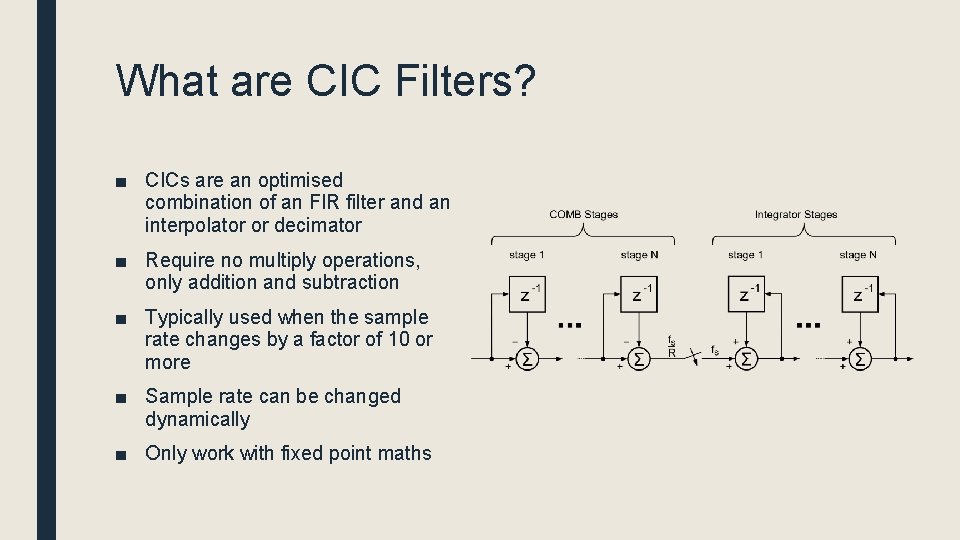
What are CIC Filters? ■ CICs are an optimised combination of an FIR filter and an interpolator or decimator ■ Require no multiply operations, only addition and subtraction ■ Typically used when the sample rate changes by a factor of 10 or more ■ Sample rate can be changed dynamically ■ Only work with fixed point maths
![HOW DO CIC FILTERS WORK? [Using only diagrams and graphs]](http://slidetodoc.com/presentation_image_h/84b1f63d5a2a764c4ad440e7378615fc/image-3.jpg "HOW DO CIC FILTERS WORK? [Using only diagrams and graphs]")
HOW DO CIC FILTERS WORK? [Using only diagrams and graphs]
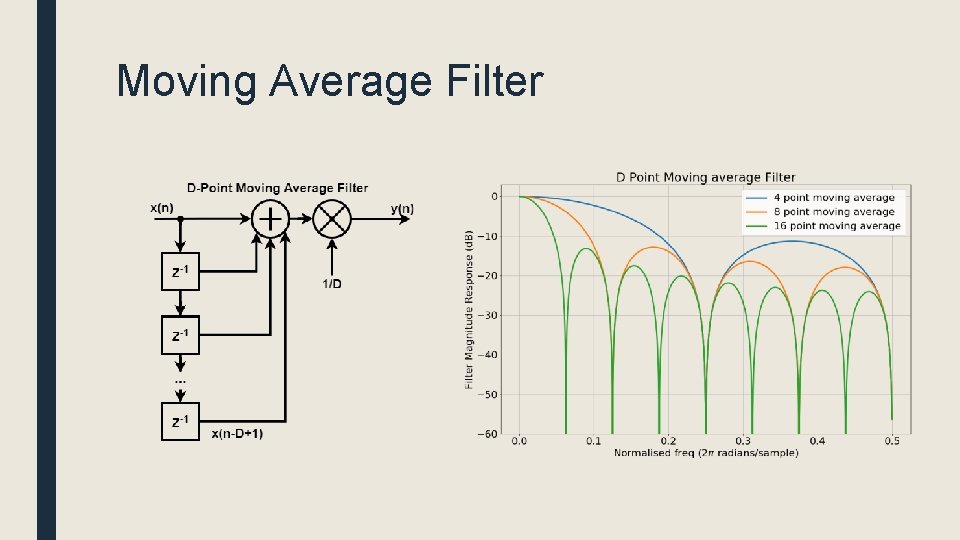
Moving Average Filter
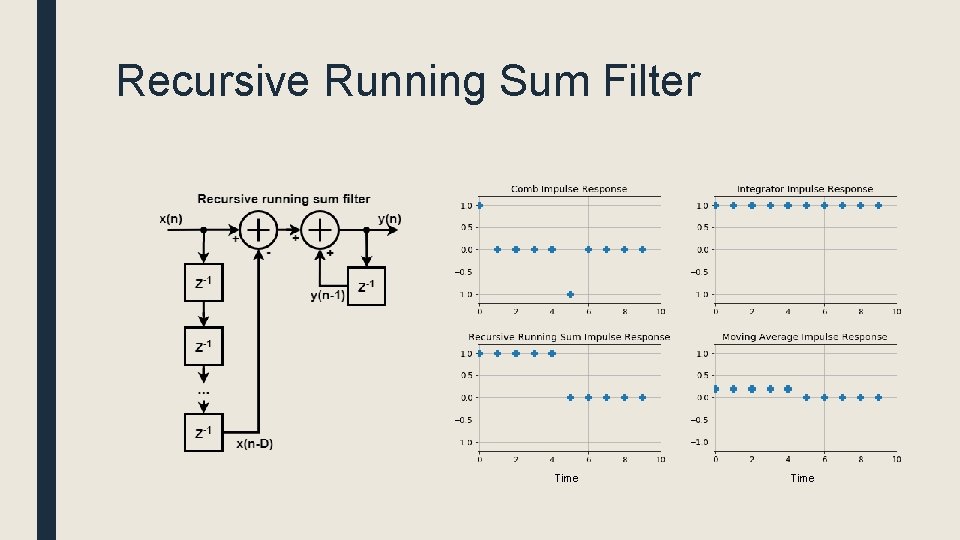
Recursive Running Sum Filter Time
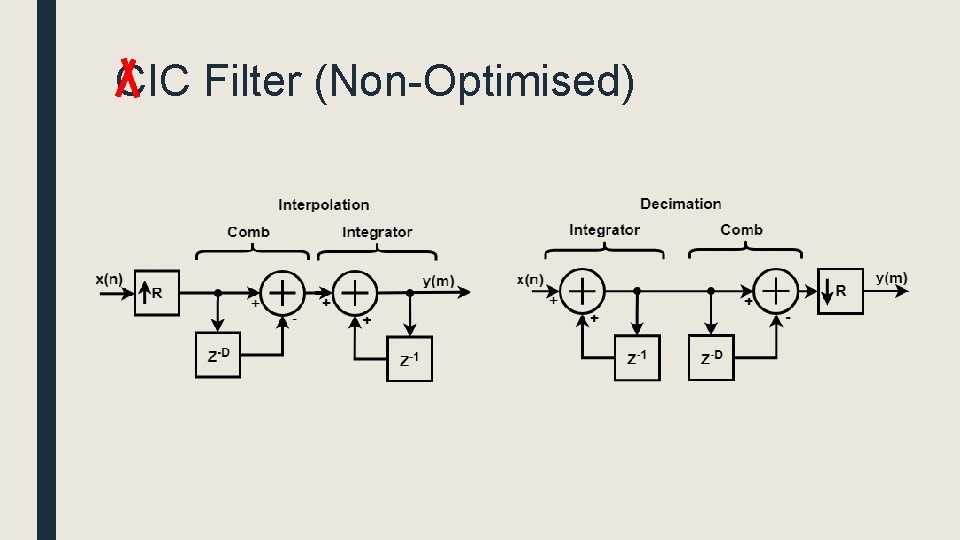
CIC Filter (Non-Optimised)
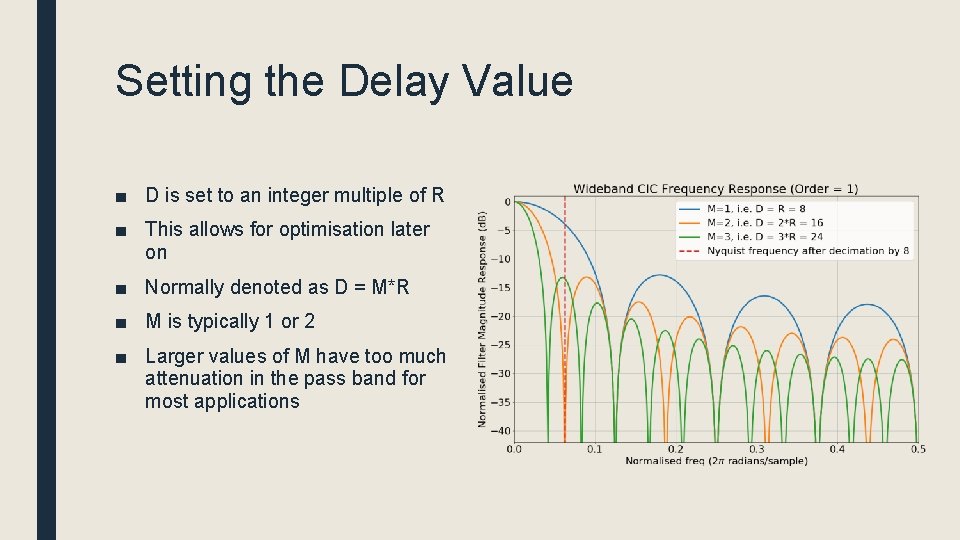
Setting the Delay Value ■ D is set to an integer multiple of R ■ This allows for optimisation later on ■ Normally denoted as D = M*R ■ M is typically 1 or 2 ■ Larger values of M have too much attenuation in the pass band for most applications
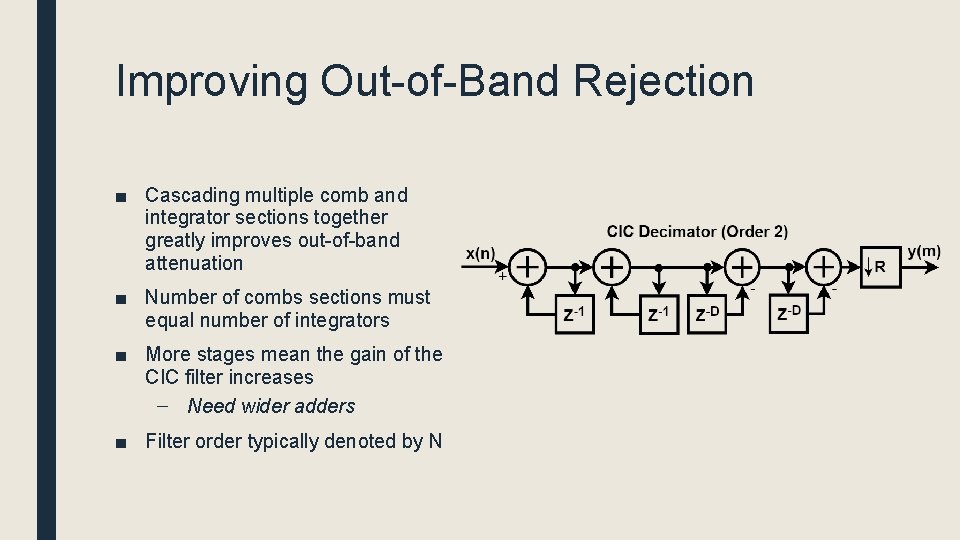
Improving Out-of-Band Rejection ■ Cascading multiple comb and integrator sections together greatly improves out-of-band attenuation ■ Number of combs sections must equal number of integrators ■ More stages mean the gain of the CIC filter increases – Need wider adders ■ Filter order typically denoted by N
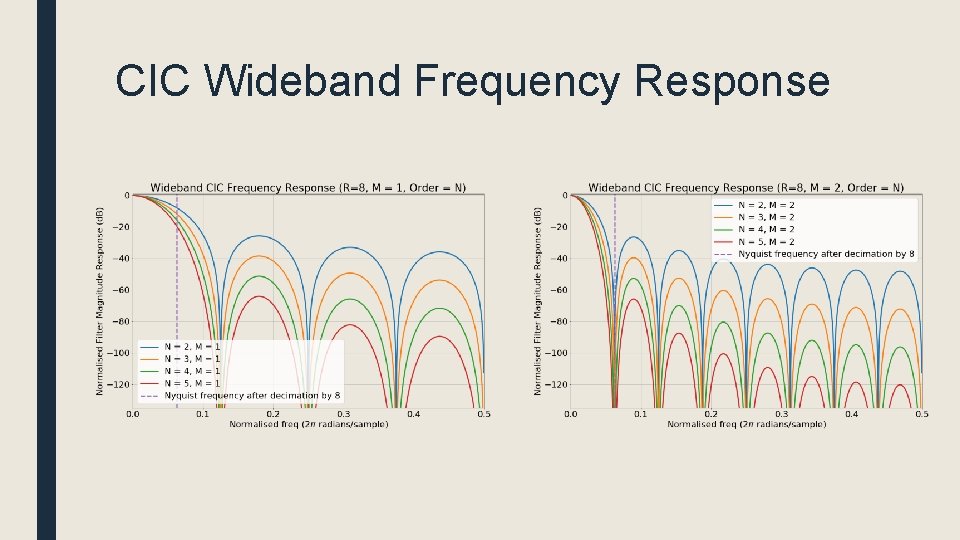
CIC Wideband Frequency Response
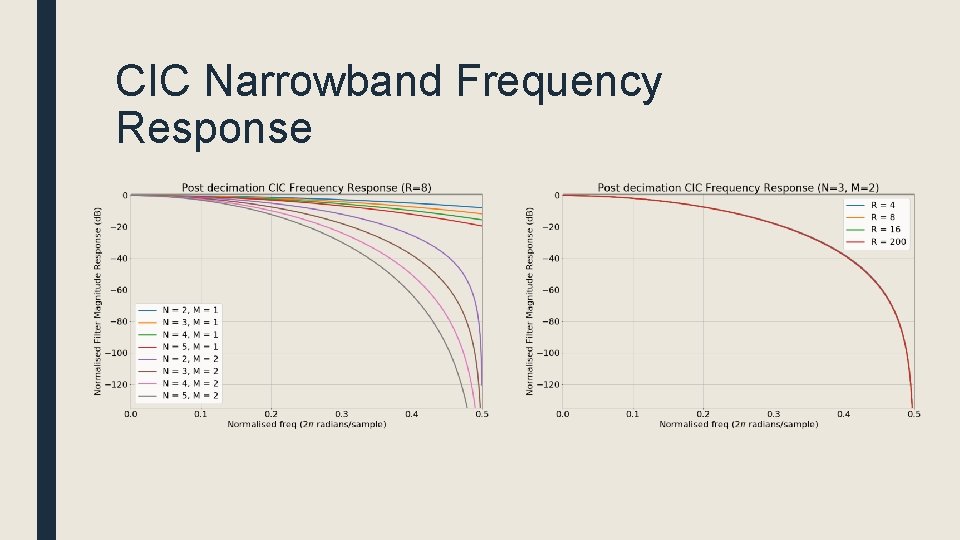
CIC Narrowband Frequency Response
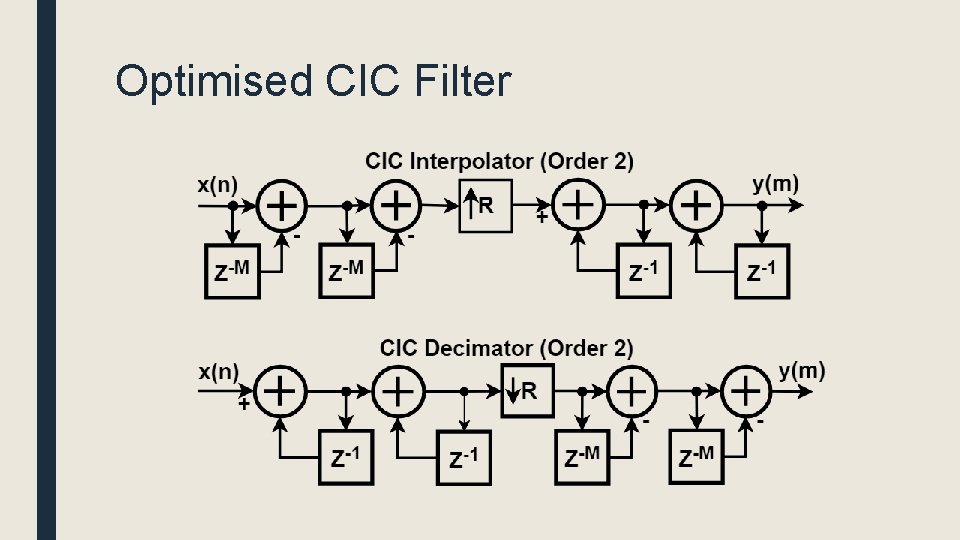
Optimised CIC Filter
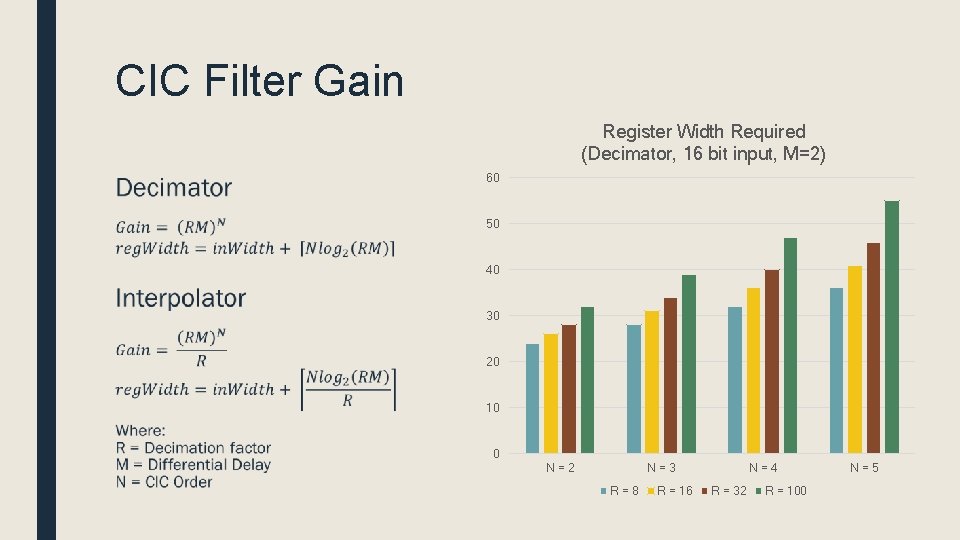
CIC Filter Gain Register Width Required (Decimator, 16 bit input, M=2) ■ 60 50 40 30 20 10 0 N=2 N=3 R=8 R = 16 N=4 R = 32 R = 100 N=5

CIC COMPENSATION FILTERS What are they and how do you design them?
![CIC Compensation Filters Fs [high] Fs [low] CIC Decimator ■ CIC filters have passband](http://slidetodoc.com/presentation_image_h/84b1f63d5a2a764c4ad440e7378615fc/image-14.jpg "CIC Compensation Filters Fs [high] Fs [low] CIC Decimator ■ CIC filters have passband")
CIC Compensation Filters Fs [high] Fs [low] CIC Decimator ■ CIC filters have passband attenuation ■ This can be corrected using a compensation filter ■ FIR compensation filters are typically used ■ Compensation filters operate at the lower sample rate – This allows for hardware efficient implementations Fs [low] FIR Compensation Filter Fs [low] CIC Interpolator Fs [high]
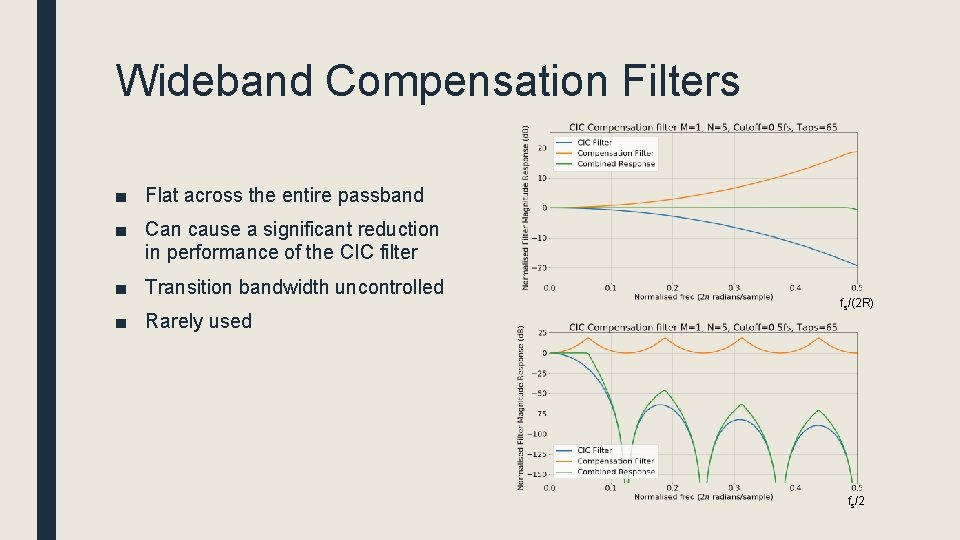
Wideband Compensation Filters ■ Flat across the entire passband ■ Can cause a significant reduction in performance of the CIC filter ■ Transition bandwidth uncontrolled ■ Rarely used fs/(2 R) fs/2
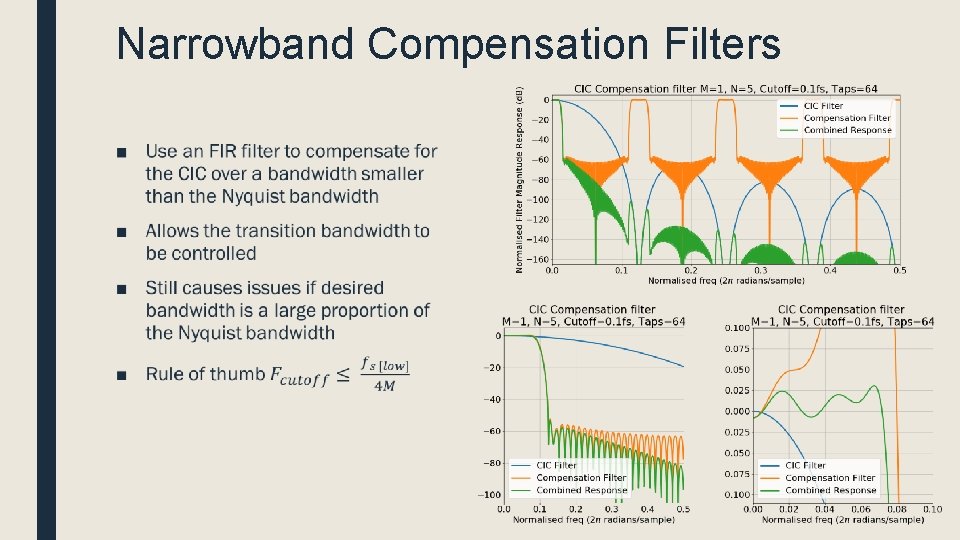
Narrowband Compensation Filters ■
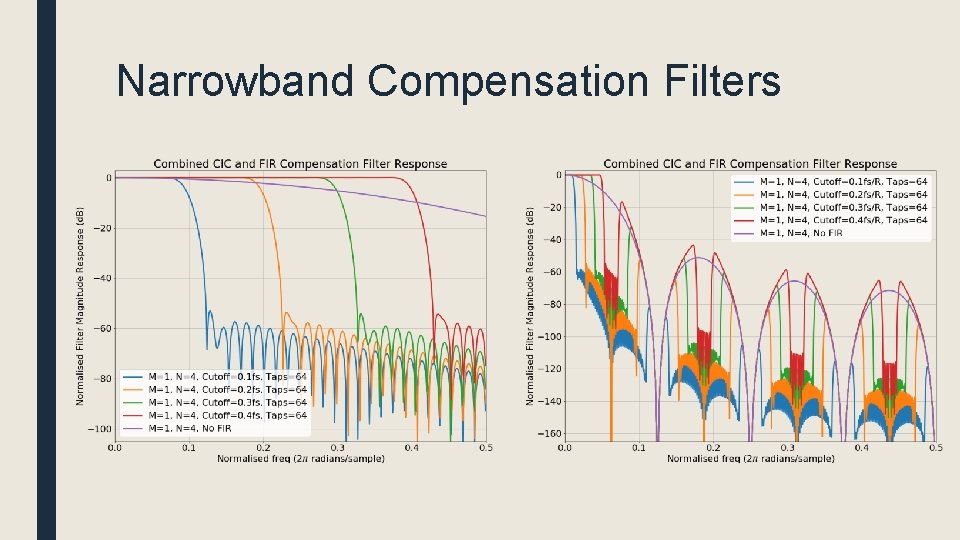
Narrowband Compensation Filters
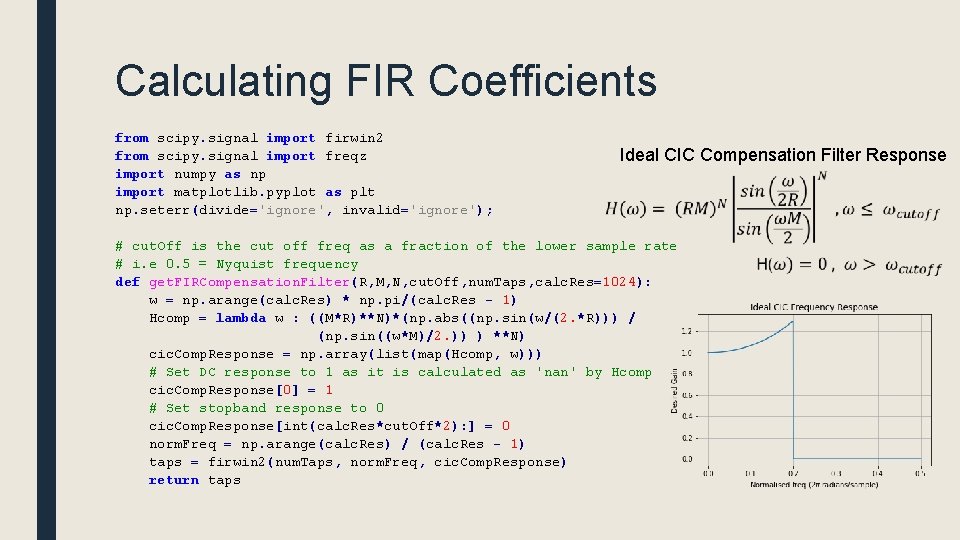
Calculating FIR Coefficients from scipy. signal import firwin 2 from scipy. signal import freqz Ideal CIC Compensation Filter Response import numpy as np import matplotlib. pyplot as plt np. seterr(divide='ignore', invalid='ignore'); # cut. Off is the cut off freq as a fraction of the lower sample rate # i. e 0. 5 = Nyquist frequency def get. FIRCompensation. Filter(R, M, N, cut. Off, num. Taps, calc. Res=1024): w = np. arange(calc. Res) * np. pi/(calc. Res - 1) Hcomp = lambda w : ((M*R)**N)*(np. abs((np. sin(w/(2. *R))) / (np. sin((w*M)/2. )) ) **N) cic. Comp. Response = np. array(list(map(Hcomp, w))) # Set DC response to 1 as it is calculated as 'nan' by Hcomp cic. Comp. Response[0] = 1 # Set stopband response to 0 cic. Comp. Response[int(calc. Res*cut. Off*2): ] = 0 norm. Freq = np. arange(calc. Res) / (calc. Res - 1) taps = firwin 2(num. Taps, norm. Freq, cic. Comp. Response) return taps
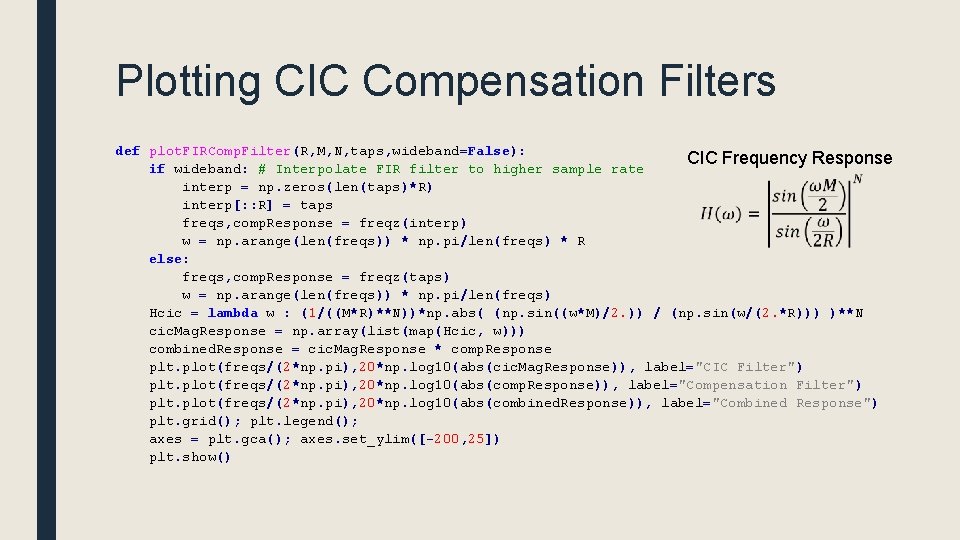
Plotting CIC Compensation Filters def plot. FIRComp. Filter(R, M, N, taps, wideband=False): CIC Frequency Response if wideband: # Interpolate FIR filter to higher sample rate interp = np. zeros(len(taps)*R) interp[: : R] = taps freqs, comp. Response = freqz(interp) w = np. arange(len(freqs)) * np. pi/len(freqs) * R else: freqs, comp. Response = freqz(taps) w = np. arange(len(freqs)) * np. pi/len(freqs) Hcic = lambda w : (1/((M*R)**N))*np. abs( (np. sin((w*M)/2. )) / (np. sin(w/(2. *R))) )**N cic. Mag. Response = np. array(list(map(Hcic, w))) combined. Response = cic. Mag. Response * comp. Response plt. plot(freqs/(2*np. pi), 20*np. log 10(abs(cic. Mag. Response)), label="CIC Filter") plt. plot(freqs/(2*np. pi), 20*np. log 10(abs(comp. Response)), label="Compensation Filter") plt. plot(freqs/(2*np. pi), 20*np. log 10(abs(combined. Response)), label="Combined Response") plt. grid(); plt. legend(); axes = plt. gca(); axes. set_ylim([-200, 25]) plt. show()
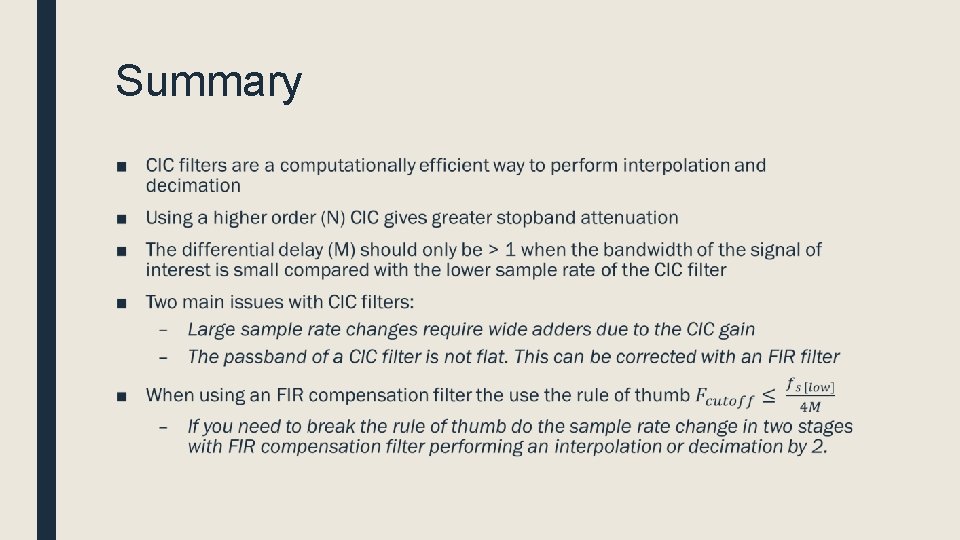
Summary ■

Further reading Additional information and Python code for all examples in this presentation https: //www. gibbard. me/cic-filters Additional information on deriving frequency response and CIC compensation filters • https: //dspguru. com/files/cic. pdf • https: //www. intel. com/content/dam/www/pr ogrammable/us/en/pdfs/literature/an/an 455. pdf • https: //www. embedded. com/design/configu rable-systems/4006446/Understandingcascaded-integrator-comb-filters Original paper on CIC filters E. Hogenauer, "An Economical Class of Digital Filters For Decimation and Interpolation, " IEEE Trans. Acoust. Speech and Signal Proc. , Vol. ASSP– 29, pp. 155– 162, ?
- Slides: 21