
Cascade View Elementary State Level Assessments require students


- Slides: 42
Cascade View Elementary
• State Level Assessments require students to both select and create answers to demonstrate knowledge, skills, and understanding in each of the EALRs. • Assessments are standardized – Same items – Same conditions – Same time during school year • Assessments are not timed 2
MATH 3
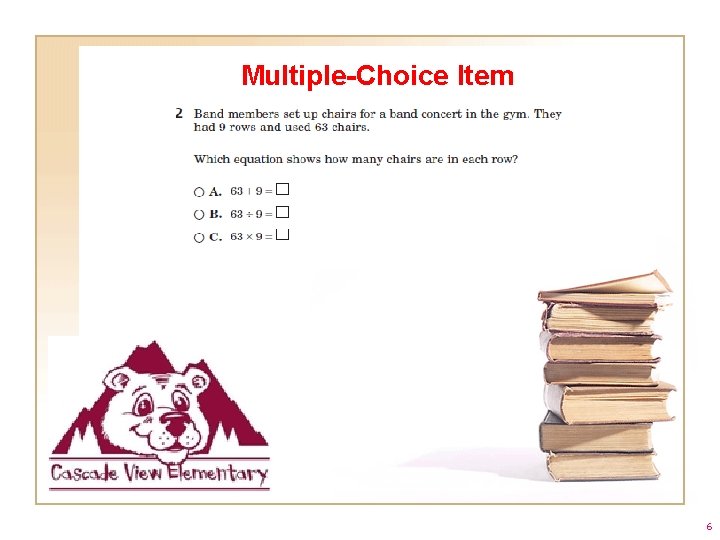
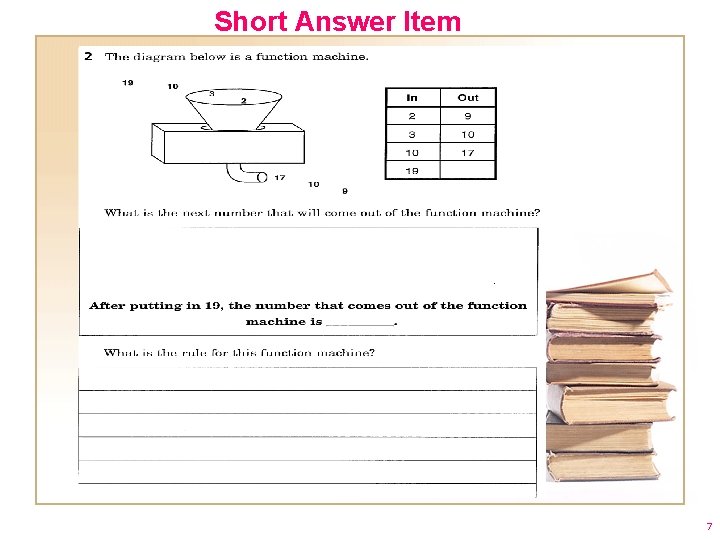
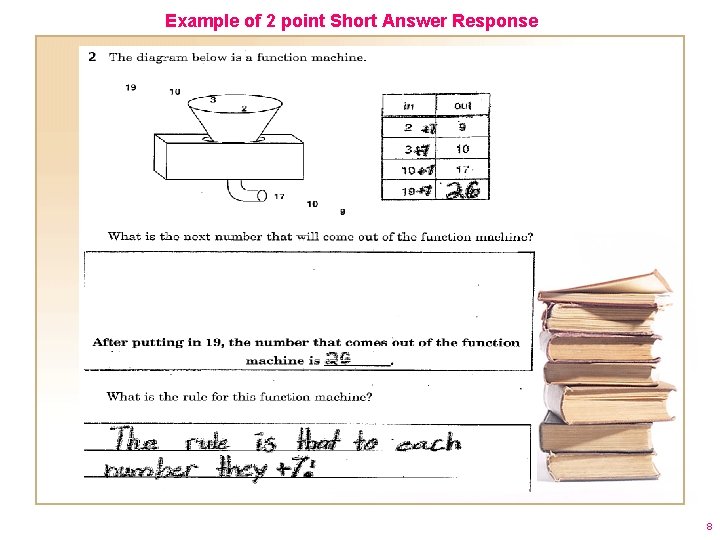
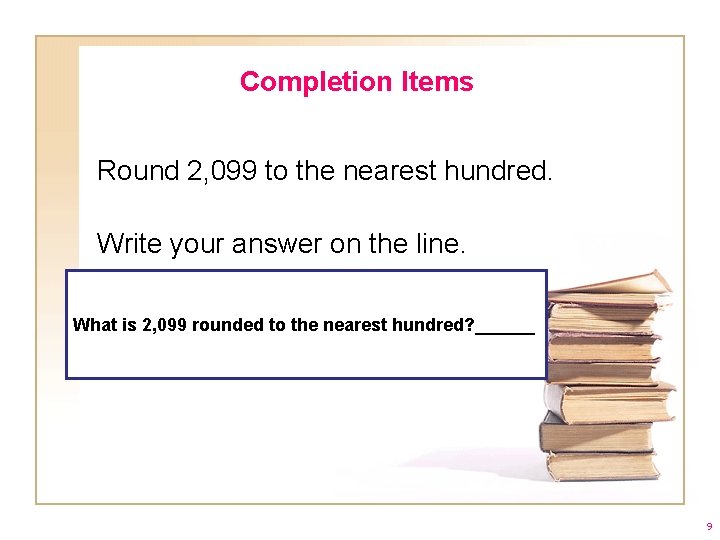
Math • Multiple Choice (1 pt. ) – 20 Problems • Completion Items (1 pt. ) – 6 Problems • Short Answer (2 pt. ) – 4 Problems 4
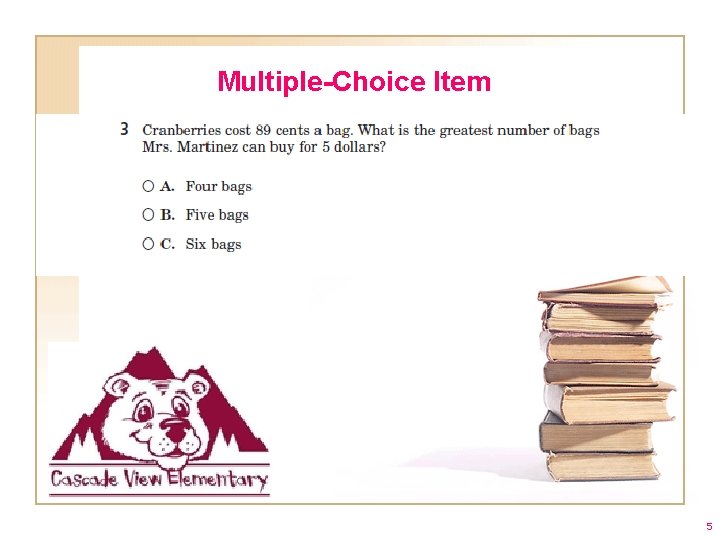
Multiple-Choice Item 5
Multiple-Choice Item 6
Short Answer Item 7
Example of 2 point Short Answer Response 8
Completion Items Round 2, 099 to the nearest hundred. Write your answer on the line. What is 2, 099 rounded to the nearest hundred? ______ 9
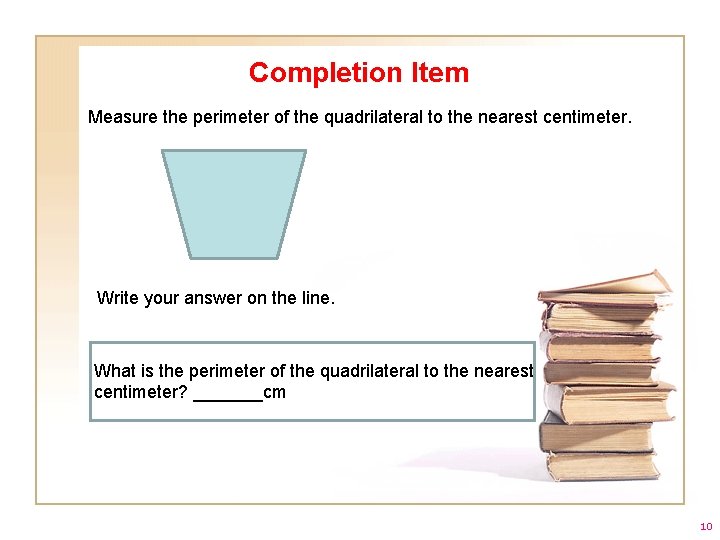
Completion Item Measure the perimeter of the quadrilateral to the nearest centimeter. Write your answer on the line. What is the perimeter of the quadrilateral to the nearest centimeter? _______cm 10
READING 11
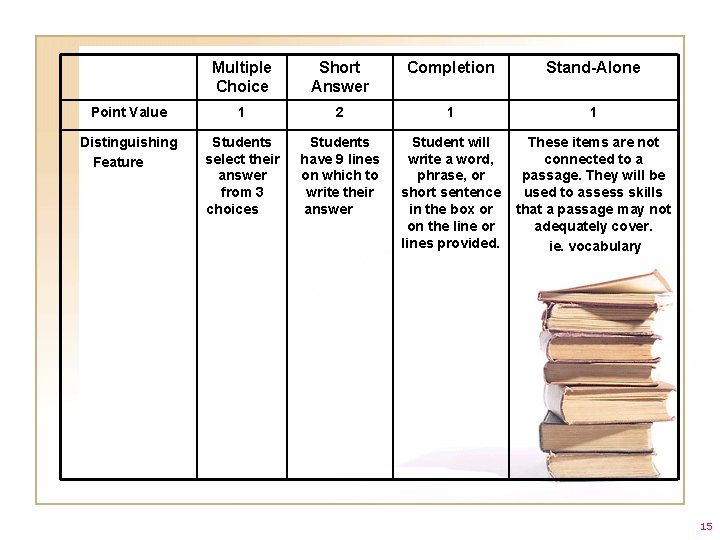
Reading Tests – What has changed Reading passages have been shortened. Another type of informational text called a functional passage will be used in addition to the typical informational texts. This type of text will apply to ”real world” reading. Extended response (4 -point) questions have been eliminated. Two additional question types will be used. These are completion and stand-alone. There will be one testing session. Grades 3, 4, and 5 tests should take about 75 minutes. These tests are not timed. 12
Reading Tests – Unchanged • The state reading standards, Grade Level Expectations (GLE), have not changed. • The reading test will look very similar to previous reading tests. • The reading test still has multiplechoice and short answer (2 -point) questions. • The reading test still has literary and informational text. • There are five to seven reading passages (depending on the grade level). 13
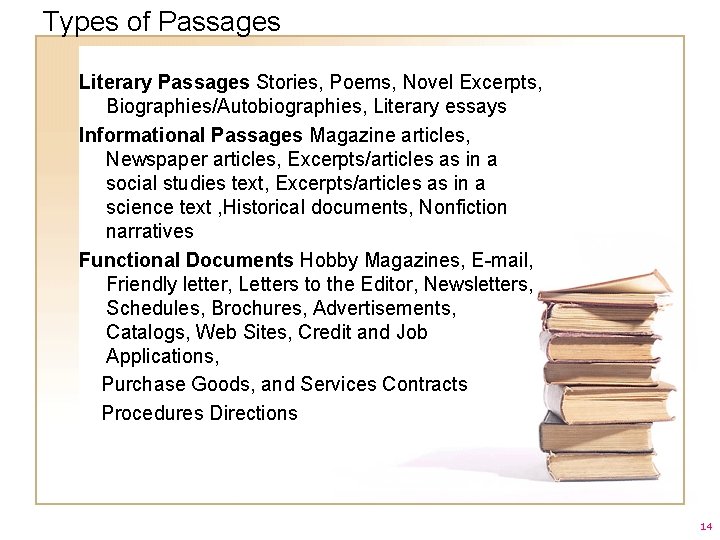
Types of Passages Literary Passages Stories, Poems, Novel Excerpts, Biographies/Autobiographies, Literary essays Informational Passages Magazine articles, Newspaper articles, Excerpts/articles as in a social studies text, Excerpts/articles as in a science text , Historical documents, Nonfiction narratives Functional Documents Hobby Magazines, E-mail, Friendly letter, Letters to the Editor, Newsletters, Schedules, Brochures, Advertisements, Catalogs, Web Sites, Credit and Job Applications, Purchase Goods, and Services Contracts Procedures Directions 14
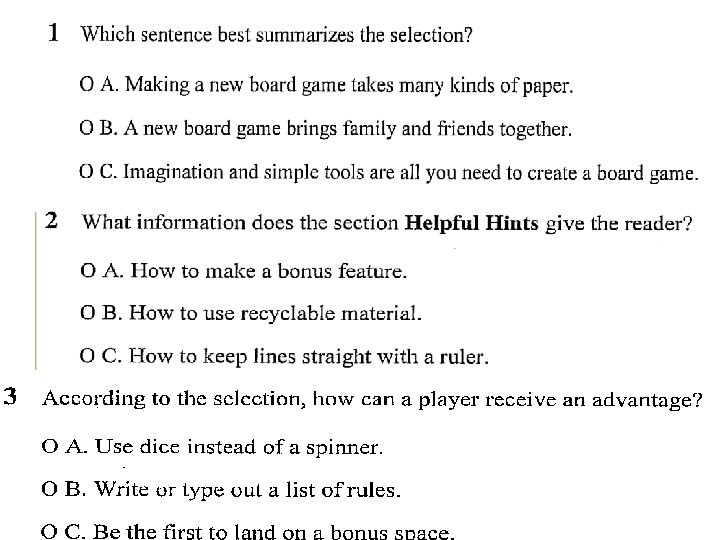
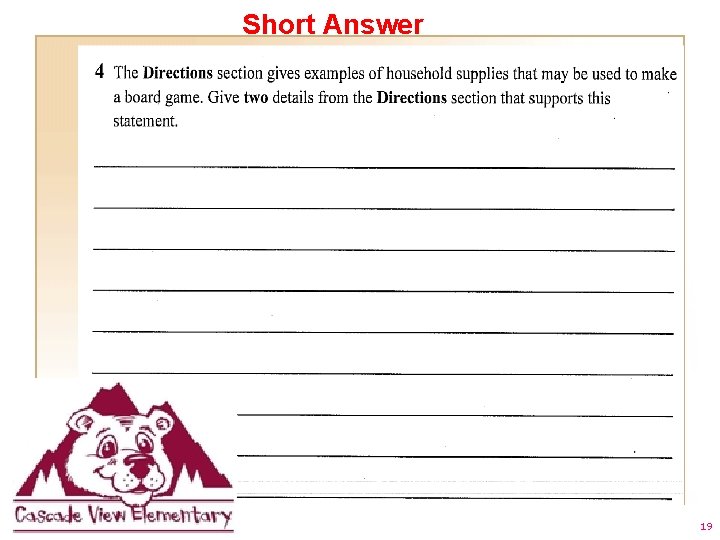
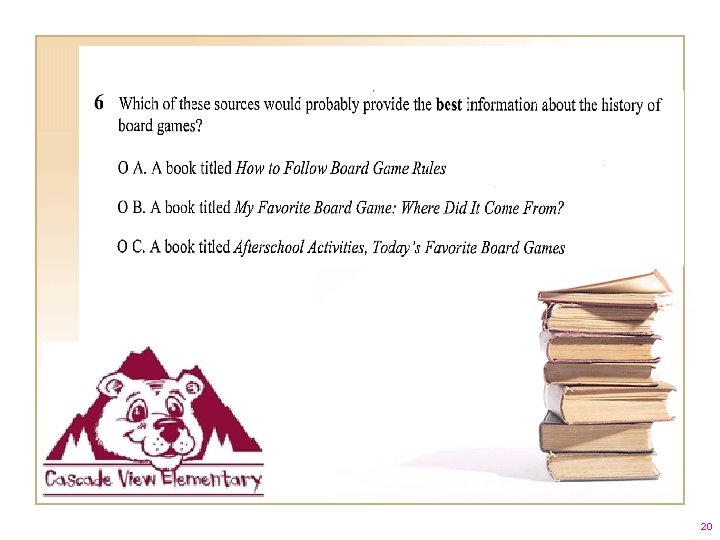
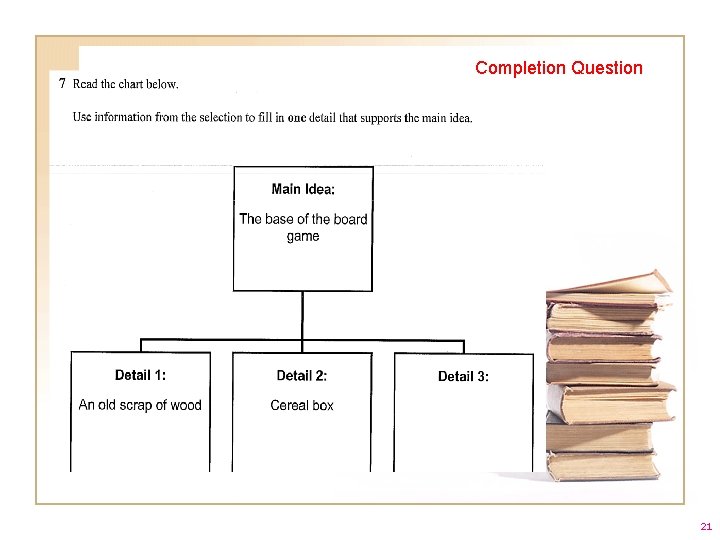
Multiple Choice Short Answer Completion Stand-Alone Point Value 1 2 1 1 Distinguishing Feature Students select their answer from 3 choices Students have 9 lines on which to write their answer Student will write a word, phrase, or short sentence in the box or on the line or lines provided. These items are not connected to a passage. They will be used to assess skills that a passage may not adequately cover. ie. vocabulary 15
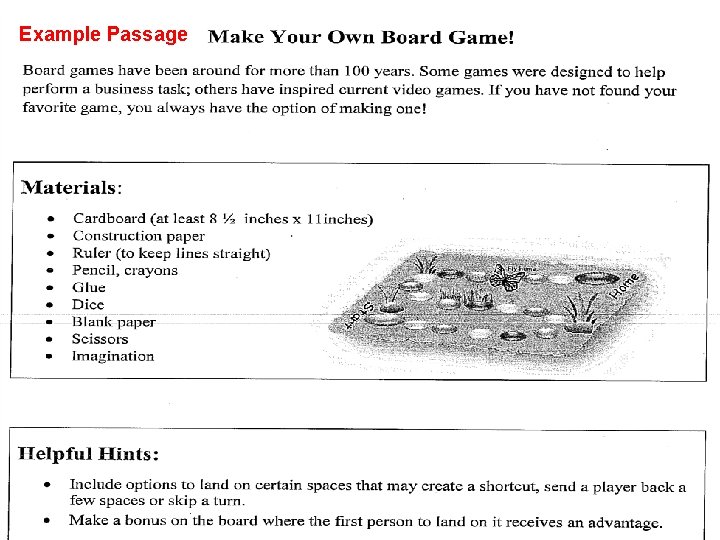
Example Passage 16
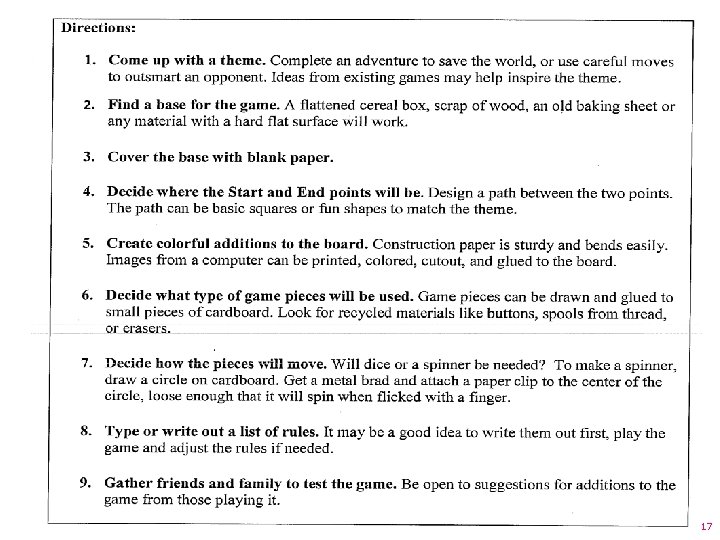
17
18
Short Answer 19
20
Completion Question 21
Writing 4 th Grade Only 22
Writing • 4 th grade only – 2 full days • All steps done in one day – – Pre-write Rough Draft Edit & Revise Final Copy • Narrative one day, Expository another day 23
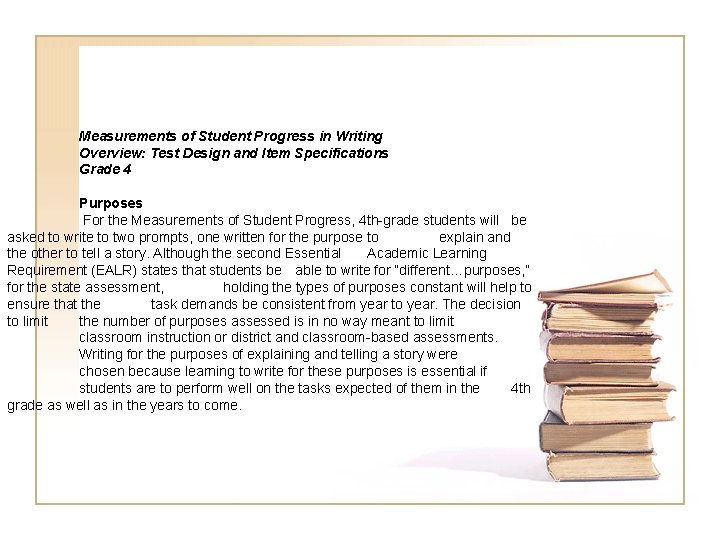
Measurements of Student Progress in Writing Overview: Test Design and Item Specifications Grade 4 Purposes For the Measurements of Student Progress, 4 th-grade students will be asked to write to two prompts, one written for the purpose to explain and the other to tell a story. Although the second Essential Academic Learning Requirement (EALR) states that students be able to write for “different…purposes, ” for the state assessment, holding the types of purposes constant will help to ensure that the task demands be consistent from year to year. The decision to limit the number of purposes assessed is in no way meant to limit classroom instruction or district and classroom-based assessments. Writing for the purposes of explaining and telling a story were chosen because learning to write for these purposes is essential if students are to perform well on the tasks expected of them in the 4 th grade as well as in the years to come.
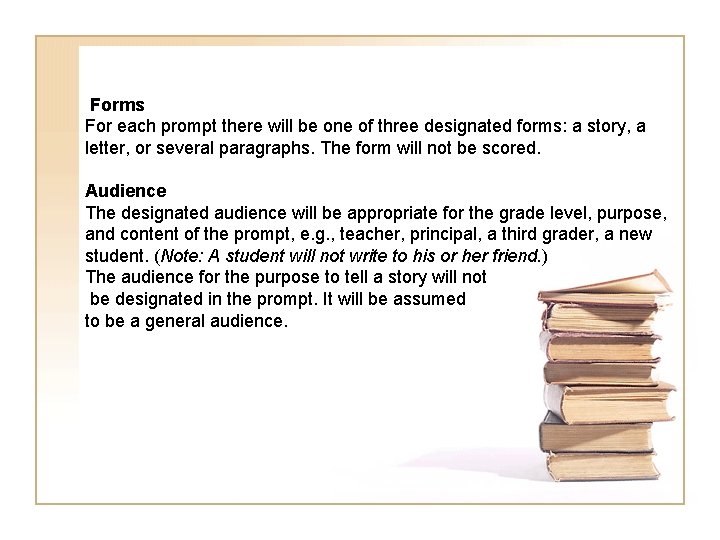
Forms For each prompt there will be one of three designated forms: a story, a letter, or several paragraphs. The form will not be scored. Audience The designated audience will be appropriate for the grade level, purpose, and content of the prompt, e. g. , teacher, principal, a third grader, a new student. (Note: A student will not write to his or her friend. ) The audience for the purpose to tell a story will not be designated in the prompt. It will be assumed to be a general audience.
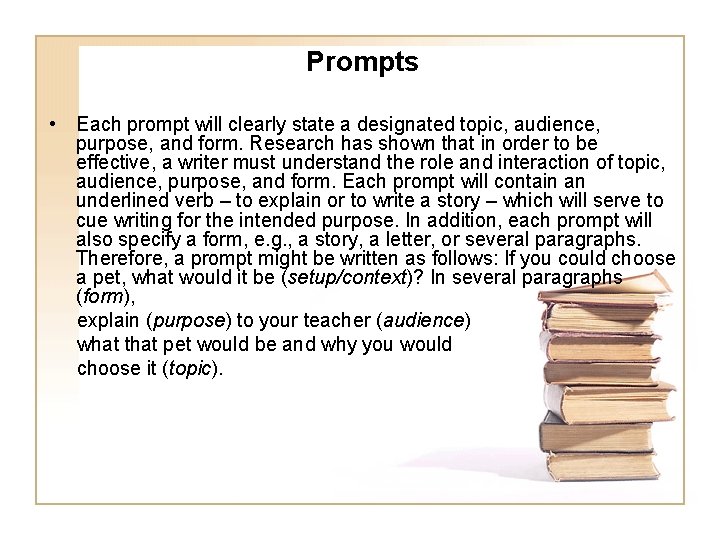
Prompts • Each prompt will clearly state a designated topic, audience, purpose, and form. Research has shown that in order to be effective, a writer must understand the role and interaction of topic, audience, purpose, and form. Each prompt will contain an underlined verb – to explain or to write a story – which will serve to cue writing for the intended purpose. In addition, each prompt will also specify a form, e. g. , a story, a letter, or several paragraphs. Therefore, a prompt might be written as follows: If you could choose a pet, what would it be (setup/context)? In several paragraphs (form), explain (purpose) to your teacher (audience) what that pet would be and why you would choose it (topic).
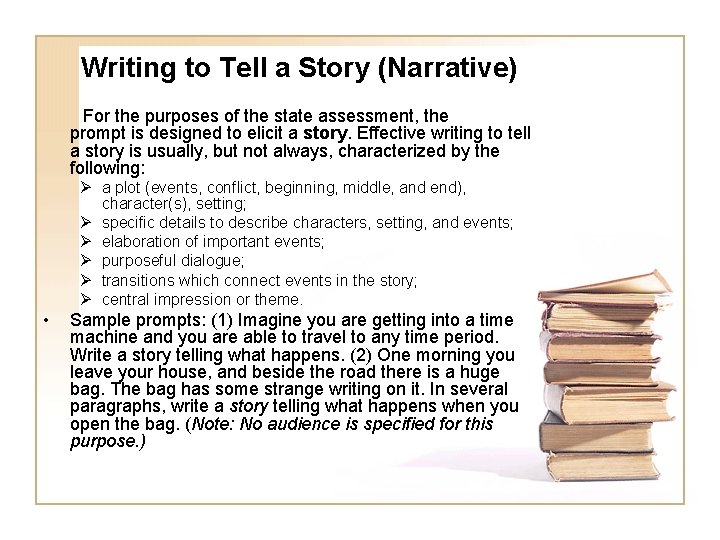
Writing to Tell a Story (Narrative) For the purposes of the state assessment, the prompt is designed to elicit a story. Effective writing to tell a story is usually, but not always, characterized by the following: Ø a plot (events, conflict, beginning, middle, and end), character(s), setting; Ø specific details to describe characters, setting, and events; Ø elaboration of important events; Ø purposeful dialogue; Ø transitions which connect events in the story; Ø central impression or theme. • Sample prompts: (1) Imagine you are getting into a time machine and you are able to travel to any time period. Write a story telling what happens. (2) One morning you leave your house, and beside the road there is a huge bag. The bag has some strange writing on it. In several paragraphs, write a story telling what happens when you open the bag. (Note: No audience is specified for this purpose. )
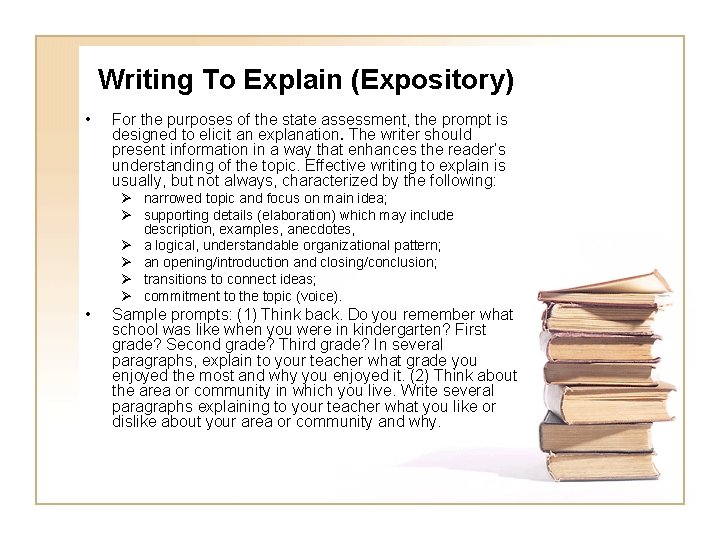
Writing To Explain (Expository) • For the purposes of the state assessment, the prompt is designed to elicit an explanation. The writer should present information in a way that enhances the reader’s understanding of the topic. Effective writing to explain is usually, but not always, characterized by the following: Ø narrowed topic and focus on main idea; Ø supporting details (elaboration) which may include description, examples, anecdotes, Ø a logical, understandable organizational pattern; Ø an opening/introduction and closing/conclusion; Ø transitions to connect ideas; Ø commitment to the topic (voice). • Sample prompts: (1) Think back. Do you remember what school was like when you were in kindergarten? First grade? Second grade? Third grade? In several paragraphs, explain to your teacher what grade you enjoyed the most and why you enjoyed it. (2) Think about the area or community in which you live. Write several paragraphs explaining to your teacher what you like or dislike about your area or community and why.
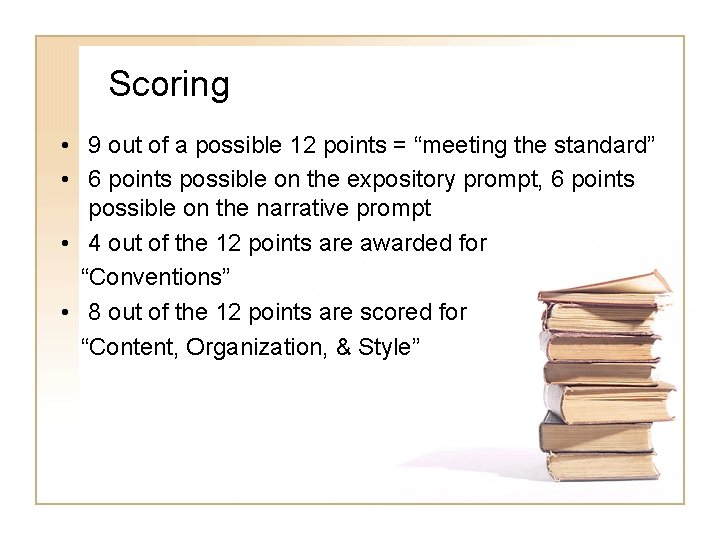
Scoring • 9 out of a possible 12 points = “meeting the standard” • 6 points possible on the expository prompt, 6 points possible on the narrative prompt • 4 out of the 12 points are awarded for “Conventions” • 8 out of the 12 points are scored for “Content, Organization, & Style”
Content, Organization, & Style (C. O. S. ) Scoring Guide: http: //www. k 12. wa. us/Writing/Assessment/Sc oring. Guides/Gr 4 COSScoring. Guide. doc Conventions Scoring Guide: http: //www. k 12. wa. us/Writing/Assessment/Scori ng. Guides/Gr 4 CONVScoring. Guide. doc Annotated Anchor Sets: http: //www. k 12. wa. us/Writing/Assessment/Annot ations 4 th. aspx
Science 5 th Grade Only 31
Fifth Grade Science We study the three domains: • Physical- Matter, Force and Motion (Physics) • Earth - Earth Changing Surface (Geology) • Life – Heredity and Adaptation (Biology) 32
Science MSP The three types of questions are: Multiple Choice – 26 questions @1 point each • Short Answer – 4 questions @ 2 points each • Total questions 34 • Points balanced among physical, earth and living and questions are based on scenarios • Test is untimed
MSP Questions cont. • 95% of the test is based on three types of scenarios: – Systems – Inquiry/investigation – Application • 5% are stand alone items, such as questions on energy transfer.
System Scenarios • Systems = analyzing systems in terms of subsystem and larger more inclusive systems. • First they are given a system scenario such as: Simon’s school has an area for a compost pile. A compost pile contains plant waste that can be decomposed. Compost is used in the garden. The diagram below shows the location of Simon’s compost pile at his school. (Diagram follows) • Then they are asked questions, such as…. Which of the following is food energy for the decomposers in the compost pile? A. Heat B. Water C. Leaves
Inquiry Scenarios • Inquiry = the knowledge of the scientific method/investigation process. – – Observation Variables Conclusions Procedures
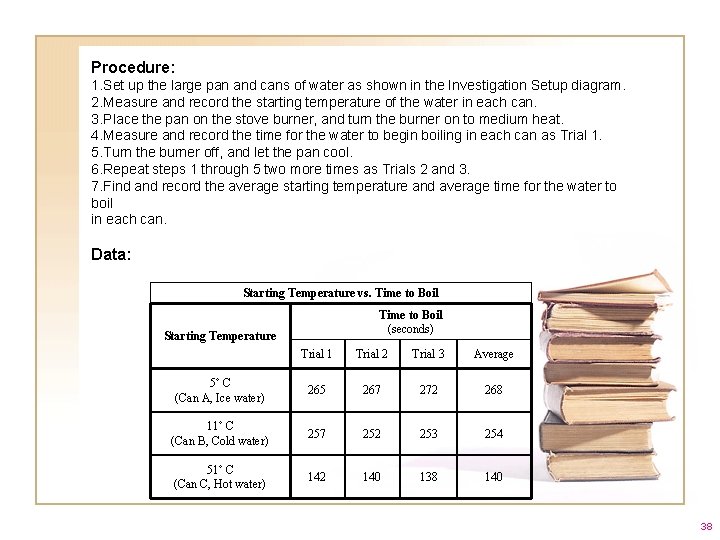
Inquiry Scenarios cont. Joel heard that cold water will begin boiling (bubbling at the surface) faster than hot water when heated the same. He and his father did the following investigation. Question: What is the effect of different starting temperature of water on the time for the water to begin boiling? Prediction: The lower the water’s starting temperature, the quicker the water will begin boiling. Materials: – – empty cans of the same size labeled A, B, C large pan stove burner water: same amounts of ice water, cold water from the faucet, and hot water from the faucet – thermometer – stopwatch
Procedure: 1. Set up the large pan and cans of water as shown in the Investigation Setup diagram. 2. Measure and record the starting temperature of the water in each can. 3. Place the pan on the stove burner, and turn the burner on to medium heat. 4. Measure and record the time for the water to begin boiling in each can as Trial 1. 5. Turn the burner off, and let the pan cool. 6. Repeat steps 1 through 5 two more times as Trials 2 and 3. 7. Find and record the average starting temperature and average time for the water to boil in each can. Data: Starting Temperature vs. Time to Boil (seconds) Starting Temperature Trial 1 Trial 2 Trial 3 Average 5˚ C (Can A, Ice water) 265 267 272 268 11˚ C (Can B, Cold water) 257 252 253 254 51˚ C (Can C, Hot water) 142 140 138 140 38
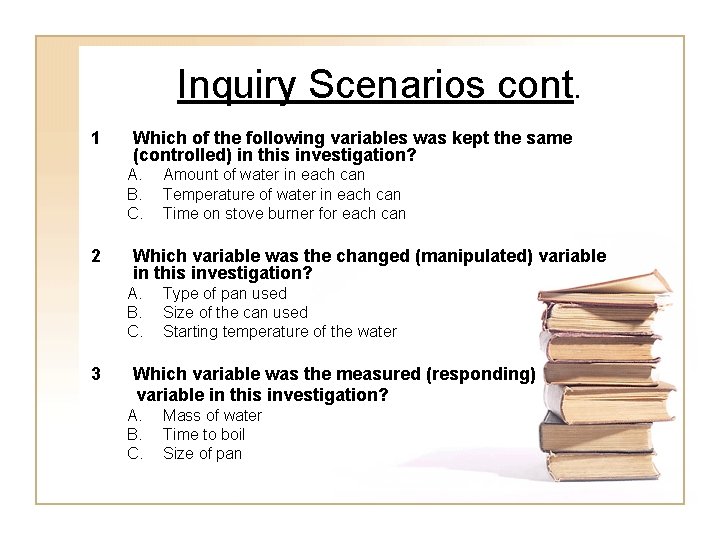
Inquiry Scenarios cont. 1 Which of the following variables was kept the same (controlled) in this investigation? A. B. C. 2 Which variable was the changed (manipulated) variable in this investigation? A. B. C. 3 Amount of water in each can Temperature of water in each can Time on stove burner for each can Type of pan used Size of the can used Starting temperature of the water Which variable was the measured (responding) variable in this investigation? A. B. C. Mass of water Time to boil Size of pan
Application Scenarios • Application = ability to solve real world problems. • Same pattern as the other two scenarios.
Testing Tips • • Get plenty of sleep. Have a nutritious breakfast. Come to school on-time. Schedule all appointments for another time. • Do your best! 41
Be all you can be on the MSP!!! CUBS we are proud of your past accomplishments!!! BEST OF LUCK!