
Cascade Control Ref Smith Corripio Principles and practice


- Slides: 21
Cascade Control Ref. : Smith & Corripio, Principles and practice of automatic process control, 3 rd Edition, Wiley, 2006, Chapter 9.
Cascade Control The disadvantage of feedback control is that it reacts only after the process has been upset. Thus a deviation in the controlled variable is needed to initiate corrective action. Even with this disadvantage, probably 80% of all control strategies used in industrial practice are simple feedback control. As the processes requirements tighten, however, and in processes with slow dynamics, or in processes with too many, or frequently occurring upsets, the control performance provided by feedback control may becomes unacceptable. Thus, it is necessary to use other strategies to provide the required performance. Cascade control is a strategy that in some applications significantly improves the performance provided by feedback control. 2
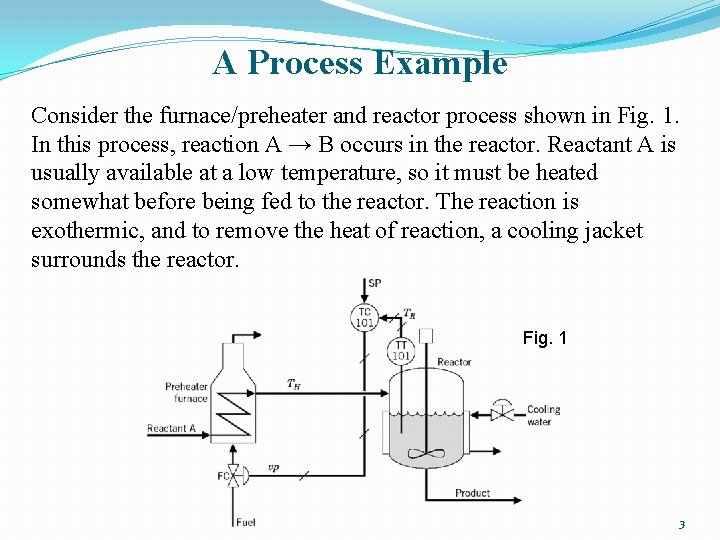
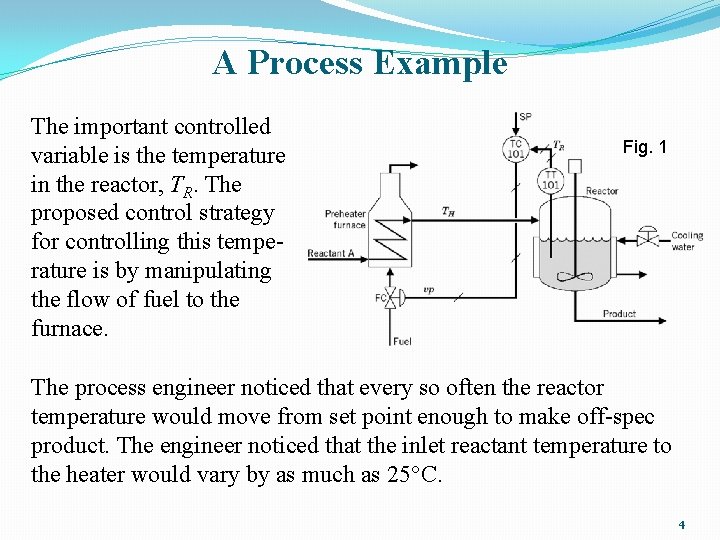
A Process Example Consider the furnace/preheater and reactor process shown in Fig. 1. In this process, reaction A → B occurs in the reactor. Reactant A is usually available at a low temperature, so it must be heated somewhat before being fed to the reactor. The reaction is exothermic, and to remove the heat of reaction, a cooling jacket surrounds the reactor. Fig. 1 3
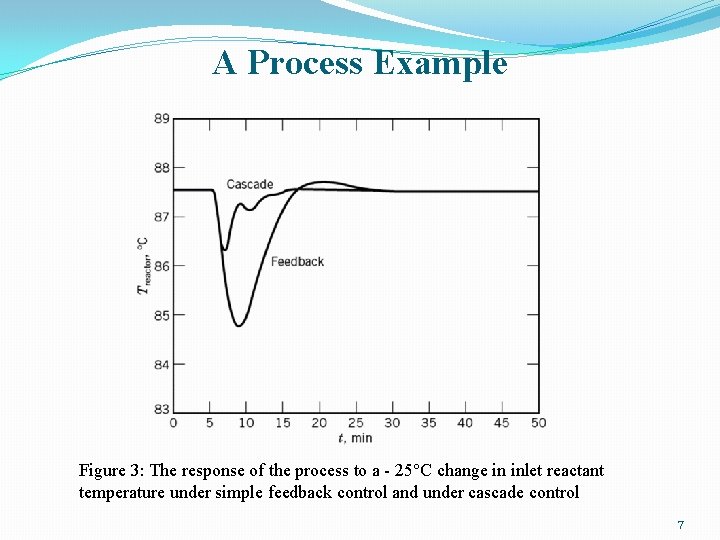
A Process Example The important controlled variable is the temperature in the reactor, TR. The proposed control strategy for controlling this temperature is by manipulating the flow of fuel to the furnace. Fig. 1 The process engineer noticed that every so often the reactor temperature would move from set point enough to make off-spec product. The engineer noticed that the inlet reactant temperature to the heater would vary by as much as 25°C. 4
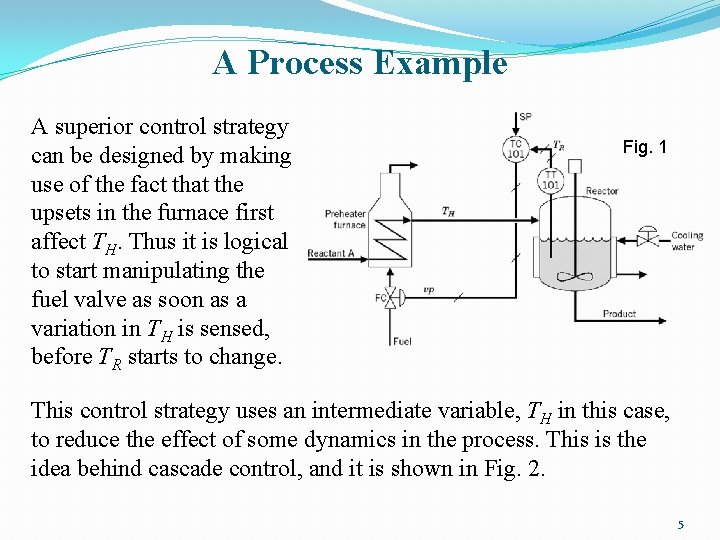
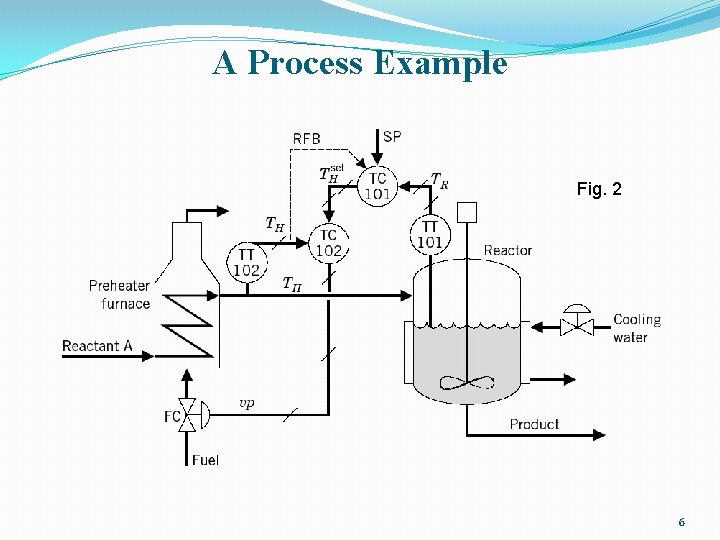
A Process Example A superior control strategy can be designed by making use of the fact that the upsets in the furnace first affect TH. Thus it is logical to start manipulating the fuel valve as soon as a variation in TH is sensed, before TR starts to change. Fig. 1 This control strategy uses an intermediate variable, TH in this case, to reduce the effect of some dynamics in the process. This is the idea behind cascade control, and it is shown in Fig. 2. 5
A Process Example Fig. 2 6
A Process Example Figure 3: The response of the process to a - 25°C change in inlet reactant temperature under simple feedback control and under cascade control 7
Cascade Control In general, the controller that keeps the primary variable at set point is referred to as the master, outer, or primary controller. The controller used to maintain the secondary variable at the set point required by the master controller is usually referred to as the slave, inner, or secondary controller. The terminology primary/secondary is commonly preferred for systems with more than two cascaded loops, because it extends naturally. In designing cascade control strategies, the most important consideration is that the inner loop must be faster than the outer loop and the faster the better. 8
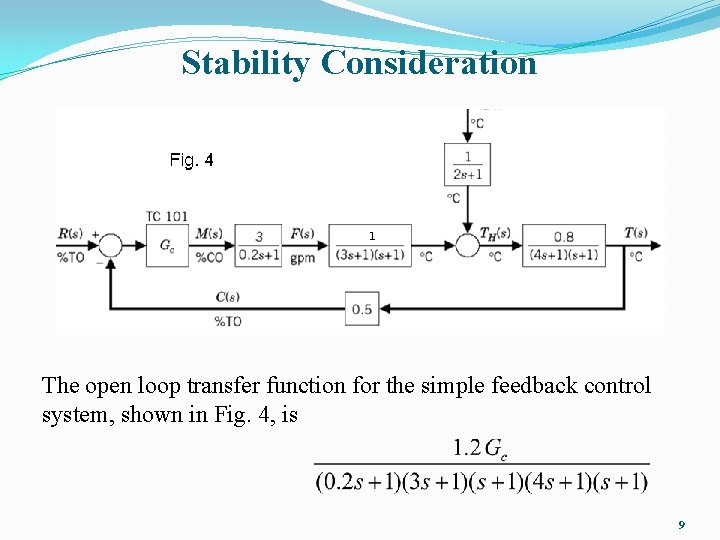
Stability Consideration The open loop transfer function for the simple feedback control system, shown in Fig. 4, is 9
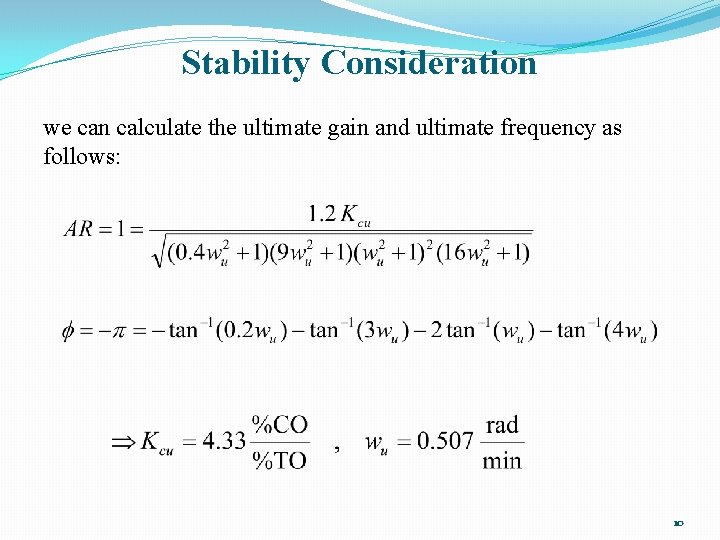
Stability Consideration we can calculate the ultimate gain and ultimate frequency as follows: 10
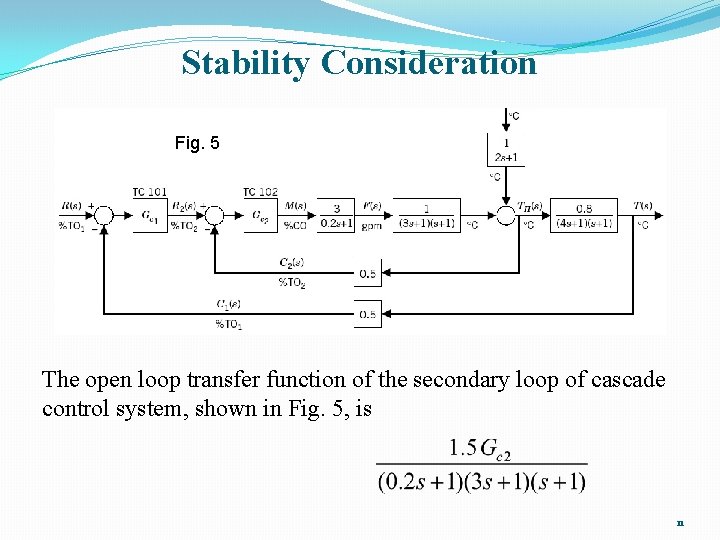
Stability Consideration Fig. 5 The open loop transfer function of the secondary loop of cascade control system, shown in Fig. 5, is 11
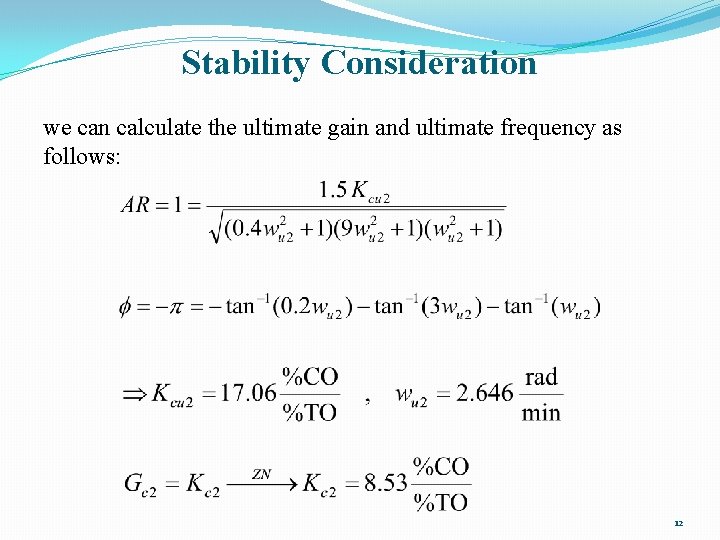
Stability Consideration we can calculate the ultimate gain and ultimate frequency as follows: 12
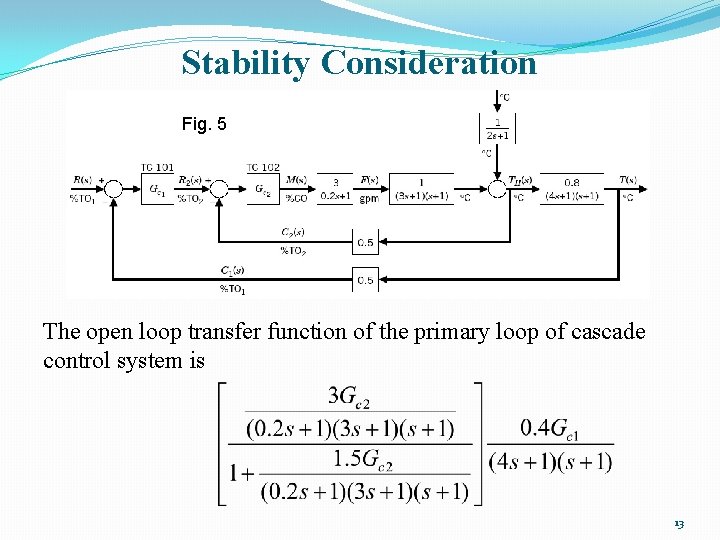
Stability Consideration Fig. 5 The open loop transfer function of the primary loop of cascade control system is 13
Stability Consideration we can calculate the ultimate gain and ultimate frequency as follows: 14
Stability Consideration Comparing the results, we note that the cascade strategy yields a greater ultimate gain, or limit of stability, 7. 2 %CO/%TO vs. 4. 33 %CO/%TO, than the simple feedback control loop. The value of the ultimate frequency is also greater for the cascade strategy, 1. 54 rad/min vs. 0. 507 rad/min, indicating faster process response. The use of cascade control makes the overall control faster and most times increases the ultimate gain of the primary controller. 15
Tuning of Cascade Controllers The inner controller is the first to be tuned and put into auto state while the other loops are in manual. As the inner controller is set in cascade, it is good practice to check how it performs before proceeding to the next controller. This checking can usually be done very simply by varying the set point. Remember, it is desired to make inner controller as fast as possible, and existing offset in the inner loop is not important, therefore a proportional controller is usually sufficient. Once this is done, the outer controller can be tuned based on the methods presented in chapter 7 and set in automatic. However, before the outer controller is set in automatic, the inner must be set to the cascade state. 16
Another Example Fig. 6 17
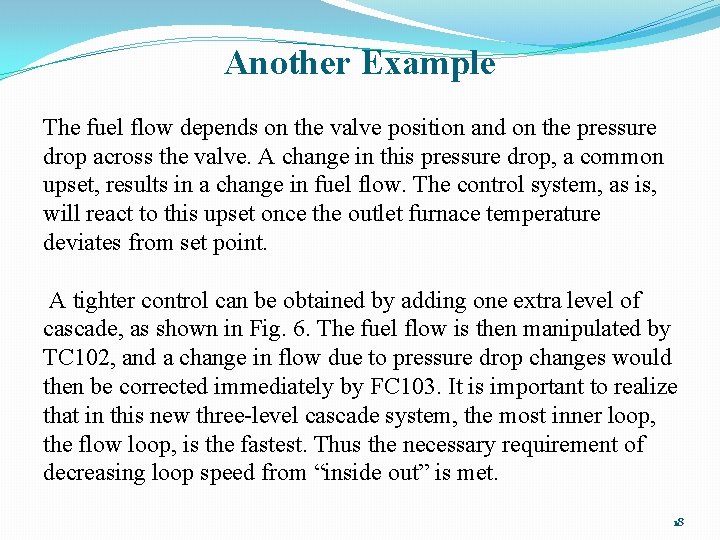
Another Example The fuel flow depends on the valve position and on the pressure drop across the valve. A change in this pressure drop, a common upset, results in a change in fuel flow. The control system, as is, will react to this upset once the outlet furnace temperature deviates from set point. A tighter control can be obtained by adding one extra level of cascade, as shown in Fig. 6. The fuel flow is then manipulated by TC 102, and a change in flow due to pressure drop changes would then be corrected immediately by FC 103. It is important to realize that in this new three-level cascade system, the most inner loop, the flow loop, is the fastest. Thus the necessary requirement of decreasing loop speed from “inside out” is met. 18
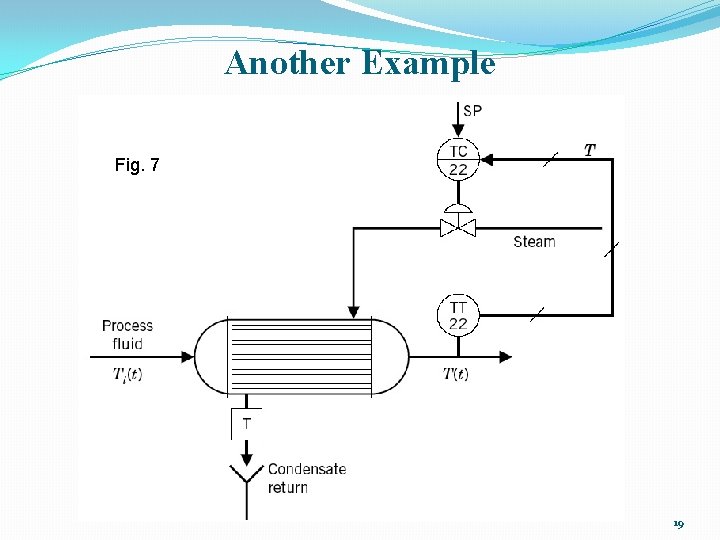
Another Example Fig. 7 19
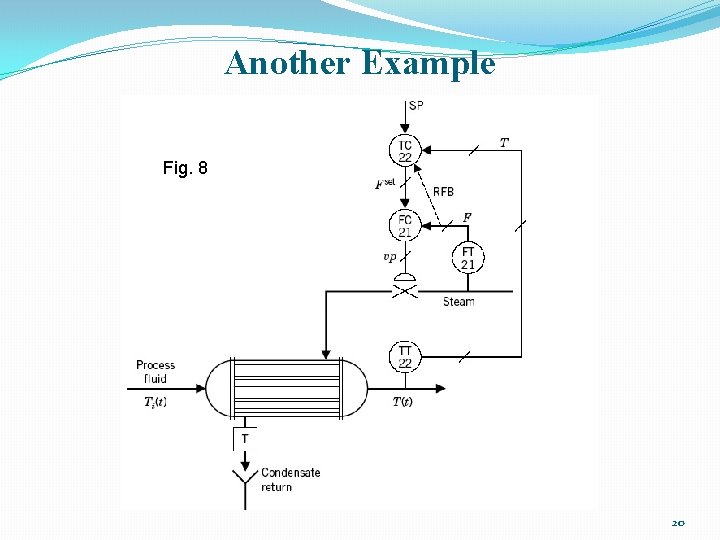
Another Example Fig. 8 20
Bumpless Cascade Controller If while the secondary controller is off cascade, its set point changes, then at the moment it is returned to cascade mode, its present set point may not be equal to the output of the primary controller. If this occurs, the set point of the secondary controller will immediately jump to equal the output of the primary controller, thus generating a “bump” in the process operation. To obtain a “bumpless” transfer, controllers are programmed so that while the secondary controller is off cascade, the output from the primary controller is forced to equal either the measurement or the set point of the secondary controller. Thus, when the secondary controller is returned to cascade operation, a smooth transfer is obtained. 21