
CASAS Handbook for Adult ESL Teachers An Interactive
CASAS Handbook for Adult ESL Teachers An Interactive Resource Guide for New and Experienced Adult ESL Teachers California Edition Teacher Training Module 2008
Agenda Warm-Up Activity Introduction to CASAS Presentation of Handbook Components Practice Activity Discussion of Application Ideas for use in the Classroom and Program Review CASAS Handbook for Adult ESL Teachers, California Edition 2008 2
Warm-Up Activity “Corners” Who am I? Introduce yourselves CASAS Handbook for Adult ESL Teachers, California Edition 2008 3
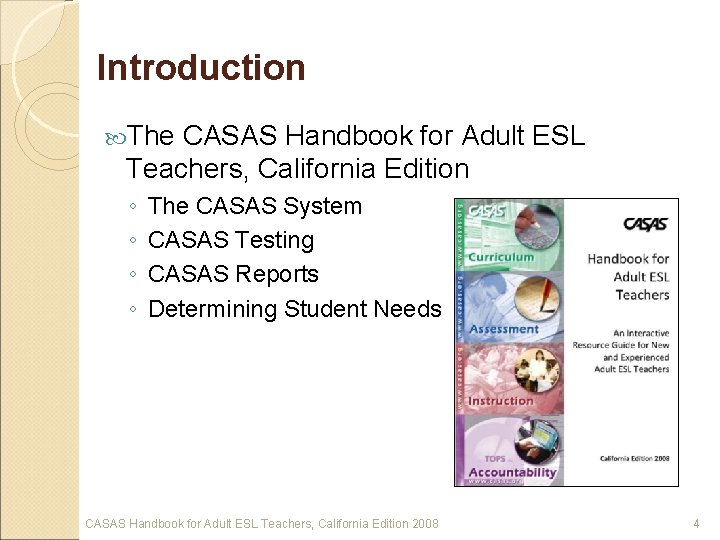
Introduction The CASAS Handbook for Adult ESL Teachers, California Edition ◦ ◦ The CASAS System CASAS Testing CASAS Reports Determining Student Needs CASAS Handbook for Adult ESL Teachers, California Edition 2008 4
Key to Icons in the Handbook Answer the questions. You may need to ask your supervisor or lead teacher for the answer. Follow the link to the CASAS website for downloadable documents or more information CASAS Handbook for Adult ESL Teachers, California Edition 2008 5
Overview What is Adult Education ESL? What is CASAS? Competencies, Task Areas and Content TOC Standards Registration, Orientation and Placement Accountability CASAS Testing Administration and Storage of Tests Appraisals, Pre-Tests and Post-Tests Using Test Results CASAS Handbook for Adult ESL Teachers, California Edition 2008 6
Types of agencies ESL program characteristics ESL student characteristics Program funding SECTION 1 WHAT IS ADULT EDUCATION ESL? 1 CASAS Handbook for Adult ESL Teachers, California Edition 2008 7
Gather the Information What kind of agency do you work for? Is your class single-level or multi-level? What type of class is it? Is your class a single-skill or an integrated skills class? How many ESL classes are offered by your school both on- and off-site? 2 CASAS Handbook for Adult ESL Teachers, California Edition 2008 8
What is CASAS? What is TOPSpro? SECTION 2 WHAT IS CASAS? 3 CASAS Handbook for Adult ESL Teachers, California Edition 2008 9

CASAS — the Organization Began in 1980 as a partnership of the California Department of Education and a consortium of local adult education agencies Nationwide, field-based consortium since 1985 Assessments used in 30+ states, Singapore, and the Pacific Rim Provides research, program evaluation, and data services CASAS stands for Comprehensive Adult Student Assessment Systems 3 CASAS Handbook for Adult ESL Teachers, California Edition 2008 10 10

Key Components There are four key components of the CASAS system. 3 CASAS Handbook for Adult ESL Teachers, California Edition 2008 11
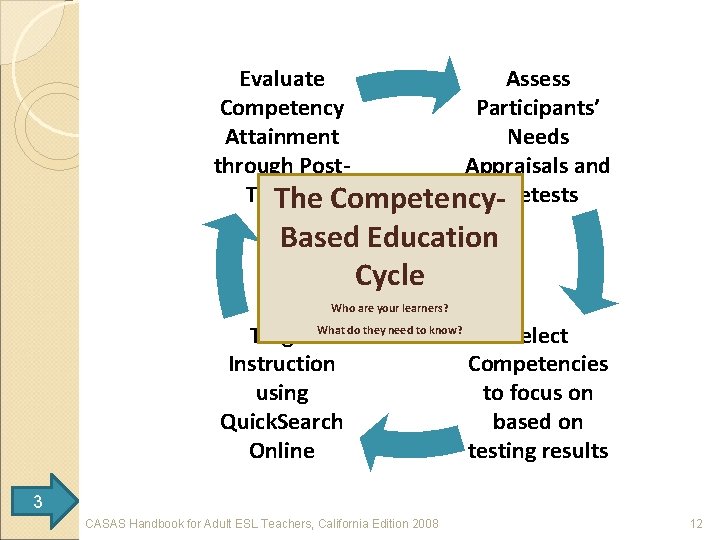
Evaluate Assess Competency Participants’ Attainment Needs through Post. Appraisals and Testing The Competency-Pretests Based Education Cycle Who are your learners? Target What do they need to know? Select Instruction Competencies using to focus on Quick. Search based on Online testing results 3 CASAS Handbook for Adult ESL Teachers, California Edition 2008 12

Gather the Information CASAS Training and Accountability contacts at my site: � Name: __________ Phone: _________ Email: _______ � Name: _____ Phone: _____ Email: _______ 3 CASAS Handbook for Adult ESL Teachers, California Edition 2008 13
What is TOPSpro? TOPSpro is a management information system that ◦ ◦ ◦ Scores CASAS Tests Identifies missing information in data collection Tracks student progress Suggests the test level for the next test Identifies inaccurate scores Generates reports for students, teachers, administrators and funding sources 4 CASAS Handbook for Adult ESL Teachers, California Edition 2008 14
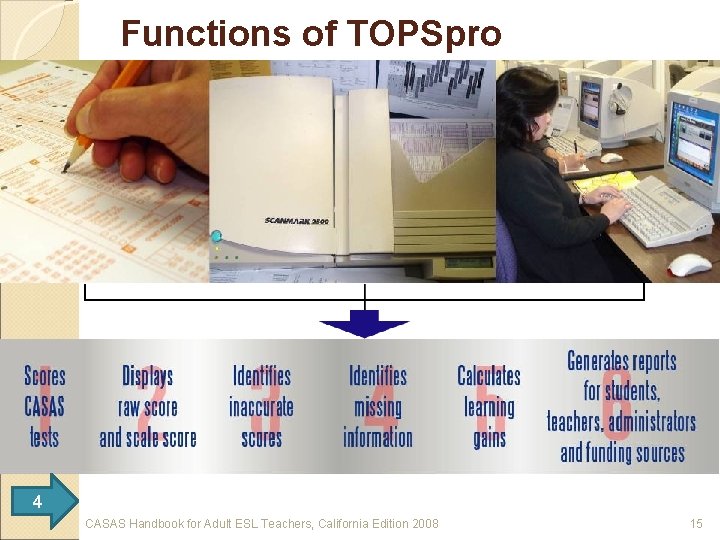
Functions of TOPSpro 4 CASAS Handbook for Adult ESL Teachers, California Edition 2008 15
What are Competencies? What are Task Areas? What are Content Standards? SECTION 3 COMPETENCIES, TASK AREAS, AND CONTENT STANDARDS 5 CASAS Handbook for Adult ESL Teachers, California Edition 2008 16
Competencies, Task Areas and Content Standards Create the foundation for the CASAS curriculum. Separately, they provide ◦ life skills contexts ◦ a variety of visual prompts ◦ the underlying basic literacy skills that together work ◦ as the ladder to successful attainment of the curriculum objectives. 5 CASAS Handbook for Adult ESL Teachers, California Edition 2008 17
What are Competencies? Competency Content Areas 0. Basic Communication 1. Consumer Economics 2. Community Resources 3. Health 4. Employment 5. Government and Law 6. Computation CASAS Web site: www. casas. org/ 7. Learning to Learn About CASAS / CASAS Competences 8. Independent Living Skills 5 CASAS Handbook for Adult ESL Teachers, California Edition 2008 18
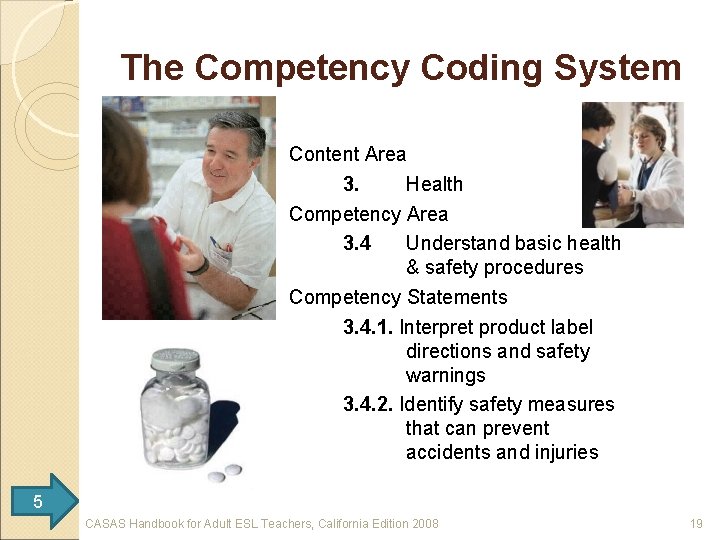
The Competency Coding System Content Area 3. Health Competency Area 3. 4 Understand basic health & safety procedures Competency Statements 3. 4. 1. Interpret product label directions and safety warnings 3. 4. 2. Identify safety measures that can prevent accidents and injuries 5 CASAS Handbook for Adult ESL Teachers, California Edition 2008 19
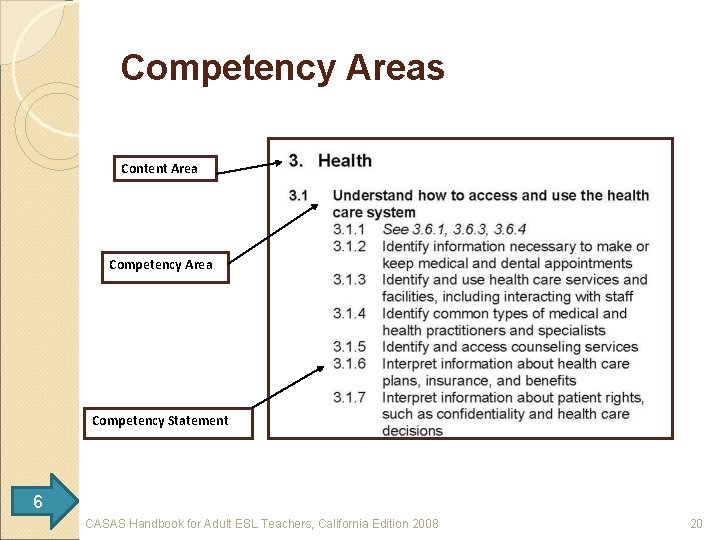
Competency Areas Content Area Competency Statement 6 CASAS Handbook for Adult ESL Teachers, California Edition 2008 20
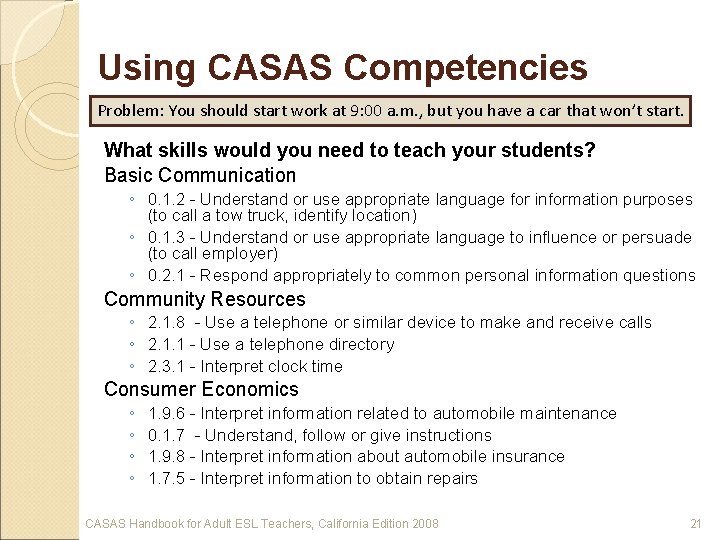
Using CASAS Competencies Problem: You should start work at 9: 00 a. m. , but you have a car that won’t start. What skills would you need to teach your students? Basic Communication ◦ 0. 1. 2 - Understand or use appropriate language for information purposes (to call a tow truck, identify location) ◦ 0. 1. 3 - Understand or use appropriate language to influence or persuade (to call employer) ◦ 0. 2. 1 - Respond appropriately to common personal information questions Community Resources ◦ 2. 1. 8 - Use a telephone or similar device to make and receive calls ◦ 2. 1. 1 - Use a telephone directory ◦ 2. 3. 1 - Interpret clock time Consumer Economics ◦ ◦ 1. 9. 6 - Interpret information related to automobile maintenance 0. 1. 7 - Understand, follow or give instructions 1. 9. 8 - Interpret information about automobile insurance 1. 7. 5 - Interpret information to obtain repairs CASAS Handbook for Adult ESL Teachers, California Edition 2008 21
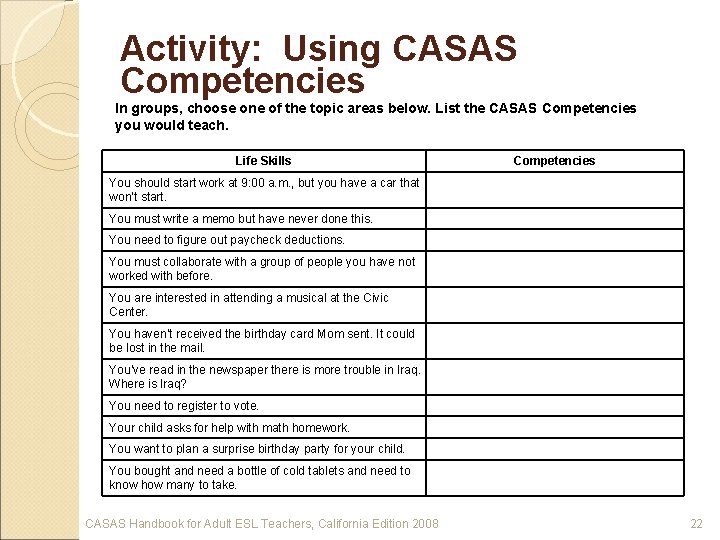
Activity: Using CASAS Competencies In groups, choose one of the topic areas below. List the CASAS Competencies you would teach. Life Skills Competencies You should start work at 9: 00 a. m. , but you have a car that won’t start. You must write a memo but have never done this. You need to figure out paycheck deductions. You must collaborate with a group of people you have not worked with before. You are interested in attending a musical at the Civic Center. You haven’t received the birthday card Mom sent. It could be lost in the mail. You’ve read in the newspaper there is more trouble in Iraq. Where is Iraq? You need to register to vote. Your child asks for help with math homework. You want to plan a surprise birthday party for your child. You bought and need a bottle of cold tablets and need to know how many to take. CASAS Handbook for Adult ESL Teachers, California Edition 2008 22
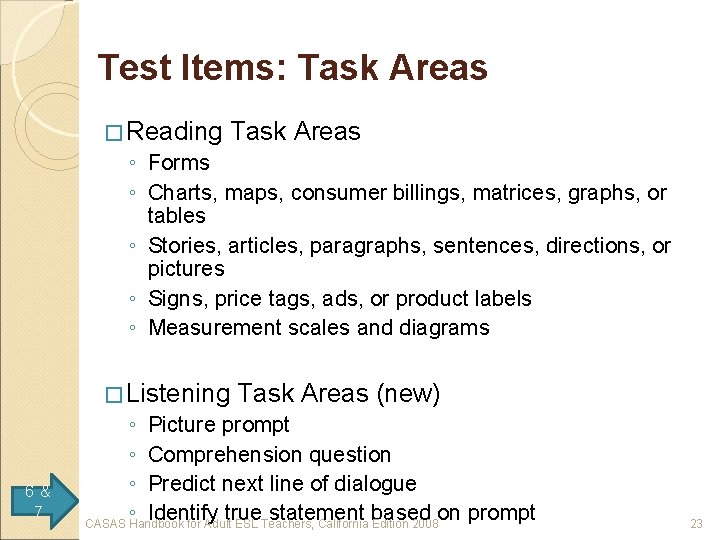
Test Items: Task Areas � Reading Task Areas ◦ Forms ◦ Charts, maps, consumer billings, matrices, graphs, or tables ◦ Stories, articles, paragraphs, sentences, directions, or pictures ◦ Signs, price tags, ads, or product labels ◦ Measurement scales and diagrams 6 & 7 � Listening Task Areas (new) ◦ Picture prompt ◦ Comprehension question ◦ Predict next line of dialogue ◦ Identify true statement based on prompt CASAS Handbook for Adult ESL Teachers, California Edition 2008 23
What are Content Standards? Basic Skills Content Standards identify the underlying basic skills associated with CASAS Competencies. The instructor can use these Basic Skills Content Standards when planning instruction to help students master a specific competency. 8 CASAS Handbook for Adult ESL Teachers, California Edition 2008 24
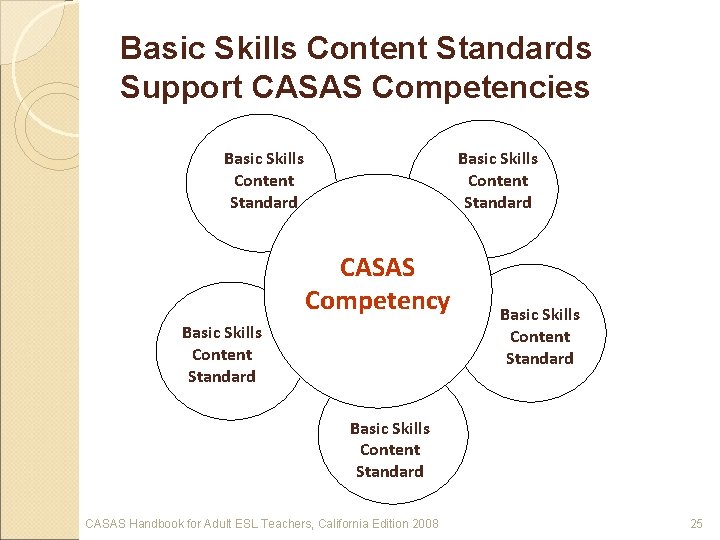
Basic Skills Content Standards Support CASAS Competencies Basic Skills Content Standard CASAS Competency Basic Skills Content Standard CASAS Handbook for Adult ESL Teachers, California Edition 2008 25
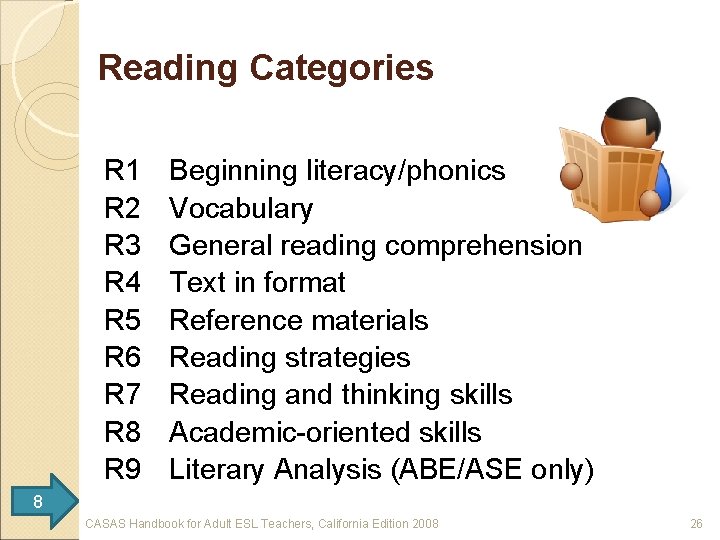
Reading Categories R 1 R 2 R 3 R 4 R 5 R 6 R 7 R 8 R 9 Beginning literacy/phonics Vocabulary General reading comprehension Text in format Reference materials Reading strategies Reading and thinking skills Academic-oriented skills Literary Analysis (ABE/ASE only) 8 CASAS Handbook for Adult ESL Teachers, California Edition 2008 26
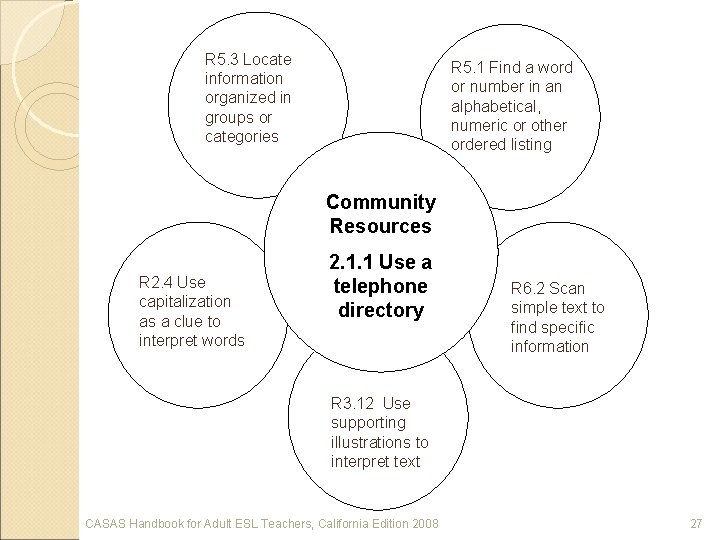
R 5. 3 Locate information organized in groups or categories R 5. 1 Find a word or number in an alphabetical, numeric or other ordered listing Community Resources R 2. 4 Use capitalization as a clue to interpret words 2. 1. 1 Use a telephone directory R 6. 2 Scan simple text to find specific information R 3. 12 Use supporting illustrations to interpret text CASAS Handbook for Adult ESL Teachers, California Edition 2008 27
Basic Skills Content Standards and CASAS Competencies Why are Basic Skills Content Standards important to use along with CASAS Competencies? ◦ Basic Skills Content Standards identify the underlying basic skills that should be taught in conjunction with CASAS Competencies. ◦ Basic Skills Content Standards support instructional planning. ◦ Learning Content Standards helps students master a specific competency to attain their goals. CASAS Handbook for Adult ESL Teachers, California Edition 2008 28
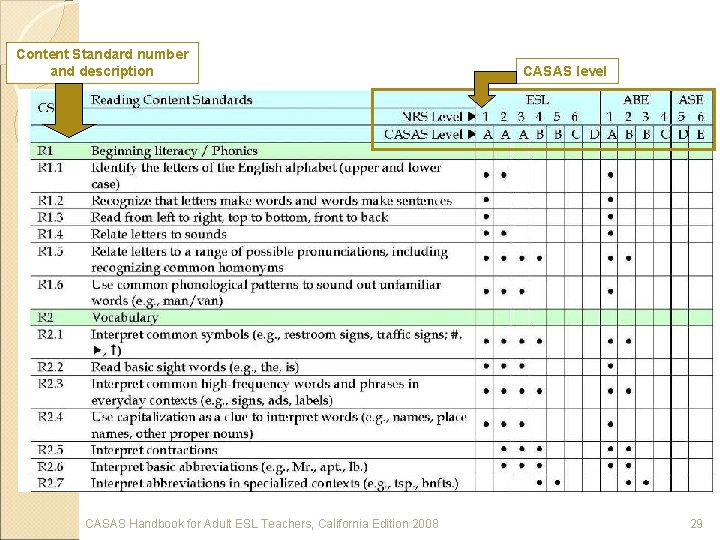
Content Standard number and description CASAS Handbook for Adult ESL Teachers, California Edition 2008 CASAS level 29
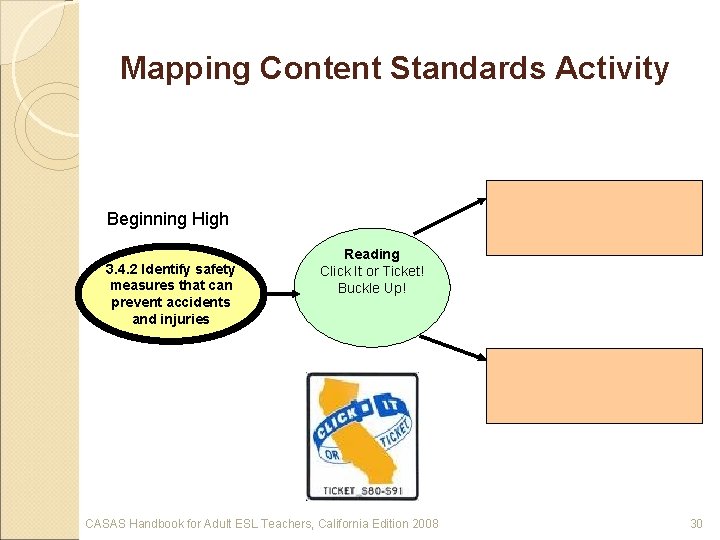
Mapping Content Standards Activity Beginning High 3. 4. 2 Identify safety measures that can prevent accidents and injuries Reading Click It or Ticket! Buckle Up! CASAS Handbook for Adult ESL Teachers, California Edition 2008 30
Think About It What are two or three things that caught your attention in this section? How can you use CASAS Competencies? How can you use Task Areas? How can you use Content Standards? 10 CASAS Handbook for Adult ESL Teachers, California Edition 2008 31
What is the process for student registration? What is the process for student orientation? What is the process for placement? SECTION 4 REGISTRATION, ORIENTATION, AND PLACEMENT 11 CASAS Handbook for Adult ESL Teachers, California Edition 2008 32
Registration and Placement CASAS Handbook for Adult ESL Teachers, California Edition 2008 33
Gather the Information Locate a registration form that your site uses and place it in this handbook. ◦ Is it a fill-in form, bubble-in or online form? ◦ If you register students in your class, what parts of the registration form are you responsible for? What’s the process after you register a student? 12 CASAS Handbook for Adult ESL Teachers, California Edition 2008 34
Ask a Supervisor or Lead Teacher Where do students go to register at your site? When can they register? What type of appraisal is given? Who gives the appraisal? Who determines class placement for each student? How is class placement determined? 12 CASAS Handbook for Adult ESL Teachers, California Edition 2008 35
Orientation and Goal Setting When is student orientation at your site? Are there orientation materials available for you to use? If so, where are they located? Place a master set in this packet for your reference. What goal setting activities are conducted in your program? What goal setting activities do you plan to use with your class? 12 CASAS Handbook for Adult ESL Teachers, California Edition 2008 36
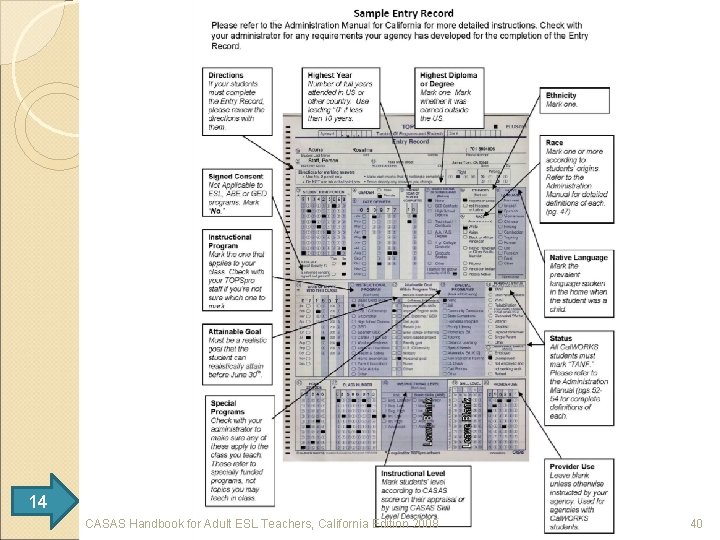
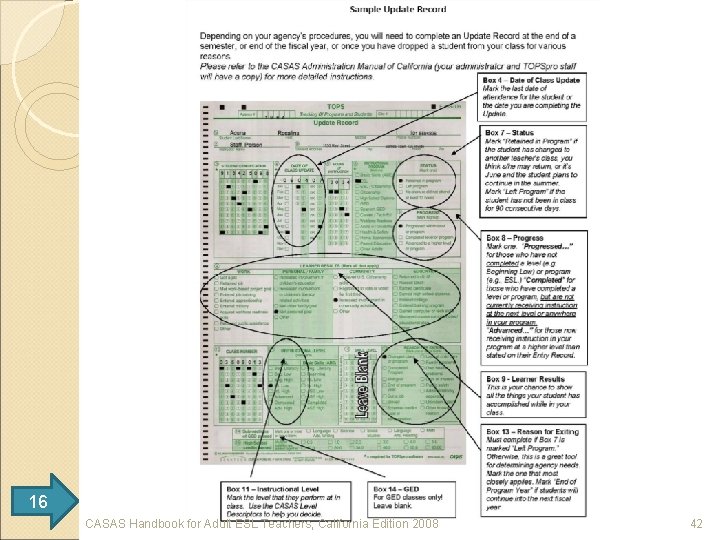
What is an Entry Record? What is an Update Record? SECTION 5 ACCOUNTABILITY 13 CASAS Handbook for Adult ESL Teachers, California Edition 2008 37
CDE Requires… All students in WIA Title II programs who have accumulated 12 or more hours must have ◦ ◦ An Entry Record An Update Record A Pretest A Post-Test (after a sufficient number of hours) 13 CASAS Handbook for Adult ESL Teachers, California Edition 2008 38
Ask a Supervisor or Lead Teacher At your site, are teachers required to fill out the Entry Record form? ◦ If not, who completes it? ◦ When must it be completed? 13 CASAS Handbook for Adult ESL Teachers, California Edition 2008 39
14 CASAS Handbook for Adult ESL Teachers, California Edition 2008 40
Ask a Supervisor or Lead Teacher Are Update Records automatically generated for your dropped students or do you need to request them? If you need to request them, from whom do you request them? List three ways you know if your students have reached their personal, family and/or academic goals? 15 CASAS Handbook for Adult ESL Teachers, California Edition 2008 41
16 CASAS Handbook for Adult ESL Teachers, California Edition 2008 42
Why do we collect this information? Helps determine targeted instruction Promotes program improvement Provides required data for state and federal reporting CASAS Handbook for Adult ESL Teachers, California Edition 2008 43
What is CASAS testing and what is my responsibility? SECTION 6 CASAS TESTING 17 CASAS Handbook for Adult ESL Teachers, California Edition 2008 44
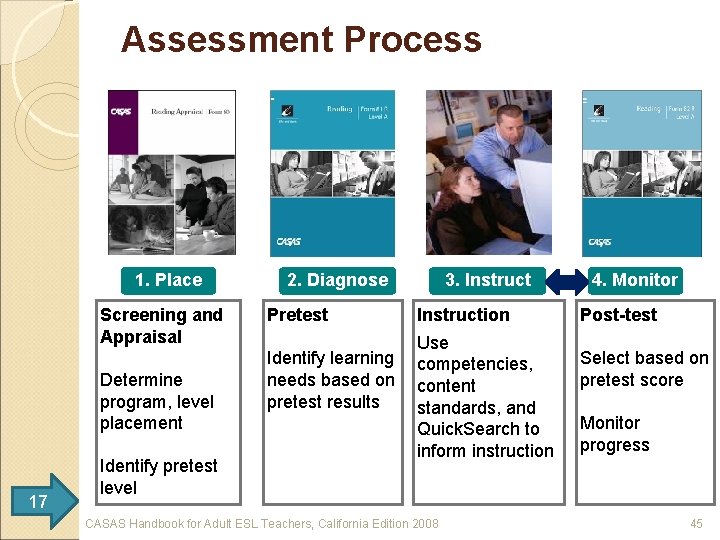
Assessment Process 1. Place Screening and Appraisal Determine program, level placement 17 Identify pretest level 2. Diagnose Pretest 3. Instruction Use Identify learning competencies, needs based on content pretest results standards, and Quick. Search to inform instruction CASAS Handbook for Adult ESL Teachers, California Edition 2008 4. Monitor Post-test Select based on pretest score Monitor progress 45
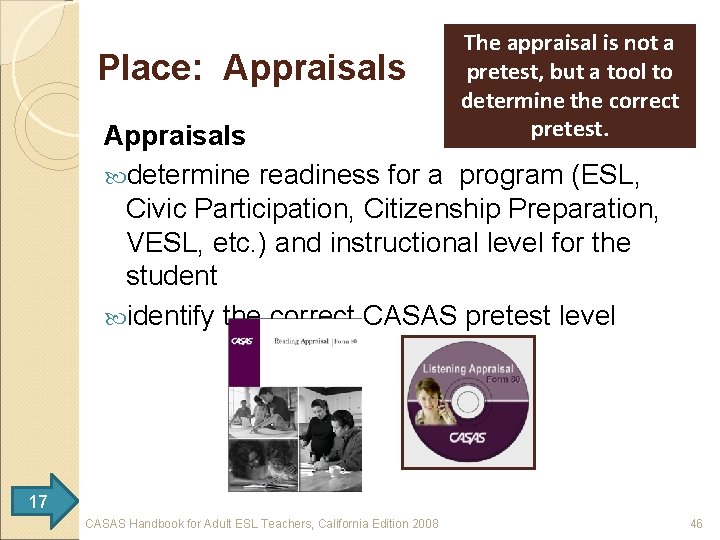
Place: Appraisals The appraisal is not a pretest, but a tool to determine the correct pretest. Appraisals determine readiness for a program (ESL, Civic Participation, Citizenship Preparation, VESL, etc. ) and instructional level for the student identify the correct CASAS pretest level 17 CASAS Handbook for Adult ESL Teachers, California Edition 2008 46
Diagnose: Pretests The pretest is given upon entry 17 into the program. “Pretest” denotes the first CASAS test administered to students after an appraisal. The pretest measures what a student knows at the beginning of your class. The results of the pretest help determine the learning needs of your students and help guide CASAS Handbook for Adult ESL Teachers, California Edition 2008 instruction. 47
Instruction is guided by test results Test Result Reports can provide: ◦ ◦ Skill level Competencies attained Competencies to attain Suggested next test Quick. Search Online ◦ Provides information on where to find curriculum materials that correlate to targeted CASAS Competencies. 18 CASAS Handbook for Adult ESL Teachers, California Edition 2008 48
Monitor: Post-Test After completing a substantial number of hours in class, you will administer a post-test (based on the State Assessment Policy. ) The Post-test will be at the same, or slightly higher difficulty level as the pre-test, and will test similar competencies as the pre-test. 18 CASAS Handbook for Adult ESL Teachers, California Edition 2008 49

Ask a Supervisor or Lead Teacher Which CASAS test series is used in your class? Where can you access the Test Administration Manual? Which skills are tested? Reading, Listening, or both? 19 CASAS Handbook for Adult ESL Teachers – California Edition 2008 50
Test Record Bubble-in the information completely Make sure information is legible Check that the test date is correct Check that the test form is written correctly AND bubbled-in correctly. 19 CASAS Handbook for Adult ESL Teachers – California Edition 2008 51
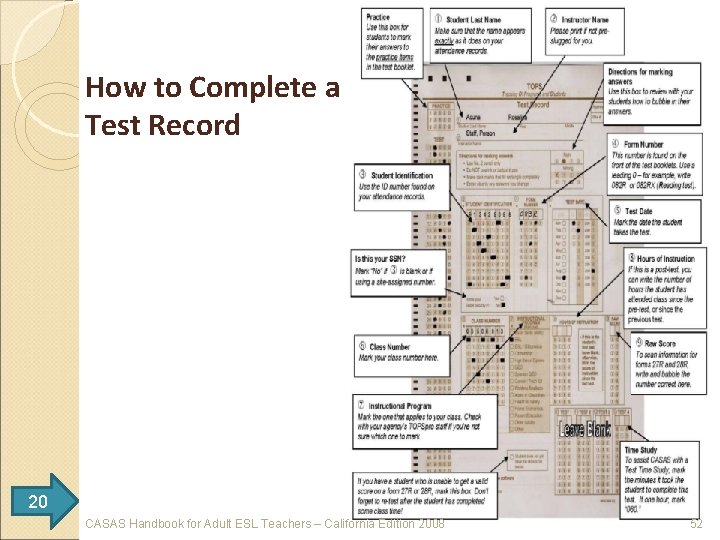
How to Complete a Test Record 20 CASAS Handbook for Adult ESL Teachers – California Edition 2008 52
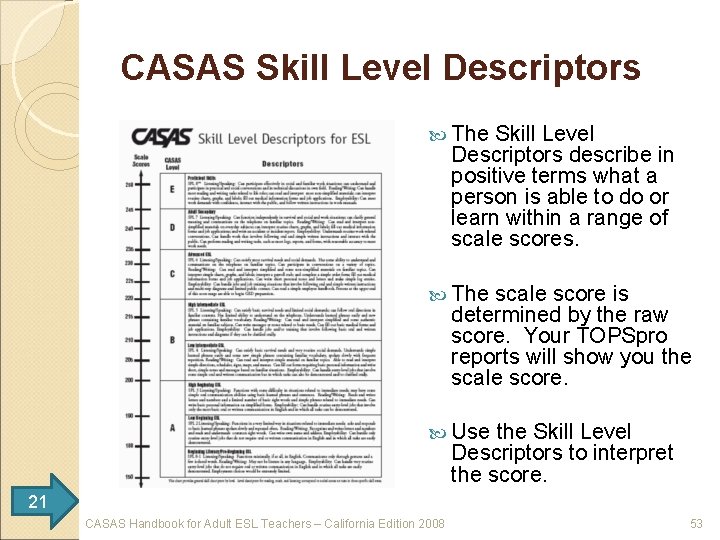
CASAS Skill Level Descriptors The Skill Level Descriptors describe in positive terms what a person is able to do or learn within a range of scale scores. The scale score is determined by the raw score. Your TOPSpro reports will show you the scale score. Use the Skill Level Descriptors to interpret the score. 21 CASAS Handbook for Adult ESL Teachers – California Edition 2008 53

CASAS Across the Levels 22 CASAS Handbook for Adult ESL Teachers – California Edition 2008 54
How do I Administer CASAS Tests? Needed for testing day Preparation for testing Getting started Give the test Test timing guidelines SECTION 7 ADMINISTRATION AND STORAGE OF TESTS 23
Needed for Testing Day � Needed for testing day: ◦ Test Administration Manual ◦ Test booklets (Number your booklets for tracking and security purposes. ) ◦ Answer sheets and #2 pencils ◦ Scratch paper for math tests ◦ A reliable CD or cassette player and the test CD or tape for listening tests ◦ Overhead of the answer sheet (optional) � Accommodations ◦ Refer to the “Guidelines for Providing Accommodations for CASAS Assessment for Learners with Disabilities” in your Test Administration Manual for alternate test forms available and for a full list of approved accommodations. 23 CASAS Handbook for Adult ESL Teachers – California Edition 2008 56
Getting Started � Provide a quiet testing room � Space students apart � Maximum of 25 learners per proctor � Explain purpose for testing � Ease student anxiety � Pass out pencils, answer sheets, and scratch paper � Assist in completing the demographic portion of the answer sheet � Demonstrate how to mark answer sheets 23 CASAS Handbook for Adult ESL Teachers – California Edition 2008 57
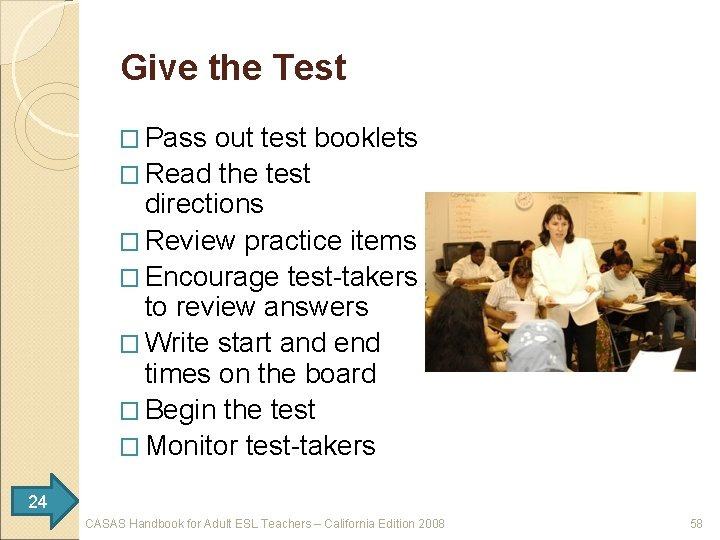
Give the Test � Pass out test booklets � Read the test directions � Review practice items � Encourage test-takers to review answers � Write start and end times on the board � Begin the test � Monitor test-takers 24 CASAS Handbook for Adult ESL Teachers – California Edition 2008 58
Timing Guidelines � Appraisals –Check the administration manual for the times allotted for each section. � Pre- and post-tests, Math and Reading - allow an hour. ◦ Allow the same amount of time for pre and post tests. � The tests are not strictly timed. ◦ Students who are not able to complete the test within the hour can be given a few extra minutes to complete the question they are working on. � For listening tests, timing is determined by the tape or CD used for the test. 24 ◦ Do not stop the tape or CD until the end of each section. CASAS Handbook for Adult ESL Teachers – California Edition 2008 59
After the Test � Collect test booklets, answer sheets, and scratch paper � Check answer sheets for completeness � Count test booklets and answer sheets � Dismiss learners � Check booklets for marks � Submit tests for scoring � Review reports for any inaccurate tests � Retest students who fall below the accurate range as soon as possible � Share results with test-takers CASAS Handbook for Adult ESL Teachers – California Edition 2008 60
Test Security All CASAS test materials including test booklets and answer sheets (which contain marks or responses) must be stored in a locked, preferably fireproof, file cabinet. After administering assessments, teachers must return all materials immediately to the program director or the director’s designees. Duplication of any part of CASAS tests is prohibited 24 CASAS Handbook for Adult ESL Teachers – California Edition 2008 61
Ask a Supervisor or Lead Teacher Where are the CASAS test booklets stored at your site? What is the check-in/check-out procedure when you take CASAS test booklets to your class? 24 CASAS Handbook for Adult ESL Teachers – California Edition 2008 62
Appraisals Pretests: How do you know which pretest to give? Scores Outside the Accuracy Range Post-tests CASAS Test Preparation Sample Test Items CASAS e. Tests SECTION 8 APPRAISALS, PRETESTS, AND POST-TESTS 25
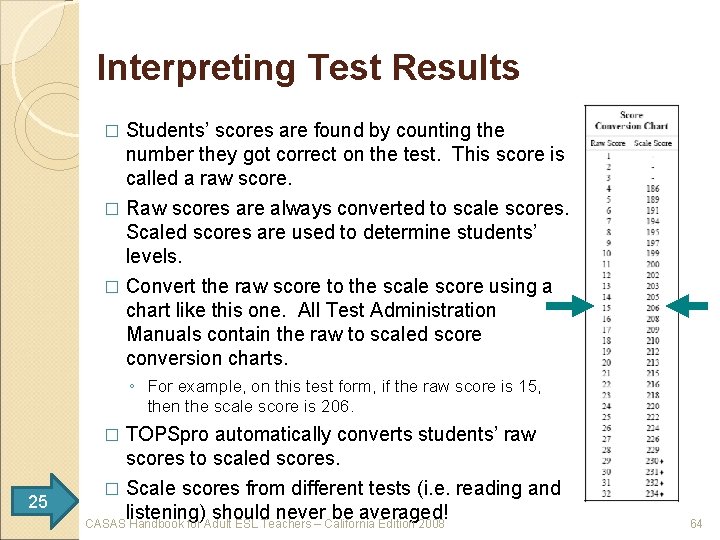
Interpreting Test Results Students’ scores are found by counting the number they got correct on the test. This score is called a raw score. � Raw scores are always converted to scale scores. Scaled scores are used to determine students’ levels. � Convert the raw score to the scale score using a chart like this one. All Test Administration Manuals contain the raw to scaled score conversion charts. � ◦ For example, on this test form, if the raw score is 15, then the scale score is 206. TOPSpro automatically converts students’ raw scores to scaled scores. � Scale scores from different tests (i. e. reading and listening) should never be averaged! CASAS Handbook for Adult ESL Teachers – California Edition 2008 � 25 64
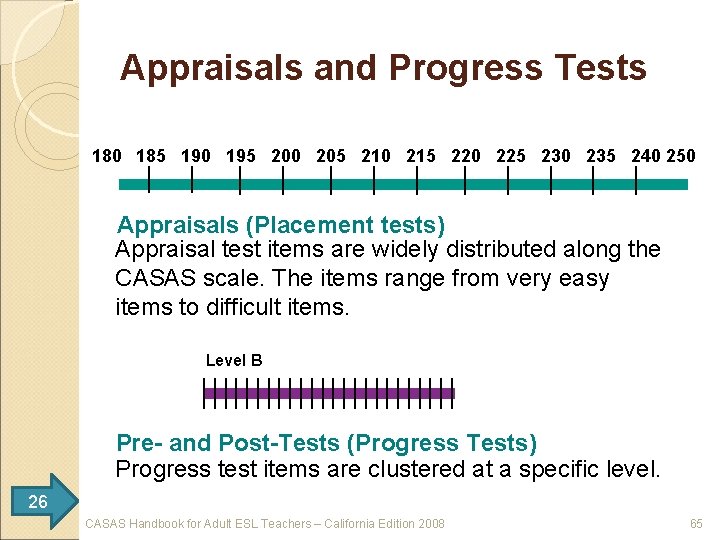
Appraisals and Progress Tests 180 185 190 195 200 205 210 215 220 225 230 235 240 250 Appraisals (Placement tests) Appraisal test items are widely distributed along the CASAS scale. The items range from very easy items to difficult items. Level B Pre- and Post-Tests (Progress Tests) Progress test items are clustered at a specific level. 26 CASAS Handbook for Adult ESL Teachers – California Edition 2008 65
Pretests should be administered during registration or early in the instructional process Pretest results serve as a baseline to determine instructional needs 27 CASAS Handbook for Adult ESL Teachers – California Edition 2008 66
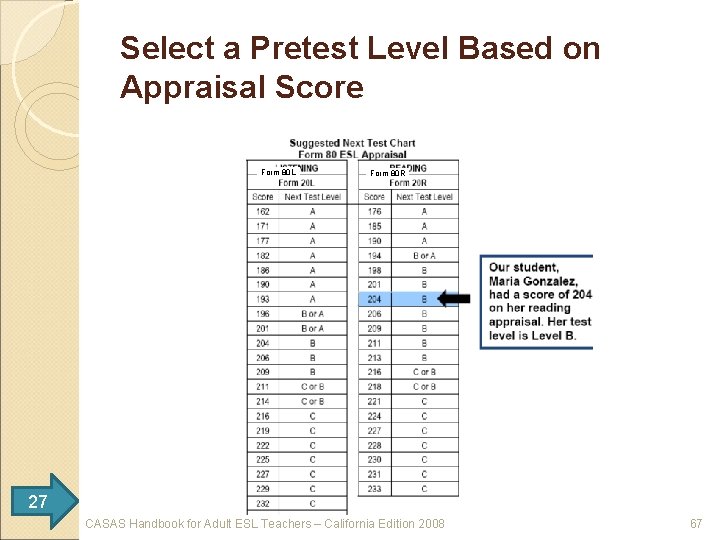
Select a Pretest Level Based on Appraisal Score Form 80 L Form 80 R 27 CASAS Handbook for Adult ESL Teachers – California Edition 2008 67
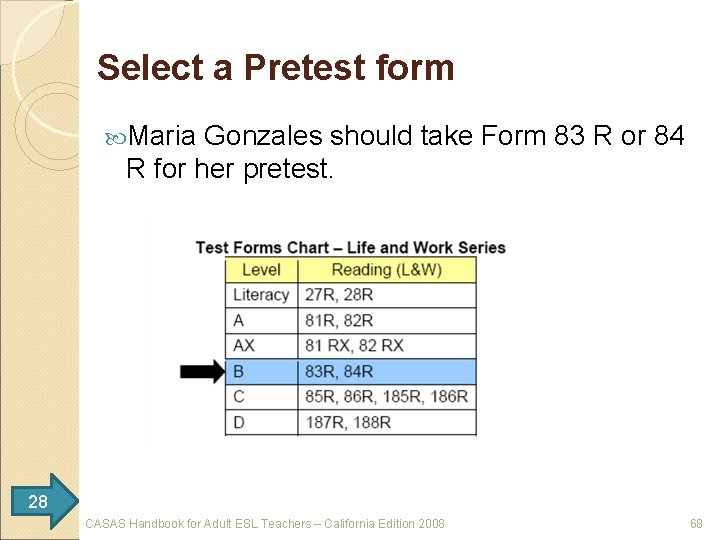
Select a Pretest form Maria Gonzales should take Form 83 R or 84 R for her pretest. 28 CASAS Handbook for Adult ESL Teachers – California Edition 2008 68
Ask a Supervisor or Lead Teacher When is the pretest given at your site? If the pretest is not given at the time of registration, when are you instructed to give the pretest in class? Who is responsible for determining which post-test to give each student? 28 CASAS Handbook for Adult ESL Teachers – California Edition 2008 69
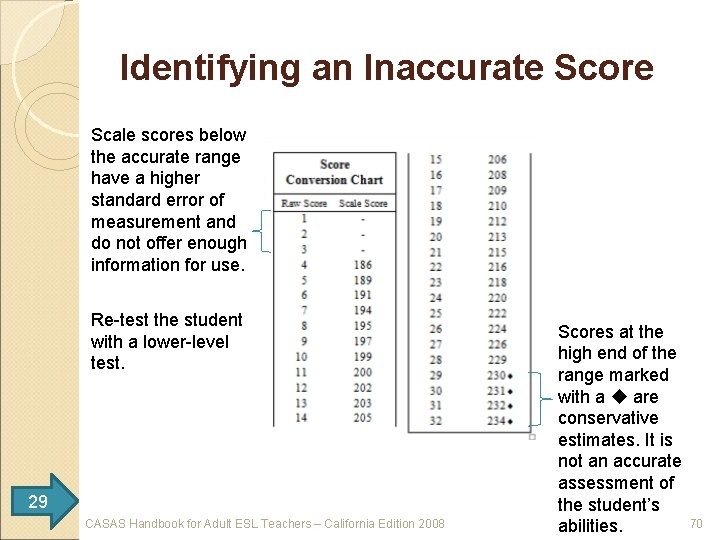
Identifying an Inaccurate Score Scale scores below the accurate range have a higher standard error of measurement and do not offer enough information for use. Re-test the student with a lower-level test. 29 CASAS Handbook for Adult ESL Teachers – California Edition 2008 Scores at the high end of the range marked with a are conservative estimates. It is not an accurate assessment of the student’s 70 abilities.
Post-Test Overview � Use Suggested Next Test Report or Score Conversion Chart to select post-test form. � Administer post-test after approximately 70 to 100 hours of instruction or when your program has determined it is appropriate to post-test. � Average expected gains after 70 to 100 hours of instruction: 29 ◦ Five points at lower levels (scale score of 210 and below) ◦ Three points at upper levels (scale score of 211 and CASAS Handbook for Adult ESL Teachers – California Edition 2008 above) 71
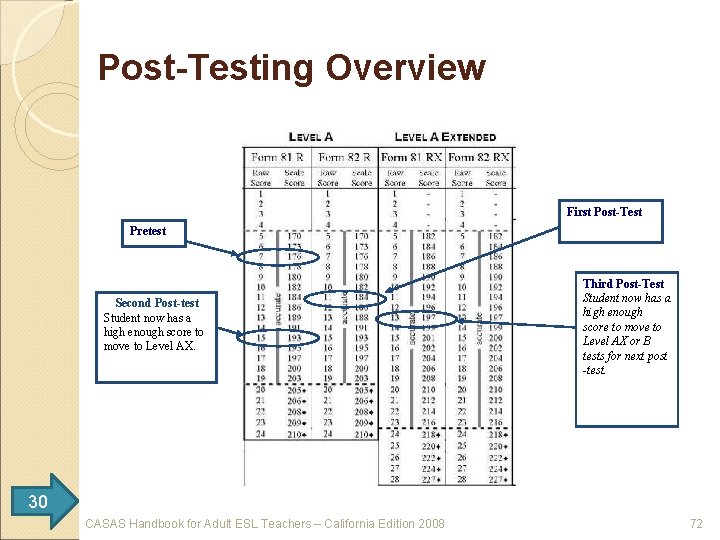
Post-Testing Overview First Post-Test Pretest Second Post-test Student now has a high enough score to move to Level AX. Third Post-Test Student now has a high enough score to move to Level AX or B tests for next post -test. 30 CASAS Handbook for Adult ESL Teachers – California Edition 2008 72
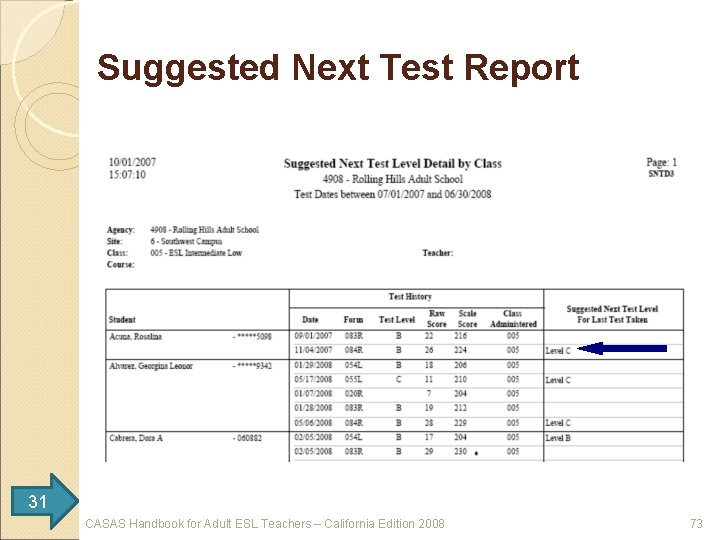
Suggested Next Test Report 31 CASAS Handbook for Adult ESL Teachers – California Edition 2008 73
Ask a Supervisor or Lead Teacher Who is responsible for determining which 31 post-test to give to each student? If the post-test is administered in your class, when are you instructed to give it? Does your site have a testing calendar? If so, get a copy and place it in this handbook. About how often do you post test your students? (Every quarter, before major holidays, etc. ) What can you do to ensure that students who are absent during post-testing eventually get CASAS Handbook for Adult ESL Teachers – California Edition 2008 74 tested?
Assessment Process Summary �Use Oral Screening (ESL/ELL only) �Administer appraisal �Use Suggested Next Test chart to select pretest �Administer pretest �Use test results to inform instruction about students’ needs �After appropriate number of hours spent in instruction, use Suggested Next Test chart to select post-test �Administer post-test CASAS Handbook for Adult ESL Teachers – California Edition 2008 75
Test Preparation Guidelines No entity (individual, school, program or business enterprise) may use or copy displays, questions, or answers that appear on any CASAS test to create materials to teach or to prepare students to answer CASAS test items. CASAS encourages use of the 32 Competencies, Content Standards, Quick Search Online, and other materials to link assessment, curriculum, and instruction. CASAS Handbook for Adult ESL Teachers – California Edition 2008 76
Test Preparation Guidelines Appropriate Strategies ◦ Use diagnostic information from test results (TOPSpro or manually) to “teach to”: Task Areas CASAS Competencies Content Standards ◦ Use other CASAS support materials to link assessment, curriculum, and instruction (Quick Search) 32 ◦ Use CASAS answer sheets to practice test-taking skills CASAS Handbook for Adult ESL Teachers – California Edition 2008 77
Test Preparation Guidelines Inappropriate Strategies ◦ Teaching to a particular test item ◦ Teaching specific vocabulary in a test item ◦ Limiting curriculum to what the test covers 32 CASAS Handbook for Adult ESL Teachers – California Edition 2008 78
CASAS Sample Test Items � An instructional tool to: ◦ Familiarize students and teachers with CASAS format ◦ Practice test taking skills using sample test items ◦ Practice marking the answer sheet �Can use TOPSpro Test Record � Sample test items for Levels A, B, and C ◦ Life and Work Reading ◦ Life Skills Listening � 5 to 6 test items per level for each skill area � Not a predictor of performance � Download at no cost from the CASAS Web site at www. casas. org. 33 CASAS Handbook for Adult ESL Teachers – California Edition 2008 79
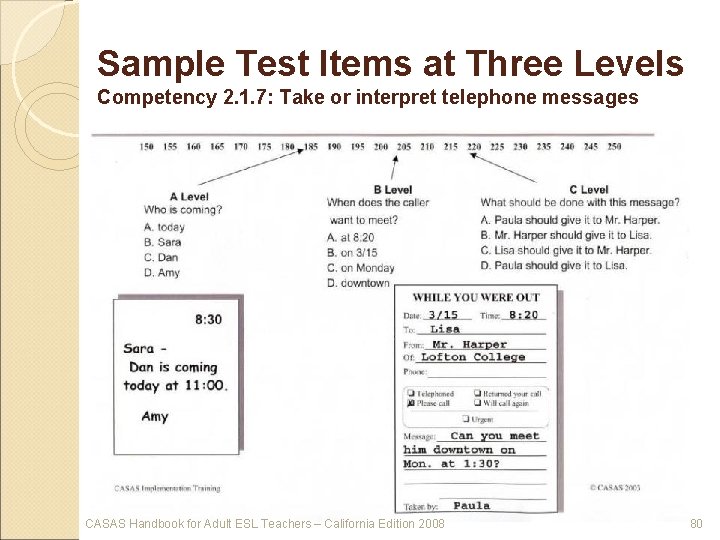
Sample Test Items at Three Levels Competency 2. 1. 7: Take or interpret telephone messages CASAS Handbook for Adult ESL Teachers – California Edition 2008 80
Gather the Information Practice Taking Sample Test Items In your group, identify the task area of each question. 33 CASAS Handbook for Adult ESL Teachers – California Edition 2008 81
CASAS e. Tests � Eliminates the need for test booklets or answer sheets � Can be given individually or to a group � Retains demographic data across all tests � Provides immediate access to test results � Selects next test automatically � Exports data to TOPSpro 34 Note: Administration procedures for CASAS e. Tests are different from those of CASAS paperand-pencil tests. CASAS Handbook for Adult ESL Teachers – California Edition 2008 82
Tie it Together How is what you’ve read about Appraisal and pre- and post-testing similar to what you’re already doing? What are some of the challenges you face with the testing process? What are some ways you can improve the testing process in your classroom or agency? 34 CASAS Handbook for Adult ESL Teachers – California Edition 2008 83
How do I use test results to guide instruction? How do I share test results with my students? Practice Activity CASAS Quick. Search Online Multiple measures of documenting student progress SECTION 9: USING TEST RESULTS 35
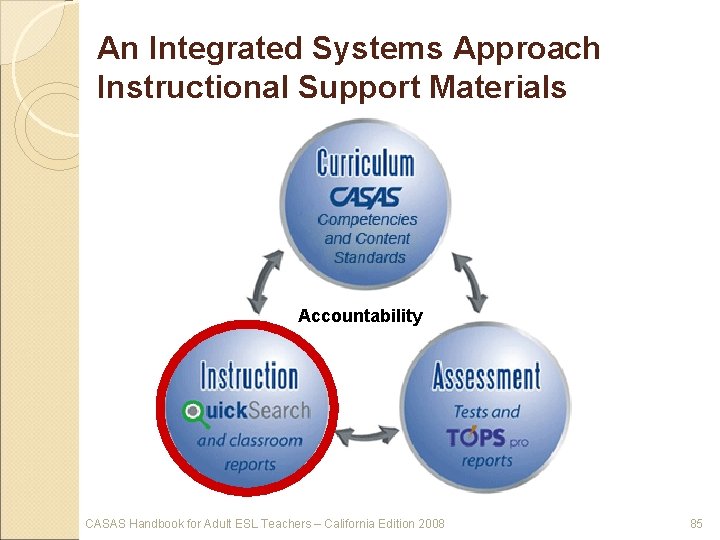
An Integrated Systems Approach Instructional Support Materials Accountability CASAS Handbook for Adult ESL Teachers – California Edition 2008 85
Key Component: Instruction TOPSpro Reports ◦ Provide diagnostic reports for teachers and learners Quick Search ◦ Helps identify effective instructional materials Teacher’s Guide ◦ Assist teachers in understanding and using the CASAS system CASAS Handbook for Adult ESL Teachers – California Edition 2008 86
Using Test Results Identify students’ instructional needs Choose competencies and Content Standards to target instruction Use Quick Search software to locate instructional materials 35 CASAS Handbook for Adult ESL Teachers – California Edition 2008 87
Ask a Supervisor or Lead Teacher Who provides you with TOPSpro reports? Name: ______________ Phone: ______________ Email: _______________ When do you receive them? 35 CASAS Handbook for Adult ESL Teachers – California Edition 2008 88
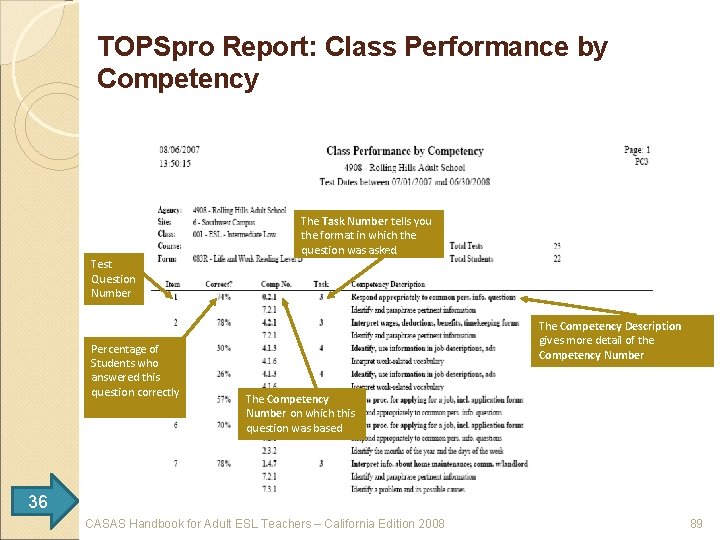
TOPSpro Report: Class Performance by Competency The Task Number tells you the format in which the question was asked. Test Question Number Percentage of Students who answered this question correctly The Competency Description gives more detail of the Competency Number The Competency Number on which this question was based 36 CASAS Handbook for Adult ESL Teachers – California Edition 2008 89
Competency Reports Identify two competencies that this particular teacher should focus on. The task area shows how an item is presented. What is the task area for item #3? 36 CASAS Handbook for Adult ESL Teachers – California Edition 2008 90
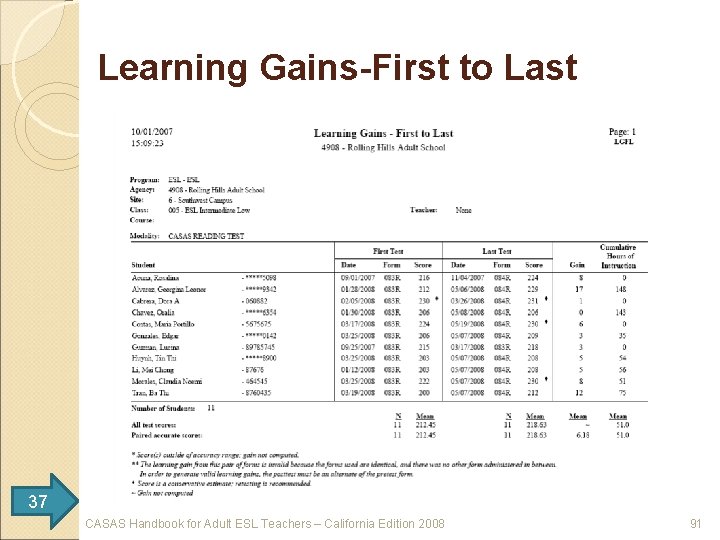
Learning Gains-First to Last 37 CASAS Handbook for Adult ESL Teachers – California Edition 2008 91
Learning Gains – First to Last What was the point gain between Maria Costas’ pretest and post-test? How will you use information about student gains? How can you use information about individual student scale scores for instruction? 37 CASAS Handbook for Adult ESL Teachers – California Edition 2008 92
Sharing Test Results How do you share test results with your students? ◦ Do you have students track their progress? How? What are some reasons to share results with students? 38 CASAS Handbook for Adult ESL Teachers – California Edition 2008 93
Handbook Page 38 Tie It Together How does this information relate to what you’re already doing? What are some of the challenges you face with using test results? What are some ways you can improve the process for getting and interpreting test results in your classroom or agency? 38 CASAS Handbook for Adult ESL Teachers – California Edition 2008 94
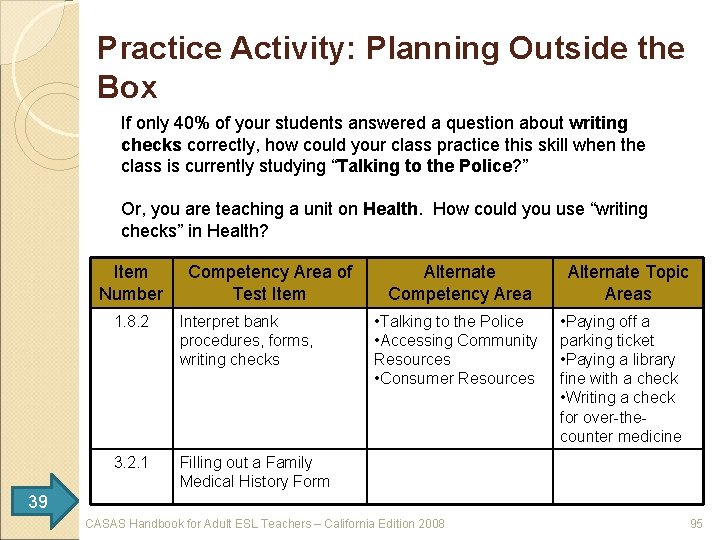
Practice Activity: Planning Outside the Box If only 40% of your students answered a question about writing checks correctly, how could your class practice this skill when the class is currently studying “Talking to the Police? ” Or, you are teaching a unit on Health. How could you use “writing checks” in Health? Item Number Competency Area of Test Item 1. 8. 2 Interpret bank procedures, forms, writing checks 3. 2. 1 Filling out a Family Medical History Form Alternate Competency Area • Talking to the Police • Accessing Community Resources • Consumer Resources Alternate Topic Areas • Paying off a parking ticket • Paying a library fine with a check • Writing a check for over-thecounter medicine 39 CASAS Handbook for Adult ESL Teachers – California Edition 2008 95
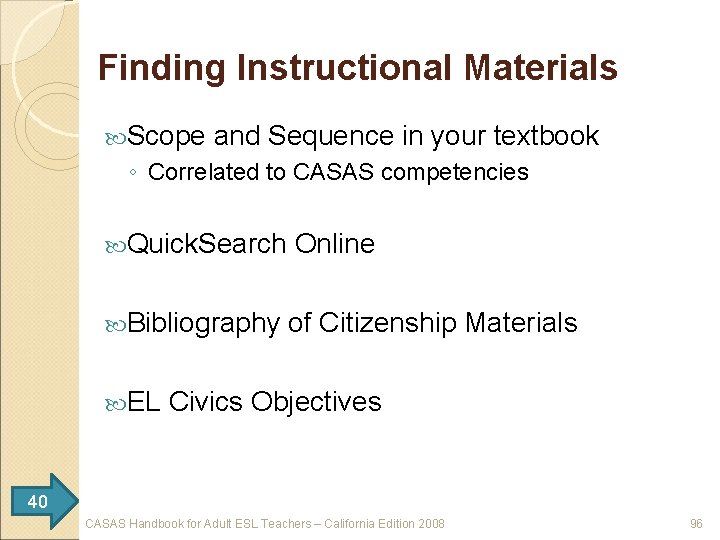
Finding Instructional Materials Scope and Sequence in your textbook ◦ Correlated to CASAS competencies Quick. Search Online Bibliography of Citizenship Materials EL Civics Objectives 40 CASAS Handbook for Adult ESL Teachers – California Edition 2008 96
Gather the Information Which core text series do you use? What level? Is there a “Scope and Sequence” section? ◦ On what page can it be found? ◦ List two ways you can use it 40 CASAS Handbook for Adult ESL Teachers – California Edition 2008 97
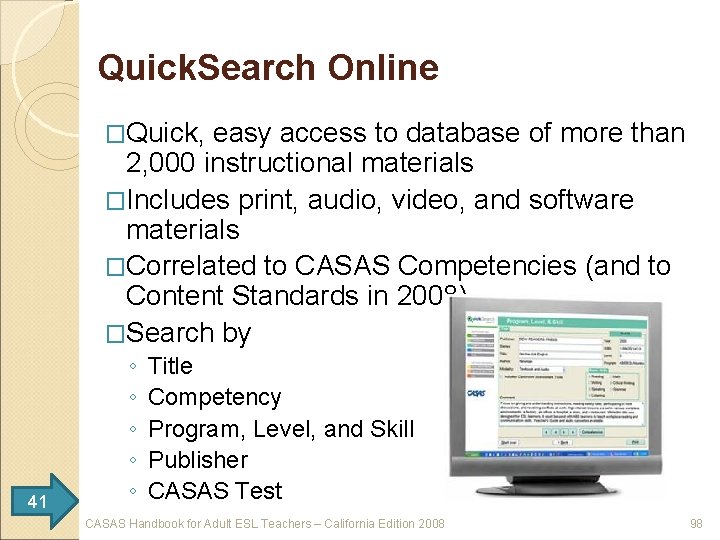
Quick. Search Online �Quick, easy access to database of more than 2, 000 instructional materials �Includes print, audio, video, and software materials �Correlated to CASAS Competencies (and to Content Standards in 2008) �Search by 41 ◦ ◦ ◦ Title Competency Program, Level, and Skill Publisher CASAS Test CASAS Handbook for Adult ESL Teachers – California Edition 2008 98
Use Quick. Search to find Resources � Leading text series’ titles are correlated by CASAS competencies, instructional level, type of learner (ESL, ABE, ASE), mode of instruction and linked within the database to selected CASAS pre- and post assessments. � Quick Searches can be done for instructional materials by: ◦ Skill area ◦ Program (including Civics, Family Literacy, Workplace) ◦ Specific CASAS assessment series, i. e. Life and Work, WLS, ECS ◦ Year of publication of instructional materials ◦ Websites for learners 41 CASAS Handbook for Adult ESL Teachers – California Edition 2008 99
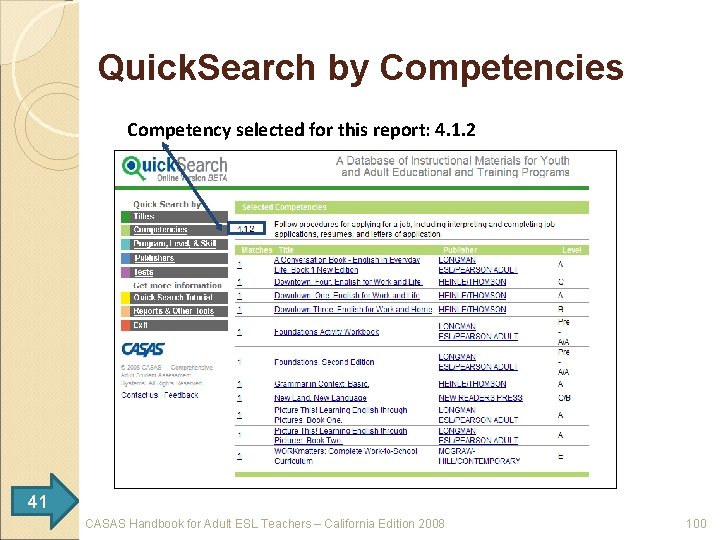
Quick. Search by Competencies Competency selected for this report: 4. 1. 2 41 CASAS Handbook for Adult ESL Teachers – California Edition 2008 100
Multiple Measures Documenting Student Progress A list or graph of CASAS test results Instructor-generated tests & quizzes Samples of student work Needs assessments Alternative (performance-based) assessments 42 CASAS Handbook for Adult ESL Teachers – California Edition 2008 101
Ask a Supervisor or Lead Teacher List two ways you monitor student progress What Student Portfolio items are required by your agency? How do you have students participate in documenting their own progress? 42 CASAS Handbook for Adult ESL Teachers – California Edition 2008 102
Training Objectives Review Basic understanding of ◦ Adult Education ESL and your agency ◦ CASAS’ role at your agency Competencies, Task Areas and Content Standards Registration, Orientation and Placement Accountability Administration and Storage of Tests Appraisals, Pre-Tests and Post-Tests Using Test Results 43 CASAS Handbook for Adult ESL Teachers – California Edition 2008 103
Thanks for your participation! CASAS Handbook for Adult ESL Teachers – California Edition 2008 104
- Slides: 104