
CAS Creativity Activity Service information summarized from IB
CAS Creativity, Activity, Service *information summarized from IB CAS guidelines
Why do we have to do CAS hours? Creativity, activity, service (CAS) is at the heart of the Diploma Program. It involves students in a range of activities alongside their academic studies
What are the requirements of CAS? 150 hours: 75 junior year, 75 senior year 25 in each category of C, A, and S for junior year and again senior year Reflections on the 7 learning outcomes Showing evidence of how you achieved outcome
What are the 3 strands of CAS? Creativity: exploring and extending ideas leading to an original or interpretive product Activity: physical exertion contributing to a healthy lifestyle Service: collaborative and reciprocal engagement with the community in response to an authentic need
For student development to occur, CAS should involve: Real, purposeful activities, with significant outcomes Personal challenge, tasks must extend the student Thoughtful consideration, such as planning, reviewing progress and reporting Reflection on outcomes and personal learning
The CAS program aims to develop students who are: Reflective thinkers Aware of themselves as members of communities with responsibilities towards each other and the environment Active participants in sustained, collaborative projects Balanced—they enjoy and find significance in a range of activities involving intellectual, physical, creative and emotional experiences
7 Learning Outcomes Students will: Identify their own strengths and developed areas for growth Demonstrate that challenges have been undertaken, developing new skills in the process Demonstrate how to plan and initiate a CAS experience Demonstrate the skills and recognized the benefits of working collaboratively
7 Learning Outcomes continued… Show perseverance and commitment in CAS experiences Demonstrate engagement with issues of global importance Recognize and consider the ethical implications of actions
Evidence of all seven outcomes must be present for a student to complete the CAS requirement. Some may be demonstrated many times, in a variety of activities, but completion requires only that there is some evidence for every learning outcome.
CAS Project: Purpose- ensure participation in sustained collaboration- at least 1 month in duration Discover the benefits of teamwork and of achievements realized through an exchange of ideas and abilities Challenge students to show initiative, demonstrate perseverance, and develop skills such as those of cooperation, problem-solving and decision-making
CAS Project continued… Involves collaboration between a group of students (3 or more) with members of the wider community A CAS project offers students the opportunity to be responsible for, or to initiate, a part of or the entire CAS project
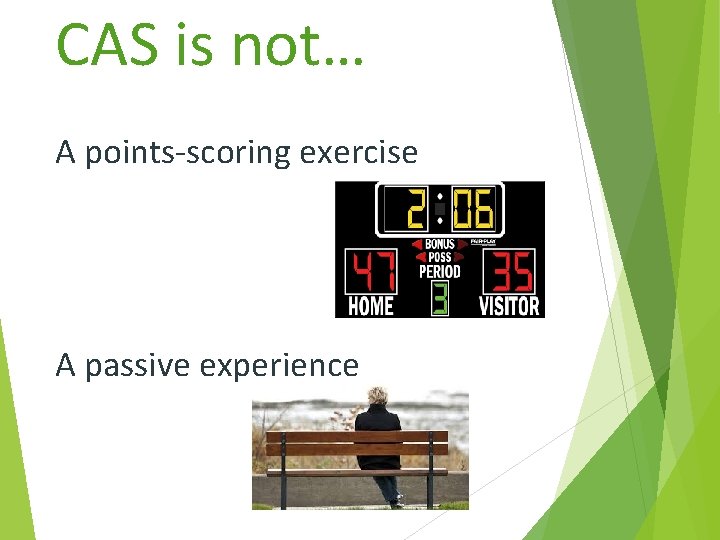
CAS is not… A points-scoring exercise A passive experience
Examples of activities which do not count for CAS: Any activity or project which is already part of the student’s Diploma Program Any activity for which a student is personally rewarded either financially or with some other benefit A passive pursuit, such as a visit to a museum, theatre, art exhibition, concert or sports event All forms of duty within the family
Other Activities that do not Count for CAS: An activity where there is no leader or responsible adult on site to evaluate and confirm student performance Religious activity which can be interpreted as proselytizing or activity involving church or Bible study where scripture is taught Activity which can cause division amongst different groups
Needed for each CAS activity Reflections Supervisor Verification Supporting Photo

- Slides: 19