
Cartoons How Cartoons have Changed Since their Beginnings
Cartoons How Cartoons have Changed Since their Beginnings By: Ryan
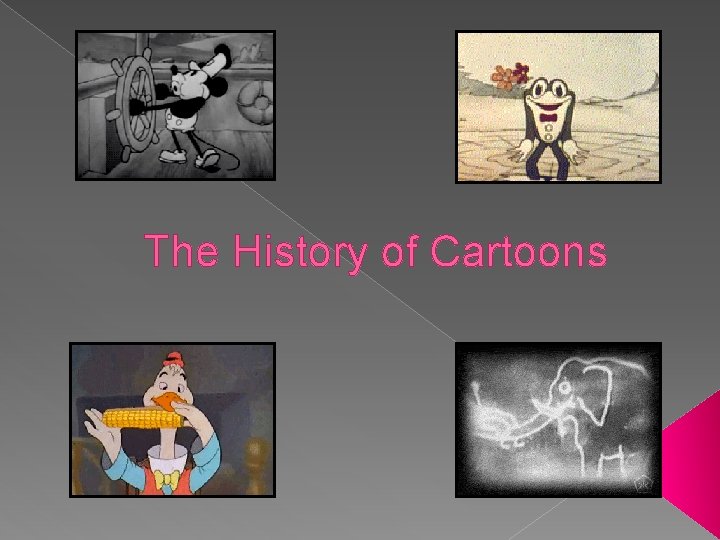
The History of Cartoons
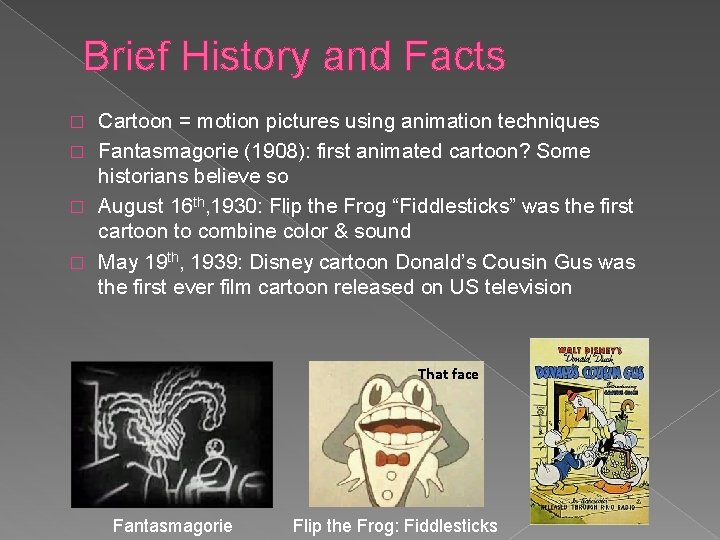
Brief History and Facts Cartoon = motion pictures using animation techniques � Fantasmagorie (1908): first animated cartoon? Some historians believe so � August 16 th, 1930: Flip the Frog “Fiddlesticks” was the first cartoon to combine color & sound � May 19 th, 1939: Disney cartoon Donald’s Cousin Gus was the first ever film cartoon released on US television � That face Fantasmagorie Flip the Frog: Fiddlesticks
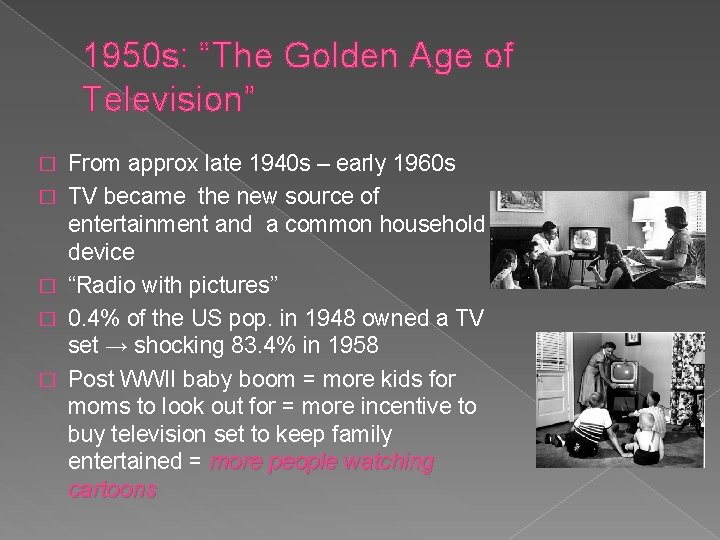
1950 s: “The Golden Age of Television” � � � From approx late 1940 s – early 1960 s TV became the new source of entertainment and a common household device “Radio with pictures” 0. 4% of the US pop. in 1948 owned a TV set → shocking 83. 4% in 1958 Post WWII baby boom = more kids for moms to look out for = more incentive to buy television set to keep family entertained = more people watching cartoons

The Early Cartoons: Not Exactly Kid Friendly
The Racist, Censored, and Banned Cartoons started off as entertainment for adults & had little restrictions on the content that they could show � During the 30 s – 50 s, many studios such as MGM, Warner Bros. , & Walt Disney created thousands of cartoons depicting racist stereotypes, sexy, crude, & shocking content � Some of these included: alcohol, marijuana, smoking, adultery, sexual situations & gambling � Many of these cartoons were banned for their content years later �
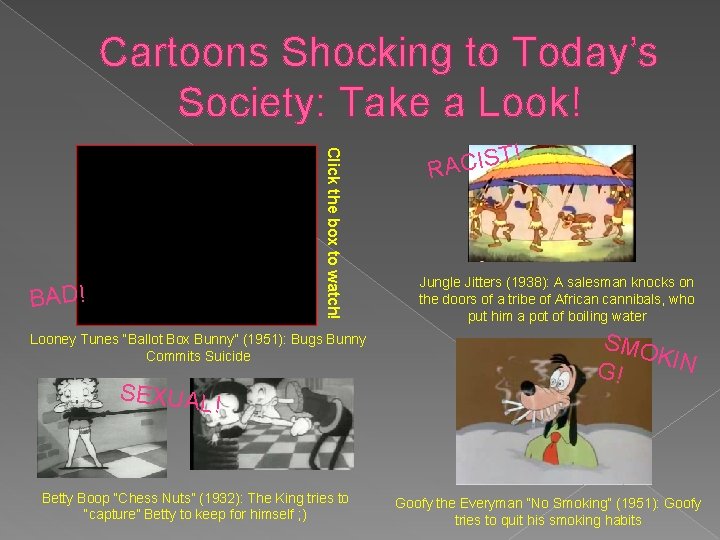
Cartoons Shocking to Today’s Society: Take a Look! Click the box to watch! BAD! Looney Tunes “Ballot Box Bunny” (1951): Bugs Bunny Commits Suicide SEXUAL ! T RACIS Jungle Jitters (1938): A salesman knocks on the doors of a tribe of African cannibals, who put him a pot of boiling water SMO KIN G! ! Betty Boop “Chess Nuts” (1932): The King tries to “capture” Betty to keep for himself ; ) Goofy the Everyman “No Smoking” (1951): Goofy tries to quit his smoking habits
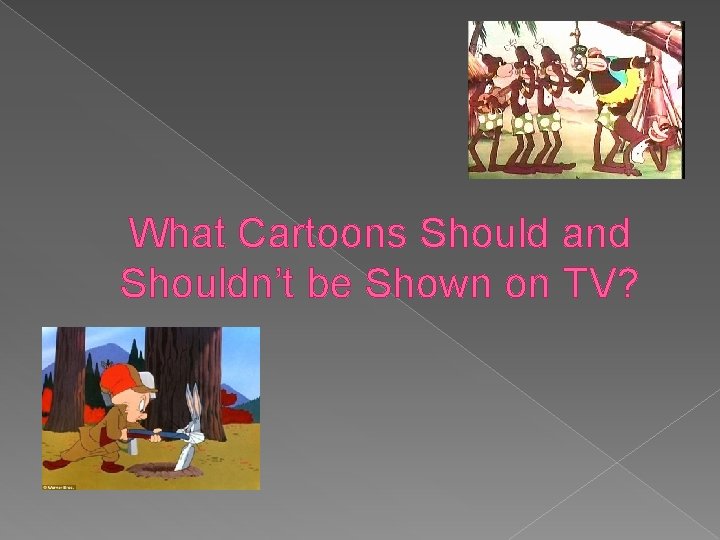
What Cartoons Should and Shouldn’t be Shown on TV?
1950 s Television Regulations March 1 st, 1952: National Association of Radio and Television Broadcasters (NATRB) introduced television code � Some regulations within the code: * (SUMMARY ON THE NEXT SLIDE) � � � � It is not enough that only those programs which are intended for viewing by children shall be suitable to the young and immature. Television is responsible for insuring that programs of all sorts which occur during the times of day when children may normally be expected to have the opportunity of viewing television shall exercise care in the following regards: (a) In affording opportunities for cultural growth as well as for wholesome entertainment. (b) In developing programs to foster and promote the commonly accepted moral, social, and ethical ideals characteristic of American life. (c) In reflecting respect for parents, for honorable behavior, and for the constituted authorities of the American community. (d) In eliminating reference to kidnapping of children or threats of kidnapping. (e) In avoiding material which is excessively violent or would create morbid suspense, or other undesirable reactions in children. (f) In exercising particular restraint and care in crime or mystery episodes involving children or minors *http: //historymatters. gmu. edu/d/6558/
1950 s Television Regulations cont. � Basically, content shown on television should be suitable for children and not cause undesirable reactions (ex. excessive violence) � Promote moral, social, and ethical ideals represented by the American community � In general, keep television programs in line, which includes cartoons
Connections to Other Events
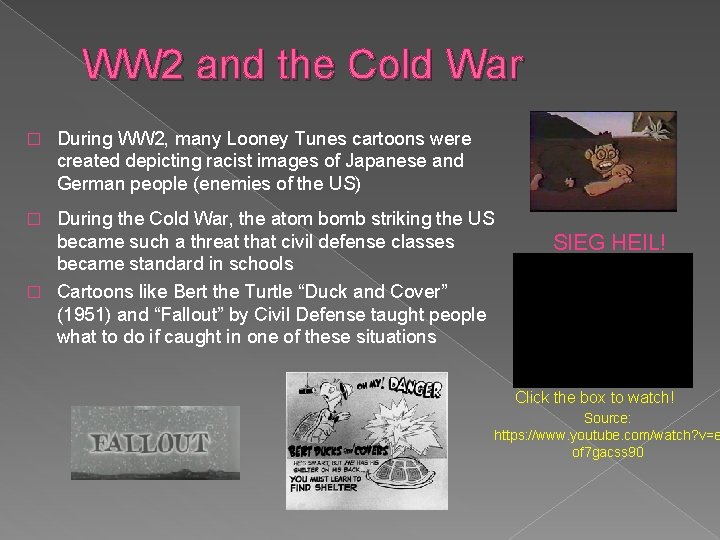
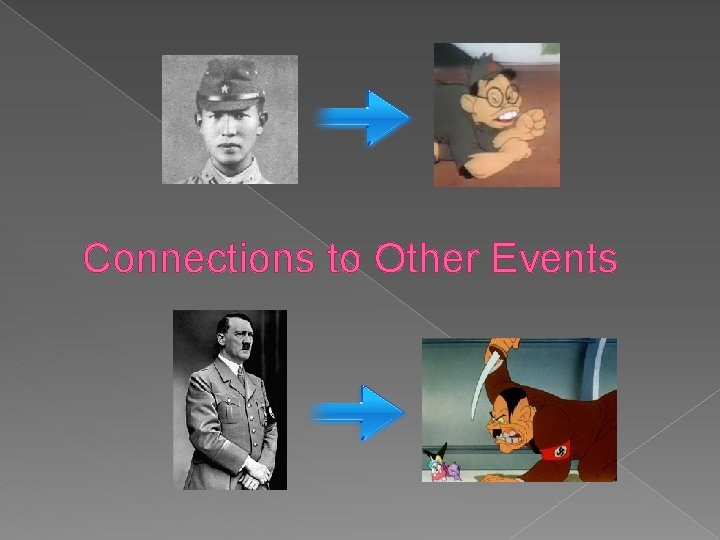
WW 2 and the Cold War � During WW 2, many Looney Tunes cartoons were created depicting racist images of Japanese and German people (enemies of the US) During the Cold War, the atom bomb striking the US became such a threat that civil defense classes became standard in schools � Cartoons like Bert the Turtle “Duck and Cover” (1951) and “Fallout” by Civil Defense taught people what to do if caught in one of these situations � SIEG HEIL! Click the box to watch! Source: https: //www. youtube. com/watch? v=e of 7 gacss 90
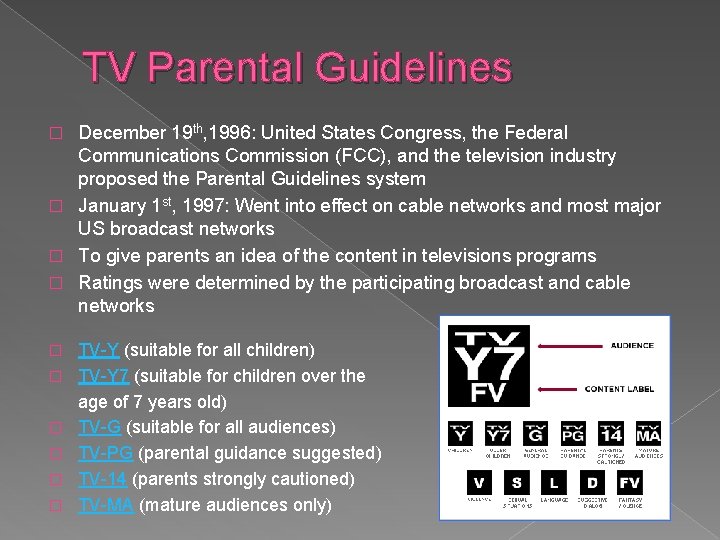
TV Parental Guidelines December 19 th, 1996: United States Congress, the Federal Communications Commission (FCC), and the television industry proposed the Parental Guidelines system � January 1 st, 1997: Went into effect on cable networks and most major US broadcast networks � To give parents an idea of the content in televisions programs � Ratings were determined by the participating broadcast and cable networks � TV-Y (suitable for all children) � TV-Y 7 (suitable for children over the age of 7 years old) � TV-G (suitable for all audiences) � TV-PG (parental guidance suggested) � TV-14 (parents strongly cautioned) � TV-MA (mature audiences only) �
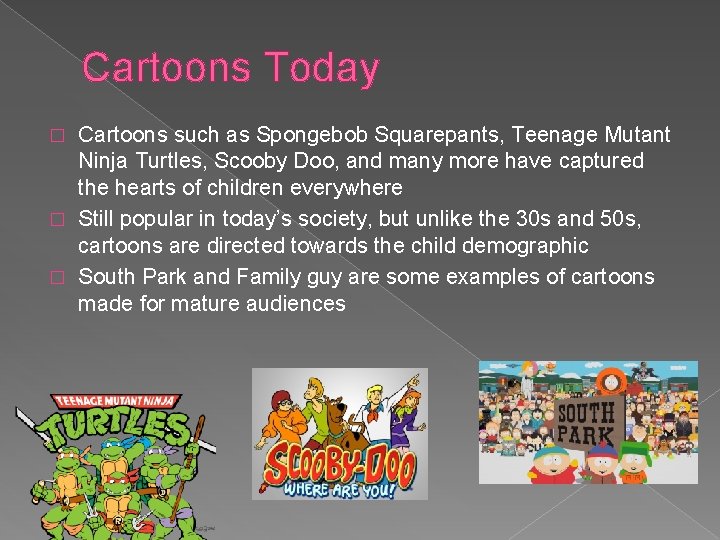
Cartoons Today Cartoons such as Spongebob Squarepants, Teenage Mutant Ninja Turtles, Scooby Doo, and many more have captured the hearts of children everywhere � Still popular in today’s society, but unlike the 30 s and 50 s, cartoons are directed towards the child demographic � South Park and Family guy are some examples of cartoons made for mature audiences �

FIN
- Slides: 15