
Cartoon Animation An Innovative Tool to Present Vaccine
- Slides: 13
Cartoon Animation: An Innovative Tool to Present Vaccine Information Marie Leiner, Ph. D. Dept of Pediatrics Texas Tech University Health Sciences Center
Behavioral modeling Most bodies of educational research argue that the passive character of a presentation, where the viewer does not have active participation, is in clear opposition to learning
Behavioral modeling Some studies show substantial effects on learning from television programs, motion pictures, or from watching an educational videotape where the viewer does not play an active role
Social Learning Theory Behavioral modeling or role modeling is based on social learning theory and states that a person may gather ideas, values and situations by watching others and learning from those experiences
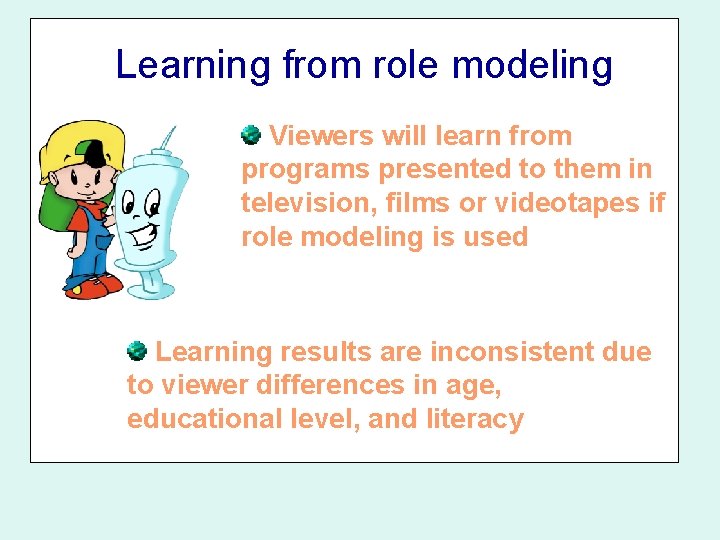
Learning from role modeling Viewers will learn from programs presented to them in television, films or videotapes if role modeling is used Learning results are inconsistent due to viewer differences in age, educational level, and literacy
There is a need to develop tools that reduce or eliminate these disparities in order to allow all viewers to learn in the same way
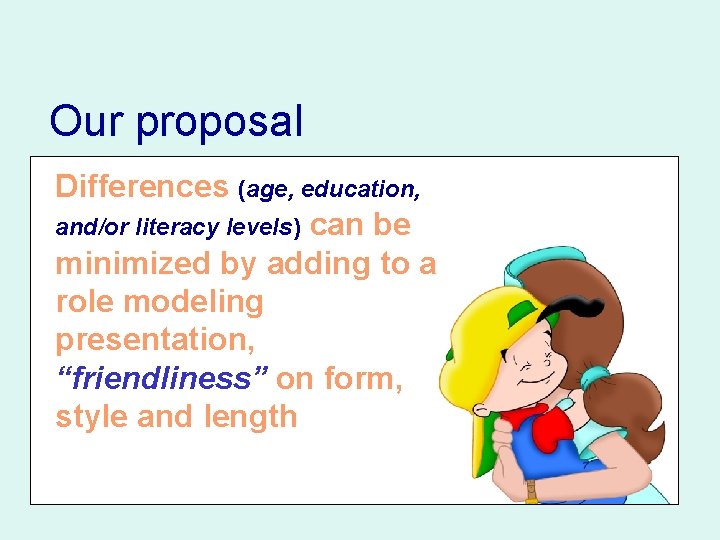
Our proposal Differences (age, education, and/or literacy levels) can be minimized by adding to a role modeling presentation, “friendliness” on form, style and length
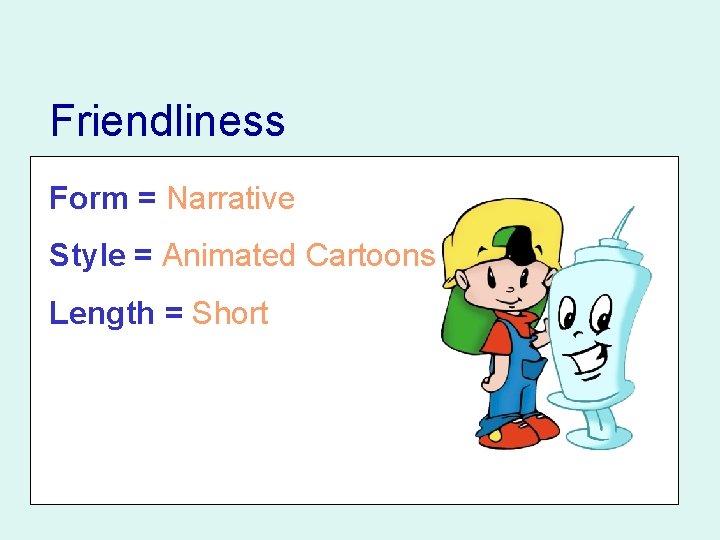
Friendliness Form = Narrative Style = Animated Cartoons Length = Short
Study Participants: Parents/caretakers during well baby visit (N = 192) Pre-test about recall of vaccine DTa. P: Questionnaire with eight questions Randomized assignment to lobby or classroom Presentation of videotape in lobby or classroom Post-test about recall of information Questionnaire with same eight questions
Results Change in scores from Pre to Post test was significant p<. 001 Lobby average before video = 2. 62 after video = 5. 07 (N=81) Classroom average before video = 2. 67 after video = 5. 09 (N=78)
Results The amount of learning that took place in the lobby and the classroom, as measured by the change in scores (post – pre), was not statistically significantly different between education or age groups. When analyzing changes in scores (post – pre) in the lobby, we observed that there were significant differences between education groups. The parents/caretakers with college education learned the least. The average (SD) change in scores was 2. 9 (2. 9), 2. 1 (1. 8), 3. 3 (2. 7), 3. 0 (2. 0), and 0. 3 (2. 5) for the elementary, middle school, high school, technical school, and college (P=0. 05).
Results When analyzing changes in scores (post – pre) in the classroom, we observed that there were significant differences between education and age groups. The parents/caretakers with elementary education learned the least. In regards to age, the older parents learned the least. The average (SD) change in scores was 0. 5 (2. 2), 2. 9 (2. 1), 3. 2 (2. 0), 3. 3 (1. 9), and 2. 1 (1. 3) for the elementary, middle school, high school, technical school, and college (P<. 001). The average (SD) change in score was 3. 1 (1. 7), 2. 7 (1. 8), 2. 1 (2. 5), 2. 6 (2. 3), 0. 3 (0. 6), and 0(3. 1) for the 18 -22, 23 -27, 28 -32, 33 -37, 38 -42 and >43 age groups respectively (P=0. 02).
Conclusions We added “friendliness” to a role modeling production by including form (narrative), style (animated cartoons) and length (short) to overcome differences in viewers’ age, and educational level. The results showed that parent/caretakers learned from our enhanced role modeling production. Learning occurred best in the lobby in the middle of intense traffic for all ages and for most educational levels (college was the exception with no change). Classroom settings may not be the best option to present educational material to older and/or uneducated viewers.