
Cartesian Product The ordered ntuple a 1 a
- Slides: 26
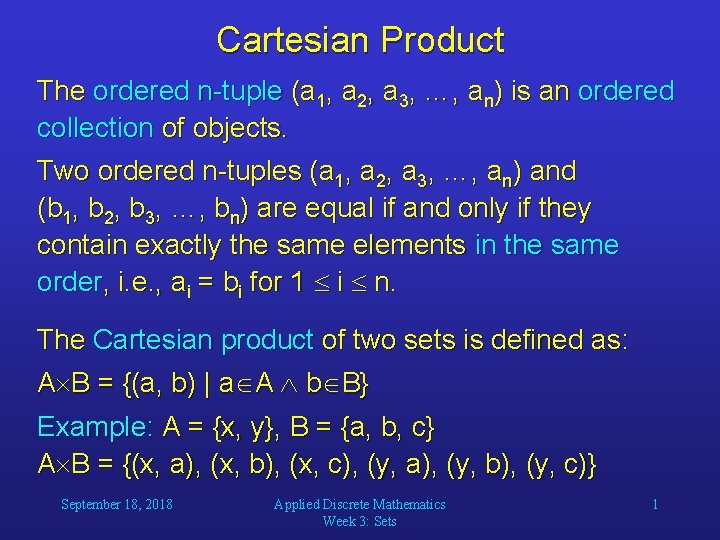
Cartesian Product The ordered n-tuple (a 1, a 2, a 3, …, an) is an ordered collection of objects. Two ordered n-tuples (a 1, a 2, a 3, …, an) and (b 1, b 2, b 3, …, bn) are equal if and only if they contain exactly the same elements in the same order, i. e. , ai = bi for 1 i n. The Cartesian product of two sets is defined as: A B = {(a, b) | a A b B} Example: A = {x, y}, B = {a, b, c} A B = {(x, a), (x, b), (x, c), (y, a), (y, b), (y, c)} September 18, 2018 Applied Discrete Mathematics Week 3: Sets 1
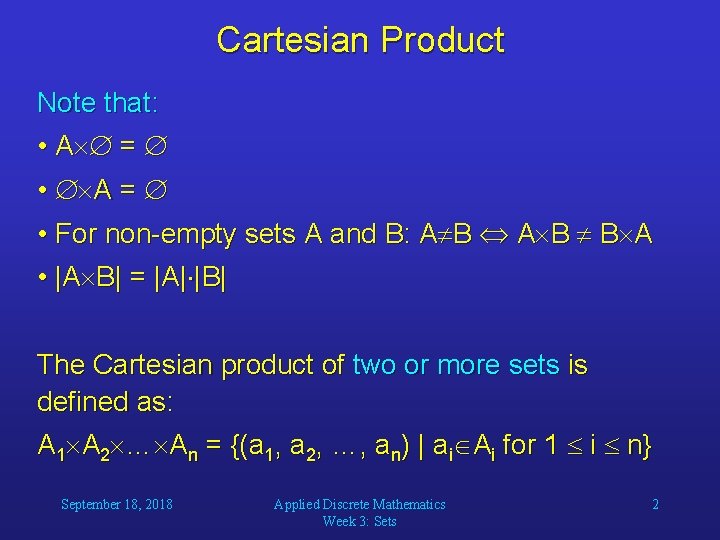
Cartesian Product Note that: • A = • A = • For non-empty sets A and B: A B B A • |A B| = |A| |B| The Cartesian product of two or more sets is defined as: A 1 A 2 … An = {(a 1, a 2, …, an) | ai Ai for 1 i n} September 18, 2018 Applied Discrete Mathematics Week 3: Sets 2
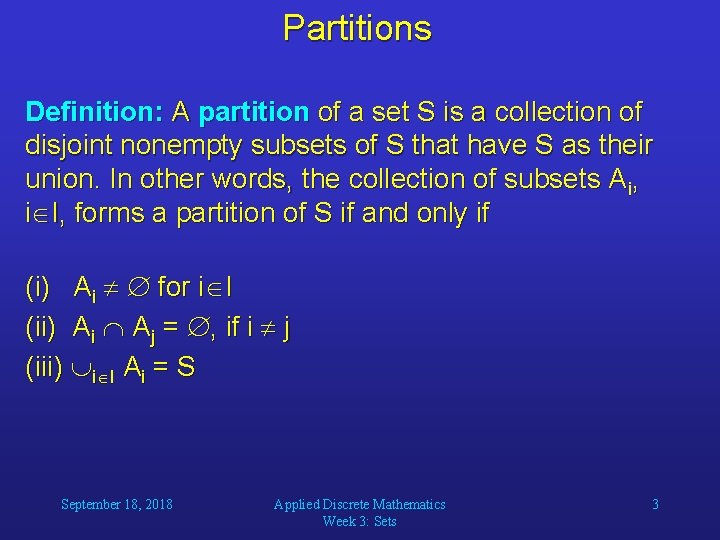
Partitions Definition: A partition of a set S is a collection of disjoint nonempty subsets of S that have S as their union. In other words, the collection of subsets Ai, i I, forms a partition of S if and only if (i) Ai for i I (ii) Ai Aj = , if i j (iii) i I Ai = S September 18, 2018 Applied Discrete Mathematics Week 3: Sets 3
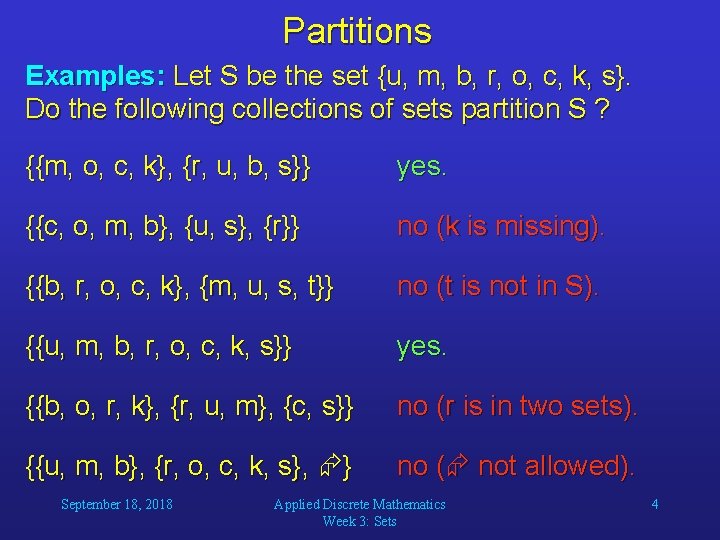
Partitions Examples: Let S be the set {u, m, b, r, o, c, k, s}. Do the following collections of sets partition S ? {{m, o, c, k}, {r, u, b, s}} yes. {{c, o, m, b}, {u, s}, {r}} no (k is missing). {{b, r, o, c, k}, {m, u, s, t}} no (t is not in S). {{u, m, b, r, o, c, k, s}} yes. {{b, o, r, k}, {r, u, m}, {c, s}} no (r is in two sets). {{u, m, b}, {r, o, c, k, s}, } no ( not allowed). September 18, 2018 Applied Discrete Mathematics Week 3: Sets 4
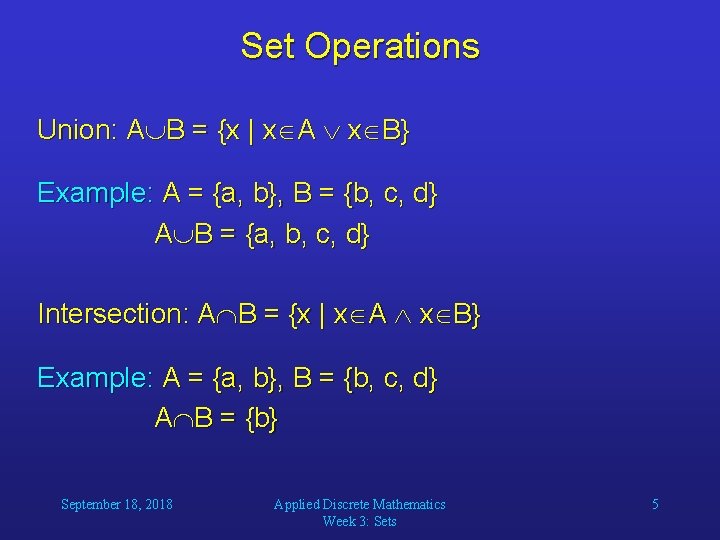
Set Operations Union: A B = {x | x A x B} Example: A = {a, b}, B = {b, c, d} A B = {a, b, c, d} Intersection: A B = {x | x A x B} Example: A = {a, b}, B = {b, c, d} A B = {b} September 18, 2018 Applied Discrete Mathematics Week 3: Sets 5
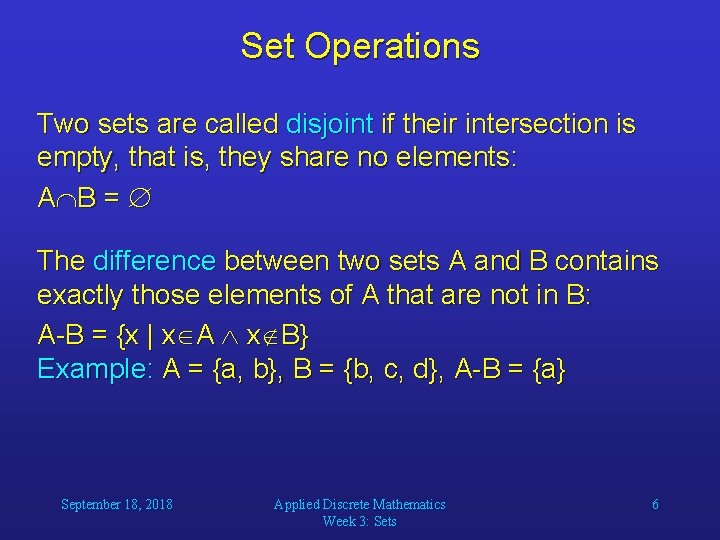
Set Operations Two sets are called disjoint if their intersection is empty, that is, they share no elements: A B = The difference between two sets A and B contains exactly those elements of A that are not in B: A-B = {x | x A x B} Example: A = {a, b}, B = {b, c, d}, A-B = {a} September 18, 2018 Applied Discrete Mathematics Week 3: Sets 6
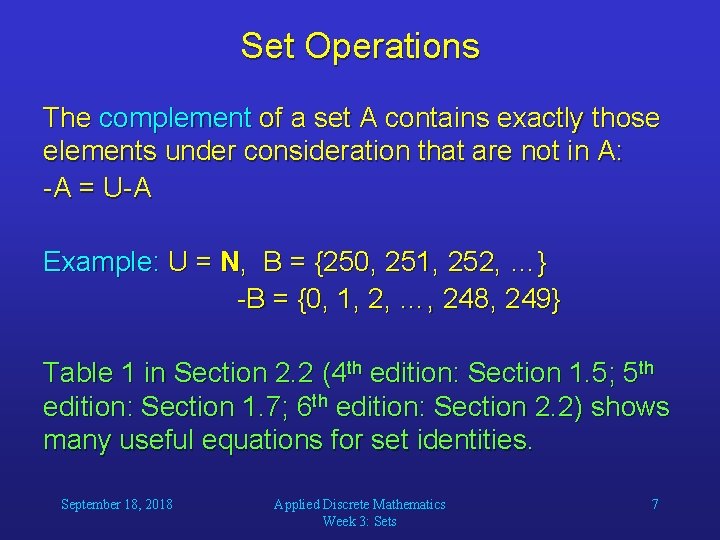
Set Operations The complement of a set A contains exactly those elements under consideration that are not in A: -A = U-A Example: U = N, B = {250, 251, 252, …} -B = {0, 1, 2, …, 248, 249} Table 1 in Section 2. 2 (4 th edition: Section 1. 5; 5 th edition: Section 1. 7; 6 th edition: Section 2. 2) shows many useful equations for set identities. September 18, 2018 Applied Discrete Mathematics Week 3: Sets 7
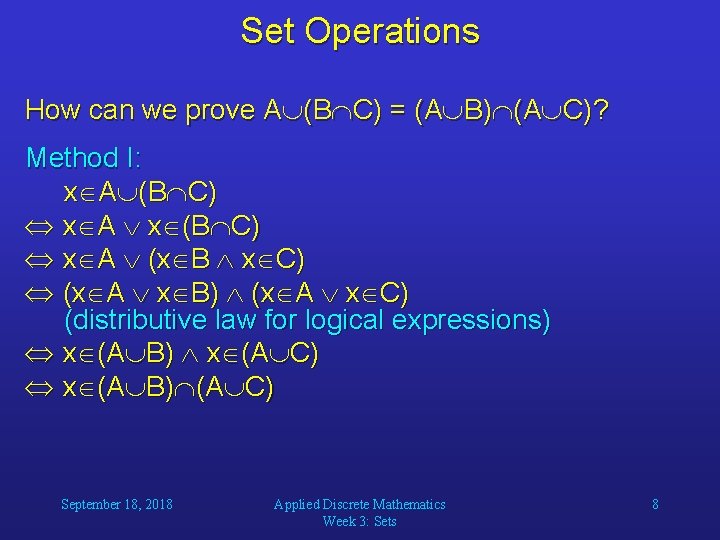
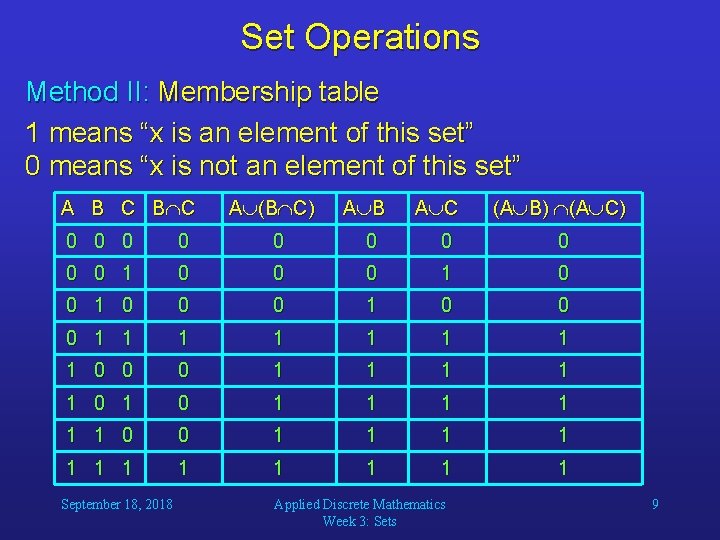
Set Operations How can we prove A (B C) = (A B) (A C)? Method I: x A (B C) x A x (B C) x A (x B x C) (x A x B) (x A x C) (distributive law for logical expressions) x (A B) x (A C) x (A B) (A C) September 18, 2018 Applied Discrete Mathematics Week 3: Sets 8
Set Operations Method II: Membership table 1 means “x is an element of this set” 0 means “x is not an element of this set” A B C A (B C) A B A C (A B) (A C) 0 0 0 0 0 1 0 0 0 1 1 1 1 0 0 0 1 1 1 0 0 1 1 1 September 18, 2018 Applied Discrete Mathematics Week 3: Sets 9
Set Operations Take-home message: Every logical expression can be transformed into an equivalent expression in set theory and vice versa. September 18, 2018 Applied Discrete Mathematics Week 3: Sets 10
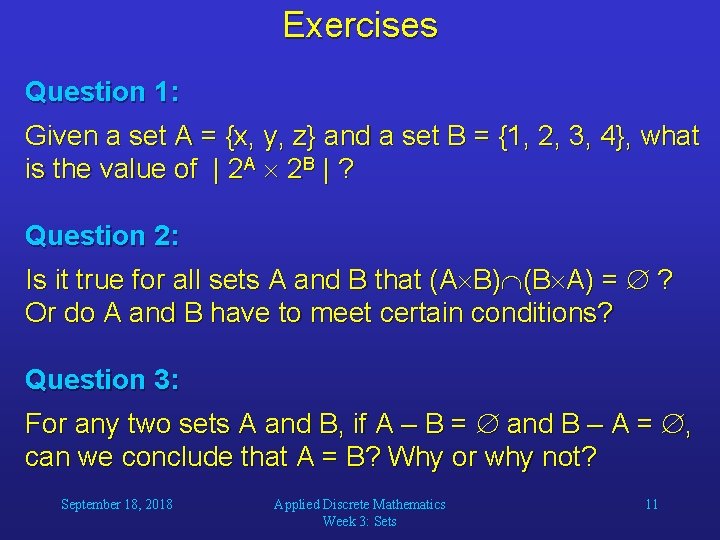
Exercises Question 1: Given a set A = {x, y, z} and a set B = {1, 2, 3, 4}, what is the value of | 2 A 2 B | ? Question 2: Is it true for all sets A and B that (A B) (B A) = ? Or do A and B have to meet certain conditions? Question 3: For any two sets A and B, if A – B = and B – A = , can we conclude that A = B? Why or why not? September 18, 2018 Applied Discrete Mathematics Week 3: Sets 11
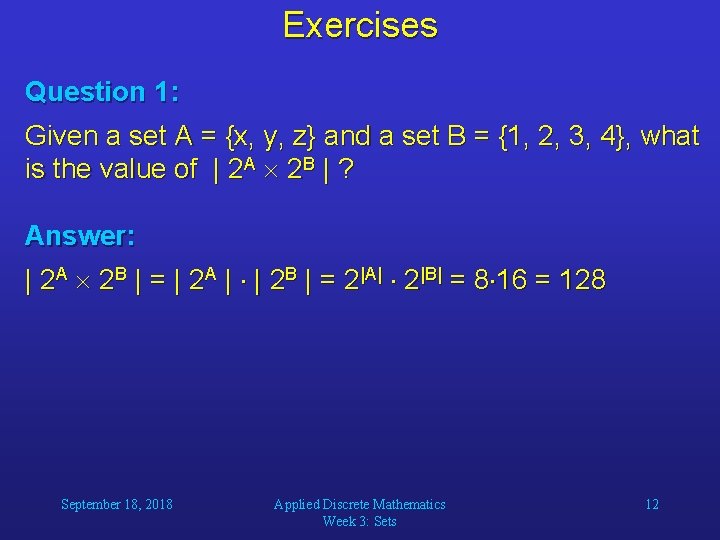
Exercises Question 1: Given a set A = {x, y, z} and a set B = {1, 2, 3, 4}, what is the value of | 2 A 2 B | ? Answer: | 2 A 2 B | = | 2 A | | 2 B | = 2|A| 2|B| = 8 16 = 128 September 18, 2018 Applied Discrete Mathematics Week 3: Sets 12
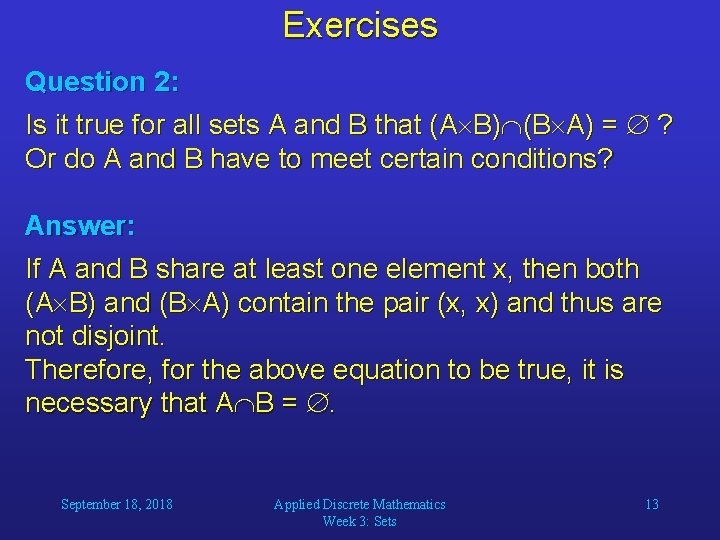
Exercises Question 2: Is it true for all sets A and B that (A B) (B A) = ? Or do A and B have to meet certain conditions? Answer: If A and B share at least one element x, then both (A B) and (B A) contain the pair (x, x) and thus are not disjoint. Therefore, for the above equation to be true, it is necessary that A B = . September 18, 2018 Applied Discrete Mathematics Week 3: Sets 13
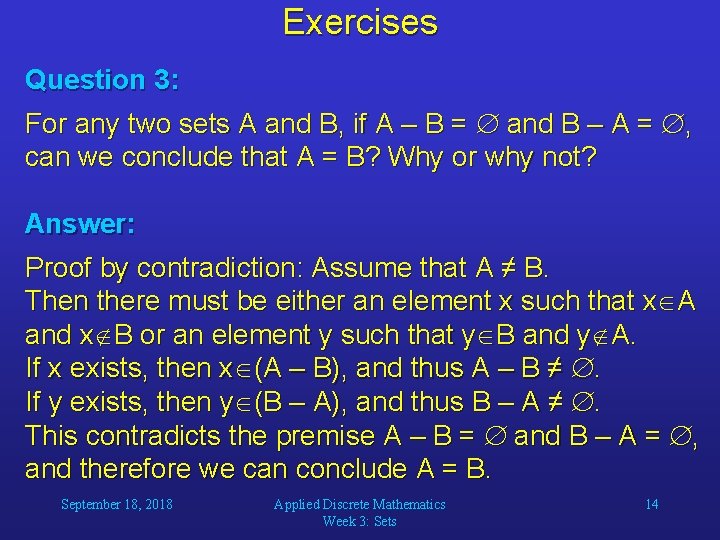
Exercises Question 3: For any two sets A and B, if A – B = and B – A = , can we conclude that A = B? Why or why not? Answer: Proof by contradiction: Assume that A ≠ B. Then there must be either an element x such that x A and x B or an element y such that y B and y A. If x exists, then x (A – B), and thus A – B ≠ . If y exists, then y (B – A), and thus B – A ≠ . This contradicts the premise A – B = and B – A = , and therefore we can conclude A = B. September 18, 2018 Applied Discrete Mathematics Week 3: Sets 14
… and the next chapter is about… Functions September 18, 2018 Applied Discrete Mathematics Week 3: Sets 15
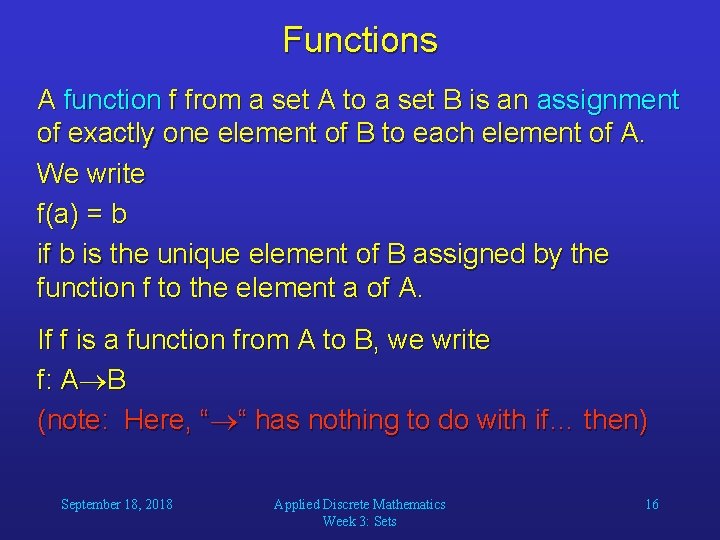
Functions A function f from a set A to a set B is an assignment of exactly one element of B to each element of A. We write f(a) = b if b is the unique element of B assigned by the function f to the element a of A. If f is a function from A to B, we write f: A B (note: Here, “ “ has nothing to do with if… then) September 18, 2018 Applied Discrete Mathematics Week 3: Sets 16
Functions If f: A B, we say that A is the domain of f and B is the codomain of f. If f(a) = b, we say that b is the image of a and a is the pre-image of b. The range of f: A B is the set of all images of elements of A. We say that f: A B maps A to B. September 18, 2018 Applied Discrete Mathematics Week 3: Sets 17
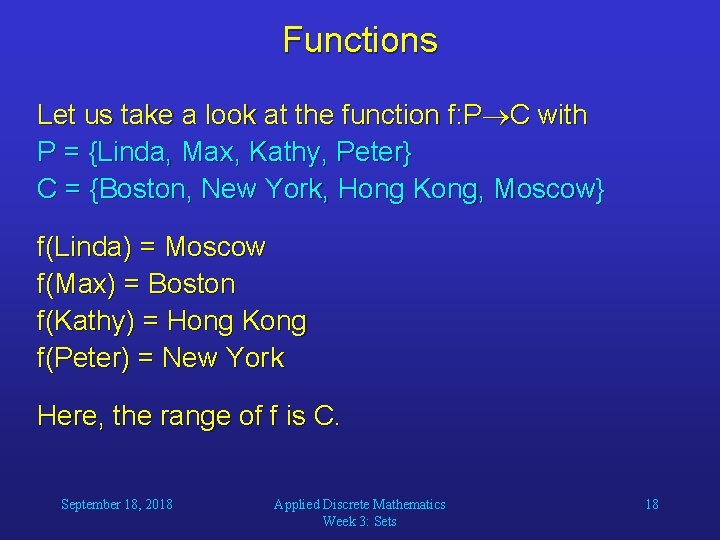
Functions Let us take a look at the function f: P C with P = {Linda, Max, Kathy, Peter} C = {Boston, New York, Hong Kong, Moscow} f(Linda) = Moscow f(Max) = Boston f(Kathy) = Hong Kong f(Peter) = New York Here, the range of f is C. September 18, 2018 Applied Discrete Mathematics Week 3: Sets 18
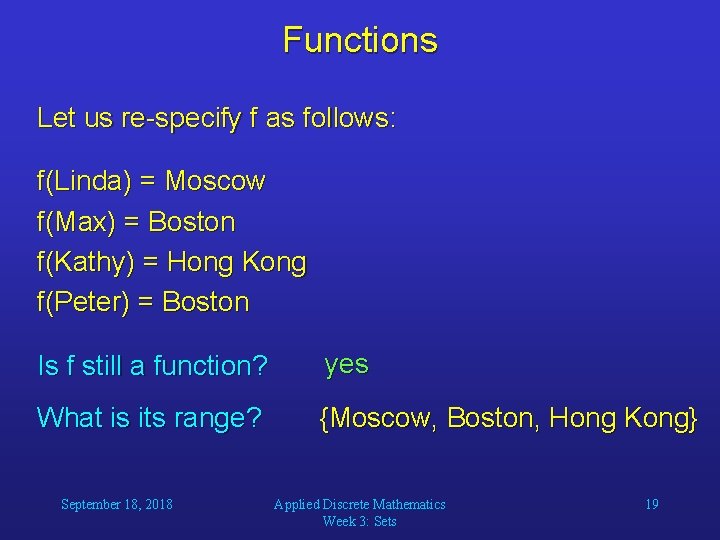
Functions Let us re-specify f as follows: f(Linda) = Moscow f(Max) = Boston f(Kathy) = Hong Kong f(Peter) = Boston Is f still a function? yes What is its range? {Moscow, Boston, Hong Kong} September 18, 2018 Applied Discrete Mathematics Week 3: Sets 19
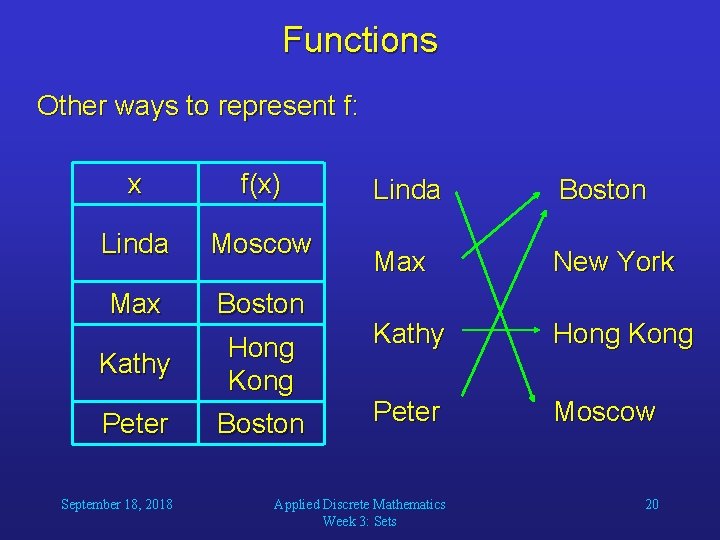
Functions Other ways to represent f: x f(x) Linda Moscow Max Boston Kathy Peter September 18, 2018 Linda Boston Max New York Kathy Hong Kong Peter Moscow Applied Discrete Mathematics Week 3: Sets 20 Hong Kong Boston
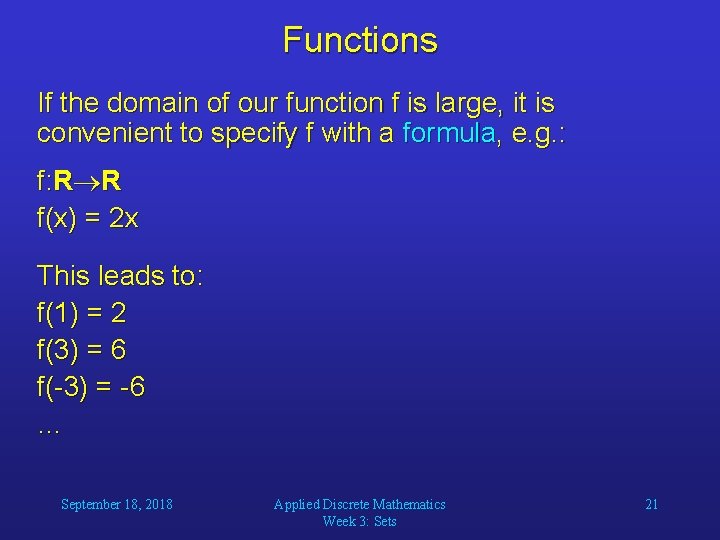
Functions If the domain of our function f is large, it is convenient to specify f with a formula, e. g. : f: R R f(x) = 2 x This leads to: f(1) = 2 f(3) = 6 f(-3) = -6 … September 18, 2018 Applied Discrete Mathematics Week 3: Sets 21
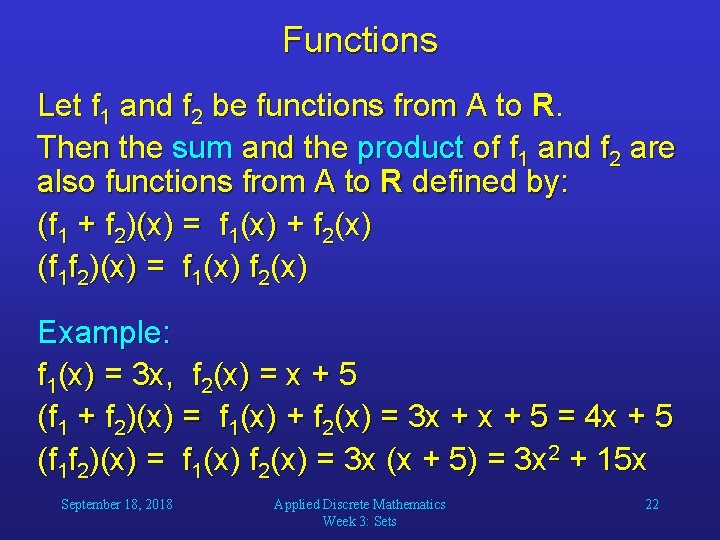
Functions Let f 1 and f 2 be functions from A to R. Then the sum and the product of f 1 and f 2 are also functions from A to R defined by: (f 1 + f 2)(x) = f 1(x) + f 2(x) (f 1 f 2)(x) = f 1(x) f 2(x) Example: f 1(x) = 3 x, f 2(x) = x + 5 (f 1 + f 2)(x) = f 1(x) + f 2(x) = 3 x + 5 = 4 x + 5 (f 1 f 2)(x) = f 1(x) f 2(x) = 3 x (x + 5) = 3 x 2 + 15 x September 18, 2018 Applied Discrete Mathematics Week 3: Sets 22
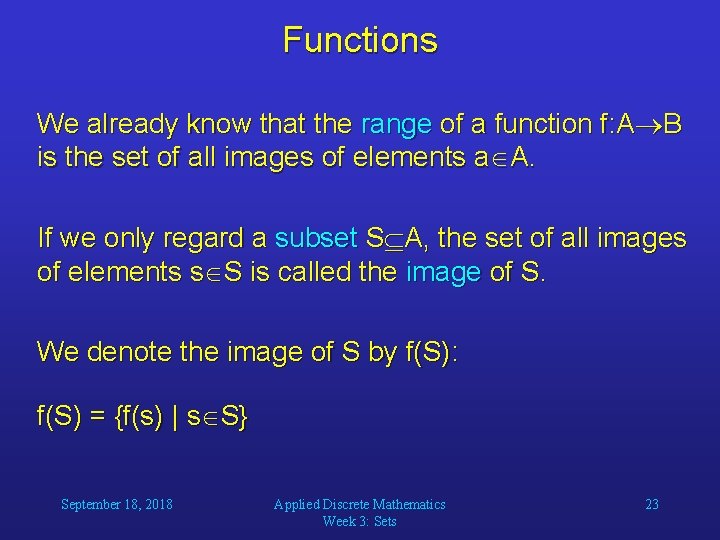
Functions We already know that the range of a function f: A B is the set of all images of elements a A. If we only regard a subset S A, the set of all images of elements s S is called the image of S. We denote the image of S by f(S): f(S) = {f(s) | s S} September 18, 2018 Applied Discrete Mathematics Week 3: Sets 23
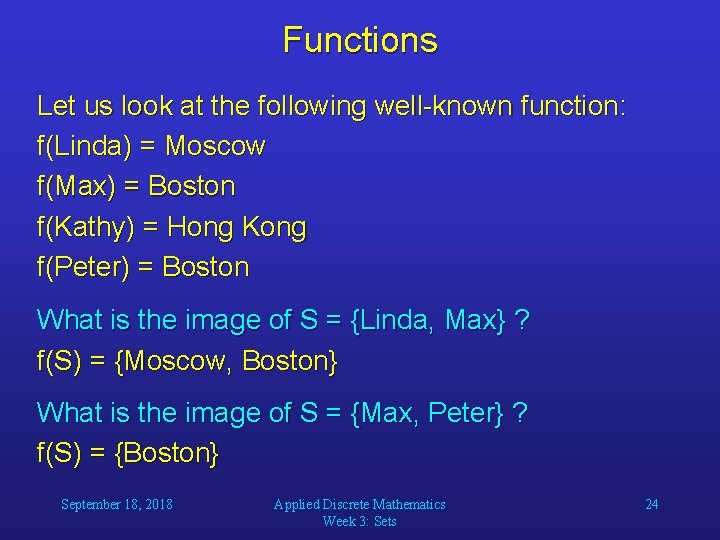
Functions Let us look at the following well-known function: f(Linda) = Moscow f(Max) = Boston f(Kathy) = Hong Kong f(Peter) = Boston What is the image of S = {Linda, Max} ? f(S) = {Moscow, Boston} What is the image of S = {Max, Peter} ? f(S) = {Boston} September 18, 2018 Applied Discrete Mathematics Week 3: Sets 24
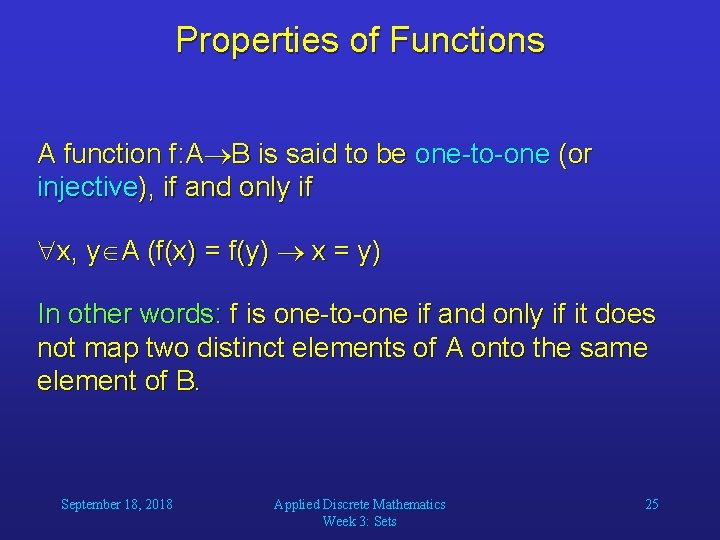
Properties of Functions A function f: A B is said to be one-to-one (or injective), if and only if x, y A (f(x) = f(y) x = y) In other words: f is one-to-one if and only if it does not map two distinct elements of A onto the same element of B. September 18, 2018 Applied Discrete Mathematics Week 3: Sets 25
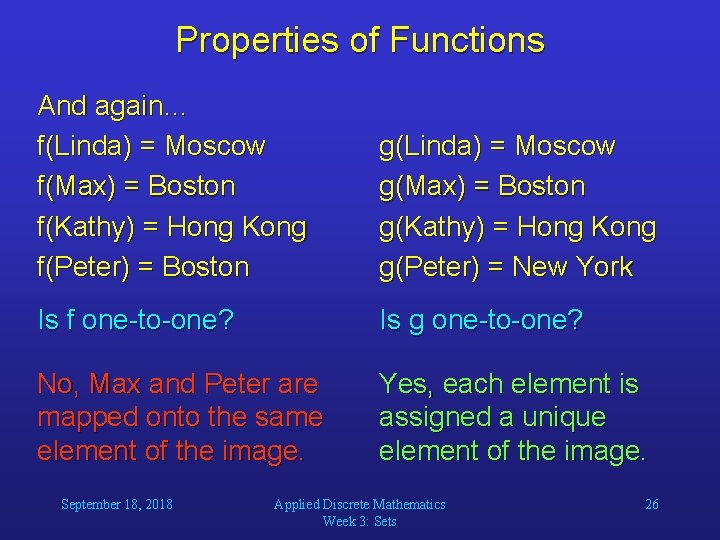
Properties of Functions And again… f(Linda) = Moscow f(Max) = Boston f(Kathy) = Hong Kong f(Peter) = Boston g(Linda) = Moscow g(Max) = Boston g(Kathy) = Hong Kong g(Peter) = New York Is f one-to-one? Is g one-to-one? No, Max and Peter are mapped onto the same element of the image. Yes, each element is assigned a unique element of the image. September 18, 2018 Applied Discrete Mathematics Week 3: Sets 26