
Cars and Physics Introduction Introduction Physics is about
Cars and Physics Introduction
Introduction Physics is about the study of motion and how objects interact, from the smallest “Higgs Boson “ particle to that of galaxies. While at school you have studied Energy Forces Frictional force Gravitational force

Measurements in Motion There are three units of measurement we need to know for studies in motion. Distance measured in metres (m) Time measured in seconds (s) Mass measured in kilograms (kg) Scientists use these units to calculate all motion units.
Other Units of Motion Speed is defined as the rate at which distance changes over a given time period. SPEED = Distance divided by time = Distance time Speed is measured in metres per second (m/s)
Calculations 1. How fast does a bike rider go if she travels 100 m in 20 s? Ans. Speed = Distance time = 100 20 = 5 m/s
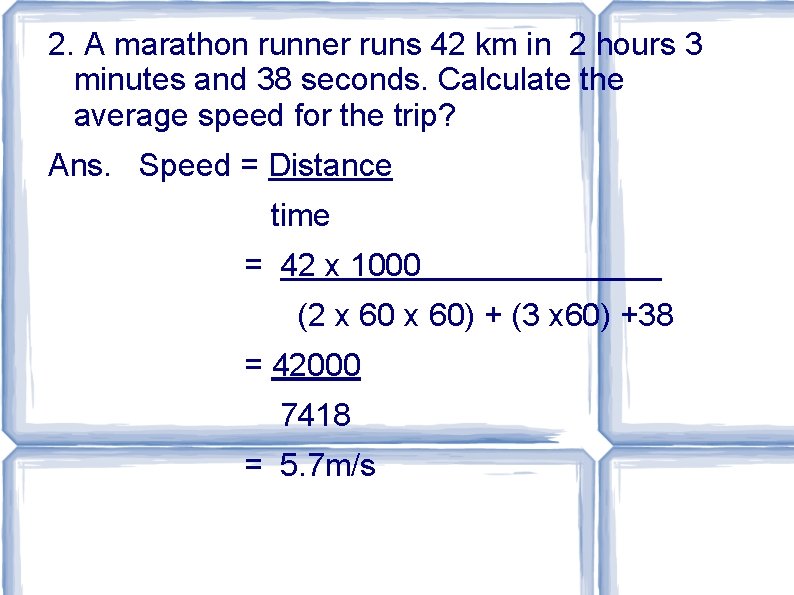
2. A marathon runner runs 42 km in 2 hours 3 minutes and 38 seconds. Calculate the average speed for the trip? Ans. Speed = Distance time = 42 x 1000 (2 x 60) + (3 x 60) +38 = 42000 7418 = 5. 7 m/s
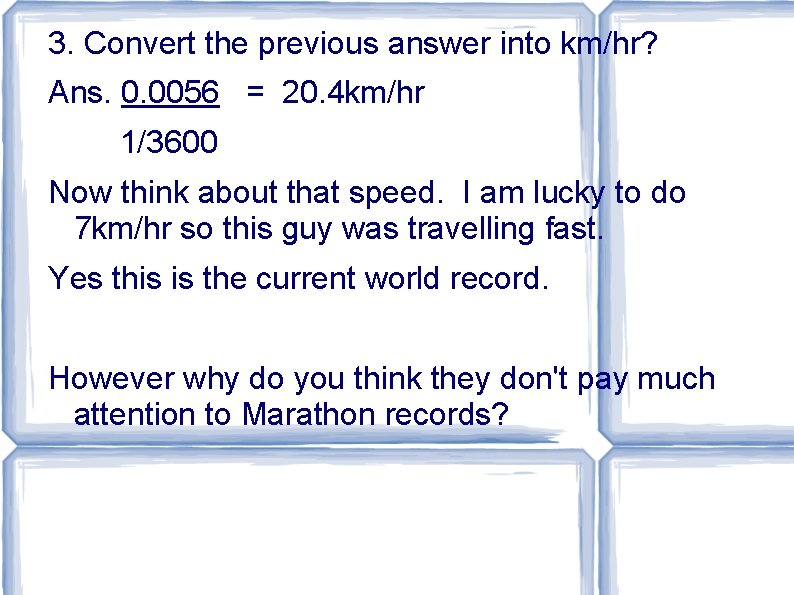
3. Convert the previous answer into km/hr? Ans. 0. 0056 = 20. 4 km/hr 1/3600 Now think about that speed. I am lucky to do 7 km/hr so this guy was travelling fast. Yes this is the current world record. However why do you think they don't pay much attention to Marathon records?
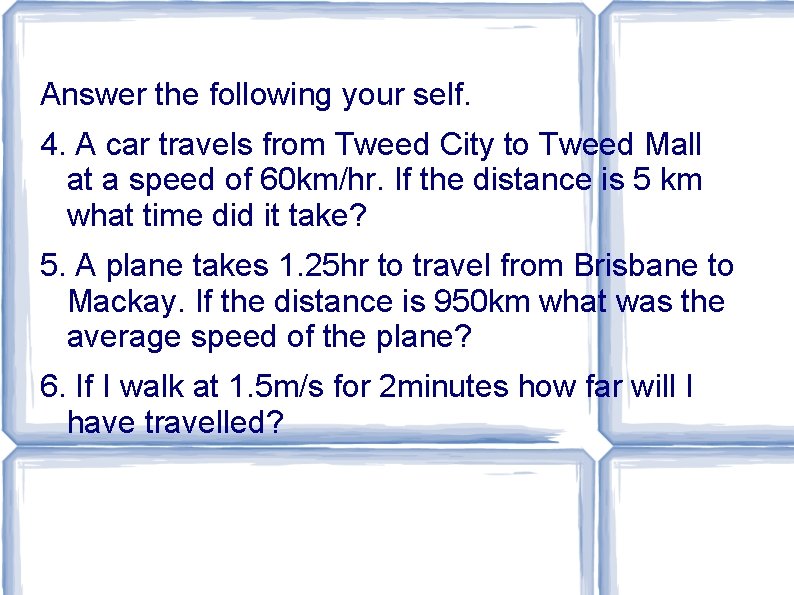
Answer the following your self. 4. A car travels from Tweed City to Tweed Mall at a speed of 60 km/hr. If the distance is 5 km what time did it take? 5. A plane takes 1. 25 hr to travel from Brisbane to Mackay. If the distance is 950 km what was the average speed of the plane? 6. If I walk at 1. 5 m/s for 2 minutes how far will I have travelled?
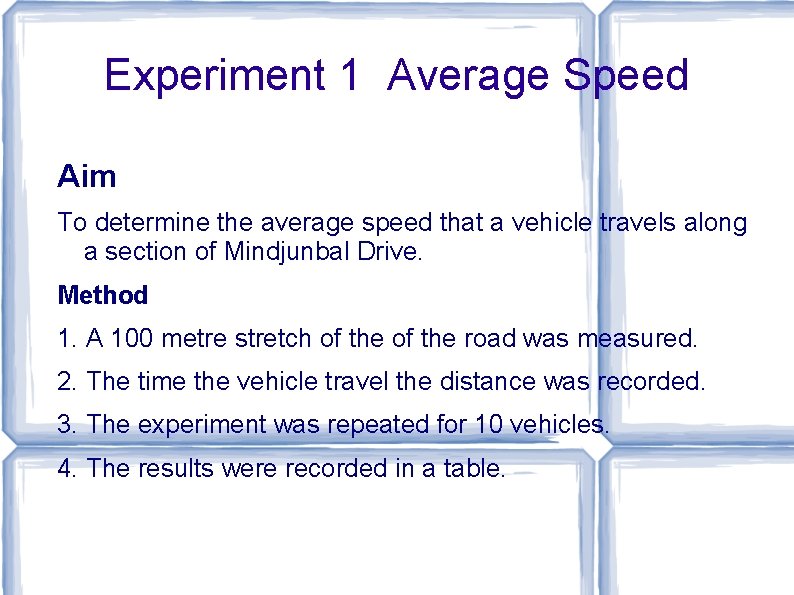
Experiment 1 Average Speed Aim To determine the average speed that a vehicle travels along a section of Mindjunbal Drive. Method 1. A 100 metre stretch of the road was measured. 2. The time the vehicle travel the distance was recorded. 3. The experiment was repeated for 10 vehicles. 4. The results were recorded in a table.
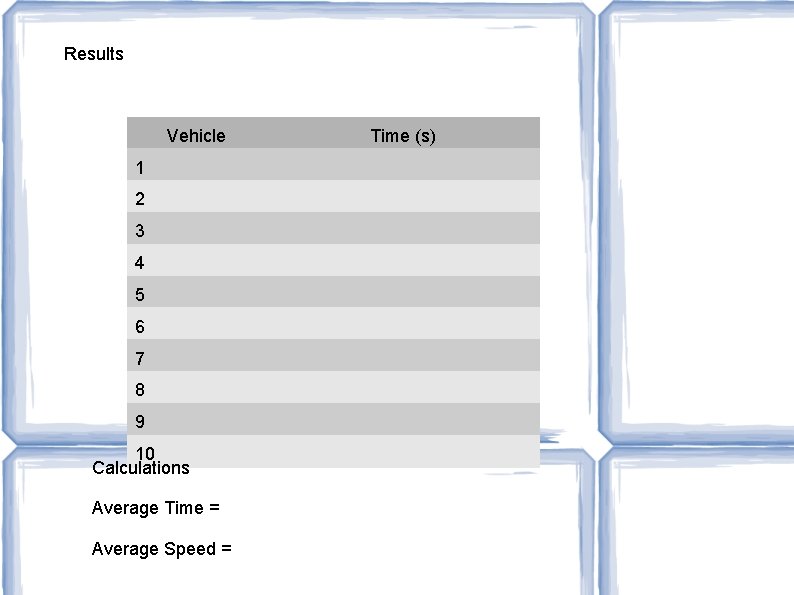
Results Vehicle 1 2 3 4 5 6 7 8 9 10 Calculations Average Time = Average Speed = Time (s)
Conclusion Discussion What would you change to improve the accuracy of the experiment? During the course of the experiment did you identify anything that you could investigate further?
Experiment 2 Reaction Time Aim. To determine the reaction time is different between your right and left hand. Introduction To be a formula 1 driver you must have very fast reactions – travelling at speeds of over 250 km per hour means about 80 m every second! So splits of a second can make all the difference! Could you respond to outside events with minimal delay and take appropriate action… let’s test your hypothesis
The experiment tests how long it takes the brain to translate visual information (falling ruler) into your voluntary (or conscious) motor commands and actions (grasping finger movements) that lead to the ruler being caught. The shorter the time, the faster your reactions. …. that’s if you were paying attention in the first place! Indeed practice specifically affects the ‘associative centres’ in the brain, so that you can respond faster to what’s happening in your visual world. The flow of information along the ‘visual’ and ‘motor’ nerve pathways is relatively constant even with lots of practice. It all comes down to ‘attention’ or ‘…being on the
Hypothesis The reaction time will be shorter for the favoured hand. Method 1) A person held the ruler near the 30 cm mark and let it hang vertically. 2) The other person placed their thumb and index finger on either side of the 0 cm mark ready to catch it when it fell - their fingers didn't touch the ruler. 3) The person holding the ruler let go and the subject tried to catch the ruler as soon as possible. [Hint: To prevent guessing, vary the time before letting go of the ruler]. 4) The level (in cm) just above the subject’s first finger where the ruler was caught was recorded.
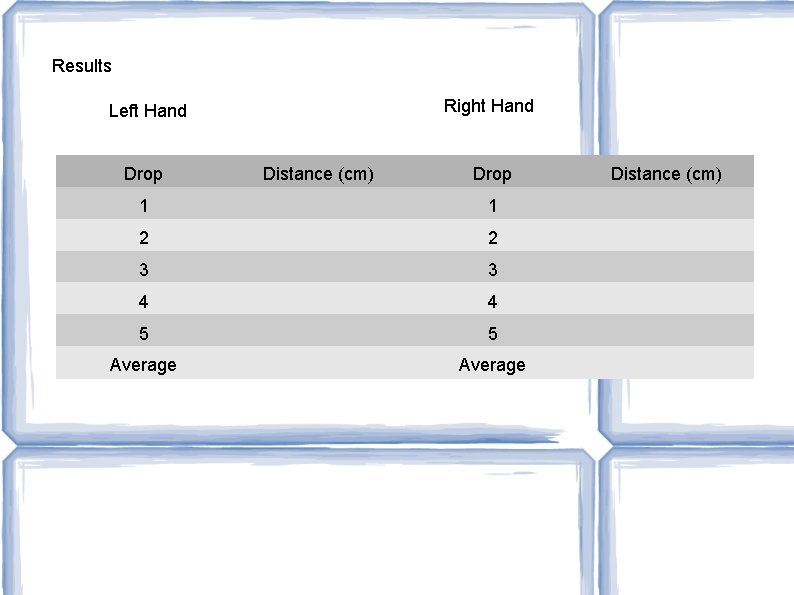
Results Right Hand Left Hand Drop Distance (cm) Drop 1 1 2 2 3 3 4 4 5 5 Average Distance (cm)

From the table below, the ‘mean catch distance’ on the ruler can be converted into a ‘mean reaction time’ in milliseconds (Remember: 1 millisecond is one thousandth of a second). DISTANCE – REACTION TIME CONVERSION TABLE Catch Distance Reaction time (cm) (milliseconds) 1 50 16 180 2 60 17 190 3 70 18 190 4 80 19 200 5 90 20 200 6 100 21 210 7 120 22 210 8 130 23 220 9 140 24 220 10 140 25 230 11 150 26 230 12 160 27 230 13 160 28 240 14 170 29 240 15 170 30 250
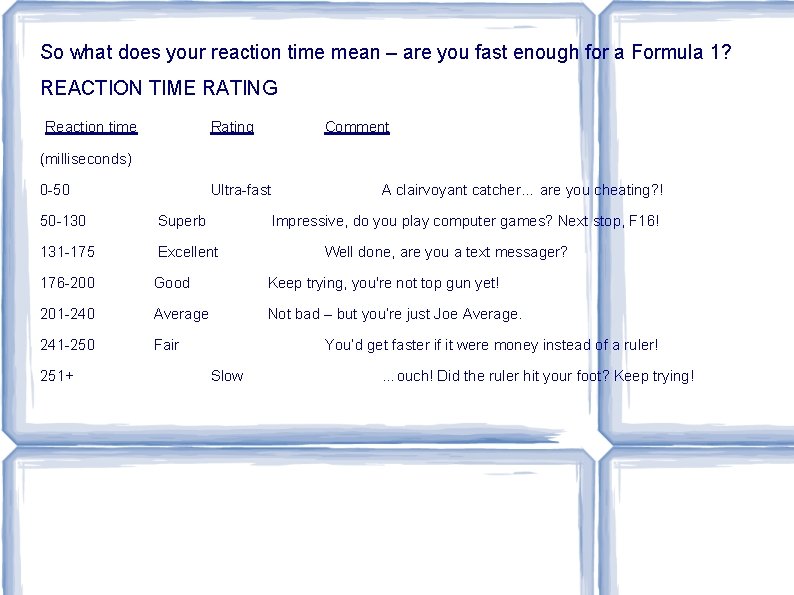
So what does your reaction time mean – are you fast enough for a Formula 1? REACTION TIME RATING Reaction time Rating Comment Ultra-fast (milliseconds) 0 -50 A clairvoyant catcher… are you cheating? ! 50 -130 Superb Impressive, do you play computer games? Next stop, F 16! 131 -175 Excellent 176 -200 Good Keep trying, you're not top gun yet! 201 -240 Average Not bad – but you’re just Joe Average. 241 -250 Fair 251+ Slow Well done, are you a text messager? You’d get faster if it were money instead of a ruler! …ouch! Did the ruler hit your foot? Keep trying!
Conclusion Discussion
Newton and Motion Who Is Newton? Sir Isaac Newton (4 January 1643 – 31 March 1727)was an English physicist, mathematician, astronomer, natural philosopher, alchemist, and theologian, who has been "considered by many to be the greatest and most influential scientist who ever lived. " http: //en. wikipedia. org/wiki/Isaac_Newton
Newtons Three Laws 1 st Law – An object at rest will stay at rest, and an object in motion will stay in motion at constant velocity, unless acted upon by an unbalanced force. 2 nd Law – Force equals mass times acceleration. 3 rd Law – For every action there is an equal and opposite reaction.
1 st Law of Motion (Law of Inertia) An object at rest will stay at rest, and an object in motion will stay in motion at constant velocity, unless acted upon by an unbalanced force.
Inertia is the tendency of an object to resist changes in its velocity: whether in motion or motionless. That is Newton's first law describes INERTIA.
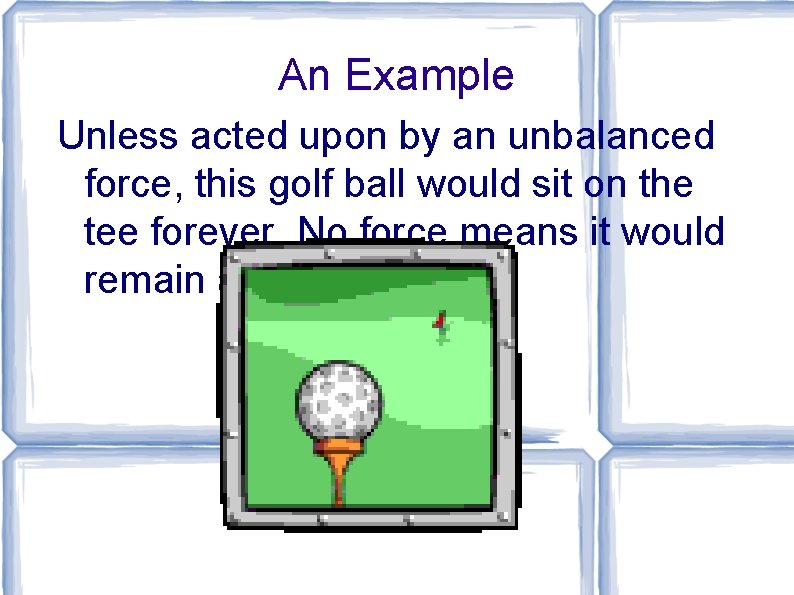
An Example Unless acted upon by an unbalanced force, this golf ball would sit on the tee forever. No force means it would remain at rest.
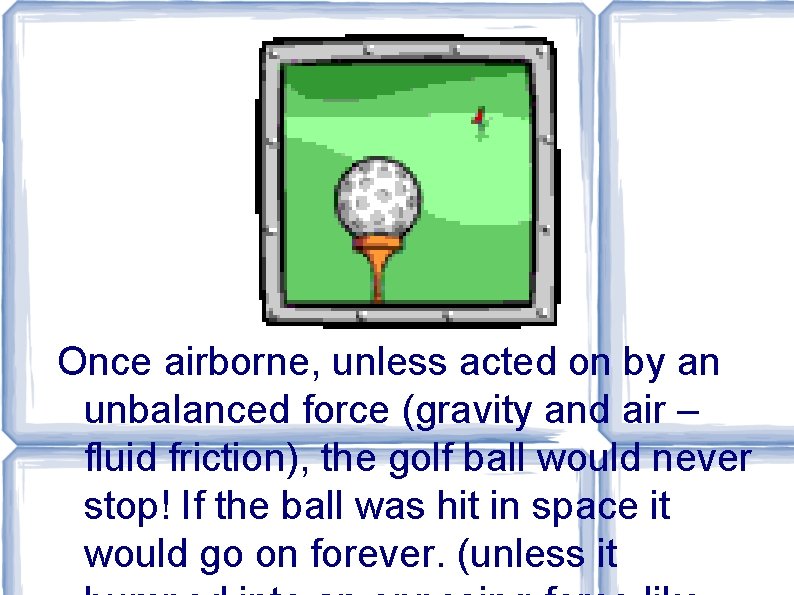
Once airborne, unless acted on by an unbalanced force (gravity and air – fluid friction), the golf ball would never stop! If the ball was hit in space it would go on forever. (unless it
Friction Why do we observe every day objects in motion slowing down and becoming motionless seemingly without an outside force? It’s a force we sometimes cannot see – friction.
Objects on earth, unlike the frictionless space the moon travels through, are under the influence of friction.
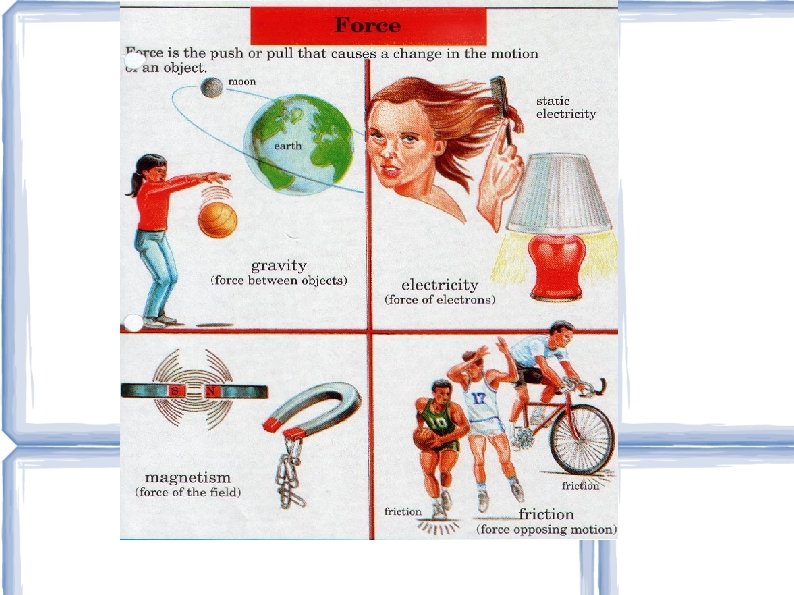
What is this unbalanced force that acts on an object in motion? There are four main types of friction: Sliding friction: ice skating Rolling friction: bowling Fluid friction (air or liquid): air or water resistance Static friction: initial friction when moving an object
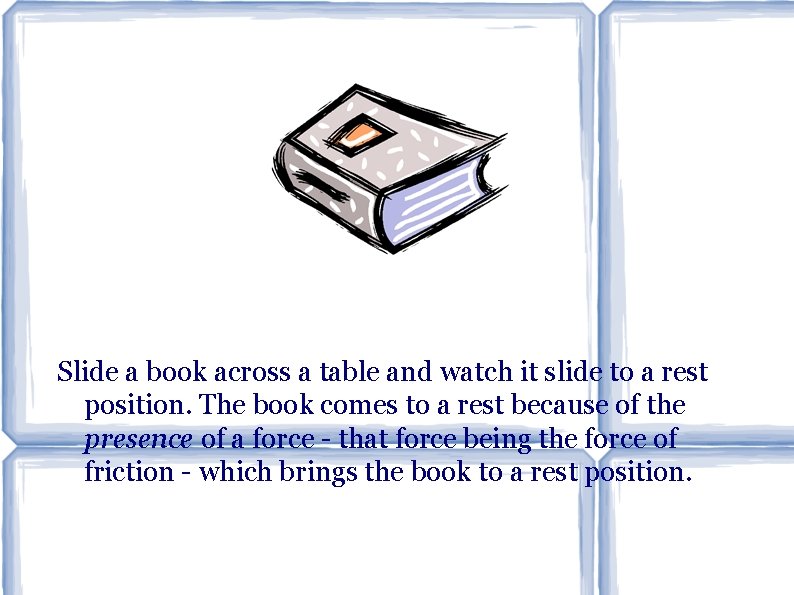
Slide a book across a table and watch it slide to a rest position. The book comes to a rest because of the presence of a force - that force being the force of friction - which brings the book to a rest position.
In the absence of a force of friction, the book would continue in motion with the same speed and direction - forever! (Or at least to the end of the table top. ) We need FRICTION. Think about it. List some things we do that we couldn't do if we didn't have friction.
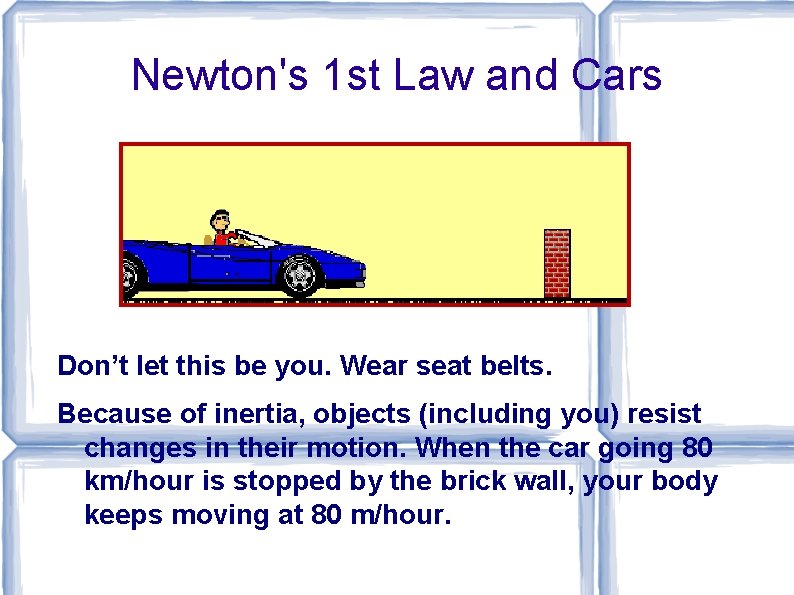
Newton's 1 st Law and Cars Don’t let this be you. Wear seat belts. Because of inertia, objects (including you) resist changes in their motion. When the car going 80 km/hour is stopped by the brick wall, your body keeps moving at 80 m/hour.
Newton's 2 nd Law The net force of an object is equal to the product of its mass and acceleration, or F=ma.
Newton's 2 nd Law When mass is in kilograms and acceleration is in m/s/s, the unit of force is in newtons (N). One newton is equal to the force required to accelerate one kilogram of mass at one metre/second.
Newton's 2 nd Law What does the 2 nd law mean? It's simple If you apply a big force to an object it will have a big acceleration. If you apply a small force it will have a small acceleration. Example. Push a toy truck with a great force and it will accelerate quickly. Push with a small force and it moves slowly.
It also means that if you have two masses one larger than the other then the smaller mass will experience a greater acceleration than the bigger mass if the same force is applied to both. Example If I push Caitlin she would fly across the room. If I pushed Vince with the same force AI would be lucky to move him 30 cm.
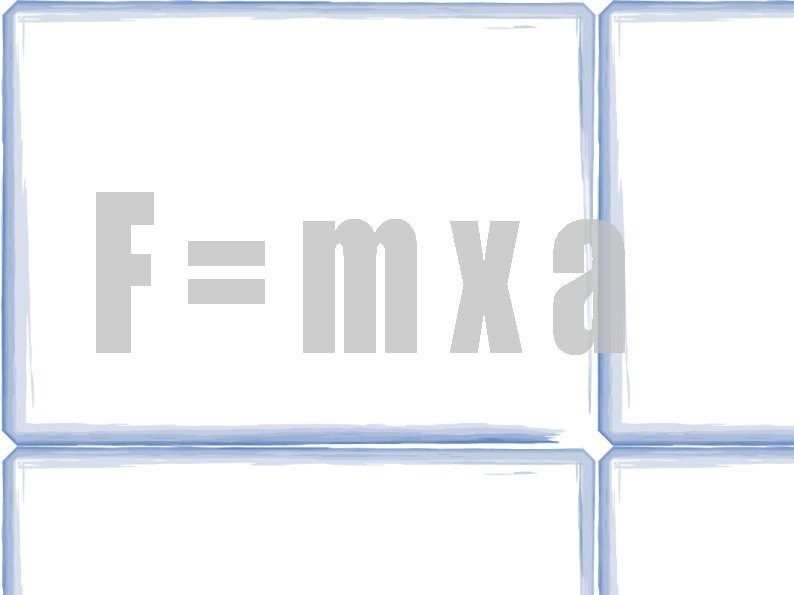
Netwon's 2 nd Law is best expressed as F=mass x acceleration.
Netwon's 2 nd Law is best expressed as F=mass x acceleration. Lets look at some questions that use this equation.
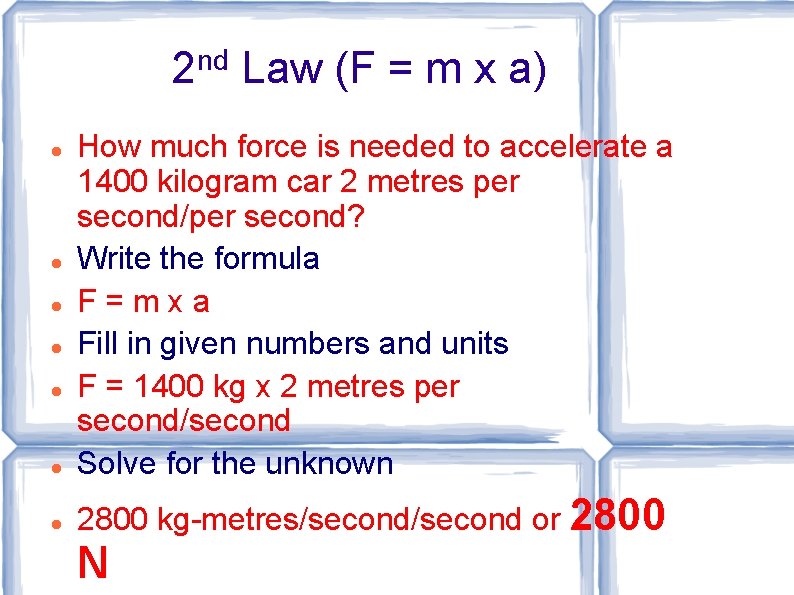
2 nd Law (F = m x a) How much force is needed to accelerate a 1400 kilogram car 2 metres per second/per second? Write the formula F = m x a Fill in given numbers and units F = 1400 kg x 2 metres per second/second Solve for the unknown 2800 kg-metres/second or 2800 N
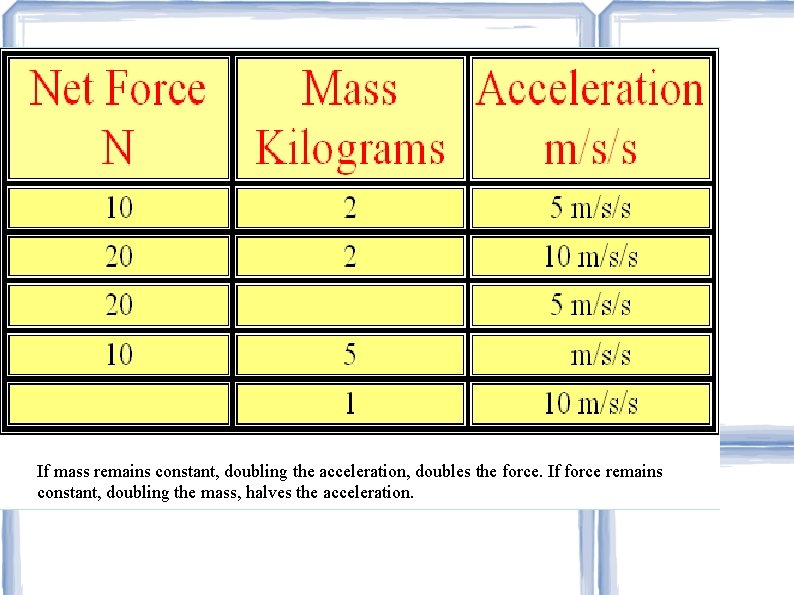
If mass remains constant, doubling the acceleration, doubles the force. If force remains constant, doubling the mass, halves the acceleration.
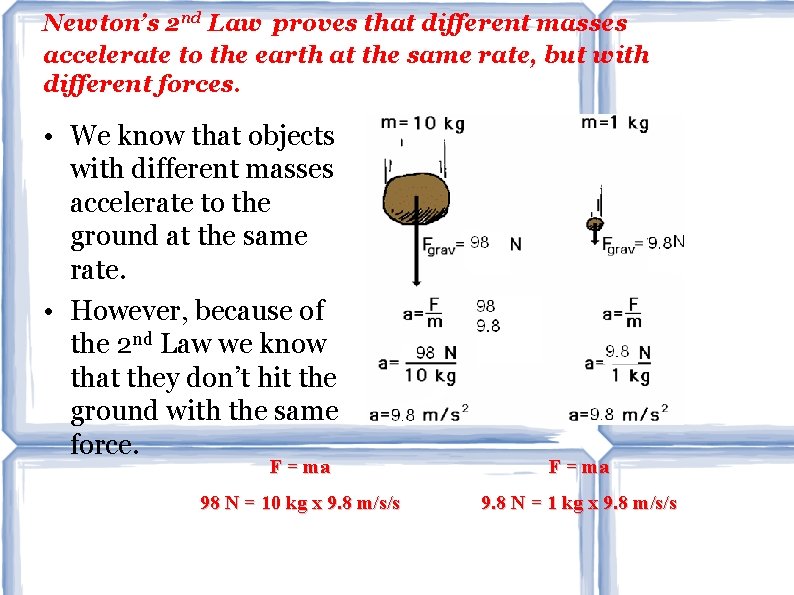
Newton’s 2 nd Law proves that different masses accelerate to the earth at the same rate, but with different forces. • We know that objects with different masses accelerate to the ground at the same rate. • However, because of the 2 nd Law we know that they don’t hit the ground with the same force. F = ma 98 N = 10 kg x 9. 8 m/s/s 9. 8 N = 1 kg x 9. 8 m/s/s
Check Your Understanding 1. What acceleration will result when a 12 N net force applied to a 3 kg object? A 6 kg object? 2. A net force of 16 N causes a mass to accelerate at a rate of 5 m/s 2. Determine the mass. 3. How much force is needed to accelerate a 66 kg skier 1 m/sec? 4. What is the force on a 1000 kg elevator that is falling freely at 9. 8 m/sec?
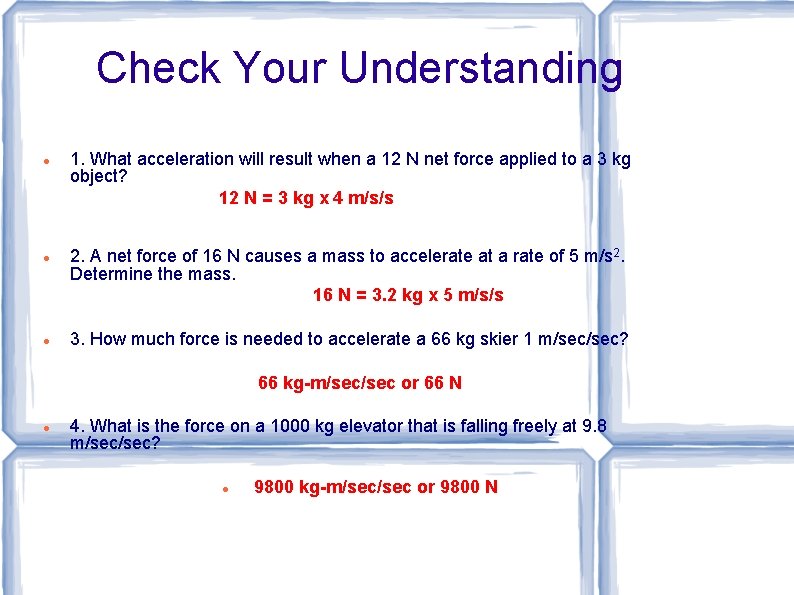
Check Your Understanding 1. What acceleration will result when a 12 N net force applied to a 3 kg object? 12 N = 3 kg x 4 m/s/s 2. A net force of 16 N causes a mass to accelerate at a rate of 5 m/s 2. Determine the mass. 16 N = 3. 2 kg x 5 m/s/s 3. How much force is needed to accelerate a 66 kg skier 1 m/sec? 66 kg-m/sec or 66 N 4. What is the force on a 1000 kg elevator that is falling freely at 9. 8 m/sec? 9800 kg-m/sec or 9800 N
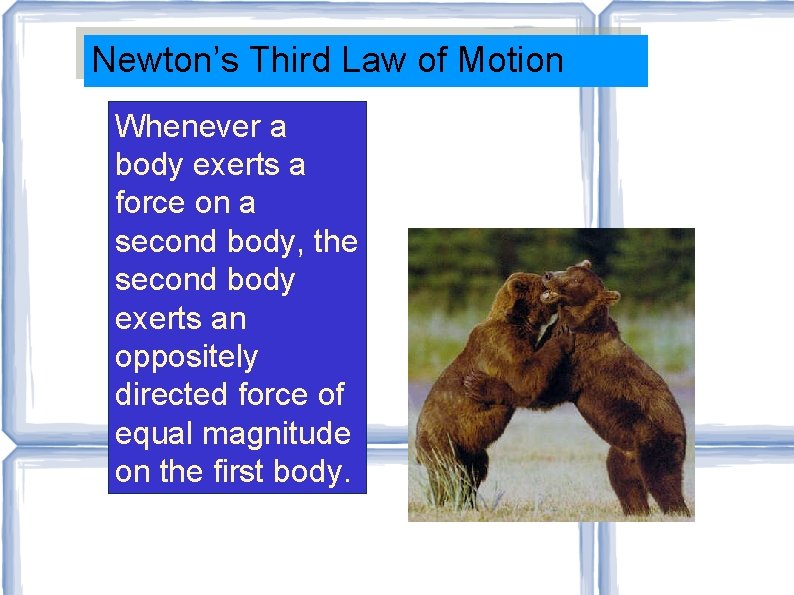
Newton’s Third Law of Motion Whenever a body exerts a force on a second body, the second body exerts an oppositely directed force of equal magnitude on the first body.
Newton’s 3 rd Law…… action force = reaction force for every action, there is an equal and opposite reaction!! tires of a car push against the road, and the road in turn pushes back on the tires, a swimmer pushes the water backward, and the water pushes swimmer forward
"A mousetrap car is propelled because the drive wheels push on the floor and the floor pushes back on the car [wheels]” The wheels can only push on the floor as hard as the floor can push back. If the floor cannot push back with the same force as the wheels push, then the wheels will spin in place and the car will not accelerate to its fullest potential.
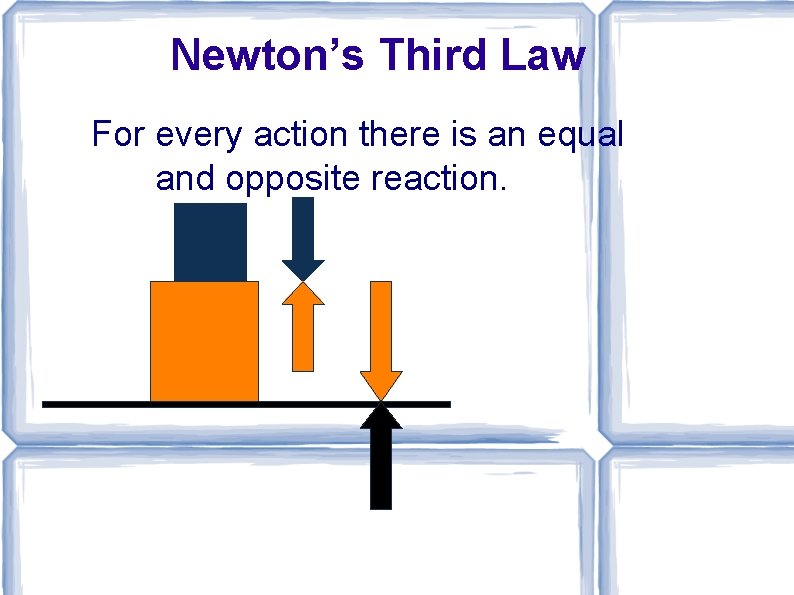
Newton’s Third Law For every action there is an equal and opposite reaction.
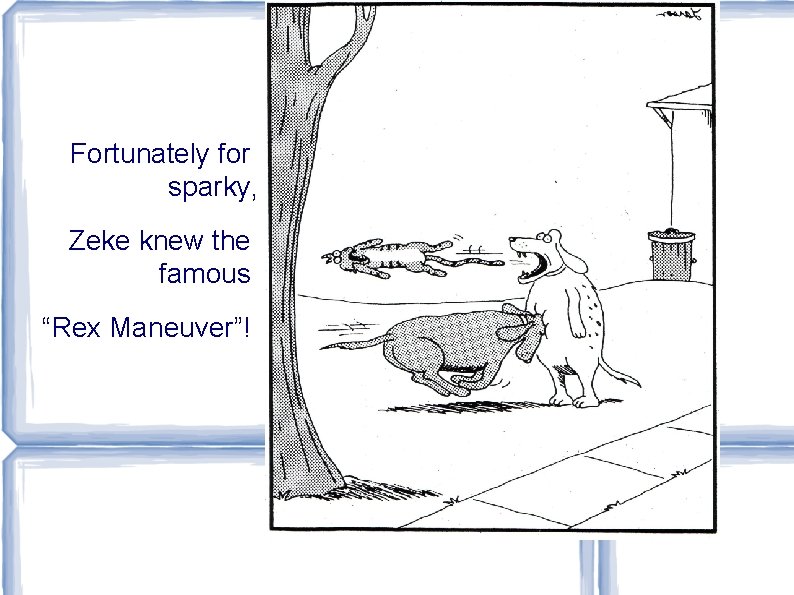
Fortunately for sparky, Zeke knew the famous “Rex Maneuver”!
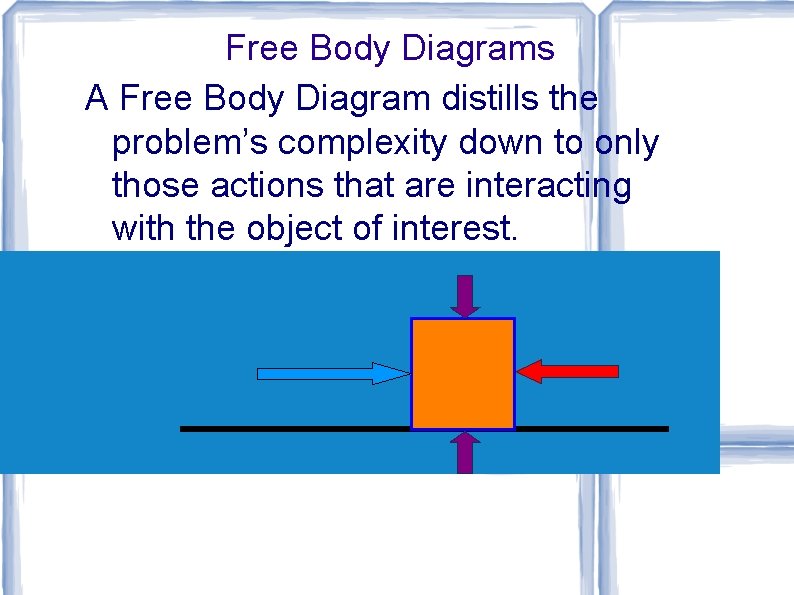
Free Body Diagrams A Free Body Diagram distills the problem’s complexity down to only those actions that are interacting with the object of interest.
Consider the following situation: You are standing in the middle of the room. Are there any forces acting on you? Is there net force acting on you? Draw the forces acting on you. Justify your answer by referring to Newton’s Laws.
Now remove the floor and draw the forces acting on you. What is your state of motion now? Characterize it by stating something that we can calculate.
GRAVITY (gravitational force) the pull an object exerts on another object the amount of gravitational force is dependent on: 1) Mass of the two objects 2) distance between objects the greater the mass, the greater the gravitational pull on that object Weight measure of gravitational force varies dependent on proximity to EARTH
Weight vs Mass is the measure of… the matter of an object and an object’s resistance to change in motion Weight is the product of mass and gravity. Weight is measured in Newtons. That is weight is a force.
- Slides: 54