
Carrier Phased Based Positioning in Australia and in
Carrier Phased Based Positioning in Australia and in Queensland Matt Higgins Principal Survey Advisor, Department of Natural Resources, Mines and Water Chair Commission 5 on Positioning and Measurement, International Federation of Surveyors (FIG)
Outline of the Presentation • Quick Overview of GNSS in Queensland – by way of Welcome! • Pseudo Range vs Carrier Phased Based GNSS • Continuously Operating Reference Stations (CORS) in Australia – Services for Post processing and Real-Time • Expanding User Base for Centimetre Accuracy • A look into the future… 2
GNSS in Queensland • GNSS has long been recognised as an ideal technology for a large, sparsely populated land; • NRMW has over 20 years experience in GNSS, eg first GPS Surveys in 1985; • Providing cutting edge GNSS infrastructure - Sun. POZ; • Strong R&D Track Record and Capabilities; • World class GNSS companies in South East Queensland; • Currently developing a strategy for Next Generation GNSS in Queensland in line with Queensland Government’s Smart State Policy 3
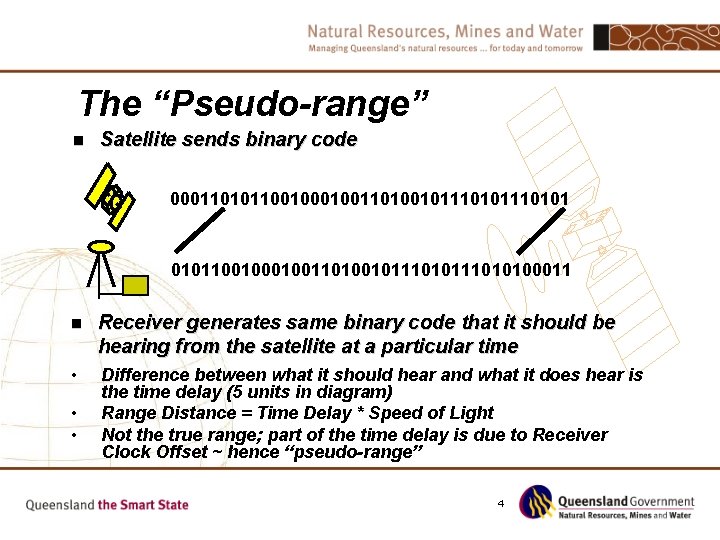
The “Pseudo-range” n Satellite sends binary code 00011010110010011010010111010100011 n Receiver generates same binary code that it should be hearing from the satellite at a particular time • Difference between what it should hear and what it does hear is the time delay (5 units in diagram) Range Distance = Time Delay * Speed of Light Not the true range; part of the time delay is due to Receiver Clock Offset ~ hence “pseudo-range” • • 4
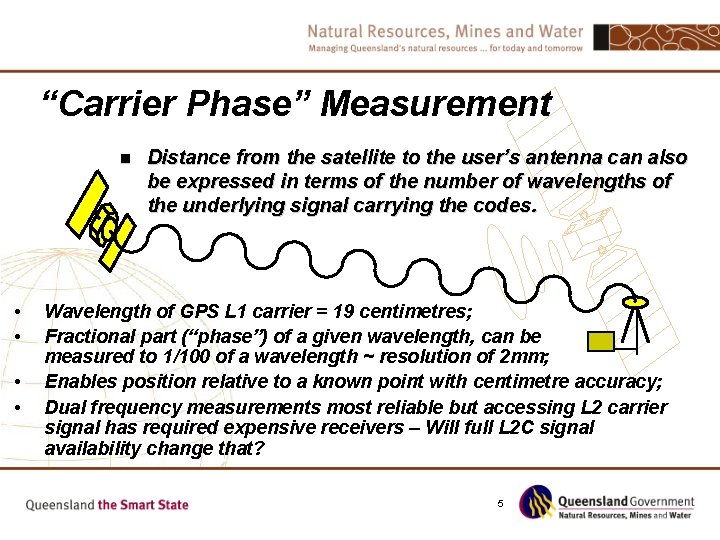
“Carrier Phase” Measurement n • • Distance from the satellite to the user’s antenna can also be expressed in terms of the number of wavelengths of the underlying signal carrying the codes. Wavelength of GPS L 1 carrier = 19 centimetres; Fractional part (“phase”) of a given wavelength, can be measured to 1/100 of a wavelength ~ resolution of 2 mm; Enables position relative to a known point with centimetre accuracy; Dual frequency measurements most reliable but accessing L 2 carrier signal has required expensive receivers – Will full L 2 C signal availability change that? 5
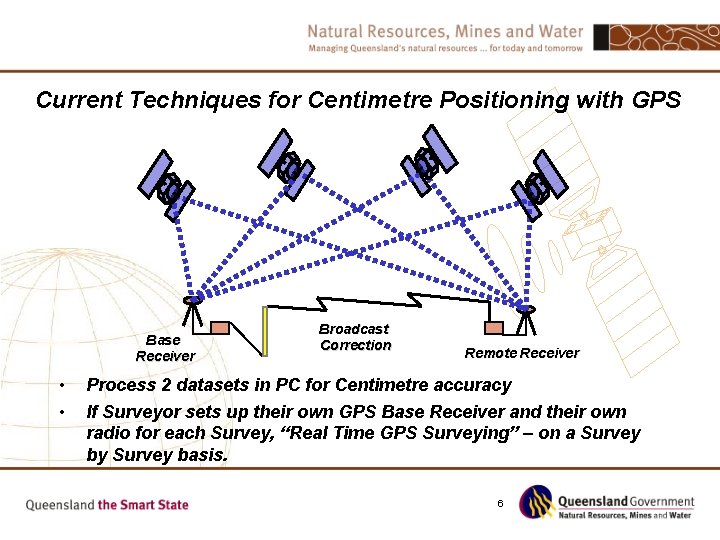
Current Techniques for Centimetre Positioning with GPS Base Receiver • • Broadcast Correction Remote Receiver Process 2 datasets in PC for Centimetre accuracy If Surveyor sets up their own GPS Base Receiver and their own radio for each Survey, “Real Time GPS Surveying” – on a Survey by Survey basis. 6

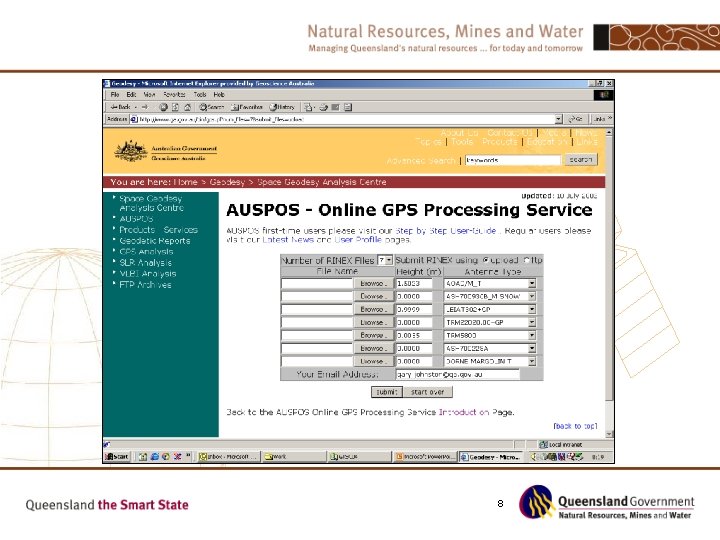
Continuously Operating Reference Stations (CORS) - Next Logical Step • Australian Regional GNSS Network – Geoscience Australia (National and International obligations); – Supporting Post-Processed Carrier Phase based positioning; – AUSPOS – Online Processing Service. • CORS Networks in Australian States and Territories – Government owned networks in Victoria, Queensland, New South Wales and Northern Territory – Private Sector Network in West Australia – Supporting Post-Processed Carrier Phase based positioning; – Delivering Real-Time corrections for Carrier Phase based positioning; – Not full national coverage for centimetre accuracy. • Nationwide Commercial Services from Omnistar and Starfire - Decimetre 7
8
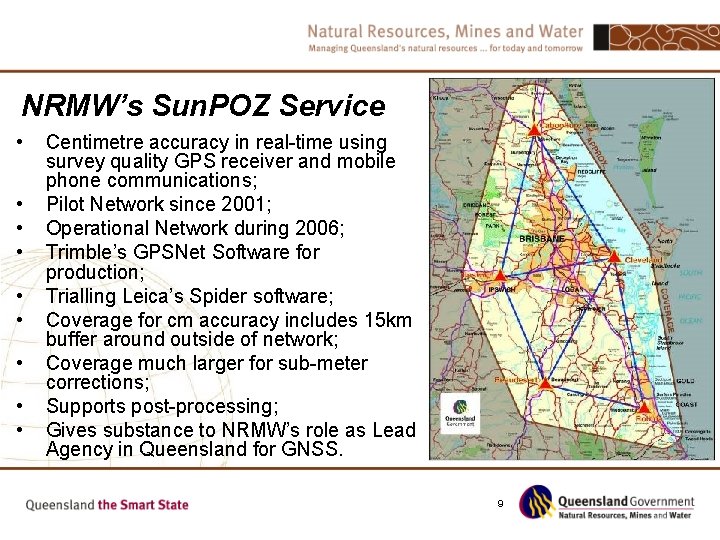
NRMW’s Sun. POZ Service • • • Centimetre accuracy in real-time using survey quality GPS receiver and mobile phone communications; Pilot Network since 2001; Operational Network during 2006; Trimble’s GPSNet Software for production; Trialling Leica’s Spider software; Coverage for cm accuracy includes 15 km buffer around outside of network; Coverage much larger for sub-meter corrections; Supports post-processing; Gives substance to NRMW’s role as Lead Agency in Queensland for GNSS. 9
Expanding User Base for Centimetre Accuracy • Traditional Surveying users embracing online processing and realtime surveying – but the user base is moving beyond surveyors; • New applications for centimetre accuracy, especially in “Machine Guidance” for Agriculture, Construction and Mining; • High value and high cost industries where marginal improvements to efficiency bring large $ savings; • Also a growing number of users who only need 10 cm but with very high reliability (eg they require 5*sigma so 1*sigma must be 2 cm) • Reliance on high accuracy GNSS services by these new users is leading to a new category of “liability critical” applications so suppliers need to deliver 2 cm @ 24/7! 10
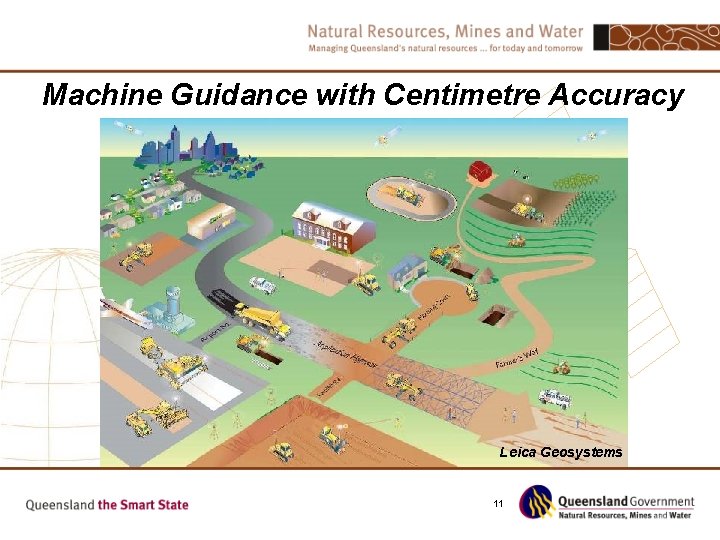
Machine Guidance with Centimetre Accuracy Leica Geosystems 11
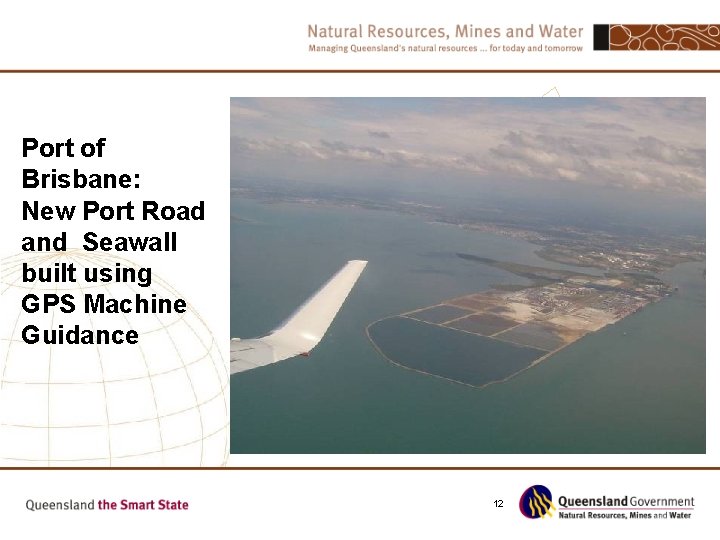
Port of Brisbane: New Port Road and Seawall built using GPS Machine Guidance 12
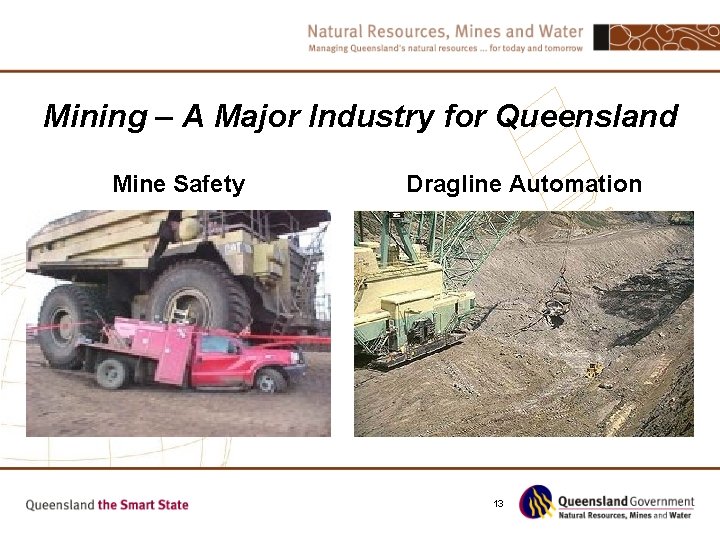
Mining – A Major Industry for Queensland Mine Safety Dragline Automation 13
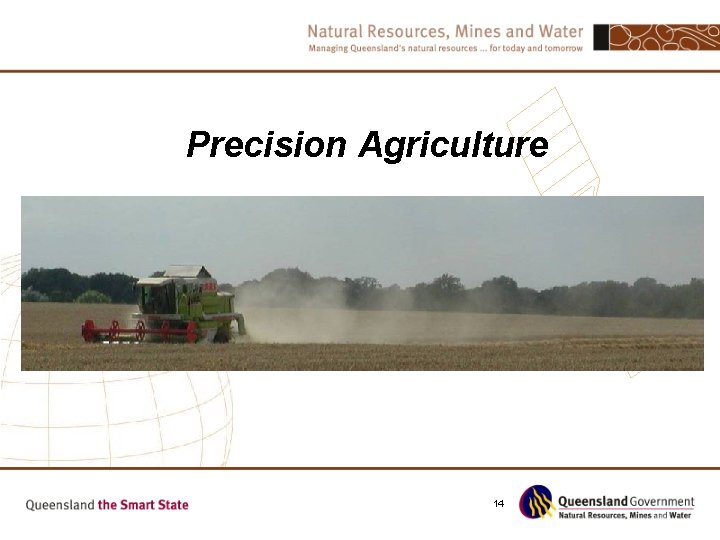
Precision Agriculture 14
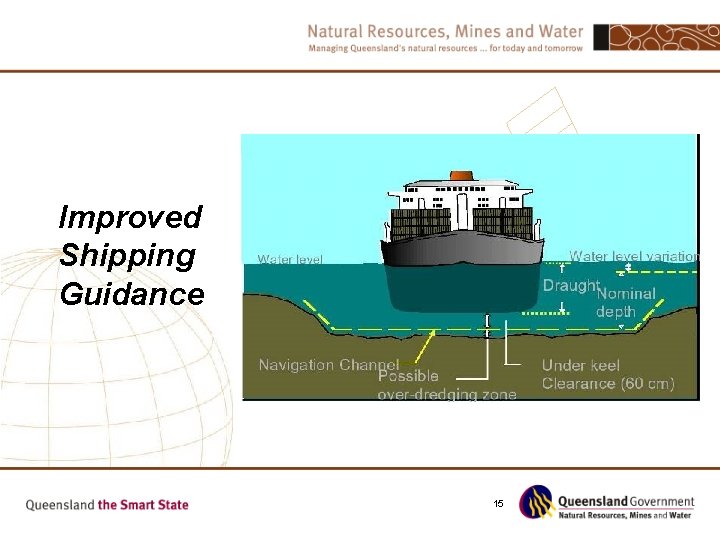
Improved Shipping Guidance 15
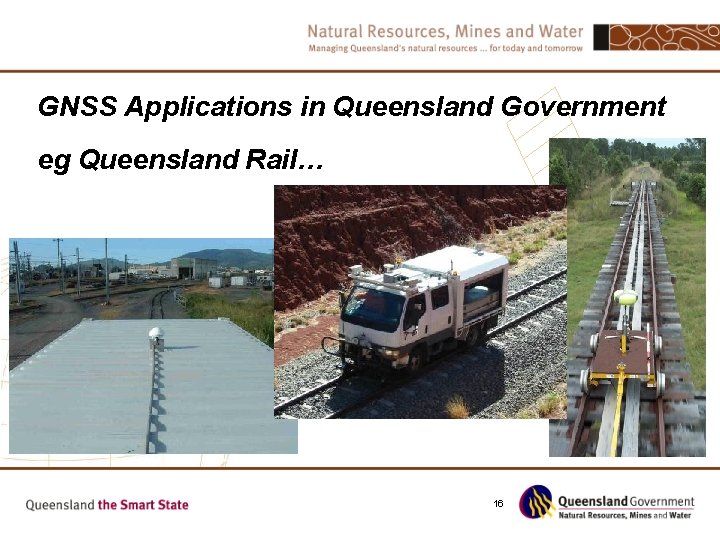
GNSS Applications in Queensland Government eg Queensland Rail… 16

What about the future? … More Satellites 17
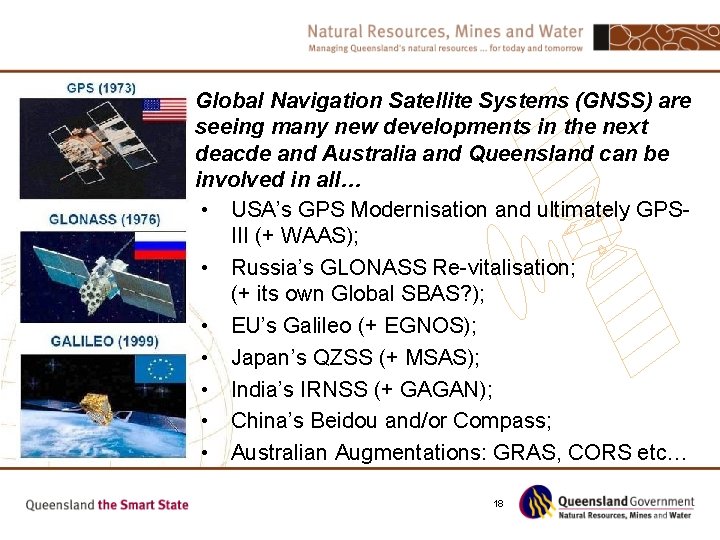
Global Navigation Satellite Systems (GNSS) are seeing many new developments in the next deacde and Australia and Queensland can be involved in all… • USA’s GPS Modernisation and ultimately GPSIII (+ WAAS); • Russia’s GLONASS Re-vitalisation; (+ its own Global SBAS? ); • EU’s Galileo (+ EGNOS); • Japan’s QZSS (+ MSAS); • India’s IRNSS (+ GAGAN); • China’s Beidou and/or Compass; • Australian Augmentations: GRAS, CORS etc… 18
What about the future? … More Signals 19
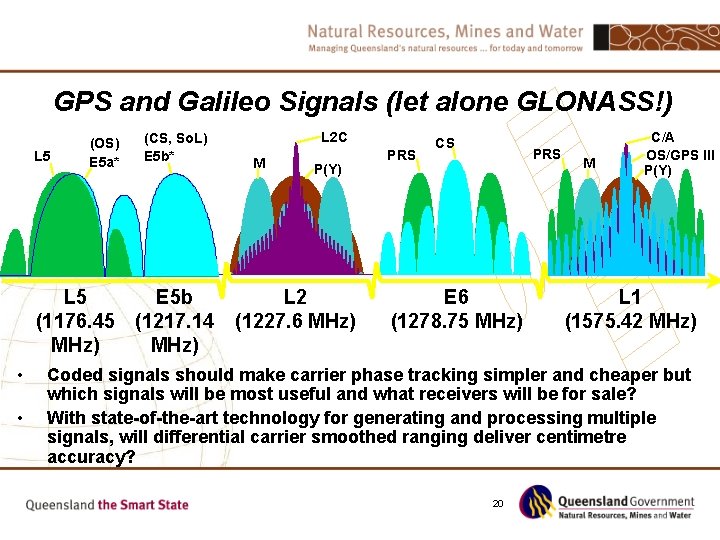
GPS and Galileo Signals (let alone GLONASS!) L 5 (OS) E 5 a* L 5 (1176. 45 MHz) • • (CS, So. L) E 5 b* E 5 b (1217. 14 MHz) L 2 C M P(Y) L 2 (1227. 6 MHz) PRS CS PRS E 6 (1278. 75 MHz) M C/A OS/GPS III P(Y) L 1 (1575. 42 MHz) Coded signals should make carrier phase tracking simpler and cheaper but which signals will be most useful and what receivers will be for sale? With state-of-the-art technology for generating and processing multiple signals, will differential carrier smoothed ranging deliver centimetre accuracy? 20
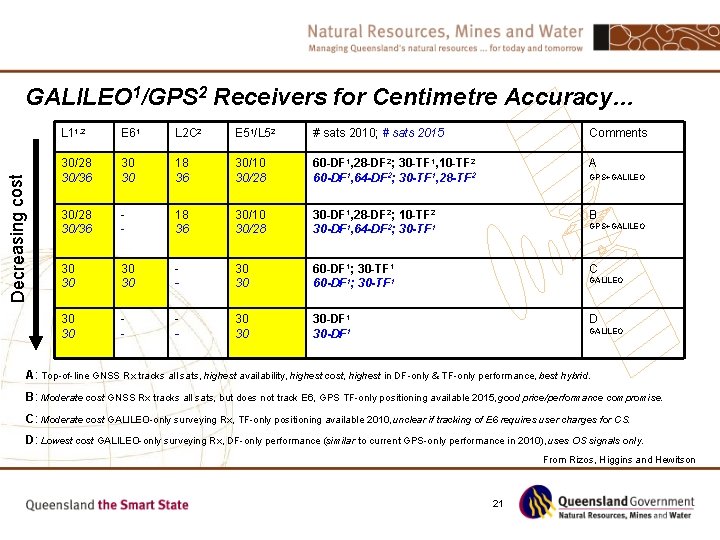
Decreasing cost GALILEO 1/GPS 2 Receivers for Centimetre Accuracy… L 11, 2 E 61 L 2 C 2 E 51/L 52 # sats 2010; # sats 2015 Comments 30/28 30/36 30 30 18 36 30/10 30/28 60 -DF 1, 28 -DF 2; 30 -TF 1, 10 -TF 2 60 -DF 1, 64 -DF 2; 30 -TF 1, 28 -TF 2 A 30/28 30/36 - 18 36 30/10 30/28 30 -DF 1, 28 -DF 2; 10 -TF 2 30 -DF 1, 64 -DF 2; 30 -TF 1 B 30 30 - 30 30 60 -DF 1; 30 -TF 1 C 30 30 - - 30 30 30 -DF 1 D GPS+GALILEO A: Top-of-line GNSS Rx tracks all sats, highest availability, highest cost, highest in DF-only & TF-only performance, best hybrid. B: Moderate cost GNSS Rx tracks all sats, but does not track E 6, GPS TF-only positioning available 2015, good price/performance compromise. C: Moderate cost GALILEO-only surveying Rx, TF-only positioning available 2010, unclear if tracking of E 6 requires user charges for CS. D: Lowest cost GALILEO-only surveying Rx, DF-only performance (similar to current GPS-only performance in 2010), uses OS signals only. From Rizos, Higgins and Hewitson 21

What about the future? … More Infrastructure 22
A Major National Initiative for CORS • National Collaborative Research Infrastructure Strategy • $540 m over 7 years • Bids between 5 m and 60 m • Infrastructure to encourage research in Australia targeting the National Research Priorities From Geoscience Australia 23
A Major National Initiative for CORS • Capability Area on “Structure and Evolution of the Australian Continent”; • Geospatial Reference Frame enhancement – Expanded VLBI, SLR, Gravimetry, GNSS; • Improve the Realisation of ITRF in Australia – GNSS network covering majority of applications; –State and Territory Cooperation. From Geoscience Australia 24
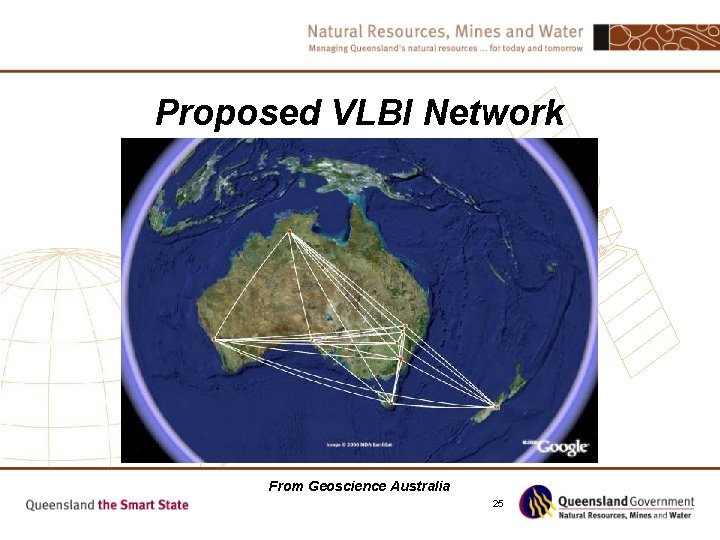
Proposed VLBI Network From Geoscience Australia 25
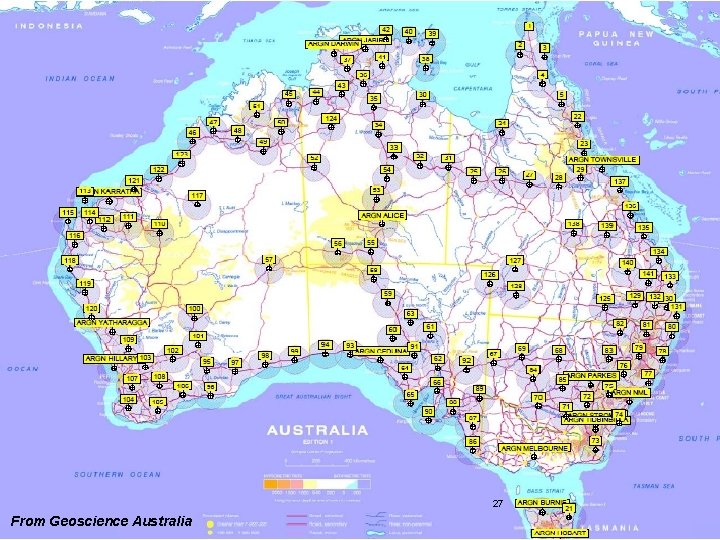
Proposed GNSS Network • • • Cross continental GNSS transects for measuring intra-plate deformation Station spacing of 200 km, resulting in users not being more then 100 km from nearest CORS station Circum-continental coverage for measuring plate dynamics, and sea level change Major road and rail routes covered Major agricultural areas covered Major population zones covered Major areas of environmental research covered Some of the existing mining industry areas covered, although it is envisaged that this number would be increase by mine operators adding their sites collaboratively to the network. Major tourism areas covered From Geoscience Australia 26
27 From Geoscience Australia
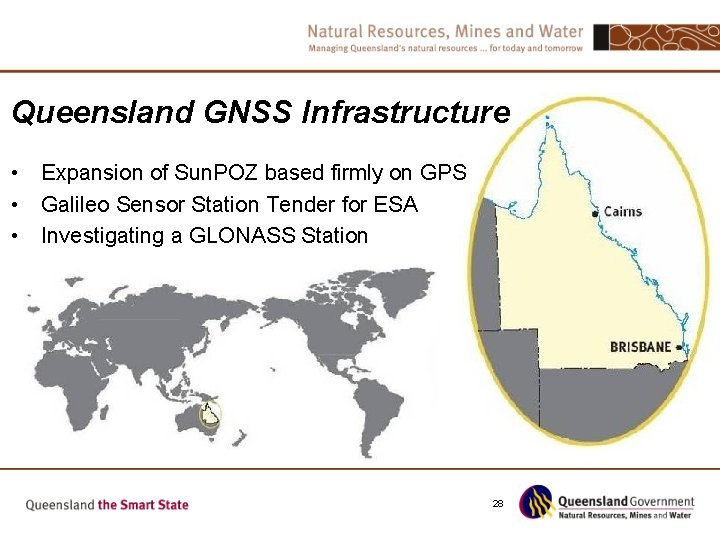
Queensland GNSS Infrastructure • Expansion of Sun. POZ based firmly on GPS • Galileo Sensor Station Tender for ESA • Investigating a GLONASS Station 28
Conclusion • Carrier phased based positioning is a growth area due to the increasing number of users requiring centimetre accuracy; • Delivering high accuracy GNSS services to new users with “liability critical” applications is a challenge; • We are moving from an environment dominated by GPS to a multi-system, multi-signal environment, which is also a challenge; • These issues require constant review to ensure provision of the necessary and suitable infrastructure. 29
- Slides: 29