
Carrier Modulation in Digital Communication Systems Xavier Fernando
- Slides: 6
Carrier Modulation in Digital Communication Systems Xavier Fernando Ryerson Communications Lab (RCL)
Why Carrier Modulation? �Until now we have been looking at baseband communications �The information is sampled, quantized pulse coded and transmitted in baseband �However, baseband transmission is not suitable in many situations �Carrier modulation is needed in these cases �Fe examples are listed in the next few slides
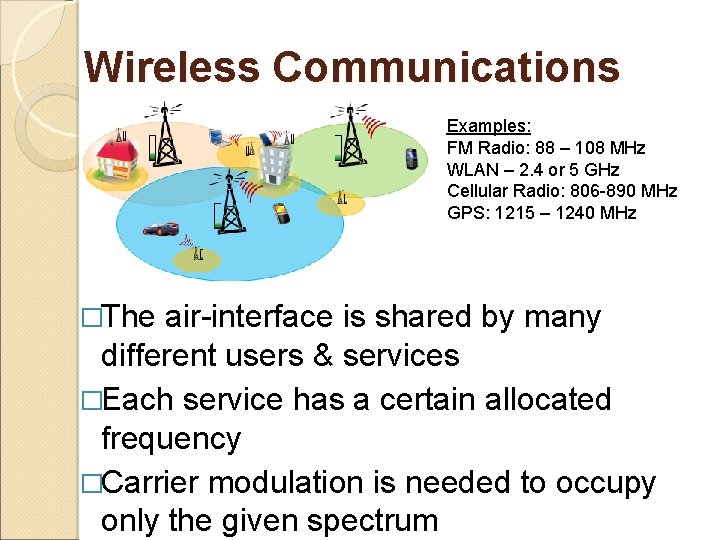
Wireless Communications Examples: FM Radio: 88 – 108 MHz WLAN – 2. 4 or 5 GHz Cellular Radio: 806 -890 MHz GPS: 1215 – 1240 MHz �The air-interface is shared by many different users & services �Each service has a certain allocated frequency �Carrier modulation is needed to occupy only the given spectrum
Digital Telephony/Cable Modem �Many of you may have Rogers Digital Phone & Cable Modem �The voice and internet data is modulated on a carrier frequency (not overlapping with TV Bands) and transmitted via cable in addition TV Channels using QPSK or 16 QAM modulation �TV Bands: 60 -88 MHz, 180 – 216
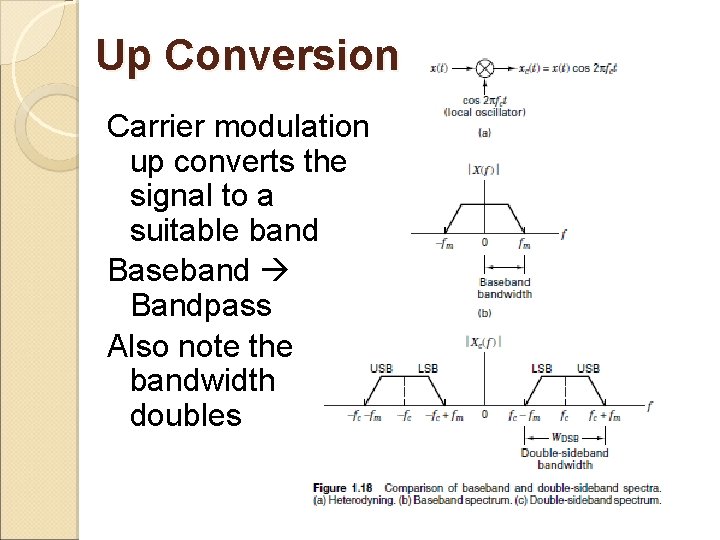
Up Conversion Carrier modulation up converts the signal to a suitable band Baseband Bandpass Also note the bandwidth doubles
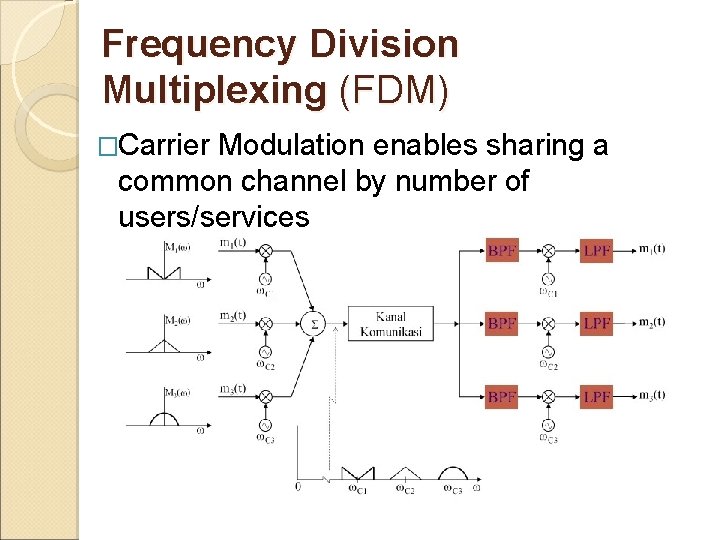
Frequency Division Multiplexing (FDM) �Carrier Modulation enables sharing a common channel by number of users/services