
Caroline Bowen Modelling Copyright 2011 Caroline Bowen All
Caroline Bowen Modelling Copyright © 2011 Caroline Bowen
All children are language learners Part of their speech and language development is innate. Part of it is learned through the modelling of people around them. Parents are young children’s main speech and language models. Copyright © 2011 Caroline Bowen
Modelling? 1. 2. Providing a ‘model’ or example, all the time, of how to communicate. ‘modelling’ an example of a specific language or speech ‘target’. Copyright © 2011 Caroline Bowen
Target A target is a speech or language “behaviour” that we want to encourage a child to use when communicating. Copyright © 2011 Caroline Bowen
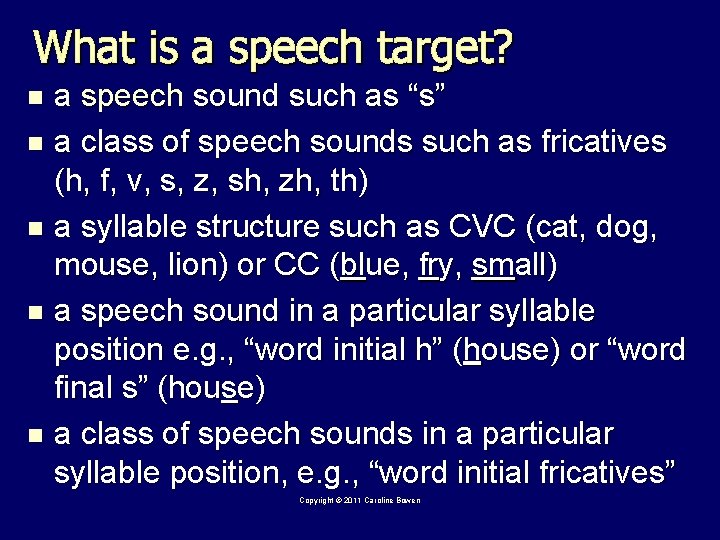
What is a speech target? a speech sound such as “s” n a class of speech sounds such as fricatives (h, f, v, s, z, sh, zh, th) n a syllable structure such as CVC (cat, dog, mouse, lion) or CC (blue, fry, small) n a speech sound in a particular syllable position e. g. , “word initial h” (house) or “word final s” (house) n a class of speech sounds in a particular syllable position, e. g. , “word initial fricatives” n Copyright © 2011 Caroline Bowen
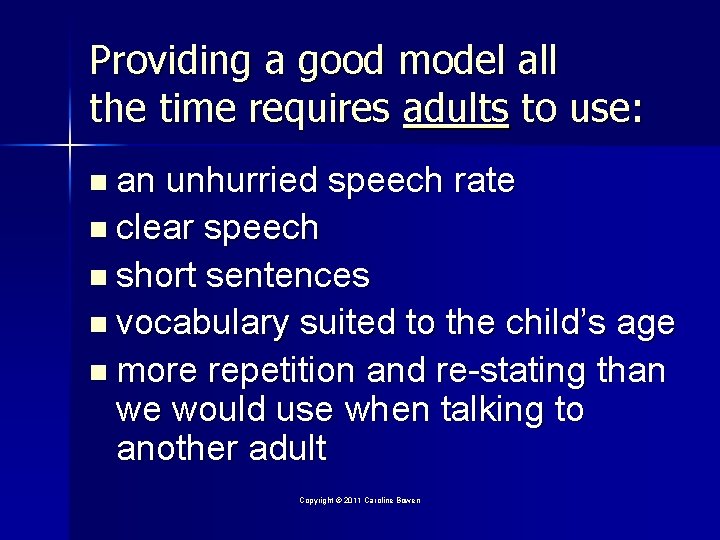
Providing a good model all the time requires adults to use: n an unhurried speech rate n clear speech n short sentences n vocabulary suited to the child’s age n more repetition and re-stating than we would use when talking to another adult Copyright © 2011 Caroline Bowen
There are many ways to provide speech models The following examples are of ineffective ways to model. They are particularly ineffective for children with speech sound disorders. C = child A = adult Copyright © 2011 Caroline Bowen
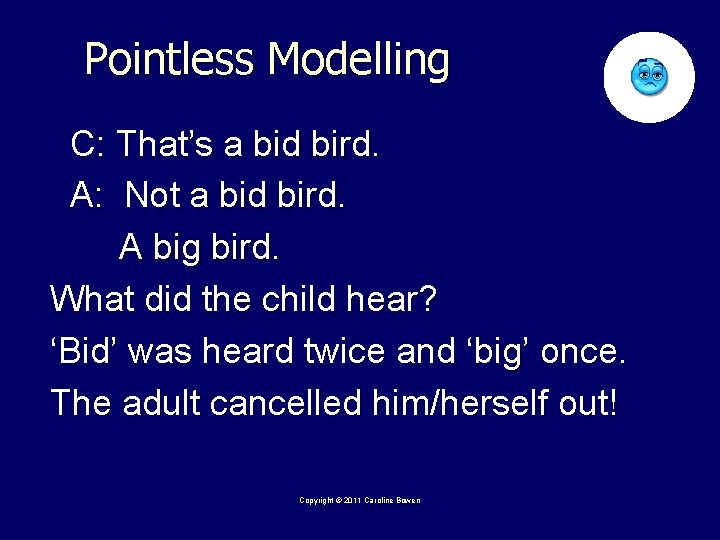
Pointless Modelling C: That’s a bid bird. A: Not a bid bird. A big bird. What did the child hear? ‘Bid’ was heard twice and ‘big’ once. The adult cancelled him/herself out! Copyright © 2011 Caroline Bowen
Ineffective. Modelling C: That’s a bid bird. A: Not a bid bird. You don’t say ‘bid bird’ You have to remember to say ‘big bird’. Child tunes out Child heard ‘bid’ three times, and ‘big’ once (if he or she was listening) Copyright © 2011 Caroline Bowen
Exaggerated modelling C: Pease can I have one? A: You mean puh-leeze. Puh-leeze may I have one? C: [THINKS] Yeah, yeah This exaggerated sort of modelling is inadvisable. It distorts the sounds, so that the child does not hear the target properly. Copyright © 2011 Caroline Bowen
Questions! C: He hurt his weg. A: Hurt his weg? What are you supposed to say? C: [thinks] Huh? In this example NO speech model has been provided. Copyright © 2011 Caroline Bowen
Questions! C: I want the wed one pweeze. A: You want the which one pweeze? No speech model has been provided. Copyright © 2011 Caroline Bowen
Too much “talk” C: Tan you det it? A: Not tan you det it. Can you get it. You say it: can you get it. C: Tan you det it. Followed by short talk on ‘can’, ‘tan’, ‘get’ and ‘det’ – sigh! Copyright © 2011 Caroline Bowen
Modelling via a single ‘recast’ The following example is typical of the way parents ‘model’ when their typical language learner makes a speech error. The adult ‘recasts’ what the child says … ONCE Copyright © 2011 Caroline Bowen
‘Weak’ Modelling C: That’s a bid bird. A: It is a big bird. It ‘comes naturally’ to model this way; it is OK for a ‘typical’ language learner but not ‘powerful’ enough for a child with a speech sound disorder. Copyright © 2011 Caroline Bowen
Effective conversational modelling The following examples are of ways to model effectively when speaking to children who are having difficulties with speech sound development. Copyright © 2011 Caroline Bowen
Modelling correction C: I like his punny pace. A: I like his funny face too. It’s a really funny face. A funny face. Do you know what that guy with the funny face is called? Copyright © 2011 Caroline Bowen
Modelling correction C: Det it down! A: Get what down? Oh, get this down? OK. I’ll get it for you. I think I can reach. Uh-huh, I can get it. Copyright © 2011 Caroline Bowen
Important! Parents are young children’s main speech and language models. Speech and language development is a gradual process. Expect children’s speech progress to be gradual. Copyright © 2011 Caroline Bowen

Copyright © 2011 Caroline Bowen
- Slides: 20