
Carnivore Meat eater Plant eater Omnivore Eats both

Carnivore: Meat eater ____: Plant eater Omnivore: Eats both plants AND animals
C Incisors- foremost teeth used to bite into food Canines- largest teeth, used for tearing food (if present in mouth) Premolars & Molars- _____ and _____ food
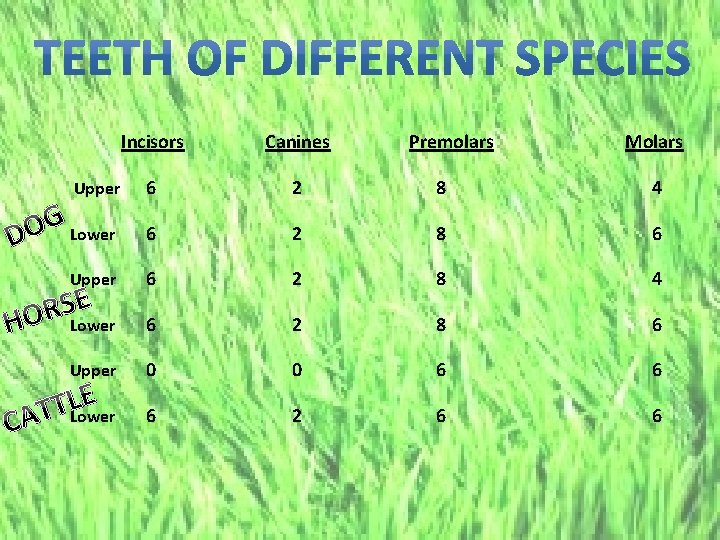
Upper G Lower O D Upper E S R HO Lower Upper C E L T AT Lower Incisors Canines Premolars Molars 6 2 8 4 6 2 8 6 0 0 6 6 6 2 6 6
Saliva: • produced by FOUR salivary glands. • Contains enzyme _______ which begins to break down starch into simple sugar, maltose. • Helps maintain stable p. H in mouth. • Makes food easier to swallow. Tongue: • Helps to obtain food and moves it around in mouth to aid in chewing _____- food that is ground into a small ball and ready to be swallowed.
Esophagus- • Delivers food through neck, chest cavity, and diaphragm into stomach • Food is propelled by _____ (set of muscle contractions in a hollow organ that propels its contents) Stomach- • Secretes _______ juices and muscle contractions to break down food. • Little absorption occurs here Monogastric- single stomach Examples…. . _____- four compartment stomach Examples…. .
Liver & Pancreas. Bo and stores certain • Controls blood _____ levels vitamins and iron • Both secrete digestive enzymes needed for further _____ Small Intestine • Lined with finger-like projections called _____, which aid in absorption of nutrients • Much of digestion and absorption of nutrients occur within small intestine THREE PARTS: 1. Duodenum, 2. Jejunum, 3. Ileum
Large Intestine • Absorbs water from material that will become feces • Three parts: Colon, _____, Rectum **Note: Horses have a well-developed large intestine Cecum is very long- 1. 25 meters (4. 1 Feet), can hold 25 -30 Liters
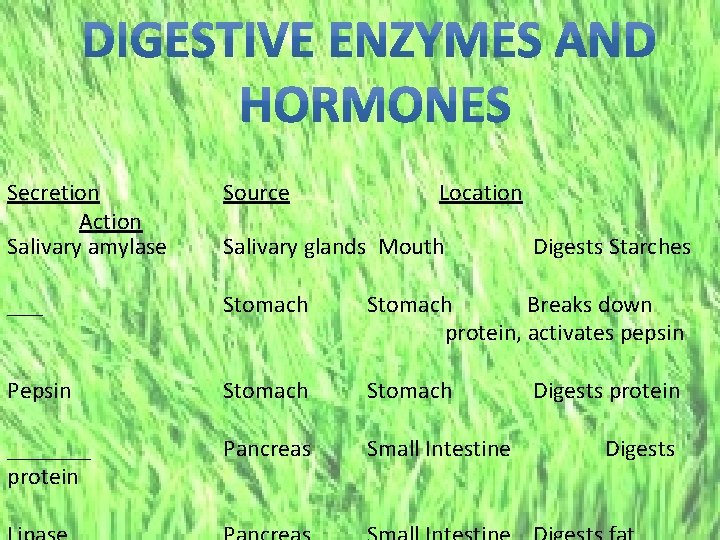
Secretion Action Salivary amylase Source Location ___ Stomach Breaks down protein, activates pepsin Pepsin Stomach _______ protein Pancreas Small Intestine Salivary glands Mouth Digests Starches Digests protein Digests
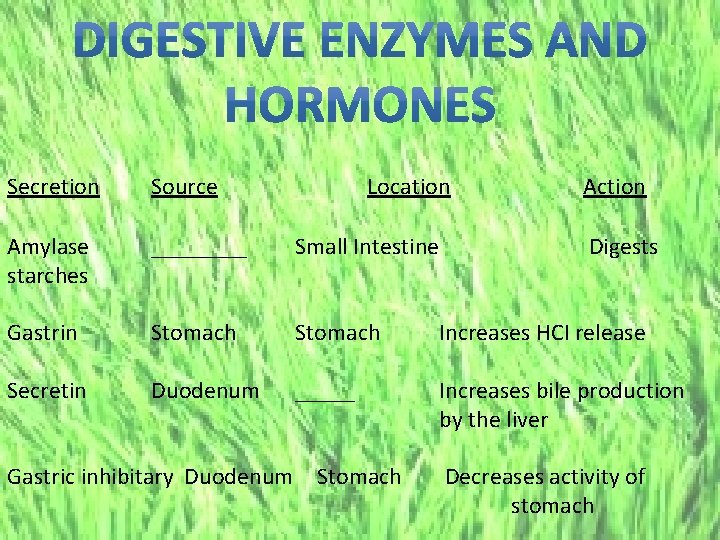
Secretion Source Location Amylase starches ____ Small Intestine Gastrin Stomach Increases HCI release Secretin Duodenum _____ Increases bile production by the liver Gastric inhibitary Duodenum Stomach Action Digests Decreases activity of stomach
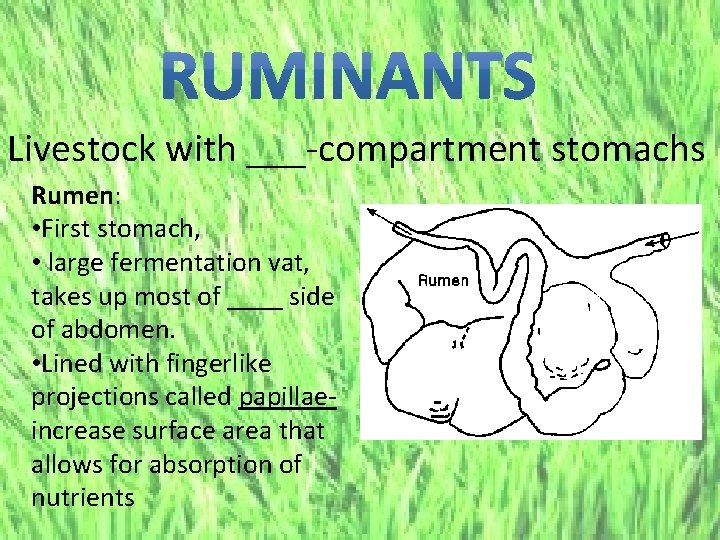
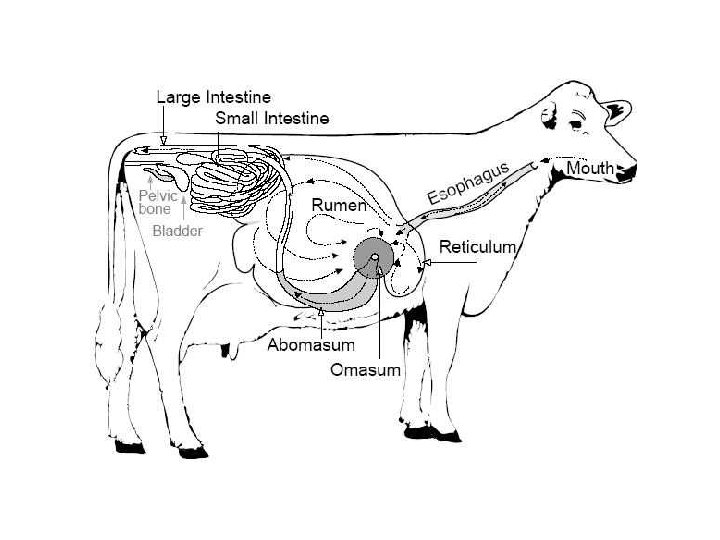
Livestock with ___-compartment stomachs Rumen: • First stomach, • large fermentation vat, takes up most of ____ side of abdomen. • Lined with fingerlike projections called papillaeincrease surface area that allows for absorption of nutrients
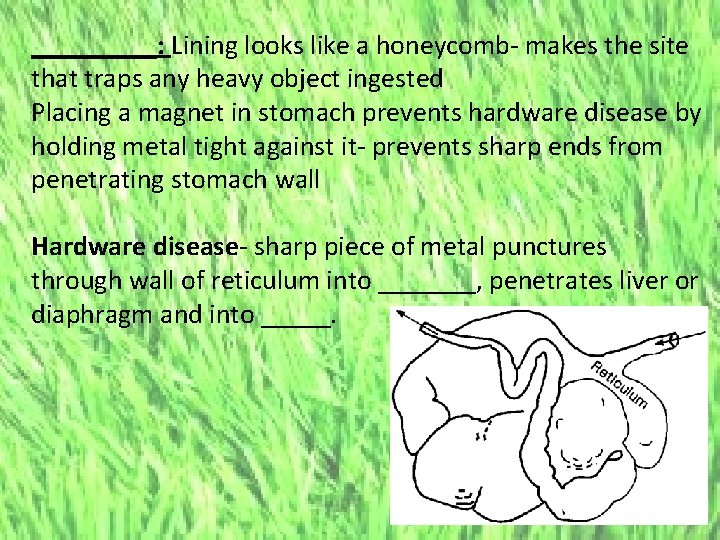
_____: Lining looks like a honeycomb- makes the site that traps any heavy object ingested Placing a magnet in stomach prevents hardware disease by holding metal tight against it- prevents sharp ends from penetrating stomach wall Hardware disease- sharp piece of metal punctures through wall of reticulum into _______, penetrates liver or diaphragm and into _____.
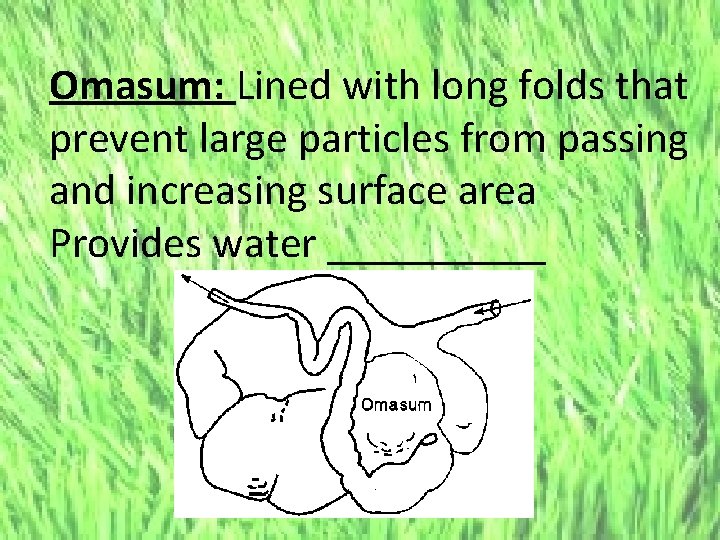
Omasum: Lined with long folds that prevent large particles from passing and increasing surface area Provides water _____
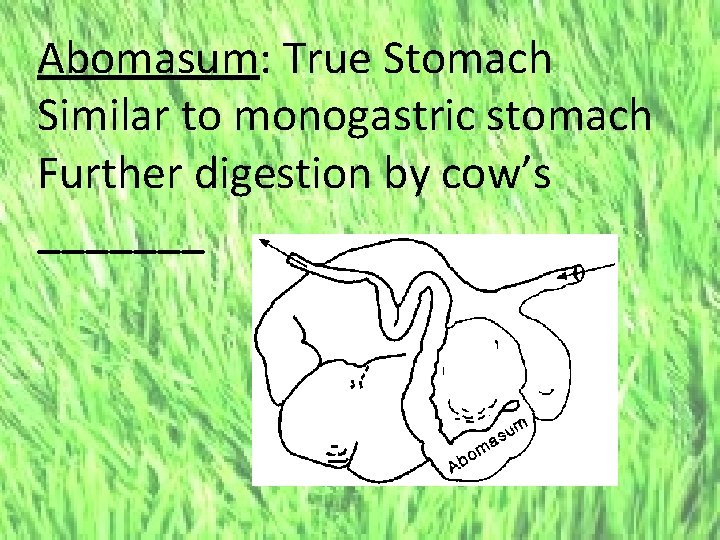
Abomasum: True Stomach Similar to monogastric stomach Further digestion by cow’s _______
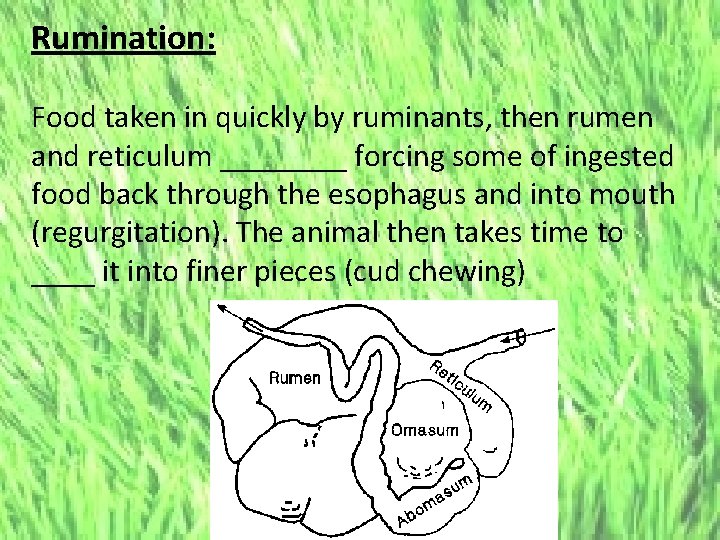
Rumination: Food taken in quickly by ruminants, then rumen and reticulum ____ forcing some of ingested food back through the esophagus and into mouth (regurgitation). The animal then takes time to ____ it into finer pieces (cud chewing)
_____- Abdominal illness in horses Symptoms- horse will turn and look or kick at their sides, lie down and get up frequently or roll to relieve pain. Common causes are _____ of food in small intestine, torsion (twist) of small intestine, extreme gas, excessive consumption of sand. _____- Large, gaseous distention of rumen (common in cattle). Cows must periodically belch to release the gas from the rumen; if not, bloat will result. In worst cases, a needle needs to be inserted in the cow’s side to relieve the gas. **Both can be fatal**
B Carbohydrates: • Supply vitamin E • Provide structure within a cell • Supply fiber and bulkiness to diet • Provides glucose to maintain blood sugar levels • Needed to complete _____ of fat Monosaccharide: simple sugars (Ex. Glucose, fructose) Disaccharides: two sugars (Ex. Lactose) Polysaccharide: long chains of simple sugars (Ex. Starch, cellulose)
Proteins: • Made of chains of _____ Acids • Key role in structure and function of cells • Act as enzymes, hormones, and antibodies • Utilized as a source of vitamin E for animals Essential amino acids: must be supplied in diet Include: arginine, histidine, isoleucine, lysine, leucine, methionine, phenylalanine, threonine, tryptophan, valine Nonessential amino acids: can be synthesized from other Amino Acids Deficiencies: poor growth, low body weight, poor immunity ____: • Immediate supply of E or stored. • Provides a source of E, insulation, and some protection to organs • Produces certain hormones • Increases palatability (tastiness) of food • Needed for absorption of certain vitamins.
Water: • Most critical nutrient • A loss of only ___ of the body’s water is a serious health risk • Loss of ___ or more is life threatening • Up to two thirds of the body is water • Provides shape to cells • Helps transport nutrients, wastes, and hormones in blood • Controls body temperature
Vitamins Most are needed in small amounts to maintain health and function of animals May act as enzymes or coenzymes Either: ___ soluble: absorbed from intestinal tract with Fat; stored in body- A, D, E, K _____ soluble: not stored in body, need to be taken on daily basis Eight Vitamin B’s and C Antioxidant (Vitamins A, C, E- protect lipid membranes of cells
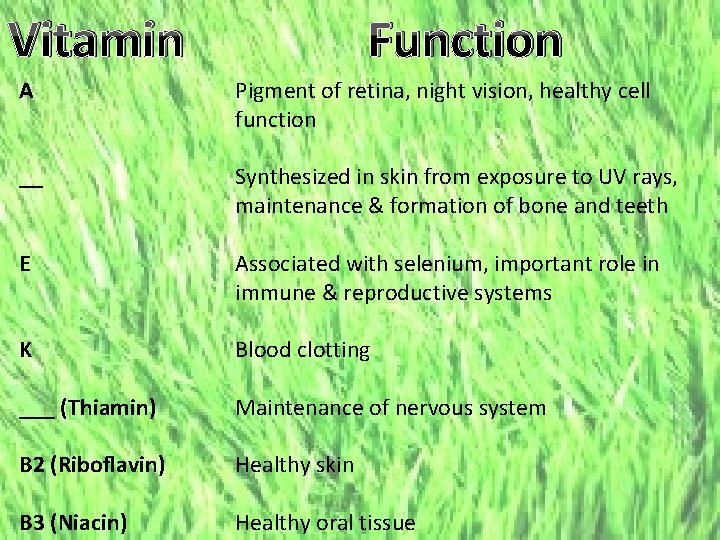
Vitamin Function A Pigment of retina, night vision, healthy cell function __ Synthesized in skin from exposure to UV rays, maintenance & formation of bone and teeth E Associated with selenium, important role in immune & reproductive systems K Blood clotting ___ (Thiamin) Maintenance of nervous system B 2 (Riboflavin) Healthy skin B 3 (Niacin) Healthy oral tissue
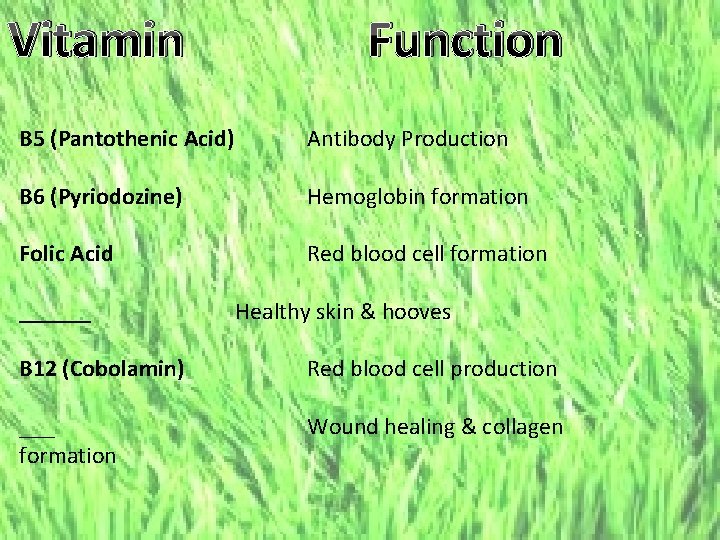
Vitamin Function B 5 (Pantothenic Acid) Antibody Production B 6 (Pyriodozine) Hemoglobin formation Folic Acid Red blood cell formation ______ Healthy skin & hooves B 12 (Cobolamin) Red blood cell production ___ formation Wound healing & collagen
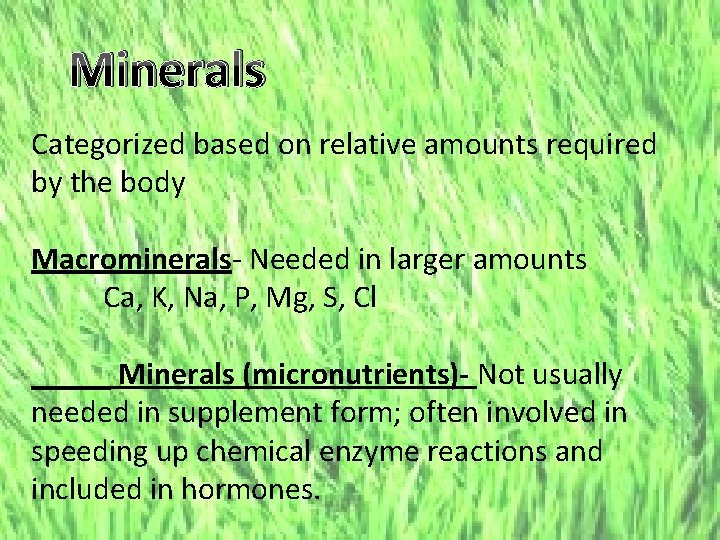
Minerals B Categorized based on relative amounts required by the body Macrominerals- Needed in larger amounts Ca, K, Na, P, Mg, S, Cl _____ Minerals (micronutrients)- Not usually needed in supplement form; often involved in speeding up chemical enzyme reactions and included in hormones.
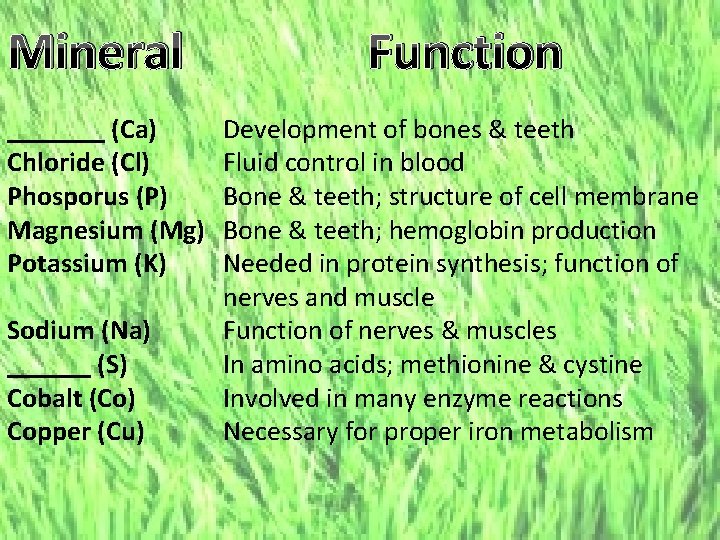
Mineral _______ (Ca) Chloride (Cl) Phosporus (P) Magnesium (Mg) Potassium (K) Sodium (Na) ______ (S) Cobalt (Co) Copper (Cu) Function Development of bones & teeth Fluid control in blood Bone & teeth; structure of cell membrane Bone & teeth; hemoglobin production Needed in protein synthesis; function of nerves and muscle Function of nerves & muscles In amino acids; methionine & cystine Involved in many enzyme reactions Necessary for proper iron metabolism
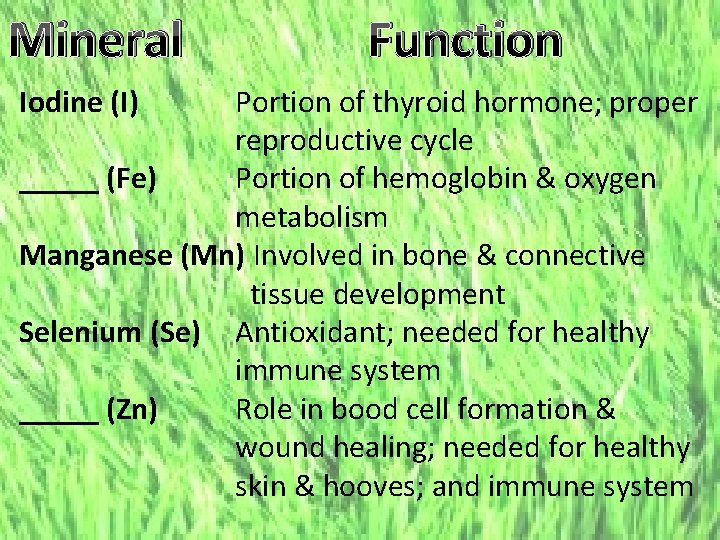
Mineral Iodine (I) Function Portion of thyroid hormone; proper reproductive cycle _____ (Fe) Portion of hemoglobin & oxygen metabolism Manganese (Mn) Involved in bone & connective tissue development Selenium (Se) Antioxidant; needed for healthy immune system _____ (Zn) Role in bood cell formation & wound healing; needed for healthy skin & hooves; and immune system
A Assignment: Research 3 Vitamins and 3 Minerals. For each, write a deficiency symptom and a food that it is found in
- Slides: 27