
Carnegie Mellon University Software Engineering Institute Software Architecture
- Slides: 30
Carnegie Mellon University Software Engineering Institute Software Architecture in Practice Chapter 8: The World Wide Web A Case Study in Interoperability Software Engineering Institute Carnegie Mellon University Pittsburgh, PA 15213 -3890 Sponsored by the U. S. Department of Defense © 1998 by Carnegie Mellon University Version 1. 0 Chapter 8 - page 1
Carnegie Mellon University Software Engineering Institute Lecture Objectives This lecture will enable students to • understand the relationship between the architecture of the World Wide Web (WWW) and the architectural environments that spawned it • understand techniques used by the WWW’s software developers to support scalability • understand how shifting requirements can cause an architecture to change over time © 1998 by Carnegie Mellon University Version 1. 0 Chapter 8 - page 2
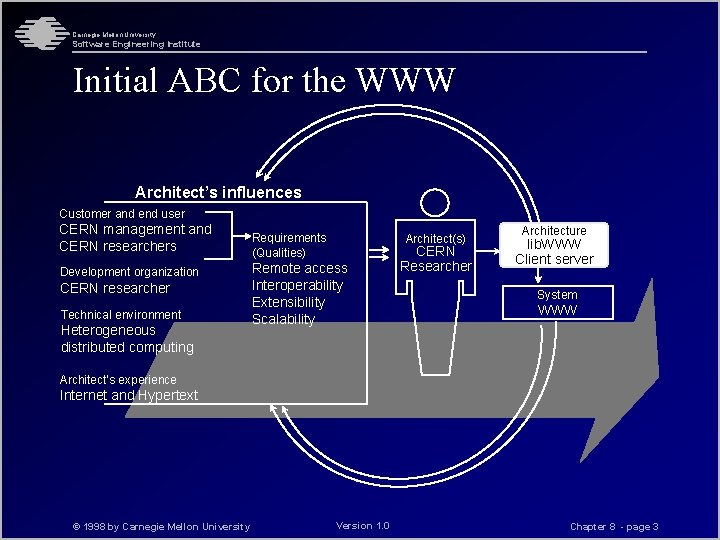
Carnegie Mellon University Software Engineering Institute Initial ABC for the WWW Architect’s influences Customer and end user CERN management and CERN researchers Development organization CERN researcher Technical environment Heterogeneous distributed computing Requirements (Qualities) Architect(s) Remote access Interoperability Extensibility Scalability CERN Researcher Architecture lib. WWW Client server System WWW Architect’s experience Internet and Hypertext © 1998 by Carnegie Mellon University Version 1. 0 Chapter 8 - page 3
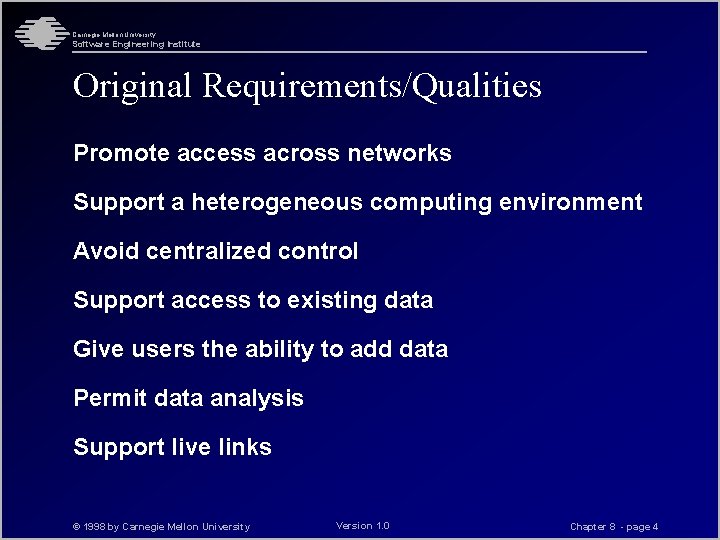
Carnegie Mellon University Software Engineering Institute Original Requirements/Qualities Promote access across networks Support a heterogeneous computing environment Avoid centralized control Support access to existing data Give users the ability to add data Permit data analysis Support live links © 1998 by Carnegie Mellon University Version 1. 0 Chapter 8 - page 4
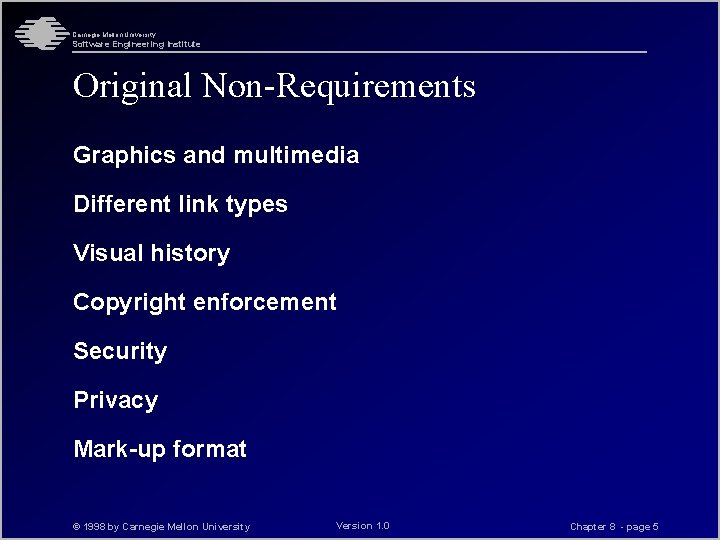
Carnegie Mellon University Software Engineering Institute Original Non-Requirements Graphics and multimedia Different link types Visual history Copyright enforcement Security Privacy Mark-up format © 1998 by Carnegie Mellon University Version 1. 0 Chapter 8 - page 5
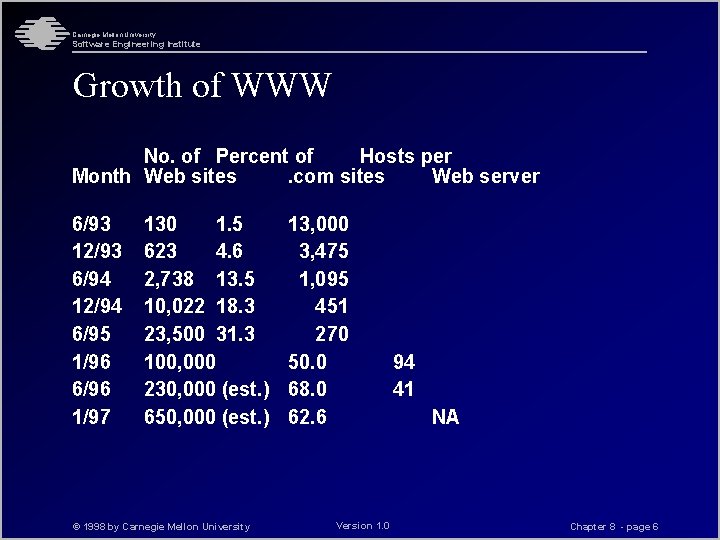
Carnegie Mellon University Software Engineering Institute Growth of WWW No. of Percent of Hosts per Month Web sites. com sites Web server 6/93 12/93 6/94 12/94 6/95 1/96 6/96 1/97 130 1. 5 623 4. 6 2, 738 13. 5 10, 022 18. 3 23, 500 31. 3 100, 000 230, 000 (est. ) 650, 000 (est. ) © 1998 by Carnegie Mellon University 13, 000 3, 475 1, 095 451 270 50. 0 68. 0 62. 6 Version 1. 0 94 41 NA Chapter 8 - page 6
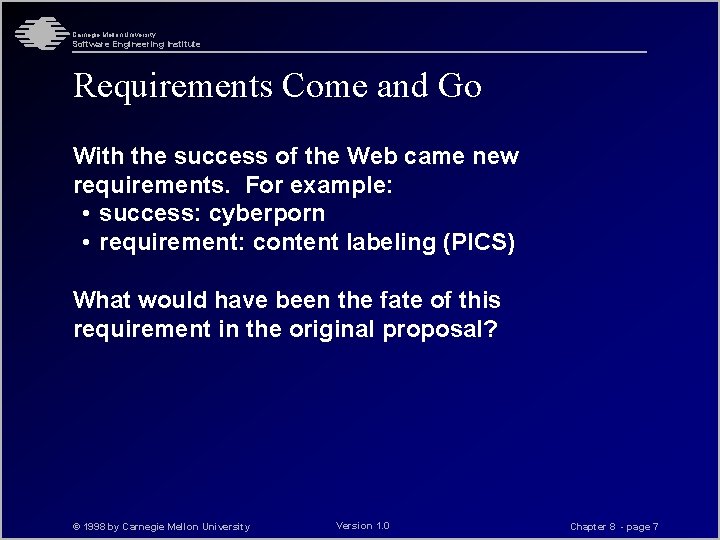
Carnegie Mellon University Software Engineering Institute Requirements Come and Go With the success of the Web came new requirements. For example: • success: cyberporn • requirement: content labeling (PICS) What would have been the fate of this requirement in the original proposal? © 1998 by Carnegie Mellon University Version 1. 0 Chapter 8 - page 7
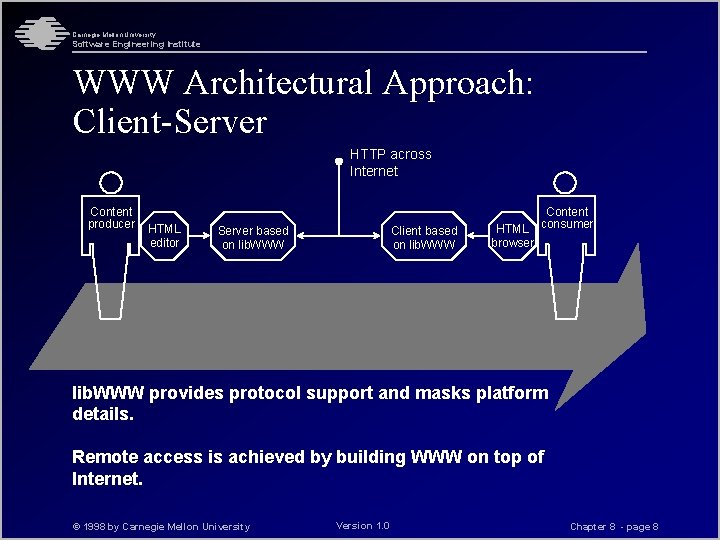
Carnegie Mellon University Software Engineering Institute WWW Architectural Approach: Client-Server HTTP across Internet Content producer HTML editor Server based on lib. WWW Client based on lib. WWW Content consumer HTML browser lib. WWW provides protocol support and masks platform details. Remote access is achieved by building WWW on top of Internet. © 1998 by Carnegie Mellon University Version 1. 0 Chapter 8 - page 8
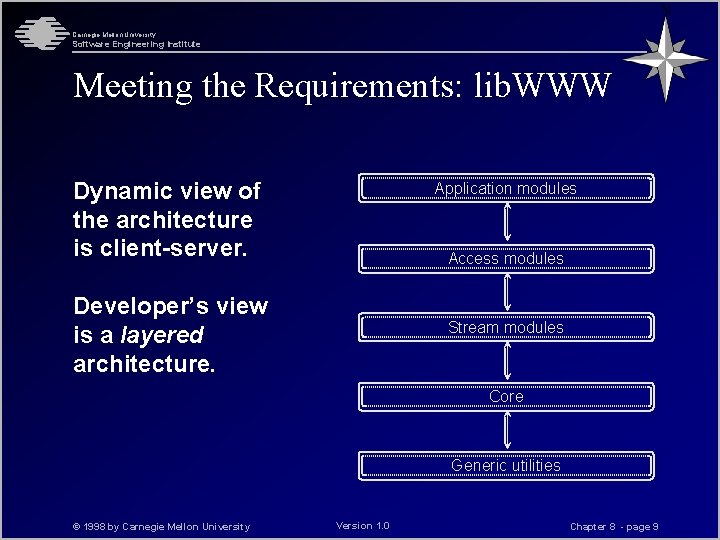
Carnegie Mellon University Software Engineering Institute Meeting the Requirements: lib. WWW Dynamic view of the architecture is client-server. Application modules Access modules Developer’s view is a layered architecture. Stream modules Core Generic utilities © 1998 by Carnegie Mellon University Version 1. 0 Chapter 8 - page 9
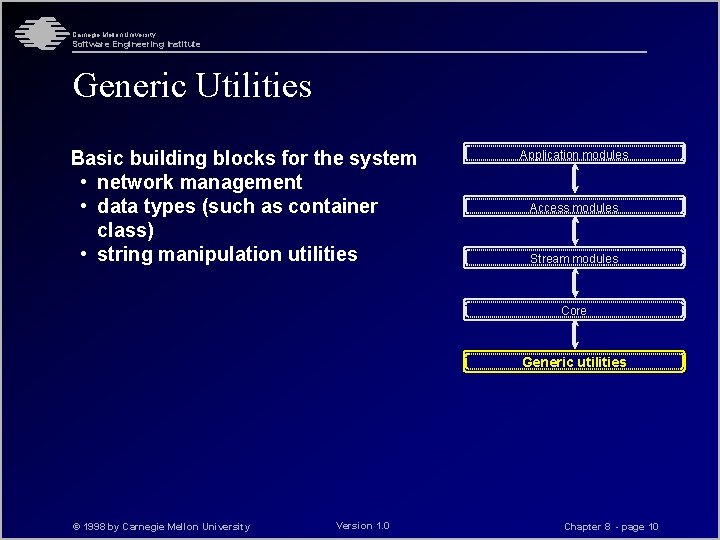
Carnegie Mellon University Software Engineering Institute Generic Utilities Basic building blocks for the system • network management • data types (such as container class) • string manipulation utilities Application modules Access modules Stream modules Core Generic utilities © 1998 by Carnegie Mellon University Version 1. 0 Chapter 8 - page 10
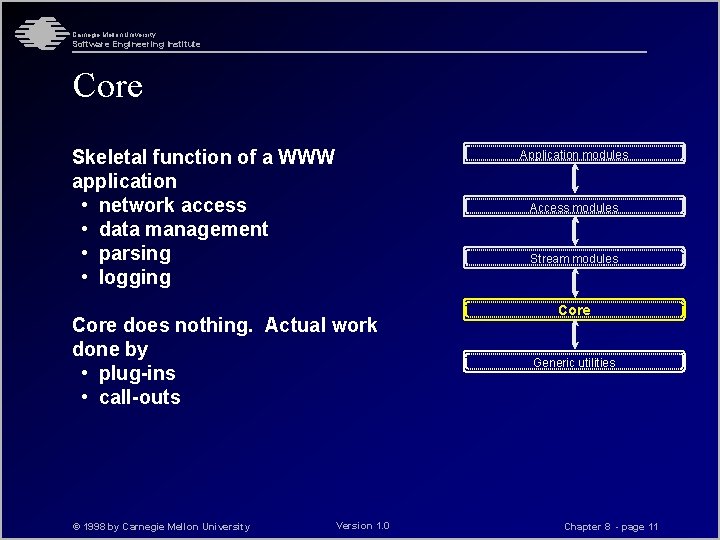
Carnegie Mellon University Software Engineering Institute Core Skeletal function of a WWW application • network access • data management • parsing • logging Application modules Access modules Stream modules Core does nothing. Actual work done by • plug-ins • call-outs © 1998 by Carnegie Mellon University Version 1. 0 Core Generic utilities Chapter 8 - page 11
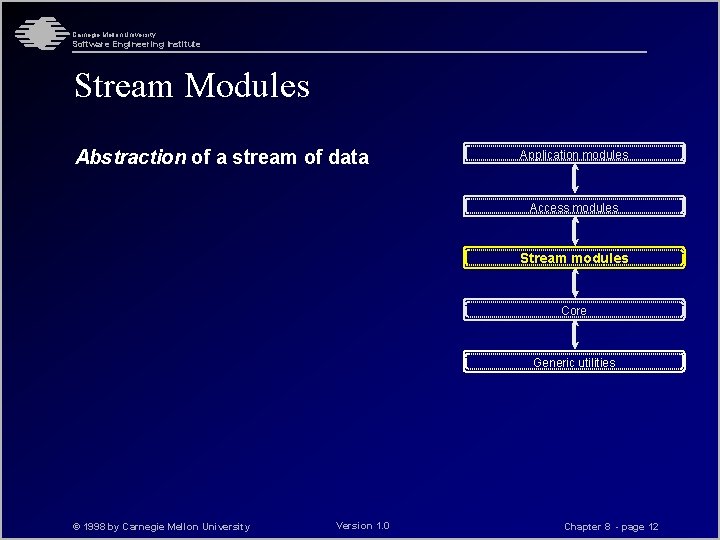
Carnegie Mellon University Software Engineering Institute Stream Modules Abstraction of a stream of data Application modules Access modules Stream modules Core Generic utilities © 1998 by Carnegie Mellon University Version 1. 0 Chapter 8 - page 12
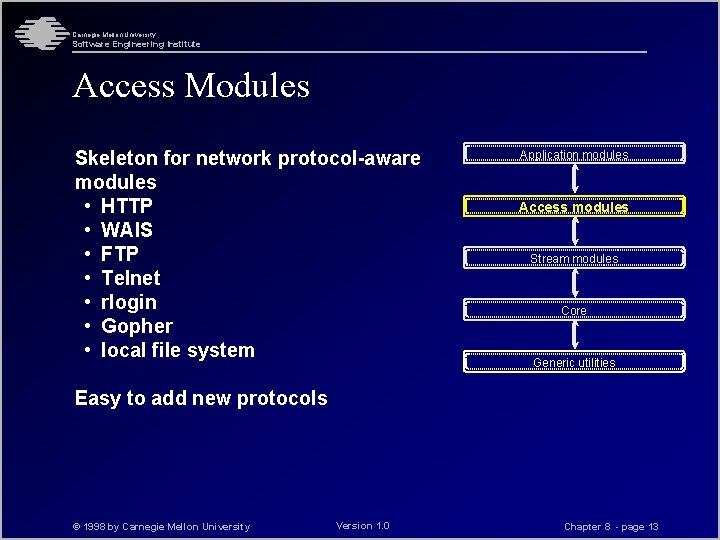
Carnegie Mellon University Software Engineering Institute Access Modules Skeleton for network protocol-aware modules • HTTP • WAIS • FTP • Telnet • rlogin • Gopher • local file system Application modules Access modules Stream modules Core Generic utilities Easy to add new protocols © 1998 by Carnegie Mellon University Version 1. 0 Chapter 8 - page 13
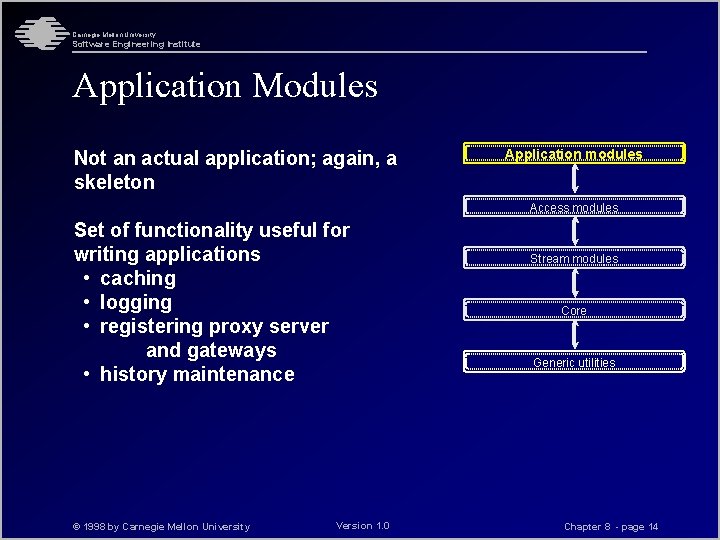
Carnegie Mellon University Software Engineering Institute Application Modules Not an actual application; again, a skeleton Application modules Access modules Set of functionality useful for writing applications • caching • logging • registering proxy server and gateways • history maintenance © 1998 by Carnegie Mellon University Version 1. 0 Stream modules Core Generic utilities Chapter 8 - page 14
Carnegie Mellon University Software Engineering Institute lib. WWW Lessons Learned lib. WWW has had many releases. Lessons learned from the many iterations include • Formalized application program interfaces (APIs) are required. • APIs must be layered. • APIs must support a dynamic, open-ended set of features. • APIs must be thread safe. Not all of these goals have been met! © 1998 by Carnegie Mellon University Version 1. 0 Chapter 8 - page 15
Carnegie Mellon University Software Engineering Institute Dynamic View of Typical WWW Architecture We will look at a typical client server. Layers of lib. WWW disappear in the runtime view. © 1998 by Carnegie Mellon University Version 1. 0 Chapter 8 - page 16
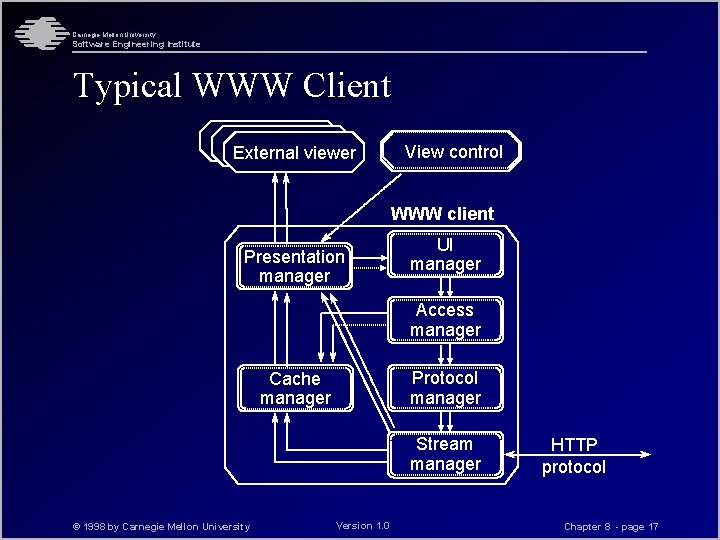
Carnegie Mellon University Software Engineering Institute Typical WWW Client External viewer View control WWW client Presentation manager UI manager Access manager Protocol manager Cache manager Stream manager © 1998 by Carnegie Mellon University Version 1. 0 HTTP protocol Chapter 8 - page 17
Carnegie Mellon University Software Engineering Institute Client Components User interface (UI) manager is responsible for the look and feel of the UI (e. g. , Web browser). Presentation manager delegates document types to viewers. • external: Quick. Time movies • internal: HTML to UI manager captures user’s request for URL and passes to access manager. Access manager determines if URL has been cached and if it has not, it initiates retrieval through protocol and stream managers. © 1998 by Carnegie Mellon University Version 1. 0 Chapter 8 - page 18
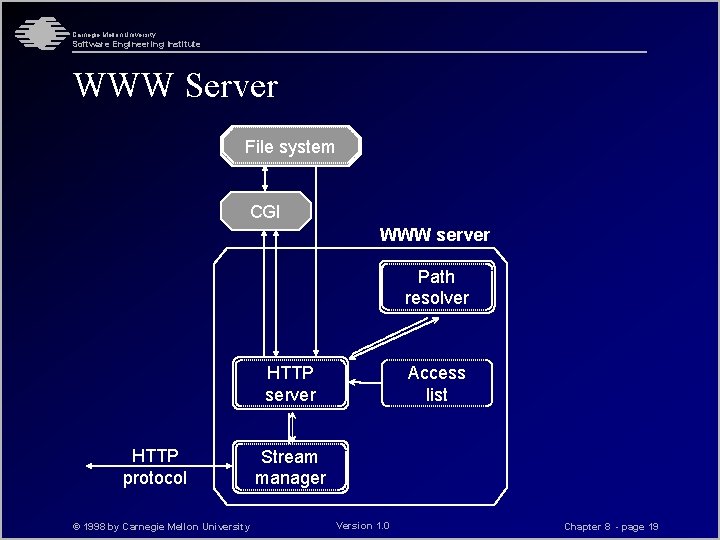
Carnegie Mellon University Software Engineering Institute WWW Server File system CGI WWW server Path resolver HTTP server HTTP protocol © 1998 by Carnegie Mellon University Access list Stream manager Version 1. 0 Chapter 8 - page 19
Carnegie Mellon University Software Engineering Institute Server Components -1 Hypertext transfer protocol (HTTP) server receives request for URL, and passes that to the path resolver, which determines the file location for the document (assuming local). HTTP server checks the access list to see if access is permitted and then gets the document from the file system. © 1998 by Carnegie Mellon University Version 1. 0 Chapter 8 - page 20
Carnegie Mellon University Software Engineering Institute Server Components -2 Common gateway interface (CGI) is a special document type that allows customized access to other data or programs. HTML is served by the HTTP server back to client. © 1998 by Carnegie Mellon University Version 1. 0 Chapter 8 - page 21
Carnegie Mellon University Software Engineering Institute Extending the Server CGI allows • dynamic documents • addition of data to existing databases • customized queries • clickable images CGI scripts • can be written in a variety of languages • run as separate processes © 1998 by Carnegie Mellon University Version 1. 0 Chapter 8 - page 22
Carnegie Mellon University Software Engineering Institute Problems With CGI Extensibility and “put” principally supported by CGI scripts in lib. WWW applications However • CGI has security holes • CGI is not portable One solution: Jigsaw resource objects © 1998 by Carnegie Mellon University Version 1. 0 Chapter 8 - page 23
Carnegie Mellon University Software Engineering Institute New Server Base Jigsaw is an object-oriented server. • written in Java • intended to replace lib. WWW for server side Jigsaw addresses • portability • security • ease of creation • extensibility (through use of resource objects) • efficiency (through minimization of file accesses) The architectural solution is Jigsaw. © 1998 by Carnegie Mellon University Version 1. 0 Chapter 8 - page 24
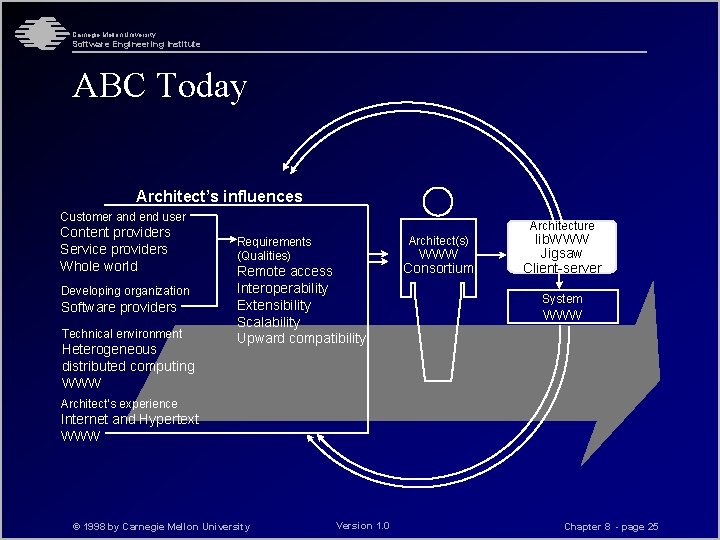
Carnegie Mellon University Software Engineering Institute ABC Today Architect’s influences Customer and end user Content providers Service providers Whole world Developing organization Software providers Technical environment Heterogeneous distributed computing WWW Architecture Architect(s) Requirements (Qualities) Remote access Interoperability Extensibility Scalability Upward compatibility WWW Consortium lib. WWW Jigsaw Client-server System WWW Architect’s experience Internet and Hypertext WWW © 1998 by Carnegie Mellon University Version 1. 0 Chapter 8 - page 25
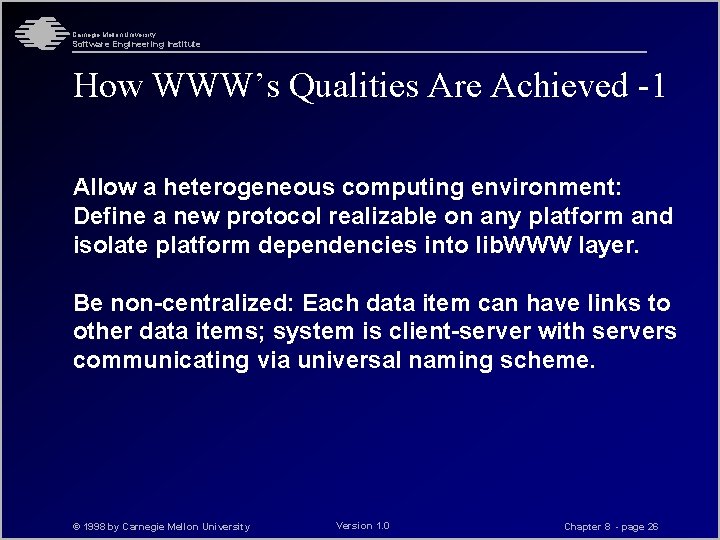
Carnegie Mellon University Software Engineering Institute How WWW’s Qualities Are Achieved -1 Allow a heterogeneous computing environment: Define a new protocol realizable on any platform and isolate platform dependencies into lib. WWW layer. Be non-centralized: Each data item can have links to other data items; system is client-server with servers communicating via universal naming scheme. © 1998 by Carnegie Mellon University Version 1. 0 Chapter 8 - page 26
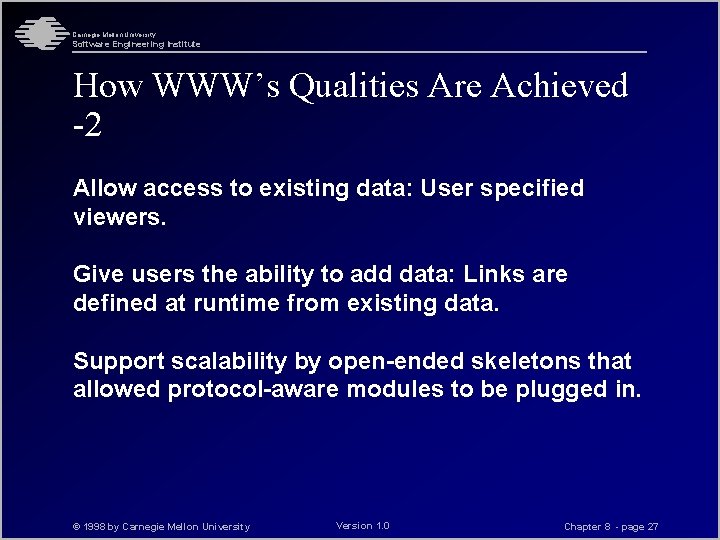
Carnegie Mellon University Software Engineering Institute How WWW’s Qualities Are Achieved -2 Allow access to existing data: User specified viewers. Give users the ability to add data: Links are defined at runtime from existing data. Support scalability by open-ended skeletons that allowed protocol-aware modules to be plugged in. © 1998 by Carnegie Mellon University Version 1. 0 Chapter 8 - page 27
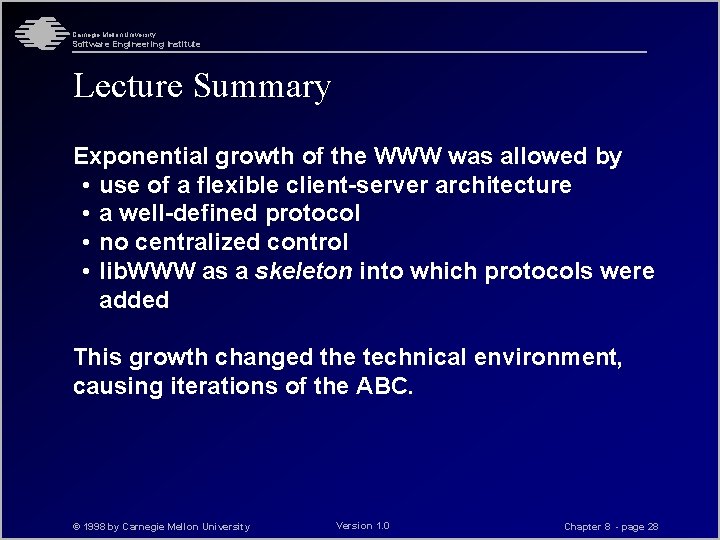
Carnegie Mellon University Software Engineering Institute Lecture Summary Exponential growth of the WWW was allowed by • use of a flexible client-server architecture • a well-defined protocol • no centralized control • lib. WWW as a skeleton into which protocols were added This growth changed the technical environment, causing iterations of the ABC. © 1998 by Carnegie Mellon University Version 1. 0 Chapter 8 - page 28
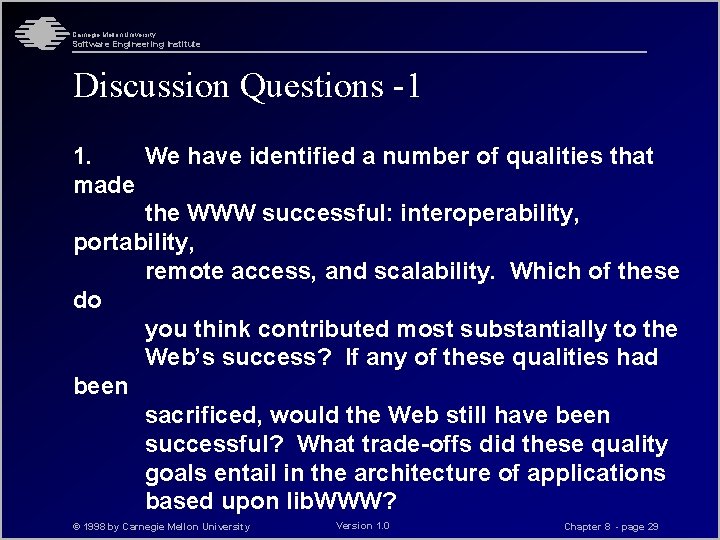
Carnegie Mellon University Software Engineering Institute Discussion Questions -1 1. We have identified a number of qualities that made the WWW successful: interoperability, portability, remote access, and scalability. Which of these do you think contributed most substantially to the Web’s success? If any of these qualities had been sacrificed, would the Web still have been successful? What trade-offs did these quality goals entail in the architecture of applications based upon lib. WWW? © 1998 by Carnegie Mellon University Version 1. 0 Chapter 8 - page 29
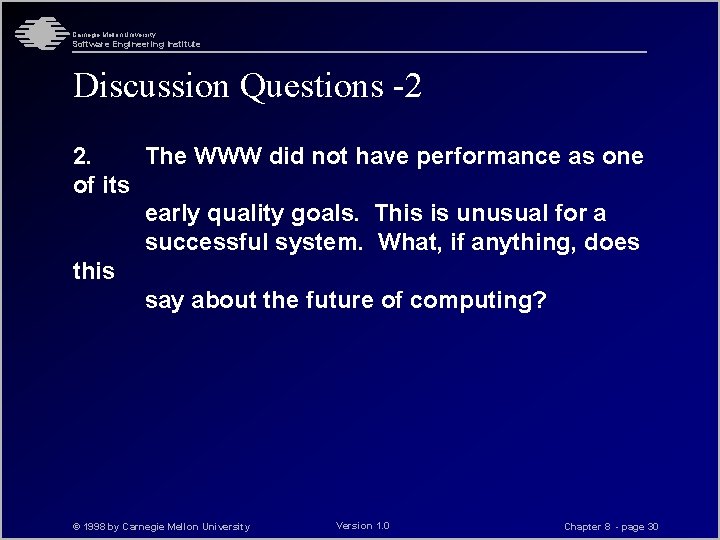
Carnegie Mellon University Software Engineering Institute Discussion Questions -2 2. The WWW did not have performance as one of its early quality goals. This is unusual for a successful system. What, if anything, does this say about the future of computing? © 1998 by Carnegie Mellon University Version 1. 0 Chapter 8 - page 30