
Carnegie Mellon Recitation 13 Proxy Lab Part 1
Carnegie Mellon Recitation 13: Proxy. Lab Part 1 Instructor: TA(s) Bryant and O’Hallaron, Computer Systems: A Programmer’s Perspective, Third Edition 1
Carnegie Mellon Outline ¢ ¢ ¢ Proxies Networking Demos Bryant and O’Hallaron, Computer Systems: A Programmer’s Perspective, Third Edition 2
Carnegie Mellon Proxy Lab ¢ There are no grace days / late submissions § 8% of final grade ¢ You are submitting an entire project § Modify the makefile § Split source file into separate pieces ¢ Submit regularly to verify proxy builds on Autolab ¢ Your proxy is a server, it should not crash! Bryant and O’Hallaron, Computer Systems: A Programmer’s Perspective, Third Edition 3
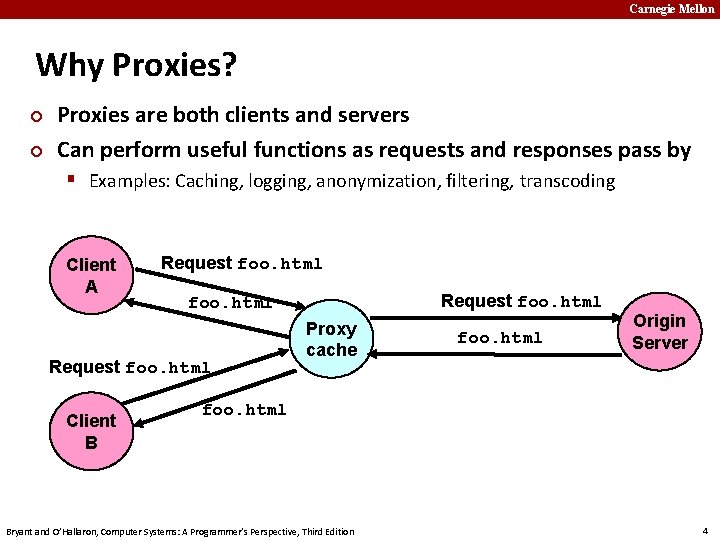
Carnegie Mellon Why Proxies? ¢ ¢ Proxies are both clients and servers Can perform useful functions as requests and responses pass by § Examples: Caching, logging, anonymization, filtering, transcoding Client A Request foo. html Client B Request foo. html Proxy cache foo. html Origin Server foo. html Bryant and O’Hallaron, Computer Systems: A Programmer’s Perspective, Third Edition 4
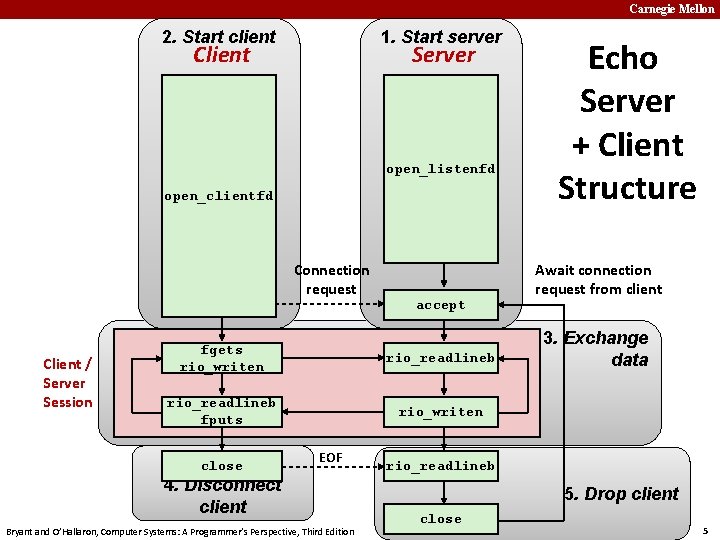
Carnegie Mellon 2. Start client 1. Start server Client Server open_listenfd open_clientfd Connection request Client / Server Session accept fgets rio_writen rio_readlineb fputs rio_writen close EOF 4. Disconnect client Bryant and O’Hallaron, Computer Systems: A Programmer’s Perspective, Third Edition Echo Server + Client Structure Await connection request from client 3. Exchange data rio_readlineb 5. Drop client close 5
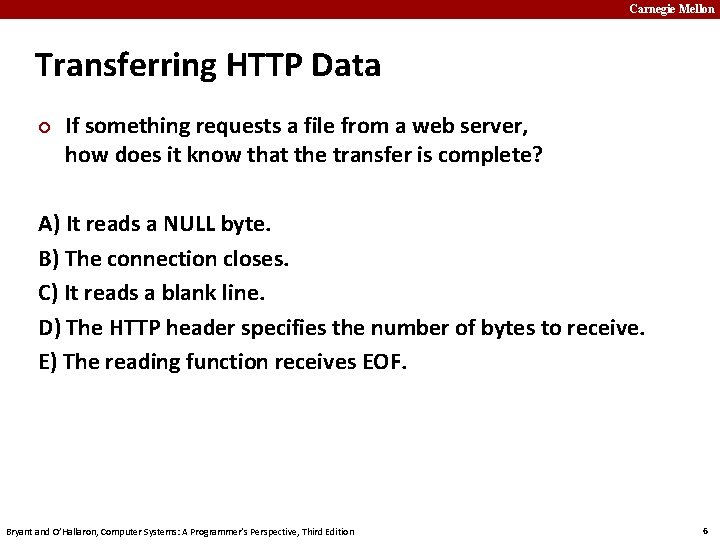
Carnegie Mellon Transferring HTTP Data ¢ If something requests a file from a web server, how does it know that the transfer is complete? A) It reads a NULL byte. B) The connection closes. C) It reads a blank line. D) The HTTP header specifies the number of bytes to receive. E) The reading function receives EOF. Bryant and O’Hallaron, Computer Systems: A Programmer’s Perspective, Third Edition 6
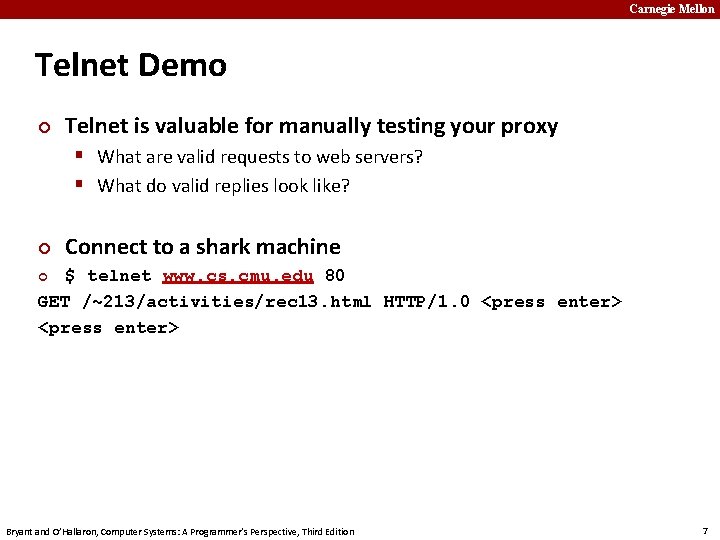
Carnegie Mellon Telnet Demo ¢ Telnet is valuable for manually testing your proxy § What are valid requests to web servers? § What do valid replies look like? ¢ Connect to a shark machine $ telnet www. cs. cmu. edu 80 GET /~213/activities/rec 13. html HTTP/1. 0 <press enter> ¢ Bryant and O’Hallaron, Computer Systems: A Programmer’s Perspective, Third Edition 7
Carnegie Mellon Echo Demo ¢ See telnet results Bryant and O’Hallaron, Computer Systems: A Programmer’s Perspective, Third Edition 8
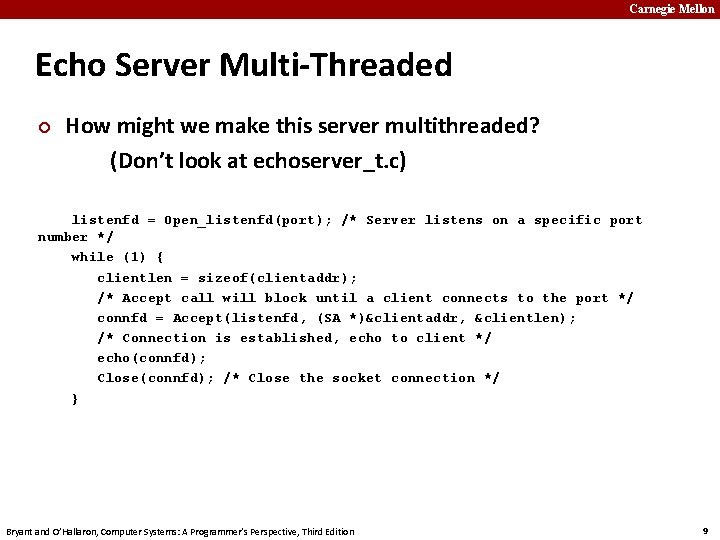
Carnegie Mellon Echo Server Multi-Threaded ¢ How might we make this server multithreaded? (Don’t look at echoserver_t. c) listenfd = Open_listenfd(port); /* Server listens on a specific port number */ while (1) { clientlen = sizeof(clientaddr); /* Accept call will block until a client connects to the port */ connfd = Accept(listenfd, (SA *)&clientaddr, &clientlen); /* Connection is established, echo to client */ echo(connfd); Close(connfd); /* Close the socket connection */ } Bryant and O’Hallaron, Computer Systems: A Programmer’s Perspective, Third Edition 9
Carnegie Mellon Echo Server Multithreaded ¢ View the code in echoserver_t. c ¢ Nominate one student in class to run server § Have other groups connect to it Bryant and O’Hallaron, Computer Systems: A Programmer’s Perspective, Third Edition 10
Carnegie Mellon Reminders ¢ Read the writeup ¢ Start early § Remember, no late submissions ¢ Work incrementally and take breaks Bryant and O’Hallaron, Computer Systems: A Programmer’s Perspective, Third Edition 11
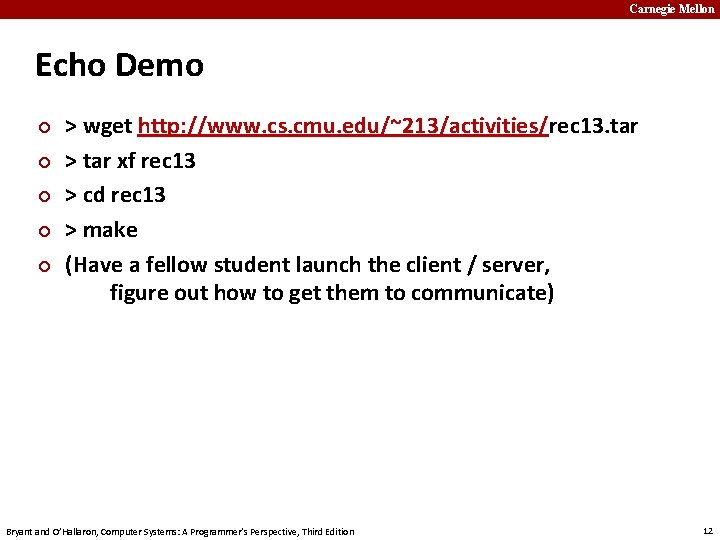
Carnegie Mellon Echo Demo ¢ ¢ ¢ > wget http: //www. cs. cmu. edu/~213/activities/rec 13. tar > tar xf rec 13 > cd rec 13 > make (Have a fellow student launch the client / server, figure out how to get them to communicate) Bryant and O’Hallaron, Computer Systems: A Programmer’s Perspective, Third Edition 12
- Slides: 12