
Carnegie Mellon Proxylab and stuff 15 213 Introduction
Carnegie Mellon Proxylab and stuff 15 -213: Introduction to Computer Systems Recitation 13: November 19, 2012 Donald Huang (donaldh) Section M 1
Carnegie Mellon Topics ¢ ¢ ¢ Summary of malloclab News Sockets Threads Proxylab 2
Carnegie Mellon Malloclab review ¢ ¢ Questions, comments, lessons learned? Starting simple and making improvements is a good way to write code § Nice because you can have something simple working relatively easily § You can test each new optimization alone ¢ When you write your code, write it so that it can be easily maintained/changed § “how can I write my explicit list so that I can change it to seglists later? ” 3
Carnegie Mellon Topics ¢ ¢ ¢ Summary of malloclab News Sockets Threads Proxylab 4
Carnegie Mellon News ¢ ¢ Last day to turn in malloc is today (if using two late days and taking a late penalty) Proxylab was out last Friday 5
Carnegie Mellon Topics ¢ ¢ ¢ Summary of malloclab News Sockets Threads Proxylab 6
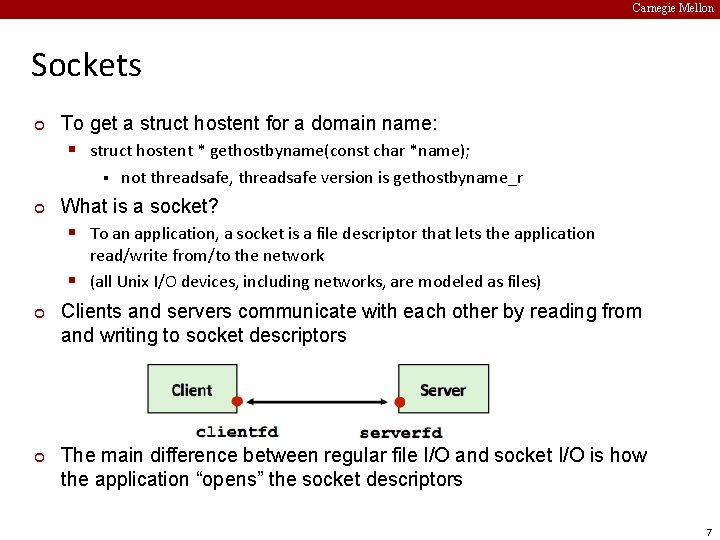
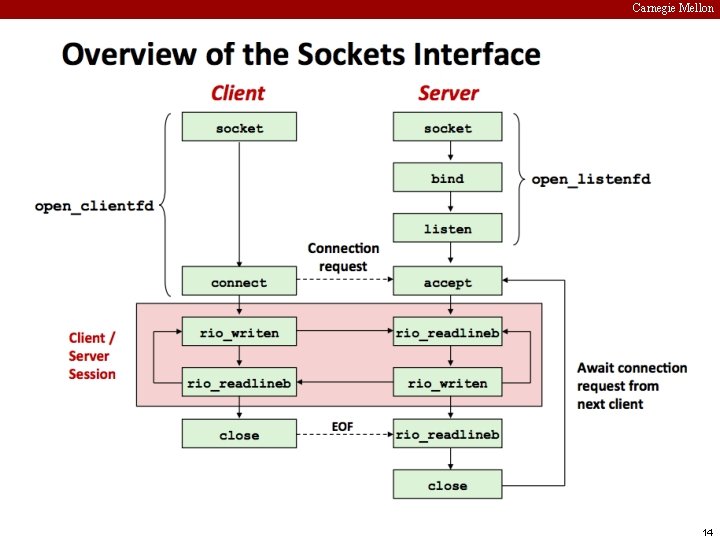
Carnegie Mellon Sockets ¢ To get a struct hostent for a domain name: § struct hostent * gethostbyname(const char *name); § ¢ not threadsafe, threadsafe version is gethostbyname_r What is a socket? § To an application, a socket is a file descriptor that lets the application read/write from/to the network § (all Unix I/O devices, including networks, are modeled as files) ¢ ¢ Clients and servers communicate with each other by reading from and writing to socket descriptors The main difference between regular file I/O and socket I/O is how the application “opens” the socket descriptors 7
Carnegie Mellon Sockets API ¢ ¢ ¢ ¢ int socket(int domain, int type, int protocol); int bind(int socket, const struct sockaddr *address, socklen_t address_len); int listen(int socket, int backlog); int accept(int socket, struct sockaddr *address, socklen_t *address_len); int connect(int socket, struct sockaddr *address, socklen_t address_len); int close(int fd); ssize_t read(int fd, void *buf, size_t nbyte); ssize_t write(int fd, void *buf, size_t nbyte); 8
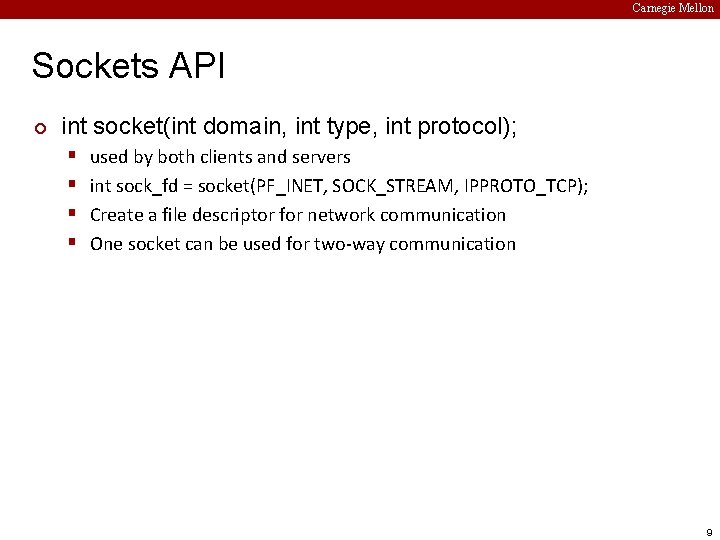
Carnegie Mellon Sockets API ¢ int socket(int domain, int type, int protocol); § § used by both clients and servers int sock_fd = socket(PF_INET, SOCK_STREAM, IPPROTO_TCP); Create a file descriptor for network communication One socket can be used for two-way communication 9
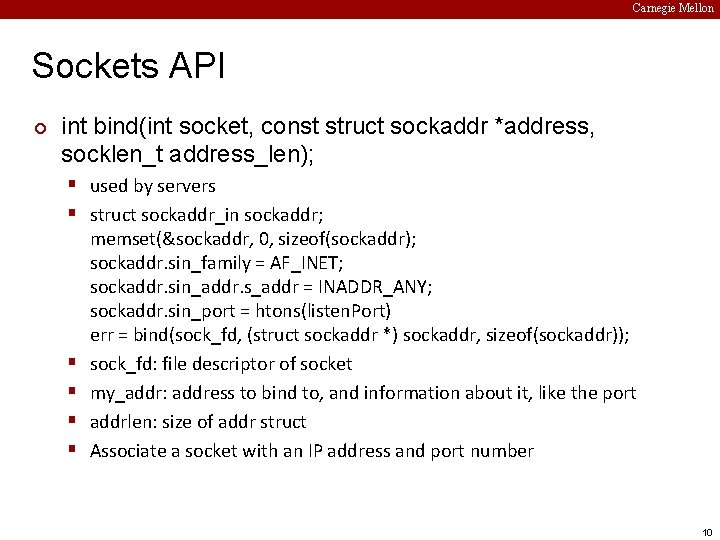
Carnegie Mellon Sockets API ¢ int bind(int socket, const struct sockaddr *address, socklen_t address_len); § used by servers § struct sockaddr_in sockaddr; § § memset(&sockaddr, 0, sizeof(sockaddr); sockaddr. sin_family = AF_INET; sockaddr. sin_addr. s_addr = INADDR_ANY; sockaddr. sin_port = htons(listen. Port) err = bind(sock_fd, (struct sockaddr *) sockaddr, sizeof(sockaddr)); sock_fd: file descriptor of socket my_addr: address to bind to, and information about it, like the port addrlen: size of addr struct Associate a socket with an IP address and port number 10
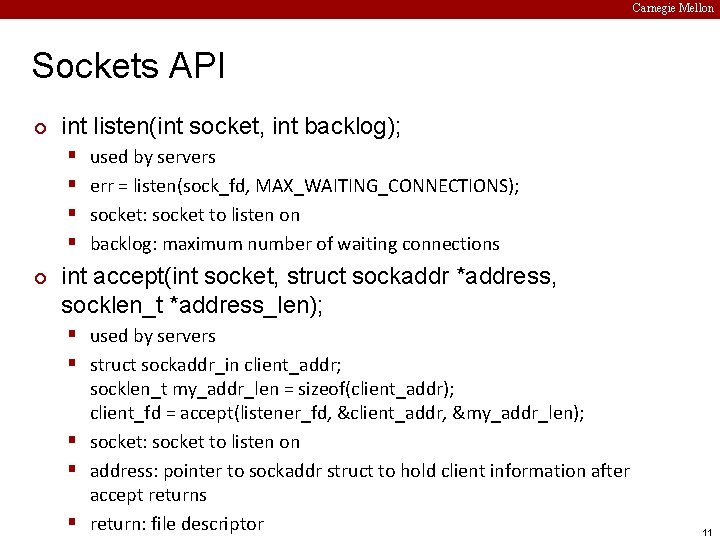
Carnegie Mellon Sockets API ¢ int listen(int socket, int backlog); § § ¢ used by servers err = listen(sock_fd, MAX_WAITING_CONNECTIONS); socket: socket to listen on backlog: maximum number of waiting connections int accept(int socket, struct sockaddr *address, socklen_t *address_len); § used by servers § struct sockaddr_in client_addr; socklen_t my_addr_len = sizeof(client_addr); client_fd = accept(listener_fd, &client_addr, &my_addr_len); § socket: socket to listen on § address: pointer to sockaddr struct to hold client information after accept returns § return: file descriptor 11
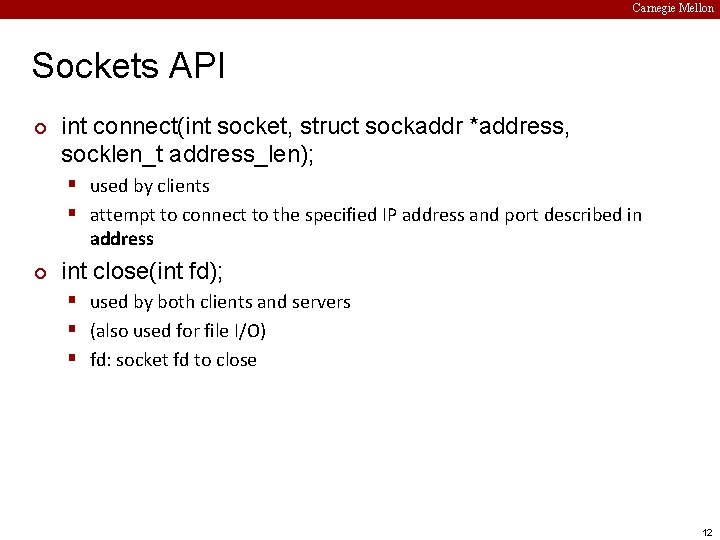
Carnegie Mellon Sockets API ¢ int connect(int socket, struct sockaddr *address, socklen_t address_len); § used by clients § attempt to connect to the specified IP address and port described in address ¢ int close(int fd); § used by both clients and servers § (also used for file I/O) § fd: socket fd to close 12
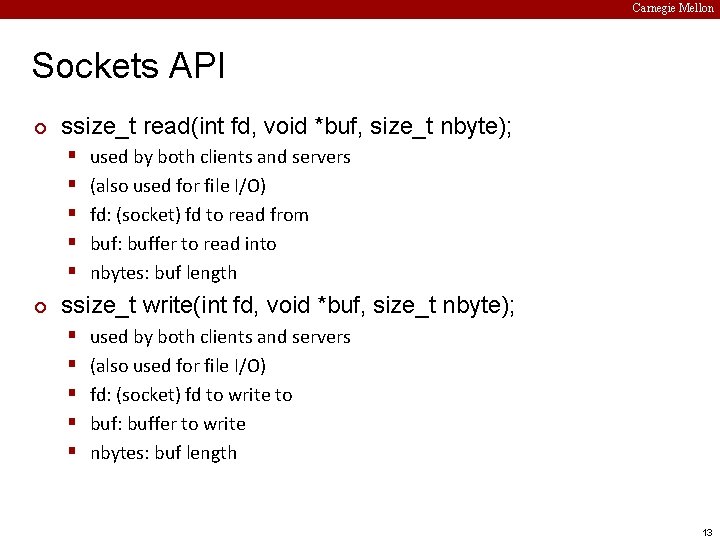
Carnegie Mellon Sockets API ¢ ssize_t read(int fd, void *buf, size_t nbyte); § § § ¢ used by both clients and servers (also used for file I/O) fd: (socket) fd to read from buf: buffer to read into nbytes: buf length ssize_t write(int fd, void *buf, size_t nbyte); § § § used by both clients and servers (also used for file I/O) fd: (socket) fd to write to buf: buffer to write nbytes: buf length 13
Carnegie Mellon 14
Carnegie Mellon Topics ¢ ¢ ¢ Summary of malloclab News Sockets Threads Proxylab 15
Carnegie Mellon Threads ¢ Similarities to processes § each thread has its own logical control flow (its own registers, so its own eip and stuff) § multiple threads can be in the middle of running at the same time, possibly on different cores § the kernel decides when to context switch to and from a thread (or a thread can voluntarily give up its share of cpu time by calling sleep, pause, sigsuspend, or something similar) ¢ Differences with processes § threads share code and data; processes generally don’t § threads are less expensive to make than processes (processes are about 2 x more expensive to create and reap) 16
Carnegie Mellon Threads ¢ ¢ Each thread has its own stack/registers, including stack pointer and program counter (imagine what would happen otherwise) Processes start out as having one thread, and they also have code, data, page directory/table, file descriptors, and some other things associated with them 17
Carnegie Mellon Threads: pthreads interface ¢ Creating/reaping threads § pthread_create § pthread_join ¢ To get your thread ID § pthread_self ¢ Terminating threads § pthread_cancel § pthread_exit ¢ synchronizing access to shared variables § § pthread_mutex_init pthread_mutex_[un]lock pthread_rwlock_init pthread_rwlock_[wr]rdlock 18
Carnegie Mellon Threads ¢ ¢ ¢ A thread terminates implicitly when its top-level thread routine returns A thread terminates explicitly by calling pthread_exit(NULL) only terminates the current thread, NOT the process exit(0) terminates ALL the threads in the process (meaning the whole process terminates pthread_cancel(tid) terminates the thread with id equal to tid 19
Carnegie Mellon Threads ¢ Joinable threads can be reaped and killed by other threads § must be reaped with pthread_join to free memory and resources ¢ Detached threads cannot be reaped or killed by other threads § resources are automatically reaped on termination ¢ Default state is joinable § use pthread_detach(pthread_self()) to make detached 20
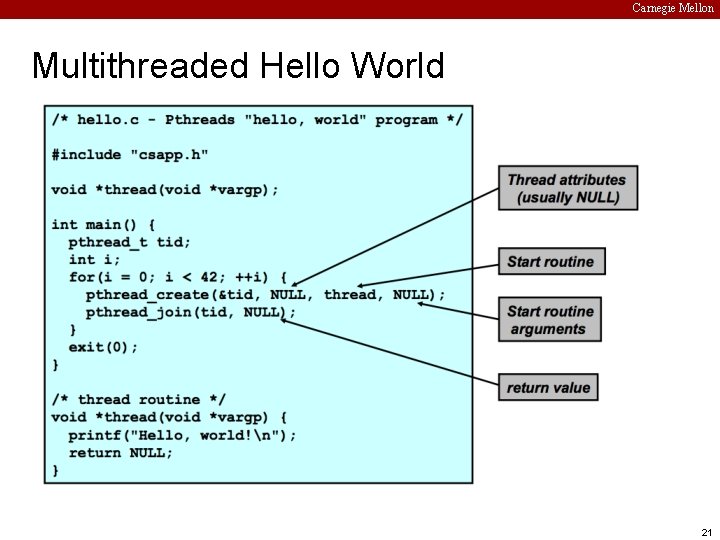
Carnegie Mellon Multithreaded Hello World 21
Carnegie Mellon Topics ¢ ¢ ¢ Summary of malloclab News Sockets Threads Proxylab 22
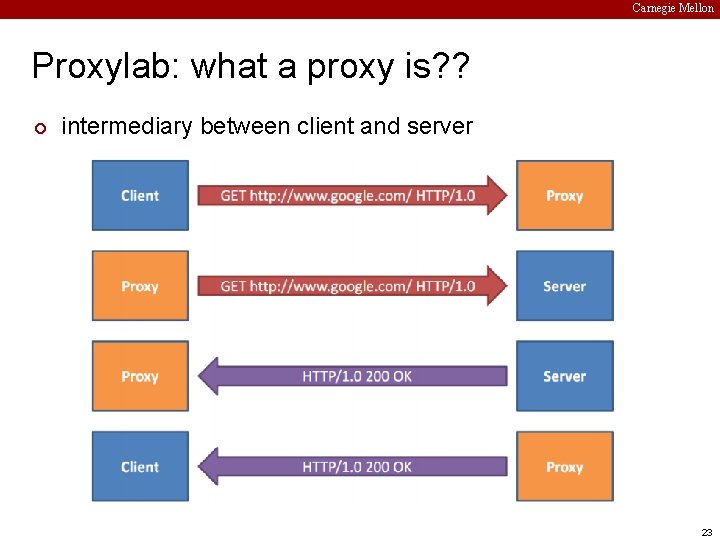
Carnegie Mellon Proxylab: what a proxy is? ? ¢ intermediary between client and server 23
Carnegie Mellon Proxylab ¢ write a web proxy § multi-threaded § caching ¢ should work for most sites (not https connections though) § § ¢ cnn. com google. com youtube. com (not facebook. com) Forwards requests from the client to the server § acts as a server to the client, but as a client to the server the client is asking you to read from 24
Carnegie Mellon Proxylab: recommended progress ¢ implement a sequential proxy § this proxy will be very slow in loading webpages ¢ upgrade to multithreaded proxy § should be decently fast ¢ add caching § this involves some multithreading issues we’ll talk about solving next week ¢ You are not given any tests, so make sure you test your proxy well on your own! 25

Carnegie Mellon Questions? (sockets, proxylab, what a proxy is? ? ) (come to office hours if you need help) 26
- Slides: 26