
Carnegie Mellon Proxy Web Concurrency Ian Hartwig 1518
Carnegie Mellon Proxy Web & Concurrency Ian Hartwig 15/18 -213 - Section E Recitation 13 April 15 th, 2013 1
Carnegie Mellon Outline � � � Getting content on the web: Telnet/c. URL Demo How the web really works Proxy Due Tuesday, Dec. 3 rd You can use your late days this year No partners this year � Threading � � Semiphores & Mutexes Readers-Writer Lock 2
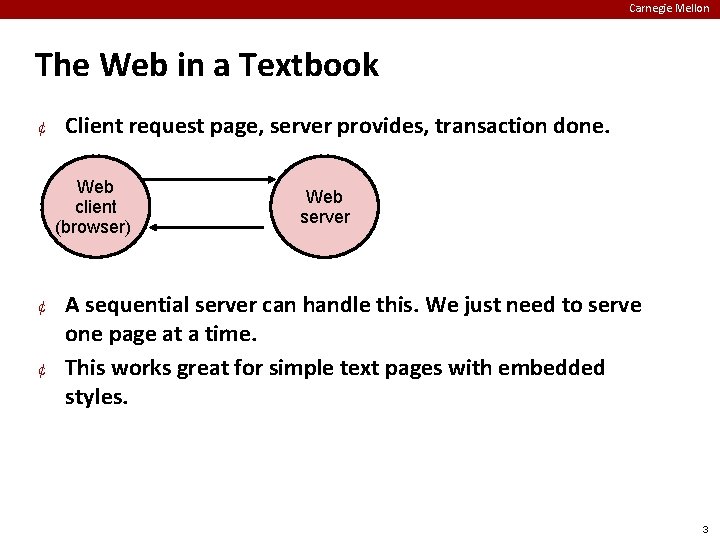
Carnegie Mellon The Web in a Textbook ¢ Client request page, server provides, transaction done. Web client (browser) ¢ ¢ Web server A sequential server can handle this. We just need to serve one page at a time. This works great for simple text pages with embedded styles. 3
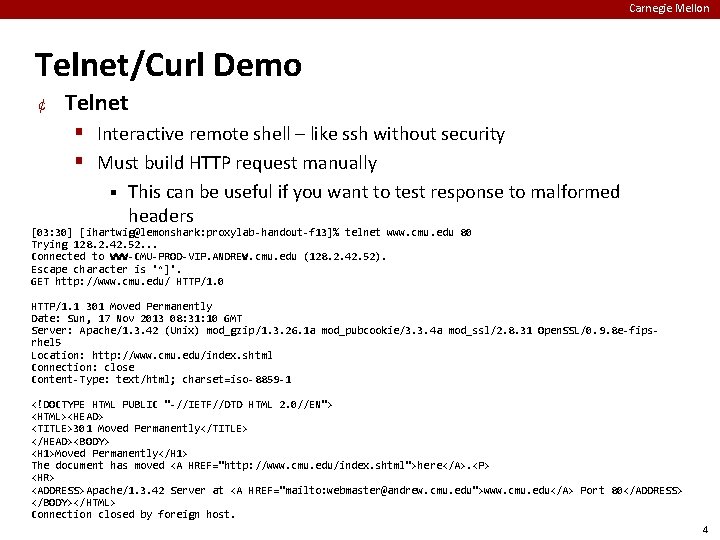
Carnegie Mellon Telnet/Curl Demo ¢ Telnet Interactive remote shell – like ssh without security Must build HTTP request manually This can be useful if you want to test response to malformed headers [03: 30] [ihartwig@lemonshark: proxylab-handout-f 13]% telnet www. cmu. edu 80 Trying 128. 2. 42. 52. . . Connected to WWW-CMU-PROD-VIP. ANDREW. cmu. edu (128. 2. 42. 52). Escape character is '^]'. GET http: //www. cmu. edu/ HTTP/1. 0 HTTP/1. 1 301 Moved Permanently Date: Sun, 17 Nov 2013 08: 31: 10 GMT Server: Apache/1. 3. 42 (Unix) mod_gzip/1. 3. 26. 1 a mod_pubcookie/3. 3. 4 a mod_ssl/2. 8. 31 Open. SSL/0. 9. 8 e-fipsrhel 5 Location: http: //www. cmu. edu/index. shtml Connection: close Content-Type: text/html; charset=iso-8859 -1 <!DOCTYPE HTML PUBLIC "-//IETF//DTD HTML 2. 0//EN"> <HTML><HEAD> <TITLE>301 Moved Permanently</TITLE> </HEAD><BODY> <H 1>Moved Permanently</H 1> The document has moved <A HREF="http: //www. cmu. edu/index. shtml">here</A>. <P> <HR> <ADDRESS>Apache/1. 3. 42 Server at <A HREF="mailto: webmaster@andrew. cmu. edu">www. cmu. edu</A> Port 80</ADDRESS> </BODY></HTML> Connection closed by foreign host. 4
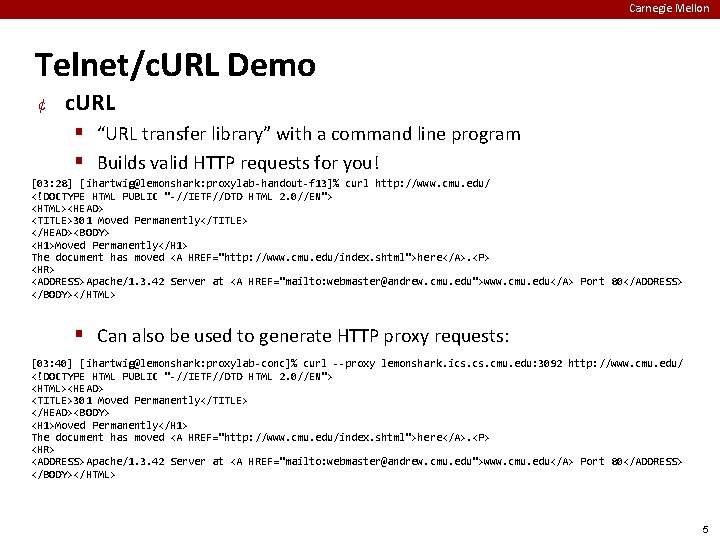
Carnegie Mellon Telnet/c. URL Demo ¢ c. URL “URL transfer library” with a command line program Builds valid HTTP requests for you! [03: 28] [ihartwig@lemonshark: proxylab-handout-f 13]% curl http: //www. cmu. edu/ <!DOCTYPE HTML PUBLIC "-//IETF//DTD HTML 2. 0//EN"> <HTML><HEAD> <TITLE>301 Moved Permanently</TITLE> </HEAD><BODY> <H 1>Moved Permanently</H 1> The document has moved <A HREF="http: //www. cmu. edu/index. shtml">here</A>. <P> <HR> <ADDRESS>Apache/1. 3. 42 Server at <A HREF="mailto: webmaster@andrew. cmu. edu">www. cmu. edu</A> Port 80</ADDRESS> </BODY></HTML> Can also be used to generate HTTP proxy requests: [03: 40] [ihartwig@lemonshark: proxylab-conc]% curl --proxy lemonshark. ics. cmu. edu: 3092 http: //www. cmu. edu/ <!DOCTYPE HTML PUBLIC "-//IETF//DTD HTML 2. 0//EN"> <HTML><HEAD> <TITLE>301 Moved Permanently</TITLE> </HEAD><BODY> <H 1>Moved Permanently</H 1> The document has moved <A HREF="http: //www. cmu. edu/index. shtml">here</A>. <P> <HR> <ADDRESS>Apache/1. 3. 42 Server at <A HREF="mailto: webmaster@andrew. cmu. edu">www. cmu. edu</A> Port 80</ADDRESS> </BODY></HTML> 5
Carnegie Mellon How the Web Really Works ¢ ¢ In reality, a single HTML page today may depend on 10 s or 100 s of support files (images, stylesheets, scripts, etc. ) Builds a good argument for concurrent servers Just to load a single modern webpage, the client would have to wait for 10 s of back-to-back request I/O is likely slower than processing, so back ¢ Caching is simpler if done in pieces rather than whole page If only part of the page changes, no need to fetch old parts again Each object (image, stylesheet, script) already has a unique URL that can be used as a key 6
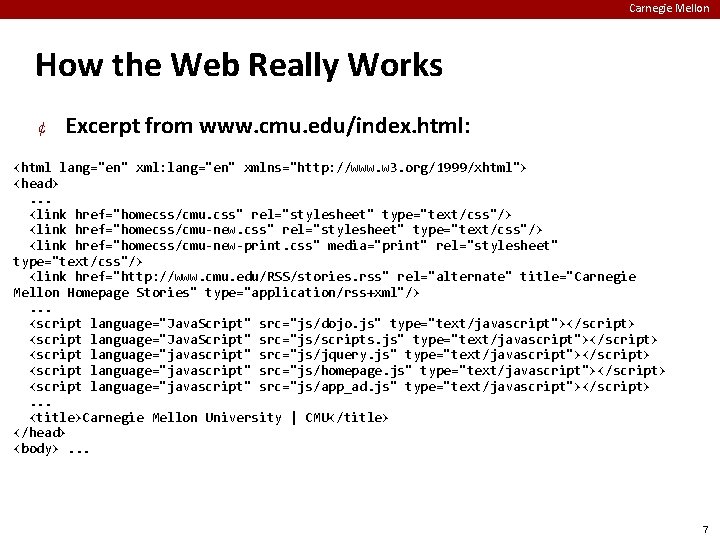
Carnegie Mellon How the Web Really Works ¢ Excerpt from www. cmu. edu/index. html: <html lang="en" xml: lang="en" xmlns="http: //www. w 3. org/1999/xhtml"> <head>. . . <link href="homecss/cmu. css" rel="stylesheet" type="text/css"/> <link href="homecss/cmu-new-print. css" media="print" rel="stylesheet" type="text/css"/> <link href="http: //www. cmu. edu/RSS/stories. rss" rel="alternate" title="Carnegie Mellon Homepage Stories" type="application/rss+xml"/>. . . <script language="Java. Script" src="js/dojo. js" type="text/javascript"></script> <script language="Java. Script" src="js/scripts. js" type="text/javascript"></script> <script language="javascript" src="js/jquery. js" type="text/javascript"></script> <script language="javascript" src="js/homepage. js" type="text/javascript"></script> <script language="javascript" src="js/app_ad. js" type="text/javascript"></script>. . . <title>Carnegie Mellon University | CMU</title> </head> <body>. . . 7
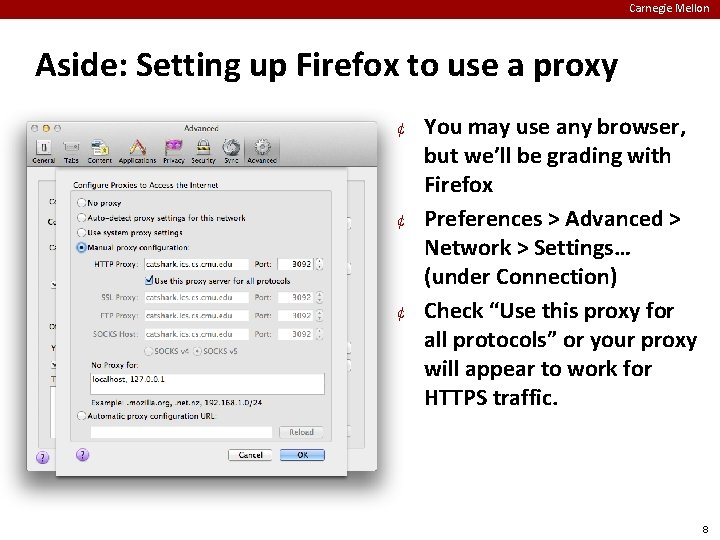
Carnegie Mellon Aside: Setting up Firefox to use a proxy ¢ ¢ ¢ You may use any browser, but we’ll be grading with Firefox Preferences > Advanced > Network > Settings… (under Connection) Check “Use this proxy for all protocols” or your proxy will appear to work for HTTPS traffic. 8
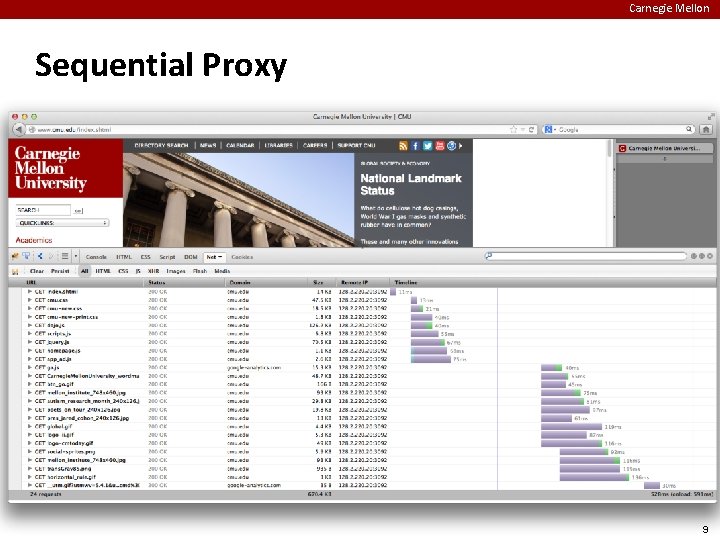
Carnegie Mellon Sequential Proxy 9
Carnegie Mellon Sequential Proxy ¢ Note the sloped shape of when requests finish Although many requests are made at once, the proxy does not accept a new job until it finishes the current one Requests are made in batches. This results from how HTML is structured as files that reference other files. ¢ Compared to the concurrent example (next), this page takes a long time to load with just static content 10
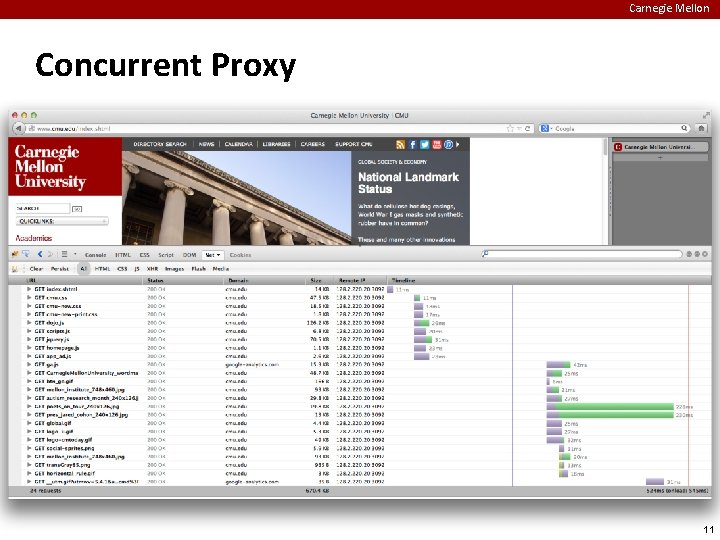
Carnegie Mellon Concurrent Proxy 11
Carnegie Mellon Concurrent Proxy ¢ ¢ Now, we see much less purple (waiting), and less time spent overall. Notice how multiple green (receiving) blocks overlap in time Our proxy has multiple connections open to the browser to handle several tasks at once 12
Carnegie Mellon How the Web Really Works ¢ A note on AJAX (and XMLHttp. Requests) Normally, a browser will make the initial page request then request any supporting files And XMLHttp. Request is simply a request from the page once it has been loaded & the scripts are running The distinction does not matter on the server side – everything is an HTTP Request 13
Carnegie Mellon Proxy - Functionality � Should work on vast majority of sites Reddit, Vimeo, CNN, You. Tube, NY Times, etc. Some features of sites which require the POST operation (sending data to the website), will not work Logging in to websites, sending Facebook message HTTPS is not expected to work Google (and some other popular websites) now try to push users to HTTPs by default; watch out for that � Cache previous requests Use LRU eviction policy Must allow for concurrent reads while maintaining consistency Details in write up 14
Carnegie Mellon Proxy - Functionality � Why a multi-threaded cache? Sequential cache would bottleneck parallel proxy Multiple threads can read cached content safely Search cache for the right data and return it Two threads can read from the same cache block But what about writing content? Overwrite block while another threading? Two threads writing to same cache block? 15
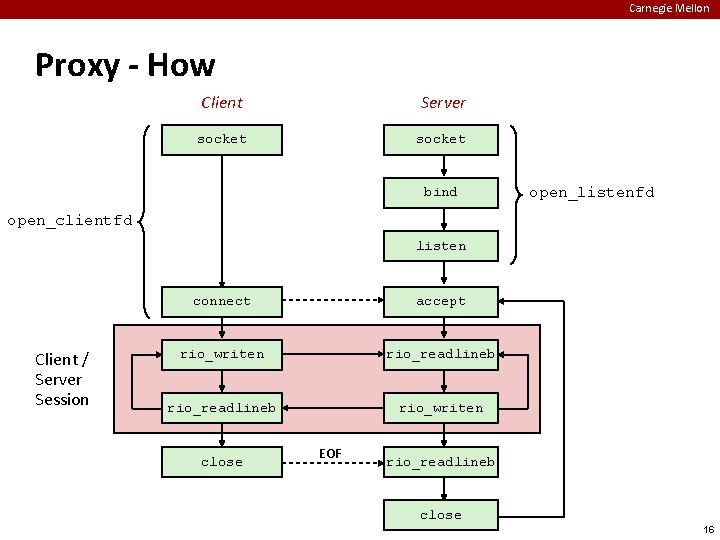
Carnegie Mellon Proxy - How Client Server socket bind open_listenfd open_clientfd listen Connection request Client / Server Session connect accept rio_writen rio_readlineb rio_writen close EOF rio_readlineb close 16
Carnegie Mellon Proxy - How ¢ Remember that picture? Proxies are a bit special; they are a server and a client at the same time. They take a request from one computer (acting as the server), and make it on their behalf (as the client). Ultimately, the control flow of your program will look like a server, but will have to act as a client to complete the request ¢ Start small Grab yourself a copy of the echo server (pg. 910) and client (pg. 909) in the book Also review the tiny. c basic web server code to see how to deal with HTTP headers Note that tiny. c ignores these; you may not 17
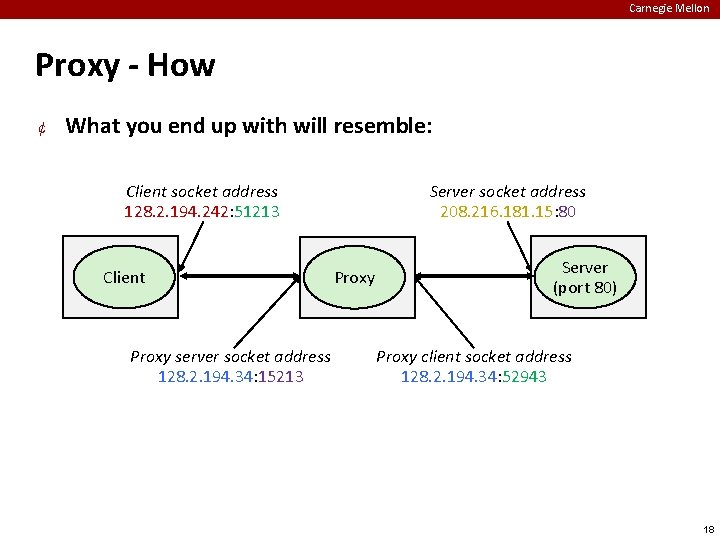
Carnegie Mellon Proxy - How ¢ What you end up with will resemble: Client socket address 128. 2. 194. 242: 51213 Client Proxy server socket address 128. 2. 194. 34: 15213 Server socket address 208. 216. 181. 15: 80 Proxy Server (port 80) Proxy client socket address 128. 2. 194. 34: 52943 18
Carnegie Mellon Proxy – Testing & Grading ¢ New: Autograder . /driver. sh will run the same tests as autolab: Ability to pull basic web pages from a server Handle a (concurrent) request while another request is still pending Fetch a web page again from your cache after the server has been stopped This should help answer the question “is this what my proxy is supposed to do? ” Please don’t use this grader to definitively test your proxy; there are many things not tested here 19
Carnegie Mellon Proxy – Testing & Grading ¢ Test your proxy liberally ¢ The web is full of special cases that want to break your proxy Generate a port for yourself with. /port-for-user. pl [andrewid] Generate more ports for web servers and such with. /free-port. sh Consider using your andrew web space (~/www) to host test files You have to visit https: //www. andrew. cmu. edu/server/publish. html to publish your folder to the public server Create a handin file with make handin Will create a tar file for you with the contents of your proxylabhandin folder 20
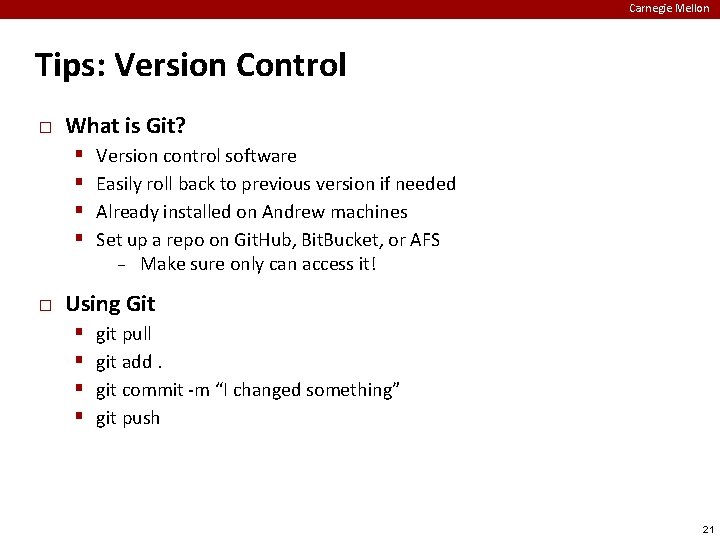
Carnegie Mellon Tips: Version Control � What is Git? � Version control software Easily roll back to previous version if needed Already installed on Andrew machines Set up a repo on Git. Hub, Bit. Bucket, or AFS Make sure only can access it! Using Git git pull git add. git commit -m “I changed something” git push 21
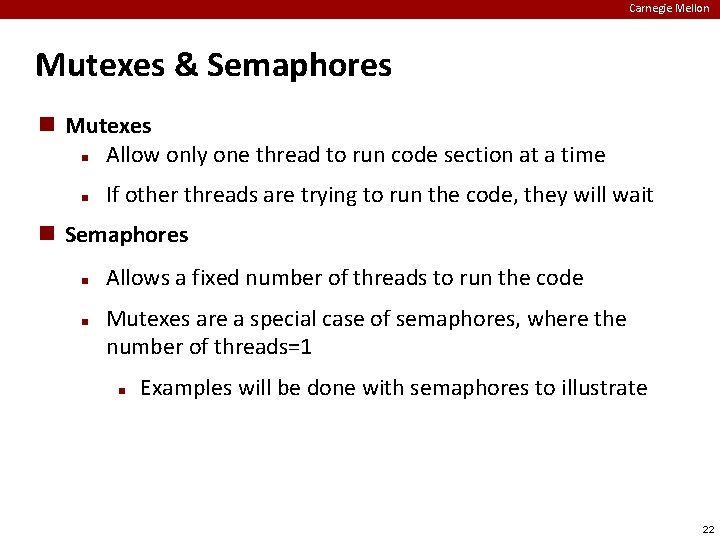
Carnegie Mellon Mutexes & Semaphores Mutexes Allow only one thread to run code section at a time If other threads are trying to run the code, they will wait Semaphores Allows a fixed number of threads to run the code Mutexes are a special case of semaphores, where the number of threads=1 Examples will be done with semaphores to illustrate 22
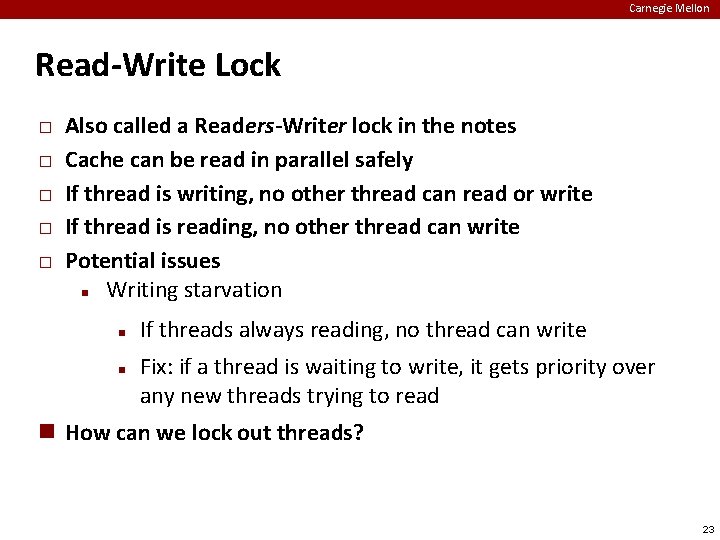
Carnegie Mellon Read-Write Lock � � � Also called a Readers-Writer lock in the notes Cache can be read in parallel safely If thread is writing, no other thread can read or write If thread is reading, no other thread can write Potential issues Writing starvation If threads always reading, no thread can write Fix: if a thread is waiting to write, it gets priority over any new threads trying to read How can we lock out threads? 23
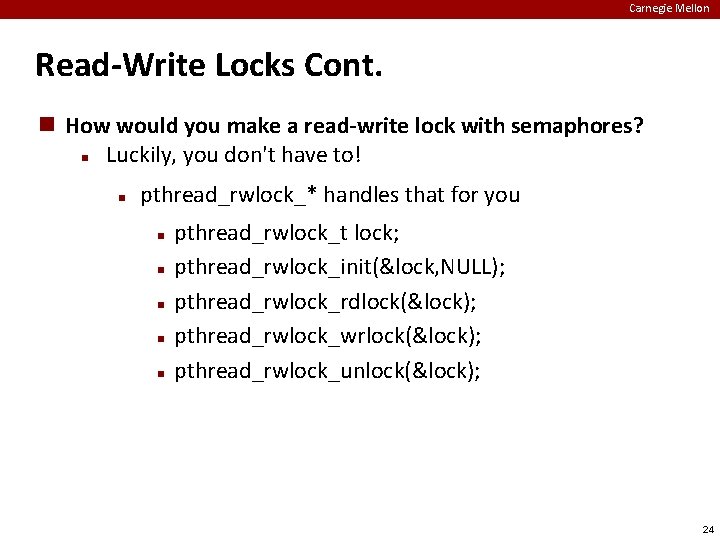
Carnegie Mellon Read-Write Locks Cont. How would you make a read-write lock with semaphores? Luckily, you don't have to! pthread_rwlock_* handles that for you pthread_rwlock_t lock; pthread_rwlock_init(&lock, NULL); pthread_rwlock_rdlock(&lock); pthread_rwlock_wrlock(&lock); pthread_rwlock_unlock(&lock); 24
Carnegie Mellon Questions? 25
- Slides: 25