
Carnegie Mellon Networking Basics and Concurrent Programming Shiva
Carnegie Mellon Networking Basics and Concurrent Programming Shiva (sshankar) Section M 1
Carnegie Mellon Topics ¢ ¢ ¢ Networking Basics Concurrent Programming Introduction to Proxy Lab 2
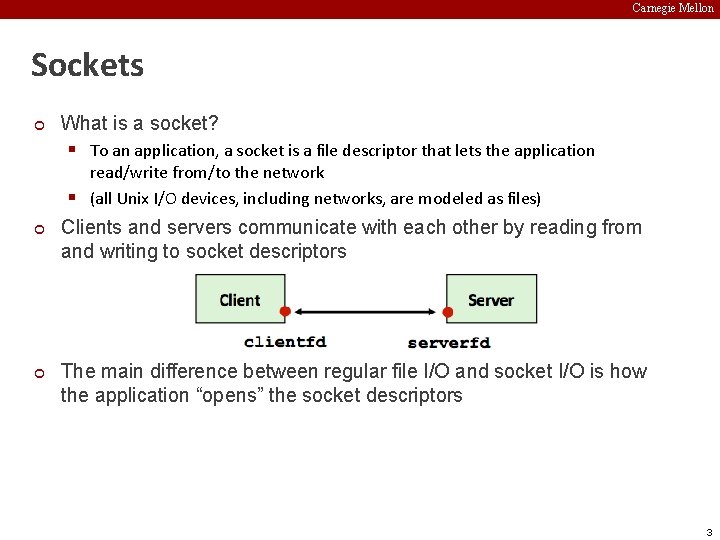
Carnegie Mellon Sockets ¢ What is a socket? § To an application, a socket is a file descriptor that lets the application read/write from/to the network § (all Unix I/O devices, including networks, are modeled as files) ¢ ¢ Clients and servers communicate with each other by reading from and writing to socket descriptors The main difference between regular file I/O and socket I/O is how the application “opens” the socket descriptors 3
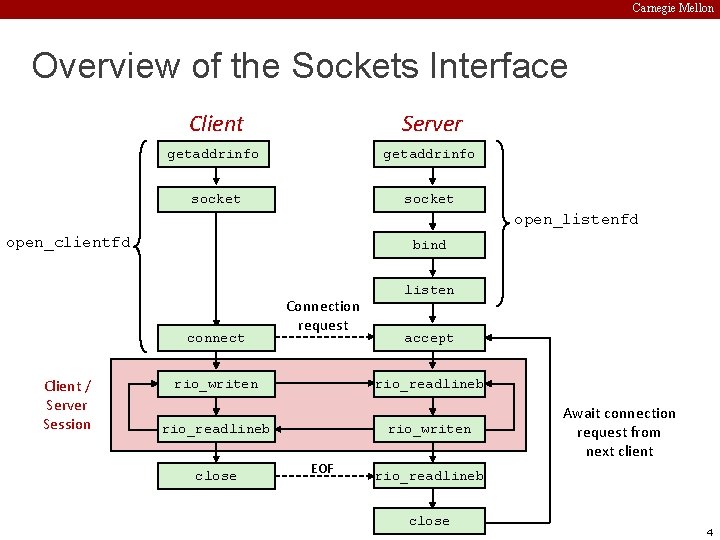
Carnegie Mellon Overview of the Sockets Interface Client Server getaddrinfo socket open_listenfd open_clientfd bind connect Client / Server Session Connection request rio_writen accept rio_readlineb close listen rio_writen EOF Await connection request from next client rio_readlineb close 4
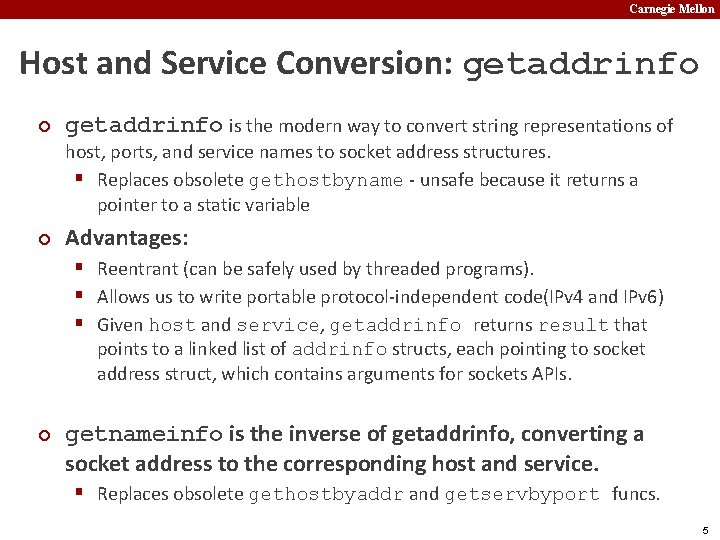
Carnegie Mellon Host and Service Conversion: getaddrinfo ¢ getaddrinfo is the modern way to convert string representations of host, ports, and service names to socket address structures. § Replaces obsolete gethostbyname - unsafe because it returns a pointer to a static variable ¢ Advantages: § Reentrant (can be safely used by threaded programs). § Allows us to write portable protocol-independent code(IPv 4 and IPv 6) § Given host and service, getaddrinfo returns result that points to a linked list of addrinfo structs, each pointing to socket address struct, which contains arguments for sockets APIs. ¢ getnameinfo is the inverse of getaddrinfo, converting a socket address to the corresponding host and service. § Replaces obsolete gethostbyaddr and getservbyport funcs. 5
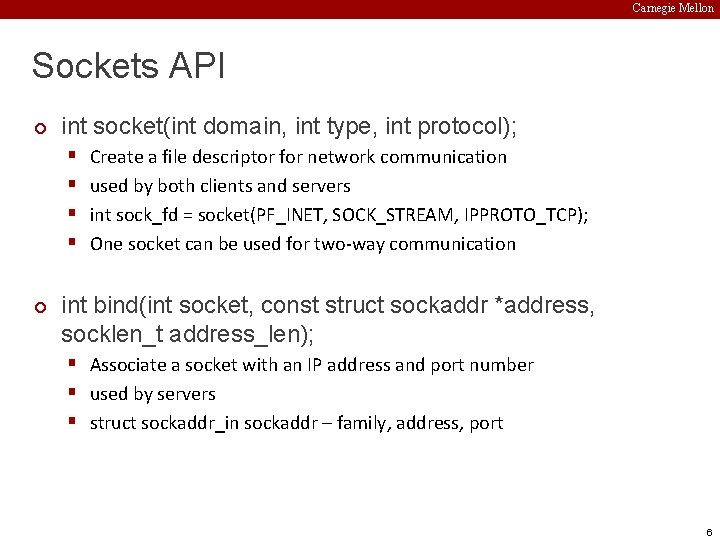
Carnegie Mellon Sockets API ¢ int socket(int domain, int type, int protocol); § § ¢ Create a file descriptor for network communication used by both clients and servers int sock_fd = socket(PF_INET, SOCK_STREAM, IPPROTO_TCP); One socket can be used for two-way communication int bind(int socket, const struct sockaddr *address, socklen_t address_len); § Associate a socket with an IP address and port number § used by servers § struct sockaddr_in sockaddr – family, address, port 6
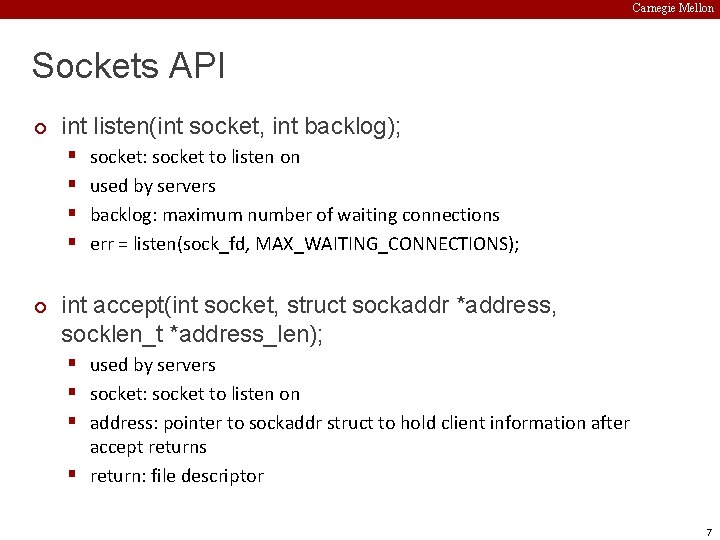
Carnegie Mellon Sockets API ¢ int listen(int socket, int backlog); § § ¢ socket: socket to listen on used by servers backlog: maximum number of waiting connections err = listen(sock_fd, MAX_WAITING_CONNECTIONS); int accept(int socket, struct sockaddr *address, socklen_t *address_len); § used by servers § socket: socket to listen on § address: pointer to sockaddr struct to hold client information after accept returns § return: file descriptor 7
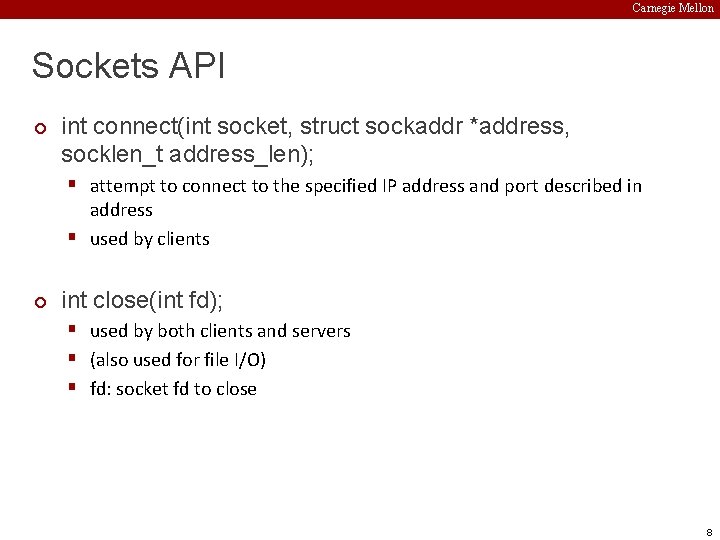
Carnegie Mellon Sockets API ¢ int connect(int socket, struct sockaddr *address, socklen_t address_len); § attempt to connect to the specified IP address and port described in address § used by clients ¢ int close(int fd); § used by both clients and servers § (also used for file I/O) § fd: socket fd to close 8
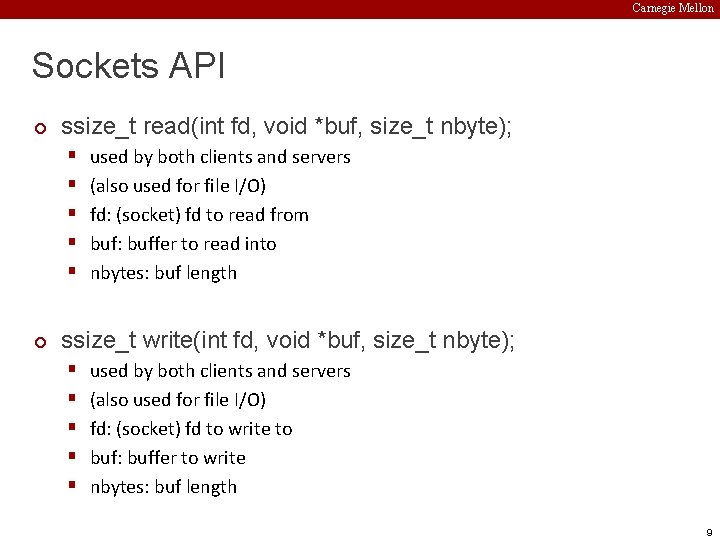
Carnegie Mellon Sockets API ¢ ssize_t read(int fd, void *buf, size_t nbyte); § § § ¢ used by both clients and servers (also used for file I/O) fd: (socket) fd to read from buf: buffer to read into nbytes: buf length ssize_t write(int fd, void *buf, size_t nbyte); § § § used by both clients and servers (also used for file I/O) fd: (socket) fd to write to buf: buffer to write nbytes: buf length 9
Carnegie Mellon Topics ¢ ¢ ¢ Networking Basics Concurrent Programming Introduction to Proxy Lab 10
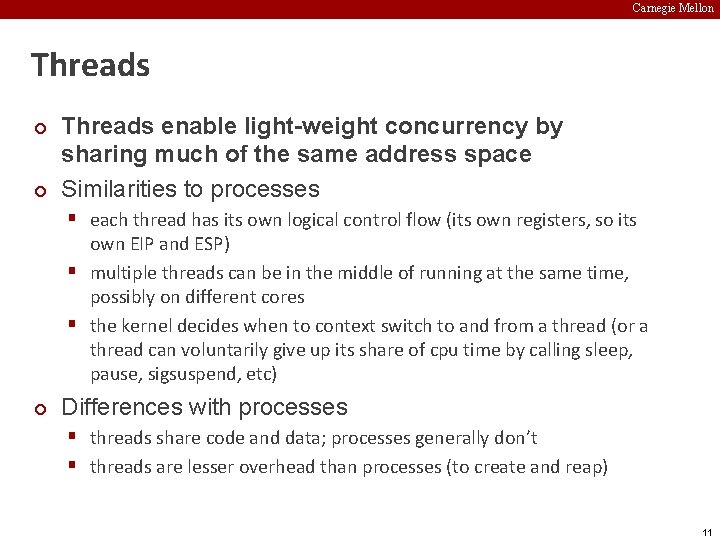
Carnegie Mellon Threads ¢ ¢ Threads enable light-weight concurrency by sharing much of the same address space Similarities to processes § each thread has its own logical control flow (its own registers, so its own EIP and ESP) § multiple threads can be in the middle of running at the same time, possibly on different cores § the kernel decides when to context switch to and from a thread (or a thread can voluntarily give up its share of cpu time by calling sleep, pause, sigsuspend, etc) ¢ Differences with processes § threads share code and data; processes generally don’t § threads are lesser overhead than processes (to create and reap) 11
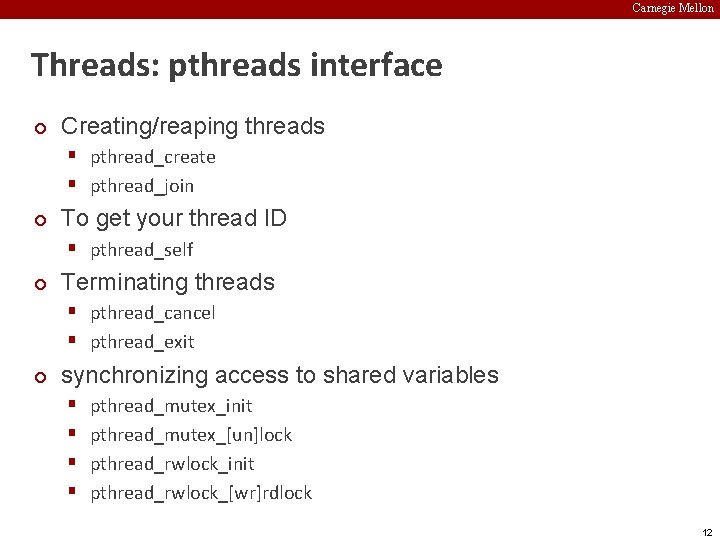
Carnegie Mellon Threads: pthreads interface ¢ Creating/reaping threads § pthread_create § pthread_join ¢ To get your thread ID § pthread_self ¢ Terminating threads § pthread_cancel § pthread_exit ¢ synchronizing access to shared variables § § pthread_mutex_init pthread_mutex_[un]lock pthread_rwlock_init pthread_rwlock_[wr]rdlock 12
Carnegie Mellon Thread exit ¢ ¢ ¢ A thread terminates implicitly when its top-level thread routine returns A thread terminates explicitly by calling pthread_exit(NULL) only terminates the current thread, NOT the process exit(0) terminates ALL the threads in the process (meaning the whole process terminates) pthread_cancel(tid) terminates the thread with id equal to tid 13
Carnegie Mellon Threads - Reaping ¢ Joinable threads can be reaped and killed by other threads § must be reaped with pthread_join to free memory and resources ¢ Detached threads cannot be reaped or killed by other threads § resources are automatically reaped on termination ¢ Default state is joinable § use pthread_detach(pthread_self()) to make detached 14
Carnegie Mellon Topics � � � Networking Basics Concurrent Programming Introduction to Proxy Lab
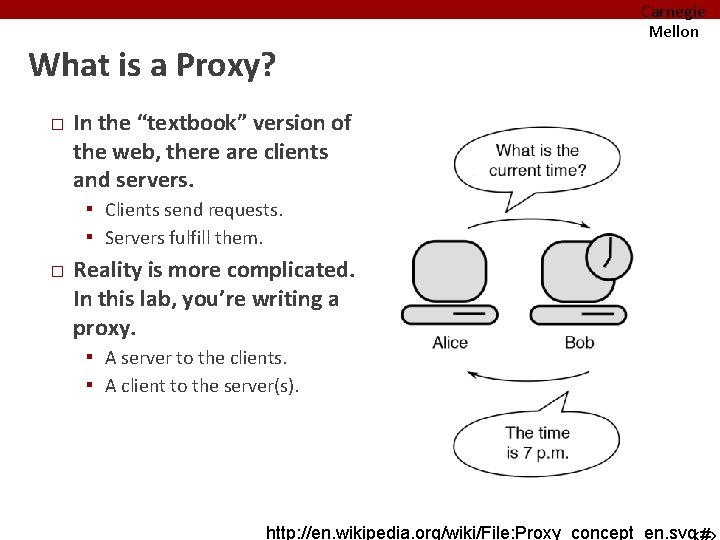
Carnegie Mellon What is a Proxy? � In the “textbook” version of the web, there are clients and servers. ▪ Clients send requests. ▪ Servers fulfill them. � Reality is more complicated. In this lab, you’re writing a proxy. ▪ A server to the clients. ▪ A client to the server(s). http: //en. wikipedia. org/wiki/File: Proxy_concept_en. svg
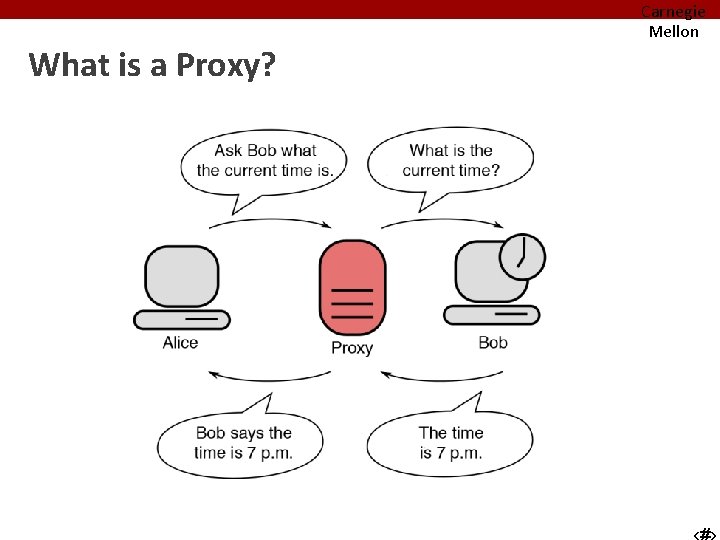
Carnegie Mellon What is a Proxy?
Carnegie Mellon Why and How? � Proxies are handy for a lot of things. ▪ To filter content … or to bypass content filtering. ▪ For anonymity, security, firewalls, etc. ▪ For caching — if someone keeps accessing the same web resource, why not store it locally? � So how do you make a proxy? ▪ It’s a server and a client at the same time. ▪ You’ve seen code in the textbook for a client and for a server; what will code for a proxy look like? ▪ Ultimately, the control flow of your program will look more like a server’s. However, when it’s time to serve the request, a proxy does so by forwarding the request onwards and then forwarding the response back to the client.
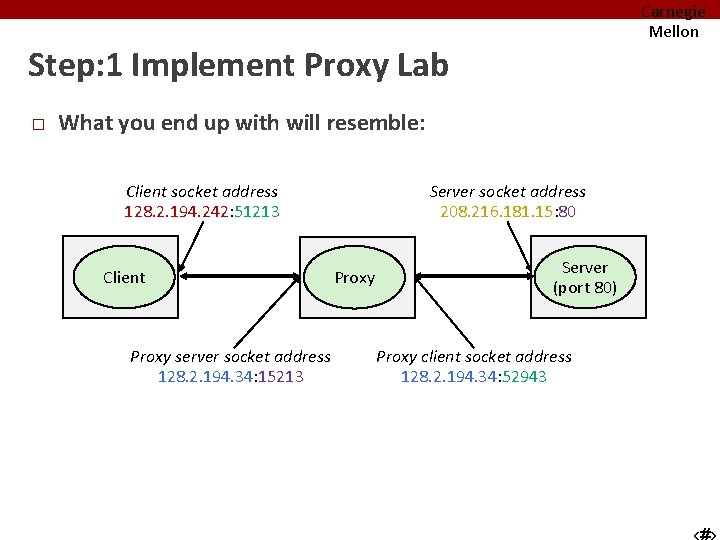
Carnegie Mellon Step: 1 Implement Proxy Lab � What you end up with will resemble: Client socket address 128. 2. 194. 242: 51213 Client Proxy server socket address 128. 2. 194. 34: 15213 Server socket address 208. 216. 181. 15: 80 Proxy Server (port 80) Proxy client socket address 128. 2. 194. 34: 52943
Carnegie Mellon Proxy Lab � Your proxy should handle HTTP/1. 0 GET requests. ▪ Luckily, that’s what the web uses most, so your proxy should work on the vast majority of sites. ▪ Reddit, Vimeo, CNN, You. Tube, NY Times, etc. � Features that require a POST operation (i. e. , sending data to the server) will not work. ▪ Logging in to websites, sending Facebook messages, etc. � HTTPS is expected not to work. ▪ Google (and some other popular websites) now try to push users to HTTPS by default; watch out for that. � Your server should be robust. It shouldn’t crash if it receives a malformed request, a request for an item that doesn’t exist, etc.
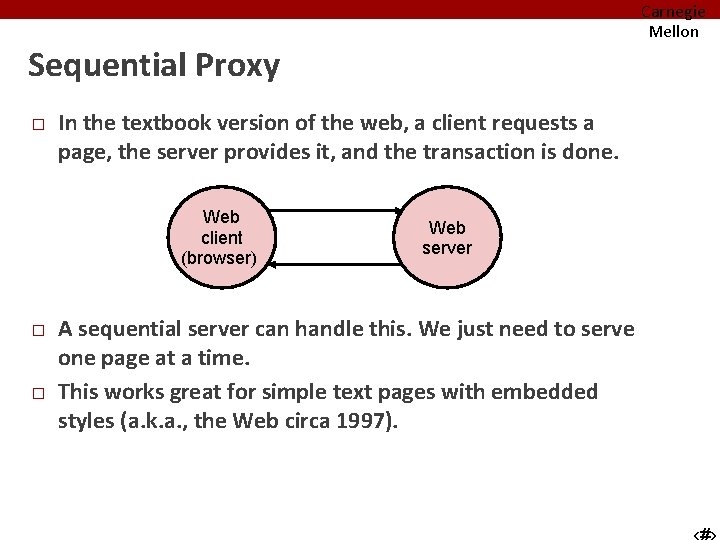
Carnegie Mellon Sequential Proxy � In the textbook version of the web, a client requests a page, the server provides it, and the transaction is done. Web client (browser) � � Web server A sequential server can handle this. We just need to serve one page at a time. This works great for simple text pages with embedded styles (a. k. a. , the Web circa 1997).
Carnegie Mellon Step 2: Concurrent Proxy � Let’s face it, what your browser is really doing is a little more complicated than that. ▪ A single HTML page may depend on 10 s or 100 s of support files (images, stylesheets, scripts, etc. ). ▪ Do you really want to load each of those one at a time? ▪ Do you really want to wait for the server to serve every other person looking at the web page before they serve you? � To speed things up, you need concurrency. ▪ Specifically, concurrent I/O, since that’s generally slower than processing here. ▪ You want your server to be able to handle lots of requests at the same time. � That’s going to require threading. (Yay!)
Carnegie Mellon Step 3: Cache Web Objects � Your proxy should cache previously requested objects. ▪ Don’t panic! This has nothing to do with cache lab. We’re just storing things for later retrieval, not managing the hardware cache. ▪ Cache individual objects, not the whole page – so, if only part of the page changes, you only refetch that part. ▪ The handout specifies a maximum object size and a maximum cache size. ▪ Use an LRU eviction policy. ▪ Your caching system must allow for concurrent reads while maintaining consistency. Concurrency? Shared Resource?
Carnegie Mellon Questions? (come to office hours if you need help) 24
- Slides: 24