
Carnegie Mellon Malloc Lab 15 213 Introduction to
Carnegie Mellon Malloc Lab 15 -213: Introduction to Computer Systems Recitation 11: Nov. 4, 2013 Marjorie Carlson Recitation A 1
Carnegie Mellon Weekly Update ¢ Malloc lab is out § Due Thursday, Nov. 14 § Start early § Seriously. . . start early. § “It is possible to write an efficient malloc package with a few pages of code. However, we can guarantee that it will be some of the most difficult and sophisticated code you have written so far in your career. ” 2
Carnegie Mellon Agenda ¢ ¢ ¢ Malloc Overview Casting & Pointer Review Macros & Inline Functions Malloc Design Debugging & an Action Plan 3
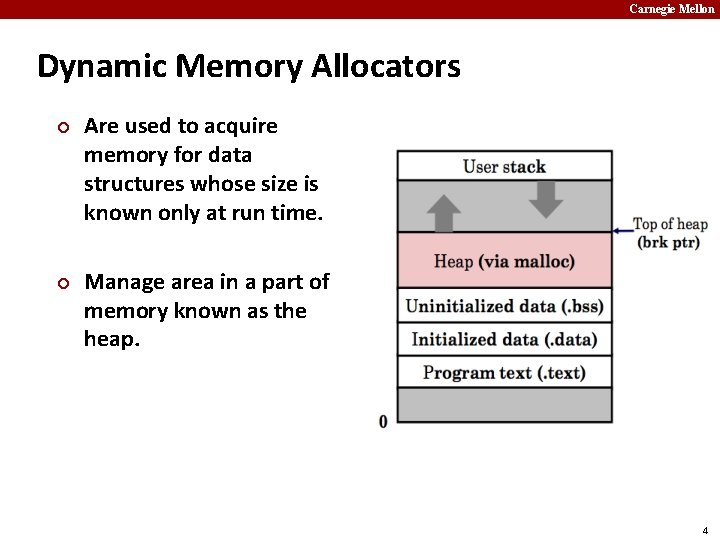
Carnegie Mellon Dynamic Memory Allocators ¢ ¢ Are used to acquire memory for data structures whose size is known only at run time. Manage area in a part of memory known as the heap. 4
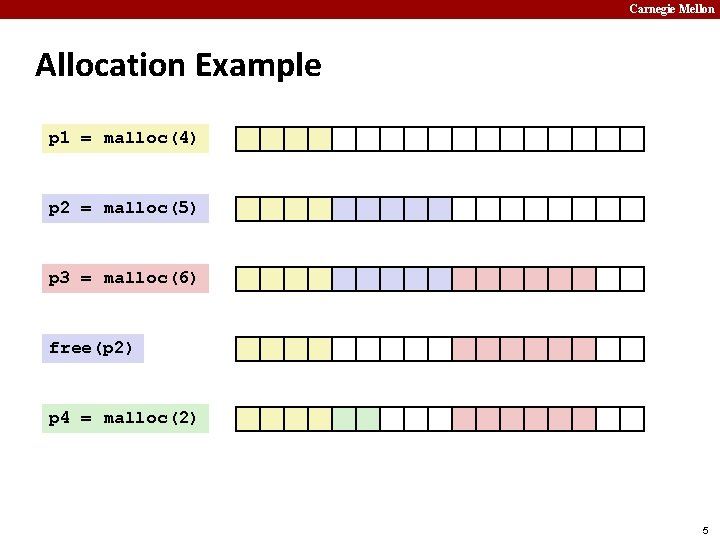
Carnegie Mellon Allocation Example p 1 = malloc(4) p 2 = malloc(5) p 3 = malloc(6) free(p 2) p 4 = malloc(2) 5
Carnegie Mellon Malloc Lab ¢ ¢ ¢ Create a general-purpose allocator that dynamically modifies the size of the heap as required. The driver calls your functions on various trace files to simulate placing data in memory. Grade is based on: § Space utilization (minimizing fragmentation) § Throughput (processing requests quickly) § Your heap checker § Style & correctness, hand-graded as always 6
Carnegie Mellon Functions You Will Implement ¢ mm_initializes the heap before malloc is called. ¢ malloc returns a pointer to a free block (>= req. size). ¢ calloc same, but zeros the memory first. ¢ realloc changes the size of a previously allocated block. (May move it to another location. ) ¢ free marks allocated memory available again. ¢ mm_checkheap debugging function (more on this later) 7
Carnegie Mellon Functions You May Use ¢ mem_sbrk § § ¢ Used for expanding the size of the heap. Allows you to dynamically increase your heap size as required. Helpful to initialize your heap. Returns a pointer to first byte in newly allocated heap area. mem_heap_lo § Pointer to first byte of heap ¢ mem_heap_hi § Pointer to last byte of heap ¢ ¢ mem_heapsize mem_pagesize 8
Carnegie Mellon Agenda ¢ ¢ ¢ Malloc Overview Casting & Pointer Review Macros & Inline Functions Malloc Design Debugging & an Action Plan 9
![Carnegie Mellon Pointer Arithmetic ¢ ¢ *(arr + i) is equivalent to arr[i] Thus](http://slidetodoc.com/presentation_image_h2/418369a3fc6df2baadd47bb791534e61/image-10.jpg "Carnegie Mellon Pointer Arithmetic ¢ ¢ *(arr + i) is equivalent to arr[i] Thus")
Carnegie Mellon Pointer Arithmetic ¢ ¢ *(arr + i) is equivalent to arr[i] Thus the result of arithmetic involving pointers depends on the type of the data the pointer points at. int *arr + 1 ¢ = 0 x 1000 = 0 x 1004 short *arr + 1 = 0 x 1000 = 0 x 1002 So ptr + i is really ptr + (i * sizeof(ptr-type)) example and pictures from 10
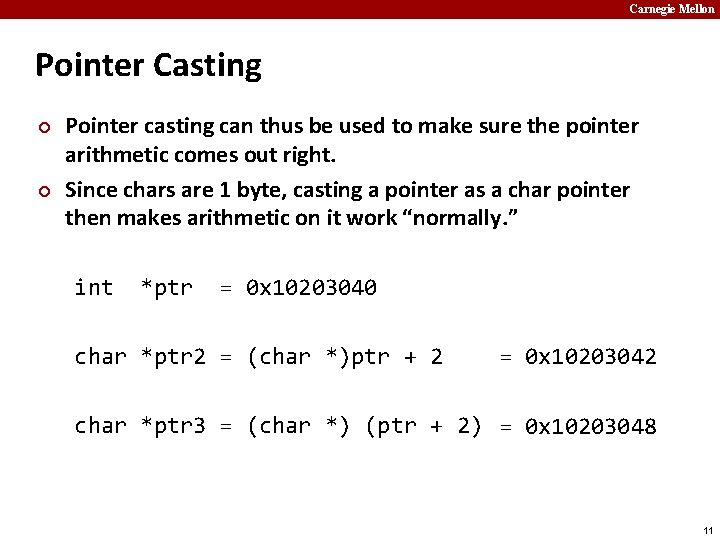
Carnegie Mellon Pointer Casting ¢ ¢ Pointer casting can thus be used to make sure the pointer arithmetic comes out right. Since chars are 1 byte, casting a pointer as a char pointer then makes arithmetic on it work “normally. ” int *ptr = 0 x 10203040 char *ptr 2 = (char *)ptr + 2 = 0 x 10203042 char *ptr 3 = (char *) (ptr + 2) = 0 x 10203048 11
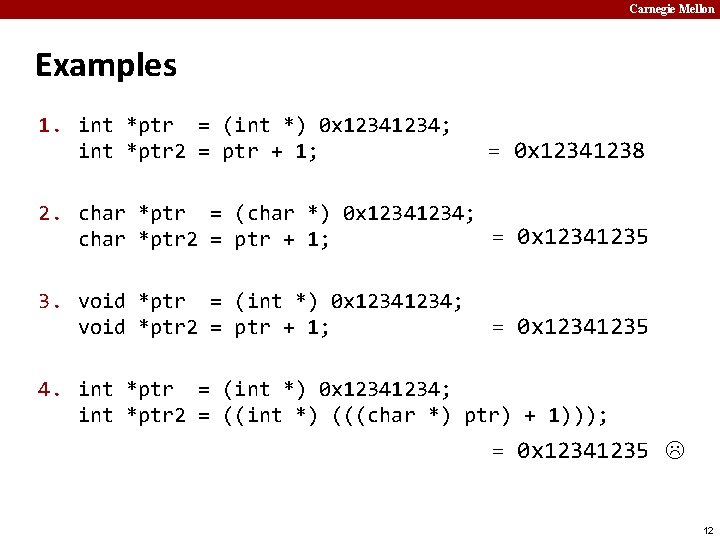
Carnegie Mellon Examples 1. int *ptr = (int *) 0 x 1234; int *ptr 2 = ptr + 1; = 0 x 12341238 2. char *ptr = (char *) 0 x 1234; = 0 x 12341235 char *ptr 2 = ptr + 1; 3. void *ptr = (int *) 0 x 1234; void *ptr 2 = ptr + 1; = 0 x 12341235 4. int *ptr = (int *) 0 x 1234; int *ptr 2 = ((int *) (((char *) ptr) + 1))); = 0 x 12341235 12
Carnegie Mellon Agenda ¢ ¢ ¢ Malloc Overview Casting & Pointer Review Macros & Inline Functions Malloc Design Debugging & an Action Plan 13
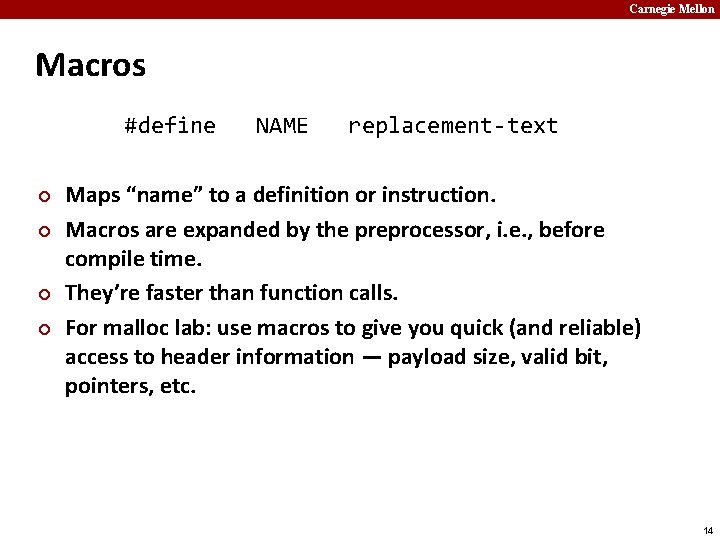
Carnegie Mellon Macros #define ¢ ¢ NAME replacement-text Maps “name” to a definition or instruction. Macros are expanded by the preprocessor, i. e. , before compile time. They’re faster than function calls. For malloc lab: use macros to give you quick (and reliable) access to header information — payload size, valid bit, pointers, etc. 14
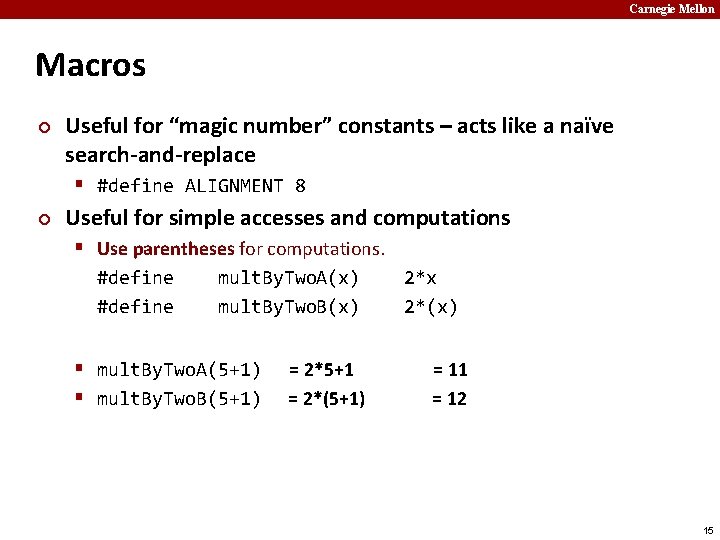
Carnegie Mellon Macros ¢ Useful for “magic number” constants – acts like a naïve search-and-replace § #define ALIGNMENT 8 ¢ Useful for simple accesses and computations § Use parentheses for computations. #define mult. By. Two. A(x) mult. By. Two. B(x) § mult. By. Two. A(5+1) § mult. By. Two. B(5+1) = 2*5+1 = 2*(5+1) 2*x 2*(x) = 11 = 12 15
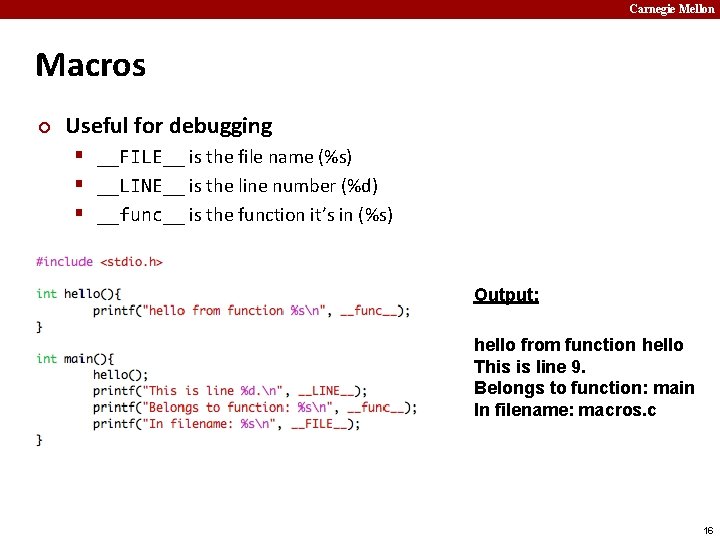
Carnegie Mellon Macros ¢ Useful for debugging § __FILE__ is the file name (%s) § __LINE__ is the line number (%d) § __func__ is the function it’s in (%s) Output: hello from function hello This is line 9. Belongs to function: main In filename: macros. c 16
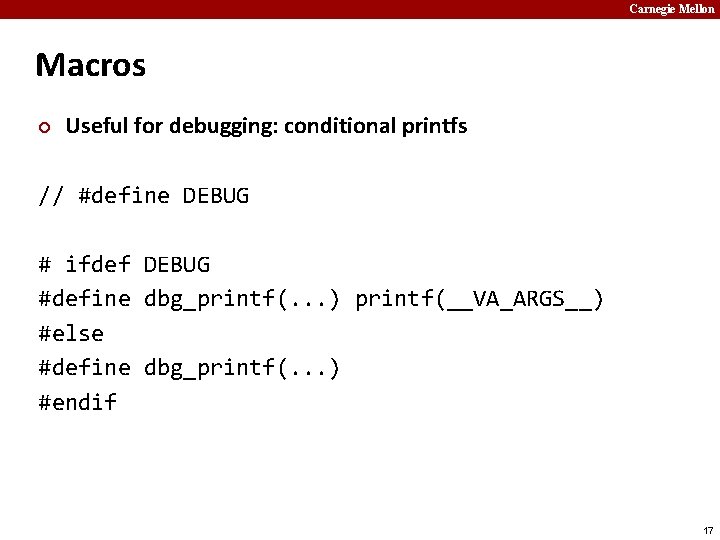
Carnegie Mellon Macros ¢ Useful for debugging: conditional printfs // #define DEBUG # ifdef DEBUG #define dbg_printf(. . . ) printf(__VA_ARGS__) #else #define dbg_printf(. . . ) #endif 17
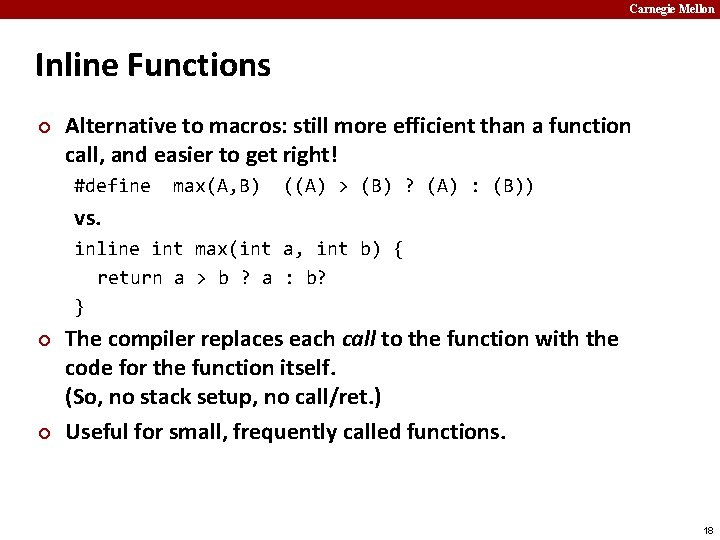
Carnegie Mellon Inline Functions ¢ Alternative to macros: still more efficient than a function call, and easier to get right! #define max(A, B) ((A) > (B) ? (A) : (B)) vs. inline int max(int a, int b) { return a > b ? a : b? } ¢ ¢ The compiler replaces each call to the function with the code for the function itself. (So, no stack setup, no call/ret. ) Useful for small, frequently called functions. 18
Carnegie Mellon Agenda ¢ ¢ ¢ Malloc Overview Casting & Pointer Review Macros & Inline Functions Malloc Design Debugging & an Action Plan 19
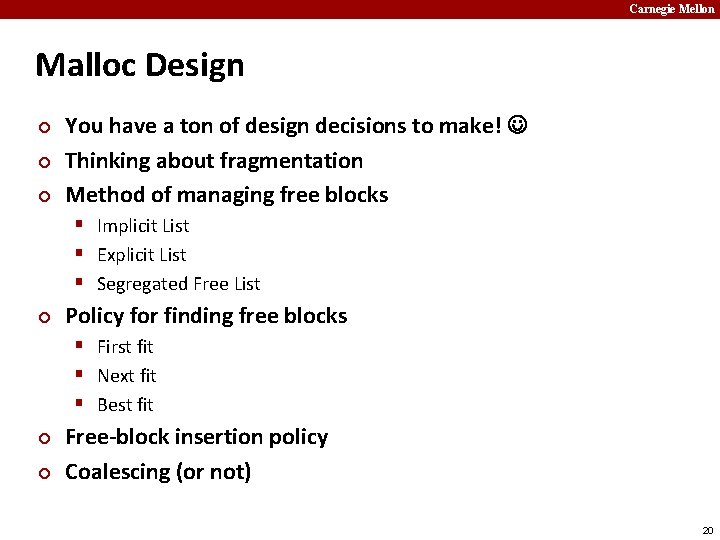
Carnegie Mellon Malloc Design ¢ ¢ ¢ You have a ton of design decisions to make! Thinking about fragmentation Method of managing free blocks § Implicit List § Explicit List § Segregated Free List ¢ Policy for finding free blocks § First fit § Next fit § Best fit ¢ ¢ Free-block insertion policy Coalescing (or not) 20
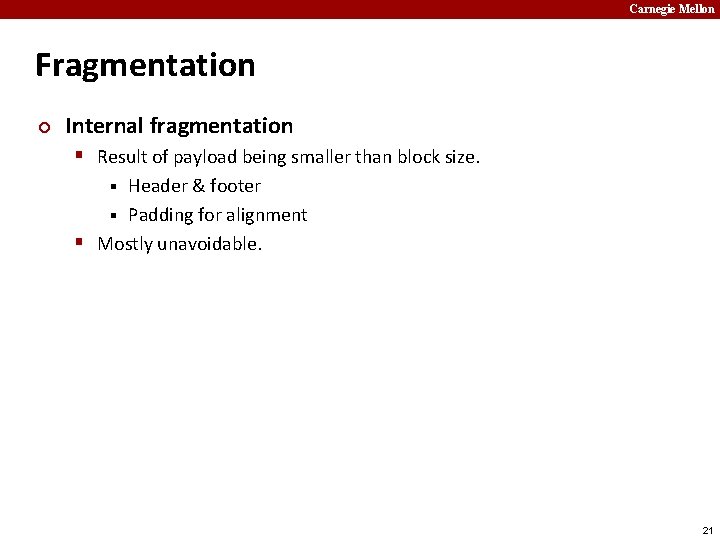
Carnegie Mellon Fragmentation ¢ Internal fragmentation § Result of payload being smaller than block size. Header & footer § Padding for alignment § Mostly unavoidable. § 21
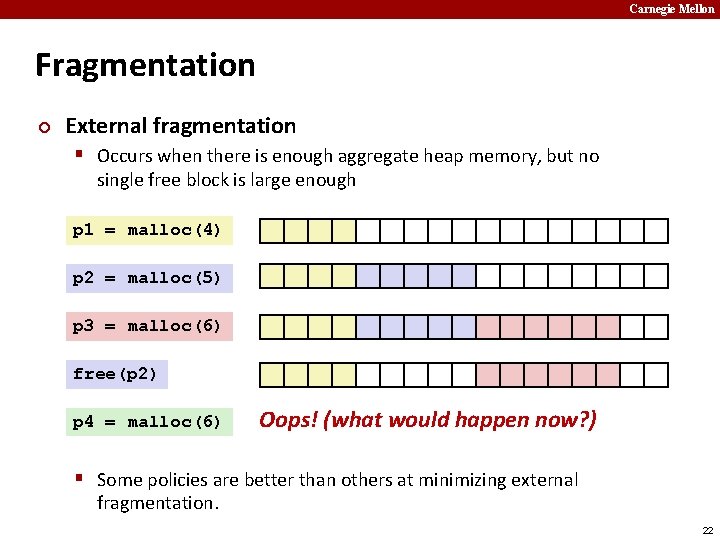
Carnegie Mellon Fragmentation ¢ External fragmentation § Occurs when there is enough aggregate heap memory, but no single free block is large enough p 1 = malloc(4) p 2 = malloc(5) p 3 = malloc(6) free(p 2) p 4 = malloc(6) Oops! (what would happen now? ) § Some policies are better than others at minimizing external fragmentation. 22
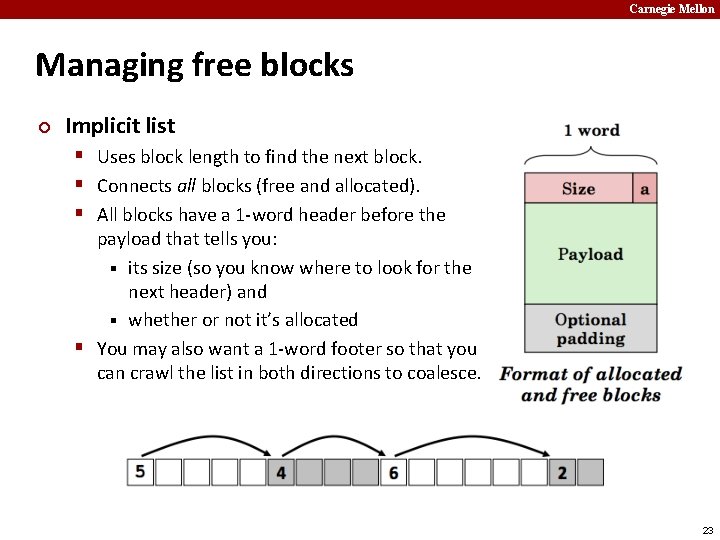
Carnegie Mellon Managing free blocks ¢ Implicit list § Uses block length to find the next block. § Connects all blocks (free and allocated). § All blocks have a 1 -word header before the payload that tells you: § its size (so you know where to look for the next header) and § whether or not it’s allocated § You may also want a 1 -word footer so that you can crawl the list in both directions to coalesce. 23
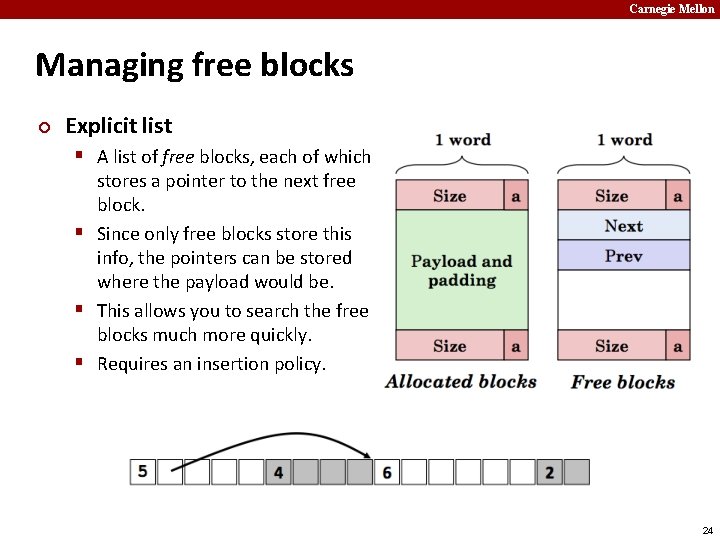
Carnegie Mellon Managing free blocks ¢ Explicit list § A list of free blocks, each of which stores a pointer to the next free block. § Since only free blocks store this info, the pointers can be stored where the payload would be. § This allows you to search the free blocks much more quickly. § Requires an insertion policy. 24
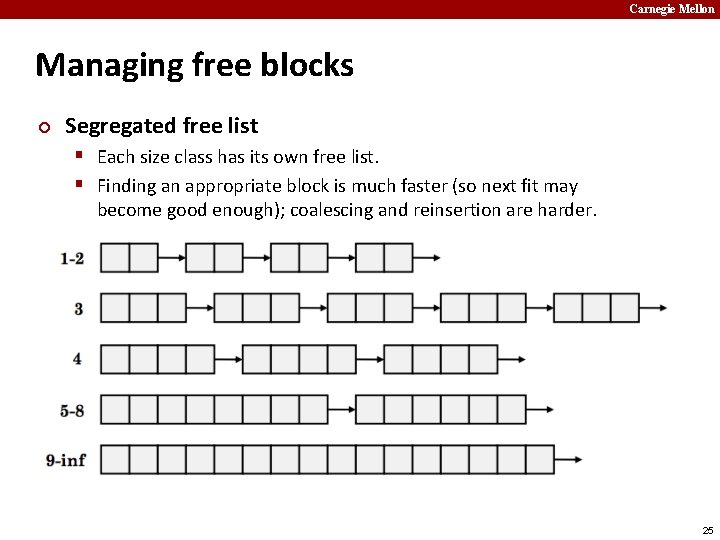
Carnegie Mellon Managing free blocks ¢ Segregated free list § Each size class has its own free list. § Finding an appropriate block is much faster (so next fit may become good enough); coalescing and reinsertion are harder. 25
Carnegie Mellon Finding free blocks ¢ First fit § Start from the beginning. § Find the first free block. § Linear time. ¢ Next fit § Search starting from where previous search finished. § Often faster than first fit. ¢ Best fit § Choose the free block closet in size to what you need. § Better memory utilization (less fragmentation), but it’s very slow to traverse the full list. ¢ What if no blocks are large enough? § Extend the heap 26
Carnegie Mellon Insertion policy ¢ Where should free blocks go? § Blocks that have just been free()d. § “Leftovers” when allocating part of a block. ¢ LIFO (Last In First Out) § Insert the free block at the beginning of the list. § Simple and constant time. § Studies suggest potentially worse fragmentation. ¢ Address-Ordered § Keep free blocks list sorted in address order. § Studies suggest better fragmentation. § Slower since you have to find where it belongs. 27
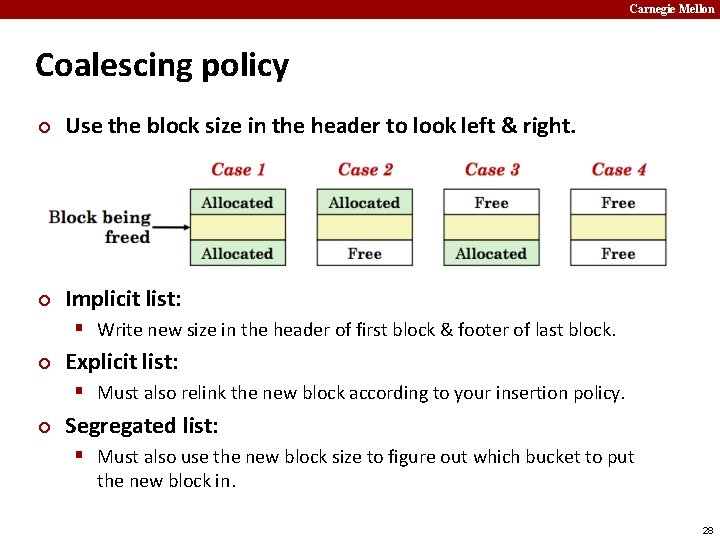
Carnegie Mellon Coalescing policy ¢ Use the block size in the header to look left & right. ¢ Implicit list: § Write new size in the header of first block & footer of last block. ¢ Explicit list: § Must also relink the new block according to your insertion policy. ¢ Segregated list: § Must also use the new block size to figure out which bucket to put the new block in. 28
Carnegie Mellon Agenda ¢ ¢ ¢ Malloc Overview Casting & Pointer Review Macros & Inline Functions Malloc Design Debugging & an Action Plan 29
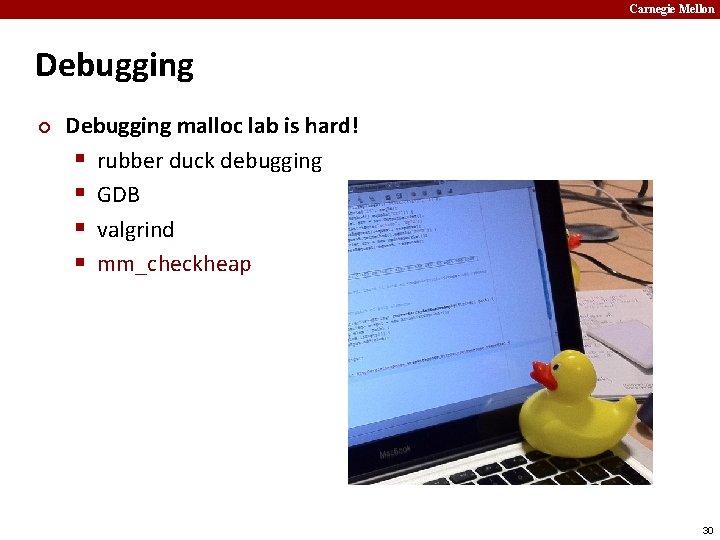
Carnegie Mellon Debugging ¢ Debugging malloc lab is hard! § rubber duck debugging § GDB § valgrind § mm_checkheap 30
Carnegie Mellon mm_checkheap ¢ mm_checkheap § A consistency checker to check the correctness of your heap. § Write it early and update as needed. § What to check for? Anything that could go wrong! § address alignment § consistency of header & footer § whether free blocks are coalescing § consistency of linked list pointers § whether blocks are being placed in the right segregated list § … § Focus on correctness, not efficiency. § Once you get it working, it should be silent and only output when your heap has messed up. § You can insert a call to it before & after functions to pin down exactly where things are going wrong. § Do not request debugging help from a TA without a working checkheap. 31
Carnegie Mellon Suggested action plan 1. Start early — make the most use of empty office hours. 2. Keep consulting the handout (e. g. the “rules”) throughout your coding process. 3. Understand implement a basic implicit list design. 4. Write your heap checker. 5. Come up with something faster/more memory efficient. 6. Implement it. 7. Debug it. 8. Git commit and/or submit. 9. Goto 5. 32
Carnegie Mellon Questions? ¢ GOOD LUCK!! 33
- Slides: 33