
Carnegie Mellon MachineLevel Programming I Basics 15 21318
Carnegie Mellon Machine-Level Programming I: Basics 15 -213/18 -213: Introduction to Computer Systems 5 th Lecture, Sep. 11, 2012 Instructors: Dave O’Hallaron, Greg Ganger, and Greg Kesden 1
Carnegie Mellon Today: Machine Programming I: Basics ¢ ¢ History of Intel processors and architectures C, assembly, machine code Assembly Basics: Registers, operands, move Intro to x 86 -64 2
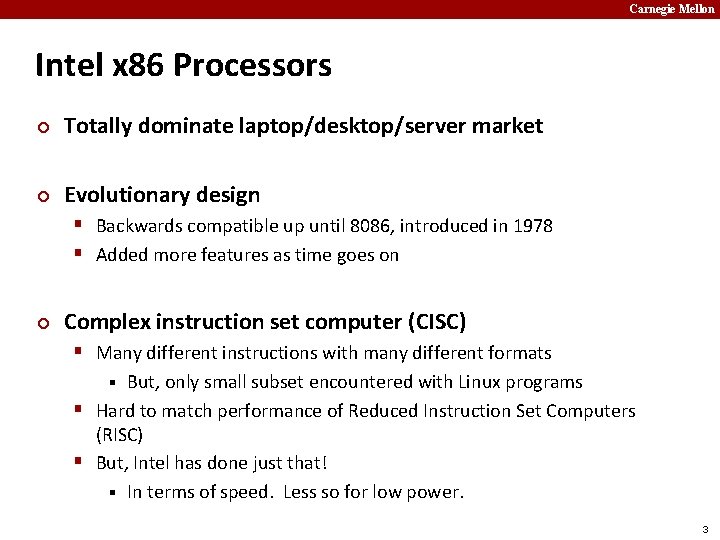
Carnegie Mellon Intel x 86 Processors ¢ Totally dominate laptop/desktop/server market ¢ Evolutionary design § Backwards compatible up until 8086, introduced in 1978 § Added more features as time goes on ¢ Complex instruction set computer (CISC) § Many different instructions with many different formats But, only small subset encountered with Linux programs § Hard to match performance of Reduced Instruction Set Computers (RISC) § But, Intel has done just that! § In terms of speed. Less so for low power. § 3
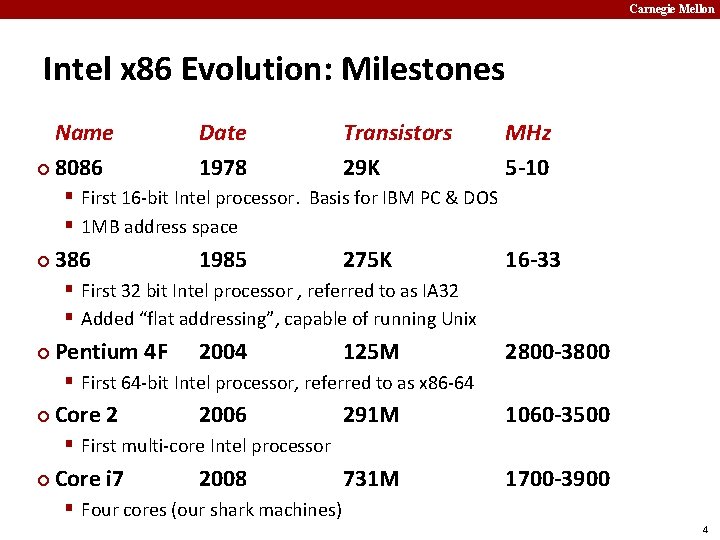
Carnegie Mellon Intel x 86 Evolution: Milestones Name ¢ 8086 Date 1978 Transistors 29 K MHz 5 -10 § First 16 -bit Intel processor. Basis for IBM PC & DOS § 1 MB address space ¢ 386 1985 275 K 16 -33 § First 32 bit Intel processor , referred to as IA 32 § Added “flat addressing”, capable of running Unix ¢ Pentium 4 F 2004 125 M 2800 -3800 § First 64 -bit Intel processor, referred to as x 86 -64 ¢ Core 2 2006 291 M 1060 -3500 731 M 1700 -3900 § First multi-core Intel processor ¢ Core i 7 2008 § Four cores (our shark machines) 4
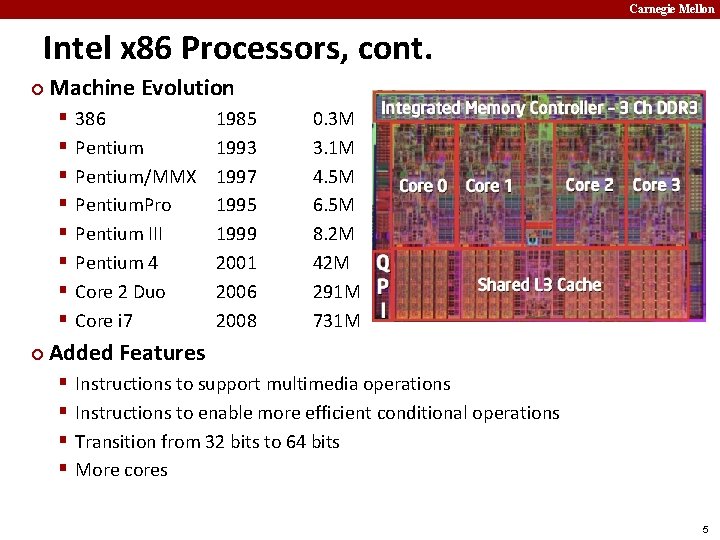
Carnegie Mellon Intel x 86 Processors, cont. ¢ Machine Evolution § § § § ¢ 386 Pentium/MMX Pentium. Pro Pentium III Pentium 4 Core 2 Duo Core i 7 1985 1993 1997 1995 1999 2001 2006 2008 0. 3 M 3. 1 M 4. 5 M 6. 5 M 8. 2 M 42 M 291 M 731 M Added Features § § Instructions to support multimedia operations Instructions to enable more efficient conditional operations Transition from 32 bits to 64 bits More cores 5
Carnegie Mellon x 86 Clones: Advanced Micro Devices (AMD) ¢ Historically § AMD has followed just behind Intel § A little bit slower, a lot cheaper ¢ Then § Recruited top circuit designers from Digital Equipment Corp. and other downward trending companies § Built Opteron: tough competitor to Pentium 4 § Developed x 86 -64, their own extension to 64 bits 6
Carnegie Mellon Intel’s 64 -Bit ¢ Intel Attempted Radical Shift from IA 32 to IA 64 § Totally different architecture (Itanium) § Executes IA 32 code only as legacy § Performance disappointing ¢ AMD Stepped in with Evolutionary Solution § x 86 -64 (now called “AMD 64”) ¢ Intel Felt Obligated to Focus on IA 64 § Hard to admit mistake or that AMD is better ¢ 2004: Intel Announces EM 64 T extension to IA 32 § Extended Memory 64 -bit Technology § Almost identical to x 86 -64! ¢ All but low-end x 86 processors support x 86 -64 § But, lots of code still runs in 32 -bit mode 7
Carnegie Mellon Our Coverage ¢ IA 32 § The traditional x 86 § shark> gcc –m 32 hello. c ¢ x 86 -64 § The emerging standard § shark> gcc hello. c § shark> gcc –m 64 hello. c ¢ Presentation § § Book presents IA 32 in Sections 3. 1— 3. 12 Covers x 86 -64 in 3. 13 We will cover both simultaneously Some labs will be based on x 86 -64, others on IA 32 8
Carnegie Mellon Today: Machine Programming I: Basics ¢ ¢ History of Intel processors and architectures C, assembly, machine code Assembly Basics: Registers, operands, move Intro to x 86 -64 9
Carnegie Mellon Definitions ¢ Architecture: (also ISA: instruction set architecture) The parts of a processor design that one needs to understand to write assembly code. § Examples: instruction set specification, registers. ¢ Microarchitecture: Implementation of the architecture. § Examples: cache sizes and core frequency. ¢ Example ISAs (Intel): x 86, IA 10
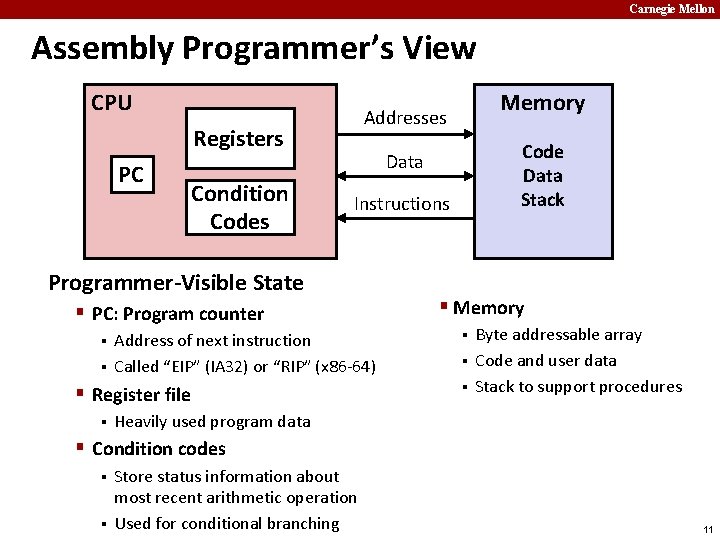
Carnegie Mellon Assembly Programmer’s View CPU Addresses Registers PC Condition Codes Code Data Stack Data Instructions Programmer-Visible State § PC: Program counter Address of next instruction § Called “EIP” (IA 32) or “RIP” (x 86 -64) § § Register file § Memory Byte addressable array § Code and user data § Stack to support procedures § Heavily used program data § Condition codes Store status information about most recent arithmetic operation § Used for conditional branching § 11
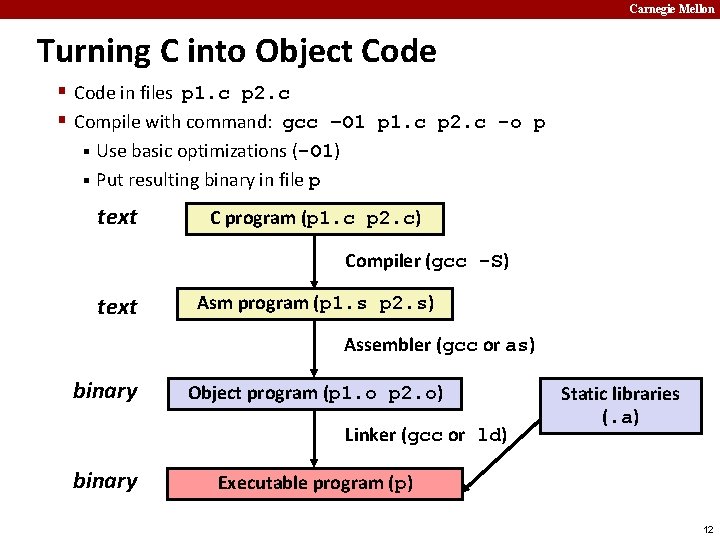
Carnegie Mellon Turning C into Object Code § Code in files p 1. c p 2. c § Compile with command: gcc –O 1 p 1. c p 2. c -o p Use basic optimizations (-O 1) § Put resulting binary in file p § text C program (p 1. c p 2. c) Compiler (gcc -S) text Asm program (p 1. s p 2. s) Assembler (gcc or as) binary Object program (p 1. o p 2. o) Linker (gcc or ld) binary Static libraries (. a) Executable program (p) 12
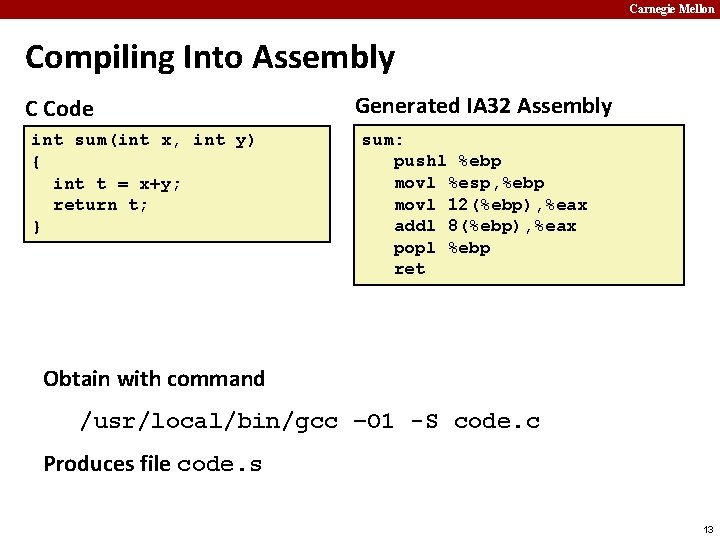
Carnegie Mellon Compiling Into Assembly C Code int sum(int x, int y) { int t = x+y; return t; } Generated IA 32 Assembly sum: pushl %ebp movl %esp, %ebp movl 12(%ebp), %eax addl 8(%ebp), %eax popl %ebp ret Obtain with command /usr/local/bin/gcc –O 1 -S code. c Produces file code. s 13
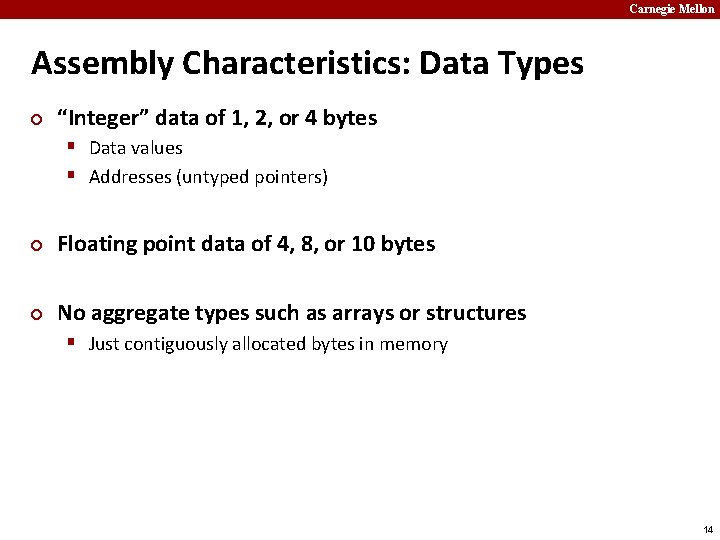
Carnegie Mellon Assembly Characteristics: Data Types ¢ “Integer” data of 1, 2, or 4 bytes § Data values § Addresses (untyped pointers) ¢ Floating point data of 4, 8, or 10 bytes ¢ No aggregate types such as arrays or structures § Just contiguously allocated bytes in memory 14
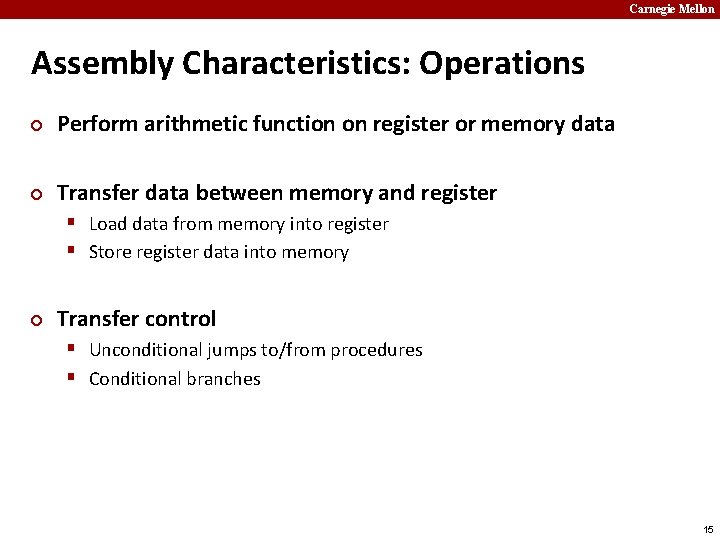
Carnegie Mellon Assembly Characteristics: Operations ¢ Perform arithmetic function on register or memory data ¢ Transfer data between memory and register § Load data from memory into register § Store register data into memory ¢ Transfer control § Unconditional jumps to/from procedures § Conditional branches 15
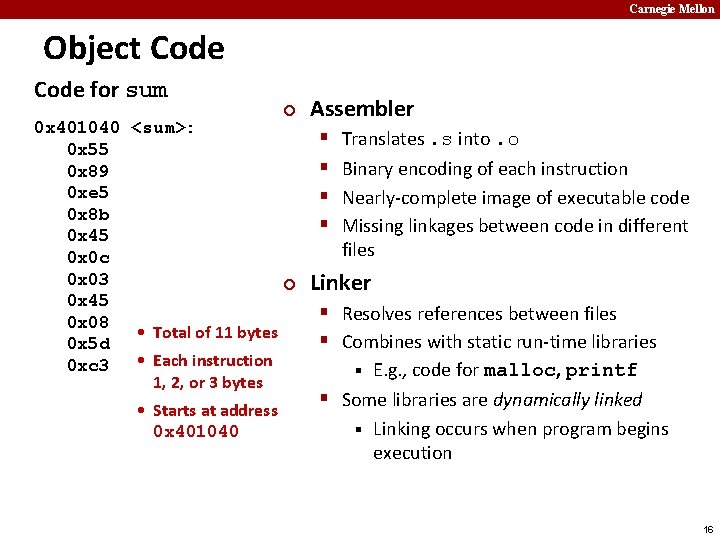
Carnegie Mellon Object Code for sum ¢ 0 x 401040 <sum>: 0 x 55 0 x 89 0 xe 5 0 x 8 b 0 x 45 0 x 0 c 0 x 03 ¢ 0 x 45 0 x 08 • Total of 11 bytes 0 x 5 d 0 xc 3 • Each instruction 1, 2, or 3 bytes • Starts at address 0 x 401040 Assembler § § Translates. s into. o Binary encoding of each instruction Nearly-complete image of executable code Missing linkages between code in different files Linker § Resolves references between files § Combines with static run-time libraries E. g. , code for malloc, printf § Some libraries are dynamically linked § Linking occurs when program begins execution § 16
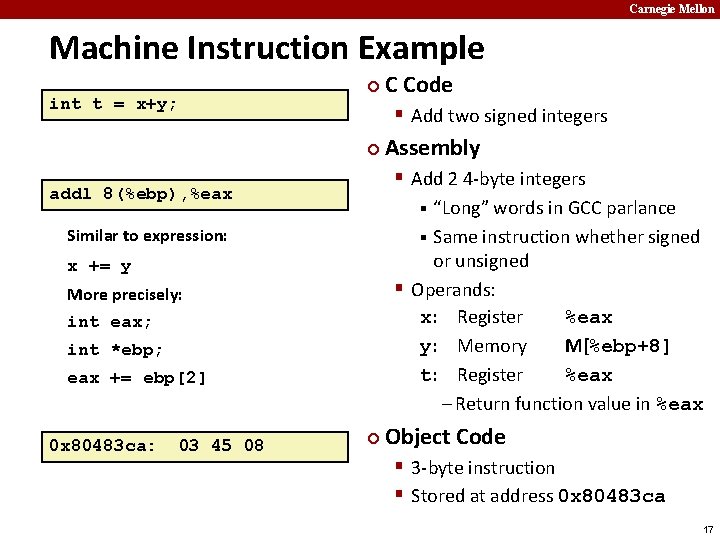
Carnegie Mellon Machine Instruction Example ¢ int t = x+y; § Add two signed integers ¢ “Long” words in GCC parlance § Same instruction whether signed or unsigned § Operands: x: Register %eax y: Memory M[%ebp+8] t: Register %eax – Return function value in %eax § Similar to expression: x += y More precisely: int eax; int *ebp; eax += ebp[2] 03 45 08 Assembly § Add 2 4 -byte integers addl 8(%ebp), %eax 0 x 80483 ca: C Code ¢ Object Code § 3 -byte instruction § Stored at address 0 x 80483 ca 17
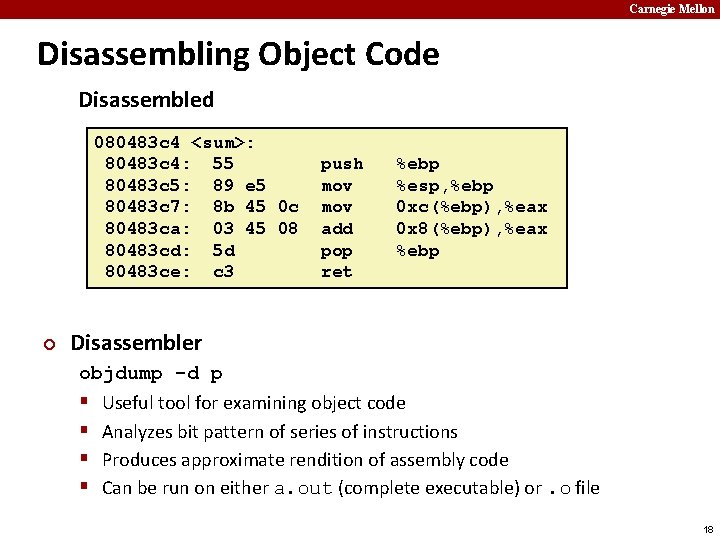
Carnegie Mellon Disassembling Object Code Disassembled 080483 c 4 <sum>: 80483 c 4: 55 80483 c 5: 89 e 5 80483 c 7: 8 b 45 0 c 80483 ca: 03 45 08 80483 cd: 5 d 80483 ce: c 3 ¢ push mov add pop ret %ebp %esp, %ebp 0 xc(%ebp), %eax 0 x 8(%ebp), %eax %ebp Disassembler objdump -d p § Useful tool for examining object code § Analyzes bit pattern of series of instructions § Produces approximate rendition of assembly code § Can be run on either a. out (complete executable) or. o file 18
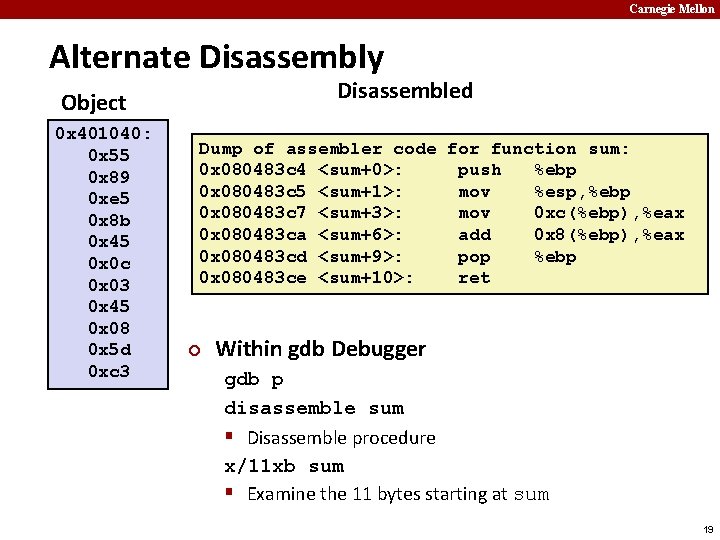
Carnegie Mellon Alternate Disassembly Disassembled Object 0 x 401040: 0 x 55 0 x 89 0 xe 5 0 x 8 b 0 x 45 0 x 0 c 0 x 03 0 x 45 0 x 08 0 x 5 d 0 xc 3 Dump of assembler code for function sum: 0 x 080483 c 4 <sum+0>: push %ebp 0 x 080483 c 5 <sum+1>: mov %esp, %ebp 0 x 080483 c 7 <sum+3>: mov 0 xc(%ebp), %eax 0 x 080483 ca <sum+6>: add 0 x 8(%ebp), %eax 0 x 080483 cd <sum+9>: pop %ebp 0 x 080483 ce <sum+10>: ret ¢ Within gdb Debugger gdb p disassemble sum § Disassemble procedure x/11 xb sum § Examine the 11 bytes starting at sum 19
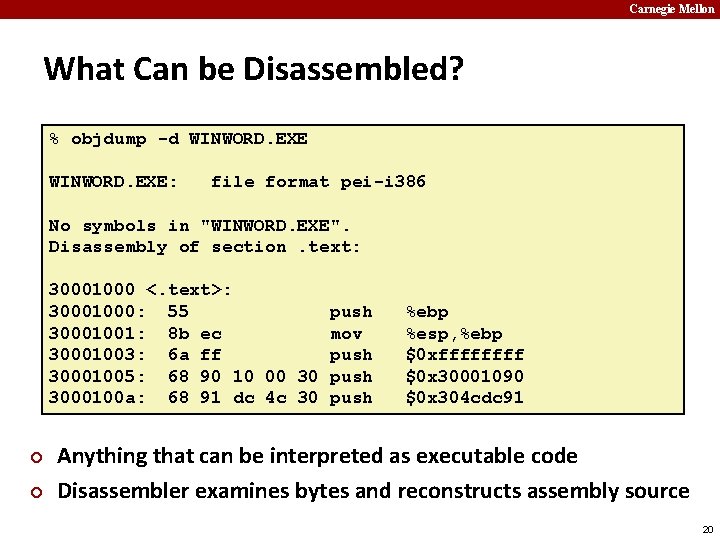
Carnegie Mellon What Can be Disassembled? % objdump -d WINWORD. EXE: file format pei-i 386 No symbols in "WINWORD. EXE". Disassembly of section. text: 30001000 <. text>: 30001000: 55 30001001: 8 b ec 30001003: 6 a ff 30001005: 68 90 10 00 30 3000100 a: 68 91 dc 4 c 30 ¢ ¢ push mov push %ebp %esp, %ebp $0 xffff $0 x 30001090 $0 x 304 cdc 91 Anything that can be interpreted as executable code Disassembler examines bytes and reconstructs assembly source 20
Carnegie Mellon Today: Machine Programming I: Basics ¢ ¢ History of Intel processors and architectures C, assembly, machine code Assembly Basics: Registers, operands, move Intro to x 86 -64 21
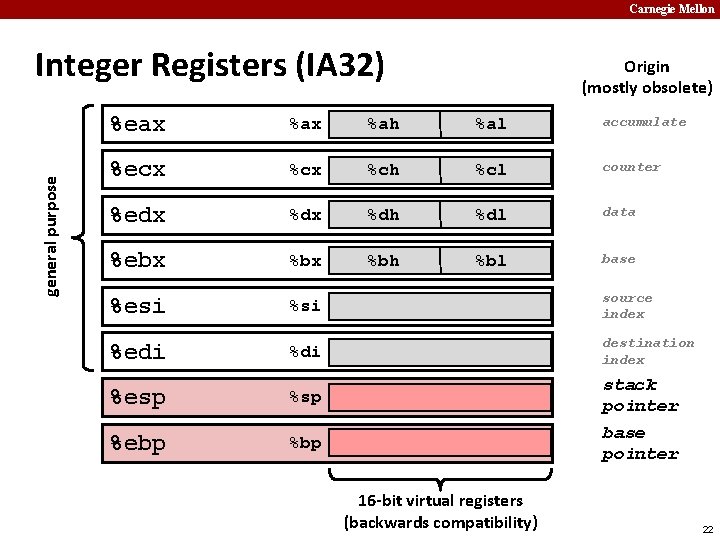
Carnegie Mellon general purpose Integer Registers (IA 32) Origin (mostly obsolete) %eax %ah %al accumulate %ecx %ch %cl counter %edx %dh %dl data %ebx %bh %bl base %esi %si source index %edi %di destination index %esp %ebp %bp stack pointer base pointer 16 -bit virtual registers (backwards compatibility) 22
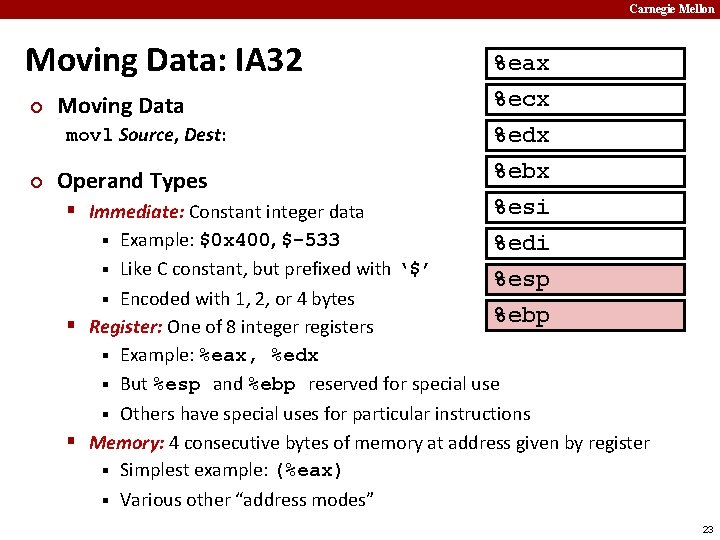
Carnegie Mellon Moving Data: IA 32 ¢ Moving Data movl Source, Dest: ¢ Operand Types § Immediate: Constant integer data %eax %ecx %edx %ebx %esi Example: $0 x 400, $-533 %edi § Like C constant, but prefixed with ‘$’ %esp § Encoded with 1, 2, or 4 bytes %ebp § Register: One of 8 integer registers § Example: %eax, %edx § But %esp and %ebp reserved for special use § Others have special uses for particular instructions § Memory: 4 consecutive bytes of memory at address given by register § Simplest example: (%eax) § Various other “address modes” § 23
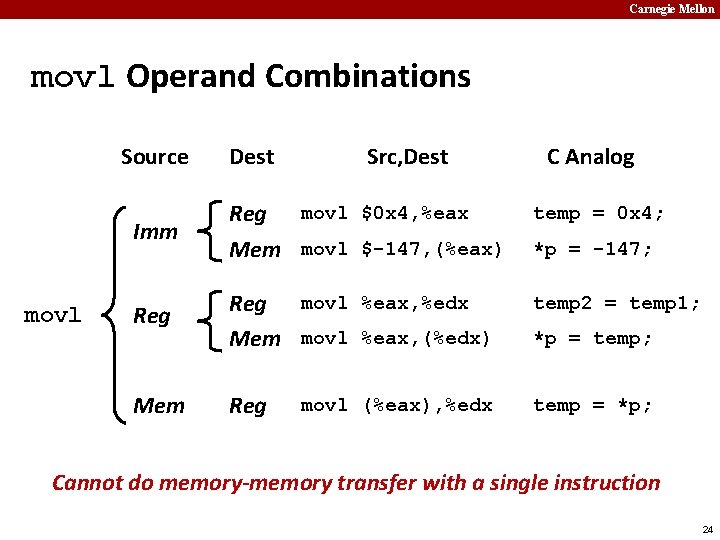
Carnegie Mellon movl Operand Combinations Source movl Dest Src, Dest C Analog Imm Reg movl $0 x 4, %eax Mem movl $-147, (%eax) temp = 0 x 4; Reg movl %eax, %edx Mem movl %eax, (%edx) temp 2 = temp 1; Mem Reg temp = *p; movl (%eax), %edx *p = -147; *p = temp; Cannot do memory-memory transfer with a single instruction 24
![Carnegie Mellon Simple Memory Addressing Modes ¢ Normal (R) Mem[Reg[R]] § Register R specifies](http://slidetodoc.com/presentation_image_h2/5256d2b68222d15d92bce14b023513f1/image-25.jpg "Carnegie Mellon Simple Memory Addressing Modes ¢ Normal (R) Mem[Reg[R]] § Register R specifies")
Carnegie Mellon Simple Memory Addressing Modes ¢ Normal (R) Mem[Reg[R]] § Register R specifies memory address § Aha! Pointer dereferencing in C movl (%ecx), %eax ¢ Displacement D(R) Mem[Reg[R]+D] § Register R specifies start of memory region § Constant displacement D specifies offset movl 8(%ebp), %edx 25
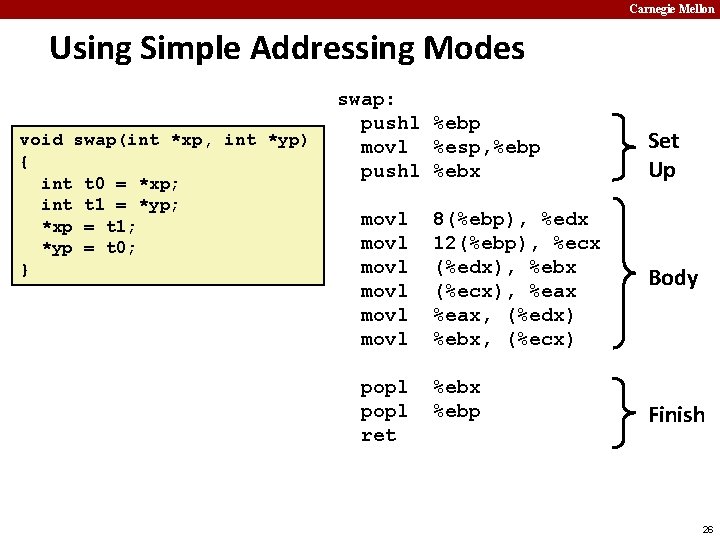
Carnegie Mellon Using Simple Addressing Modes void swap(int *xp, int *yp) { int t 0 = *xp; int t 1 = *yp; *xp = t 1; *yp = t 0; } swap: pushl %ebp movl %esp, %ebp pushl %ebx movl movl 8(%ebp), %edx 12(%ebp), %ecx (%edx), %ebx (%ecx), %eax, (%edx) %ebx, (%ecx) popl ret %ebx %ebp Set Up Body Finish 26
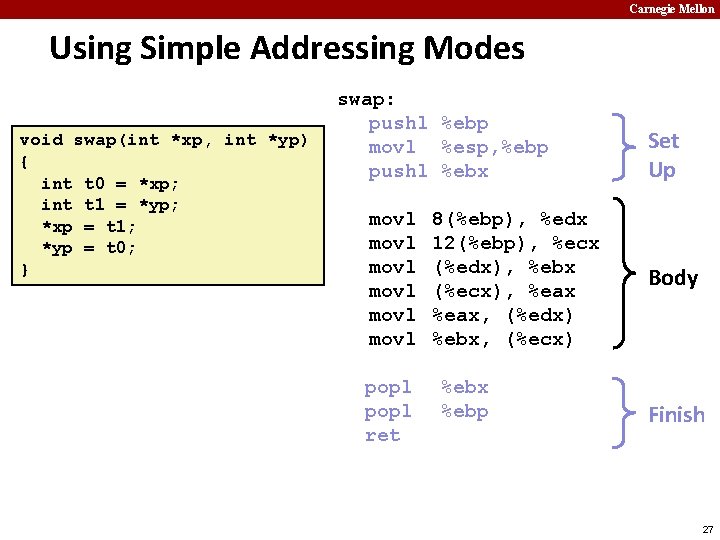
Carnegie Mellon Using Simple Addressing Modes void swap(int *xp, int *yp) { int t 0 = *xp; int t 1 = *yp; *xp = t 1; *yp = t 0; } swap: pushl %ebp movl %esp, %ebp pushl %ebx movl movl popl ret 8(%ebp), %edx 12(%ebp), %ecx (%edx), %ebx (%ecx), %eax, (%edx) %ebx, (%ecx) %ebx %ebp Set Up Body Finish 27
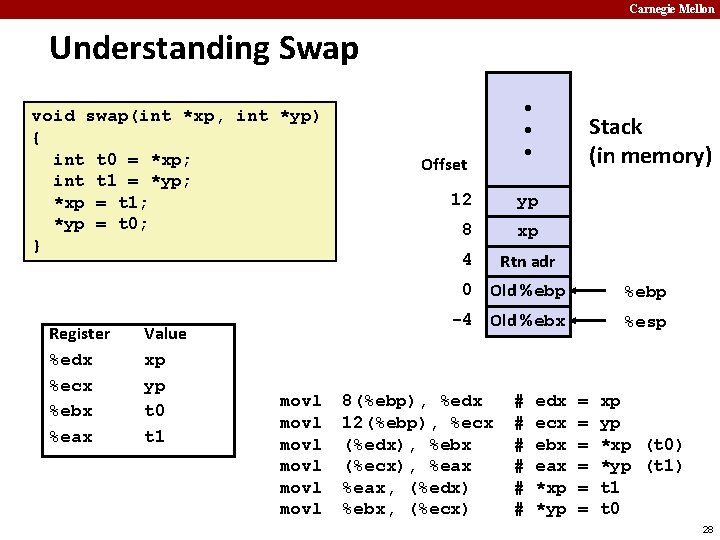
Carnegie Mellon Understanding Swap void swap(int *xp, int *yp) { int t 0 = *xp; int t 1 = *yp; *xp = t 1; *yp = t 0; } Register %edx %ecx %ebx %eax Value xp yp t 0 t 1 movl movl Offset • • • Stack (in memory) 12 yp 8 xp 4 Rtn adr 0 Old %ebp -4 Old %ebx %esp 8(%ebp), %edx 12(%ebp), %ecx (%edx), %ebx (%ecx), %eax, (%edx) %ebx, (%ecx) # # # edx ecx ebx eax *xp *yp = = = xp yp *xp (t 0) *yp (t 1) t 1 t 0 28
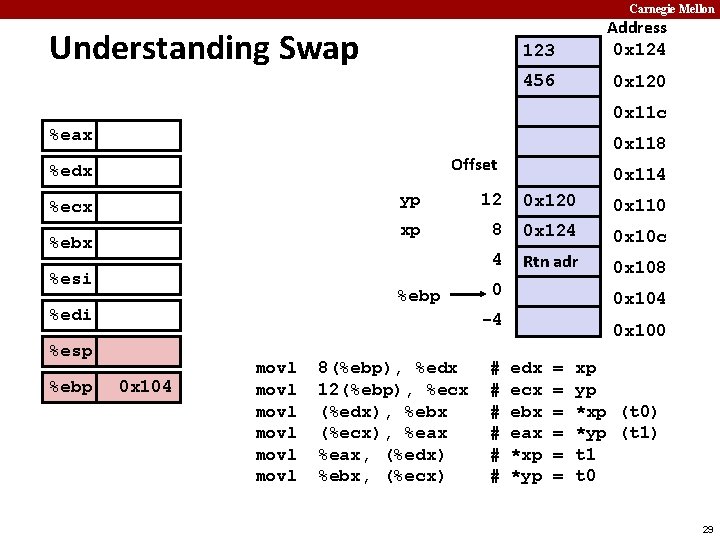
Carnegie Mellon Understanding Swap 123 Address 0 x 124 456 0 x 120 0 x 11 c %eax Offset %edx %ecx %ebx %esi 0 x 114 yp 12 0 x 120 0 x 110 xp 8 0 x 124 0 x 10 c 4 Rtn adr 0 x 108 %ebp %edi 0 0 x 104 -4 %esp %ebp 0 x 118 0 x 104 movl movl 8(%ebp), %edx 12(%ebp), %ecx (%edx), %ebx (%ecx), %eax, (%edx) %ebx, (%ecx) # # # 0 x 100 edx ecx ebx eax *xp *yp = = = xp yp *xp (t 0) *yp (t 1) t 1 t 0 29
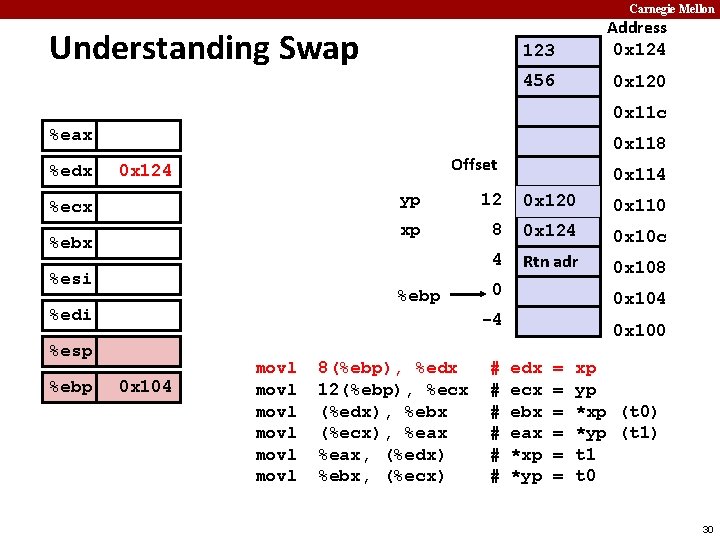
Carnegie Mellon Understanding Swap 123 Address 0 x 124 456 0 x 120 0 x 11 c %eax %edx Offset 0 x 124 %ecx %ebx %esi 0 x 114 yp 12 0 x 120 0 x 110 xp 8 0 x 124 0 x 10 c 4 Rtn adr 0 x 108 %ebp %edi 0 0 x 104 -4 %esp %ebp 0 x 118 0 x 104 movl movl 8(%ebp), %edx 12(%ebp), %ecx (%edx), %ebx (%ecx), %eax, (%edx) %ebx, (%ecx) # # # 0 x 100 edx ecx ebx eax *xp *yp = = = xp yp *xp (t 0) *yp (t 1) t 1 t 0 30
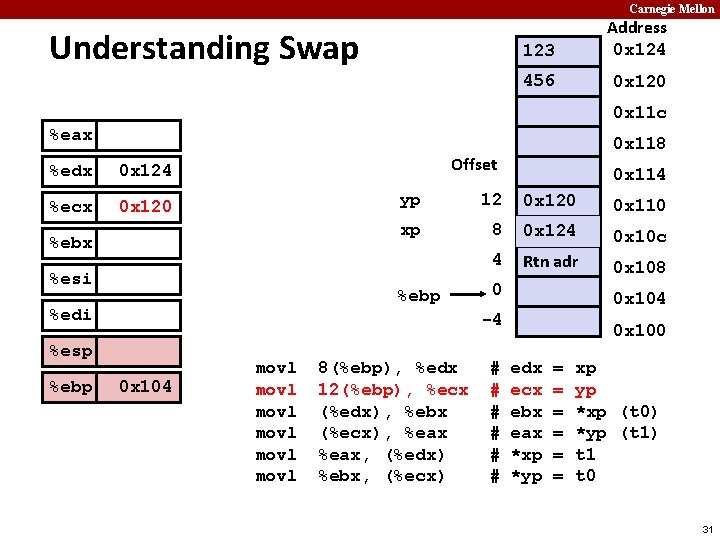
Carnegie Mellon Understanding Swap 123 Address 0 x 124 456 0 x 120 0 x 11 c %eax %edx 0 x 124 %ecx 0 x 120 Offset %ebx %esi 0 x 114 yp 12 0 x 120 0 x 110 xp 8 0 x 124 0 x 10 c 4 Rtn adr 0 x 108 %ebp %edi 0 0 x 104 -4 %esp %ebp 0 x 118 0 x 104 movl movl 8(%ebp), %edx 12(%ebp), %ecx (%edx), %ebx (%ecx), %eax, (%edx) %ebx, (%ecx) # # # 0 x 100 edx ecx ebx eax *xp *yp = = = xp yp *xp (t 0) *yp (t 1) t 1 t 0 31
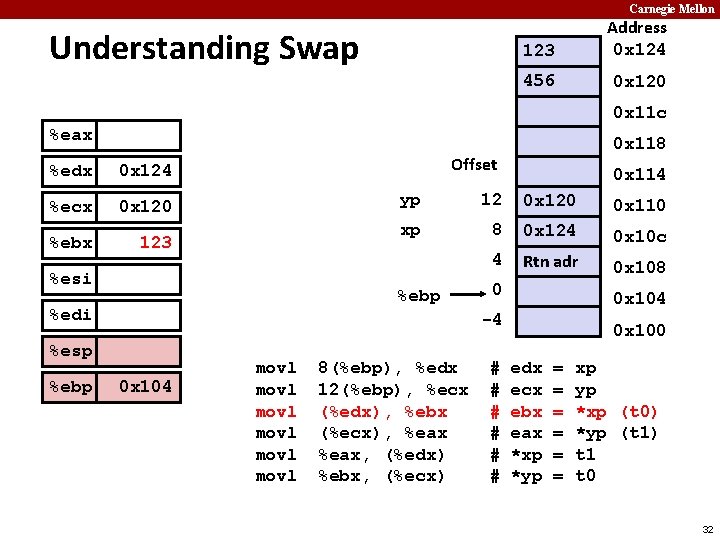
Carnegie Mellon Understanding Swap 123 Address 0 x 124 456 0 x 120 0 x 11 c %eax %edx 0 x 124 %ecx 0 x 120 %ebx Offset 123 %esi 0 x 114 yp 12 0 x 120 0 x 110 xp 8 0 x 124 0 x 10 c 4 Rtn adr 0 x 108 %ebp %edi 0 0 x 104 -4 %esp %ebp 0 x 118 0 x 104 movl movl 8(%ebp), %edx 12(%ebp), %ecx (%edx), %ebx (%ecx), %eax, (%edx) %ebx, (%ecx) # # # 0 x 100 edx ecx ebx eax *xp *yp = = = xp yp *xp (t 0) *yp (t 1) t 1 t 0 32
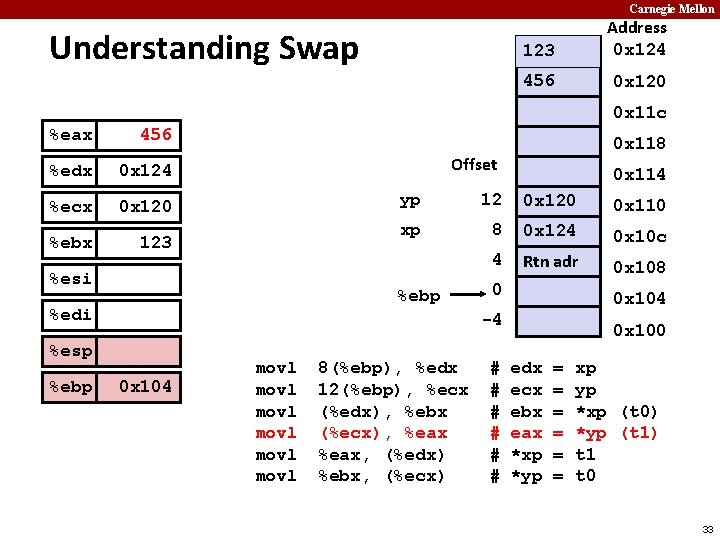
Carnegie Mellon Understanding Swap 123 Address 0 x 124 456 0 x 120 0 x 11 c %eax 456 %edx 0 x 124 %ecx 0 x 120 %ebx Offset 123 %esi 0 x 114 yp 12 0 x 120 0 x 110 xp 8 0 x 124 0 x 10 c 4 Rtn adr 0 x 108 %ebp %edi 0 0 x 104 -4 %esp %ebp 0 x 118 0 x 104 movl movl 8(%ebp), %edx 12(%ebp), %ecx (%edx), %ebx (%ecx), %eax, (%edx) %ebx, (%ecx) # # # 0 x 100 edx ecx ebx eax *xp *yp = = = xp yp *xp (t 0) *yp (t 1) t 1 t 0 33
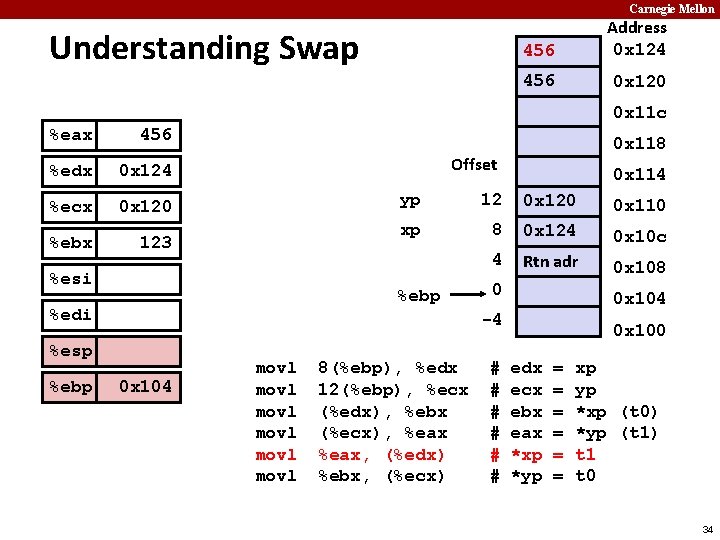
Carnegie Mellon Understanding Swap 456 Address 0 x 124 456 0 x 120 0 x 11 c %eax 456 %edx 0 x 124 %ecx 0 x 120 %ebx Offset 123 %esi 0 x 114 yp 12 0 x 120 0 x 110 xp 8 0 x 124 0 x 10 c 4 Rtn adr 0 x 108 %ebp %edi 0 0 x 104 -4 %esp %ebp 0 x 118 0 x 104 movl movl 8(%ebp), %edx 12(%ebp), %ecx (%edx), %ebx (%ecx), %eax, (%edx) %ebx, (%ecx) # # # 0 x 100 edx ecx ebx eax *xp *yp = = = xp yp *xp (t 0) *yp (t 1) t 1 t 0 34
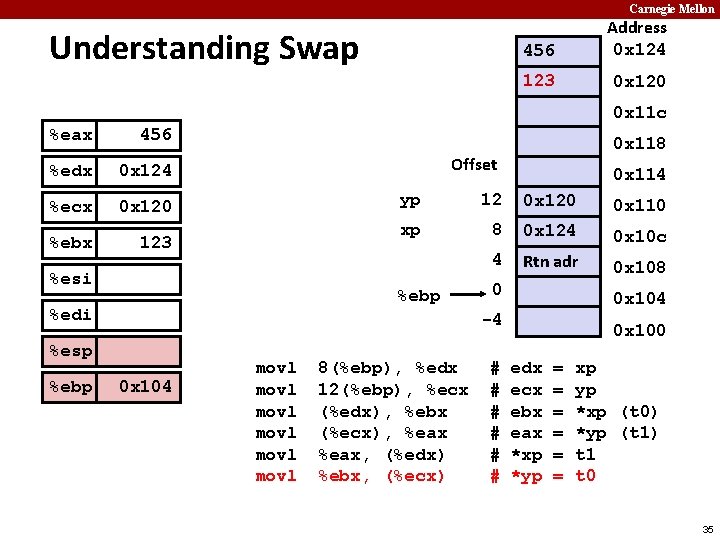
Carnegie Mellon Understanding Swap 456 Address 0 x 124 123 0 x 120 0 x 11 c %eax 456 %edx 0 x 124 %ecx 0 x 120 %ebx Offset 123 %esi 0 x 114 yp 12 0 x 120 0 x 110 xp 8 0 x 124 0 x 10 c 4 Rtn adr 0 x 108 %ebp %edi 0 0 x 104 -4 %esp %ebp 0 x 118 0 x 104 movl movl 8(%ebp), %edx 12(%ebp), %ecx (%edx), %ebx (%ecx), %eax, (%edx) %ebx, (%ecx) # # # 0 x 100 edx ecx ebx eax *xp *yp = = = xp yp *xp (t 0) *yp (t 1) t 1 t 0 35
![Carnegie Mellon Complete Memory Addressing Modes ¢ Most General Form D(Rb, Ri, S) Mem[Reg[Rb]+S*Reg[Ri]+](http://slidetodoc.com/presentation_image_h2/5256d2b68222d15d92bce14b023513f1/image-36.jpg "Carnegie Mellon Complete Memory Addressing Modes ¢ Most General Form D(Rb, Ri, S) Mem[Reg[Rb]+S*Reg[Ri]+")
Carnegie Mellon Complete Memory Addressing Modes ¢ Most General Form D(Rb, Ri, S) Mem[Reg[Rb]+S*Reg[Ri]+ D] § D: § Rb: § Ri: Constant “displacement” 1, 2, or 4 bytes Base register: Any of 8 integer registers Index register: Any, except for %esp § Unlikely you’d use %ebp, either § S: Scale: 1, 2, 4, or 8 (why these numbers? ) ¢ Special Cases (Rb, Ri) D(Rb, Ri) (Rb, Ri, S) Mem[Reg[Rb]+Reg[Ri]] Mem[Reg[Rb]+Reg[Ri]+D] Mem[Reg[Rb]+S*Reg[Ri]] 36
Carnegie Mellon Today: Machine Programming I: Basics ¢ ¢ History of Intel processors and architectures C, assembly, machine code Assembly Basics: Registers, operands, move Intro to x 86 -64 37
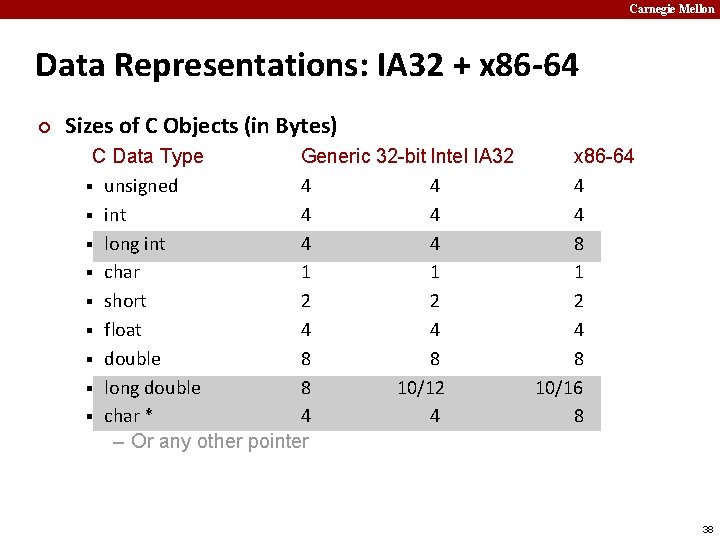
Carnegie Mellon Data Representations: IA 32 + x 86 -64 ¢ Sizes of C Objects (in Bytes) C Data Type Generic 32 -bit Intel IA 32 § unsigned 4 4 § int 4 4 § long int 4 4 § char 1 1 § short 2 2 § float 4 4 § double 8 8 § long double 8 10/12 § char * 4 4 – Or any other pointer x 86 -64 4 4 8 1 2 4 8 10/16 8 38
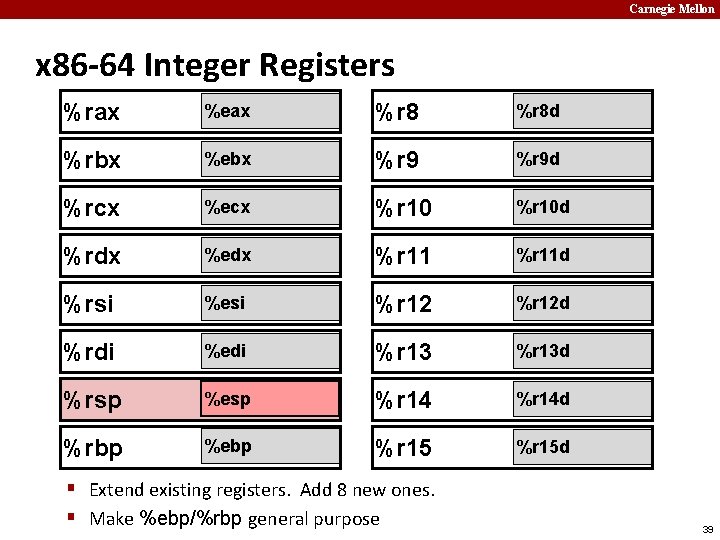
Carnegie Mellon x 86 -64 Integer Registers %rax %eax %r 8 d %rbx %ebx %r 9 d %rcx %ecx %r 10 d %rdx %edx %r 11 d %rsi %esi %r 12 d %rdi %edi %r 13 d %rsp %esp %r 14 d %rbp %ebp %r 15 d § Extend existing registers. Add 8 new ones. § Make %ebp/%rbp general purpose 39
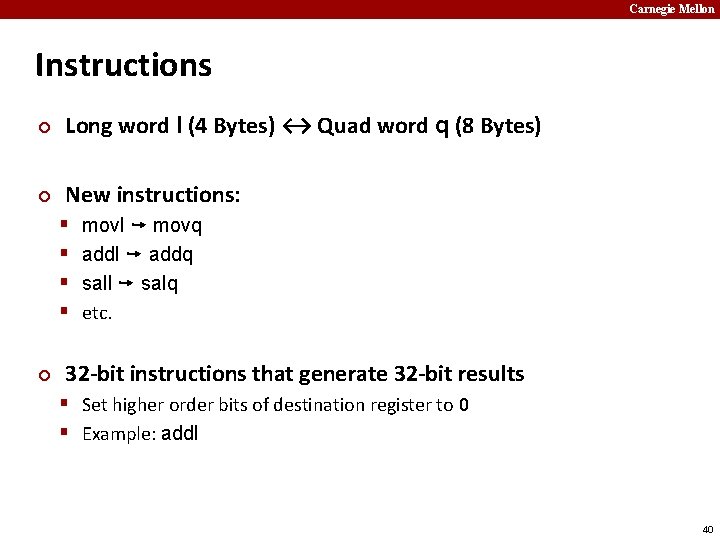
Carnegie Mellon Instructions ¢ Long word l (4 Bytes) ↔ Quad word q (8 Bytes) ¢ New instructions: § § ¢ movl ➙ movq addl ➙ addq sall ➙ salq etc. 32 -bit instructions that generate 32 -bit results § Set higher order bits of destination register to 0 § Example: addl 40
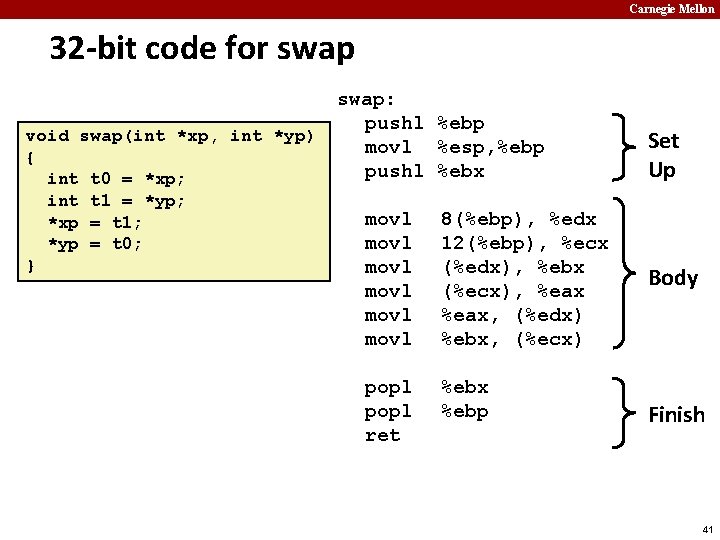
Carnegie Mellon 32 -bit code for swap void swap(int *xp, int *yp) { int t 0 = *xp; int t 1 = *yp; *xp = t 1; *yp = t 0; } swap: pushl %ebp movl %esp, %ebp pushl %ebx movl movl 8(%ebp), %edx 12(%ebp), %ecx (%edx), %ebx (%ecx), %eax, (%edx) %ebx, (%ecx) popl ret %ebx %ebp Set Up Body Finish 41
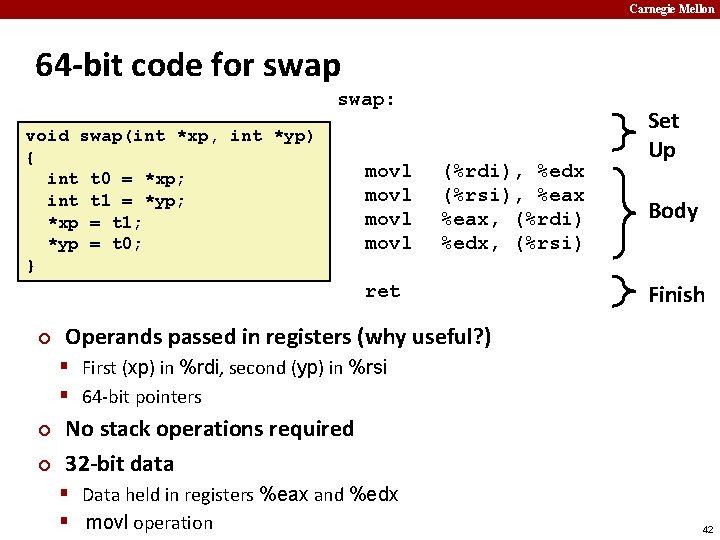
Carnegie Mellon 64 -bit code for swap: void swap(int *xp, int *yp) { int t 0 = *xp; int t 1 = *yp; *xp = t 1; *yp = t 0; } movl (%rdi), %edx (%rsi), %eax, (%rdi) %edx, (%rsi) ret ¢ Set Up Body Finish Operands passed in registers (why useful? ) § First (xp) in %rdi, second (yp) in %rsi § 64 -bit pointers ¢ ¢ No stack operations required 32 -bit data § Data held in registers %eax and %edx § movl operation 42
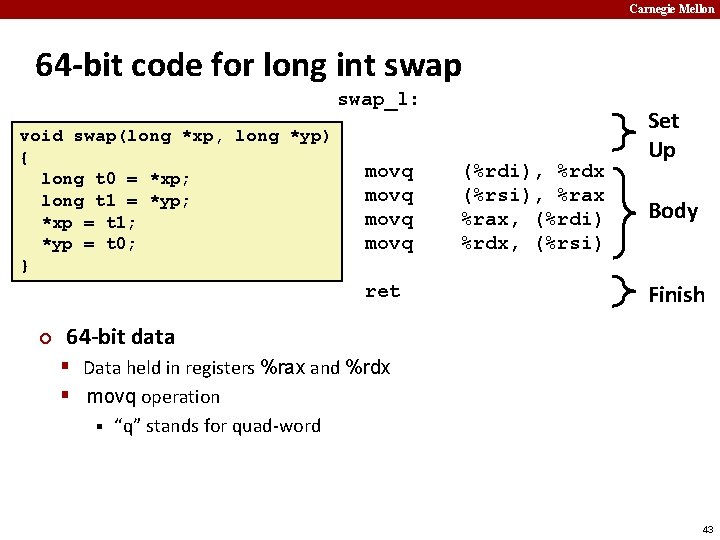
Carnegie Mellon 64 -bit code for long int swap_l: void swap(long *xp, long *yp) { long t 0 = *xp; long t 1 = *yp; *xp = t 1; *yp = t 0; } movq ret ¢ (%rdi), %rdx (%rsi), %rax, (%rdi) %rdx, (%rsi) Set Up Body Finish 64 -bit data § Data held in registers %rax and %rdx § movq operation § “q” stands for quad-word 43
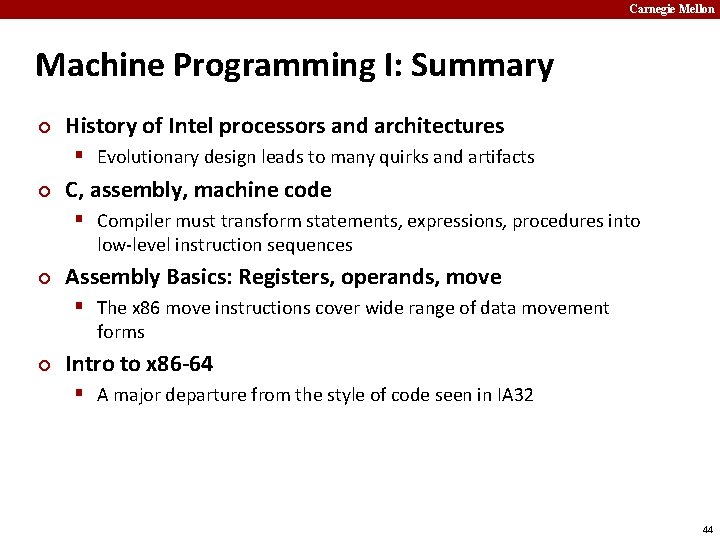
Carnegie Mellon Machine Programming I: Summary ¢ History of Intel processors and architectures § Evolutionary design leads to many quirks and artifacts ¢ C, assembly, machine code § Compiler must transform statements, expressions, procedures into low-level instruction sequences ¢ Assembly Basics: Registers, operands, move § The x 86 move instructions cover wide range of data movement forms ¢ Intro to x 86 -64 § A major departure from the style of code seen in IA 32 44
- Slides: 44