
Carnegie Mellon About the New Slides for Introduction
Carnegie Mellon About the New Slides for Introduction to Computer Systems 15 -213/18 -243, spring 2009 Markus Püschel Electrical and Computer Engineering
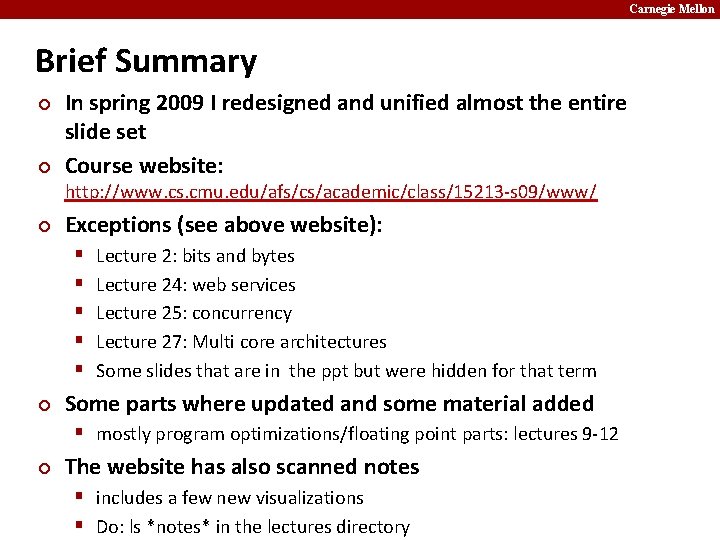
Carnegie Mellon Brief Summary ¢ ¢ In spring 2009 I redesigned and unified almost the entire slide set Course website: http: //www. cs. cmu. edu/afs/cs/academic/class/15213 -s 09/www/ ¢ Exceptions (see above website): § § § ¢ Lecture 2: bits and bytes Lecture 24: web services Lecture 25: concurrency Lecture 27: Multi core architectures Some slides that are in the ppt but were hidden for that term Some parts where updated and some material added § mostly program optimizations/floating point parts: lectures 9 -12 ¢ The website has also scanned notes § includes a few new visualizations § Do: ls *notes* in the lectures directory
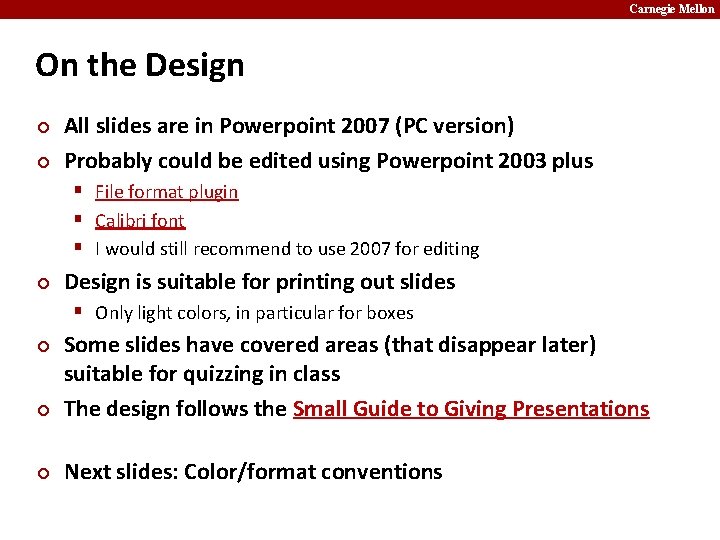
Carnegie Mellon On the Design ¢ ¢ All slides are in Powerpoint 2007 (PC version) Probably could be edited using Powerpoint 2003 plus § File format plugin § Calibri font § I would still recommend to use 2007 for editing ¢ Design is suitable for printing out slides § Only light colors, in particular for boxes ¢ Some slides have covered areas (that disappear later) suitable for quizzing in class The design follows the Small Guide to Giving Presentations ¢ Next slides: Color/format conventions ¢
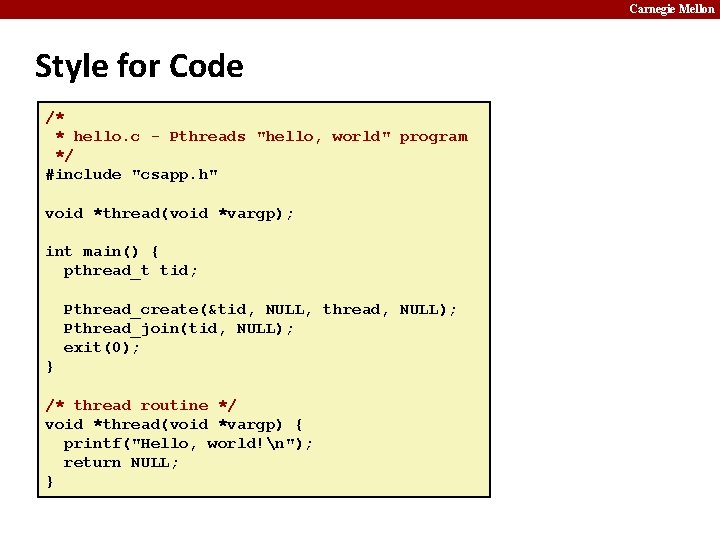
Carnegie Mellon Style for Code /* * hello. c - Pthreads "hello, world" program */ #include "csapp. h" void *thread(void *vargp); int main() { pthread_t tid; Pthread_create(&tid, NULL, thread, NULL); Pthread_join(tid, NULL); exit(0); } /* thread routine */ void *thread(void *vargp) { printf("Hello, world!n"); return NULL; }
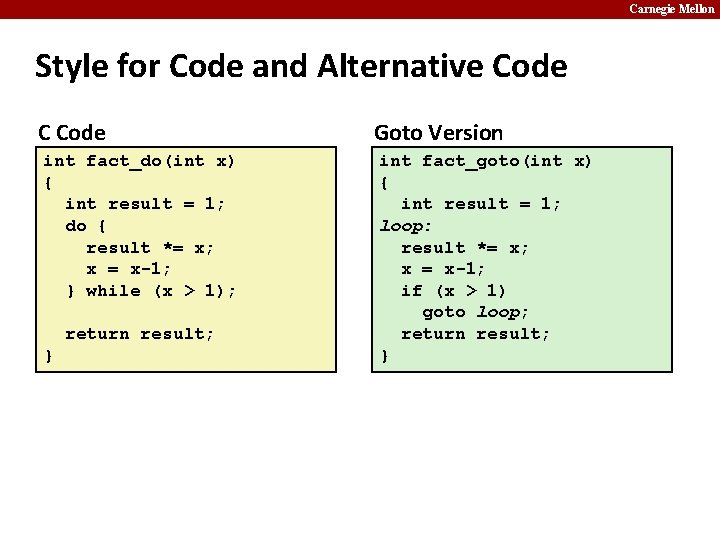
Carnegie Mellon Style for Code and Alternative Code C Code int fact_do(int x) { int result = 1; do { result *= x; x = x-1; } while (x > 1); return result; } Goto Version int fact_goto(int x) { int result = 1; loop: result *= x; x = x-1; if (x > 1) goto loop; return result; }
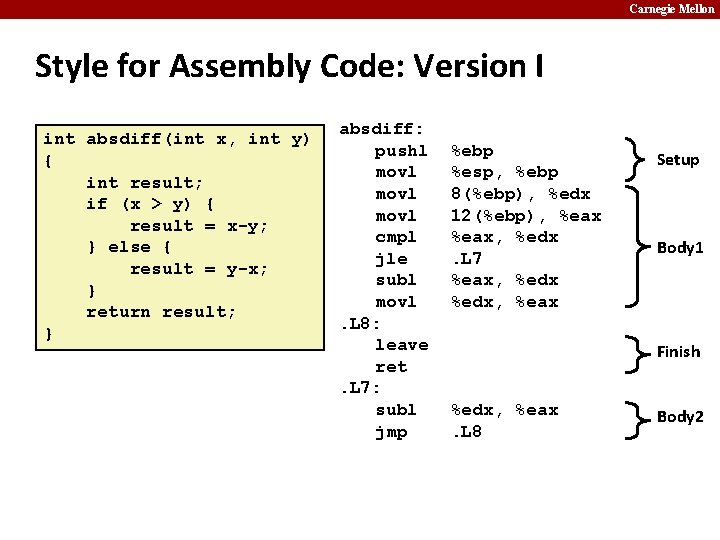
Carnegie Mellon Style for Assembly Code: Version I int absdiff(int x, int y) { int result; if (x > y) { result = x-y; } else { result = y-x; } return result; } absdiff: pushl movl cmpl jle subl movl. L 8: leave ret. L 7: subl jmp %ebp %esp, %ebp 8(%ebp), %edx 12(%ebp), %eax, %edx. L 7 %eax, %edx, %eax Setup Body 1 Finish %edx, %eax. L 8 Body 2
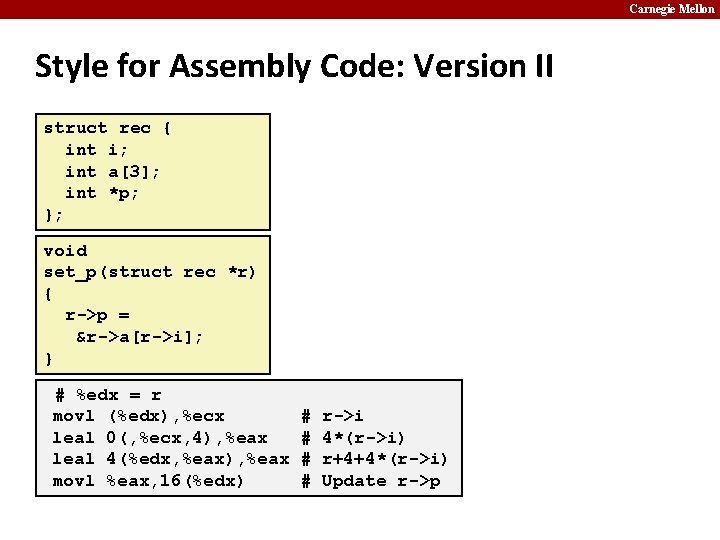
Carnegie Mellon Style for Assembly Code: Version II struct rec { int i; int a[3]; int *p; }; void set_p(struct rec *r) { r->p = &r->a[r->i]; } # %edx = r movl (%edx), %ecx leal 0(, %ecx, 4), %eax leal 4(%edx, %eax), %eax movl %eax, 16(%edx) # # r->i 4*(r->i) r+4+4*(r->i) Update r->p
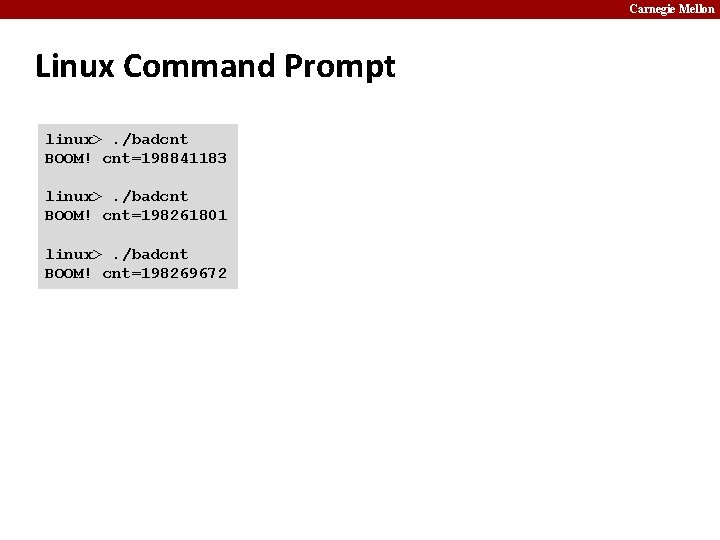
Carnegie Mellon Linux Command Prompt linux>. /badcnt BOOM! cnt=198841183 linux>. /badcnt BOOM! cnt=198261801 linux>. /badcnt BOOM! cnt=198269672
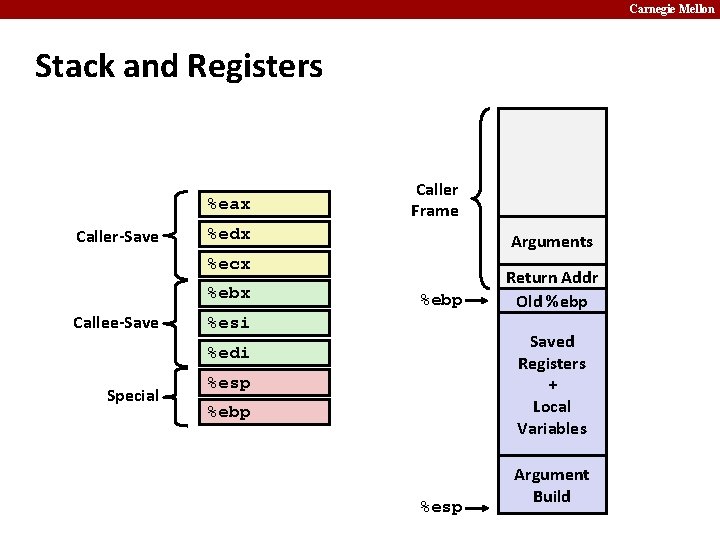
Carnegie Mellon Stack and Registers %eax Caller-Save Caller Frame %edx Arguments %ecx %ebx Callee-Save %ebp %esi Saved Registers + Local Variables %edi Special Return Addr Old %ebp %esp Argument Build
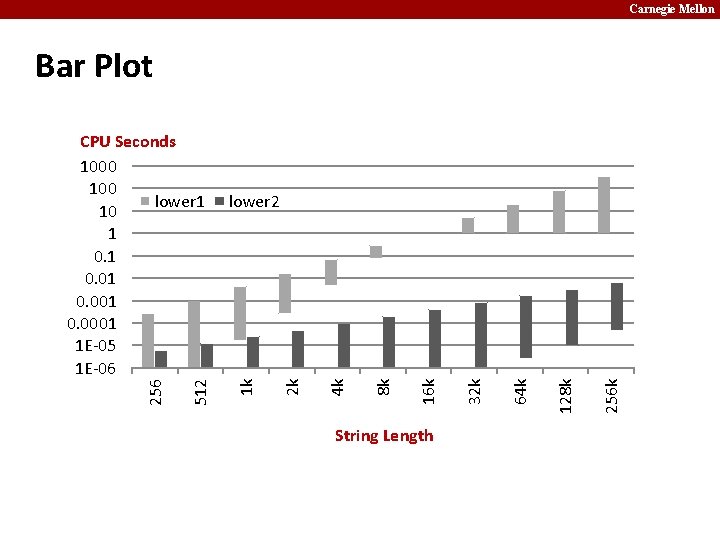
Carnegie Mellon Bar Plot String Length 256 k 128 k 64 k 32 k 16 k 8 k 4 k 2 k lower 2 1 k 512 256 CPU Seconds 1000 100 lower 1 10 1 0. 01 0. 0001 1 E-05 1 E-06
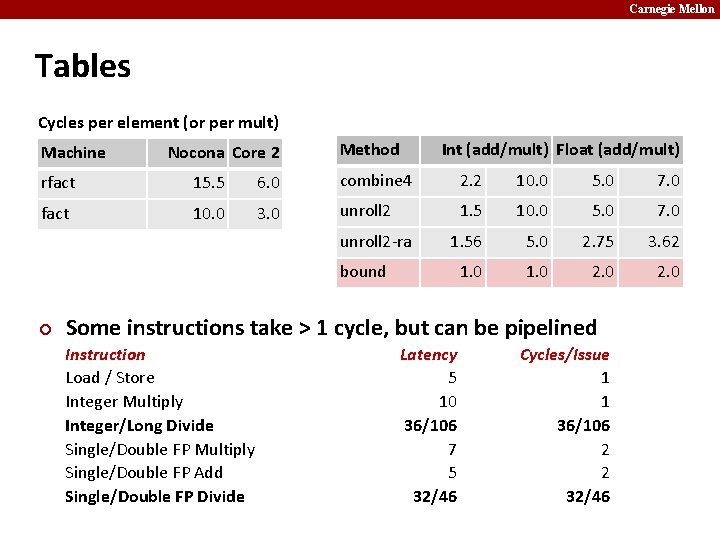
Carnegie Mellon Tables Cycles per element (or per mult) Machine Nocona Core 2 Method Int (add/mult) Float (add/mult) rfact 15. 5 6. 0 combine 4 2. 2 10. 0 5. 0 7. 0 fact 10. 0 3. 0 unroll 2 1. 5 10. 0 5. 0 7. 0 1. 56 5. 0 2. 75 3. 62 1. 0 2. 0 unroll 2 -ra bound ¢ Some instructions take > 1 cycle, but can be pipelined Instruction Load / Store Integer Multiply Integer/Long Divide Single/Double FP Multiply Single/Double FP Add Single/Double FP Divide Latency 5 10 36/106 7 5 32/46 Cycles/Issue 1 1 36/106 2 2 32/46
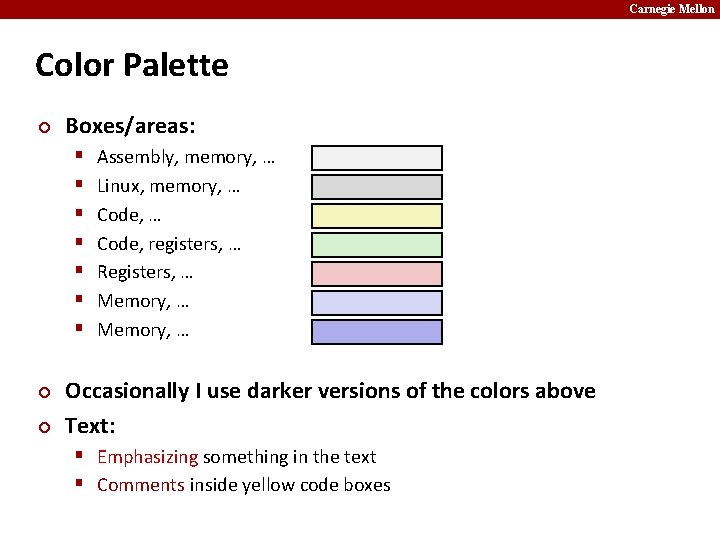
Carnegie Mellon Color Palette ¢ Boxes/areas: § § § § ¢ ¢ Assembly, memory, … Linux, memory, … Code, registers, … Registers, … Memory, … Occasionally I use darker versions of the colors above Text: § Emphasizing something in the text § Comments inside yellow code boxes
- Slides: 12