
Carnegie Mellon 15 213 Recitation Data Lab Your
Carnegie Mellon 15 -213 Recitation: Data Lab Your TAs Sep 9, 2019
Carnegie Mellon Agenda ● Introduction ● Course Details ● Data Lab ○ Getting started ○ Running your code ○ ANSI C ○ Reminders ● Floating Point
Carnegie Mellon Introduction ● Welcome to 15 -213/18 -213/15 -513! ● Recitations are for… ○ Reviewing lectures ○ Discussing homework problems ○ Interactively exploring concepts ○ Previewing future lecture material ● Please, please ask questions!
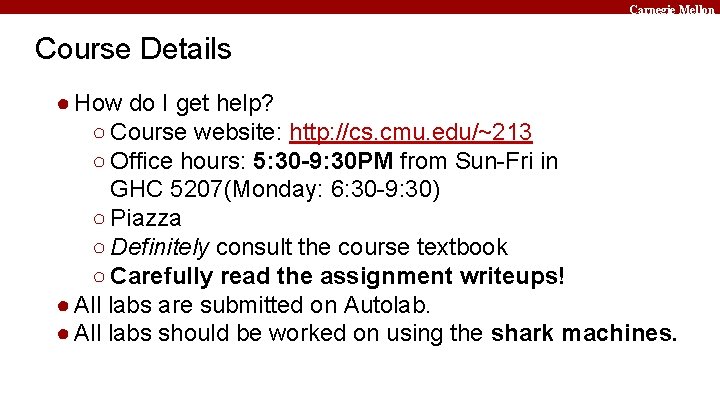
Carnegie Mellon Course Details ● How do I get help? ○ Course website: http: //cs. cmu. edu/~213 ○ Office hours: 5: 30 -9: 30 PM from Sun-Fri in GHC 5207(Monday: 6: 30 -9: 30) ○ Piazza ○ Definitely consult the course textbook ○ Carefully read the assignment writeups! ● All labs are submitted on Autolab. ● All labs should be worked on using the shark machines.
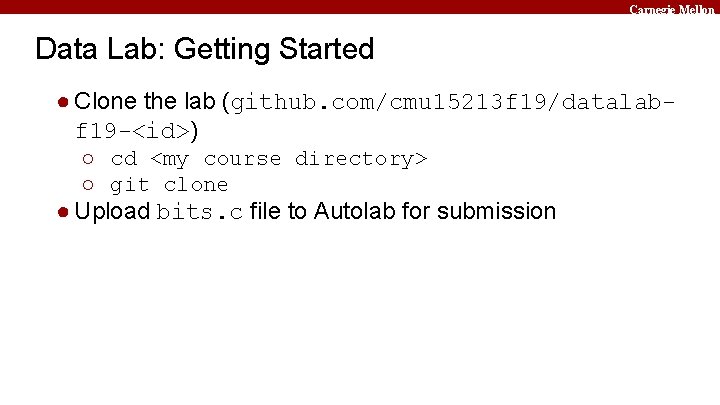
Carnegie Mellon Data Lab: Getting Started ● Clone the lab (github. com/cmu 15213 f 19/datalabf 19 -<id>) ○ cd <my course directory> ○ git clone ● Upload bits. c file to Autolab for submission
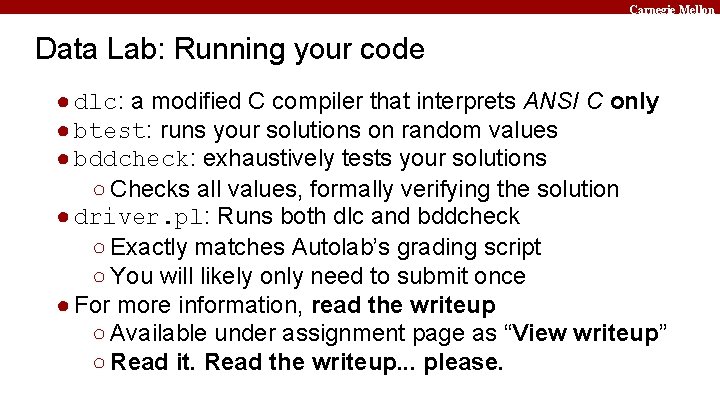
Carnegie Mellon Data Lab: Running your code ● dlc: a modified C compiler that interprets ANSI C only ● btest: runs your solutions on random values ● bddcheck: exhaustively tests your solutions ○ Checks all values, formally verifying the solution ● driver. pl: Runs both dlc and bddcheck ○ Exactly matches Autolab’s grading script ○ You will likely only need to submit once ● For more information, read the writeup ○ Available under assignment page as “View writeup” ○ Read it. Read the writeup. . . please.
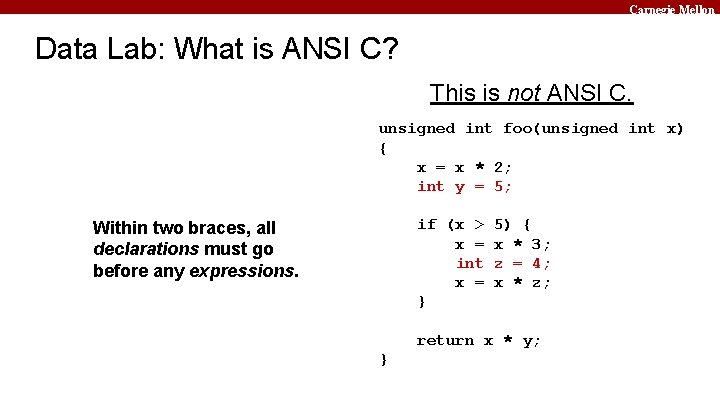
Carnegie Mellon Data Lab: What is ANSI C? This is not ANSI C. unsigned int foo(unsigned int x) { x = x * 2; int y = 5; if (x > x = int x = } Within two braces, all declarations must go before any expressions. 5) { x * 3; z = 4; x * z; return x * y; }
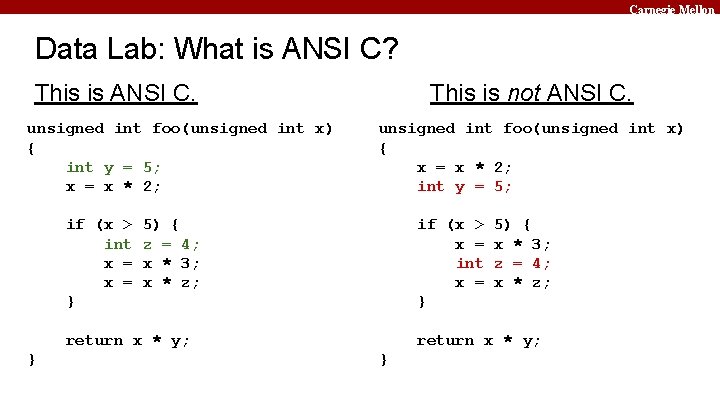
Carnegie Mellon Data Lab: What is ANSI C? This is ANSI C. unsigned int foo(unsigned int x) { int y = 5; x = x * 2; if (x > int x = } This is not ANSI C. unsigned int foo(unsigned int x) { x = x * 2; int y = 5; 5) { z = 4; x * 3; x * z; if (x > x = int x = } return x * y; } 5) { x * 3; z = 4; x * z; return x * y; }
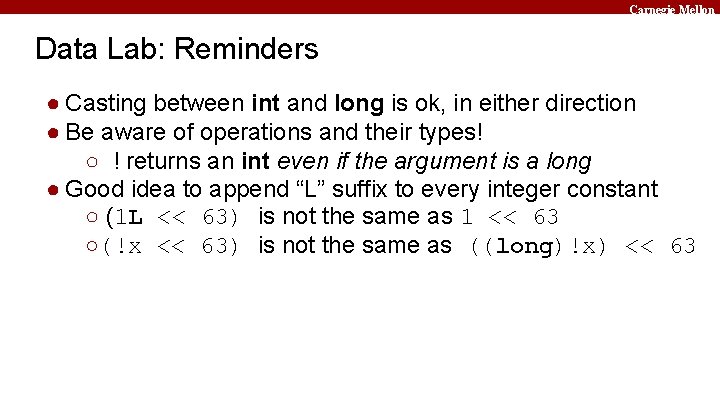
Carnegie Mellon Data Lab: Reminders ● Casting between int and long is ok, in either direction ● Be aware of operations and their types! ○ ! returns an int even if the argument is a long ● Good idea to append “L” suffix to every integer constant ○ (1 L << 63) is not the same as 1 << 63 ○(!x << 63) is not the same as ((long)!x) << 63
Carnegie Mellon Form Groups of 3 - 4 ■ Series of exercises ■Operators ■Floating point ■Puzzle
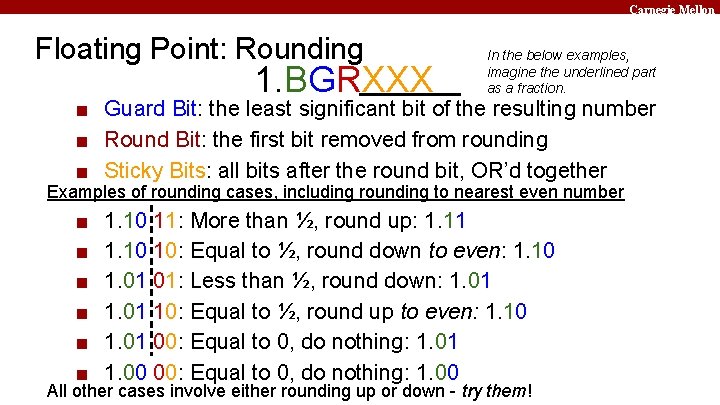
Carnegie Mellon Floating Point: Rounding 1. BGRXXX In the below examples, imagine the underlined part as a fraction. ■ Guard Bit: the least significant bit of the resulting number ■ Round Bit: the first bit removed from rounding ■ Sticky Bits: all bits after the round bit, OR’d together Examples of rounding cases, including rounding to nearest even number ■ ■ ■ 1. 10 11: More than ½, round up: 1. 11 1. 10 10: Equal to ½, round down to even: 1. 10 1. 01 01: Less than ½, round down: 1. 01 10: Equal to ½, round up to even: 1. 10 1. 01 00: Equal to 0, do nothing: 1. 01 1. 00 00: Equal to 0, do nothing: 1. 00 All other cases involve either rounding up or down - try them!
Carnegie Mellon Questions? ■ Remember, data lab is due this Thursday! ■ You really should have started already! ■ Read the lab writeup. ▪ Read the lab writeup. – Read the lab writeup. » Please. : )
- Slides: 12