
Carmen Miranda Ben Michaelson Natalie Stratton Vanna Deeds

Carmen Miranda Ben Michaelson, Natalie Stratton, Vanna Deeds, Alexandra Hodges
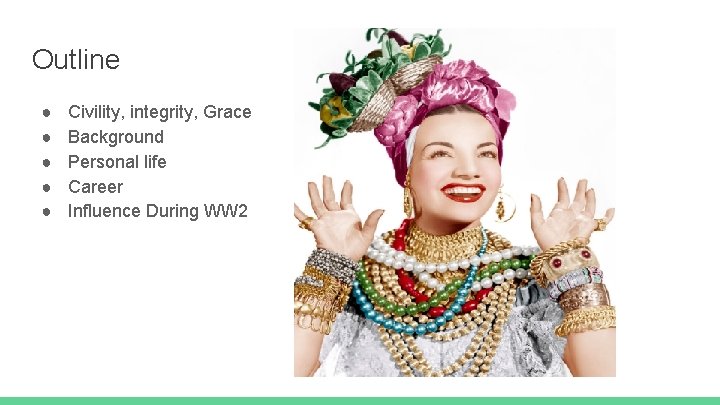
Outline ● ● ● Civility, integrity, Grace Background Personal life Career Influence During WW 2
Civility, Integrity, & Grace ● ● Civility: politeness in speech and behavior ○ Before she went to America she represented Latin America by singing her joy that with along with Latin America ○ To America: she represented a place that was unknown to them Integrity: being honest ○ Tried to show the US what it was like being Latin American ■ ● Despite the backlash she got for some of her efforts she stayed true to her culture and to what she thought was right i Grace: showing honor ○ She showed honor by being proud of where she came from and trying to show America what Brazil culture had to offer ■ America wasn’t aware what it was like to be a Latina or Portugese/Brazilian
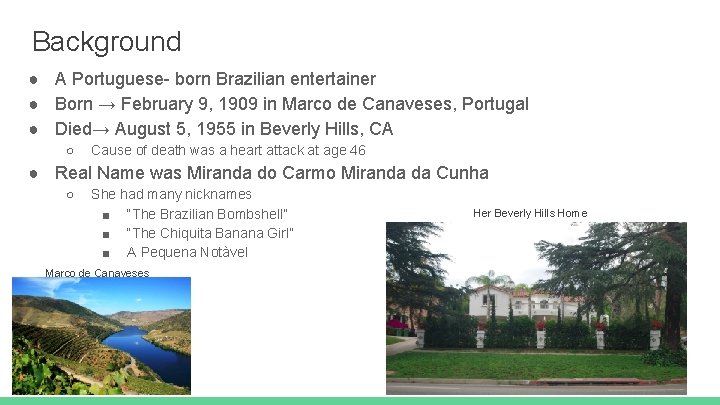
Background ● A Portuguese- born Brazilian entertainer ● Born → February 9, 1909 in Marco de Canaveses, Portugal ● Died→ August 5, 1955 in Beverly Hills, CA ○ Cause of death was a heart attack at age 46 ● Real Name was Miranda do Carmo Miranda da Cunha ○ She had many nicknames ■ “The Brazilian Bombshell” ■ “The Chiquita Banana Girl” ■ A Pequena Notàvel Marco de Canaveses Her Beverly Hills Home
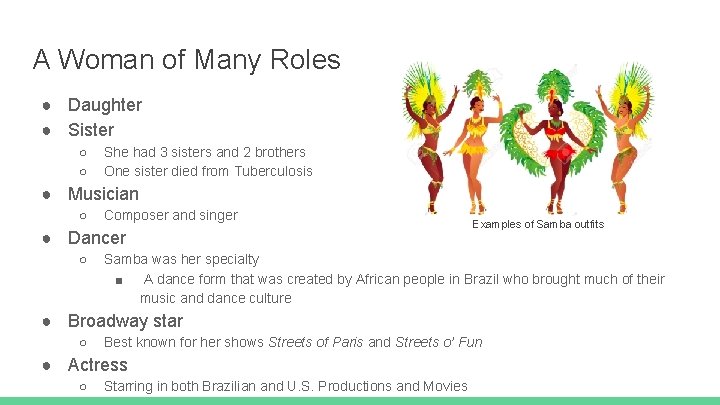
A Woman of Many Roles ● Daughter ● Sister ○ ○ She had 3 sisters and 2 brothers One sister died from Tuberculosis ● Musician ○ Composer and singer ● Dancer ○ Examples of Samba outfits Samba was her specialty ■ A dance form that was created by African people in Brazil who brought much of their music and dance culture ● Broadway star ○ Best known for her shows Streets of Paris and Streets o’ Fun ● Actress ○ Starring in both Brazilian and U. S. Productions and Movies
Personal Life ● Father: José Maria Pinto da Cunha ● Mother: Maria Emília Miranda ● Named “Carmen” by her father because of his love for Bizet’s opera masterpiece ● Grew up very poor and was able to make her fame out of nothing despite her father’s disapproval to enter show business ○ Performers had bad and risqué reputations at the time ● Miranda worked in a boutique shop where she learned how to make hats… something that became a big part of her career
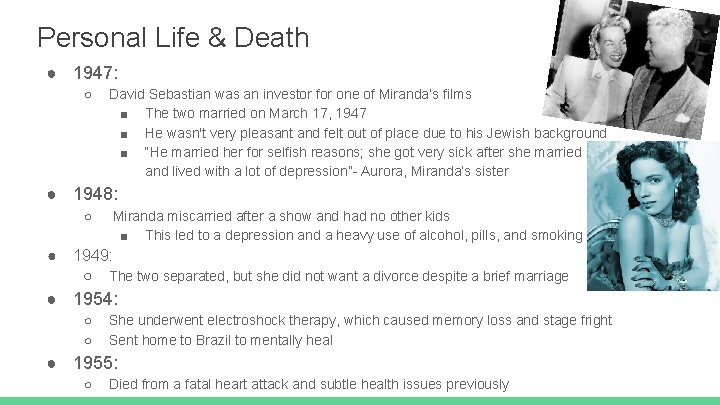
Personal Life & Death ● 1947: ○ David Sebastian was an investor for one of Miranda’s films ■ The two married on March 17, 1947 ■ He wasn't very pleasant and felt out of place due to his Jewish background ■ “He married her for selfish reasons; she got very sick after she married and lived with a lot of depression”- Aurora, Miranda’s sister ● 1948: ○ ● Miranda miscarried after a show and had no other kids ■ This led to a depression and a heavy use of alcohol, pills, and smoking 1949: ○ The two separated, but she did not want a divorce despite a brief marriage ● 1954: ○ ○ She underwent electroshock therapy, which caused memory loss and stage fright Sent home to Brazil to mentally heal ● 1955: ○ Died from a fatal heart attack and subtle health issues previously
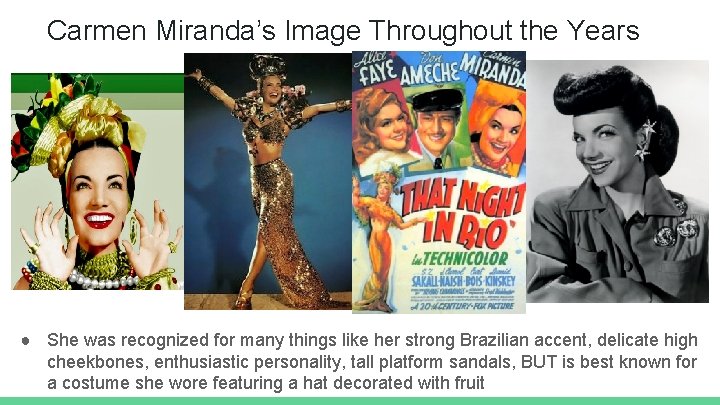
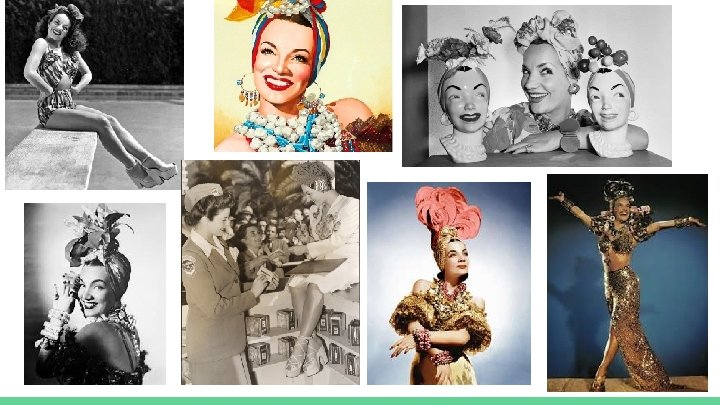
Carmen Miranda’s Image Throughout the Years ● She was recognized for many things like her strong Brazilian accent, delicate high cheekbones, enthusiastic personality, tall platform sandals, BUT is best known for a costume she wore featuring a hat decorated with fruit
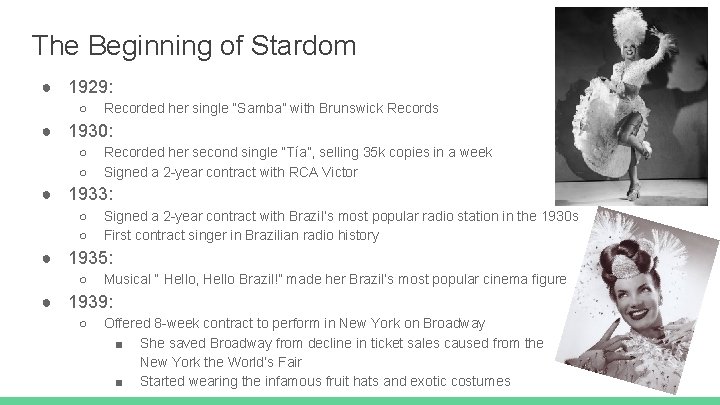
The Beginning of Stardom ● 1929: ○ Recorded her single “Samba” with Brunswick Records ● 1930: ○ ○ Recorded her second single “Tía”, selling 35 k copies in a week Signed a 2 -year contract with RCA Victor ● 1933: ○ ○ Signed a 2 -year contract with Brazil’s most popular radio station in the 1930 s First contract singer in Brazilian radio history ● 1935: ○ Musical “ Hello, Hello Brazil!” made her Brazil’s most popular cinema figure ● 1939: ○ Offered 8 -week contract to perform in New York on Broadway ■ She saved Broadway from decline in ticket sales caused from the New York the World’s Fair ■ Started wearing the infamous fruit hats and exotic costumes
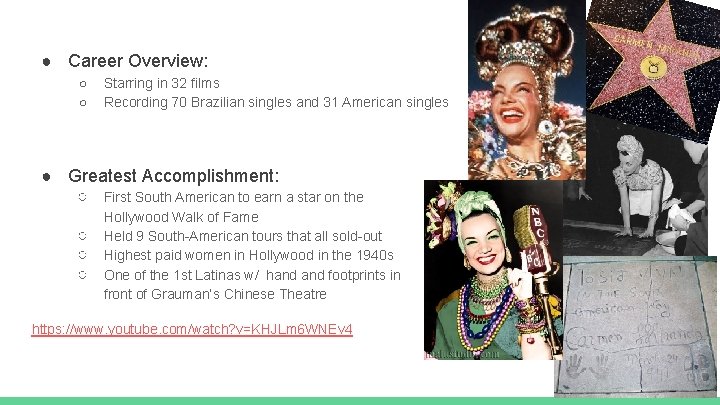
● Career Overview: ○ ○ Starring in 32 films Recording 70 Brazilian singles and 31 American singles ● Greatest Accomplishment: ○ First South American to earn a star on the ○ ○ ○ Hollywood Walk of Fame Held 9 South-American tours that all sold-out Highest paid women in Hollywood in the 1940 s One of the 1 st Latinas w/ hand footprints in front of Grauman’s Chinese Theatre https: //www. youtube. com/watch? v=KHJLm 6 WNEv 4
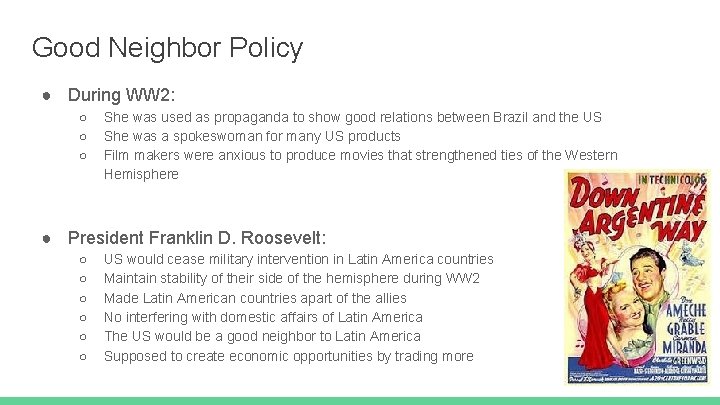
Good Neighbor Policy ● During WW 2: ○ ○ ○ She was used as propaganda to show good relations between Brazil and the US She was a spokeswoman for many US products Film makers were anxious to produce movies that strengthened ties of the Western Hemisphere ● President Franklin D. Roosevelt: ○ ○ ○ US would cease military intervention in Latin America countries Maintain stability of their side of the hemisphere during WW 2 Made Latin American countries apart of the allies No interfering with domestic affairs of Latin America The US would be a good neighbor to Latin America Supposed to create economic opportunities by trading more
Good Neighbor Policy Effect on Latin America ● Return to Brazil in 1940: ○ ○ ○ Criticized for portraying Brazil negatively Booed off stage at a charity event Claimed to be “too Americanized” Thought her fruity tutti image was insulting Felt like it wasn’t her place to represent Argentina in “Down Argentine Way” Sang songs about Costa Rica and Havana ● Latin America Was Not Convinced… ○ In 1944, United Fruit Company evoked Chiquitita because Miranda was the Chiquita banana lady ■ Most recognized food-related figures in America
In Conclusion ● She was an extremely talented woman who truly left her mark on the world and is still recognized as an icon of Brazil and Samba today ● Despite Miranda’s effort in the business she faced a lot of issues ○ Depression and issues with drugs and alcohol ■ Miscarriage, unhappy marriage ● She was symbolic figure for Latin America in North America because they weren’t familiar with Latin Americans ○ ○ Highest paid woman in Hollywood in the 1940 s Not so appreciated by the people of Latin America because of the way she portrayed Latin America
Sources Canelo, Maria José. 2014. Producing Good Neighbors: Carmen Miranda’s Body as Spectacular Pan-Americanism, Revue française d’études américaines, 139(2), pp. 60 -76. “Carmen Miranda. ” 2019, https: //www. revolvy. com/page/Carmen-Miranda. “Carmen Miranda and Her Fruit Hats. ” 2017. Itineraries of Taste, itinerariesoftaste. sanpellegrino. com/how-we-were/carmen-miranda. “Carmen Miranda. ” Smithsonian Institution, www. si. edu/spotlight/latin-music-legends-stamps/carmen-miranda. Mc. Collom, Jason. 2019. “Good Neighbor Policy: Definition & Summary. ” Study. com, study. com/academy/lesson/good-neighbor-policy-definition-summary. html. Outing, Alicia. 2010. Carmen Miranda and Cultural Exchange: In the Era of the New State and the Good Neighbor, https: //dance. barnard. edu/sites/default/files/inline/alicia_outing_2010. pdf.
Sources Continued: Perrone, C. , Dunn, C. , & Routledge. 2001. Brazilian Popular Music and Globalization, Pro. Quest Ebook Central, https: //ebookcentral. proquest. com/lib/jmu/detail. action? doc. ID=1111640. Roberts, Shari. 1993. "The Lady in the Tutti-Frutti Hat: Carmen Miranda, a Spectacle of Ethnicity", Cinema Journal 32(3), pp. 3 -23, https: //www. jstor. org/stable/1225876? seq=1#metadata_info_tab_contents. Thompson, Nicole. 2014. “The Brazilian Bombshell” Carmen Miranda & Her Life with and without the Fruit Hat. Latin Post, https: //www. latinpost. com/articles/5706/20140109/the-brazilian-bombshell-carmen-miranda-hollywood-fruithat. htm.
- Slides: 16